A great companion to the surprisingly fantastic first volume on Microeconomics.
Continuing in the same vein as the first book, with little pirates and such like explaining the basic theories of economics, this book and its companion make what is very dry, and overtly complex material clear, simple and importantly painless.
The book covers unemployment, money, inflation, GDP, government, trade, technology, aid and currencies, gradually increasing the scale of theory from the individual nation to international relations (in line with the microeconomic book moving from the individual to the group to the many) and then concludes with a some open questions about the future of the world as a whole - business cycles (i.e. the current financial mess), poverty, the environment and demographics (i.e. the aging population).
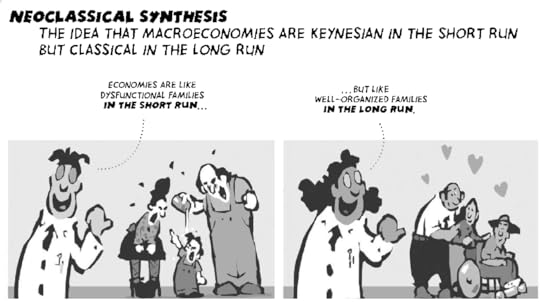
These ideas are described amazingly succinctly, so much so that not only do I feel I now have a vague grasp of macroeconomic theory, but that I also want to learn more about it. Whilst most people retain some knowledge of "economics" grasped through the media and following politics and world events, this book does a very good job of outlining the academic theory that underlies it, and in a sense is quite separated from the Punch & Judy of politics. I certainly finished the book feeling economics theory had something to contribute to society, more than just as a political bludgeon. Though there is discussion of the politics as well, in particular the classical-Keynesian-Milton-post-Keysian progression, which again is an academic economic debate that seems to have great significance for society and something we should be all a bit more aware of.
I recommend this book (along with its companion on Microeconomics) to anyone beginning their study in economics, or to academics and business professionals, who find they are crossing over into the subject more and need a basic understanding of the subject - even if it is just to understand what the economist is saying. Indeed, perhaps the most important aspect of these books, is that they explain very well 'how economists think', which will greatly aide with communication.