

What do you think?

The Barefoot Surgeon: The inspirational story of Dr Sanduk Ruit, the eye surgeon giving sight and hope to the world's poor
A true insight into my remarkable friend Dr Sanduk Ruit.' - Gabi Hollows
'He reminds me of Don Bradman. They both have a God-given talent and skill...' - Ray Martin
'If I've done one thing in life I'm proud of, it's launching Ruit into the world'. - Fred Hollows
'One of the greatest people I've ever met.' - Joel Edgerton
'I've known Dr Sanduk Ruit for over thirty years. He is one of our greatest living eye surgeons and humanitarians... Watching him give the gift of sight is like watching someone give a second life.' - Richard Gere
Inspiring and uplifting, this is the extraordinary story of Dr Sanduk Ruit who, like his mentor Fred Hollows, took on the world's medical establishment to give the life-changing gift of sight to hundreds and thousands of the world's poorest and most isolated people. It is the story of a boy from the lowest tiers of a rigid caste system who grew up in a tiny, remote Himalayan village with no school to become one of the most respected ophthalmologists in the world and a medical giant of Asia.
Compelling and compassionate, it is also the story of a young doctor who became Fred Hollows' medical soul mate and who chose to defy the world's medical establishment and the lure of riches to make the world a better place.
'He reminds me of Don Bradman. They both have a God-given talent and skill...' - Ray Martin
'If I've done one thing in life I'm proud of, it's launching Ruit into the world'. - Fred Hollows
'One of the greatest people I've ever met.' - Joel Edgerton
'I've known Dr Sanduk Ruit for over thirty years. He is one of our greatest living eye surgeons and humanitarians... Watching him give the gift of sight is like watching someone give a second life.' - Richard Gere
Inspiring and uplifting, this is the extraordinary story of Dr Sanduk Ruit who, like his mentor Fred Hollows, took on the world's medical establishment to give the life-changing gift of sight to hundreds and thousands of the world's poorest and most isolated people. It is the story of a boy from the lowest tiers of a rigid caste system who grew up in a tiny, remote Himalayan village with no school to become one of the most respected ophthalmologists in the world and a medical giant of Asia.
Compelling and compassionate, it is also the story of a young doctor who became Fred Hollows' medical soul mate and who chose to defy the world's medical establishment and the lure of riches to make the world a better place.
284 pages, Paperback
Published January 1, 2018
Ratings & Reviews
Friends & Following
Create a free account to discover what your friends think of this book!
Community Reviews
Displaying 1 - 30 of 79 reviews

August 4, 2018
4.5★
“‘Slow your pace down to that of the yaks,’ Sonam told his young son as they navigated the narrow mountain passes, their backs pressed against the cliff faces. ‘And look where you are going. Don’t put your foot down unless you’ve worked out what stone or rock you are going to land on. Don’t look down, don’t look around, and don’t get distracted.’ It was good advice for the journey of his life.
The main focus of the book, of course, is the journey of this remarkable man’s life, restoring sight to thousands of people in the most remote parts of the world. Imagine being blind in a part of the world where walking can be so treacherous. Impossible. When someone is blind, particularly in an isolated village, it takes two people out of circulation. The blind person is almost totally helpless and needs constant care. When sight is restored, both can contribute.
Constant through the book is the absolute thrill and joy that everyone feels when the bandages come off and people see their families for the first time in years - or see grandchildren for the first time ever.
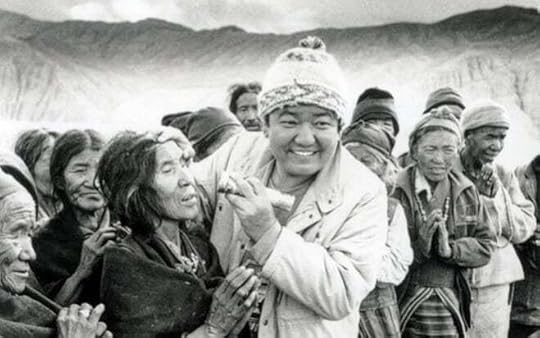
Dr Sanduk Ruit checking eyes
Now, back to that young son. Today, Sanduk Ruit is a world-renowned eye surgeon, but he was born into the lowest caste in Nepal. His father was a salt trader who trekked away from home to Tibet for long periods of time. His village of Olanchungola was 3200m high in the Himalayas, by Kanchenjunga, the third highest mountain in the world. Four days walk away was a 500 year old monastery, beyond that, only mountains. So his father knew how to tell his son how to walk safely . . .like the yaks.
But, Sanduk was only seven years old. SEVEN! His father was walking him to school, as we do our children, but this was a two-week long, hair-raising trek to Darjeeling.
“In a trip that would be almost unimaginable to most boys of the same age, Sanduk walked with his father for two weeks in his simple Chinese sneakers across stone crags, ice crusts, and over torrential rivers on flimsy log bridges.
. . . Sanduk dreaded every one of the small, swaying suspension bridges that punctuated their journey. One step in the wrong direction and he could fall into the crevasse. Mistakes could be fatal. At one point, they crossed the roaring Tamor River on a single plank of wood.
‘I remember that Dharkey held one of my hands, and another trader held the other. I didn’t look down. I knew if I’d fallen into the river, I would have just been swept away.’
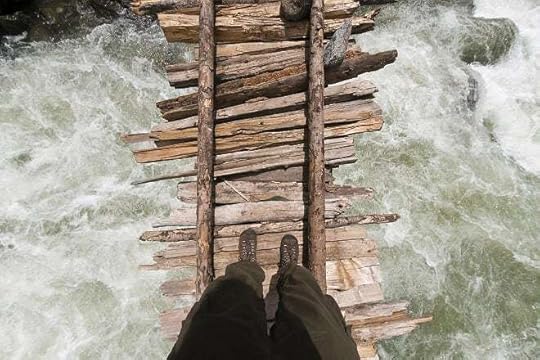
This is not a bridge from Nepal, but close enough to get the idea!
The focus of the book, of course, is the adult, life-changing Dr Sanduk Ruit, who uses his bare feet to help guide the instruments with which he performs his eye surgery. He does truly remarkable work training surgeons in many remote parts of the world to cure blindness, but what interested me too, was the fact that he came from such an extremely poor background, where he’d lost half his family – as was considered normal there – but had such drive and developed such sensitivity to go with his inbuilt stamina to do the work.
He was extremely close to his sister, and it’s because of her that he was determined to become a doctor and DO something about these dreadful statistics. Losing half of your family is not acceptable. People need to be able to get medical care no matter where they are.
There is much about his friendship – really an extended family relationship – with the late, popular, dynamic Aussie eye surgeon Fred Hollows, whose Fred Hollows Foundation continues to support Dr Ruit’s work. Fred was a funny, profane, rumpled, impatient man who didn’t take no for an answer. He was the perfect mentor for Ruit when they met.
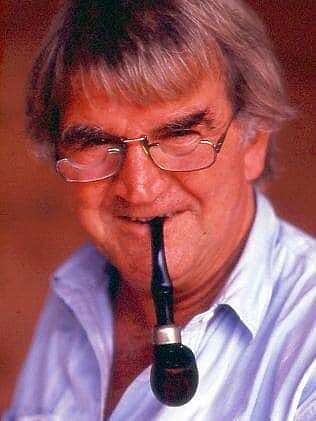
Aussie Dr Fred Hollows, with his trademark grin and pipe.
Fred had begun working to treat the widespread trachoma in Australia’s remote indigenous communities with Gabi. They married later, and she has continued his work.
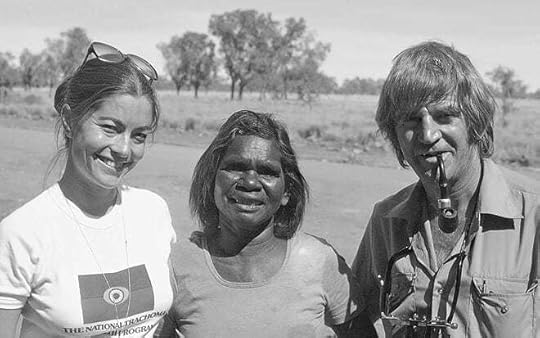
Gabi, Penny Luck, Fred 1977 Northern Territory
When Fred met Ruit, he was already familiar with working in remote places. These two men didn't travel in style or work in fancy clinics (although Fred did in Sydney). Everything was primitive. Here was a typical road trip for Ruit.
“The jeep or bus was often so cramped that they had to take turns riding on the roof. Anyone unlucky enough to be on the top had to grip the rails as they teetered on the cliff’s edge, just inches away from precipitous drops below. Ruit sat on the roof a couple of times, but was usually inside, nursing a precious microscope on his lap.
. . . Often there were no road barriers, and the roads were scenes of carnage. Buses and trucks that had plummeted over the edge were a frequent sight.”
Ruit and his wife lived with the Hollows for a year in Sydney before returning to Nepal and raising a family and building a huge training clinic and treating North Koreans (where nobody had been allowed in) and . . . many other far-flung places.
He was heart-broken after Fred died, but he kept up the momentum and has taught and infected many others with his enthusiasm, not least of all American Dr Geoffrey Tabin. Tabin seemed like a flighty, hyperactive guy when Ruit first met him, so Ruit wasn’t sure what to make of him. But when Tabin told him he’d climbed Everest (in fact the highest peak on each of the seven continents), Ruit knew he was something out of the ordinary, and they’ve forged a strong partnership - more extended family for him and the start of the Himalayan Cataract Project.
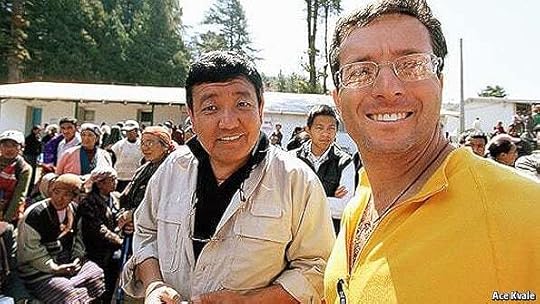
Dr Sanduk Ruit and Dr Geoffrey Tabin
Ruit’s ground-breaking work was absolutely magic. Nobody believed for years that he’d designed a quick, cheap, efficient way to produce intraocular lenses and implant them in people in a matter of minutes, but when they had a head-to-head competition with a fancy western doctor, the man was exhausted and now uses Ruit’s techniques on patients with difficult problems in his California eye clinic.
The thrill of restoring eyesight never gets old, but Ruit has to work hard at not working hard - taking time to meditate, restore, visit the monks, visit Bhutan - and restore his own vitality. What wonderful ripples have spread around the world from his stirring up accepted medical practice with his can-do ways! Fred would be so proud!
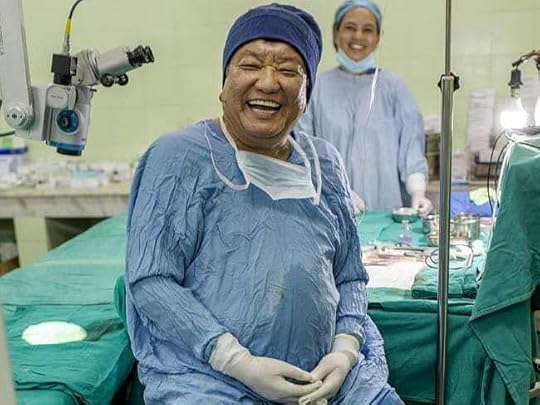
Dr Ruit after a long day. Photo by Michael Amendolia, who has been travelling and photographing this work for many years.
It’s an important story and one that deserves a lot of attention. Ali Gripper has done a great job of pulling the story together and giving us a good feel for the people, the country, and the work. I'm sure it was fascinating and difficult. And I liked all the photos!
Some of this book is shown on the SBS website, and there are photos as well. I don’t know how long it will stay online, but there is plenty of information about him everywhere.
https://www.sbs.com.au/yourlanguage/n...
This is a great interview with him - hope you can listen. There are many online.
http://www.abc.net.au/radio/programs/...
And if you feel inclined to support this work - and why not, it's such a cheap way to have a HUGE effect on a whole family's life, there are several options:
https://tilganga.org/ [Ruit's institute in Kathmandu]
https://www.hollows.org/au/home [Fred's legacy, run by Gabi]
https://www.cureblindness.org/ [The Himalayan Cataract Project - Tabin's part of the team]
“‘Slow your pace down to that of the yaks,’ Sonam told his young son as they navigated the narrow mountain passes, their backs pressed against the cliff faces. ‘And look where you are going. Don’t put your foot down unless you’ve worked out what stone or rock you are going to land on. Don’t look down, don’t look around, and don’t get distracted.’ It was good advice for the journey of his life.
The main focus of the book, of course, is the journey of this remarkable man’s life, restoring sight to thousands of people in the most remote parts of the world. Imagine being blind in a part of the world where walking can be so treacherous. Impossible. When someone is blind, particularly in an isolated village, it takes two people out of circulation. The blind person is almost totally helpless and needs constant care. When sight is restored, both can contribute.
Constant through the book is the absolute thrill and joy that everyone feels when the bandages come off and people see their families for the first time in years - or see grandchildren for the first time ever.
Dr Sanduk Ruit checking eyes
Now, back to that young son. Today, Sanduk Ruit is a world-renowned eye surgeon, but he was born into the lowest caste in Nepal. His father was a salt trader who trekked away from home to Tibet for long periods of time. His village of Olanchungola was 3200m high in the Himalayas, by Kanchenjunga, the third highest mountain in the world. Four days walk away was a 500 year old monastery, beyond that, only mountains. So his father knew how to tell his son how to walk safely . . .like the yaks.
But, Sanduk was only seven years old. SEVEN! His father was walking him to school, as we do our children, but this was a two-week long, hair-raising trek to Darjeeling.
“In a trip that would be almost unimaginable to most boys of the same age, Sanduk walked with his father for two weeks in his simple Chinese sneakers across stone crags, ice crusts, and over torrential rivers on flimsy log bridges.
. . . Sanduk dreaded every one of the small, swaying suspension bridges that punctuated their journey. One step in the wrong direction and he could fall into the crevasse. Mistakes could be fatal. At one point, they crossed the roaring Tamor River on a single plank of wood.
‘I remember that Dharkey held one of my hands, and another trader held the other. I didn’t look down. I knew if I’d fallen into the river, I would have just been swept away.’
This is not a bridge from Nepal, but close enough to get the idea!
The focus of the book, of course, is the adult, life-changing Dr Sanduk Ruit, who uses his bare feet to help guide the instruments with which he performs his eye surgery. He does truly remarkable work training surgeons in many remote parts of the world to cure blindness, but what interested me too, was the fact that he came from such an extremely poor background, where he’d lost half his family – as was considered normal there – but had such drive and developed such sensitivity to go with his inbuilt stamina to do the work.
He was extremely close to his sister, and it’s because of her that he was determined to become a doctor and DO something about these dreadful statistics. Losing half of your family is not acceptable. People need to be able to get medical care no matter where they are.
There is much about his friendship – really an extended family relationship – with the late, popular, dynamic Aussie eye surgeon Fred Hollows, whose Fred Hollows Foundation continues to support Dr Ruit’s work. Fred was a funny, profane, rumpled, impatient man who didn’t take no for an answer. He was the perfect mentor for Ruit when they met.
Aussie Dr Fred Hollows, with his trademark grin and pipe.
Fred had begun working to treat the widespread trachoma in Australia’s remote indigenous communities with Gabi. They married later, and she has continued his work.
Gabi, Penny Luck, Fred 1977 Northern Territory
When Fred met Ruit, he was already familiar with working in remote places. These two men didn't travel in style or work in fancy clinics (although Fred did in Sydney). Everything was primitive. Here was a typical road trip for Ruit.
“The jeep or bus was often so cramped that they had to take turns riding on the roof. Anyone unlucky enough to be on the top had to grip the rails as they teetered on the cliff’s edge, just inches away from precipitous drops below. Ruit sat on the roof a couple of times, but was usually inside, nursing a precious microscope on his lap.
. . . Often there were no road barriers, and the roads were scenes of carnage. Buses and trucks that had plummeted over the edge were a frequent sight.”
Ruit and his wife lived with the Hollows for a year in Sydney before returning to Nepal and raising a family and building a huge training clinic and treating North Koreans (where nobody had been allowed in) and . . . many other far-flung places.
He was heart-broken after Fred died, but he kept up the momentum and has taught and infected many others with his enthusiasm, not least of all American Dr Geoffrey Tabin. Tabin seemed like a flighty, hyperactive guy when Ruit first met him, so Ruit wasn’t sure what to make of him. But when Tabin told him he’d climbed Everest (in fact the highest peak on each of the seven continents), Ruit knew he was something out of the ordinary, and they’ve forged a strong partnership - more extended family for him and the start of the Himalayan Cataract Project.
Dr Sanduk Ruit and Dr Geoffrey Tabin
Ruit’s ground-breaking work was absolutely magic. Nobody believed for years that he’d designed a quick, cheap, efficient way to produce intraocular lenses and implant them in people in a matter of minutes, but when they had a head-to-head competition with a fancy western doctor, the man was exhausted and now uses Ruit’s techniques on patients with difficult problems in his California eye clinic.
The thrill of restoring eyesight never gets old, but Ruit has to work hard at not working hard - taking time to meditate, restore, visit the monks, visit Bhutan - and restore his own vitality. What wonderful ripples have spread around the world from his stirring up accepted medical practice with his can-do ways! Fred would be so proud!
Dr Ruit after a long day. Photo by Michael Amendolia, who has been travelling and photographing this work for many years.
It’s an important story and one that deserves a lot of attention. Ali Gripper has done a great job of pulling the story together and giving us a good feel for the people, the country, and the work. I'm sure it was fascinating and difficult. And I liked all the photos!
Some of this book is shown on the SBS website, and there are photos as well. I don’t know how long it will stay online, but there is plenty of information about him everywhere.
https://www.sbs.com.au/yourlanguage/n...
This is a great interview with him - hope you can listen. There are many online.
http://www.abc.net.au/radio/programs/...
And if you feel inclined to support this work - and why not, it's such a cheap way to have a HUGE effect on a whole family's life, there are several options:
https://tilganga.org/ [Ruit's institute in Kathmandu]
https://www.hollows.org/au/home [Fred's legacy, run by Gabi]
https://www.cureblindness.org/ [The Himalayan Cataract Project - Tabin's part of the team]
November 14, 2020
The Barefoot Surgeon is the story of Dr. Sanduk Ruit's life. Giving eyesight back to over 120,000 people around the world is no small feat, but it is still possible, through hardwork and devotion.
The book is written in simple language and is very easy to understand. But, it can also have a negative aspect , as the writing may feel dull at times.
From being a child of a mountain village to one of the world's most renowned ophthalmologist, Dr. Ruit's story is indeed fascinating and inspiring.
The book is written in simple language and is very easy to understand. But, it can also have a negative aspect , as the writing may feel dull at times.
From being a child of a mountain village to one of the world's most renowned ophthalmologist, Dr. Ruit's story is indeed fascinating and inspiring.

October 17, 2019
To me, hard work is above and beyond everything - more important than talent or fate. So I really, really appreciate Dr. Sanduk Ruit, whose determination and hard work have brought him from a remote village in the foothills of the mountains to establish a world-class eye hospital and offer hundreds of thousands of people people a chance to see the world. Our whole family has undergone treatment at this excellent hospital. For that alone, I love, love this inspirational work that shows us a glimpse of his life. The troubles he has overcome, his extraordinary vision, his superhuman benevolence and grit. The book is relatively honest, and offers a human perspective on the doctor.
I read the Nepali version, and I am not impressed with the translation - it is often stilted, lazy, and awkward. I understand that this is inevitable, for translation is an arduous and thankless task, and will never satisfy readers and critics. But to me it took away from the joy of reading, I could actually form the sentences in English in my mind because some of it was so literal.
The biography itself is quite repetitive, and get tiring at times, especially when there is nothing but a list of people and their contributions (all very important, but not perhaps in a literary work). As a Nepali, I also noticed unnecessary romanticization and glorification that our dear doctor does not need. Nepal is poor in terms of money, yes, but saying that hundreds of times in different ways does not make the book interesting.
I am happy that this book will document Dr. Ruit's glorious life throughout the world and for all generations beyond, but it wasn't quite the sparkling read I'd anticipated.
I read the Nepali version, and I am not impressed with the translation - it is often stilted, lazy, and awkward. I understand that this is inevitable, for translation is an arduous and thankless task, and will never satisfy readers and critics. But to me it took away from the joy of reading, I could actually form the sentences in English in my mind because some of it was so literal.
The biography itself is quite repetitive, and get tiring at times, especially when there is nothing but a list of people and their contributions (all very important, but not perhaps in a literary work). As a Nepali, I also noticed unnecessary romanticization and glorification that our dear doctor does not need. Nepal is poor in terms of money, yes, but saying that hundreds of times in different ways does not make the book interesting.
I am happy that this book will document Dr. Ruit's glorious life throughout the world and for all generations beyond, but it wasn't quite the sparkling read I'd anticipated.
March 21, 2020
The subtitle of this book justifies the content. The story of the barefoot surgeon, Dr. Sanduk Ruit, is truly inspiring. The hardships that Dr. Sanduk Ruit endured and the motivations that kept him driving has proved to be fruitful, making him one of the best ophthalmologist in the world.
Today, many foreigners prefer their eye surgery done in Nepal, mainly in Tilganga Institute of Ophthalmology, rather than Western hospitals. Nepal also exports intraocular lens to various countries in the world. For a small developing country like Nepal, these facts are truly amazing. One should read this non-fiction to dig deeper into these amazing facts.
Nepalese media often reports worst case scenarios, mostly death, of patients due to the carelessness of so-called reputed hospitals and doctors. My personal opinion says that, in most cases, MBBS graduates working in reputed hospitals use their position to recover what they have spent to earn their degrees. Many times they don't care for their patients. The undergraduates in the phase of becoming a doctor can study and learn from Dr. Ruit's biography.
Had this book been published and I have read it a little earlier, a career as an ophthalmologist would have been added to my list of many unfulfilled aims. The biography of the barefoot surgeon is sure to inspire many young generations to come.
As for the author, Ali Gripper have brilliantly presented words of mouth to literature. One can visualize the smile of a poor person after getting his/her sight back. This definitely gives a feel-good sense.
Today, many foreigners prefer their eye surgery done in Nepal, mainly in Tilganga Institute of Ophthalmology, rather than Western hospitals. Nepal also exports intraocular lens to various countries in the world. For a small developing country like Nepal, these facts are truly amazing. One should read this non-fiction to dig deeper into these amazing facts.
Nepalese media often reports worst case scenarios, mostly death, of patients due to the carelessness of so-called reputed hospitals and doctors. My personal opinion says that, in most cases, MBBS graduates working in reputed hospitals use their position to recover what they have spent to earn their degrees. Many times they don't care for their patients. The undergraduates in the phase of becoming a doctor can study and learn from Dr. Ruit's biography.
Had this book been published and I have read it a little earlier, a career as an ophthalmologist would have been added to my list of many unfulfilled aims. The biography of the barefoot surgeon is sure to inspire many young generations to come.
As for the author, Ali Gripper have brilliantly presented words of mouth to literature. One can visualize the smile of a poor person after getting his/her sight back. This definitely gives a feel-good sense.

November 8, 2021
I read The Barefoot Surgeon by Ali Gripper for my in person book club and around the table there were mixed feelings. All agreed that Sanduk Ruit was an amazing man but some felt the book was boring, repetitive and could have done with some tighter editing. Personally I wasn't bothered by these issues - though I admit noticing the repetition - because I was so inspired by the man himself.
Sanduk Ruit was from a very poor Nepalese family but his father chose to send him to a boarding school as a very young boy. He was sad to be away from his family and it was three long years before he next got to see them. He remained at the boarding school until he was old enough to study at university. While at school (and later at uni) he made the best of his opportunity and studied like crazy. He never intended to become a Doctor until he lost his 17 year old sister because they couldn't afford medical treatment. At that time he decided to use his life to help others. Oh brother did he ever do that.
He became a world famous Ophthalmologist and worked around the clock curing blindness and restoring sight to hundreds of thousands of people from villages in Nepal and across the world. Not only did he perform surgery for free for those who could not afford it but with the help of his friend Dr Fred Hollows he established a hospital, trained other surgeons and took his team to remote parts if the world to continue their good work for those unable to travel. Not only was he a amazingly good surgeon but he thought outside the box building a factory where they produced the intraocular lenses locally at a fraction of the cost of those they'd been importing. On top of this he worked closely with a local Hindu temple, and the families who came there to mourn their dead, persuading them that donating the corneas of their families would benefit the living. This arrangement has led to it becoming a highly successful eye bank with many thousands of people now pledging to donate their corneas.
So yes, he was a great man. By all accounts he was highly likeable but there were a couple of traits I wasn't so fond of. His determination which has seen him achieve wonderful things at times seemed excessive. He also had a bit of a temper but nobody is perfect and overall I was in awe of all he's done. Rising up from a small village, dedicating his life to helping others and having a hand in restoring sight to over 1 million people worldwide. We need more people like Dr. Sanduk Ruit in this world.
Sanduk Ruit was from a very poor Nepalese family but his father chose to send him to a boarding school as a very young boy. He was sad to be away from his family and it was three long years before he next got to see them. He remained at the boarding school until he was old enough to study at university. While at school (and later at uni) he made the best of his opportunity and studied like crazy. He never intended to become a Doctor until he lost his 17 year old sister because they couldn't afford medical treatment. At that time he decided to use his life to help others. Oh brother did he ever do that.
He became a world famous Ophthalmologist and worked around the clock curing blindness and restoring sight to hundreds of thousands of people from villages in Nepal and across the world. Not only did he perform surgery for free for those who could not afford it but with the help of his friend Dr Fred Hollows he established a hospital, trained other surgeons and took his team to remote parts if the world to continue their good work for those unable to travel. Not only was he a amazingly good surgeon but he thought outside the box building a factory where they produced the intraocular lenses locally at a fraction of the cost of those they'd been importing. On top of this he worked closely with a local Hindu temple, and the families who came there to mourn their dead, persuading them that donating the corneas of their families would benefit the living. This arrangement has led to it becoming a highly successful eye bank with many thousands of people now pledging to donate their corneas.
So yes, he was a great man. By all accounts he was highly likeable but there were a couple of traits I wasn't so fond of. His determination which has seen him achieve wonderful things at times seemed excessive. He also had a bit of a temper but nobody is perfect and overall I was in awe of all he's done. Rising up from a small village, dedicating his life to helping others and having a hand in restoring sight to over 1 million people worldwide. We need more people like Dr. Sanduk Ruit in this world.

April 7, 2019
This is incredible. Not only is this the story of a truly extraordinary and amazing human being, but it is also an extremely well told and outstanding biography. Two huge reasons to read it; be humbled, be excited, enthralled, and grateful that the almost unbelievable story can be told so graciously and so well.
Sanduk Ruit was born in the mid 1950s, into a poor and humble farming community in the mountains of Nepal. Life expectancy was not long, child mortality high, blindness everywhere. And yet from this deprivation, he becomes a world famous healer of the blind, adapting and improving surgery procedures and techniques to pioneer a new and innovative way of cataract surgery, bringing sight back to hundreds of thousands of people. He teams up with Australian ophthalmoloigst Fred Hollows, also a pioneer in the field of cataract surgery and together they take on the rigid and conservative Western medical system to revolutionise the way cataract surgery is done. A real David and Goliath story. Never once does Ruit lose his sense of where he comes from, despite all the fame, accolades, the rich and famous wanting to be associated with him. He continues to perform hundreds of operations a day, in bare feet, in the most impossible environments, with the minimum of facilities and sanitation. His motivation? Seeing what the miracle of sight does to a person, deprived of it for so many years. The rebirth of a life.
The writer has spent a lot of time with Ruit his family, his team of doctors and nurses. She tells his story in his words, his vision, his perseverance and determination. His compassion and love for his fellow man comes shining through, as does his humour, and humbleness. The writer clearly adores her subject, what he represents and how in this deeply troubled world we live in, there are still some very very good people. Outstanding.
Sanduk Ruit was born in the mid 1950s, into a poor and humble farming community in the mountains of Nepal. Life expectancy was not long, child mortality high, blindness everywhere. And yet from this deprivation, he becomes a world famous healer of the blind, adapting and improving surgery procedures and techniques to pioneer a new and innovative way of cataract surgery, bringing sight back to hundreds of thousands of people. He teams up with Australian ophthalmoloigst Fred Hollows, also a pioneer in the field of cataract surgery and together they take on the rigid and conservative Western medical system to revolutionise the way cataract surgery is done. A real David and Goliath story. Never once does Ruit lose his sense of where he comes from, despite all the fame, accolades, the rich and famous wanting to be associated with him. He continues to perform hundreds of operations a day, in bare feet, in the most impossible environments, with the minimum of facilities and sanitation. His motivation? Seeing what the miracle of sight does to a person, deprived of it for so many years. The rebirth of a life.
The writer has spent a lot of time with Ruit his family, his team of doctors and nurses. She tells his story in his words, his vision, his perseverance and determination. His compassion and love for his fellow man comes shining through, as does his humour, and humbleness. The writer clearly adores her subject, what he represents and how in this deeply troubled world we live in, there are still some very very good people. Outstanding.
December 24, 2019
I really wished I had read this book ten years ago. (but it was only published in 2018!) I feel inspired to travel back to Nepal and visit the hospital and volunteer! Dr Ruit life story is mind blowing- we need more Drs like this in the world! Love love love this story, well told, so inspirational, the gift of sight. Say no more.
April 16, 2020
A very inspiring, beautifully written biography of Dr. Sanduk Ruit.
Read
June 30, 2026Incredibly inspiring man but thought it was poorly written! Such a bummer
August 21, 2020
Dr. Ruit's life is an extraordinary story of a boy despite born in destitute embarks on a vision to bring others out of their destitution and change their lives. Words fall short to recount how inspiring and exemplary Dr. Ruit's work is. I have been following his work for years now and what I appreciate about this book is the modest sneak peek it gives into his personal life as a son, brother, husband, friend, and father. It is a humble attempt to piece together the struggles, grit, influences, vision and perseverance that make his work a super one. My heart filled with profound joy, hope and emotion every time I read about the empowering impact of his (and team's) work -- a young mother saw her baby for the first time after Dr. Ruit operated on her, two blind sisters (in their teens) holding hands after the surgery, and many many more! This book is a 270-page long testimonial of Dr. Ruit brilliant work. No stars in the galaxy are enough to rate this superhuman's work.
As a reader, however, I wish the writer and editors had done a better job in narrating Dr. Ruit’s extraordinary story. Found many blunders and honestly was quite hard for me to get past them because we are talking about the doctor who's work is simply immaculate.
As a reader, however, I wish the writer and editors had done a better job in narrating Dr. Ruit’s extraordinary story. Found many blunders and honestly was quite hard for me to get past them because we are talking about the doctor who's work is simply immaculate.

December 24, 2018
Ali Gripper has done an amazing job at conveying the scope and humanity of Dr Sanduk Ruit's work. Given his immense surgical skill, he easily could have chosen a lifestyle of comfort and riches. Instead, he has dedicated his life to ending preventable blindness within developing nations, especially for the poor and marginalised, personally curing 100,000 patients of blindness and indirectly impacting millions more.
However, what captured my imagination even more was the first part of the book. It detailed Dr Ruit's humble beginnings as a young boy living in an isolated Himalayan village, who through superhuman resilence and determination worked his way to the top of his class in high school, medical school and finally the ophthalmic world. The story of how his young sister motivated him to become a doctor was simply gut-wrenching (no spoilers). I really loved how this book has been written like a hero's journey that you might expect from a top-class fiction which is probably why I finished it in 2 days. Dr Ruit's story and genuine humanity is something that everyone can learn from. One of the best books I have ever read!
However, what captured my imagination even more was the first part of the book. It detailed Dr Ruit's humble beginnings as a young boy living in an isolated Himalayan village, who through superhuman resilence and determination worked his way to the top of his class in high school, medical school and finally the ophthalmic world. The story of how his young sister motivated him to become a doctor was simply gut-wrenching (no spoilers). I really loved how this book has been written like a hero's journey that you might expect from a top-class fiction which is probably why I finished it in 2 days. Dr Ruit's story and genuine humanity is something that everyone can learn from. One of the best books I have ever read!
October 12, 2019
Inspiring!

February 5, 2024
Amazing, inspiring story 🙏
April 20, 2026
One of the most inspirational and incredible biographies I have ever read, highly reccommend. Dr Sanduk Ruit's amazing work needs to be heard about.
August 22, 2025
Dr Ruit, how he did so much, a guy born at such a solitary and isolated place from the urban called Olangchungola, Taplejung. The guy who didn't even know how to talk Nepali did so much to Nepal. Huge applaud to all the contributing hands of the campaign, which includes many figures. By reading this, I think Yangla, his sister, is a prime factor he did all of this. The death of yangla diverged his thought of becoming a businessman to the dream of becoming doctor, which indeed helped the world. He became too obssessed that he and his team even went to North Korea, which was a mini heart-attack, which is described in the book as a whole chapter. Patch of Ceremony is one of the things, I would love to see Live if fate gives me a chance. Amazed by his stubbornness, to set Nanda ji in his life. Must Read, inspires us to give more rather than take more.
April 17, 2024
4 ⭐️
This books tells the inspirational story of Dr Ruit, his quest from a rural village to becoming a doctor, and his mission to reduce avoidable blindness in Nepal (his home country) and other non-Western countries.
I loved learning about Nepal - the bits of history woven into the book were fascinating and the author brought the country to life through their writing.
Dr Ruit himself was fascinating to learn about - the author told the good and the bad, sharing his whole humanness with the reader. On finishing this book I would summarize him as tenacious, humble and committed.
I also leave this book with a much more in depth knowledge of blindness, its causes and its treatments. But at no point did I feel lectured to - it was almost like learning through stealth.
I gave 4 stars to this book as it was quite repetitive - especially the second half - and I think this didn’t do justice to the content. I found I skimmed through the last sections due to this.
This books tells the inspirational story of Dr Ruit, his quest from a rural village to becoming a doctor, and his mission to reduce avoidable blindness in Nepal (his home country) and other non-Western countries.
I loved learning about Nepal - the bits of history woven into the book were fascinating and the author brought the country to life through their writing.
Dr Ruit himself was fascinating to learn about - the author told the good and the bad, sharing his whole humanness with the reader. On finishing this book I would summarize him as tenacious, humble and committed.
I also leave this book with a much more in depth knowledge of blindness, its causes and its treatments. But at no point did I feel lectured to - it was almost like learning through stealth.
I gave 4 stars to this book as it was quite repetitive - especially the second half - and I think this didn’t do justice to the content. I found I skimmed through the last sections due to this.
August 28, 2026
Biography of a Surgeon with Himalayan Vision
For more than three decades, Dr. Sanduk Ruit’s mission has been to bring life-transforming eye surgeries to the visually impaired, whom he affectionately refers to as "children of a lesser God." No terrain has ever been too steep or too remote for his outreach.
Born in a small village of barely 200 people in the shadows of Mount Kanchenjunga, Sanduk came from a world so isolated that when his father enrolled him in a school in Darjeeling, the journey took a grueling two-week trek across mountains to cover a straight-line distance of 150 kilometers.
Tragedy struck early. Before turning nineteen, Sanduk had lost three siblings: an elder brother to childhood diarrhea, his eight-year-old sister Chundak to fever, and his sister Yangla to tuberculosis. While his father resigned himself to grief, Sanduk viewed these preventable losses as a profound injustice, resolving to channel his grief into becoming a doctor.
After completing his medical degree at King George's Medical College in Lucknow and witnessing the vast need for eye care in rural Nepal, he earned a WHO-funded postgraduate residency in ophthalmology at AIIMS, New Delhi. His early personal life mirrored this fierce independence; he defied social conventions to marry outside his caste, living away from Nepal for years due to family disapproval.
Historically, cataract treatment in Nepal relied on intracapsular cataract extraction, which left patients dependent on heavy, thick "aphakic" glasses that caused visual distortion and were ill-suited for rugged terrain. Dr. Ruit pioneered sutureless, small-incision cataract surgery using low-cost Intraocular Lenses (IOLs), enabling complete, high-quality sight restoration within minutes.
When he first championed IOLs during the 1980s, the medical establishment resisted, claiming the technology was too complex and costly for the developing world. Dr. Ruit proved the skeptics wrong. He left his institutional post in Kathmandu, assembled a dedicated seven-member team, and began organizing surgical camps across remote villages. As the impact of his work grew, ophthalmologists from the United States, Australia, and around the world joined his camps, building international solidarity and donor support.
A pivotal milestone was the establishment of The Fred Hollows Intraocular Lens Laboratory in Nepal, established alongside his mentor Fred Hollows. By utilizing advanced equipment and stringent quality controls, the facility manufactured world-class lenses for around $5 each, compared to the $100 price tag of Western imports. Despite resistance and skepticism from multinational manufacturers, the laboratory broke market monopolies. To date, it has exported more than five million lenses across over 70 countries.
Reflecting on the transformation of his patients, Dr. Ruit remarks:
He brought the same tenacity to tackling corneal blindness, the second leading cause of sight loss globally. Confronted by deep cultural taboos against post-mortem tissue donation, Dr. Ruit partnered with the authorities at Kathmandu’s holy Pashupatinath temple in 1994 to establish Nepal's first eye bank. By training compassionate counselors to support grieving families, he fostered community trust and restored vision to thousands of individuals who had spent years in darkness.
His leadership style explains why so many core team members have remained with him for over three decades:
His work gradually expanded into neighboring regions, most notably Bhutan. Guided by the philosophy of taking the best from the outside world while preserving local culture, successive Bhutanese monarchs of Wangchuk dynasty have systematically modernized the kingdom’s healthcare and social framework. Dr. Ruit's sustainable, high-volume model integrated seamlessly with their public health goals. A guiding philosophy of his life has been that whether or not one believes in God, what truly matters is personal accountability and doing good for people.
Dr. Sanduk's grit and determination are shown throughout this biography, starting from having to stay away from his family at the tender age of seven, to deciding to become the first doctor from his village of Walung. Without stopping at a general medical degree, he pursues postgraduate studies, begins conducting eye camps in remote parts of Nepal, and takes up the mammoth task of building a hospital in Kathmandu despite severe constraints. He then starts manufacturing intraocular lenses locally and ultimately exports his eye care model to other countries and remote regions, including but not limited to; Bhutan, North Korea, Ethiopia and Tibet.
The genuine nature of his work and his firm commitment naturally attract top talent from throughout the world to support him on this journey. Good truly begets good, and Dr. Sanduk is a shining example of this from Nepal.
There are a few editing errors in the book, but that is a minor quibble compared to the lucid writing and extremely engaging life story told by the author.
Despite being the biography of a world-renowned personality, its tone does not read like a hagiography. The author does not shy away from writing about Dr. Sanduk's temper, his struggle with alcoholism, and other flaws. She keeps him grounded in a human frame, and essentially, that is what further elevates the importance of his work in the field of eye care.
It's an awe-inspiring biography!
For more than three decades, Dr. Sanduk Ruit’s mission has been to bring life-transforming eye surgeries to the visually impaired, whom he affectionately refers to as "children of a lesser God." No terrain has ever been too steep or too remote for his outreach.
Born in a small village of barely 200 people in the shadows of Mount Kanchenjunga, Sanduk came from a world so isolated that when his father enrolled him in a school in Darjeeling, the journey took a grueling two-week trek across mountains to cover a straight-line distance of 150 kilometers.
"Everything at the school was new to him, even the most common objects, blackboards, the electric lights, the radio and the heaters he'd never seen any such things before. He stood with his mouth open, taking it all in. After a tour of the school grounds, he was taken to the tailor, where he was measured up for his uniform of grey pants, grey sweater and white shirt, all of which made him feel even more ill-at-ease."
Tragedy struck early. Before turning nineteen, Sanduk had lost three siblings: an elder brother to childhood diarrhea, his eight-year-old sister Chundak to fever, and his sister Yangla to tuberculosis. While his father resigned himself to grief, Sanduk viewed these preventable losses as a profound injustice, resolving to channel his grief into becoming a doctor.
After completing his medical degree at King George's Medical College in Lucknow and witnessing the vast need for eye care in rural Nepal, he earned a WHO-funded postgraduate residency in ophthalmology at AIIMS, New Delhi. His early personal life mirrored this fierce independence; he defied social conventions to marry outside his caste, living away from Nepal for years due to family disapproval.
Historically, cataract treatment in Nepal relied on intracapsular cataract extraction, which left patients dependent on heavy, thick "aphakic" glasses that caused visual distortion and were ill-suited for rugged terrain. Dr. Ruit pioneered sutureless, small-incision cataract surgery using low-cost Intraocular Lenses (IOLs), enabling complete, high-quality sight restoration within minutes.
When he first championed IOLs during the 1980s, the medical establishment resisted, claiming the technology was too complex and costly for the developing world. Dr. Ruit proved the skeptics wrong. He left his institutional post in Kathmandu, assembled a dedicated seven-member team, and began organizing surgical camps across remote villages. As the impact of his work grew, ophthalmologists from the United States, Australia, and around the world joined his camps, building international solidarity and donor support.
"During the operation, I am giving them the best of my skills and all of my love. And then experiencing all those complex feelings in the room when the patients realise they can see the relief, the joy, the tears, the hugs, the jubilation of seeing their children, their parents, their brothers and sisters again is always such a powerful moment. It really keeps me going. The rewards are just so rich."
A pivotal milestone was the establishment of The Fred Hollows Intraocular Lens Laboratory in Nepal, established alongside his mentor Fred Hollows. By utilizing advanced equipment and stringent quality controls, the facility manufactured world-class lenses for around $5 each, compared to the $100 price tag of Western imports. Despite resistance and skepticism from multinational manufacturers, the laboratory broke market monopolies. To date, it has exported more than five million lenses across over 70 countries.
Reflecting on the transformation of his patients, Dr. Ruit remarks:
"Often, they remind me of wilted plants that suddenly bloom when potted in the sun. Their dignity is restored because they can earn money or help out on the family's farm. There are no side effects of cataract surgery. There are no downsides."
He brought the same tenacity to tackling corneal blindness, the second leading cause of sight loss globally. Confronted by deep cultural taboos against post-mortem tissue donation, Dr. Ruit partnered with the authorities at Kathmandu’s holy Pashupatinath temple in 1994 to establish Nepal's first eye bank. By training compassionate counselors to support grieving families, he fostered community trust and restored vision to thousands of individuals who had spent years in darkness.
His leadership style explains why so many core team members have remained with him for over three decades:
"I see the best in others. I watch what people are good at and then set them doing it. I harness their particular talents. Everyone has strengths and weaknesses; being a good manager means recognising and drawing on their strengths. It's also important to create a good atmosphere in your team. To really care for each other. I try to really look after my staff. I make sure they are all happy and well. I give them opportunities, such as sending them to the US or Australia or the UK to enhance their skills by learning with great surgeons. And I share my vision with them, so they know they are part of something greater than themselves."
His work gradually expanded into neighboring regions, most notably Bhutan. Guided by the philosophy of taking the best from the outside world while preserving local culture, successive Bhutanese monarchs of Wangchuk dynasty have systematically modernized the kingdom’s healthcare and social framework. Dr. Ruit's sustainable, high-volume model integrated seamlessly with their public health goals. A guiding philosophy of his life has been that whether or not one believes in God, what truly matters is personal accountability and doing good for people.
Dr. Sanduk's grit and determination are shown throughout this biography, starting from having to stay away from his family at the tender age of seven, to deciding to become the first doctor from his village of Walung. Without stopping at a general medical degree, he pursues postgraduate studies, begins conducting eye camps in remote parts of Nepal, and takes up the mammoth task of building a hospital in Kathmandu despite severe constraints. He then starts manufacturing intraocular lenses locally and ultimately exports his eye care model to other countries and remote regions, including but not limited to; Bhutan, North Korea, Ethiopia and Tibet.
The genuine nature of his work and his firm commitment naturally attract top talent from throughout the world to support him on this journey. Good truly begets good, and Dr. Sanduk is a shining example of this from Nepal.
There are a few editing errors in the book, but that is a minor quibble compared to the lucid writing and extremely engaging life story told by the author.
Despite being the biography of a world-renowned personality, its tone does not read like a hagiography. The author does not shy away from writing about Dr. Sanduk's temper, his struggle with alcoholism, and other flaws. She keeps him grounded in a human frame, and essentially, that is what further elevates the importance of his work in the field of eye care.
It's an awe-inspiring biography!
October 7, 2021
Do not take my rating as being indicative of my views on Dr Ruit. He is an amazing person who has given so much to the world. I had heard of Fred Hollows but had never heard of Dr Ruit. His attitude, his achievements, his compassion - amazing. And from such beginnings that may have daunted so many others.
This book, however, does not do him or his story justice. In honesty, the only part that really moved me was the recount of his sister, Yangla's, death. Other than that, I found the writing to be pedestrian and less than inspiring.
This book, however, does not do him or his story justice. In honesty, the only part that really moved me was the recount of his sister, Yangla's, death. Other than that, I found the writing to be pedestrian and less than inspiring.
January 24, 2020
Despite his revolutionary work in treating cataracts and establishment of the famous Tilganga Hospital, Dr Sanduk Ruit is not as famous as he should be. This is probably due to his low-profile attitude, his appreciation for his team, and insufficient media coverage from Nepal. This is a book that helps one understand Ruit and appreciate his hard work in helping the helpless. It gives insight into the strengths and weaknesses of the beloved doctor. It tells about his family, his beliefs and his passion. These factors make the book valuable.
Dr Ruit's greatest achievement lies in the establishment of a cheap and efficient method of cataract surgery, and the book does wonderful work in capturing that. His work in the Upper Mustang is the best because the team had suffered a lot to reach there and establish a camp. In spite of all the hardships, they were able to restore sights of hundreds. This and several other camps are inspiring.
The non-linear narration gives the feel of watching a documentary. In some places, it is good but in many places, when the timeline shifts from one to another, I felt like I missed an important matter. The non-linearity also means that sentences, paragraphs, and at one instance, a case are repeated.
There are some issues in the book that disappointed me. One is the exaggeration of the caste issue. In the part where Ruit's parents got married, class could have been an issue instead of caste. But even that does not take the narrative anywhere. The wedding is accepted by both the families and there is no pride in them. In the chapters of his childhood in the school at Darjeeling, he is said to have been bullied and he was left alone because of his caste/race. A picture in the book itself, however, tells a different story. Another is when the doctors of Nepal Eye Hospital refused to follow Ruit's method. The reasons are obvious: (1) Ruit's method had not gone through a proper clinical trial, and (2) people are always sceptical about new technologies that have not appeared in peer-reviewed journals. To bring caste, in this case, was unnecessary.
Another is this part of Ruit's life that made me sad and furious. Ruit pulled off a cheap Bollywood style stunt in order to make Nanda talk to him. This is the worst part, and the most uninspiring. The fact that Nanda, despite being great at nursing, left her job "to look after the family" is also uninspiring. She did what is traditionally expected of women in Nepal. But I felt they could have done so much more, had she and Ruit been together in all their camps.
Dr Ruit's greatest achievement lies in the establishment of a cheap and efficient method of cataract surgery, and the book does wonderful work in capturing that. His work in the Upper Mustang is the best because the team had suffered a lot to reach there and establish a camp. In spite of all the hardships, they were able to restore sights of hundreds. This and several other camps are inspiring.
The non-linear narration gives the feel of watching a documentary. In some places, it is good but in many places, when the timeline shifts from one to another, I felt like I missed an important matter. The non-linearity also means that sentences, paragraphs, and at one instance, a case are repeated.
There are some issues in the book that disappointed me. One is the exaggeration of the caste issue. In the part where Ruit's parents got married, class could have been an issue instead of caste. But even that does not take the narrative anywhere. The wedding is accepted by both the families and there is no pride in them. In the chapters of his childhood in the school at Darjeeling, he is said to have been bullied and he was left alone because of his caste/race. A picture in the book itself, however, tells a different story. Another is when the doctors of Nepal Eye Hospital refused to follow Ruit's method. The reasons are obvious: (1) Ruit's method had not gone through a proper clinical trial, and (2) people are always sceptical about new technologies that have not appeared in peer-reviewed journals. To bring caste, in this case, was unnecessary.
Another is this part of Ruit's life that made me sad and furious. Ruit pulled off a cheap Bollywood style stunt in order to make Nanda talk to him. This is the worst part, and the most uninspiring. The fact that Nanda, despite being great at nursing, left her job "to look after the family" is also uninspiring. She did what is traditionally expected of women in Nepal. But I felt they could have done so much more, had she and Ruit been together in all their camps.
July 18, 2019
THE BAREFOOT SURGEON BY ALI GRIPPER - the story of Dr Sanduk Ruit, giving site and hope to the world's poor.
Every once in a while we come across a true legend.
Sanduk Ruit was born into a poor family in the remote mountains of Nepal with no hope of education. His parents noticed Sanduk's hunger for learning and sent him (at the young age of seven) miles away to a boarding school to be educated.
Ruit goes onto follow his dreams of becoming a Doctor of ophthalmology, following in the footsteps of his mentor and closest friend Fred Hollows, Australia's pioneer in cataract surgery.
This EXTRAORDINARY, UNIQUE HUMAN BEING is absolutely astounding. He travels to the worlds most remote areas of Nepal, Tibet, India, North Korea and many more underprivileged countries to give back site to the hundreds of thousands of men, woman and children who suffer from blindness due to cataracts and cornea issues. Most of the surgery is done for free - Ruit's wealth comes from the pleasure he gains as he removes the bandages from the 70 patients he treats daily. As quoted in the book by the fabulous story teller Ali Gripper, "The pleasure he receives every day helping people see again keeps him wealthy in his spirit and soul" and in Doctor Ruit's words "You can't take anything with you when it's time to go. What you take is your character and your good deeds: what you have done to help others"
As one of his patients quotes, "For me, there is G-d and there is Dr. Ruit, and those two things are the same. He gave me more than my sight back. He gave me my life."
If I have not inspired you to read his story, I hope these words will change your mind. "Like a scene from an epic biblical movie, over a thousand people came down from the surrounding mountains, the blind led or carried by family and friends, expecting miracles. And the miracle of modern medicine is what Dr. Ruit and his team delivered, over and over again."
I was in awe of this giant of a man from the back streets of Nepal who gains respect from the Western World with his extraordinary success in treating his patients in the most remote places imaginable.
If I ever need cataract surgery, Ruit would be my surgeon of choice!
If you love inspirational stories it has been a privilege to learn about this remarkable Nepalese Ophthalmologist, giving sight to over 120,000 deserving individuals.
WOW, A MAN IN A MILLION - A HUGE FIVE STARS FROM ME. I WISH I COULD HAVE HIM AND HIS FAMILY OVER AT MY NEXT DINNER PARTY.
Every once in a while we come across a true legend.
Sanduk Ruit was born into a poor family in the remote mountains of Nepal with no hope of education. His parents noticed Sanduk's hunger for learning and sent him (at the young age of seven) miles away to a boarding school to be educated.
Ruit goes onto follow his dreams of becoming a Doctor of ophthalmology, following in the footsteps of his mentor and closest friend Fred Hollows, Australia's pioneer in cataract surgery.
This EXTRAORDINARY, UNIQUE HUMAN BEING is absolutely astounding. He travels to the worlds most remote areas of Nepal, Tibet, India, North Korea and many more underprivileged countries to give back site to the hundreds of thousands of men, woman and children who suffer from blindness due to cataracts and cornea issues. Most of the surgery is done for free - Ruit's wealth comes from the pleasure he gains as he removes the bandages from the 70 patients he treats daily. As quoted in the book by the fabulous story teller Ali Gripper, "The pleasure he receives every day helping people see again keeps him wealthy in his spirit and soul" and in Doctor Ruit's words "You can't take anything with you when it's time to go. What you take is your character and your good deeds: what you have done to help others"
As one of his patients quotes, "For me, there is G-d and there is Dr. Ruit, and those two things are the same. He gave me more than my sight back. He gave me my life."
If I have not inspired you to read his story, I hope these words will change your mind. "Like a scene from an epic biblical movie, over a thousand people came down from the surrounding mountains, the blind led or carried by family and friends, expecting miracles. And the miracle of modern medicine is what Dr. Ruit and his team delivered, over and over again."
I was in awe of this giant of a man from the back streets of Nepal who gains respect from the Western World with his extraordinary success in treating his patients in the most remote places imaginable.
If I ever need cataract surgery, Ruit would be my surgeon of choice!
If you love inspirational stories it has been a privilege to learn about this remarkable Nepalese Ophthalmologist, giving sight to over 120,000 deserving individuals.
WOW, A MAN IN A MILLION - A HUGE FIVE STARS FROM ME. I WISH I COULD HAVE HIM AND HIS FAMILY OVER AT MY NEXT DINNER PARTY.
July 10, 2020
The book is an inspirational story of Dr Ruit's journey from being a village boy to be a world class surgeon. His journey of life is full of love, passion, hardwork, overcoming obstacles, teamwork and much more. It is remarkable how one's work can speak for oneself without having to boast out loud in words. Dr Ruit is no less than an incarnation of the Buddha for the blind especially the blind in the underprivileged class. It's amazing to read about lives that he has been able to change for the better through the gift of sight. It was, however, discouraging to read about how colleagues, even in the prestigious professions can be outright against new technologies, I am only glad that Dr Ruit had the conviction and the fortune of the company of some well intentioned, like minded people in his journey for him to succeed in his mission. It was also a pleasant and heartwarming to learn about his private life and his love towards his family. I am grateful that he exists in our times and his work has been recognized during his lifetime. I wish more professionals get the courage and the encouragement to take their profession not merely as a way to make fortune but also to change lives of people for the better.
January 27, 2022
Non-fiction about a medical specialist, Sanduk Ruit, selflessly doing his work and working incredibly hard at it.
"What's powerful about Ruit's work is the simplicity of purpose. You may not be able to change the world, but Ruit is showing us that fixing one big problem is possible - you can let the blind see". His work has the "wow' factor with immediate gratification.
He forsook becoming a successful opthalmologist and a multi-millionaire in private practice by chosing 'to stay and serve his own country' (Nepal), curing millions of people from blindness from cataracts. He went to many other countries too, doing free eye camps. In North Korea he quietly accepted that his patients were convinced that their Dear Leader, Kim Jong-II, just by allowing them to attend the eye camps in his country, had restored their sight rather than Dr. Ruit, his team and modern sugical skills. Dr Ruit is quoted as saying " We weren't there to change the political system, after all, we were there to help them see again".
Amazing man with a big heart.
"What he shows his team is that it is not how much money the organisation made in a year, but how much suffering they have alleviated during the year".
"What's powerful about Ruit's work is the simplicity of purpose. You may not be able to change the world, but Ruit is showing us that fixing one big problem is possible - you can let the blind see". His work has the "wow' factor with immediate gratification.
He forsook becoming a successful opthalmologist and a multi-millionaire in private practice by chosing 'to stay and serve his own country' (Nepal), curing millions of people from blindness from cataracts. He went to many other countries too, doing free eye camps. In North Korea he quietly accepted that his patients were convinced that their Dear Leader, Kim Jong-II, just by allowing them to attend the eye camps in his country, had restored their sight rather than Dr. Ruit, his team and modern sugical skills. Dr Ruit is quoted as saying " We weren't there to change the political system, after all, we were there to help them see again".
Amazing man with a big heart.
"What he shows his team is that it is not how much money the organisation made in a year, but how much suffering they have alleviated during the year".
June 15, 2019
The Barefoot Surgeon ~ Ali Gripper
What an amazing, inspirational life Dr Sanduk Ruit has lived!
To gain happiness from truly helping other human beings is an incredibly humbling experience to read about.
Sanduk grew up in an isolated village in Eastern Nepal where he quickly discovered a passion for academia. The unfortunate passing of one of his younger sisters stirred a fire within him. Why should some human beings have little to no access to health practices readily available in the western world? Why were surgeons providing second rate eye care to some of the people who needed their sight the most?
Being blind in a country like Nepal does not just affect one person, it affects the entire community. If the individual is one of the lucky ones who does not get shunned, one of their relatives (typically the youngest girl in the family) will stay home from school to take care of them. Need I say more about the effect this has on the community, the family and the individual? Dr Ruits ambition to provide first class eye care to people living with avoidable blindness is truly inspiring and transforming.
What an amazing story to read and great cause to support!
3/5
What an amazing, inspirational life Dr Sanduk Ruit has lived!
To gain happiness from truly helping other human beings is an incredibly humbling experience to read about.
Sanduk grew up in an isolated village in Eastern Nepal where he quickly discovered a passion for academia. The unfortunate passing of one of his younger sisters stirred a fire within him. Why should some human beings have little to no access to health practices readily available in the western world? Why were surgeons providing second rate eye care to some of the people who needed their sight the most?
Being blind in a country like Nepal does not just affect one person, it affects the entire community. If the individual is one of the lucky ones who does not get shunned, one of their relatives (typically the youngest girl in the family) will stay home from school to take care of them. Need I say more about the effect this has on the community, the family and the individual? Dr Ruits ambition to provide first class eye care to people living with avoidable blindness is truly inspiring and transforming.
What an amazing story to read and great cause to support!
3/5
August 31, 2024
3.5 stars
Not a big sucker for autobiographies; however, I was pleasantly suprised when I realized this book had a stronger hook on me than I expected it to have.
As a Buddist Tibetan who grew up in Darjeeling, I developed a fond connection to the Doctor. The early adversities he and his family faced brought me to tears.
Nearly every chapter left me in a shock state, as I wondered how in-spite of the socioeconomic and social status Dr.Ruti held in society: how he was able to become one of the top surgeons in all of Nepal; South
Asia.
One draw back was how the narrator kept repeating information that was already shared to the readers.
While it is a good strategy to highlight details that the reader may have missed; I found the repetition to be annoying and worsened the quality of writing of the book itself.
Overall, I would read it again. I found several moving quotes and am in admiration of the humility & compassion Dr. Ruti possesses to ALL his patients. I believe we can all learn something from this globally recognized surgeon, who was once a poor village boy raised by two uneducated and simple parents.
Not a big sucker for autobiographies; however, I was pleasantly suprised when I realized this book had a stronger hook on me than I expected it to have.
As a Buddist Tibetan who grew up in Darjeeling, I developed a fond connection to the Doctor. The early adversities he and his family faced brought me to tears.
Nearly every chapter left me in a shock state, as I wondered how in-spite of the socioeconomic and social status Dr.Ruti held in society: how he was able to become one of the top surgeons in all of Nepal; South
Asia.
One draw back was how the narrator kept repeating information that was already shared to the readers.
While it is a good strategy to highlight details that the reader may have missed; I found the repetition to be annoying and worsened the quality of writing of the book itself.
Overall, I would read it again. I found several moving quotes and am in admiration of the humility & compassion Dr. Ruti possesses to ALL his patients. I believe we can all learn something from this globally recognized surgeon, who was once a poor village boy raised by two uneducated and simple parents.
February 23, 2019
I found this to be a transforming read, I wish I had Ali Gripper's writing prowess for this review as I'm not sure I can give it justice. Dr Sanduk Ruit is a true inspiration. I was in Nepal whilst reading and found myself asking about him, he is revered and a pioneer and I am lucky to have read his story.
From reading the book it is clear that Dr Ruit is well liked and respected by all he engages with and Ali Gripper shares his wisdom throughout the book, I found his advice invaluable and believe his words will help many.
I was constantly astounded by his stories and life experiences particularly the outreach camps he embarked on and the training of ophthalmologists in North Korea. Dr Ruit pursues the noble act of healing people that transcends politics and his pursuit of curing blindless is universally respected by all. His story is one that gives me faith in the human spirit and belief in our strengths.
From reading the book it is clear that Dr Ruit is well liked and respected by all he engages with and Ali Gripper shares his wisdom throughout the book, I found his advice invaluable and believe his words will help many.
I was constantly astounded by his stories and life experiences particularly the outreach camps he embarked on and the training of ophthalmologists in North Korea. Dr Ruit pursues the noble act of healing people that transcends politics and his pursuit of curing blindless is universally respected by all. His story is one that gives me faith in the human spirit and belief in our strengths.
September 17, 2020
Instead of choosing the life of comfort and riches, Dr. Sanduk Ruit chose to chase his ‘audacious dream’ of wiping out blindness in Nepal and beyond. He is now a world renowned surgeon, had has put Nepal on the global map. Nepal is now not only known for Mt. Everest and the birthplace of Buddha but also the country that sends out surplus amount of intraocular lenses to the countries in need.
The humbling life of Dr. Ruit is truly inspirational. He did not play by rules and made his own way to help the people most in need, the people as he says “the most deserving people in the world” a chance at living a decent and dignified life.
The writer has grasped the emotions so well and has the written the perfect biography. The book is a highly recommend read!
The humbling life of Dr. Ruit is truly inspirational. He did not play by rules and made his own way to help the people most in need, the people as he says “the most deserving people in the world” a chance at living a decent and dignified life.
The writer has grasped the emotions so well and has the written the perfect biography. The book is a highly recommend read!
July 20, 2019
Read this for Book Group. Not the only one to be surprised that Fred Hollows wasn't the one doing all the actual work in Asia. Inspirational story of a lowest caste boy from Nepal who was inspired by Fred among others to go on and become a philanthropic eye surgeon and to invent a much simpler operation for cataracts. Also set up intraocular lens factory in his hospital in Nepal. Outreach to the poorest villages and to places as far from home as North Korea and Africa. Very simply written. Easy to read. Some in our group felt it too repetitive and over-padded. Personally I found it a good read of a night during our full-on Yearly Meeting.
July 20, 2019
5 stars
Dr.Ruit is inspirational, hardworking, dedicated, caring and compassionate. I throughly enjoyed following his life story from the huts of his rural village in the Himalayas all the way to him building his own hospital in the cities of Nepal. This story exemplifies the power of education and why it is necessary on a global scale. Imagine if Ruit’s parents did not see the potential in him and did not send him away to receive his education. The world would of have lost one of the best eye doctors known to man. What a beautiful story, would recommend to anyone.
Dr.Ruit is inspirational, hardworking, dedicated, caring and compassionate. I throughly enjoyed following his life story from the huts of his rural village in the Himalayas all the way to him building his own hospital in the cities of Nepal. This story exemplifies the power of education and why it is necessary on a global scale. Imagine if Ruit’s parents did not see the potential in him and did not send him away to receive his education. The world would of have lost one of the best eye doctors known to man. What a beautiful story, would recommend to anyone.
July 3, 2022
Wish to read the 'original version' by the author, and I am sure that would be a great read again. Nepali translators have their own biased perspectives, accent, and tone that doesn't match the character's lifestyle. Not enjoyed much in words, that manipulated in a different way to the emotion of the story.
लेखकका मूल संस्करण पढ्न चाहन्छु र त्यो पक्कै एउटा रमाईलो पठन हुनेछ । नेपाली अनुवादकहरूको आफ्नै पक्षपाती दृष्टिकोण, उच्चारण र स्वरका गंध छन, जुन पात्रको जीवनशैली र त्यस लोकेसनमा हुने दिनचर्या वा भेषभाषा सँग मेल खाँदैन। कथाको भावनामा फरक तरिकाले हेरफेर गरिएका शब्दहरू रमाइलो लागेन ।
लेखकका मूल संस्करण पढ्न चाहन्छु र त्यो पक्कै एउटा रमाईलो पठन हुनेछ । नेपाली अनुवादकहरूको आफ्नै पक्षपाती दृष्टिकोण, उच्चारण र स्वरका गंध छन, जुन पात्रको जीवनशैली र त्यस लोकेसनमा हुने दिनचर्या वा भेषभाषा सँग मेल खाँदैन। कथाको भावनामा फरक तरिकाले हेरफेर गरिएका शब्दहरू रमाइलो लागेन ।
March 8, 2023
First, Thank you ABhi for gifting me this biography.
Second, I would want you and everybody to read this book because this book is amazing.
Third, I realized that a man is handsome not just for his look, but because of his character and personality. (Ps. Everybody knows yet I am re-quoting it. LOL!)
Dr. Ruit is kind, patient, generous, and humble. There is so much to learn and the book is inspiring. Everything about his childhood, study life, family life, and career is inspiring. So just go and read the book.
Also, Nanda and Ruit is my next favorite love story.
#sept4
#happyreading
Second, I would want you and everybody to read this book because this book is amazing.
Third, I realized that a man is handsome not just for his look, but because of his character and personality. (Ps. Everybody knows yet I am re-quoting it. LOL!)
Dr. Ruit is kind, patient, generous, and humble. There is so much to learn and the book is inspiring. Everything about his childhood, study life, family life, and career is inspiring. So just go and read the book.
Also, Nanda and Ruit is my next favorite love story.
#sept4
#happyreading
Displaying 1 - 30 of 79 reviews