

What do you think?

Early Asimov #1-3
The Early Asimov or, Eleven Years of Trying
Contents:
• Biographical Comments
• The Callistan Menace
• Ring Around the Sun
• The Magnificent Possession
• Trends
• The Weapon Too Dreadful to Use
• Black Friar of the Flame
• Half-Breed
• The Secret Sense
• Homo Sol
• Half-Breeds on Venus
• The Imaginary
• Heredity
• History
• Christmas on Ganymede
• The Little Man on the Subway by Isaac Asimov and Frederik Pohl
• The Hazing
• Super-Neutron
• Not Final!
• Legal Ritesby Isaac Asimov and Frederik Pohl
• Time Pussy
• Author! Author!
• Death Sentence
• Blind Alley
• No Connection
• The Endochronic Properties of Resublimated Thiotimoline
• The Red Queen's Race
• Mother Earth
• Biographical Comments
• The Callistan Menace
• Ring Around the Sun
• The Magnificent Possession
• Trends
• The Weapon Too Dreadful to Use
• Black Friar of the Flame
• Half-Breed
• The Secret Sense
• Homo Sol
• Half-Breeds on Venus
• The Imaginary
• Heredity
• History
• Christmas on Ganymede
• The Little Man on the Subway by Isaac Asimov and Frederik Pohl
• The Hazing
• Super-Neutron
• Not Final!
• Legal Ritesby Isaac Asimov and Frederik Pohl
• Time Pussy
• Author! Author!
• Death Sentence
• Blind Alley
• No Connection
• The Endochronic Properties of Resublimated Thiotimoline
• The Red Queen's Race
• Mother Earth
568 pages, Hardcover
First published September 1, 1972
About the author
Isaac Asimov
4,430 books28.8k followersWorks of prolific Russian-American writer Isaac Asimov include popular explanations of scientific principles,
The Foundation Trilogy
(1951-1953), and other volumes of fiction.
Isaac Asimov, a professor of biochemistry, wrote as a highly successful author, best known for his books.
Asimov, professor, generally considered of all time, edited more than five hundred books and ninety thousand letters and postcards. He published in nine of the ten major categories of the Dewey decimal classification but lacked only an entry in the category of philosophy (100).
People widely considered Asimov, a master of the genre alongside Robert Anson Heinlein and Arthur Charles Clarke as the "big three" during his lifetime. He later tied Galactic Empire and the Robot into the same universe as his most famous series to create a unified "future history" for his stories much like those that Heinlein pioneered and Cordwainer Smith and Poul Anderson previously produced. He penned "Nightfall," voted in 1964 as the best short story of all time; many persons still honor this title. He also produced well mysteries, fantasy, and a great quantity of nonfiction. Asimov used Paul French, the pen name, for the Lucky Starr, series of juvenile novels.
Most books of Asimov in a historical way go as far back to a time with possible question or concept at its simplest stage. He often provides and mentions well nationalities, birth, and death dates for persons and etymologies and pronunciation guides for technical terms. Guide to Science, the tripartite set Understanding Physics, and Chronology of Science and Discovery exemplify these books.
Asimov, a long-time member, reluctantly served as vice president of Mensa international and described some members of that organization as "brain-proud and aggressive about their IQs." He took more pleasure as president of the humanist association. The asteroid 5020 Asimov, the magazine Asimov's Science Fiction, an elementary school in Brooklyn in New York, and two different awards honor his name.
http://en.wikipedia.org/wiki/Isaac_As...
Isaac Asimov, a professor of biochemistry, wrote as a highly successful author, best known for his books.
Asimov, professor, generally considered of all time, edited more than five hundred books and ninety thousand letters and postcards. He published in nine of the ten major categories of the Dewey decimal classification but lacked only an entry in the category of philosophy (100).
People widely considered Asimov, a master of the genre alongside Robert Anson Heinlein and Arthur Charles Clarke as the "big three" during his lifetime. He later tied Galactic Empire and the Robot into the same universe as his most famous series to create a unified "future history" for his stories much like those that Heinlein pioneered and Cordwainer Smith and Poul Anderson previously produced. He penned "Nightfall," voted in 1964 as the best short story of all time; many persons still honor this title. He also produced well mysteries, fantasy, and a great quantity of nonfiction. Asimov used Paul French, the pen name, for the Lucky Starr, series of juvenile novels.
Most books of Asimov in a historical way go as far back to a time with possible question or concept at its simplest stage. He often provides and mentions well nationalities, birth, and death dates for persons and etymologies and pronunciation guides for technical terms. Guide to Science, the tripartite set Understanding Physics, and Chronology of Science and Discovery exemplify these books.
Asimov, a long-time member, reluctantly served as vice president of Mensa international and described some members of that organization as "brain-proud and aggressive about their IQs." He took more pleasure as president of the humanist association. The asteroid 5020 Asimov, the magazine Asimov's Science Fiction, an elementary school in Brooklyn in New York, and two different awards honor his name.
http://en.wikipedia.org/wiki/Isaac_As...
Ratings & Reviews
Friends & Following
Create a free account to discover what your friends think of this book!
Community Reviews
Displaying 1 - 30 of 32 reviews

September 30, 2016
Favourite stories:
Trends
Magnificent Posession
Weapon
Half-Breed
Black Friar of the Flame
Ring Around the Sun
I'm honing in on the ideal short story collection. 27 stories is too long. And spending over a month reading it is also too long. I started to not remember which stories I had or had not read (that could be fixed by reading them in order, though).
Trends
Magnificent Posession
Weapon
Half-Breed
Black Friar of the Flame
Ring Around the Sun
I'm honing in on the ideal short story collection. 27 stories is too long. And spending over a month reading it is also too long. I started to not remember which stories I had or had not read (that could be fixed by reading them in order, though).

June 12, 2018
Hardcover omnibus.
For completists only. Most stories unfortunate. Scientifically ridiculous, written to sell to the teens who bought the nascent pulps (Asimov admits same himself), with nary a woman who is a person. Or a man, for that matter. Way too much of that 'psychohistory' stuff.
I did sort of like "Blind Alley," one of the last. It's got that hero in disguise thing going, that Asimov likes so much... but this time the guy is believable, and he's not a "Half-Breed" or otherwise an object of ridicule &/or pity.
Then there's the last story, "Mother Earth," which is a prequel for the Lije Baley stories. Asimov by then had gotten the hang of expressing his stance on anti-racism, anti-Eugenics, thank goodness. I don't know whether "Mother Earth" is a good story or not, but I enjoyed it because I recently enjoyed all the Lije Baley stories.
This book also had lots of biographical data between stories. Mostly pretty dry accountings derived from his 'journals.' I skimmed.
For completists only. Most stories unfortunate. Scientifically ridiculous, written to sell to the teens who bought the nascent pulps (Asimov admits same himself), with nary a woman who is a person. Or a man, for that matter. Way too much of that 'psychohistory' stuff.
I did sort of like "Blind Alley," one of the last. It's got that hero in disguise thing going, that Asimov likes so much... but this time the guy is believable, and he's not a "Half-Breed" or otherwise an object of ridicule &/or pity.
Then there's the last story, "Mother Earth," which is a prequel for the Lije Baley stories. Asimov by then had gotten the hang of expressing his stance on anti-racism, anti-Eugenics, thank goodness. I don't know whether "Mother Earth" is a good story or not, but I enjoyed it because I recently enjoyed all the Lije Baley stories.
This book also had lots of biographical data between stories. Mostly pretty dry accountings derived from his 'journals.' I skimmed.

January 20, 2018
I really enjoyed this book. I like sci-fi but do not read it too often. In fact this is the first time I read anything by Asimov.
I enjoyed these stories, even if they were some of his earlier published stories and by his standards mediocre. Maybe I just haven't read enough of this genre to critique it well.
I really liked Asimov's commentary on his stories. Each story is preceded by an account of how it got published and preceded by a short commentary on things he liked and disliked about it. It's interesting to have him judge his own stories and see his opinion on them. It's also neat to see what it is like to get published in magazines and what that looks like for a writer. It gives me a great deal of respect for writers and editors.
Overall, an enjoyable book.
I enjoyed these stories, even if they were some of his earlier published stories and by his standards mediocre. Maybe I just haven't read enough of this genre to critique it well.
I really liked Asimov's commentary on his stories. Each story is preceded by an account of how it got published and preceded by a short commentary on things he liked and disliked about it. It's interesting to have him judge his own stories and see his opinion on them. It's also neat to see what it is like to get published in magazines and what that looks like for a writer. It gives me a great deal of respect for writers and editors.
Overall, an enjoyable book.

September 30, 2021
Me encanto poder dar este paseo de la mano de Asimov por el camino con los aciertos y errores que lo llevaron a ser ese escritor que todos conocemos.
Hablando del contenido tiene varios cuentos con ideas que son precursoras de varias de sus grandes obras , Algún experimento creativo y otros que realmente no me gustaron nada. Por lo que no diría que es un imprescindible pero vale la pena para los fans mas acerinos para conocer mas de como fueron esos primeros años antes de que se considerara a si mismo como un ESCRITOR.
Hablando del contenido tiene varios cuentos con ideas que son precursoras de varias de sus grandes obras , Algún experimento creativo y otros que realmente no me gustaron nada. Por lo que no diría que es un imprescindible pero vale la pena para los fans mas acerinos para conocer mas de como fueron esos primeros años antes de que se considerara a si mismo como un ESCRITOR.
September 20, 2022
I thoroughly enjoyed this book! The short stories themselves are variously silly, satirical, full of tension, and just good, solid tales. Some of them link to his robot and empire series. Woven around them all is a biography of Asimov's early writing career. Getting a glimpse into the life of an author I have admired for a long time was even better than the fiction. At one point I felt like I was in the room with him. The final comments were exceedingly moving. As a tribute to a friend and mentor, this is a beautiful volume.

January 8, 2017
This lengthy collection of short stories (27 in all) gathers pieces Isaac Asimov wrote and published during his first 11 years as a writer. This is not everything he wrote during that period, as many of his stories (especially the Robot and Foundation tales) have already been collected elsewhere. So in essence, these are the outtakes and B side, and as such, some of them are not very good.
What keeps the book interesting is that Asimov places the stories in chronological order of when they were written and provides a running commentary. His additional narrative includes information on the genesis of the story idea, how and when the story got published and what was happening in the world and his life during the time when he wrote it. This framing device proves the most compelling thing in the book, as it gives a great deal of insight into the youthful mind of a legendary writer. It also allows the reader to watch the evolution of certain ideas and the development of the writer in his craft; the stories do improve from the first part of the book to the latter.
Many of the stories here deal with some familiar Asimovian subjects, like sentient robots ("Death Sentence"), galactic empires ("Homo Sol"), chemistry experiments gone wrong ("The Magnificent Possession") and the importance of psychology as a scientific discipline ("The Imaginary"). What struck me however was how many of the stories had a strong action-adventure orientation (e.g. "The Callistan Menace," "Heredity," "The Weapon too Dreadful to Use," "The Hazing" etc.) and how several dealt with the occult or supernatural (e.g. "The Little Man on the Subway," "Legal Rites" and "Author! Author!"). The former trend may simply be an indication of Asimov playing to the taste of his audience and editors or it could be an expression of his own youthful energy. The latter trend is more unusual, as the supernatural simply doesn't pay a large part in the rest of Asimov's work - although it does crop up from time to time.
There are several really bad or just quite silly stories in this collection (e.g. "Black Friar of the Flame," "Half Breeds on Venus," "Christmas on Ganymede") and Asimov himself is quick to point out how embarrassing some of them are. But the best of the writing here ("Ring Around the Sun," "Blind Alley") shows us the seeds of a talent that would later become world famous. This book is probably going to be most interesting for those who are huge Asimov fans or for those interested in how writers grow and develop.
What keeps the book interesting is that Asimov places the stories in chronological order of when they were written and provides a running commentary. His additional narrative includes information on the genesis of the story idea, how and when the story got published and what was happening in the world and his life during the time when he wrote it. This framing device proves the most compelling thing in the book, as it gives a great deal of insight into the youthful mind of a legendary writer. It also allows the reader to watch the evolution of certain ideas and the development of the writer in his craft; the stories do improve from the first part of the book to the latter.
Many of the stories here deal with some familiar Asimovian subjects, like sentient robots ("Death Sentence"), galactic empires ("Homo Sol"), chemistry experiments gone wrong ("The Magnificent Possession") and the importance of psychology as a scientific discipline ("The Imaginary"). What struck me however was how many of the stories had a strong action-adventure orientation (e.g. "The Callistan Menace," "Heredity," "The Weapon too Dreadful to Use," "The Hazing" etc.) and how several dealt with the occult or supernatural (e.g. "The Little Man on the Subway," "Legal Rites" and "Author! Author!"). The former trend may simply be an indication of Asimov playing to the taste of his audience and editors or it could be an expression of his own youthful energy. The latter trend is more unusual, as the supernatural simply doesn't pay a large part in the rest of Asimov's work - although it does crop up from time to time.
There are several really bad or just quite silly stories in this collection (e.g. "Black Friar of the Flame," "Half Breeds on Venus," "Christmas on Ganymede") and Asimov himself is quick to point out how embarrassing some of them are. But the best of the writing here ("Ring Around the Sun," "Blind Alley") shows us the seeds of a talent that would later become world famous. This book is probably going to be most interesting for those who are huge Asimov fans or for those interested in how writers grow and develop.

June 7, 2022
A decent story collection, made more interesting by the author’s notes about each story. None of the stories really stands out, but interesting to see how Asimov developed as a writer.

February 1, 2021
I found a copy of this a year ago and started it soon after. I lost my original copy to a fire in 2013 and wasn't actively looking for a replacement, though I jumped on it when I saw one because it had a nostalgic longing for some of those lost pieces of my youth. As one can see from the date log, it took me a while to get through it...I am not a big fan of collections of short stories - even those of Asimov. Yes, he has exceptions - the robot shorts and the stories that became the Foundation trilogy; but those are somewhat serialized, or have the common theme/thread.
What I remembered from 45 years ago was not the stories, but Asimov's notes about his writings, publishing successes and rejections. Yes, I'd forgotten most of the stories. Certainly one titled "The Endochronic Properties of Resublimated Thiotimoline" that was a parody of research papers, complete with fictional citations. Written nearly fifty years before Alan Sokal's hoax perpetrated on the post-modern cultural studies anti-intellectuals, Asimov recalls with humor that some who read his story/pseudoarticle in Astounding Science Fiction, "I was told that weeks after its appearance the librarians of the New York Public Library were driven out of their minds by hordes of youngsters who demanded to see copies of the fake journals I had used as pseudo references."
The subtitle refers to his first eleven years of writing that this book covers - not all of his stories are in here...some are in the robot and Foundation books and a few in other anthology collections. You can see his maturation as a writer as they are arranged chronologically. Asimov noted much in his diaries, not the least how much he was paid because the money determined his career. "It paid enough to put me through school and not so much top lure me out of it. You'll see as we go along." He observes the stories that were rejected and lost, and which he recalled nothing save the titles noted in his journals. At a point in his career through, he began saving everything, which helped when he passed on a twenty year old manuscript to be revised and published. He lost eleven manuscripts, but no more after that.
Asimov credits his influences not that of "high-prestige literary figures as Kafka, Proust and Joyce." Rather, "I learned how to write science fiction by the attentive reading of science fiction, and among the major influences on my style was Clifford Simak." And he admits embarrassment at his naiveté wherein one of his stories his assumes an intelligent race on Mars sufficiently close to Earthmen as to make interbreeding possible. The story, "Half-breed" (the title alone dates him), made him say in his after notes "I can only shake my head wearily. I knew better in 1939; I really did. I just accepted science fiction clichés, that's all. Eventually, I stopped doing that."
He recalled once that John Campbell had found an Emerson quote "If the stars should appear one night in a thousand years, how would men believe and adore, and preserve for many generations the remembrance of the city of God." In a footnote, Asimov asked "Does anyone know in what essay, and in what connection, Emerson says this? Every once in a while I make a desultory search through quotation books or through a collection of Emerson but haven;t found it yet. I hope it exists and that the quote is given correctly." I hope he found it. The internet being what it is, I found that is was from an 1849 essay titled "Nature".
Asimov included a work which was a collaboration between him and Frederick Pohl, and noted that he'd only written two pieces of fiction is collaboration, not really enjoying the process. (He also didn't like the handful of nonfiction collaborations.) I know that some collaborate well (Niven and Pournelle), but also that some, like Clarke's collaborations, diminished the primary author.
What I remembered from 45 years ago was not the stories, but Asimov's notes about his writings, publishing successes and rejections. Yes, I'd forgotten most of the stories. Certainly one titled "The Endochronic Properties of Resublimated Thiotimoline" that was a parody of research papers, complete with fictional citations. Written nearly fifty years before Alan Sokal's hoax perpetrated on the post-modern cultural studies anti-intellectuals, Asimov recalls with humor that some who read his story/pseudoarticle in Astounding Science Fiction, "I was told that weeks after its appearance the librarians of the New York Public Library were driven out of their minds by hordes of youngsters who demanded to see copies of the fake journals I had used as pseudo references."
The subtitle refers to his first eleven years of writing that this book covers - not all of his stories are in here...some are in the robot and Foundation books and a few in other anthology collections. You can see his maturation as a writer as they are arranged chronologically. Asimov noted much in his diaries, not the least how much he was paid because the money determined his career. "It paid enough to put me through school and not so much top lure me out of it. You'll see as we go along." He observes the stories that were rejected and lost, and which he recalled nothing save the titles noted in his journals. At a point in his career through, he began saving everything, which helped when he passed on a twenty year old manuscript to be revised and published. He lost eleven manuscripts, but no more after that.
Asimov credits his influences not that of "high-prestige literary figures as Kafka, Proust and Joyce." Rather, "I learned how to write science fiction by the attentive reading of science fiction, and among the major influences on my style was Clifford Simak." And he admits embarrassment at his naiveté wherein one of his stories his assumes an intelligent race on Mars sufficiently close to Earthmen as to make interbreeding possible. The story, "Half-breed" (the title alone dates him), made him say in his after notes "I can only shake my head wearily. I knew better in 1939; I really did. I just accepted science fiction clichés, that's all. Eventually, I stopped doing that."
He recalled once that John Campbell had found an Emerson quote "If the stars should appear one night in a thousand years, how would men believe and adore, and preserve for many generations the remembrance of the city of God." In a footnote, Asimov asked "Does anyone know in what essay, and in what connection, Emerson says this? Every once in a while I make a desultory search through quotation books or through a collection of Emerson but haven;t found it yet. I hope it exists and that the quote is given correctly." I hope he found it. The internet being what it is, I found that is was from an 1849 essay titled "Nature".
Asimov included a work which was a collaboration between him and Frederick Pohl, and noted that he'd only written two pieces of fiction is collaboration, not really enjoying the process. (He also didn't like the handful of nonfiction collaborations.) I know that some collaborate well (Niven and Pournelle), but also that some, like Clarke's collaborations, diminished the primary author.

Want to Read
November 1, 2021Placeholder - Reading this once I can find a copy somewhere ...
■ Biographical Comments - ⭐ -
■ The Callistan Menace - ⭐ -
■ Ring Around the Sun - ⭐ -
■ The Magnificent Possession - ⭐ -
■ Trends - ⭐ -
■ The Weapon Too Dreadful to Use - ⭐ -
■ Black Friar of the Flame - ⭐ -
■ Half-Breed - ⭐ -
■ The Secret Sense - ⭐ -
■ Homo Sol - ⭐ -
■ Half-Breeds on Venus - ⭐ -
■ The Imaginary - ⭐ -
■ Heredity - ⭐ -
■ History - ⭐ -
■ Christmas on Ganymede - ⭐ -
■ The Little Man on the Subway by Isaac Asimov and Frederik Pohl - ⭐ -
■ The Hazing - ⭐ -
■ Super-Neutron - ⭐ -
■ Not Final! - ⭐ -
■ Legal Ritesby Isaac Asimov and Frederik Pohl - ⭐ -
■ Time Pussy - ⭐ -
■ Author! Author! - ⭐ -
■ Death Sentence - ⭐ -
■ Blind Alley - ⭐ -
■ No Connection - ⭐ -
■ The Endochronic Properties of Resublimated Thiotimoline - ⭐ -
■ The Red Queen's Race - ⭐ -
■ Mother Earth - ⭐ -
■ - ⭐ -
■ Biographical Comments - ⭐ -
■ The Callistan Menace - ⭐ -
■ Ring Around the Sun - ⭐ -
■ The Magnificent Possession - ⭐ -
■ Trends - ⭐ -
■ The Weapon Too Dreadful to Use - ⭐ -
■ Black Friar of the Flame - ⭐ -
■ Half-Breed - ⭐ -
■ The Secret Sense - ⭐ -
■ Homo Sol - ⭐ -
■ Half-Breeds on Venus - ⭐ -
■ The Imaginary - ⭐ -
■ Heredity - ⭐ -
■ History - ⭐ -
■ Christmas on Ganymede - ⭐ -
■ The Little Man on the Subway by Isaac Asimov and Frederik Pohl - ⭐ -
■ The Hazing - ⭐ -
■ Super-Neutron - ⭐ -
■ Not Final! - ⭐ -
■ Legal Ritesby Isaac Asimov and Frederik Pohl - ⭐ -
■ Time Pussy - ⭐ -
■ Author! Author! - ⭐ -
■ Death Sentence - ⭐ -
■ Blind Alley - ⭐ -
■ No Connection - ⭐ -
■ The Endochronic Properties of Resublimated Thiotimoline - ⭐ -
■ The Red Queen's Race - ⭐ -
■ Mother Earth - ⭐ -
■ - ⭐ -

February 9, 2018
This is a collection of Asimov's early works, so the writing is not as mature as can be found in other collections. However the quality of many of these stories is still quite good. The highlight of this book though is the autobiography Asimov writes in between each story. He describes exactly what he was doing and thinking at the time that he wrote each novel, described his relationship with various editors, and even shared the price he was paid for each accepted work. This level of detail of his early writing career alongside the actual source materials paints a very detailed view of how Asimov shaped his written career. His long college career, his work at the N.A.E.S research facility during WWII, his short stay in the army due to draft, and his relationships with people of his youth are all insightful to his character and writing.

April 1, 2026
the story behind the stories made for a brief and enticing look at the early sci-fi magazine industry circa 1930's and of the mistakes of a fledgling and honest author.
The stories themselves were ok, mostly more interesting for the role the played in inspiring later more fully realized classics. Some like blind alley and red queens race are good in their own right and even the earliest show some spark of that which was yet to come.
The stories themselves were ok, mostly more interesting for the role the played in inspiring later more fully realized classics. Some like blind alley and red queens race are good in their own right and even the earliest show some spark of that which was yet to come.
April 24, 2020
Favourite Stories (in no particular vertical hierarchical order of precendece ):
Ring around the sun
The Secret Sense
Whilst those middling around par include:
Trends
The Weapon to Dreadful to use
Half Breed
The Imaginary
Half Breeds on Venus
History
Super-Neutron
Not Final!
Time Pussy
Death Sentence
Mother Earth
Those excluded estimated as poor.
Ring around the sun
The Secret Sense
Whilst those middling around par include:
Trends
The Weapon to Dreadful to use
Half Breed
The Imaginary
Half Breeds on Venus
History
Super-Neutron
Not Final!
Time Pussy
Death Sentence
Mother Earth
Those excluded estimated as poor.

September 10, 2019
Asimov of course gets better at writing as time passes. So the first book is full of fairly weak stories, which give some interesting insight (actually the writing style is there from the beginning, it's just decent plots that are lacking) while by the third book they are just all solid stories.

September 19, 2020
27 early short stories and an autobiography. Locus Award Nominee for Best Reprint Anthology/Collection (1973), Retro Hugo Award Nominee for Best Short Story for "Death Sentence" (2019). A Science Fiction Book Club selection.

October 3, 2016
Review from https://darrengoossens.wordpress.com/2016/09/21/the-early-and-marginally-interesting-asimov/
Can there be anything left to say about Asimov? Between his various volumes of autobiography, his vast and highly personal output of essays, introductions and afterwords, and the various volumes of critical material written by others, surely not much space is left. Well, there's always room for a personal response. And The Early Asimov invites such a response possibly more strongly than any other volume of Asimov's fiction.
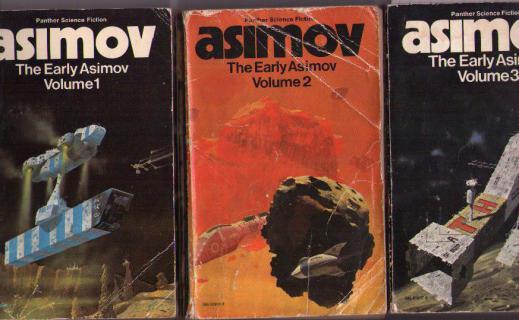
Covers of the Panther editions of The Early Asimov, with typical, essentially unrelated, Chris Foss spaceships. They don't quite all fit on my scanner.
Speaking of fiction, let's get that out of the way first. This is, essentially, a leftovers collection. By the early 70s, most of Asimov's output had been collected. The premier collections relevant to the 40s were the robot books, I, Robot and the much inferior The Rest of the Robots (which, as we say, filled a much needed gap in the literature) and the Foundation series. Other stories from the early days (bracketed as 1938 to 1949) that had already been collected elsewhere include the famous 'Nightfall' and his first story to see print (though not earliest written) 'Marooned Off Vesta'.
So, it is fair to say, much of the stuff here is second-rate. If it wasn't it would not be here. It is interesting in the context of the author's career, but not of itself. 'Black Friar of the Flame' is interesting as a precursor to Foundation, but is otherwise a fairly routine adventure. There are a few forgotten gems, 'The Red Queen's Race' is in volume 3, by which time Asimov was an established pro, putting most of his work into Astounding, the premier outlet of the field. These later stories read much like the stuff to be found in collections like Nine Tomorrows and Earth is Room Enough.
One of the more interesting things to look at is the evolution of the author. At the beginning the stories show signs of very careful planning -- the rigging of the deck that allows the science-y core of the story to matter at all. This is most apparent in 'Marooned Off Vesta' (in Asimov's Mysteries) and 'The Callistan Menace'. By the early 50s in his second-string novels like The Stars Like Dust, Asimov was clearly making it up as he went along, then justifying the plot after the fact by putting long, unlikely speeches into the mouths of his characters. It's not in everything he wrote, but it occurs often enough to suggest that he was not terribly fond of rewriting or, when it comes down to it, of writing a really good book when a fast and acceptable one would do. And we can see that happening before our eyes in this collection; Asimov's goal is to publish, not to write great stories.
This is implicit in the stories, but explicit in the other main component of the book, the lengthy afterwords and introductions that bracket every story. This book is really mash-up of nostalgic autobiography and anthology, and as we go along we see, in his notes, Asimov 'learning' not to plan ahead too much, 'learning' not to rewrite. As he becomes surer of himself it becomes progressively clearer that the only metric that matters is whether the story sells. I don't know if it is true, but Asimov appears to show very little interest in writing as an art. He notes that he 'found the range' and after that everything sold, but there is no critical evaluation, really, of his earlier works. Stories are evaluated in terms of how many times they were rejected before being sold (or lost) and how much money they netted him. This is, perhaps, the root of why Asimov is so frustrating as an author.
The middle section of The Gods Themselves, a handful of stories scattered through his career, some of the Foundation books, perhaps the early Robot novels and The End of Eternity; these are wonderful tales. But they are buried in so much that is little more than filler. Asimov was proud of being productive, and now and again pointed out that, when moved, he could also be 'good', but that was clearly not his primary objective. What books might he have written had been happy to knock out but one or two a year? Who knows.
There is little here of current interest unless Asimov himself is interesting to you; but if he is, then this is a must-read.
Say it ain't so, Joe.
Can there be anything left to say about Asimov? Between his various volumes of autobiography, his vast and highly personal output of essays, introductions and afterwords, and the various volumes of critical material written by others, surely not much space is left. Well, there's always room for a personal response. And The Early Asimov invites such a response possibly more strongly than any other volume of Asimov's fiction.

Covers of the Panther editions of The Early Asimov, with typical, essentially unrelated, Chris Foss spaceships. They don't quite all fit on my scanner.
Speaking of fiction, let's get that out of the way first. This is, essentially, a leftovers collection. By the early 70s, most of Asimov's output had been collected. The premier collections relevant to the 40s were the robot books, I, Robot and the much inferior The Rest of the Robots (which, as we say, filled a much needed gap in the literature) and the Foundation series. Other stories from the early days (bracketed as 1938 to 1949) that had already been collected elsewhere include the famous 'Nightfall' and his first story to see print (though not earliest written) 'Marooned Off Vesta'.
So, it is fair to say, much of the stuff here is second-rate. If it wasn't it would not be here. It is interesting in the context of the author's career, but not of itself. 'Black Friar of the Flame' is interesting as a precursor to Foundation, but is otherwise a fairly routine adventure. There are a few forgotten gems, 'The Red Queen's Race' is in volume 3, by which time Asimov was an established pro, putting most of his work into Astounding, the premier outlet of the field. These later stories read much like the stuff to be found in collections like Nine Tomorrows and Earth is Room Enough.
One of the more interesting things to look at is the evolution of the author. At the beginning the stories show signs of very careful planning -- the rigging of the deck that allows the science-y core of the story to matter at all. This is most apparent in 'Marooned Off Vesta' (in Asimov's Mysteries) and 'The Callistan Menace'. By the early 50s in his second-string novels like The Stars Like Dust, Asimov was clearly making it up as he went along, then justifying the plot after the fact by putting long, unlikely speeches into the mouths of his characters. It's not in everything he wrote, but it occurs often enough to suggest that he was not terribly fond of rewriting or, when it comes down to it, of writing a really good book when a fast and acceptable one would do. And we can see that happening before our eyes in this collection; Asimov's goal is to publish, not to write great stories.
This is implicit in the stories, but explicit in the other main component of the book, the lengthy afterwords and introductions that bracket every story. This book is really mash-up of nostalgic autobiography and anthology, and as we go along we see, in his notes, Asimov 'learning' not to plan ahead too much, 'learning' not to rewrite. As he becomes surer of himself it becomes progressively clearer that the only metric that matters is whether the story sells. I don't know if it is true, but Asimov appears to show very little interest in writing as an art. He notes that he 'found the range' and after that everything sold, but there is no critical evaluation, really, of his earlier works. Stories are evaluated in terms of how many times they were rejected before being sold (or lost) and how much money they netted him. This is, perhaps, the root of why Asimov is so frustrating as an author.
The middle section of The Gods Themselves, a handful of stories scattered through his career, some of the Foundation books, perhaps the early Robot novels and The End of Eternity; these are wonderful tales. But they are buried in so much that is little more than filler. Asimov was proud of being productive, and now and again pointed out that, when moved, he could also be 'good', but that was clearly not his primary objective. What books might he have written had been happy to knock out but one or two a year? Who knows.
There is little here of current interest unless Asimov himself is interesting to you; but if he is, then this is a must-read.
Say it ain't so, Joe.
January 8, 2018
É muito boa a coletânea, e em que pese já ter lido os principais livros, de contos inclusive, não fica atrás do Fundação ou de Eu Robô, imperdível.
April 29, 2020
Some good stories and some boring ones. Interesting to hear the background of the publishing process
May 10, 2026
i love the book collection for asimov writings
April 27, 2024
This is a fun read overall. The short stories in the book are varied enough that I would guess most people won't like all the stories. However, because it's not a novel with one story leading to the next, you can skim through, or altogether skip stories that don't catch your interest. I read them all and if I were to rate every individual story, the star ratings would be between 2 and 4 stars. The collection still feels like a 4 star to me if only for the autobiographical content before and after every short story. Reading about his life was for me the best part. If you skip all the short stories, and only read the autobiographical content, it's worth it. For me, all of it was worth it, even the stories I didn't enjoy as much.

March 9, 2017
A collection of his early stories that haven't been collected elsewhere. The forwards dealing with how the story got published are interesting, if you're into that sort of thing. The stories are hit and miss, mostly miss. More for the completist, rather than the "Best of" crowd.

January 1, 2018
I ran into this book in the high school library, in 1980. I enjoyed it so much I checked it out again a few months later. And again the following year. I think I checked it out and read it three or four times, over three years. During that time only one other name appeared on the sub-card, it was a friend of mine.
During my senior year the school installed a magnetic anti-theft system in the library, sort of like those systems you find at some big-box stores. Walk through the gate at the door and it'll beep if you're carrying a book that hasn't been demagnetized. The week before this system went active, I decided to steal their copy of The Early Asimov. I walked through the door without checking it out, and took it home. It sits on my bookshelf to this day. I felt bad about it, and told myself that one day I would buy a new copy of the book and donate it to my old school.
In 2012 I attended the 30th class reunion. We toured the school, which had grown considerably in the intervening years. Much had changed, but I was unprepared for what had become of the library. When I was a student I spent quite a lot of time in the library. It was an impressive space, well lit, row upon row of tall shelves, tens of thousands of volumes, all organized in a massive card catalog. Comfortable chairs and couches, desks and wide tables, plus separate rooms for listening to records and tapes, and a large microfilm library. Flash forward to 2012 and all those things were gone. The library was small and dim. I expected the card catalog to be gone, replaced by a modern database. But to my shock and dismay the majestic bookshelves were gone! Replaced by a handful of low, sparse shelves, reaching a mere 30" tall. These shelves weren't filled by any means. In the center of each shelf, bracketed artfully, were a dozen or so books, on display like some kind of quaint artifacts. It was as though the temple had been bulldozed and replaced with a McDonalds.
Anyway, from that moment forward I let go of any regret I may have felt about stealing a library book in 1982. I didn't steal it, I rescued the poor thing!
During my senior year the school installed a magnetic anti-theft system in the library, sort of like those systems you find at some big-box stores. Walk through the gate at the door and it'll beep if you're carrying a book that hasn't been demagnetized. The week before this system went active, I decided to steal their copy of The Early Asimov. I walked through the door without checking it out, and took it home. It sits on my bookshelf to this day. I felt bad about it, and told myself that one day I would buy a new copy of the book and donate it to my old school.
In 2012 I attended the 30th class reunion. We toured the school, which had grown considerably in the intervening years. Much had changed, but I was unprepared for what had become of the library. When I was a student I spent quite a lot of time in the library. It was an impressive space, well lit, row upon row of tall shelves, tens of thousands of volumes, all organized in a massive card catalog. Comfortable chairs and couches, desks and wide tables, plus separate rooms for listening to records and tapes, and a large microfilm library. Flash forward to 2012 and all those things were gone. The library was small and dim. I expected the card catalog to be gone, replaced by a modern database. But to my shock and dismay the majestic bookshelves were gone! Replaced by a handful of low, sparse shelves, reaching a mere 30" tall. These shelves weren't filled by any means. In the center of each shelf, bracketed artfully, were a dozen or so books, on display like some kind of quaint artifacts. It was as though the temple had been bulldozed and replaced with a McDonalds.
Anyway, from that moment forward I let go of any regret I may have felt about stealing a library book in 1982. I didn't steal it, I rescued the poor thing!

May 9, 2012
Long-time readers know of my enormous affection for the good doctor Asimov; imagine my delight in finding this anthology of over two dozen of his earlier and previously uncollected works, from his first eleven years as an author. These were stories written in the late 1930s and throughout the 1940s, when young Asimov worked in a candy store to pay for college, later doing civilian work for the army before being drafted. It's a splendid collection for an Asimov fan like myself. Although the stories are rougher than one would expect (judging by his usual standard), seeing him write outside the conventions established by his adult self is fascinating. Aliens abound, for one thing: it's a rare story in this collection which doesn't see Earthmen fighting against wicked Martians, or putting off Venusian rebellions. Asimov has maintained in other works that he disliked the antagonistic relationship editors demanded to exist between humans and aliens, so he established his own human-only universe. His generous use of alien life here hints at the stories' lack of scientific polish; although simple datedness is easy to understand, often Asimov should have known better. Even the science of his day ruled out the possibility of extant life on Mars, and he acknowledges this in his extensive commentary, which knits the book together and makes it semi-autobiographical. The collection also includes his legendary essay, "The Endochronic Properties of Sublimated Thiotimoline", which satirized the language of academic articles.
It is available in either a three-volume set, or this complete edition.
It is available in either a three-volume set, or this complete edition.

July 30, 2012
This is a great collection of Asimov's early short stories. It is interesting to see his writing style develop and his stories get profoundly better as the book progresses. You can also see him laying the groundwork for works like Foundation and I, Robot. I feel that in short story collections more than novels I get to know the author better. He narrates in between stories about what was going on in his life when he wrote them. The eleven years of short stories contained here include World War II and the split is pretty obvious. Atomic power and cold war themes are evident and are in Foundation as well. A good collection overall.

August 14, 2012
To be honest, I just read the last chapter, Mother Earth, because i wanted to know more about the gap between the robot series and the Spacer Worlds. I was amazed how Asimov directly addressed xenophobia and racism in this story, and that it had two POC as characters. Yet, at the same time this is slightly disappointing because it just restricts the rest of the spacer stories as places with white people.

March 5, 2014
Didn't read it cover to cover, but not a bad book to pick up if you can find it cheap. The book consists of his stories sold in various sci-fi magazines back in the day plus little postscripts detailing his experiences as a writer trying to get published. In a weird way, it is encouraging to see even a famous writer like Asimov not being particularly great as a 19 or 20 year old. It gives me hope that the teenage writers I see may yet mature into true talent.

July 28, 2015
This book includes stories from the beggining of Asimov's career. Asimov gives a brief history between stories about when they were written, how and when he got them published, etc. While some of the stories may not be his best (Asimov's worst is hands down better than most other's best), this was an interesting look into the mind of an author and the world of scifi magazine publishing in the very early years of the genre.
November 21, 2016
Hampered by stories being order they were written, so his weakest stories are at the beginning.
Worth it for a couple of the stories towards the end, especially the "Red Queen's Race" but his earliest works are pretty weak.
His commentary is pretty interesting however, and I think offers some useful tips to aspiring writers.
Towards the end it gets better, especially as you see him improve as a writer, but it does weigh down this book and make it hard to get to the best stories.
Worth it for a couple of the stories towards the end, especially the "Red Queen's Race" but his earliest works are pretty weak.
His commentary is pretty interesting however, and I think offers some useful tips to aspiring writers.
Towards the end it gets better, especially as you see him improve as a writer, but it does weigh down this book and make it hard to get to the best stories.
June 19, 2009
Earliest works of Asimov accompanied by autobiographical comments concerning the circumstances of how they came to be written.

January 31, 2013
Just picked it up to read a couple of stories... Blind alley and Mother Earth, which both tie in to the foundation universe
February 1, 2014
Great to be able to read his very first books that did or didn't make it into other publications, and to hear first hand how he started out. A must read for any Asimov fans.
Displaying 1 - 30 of 32 reviews