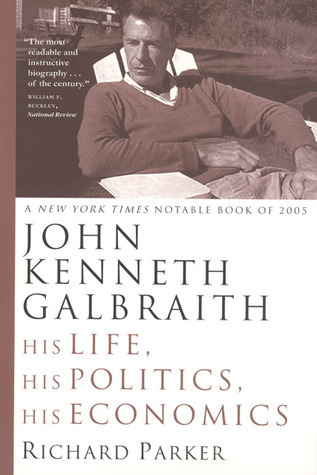
John Kenneth Galbraith (1908-2006) was one of America’s most famous economists for good reason. From his acerbic analysis of America’s “private wealth and public squalor” to his denunciation of the wars in Vietnam and Iraq, Galbraith consistently challenged “conventional wisdom” (a phrase he coined). He did so as a witty commentator on America’s political follies and as a versatile author of bestselling books—such as The Affluent Society and The New Industrial State—that warn of the dangers of deregulated markets, corporate greed, and inattention to the costs of our military power. Here, in the first full-length biography of Galbraith and his times, Richard Parker provides not only a nuanced portrait of this extraordinary man, but also an important reinterpretation of twentieth-century public policy and economic practices.“Whatever you may think of his ideas, John Kenneth Galbraith has led an extraordinary life. . . . Doing justice to this life story requires an outsize biography, one that not only tells Mr. Galbraith’s tale but sets it on the broader canvas of America’s political and economic evolution. And Richard Parker’s book does just that.”—Economist“Parker’s book is more than a chronicle of Galbraith’s life; it’s a history of American politics and policy from FDR through George W. Bush. . . . It will make readers more economically and politically aware.”—USA Today “The most readable and instructive biography of the century.”—William F. Buckley, National Review “The story of this man’s life and work is wonderfully rendered in this magnum opus, and offers an antidote to the public ennui, economic cruelty, and government malfeasance that poison life in America today.”—James Carroll, Boston Globe
Librarian Note: There is more than one author by this name in the Goodreads database.
Richard Parker is an Oxford-trained economist and senior fellow of the Shorenstein Center at Harvard's John F. Kennedy School of Government. A cofounder of the magazine Mother Jones, he writes extensively on economics and public policy.
Parker's biography of Galbraith's place in economic history, and how the tides of economic thought shaped him and were shaped by him is an absolute masterpiece. From his childhood in agricultural Ottawa all across American economic revolutions from the Great Depression down to Clinton, the train of history is well woven here.
The only reason I rate it 4 stars is because while it is an excellent biography of Galbraith the economist, Galbraith the intellectual, and even Galbraith the politician, it does not really touch too much on Galbraith the man. It reads more as a book on Galbraith in economic history as opposed to a true biography of the man. This is not to say it isn't a biography, it still is, but it reads purely through that lens of economic history.
However, the book is a definite reread for me. Galbraith's life, his work, and his flaws are well written here, in an easily accessible and well argued (many sides of the argument) work. It serves as a comprehensive description of economic history, from a tradition not too dissimilar to my own, at least for the first half of the book, but doesn't limit it to that alone.
Richard Parker accomplishes two noteworthy things with this book: he documents the life of one of the most influential economic figures of the 20th century while creating an enlightening backdrop in which Galbraith's work is presented. Even when Galbraith's ideas fell out of favor once the Great Depression was a more distant memory, he nonetheless exhibited the incredible ability to predict the outcomes of economic policy in the latter 20th century that ran counter to basic Keynesian concepts. The two biggest takeaways for me: 1. Galbraith's assertion (rightly) that economics, politics, and history are intertwined. As such, good economic policy should (and never will) act in a vacuum without political influence in some way. Good economic policy should never (but often does) act without a thorough examination of history. 2. His core belief that largely conservative economic policy doesn't spur real economic growth; in fact, it often does the opposite by creating wage inequality and burdening the middle class. While obviously controversial, this point is borne out by empirical data and recorded history. Interestingly, Galbraith was often sought by news media for his thoughts on failed or failing conservative policy results (which he had predicted and which were initiated by administrations of both parties ) even after he was considered outside the economic and academic mainstream. In fact, this book provides a great overview of economic policy for the presidencies of Roosevelt to the early Bush 43 days, with particular emphasis on the Kennedy and Johnson years. In summary, this book is easily a top 10 for me due to its ability to present a story on a wider canvas than just the life of a single person.
Galbraith consistently challenged “conventional wisdom” (a phrase he coined). The biography is as interesting today as in his heyday and so many of the issues he found confronting have just exacerbated since. Galbraith and his life were anything but dull and the biography spans a political and economic landscape that is fascinating. Its a large book but it reads better than any novel,
John Kenneth Galbraith was one of the most famous progressive economists of the twentieth century. Of towering stature at 6’9”, he taught at Harvard and Princeton, served as ambassador to India, advised numerous Democratic presidents (e.g., FDR, JFK, LBJ) and shaped their domestic and international (including wartime) policies. Much of his unabashed liberal worldview was shaped during his formative years; Galbraith grew up on a modest farm in the middle of the Progressive Era and his father was a devoted supporter of Canada’s Liberal Party. While earning his Ph.D in agricultural economics at the University of California, Berkeley, the country was in the throes of the Great Depression - with farmers being hit especially hard. Galbraith started teaching at Harvard in 1934, when the university was also undergoing a shift towards the left. His mentor was John D. Black and many of his Harvard colleagues believed that unfettered capitalism was to blame for the Great Depression although there were others, such as one Joseph Schumpeter, that begged to differ. Perhaps the biggest professional influence on Galbraith, however, was John Maynard Keynes and his opus The General Theory of Employment, Interest, and Money. From Keynes, Galbraith not only adopted philosophies on the active role of government in America’s economic affairs but also the level and manner of engaging in politics. In such regard Galbraith advocated government control over wages, prices, earnings, production, and labor conditions during crises in order to promote economic recovery. It would be an understatement to say that Galbraith butted heads with free market / neoclassical proponents from the Austrian and Chicago schools, including Schumpeter, Friedrich Hayek, Frank Knight, George Stigler, James Buchanan, and notably Milton Friedman. This is not to say that Galbraith was completely dogmatic in his progressive views. For example and in his book American Capitalism (published 1952), he recognized the inherent relationship between markets and human freedom, and how private ownership and property rights undergirded the liberty of individuals. Galbraith also recognized that the welfare state would inevitably lead to modern day serfdom (per Hayek). He derided both conservatives and liberals (to an extent), coining the term “conventional wisdom” in his book The Affluent Society (published 1958), which made him a rockstar. Even his detractors recognized that Galbraith was an entertaining and elegant writer. Galbraith also was not shy about engaging or even befriending conservatives. Henry Robinson Luce was an ardent Republican, a Yalie (a Skull & Bones member) one of America’s most powerful publishers, and the person who invited Galbraith to join Time magazine and thereafter Fortune magazine. William F. Buckley Jr. was another conservative that embraced Galbraith as a friend in spite of their diametrically opposed political views. In contrast, possibly the most famous Republican who had no love for him was President Richard Nixon - from the Watergate Scandal Galbraith it came to light that Galbraith was on the infamous ‘enemies list’ (though Nixon’s successor President Gerald Ford was opened minded enough to have asked both Galbraith and Friedman to advise him). Galbraith continued to write, travel, and lecture well into his 90s. In sum and for all his successes, even today he remains a disputed figure in American economics and politics but few would dispute that Galbraith’s life was a remarkable one.
Galbraith and his life are captivating subjects, but this personal biography may be better described as an account of Galbraith’s place in and reaction to 20th century economic history. This is an informative book in that sense, but not as a personal biography per se.
Parker is a trained economist, a senior fellow at the Kennedy School of Government at Harvard and a cofounder of the magazine Mother Jones. As such, he is a first rate scholar. Obviously the book follows Galbraith's life from the Canadian prairies in the 1920s to the present, he is 97. But it also covers all economic schools of thought and most economists of any stripe during the period.
Early in the 20th Century the study of economics was called, "Political Economy." Galbraith held various important government positions including head of wage and price controls during World War II. He was very active in Democratic Party politics, was a close advisor to JFK and was a high-level participant in Stevenson's, Humphrey's, and McGovern's presidential campaign. The book is a history of American politics during the 20th Century from a liberal viewpoint.
JFK appointed Galbraith as the U. S. Ambassador to India. As he was much closer to Viet Nam than most in Washington, Galbraith provided JFK with much advice concerning that country. In summary this advice was to negotiate and get out. After Kennedy's death, Galbraith became much more active in his opposition to the war and this lead to a break with LBJ.
The Affluent Society and New Industrial State are among Galbraith's greatest contributions. In them he showed how large U. S. corporations, through advertising, create their own demand. These corporations also use their wealth to successfully influence government to their advantage. Halliburton with its favorable no-bid contracts in Iraq and now on the Gulf Coast is a perfect example. Galbraith in these and other books describes how the U. S. although privately affluent is publicly poor. He argues for better and more widespread education, health care, environmental protection and parks.
Joy Fades is the penultimate chapter in this massive and challenging tome. Here Parker details Galbraith's great dissatisfaction with GOP economics starting with Reagan and going through Bush, father and son. Basically, they significantly overly rely on deficits, monetary policy, and especially in the case of George W. huge tax cuts for the rich. These policies cause hugely unequal income distributions.
Parker's citations, footnotes, index and bibliography make this an excellent economic reference book.
Certainly not an easy read. At times it seemed to drag with economic theories but, for the most part, it was a history book giving a new perspective to the great depression, WWII, the Cold War, JFK all the way up to and including the Clinton presidency. For someone who likes history and politics, this is a fascinating look from a different angle. Galbreaith sure got around and was successful due to hard work, an engaging personality and an attention-getting physical stature, 6'7" at a time when that kind of height was more rare than now. He started out on a small Canadian farm and applied himself, first getting acceptance to a program at Berkley followed by acceptance to Harvard. He befriended the right people which continued to open doors. He was a confidant of more than one president and a critic of other presidents. An outspoken opponent to the Vietnam war and to a world wide military presence. Just a good read, one that an interested reader did not want to end and, appropriately, was in excess of 600 pages.
Good balance between his contributions as an economist as well as personal life. The author really tried to capture a detailed a portrait of Galbraith so that the reader can have a better insight into the influences behind his work as an economist. Although written for the general public, this book is quite dense with details at times. However, there is a nice narrative flow so it doesn't get bogged down.