Jump to ratings and reviews
Rate this book

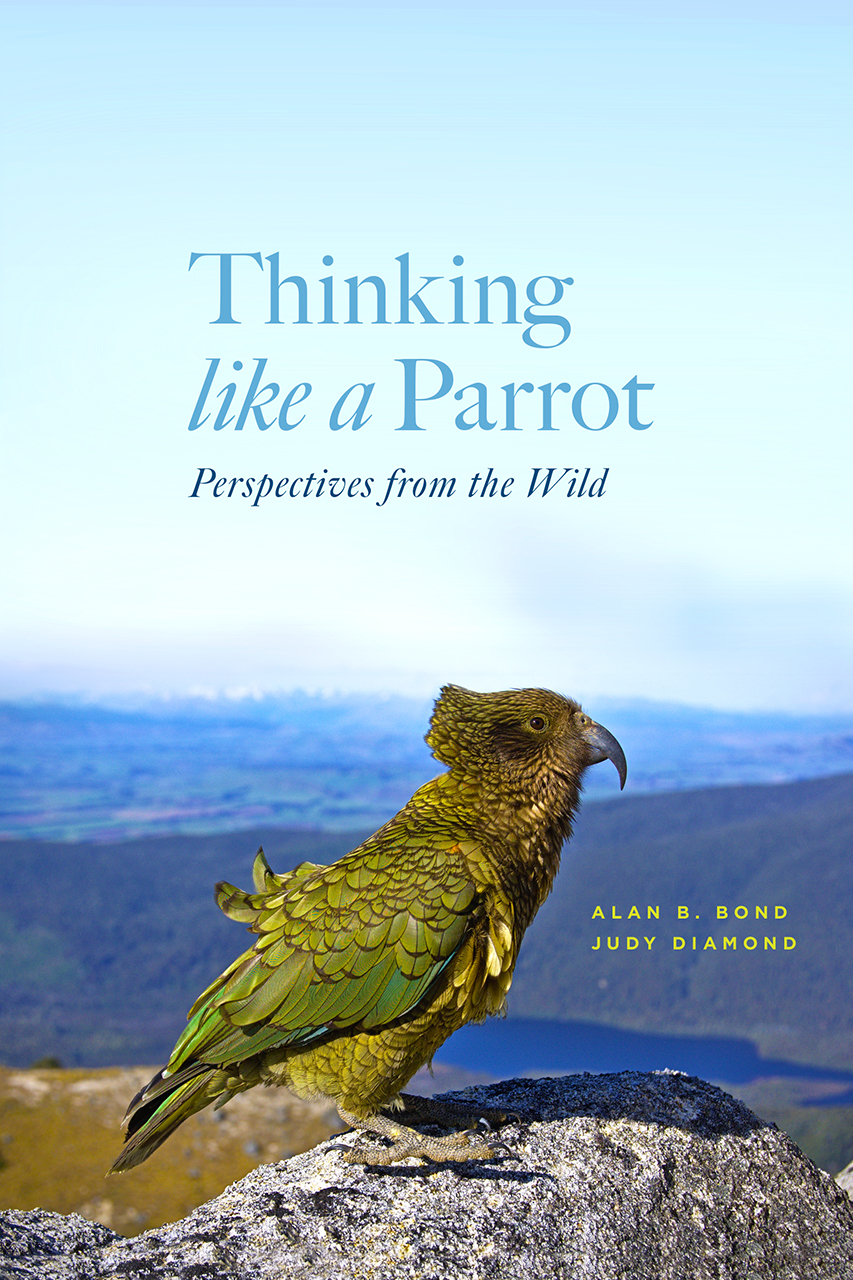
Thinking like a Parrot: Perspectives from the Wild

Rate this book
From two experts on wild parrot cognition, a close look at the intelligence, social behavior, and conservation of these widely threatened birds.

People form enduring emotional bonds with other animal species, such as dogs, cats, and horses. For the most part, these are domesticated animals, with one notable many people form close and supportive relationships with parrots, even though these amusing and curious birds remain thoroughly wild creatures. What enables this unique group of animals to form social bonds with people, and what does this mean for their survival?

In Thinking like a Parrot , Alan B. Bond and Judy Diamond look beyond much of the standard work on captive parrots to the mischievous, inquisitive, and astonishingly vocal parrots of the wild. Focusing on the psychology and ecology of wild parrots, Bond and Diamond document their distinctive social behavior, sophisticated cognition, and extraordinary vocal abilities. Also included are short vignettes—field notes on the natural history and behavior of both rare and widely distributed species, from the neotropical crimson-fronted parakeet to New Zealand’s flightless, ground-dwelling kākāpō. This composite approach makes clear that the behavior of captive parrots is grounded in the birds’ wild ecology and evolution, revealing that parrots’ ability to bond with people is an evolutionary accident, a by-product of the intense sociality and flexible behavior that characterize their lives.

Despite their adaptability and intelligence, however, nearly all large parrot species are rare, threatened, or endangered. To successfully manage and restore these wild populations, Bond and Diamond argue, we must develop a fuller understanding of their biology and the complex set of ecological and behavioral traits that has led to their vulnerability. Spanning the global distribution of parrot species, Thinking like a Parrot is rich with surprising insights into parrot intelligence, flexibility, and—even in the face of threats—resilience.

296 pages, Hardcover

Published July 2, 2019

17 people are currently reading
111 people want to read

About the author

Alan Bond

36 books1 follower

Ratings & Reviews

What do you think?
Rate this book

Friends & Following

Create a free account to discover what your friends think of this book!

Community Reviews

5 stars
10 (37%)
4 stars
10 (37%)
3 stars
6 (22%)
2 stars
1 (3%)
1 star
0 (0%)
Displaying 1 - 9 of 9 reviews
Profile Image for Grrlscientist.
163 reviews26 followers
October 1, 2019
After we clambered down from the trees ourselves, people have kept (and sometimes bred) parrots as pets, for ceremonial purposes and to advertize their personal wealth or power to their fellow humans for more than three thousand years. But unlike cats, dogs and the other animals that we live with, parrots are not domesticated; they are still wild animals. What is it about parrots that enables them to form close social bonds with people?

Parrots’ obvious cleverness, gregarious personalities, rich social lives, behavioral flexibility, and long lifespans, combined with their almost uncanny ability to mimic sounds gives them the social flexibility to bond to humans and impart a seemingly human-like intelligence. For many parrot keepers, these birds are family members and for some of us, parrots are our best, and perhaps only, friends. Considering the outsized presence of parrots in our lives, our homes and our imaginations, we often think we know nearly everything there is to know about them — but do we really?

Much of what we know about parrots is the result of working with captive individuals rather than wild birds. In fact, parrots have always been particularly challenging to study in the wild, so our knowledge of how they think and live away from human control is still expanding. This new book, Thinking Like a Parrot: Perspectives from the Wild by Alan Bond and Judy Diamond (University of Chicago Press; 2019) focuses on the psychology and ecology of wild parrots, sharing what we know about their social behavior, cognition and vocal abilities. As we, the readers, embark on this fascinating adventure of discovery, we couldn’t have finer guides: Alan Bond is professor emeritus of biological sciences at the University of Nebraska and Judy Diamond is professor and curator at the University of Nebraska State Museum. Together they have studied the social behavior, cognition, and vocalizations of wild parrots for more than three decades. Under their expert guidance, we meet brilliant keas, cheeky sulphur-crested cockatoos, affable crimson-fronted parakeets, dazzling rainbow lorikeets, adaptable rose-ringed parakeets, and adorable kakapos.

The book is divided into seven parts, each of which (except the last one) contains two or thee chapters. The first of these chapters presents field notes and observations of a particular parrot species that the authors studied in the wild, followed by a chapter or two that presents an in-depth explanation of relevant research into an aspect of parrot ecology and evolution. “Through this composite approach, we hope to give a sense of how the indications of intelligence and the sometimes frustrating behavior of captive parrots have their sources in the birds’ wild ecology and evolution”, Professors Bond and Diamond write in the preface (p. xiii). Indeed, capturing the reader’s attention with anecdotes about wild parrots before exploring the subtleties of their behaviors is a wonderful way to appeal to the reader.

This book is filled with intriguing information, some of it new or unfamiliar to those who know parrots best. For example, we learn that the vocally flexible kākā are talented singers that have regional vocal dialects whilst their closest living relatives, the kea, do not; that rose-ringed parakeets have been introduced accidentally or purposefully in over 70 countries and have established breeding populations in half of them; and that newly independent male kākāpō can attack and inflict serious injury to their much smaller female siblings.

In this engaging and wonderfully-written book, Professors Bond and Diamond provide a readable overview of wild parrots, how both evolution and ecology have shaped the physical architecture of parrots’ extraordinarily large brains and how that has given rise to their sensory abilities and their memory, before launching into an in-depth exploration of what wild parrots can do with their magnificent brains: their complex social networks and relationships, their vocal communication, their sophisticated and flexible problem solving abilities and intelligence, cognition in the wild, and how parrots express their emotions and play.

Professors Bond and Diamond also provide insights into why, despite their adaptability and intelligence, some parrot species are so vulnerable to extinction whilst others can establish breeding populations in alien landscapes far from their natural ranges. Indeed, to restore and protect these endangered wild parrot populations, the authors argue that we must develop a more nuanced understanding of the special biology that underpins endangered parrot species and an appreciation for the ecological and behavioral traits that led to their vulnerability.

Whilst reading this book, I emailed the authors and discussed a variety of points they made. For example, I asked for their thoughts about Alex (Irene Pepperberg’s grey parrot) and how he independently used the word “none” to indicate the absence of something — a seemingly huge intellectual breakthrough.

“Yes, we do know that Alex used the word, ‘none’,” Professor Diamond responded in email.

“Alan knows Irene pretty well”, Professor Diamond continued. “The question is how Alex learned the concept of ‘none,’ and how he represented it cognitively. It could be, for example, that he learned ‘none’ as a response when there was no obvious choice (e.g. ‘I can’t respond’), so that is relatively easy to generalize to other situations where he couldn’t make a choice,” Professor Diamond explained. “The issue with Alex is that there are many alternative interpretations of some of his responses. Hard not to cherry pick.”

I asked Professor Diamond how the minds of parrots and people can seem so similar, despite following separate evolutionary trajectories for many millions of years?

“The apparent similarities between the minds of parrots and those of people are not the reflection of a common inheritance, but rather a convergence — two separate lineages evolving some strikingly similar solutions to life’s problems,” Professor Diamond responded in email.

In fact, parrots are so intelligent and are such keen observers of human behavior that it has been alleged that they have a “Theory of Mind”. A Theory of Mind has two features: first, it is the ability to attribute mental states — beliefs, intents, desires, emotions, knowledge, and so forth — to oneself and to others, and second, it is the ability to understand that others have beliefs, desires, intentions, and perspectives that are different from one’s own. Based on my own experiences with parrots, it seemed that at least some parrot species are good candidates for possessing a Theory of Mind. So I was surprised to read that Professors Bond and Diamond flatly state in their book that parrots do not have a Theory of Mind (p. 139), which lead me to ask Professor Diamond whether any birds — specifically, any of the corvids — may have a Theory of Mind?

“We don’t feel that there is sufficient evidence for Theory of Mind in any bird,” Professor Diamond responded in email.

Of course, finding unequivocal scientific evidence for a Theory of Mind in animals such as parrots is a very difficult exercise because they are such conscientious observers of human behavior.

In the last chapter of the book, entitled “Captain Flint Meets Polynesia”, Professors Bond and Diamond summarize points made in their book with a comparison of two literary parrot extremes: Captain Flint, the macaw in Robert Louis Stevenson’s Treasure Island who repeatedly shouted “Pieces of eight! Pieces of eight!” with no grasp of the meaning behind her mimicked utterances, versus Polynesia, Dr. Doolittle’s polyglot companion grey parrot whose intelligence transcends that of humans.


“These two avian characters epitomize the abilities that make parrots stand out from all other birds. Flint and Polynesia don’t just speak, they are close friends and confidants of their human companions. But a bright line separates how their vocalizations are portrayed: Flint is an automated voice recorder; Polynesia is a little person in a parrot suit. Flint understands nothing; she simply echoes the sounds she hears on shipboard. Polynesia understands everything. She has a full grasp of linguistics, a comprehensive memory, and a well-developed theory of mind, which allows her to deceive hapless humans. The relationship between actual people and actual parrots lies somewhere between these literary polar opposites.” (Bond and Diamond, p. 132)


A careful reading of this book makes it plain that the behaviors of captive parrots stem from the wild birds’ ecology and evolution, revealing that parrots’ ability to bond with people is an evolutionary accident, a by-product of their intense sociality and the flexible behavior that characterize their lives.

This captivating book’s appealing design makes it even more accessible to its readership. It includes many dozens of useful diagrams, maps and black and white photographs embedded within the text alongside the relevant portion of the book as well as a crowd-pleasing 16-page inset of full-color photographs of parrots. This scholarly work respects its readers’ time and intelligence by meticulously citing all the information presented: nearly half of the total length of the book consists of a number of useful appendices, detailed chapter notes, extensive references (72 pages!) and a handy index (6 pages). Altogether, these sections comprise 122 pages of the book, and provide interested readers with a veritable treasure-trove of primary literature sources so we can read and explore more in-depth on our own.

Over the years, I have read almost every book about parrots published in the English language, and this is, hands down, the best parrot book published in the past ten years, and certainly one of the best ever published. This succinct and erudite summary of the latest scientific research into these birds’ natural history, biology, ecology and evolution is most unusual because it will be read and cherished by ornithologists and scientists as well as non-specialists, and by parrot breeders, behaviorists and owners alike for years to come, and will appeal to anyone who wishes to learn more about how parrots view the world.


NOTE: Originally published at Forbes on 19 September 2019.
Profile Image for John Geary.
345 reviews2 followers
February 8, 2020
Interesting book. It may not be for all tastes, as it is written in a very “scientific“ style. That’s not to say it’s difficult to read; the chapters are short and the concepts are easy to understand. The authors have done an excellent job of turning scientific knowledge into writing that the average lay person can understand. They’ve also done an excellent job of footnoting everything that needs to be.
Basically, the book looks at the different behaviours in wild parrots and how by studying them over the past 30 years, humans have been able to better understand why the birds do what they do – and how that relates to, or can relate to, the parrots we have in our homes as companion animals. It certainly demonstrates - with ample documentation - that parrots’ brains are far more complex and intelligent than what we have given them credit for in the past.
The book is almost 300 pages long but only 141 of those pages are actual text. The rest are photo plates, appendices and footnotes.
Profile Image for Lacey Losh.
384 reviews15 followers
September 11, 2020
This is an excellent book for anyone who loves parrots and wants to learn more about particular varieties (especially the endangered species native to New Zealand) but lots of parrot knowledge, insight, and science is included.
Profile Image for Jeremy.
380 reviews3 followers
May 23, 2023
It's no surprise that I (and anyone reading this book) love parrots and want to learn more about them. I had a cockatiel for 27 years and like most people living with pets I witnessed an intelligence and complexity of behavior that the world doesn't seem to acknowledge.

This book is a published account of researcher findings on mostly Keas, Kakas, and then some accounts of other parrots around the world. It talks about overall parrot populations, vulnerability in current times, and populations that thrive in cities and areas where they escaped from being pets.

I knew all of these things in general. I was hoping for more interesting detail. I didn't find the book to be especially educational. Maybe slightly.

Note: if you're reading the kindle version, it ends when it's about 39% complete and then has appendices and references etc. They really should have the % complete based on the main text.
Profile Image for Michael Lewyn.
957 reviews27 followers
March 7, 2021
This book is not really for the average pet owner trying to learn more about their breed; instead, it is a short but science-heavy book based on observations of wild parrots, and mostly types of parrots that are never turned into pets. Not surprisingly, the book shows how smart and sociable these parrots are; they play, make friends with other birds, etc.

Near the end, there are some insights useful to pet owners: parrots mimic words and other noises not because they understand the meaning, but because humans reward these noises with food and attention.
Profile Image for Linda Gaines.
96 reviews3 followers
January 6, 2022
This book discusses some really interesting science about parrots. It covers lots of topics about how smart they are, their behavior, and how most of them are endangered. The information was very interesting to learn. However, it is kind of heavy into the science, which isn't bad, but it is not a "light" read. Conversely, the book is only about 150 pages, if you don't include all the appendices.
Profile Image for Verónica Juárez.
598 reviews39 followers
June 24, 2024
Un libro fascinante sobre una especie de aves igualmente fascinante. Recomiendo ampliamente a los amantes de las aces y a los tutores de loros. Aunque seguramente, cualquier otro lector interesado en el tema, también encontrará fascinante este libro.
Displaying 1 - 9 of 9 reviews

Can't find what you're looking for?

Get help and learn more about the design.