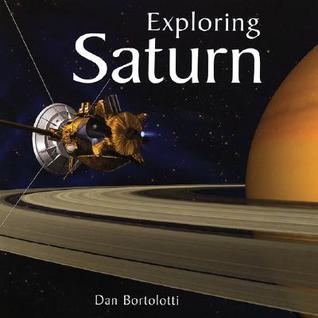
An illustrated preview to the Cassini-Huygens mission arriving at Saturn in 2004. Exploring Saturn is a lively, informative way for students to fully appreciate and understand the Cassini orbiter's historic rendezvous with the ringed planet in 2004. It features Cassini's 4-year mission details including the breakaway Huygens probe that will plummet to Saturn's largest moon, Titan -- the only moon in our solar system with an atmosphere. The data gathered from the Cassini-Huygens mission will help scientists to unravel Saturn's many mysteries, answer questions about Earth's formation, and investigate the possibility of life on other planets. Exploring Saturn tells the remarkable story of discovering Saturn and its moons. Ancient astronomers estimated with surprising accuracy the distance, weight, and composition of Saturn using little more than observation and elementary physics. The book includes the latest findings from NASA as well as stunning color images from the Hubble Space Telescope, Voyager and Pioneer probes. Included are practical website resources and a six-year schedule and location guide for backyard observations of the planet. The informative text is lively and conversational-easily accessible by students and amateur astronomers.
The book was published in 2003, before Cassini-Huygens even reached Saturn or commenced it's original mission. Because of this, I thought it would be out of date and some passages would be proven wrong by now, but Bortolotti actually did quite a good job making the book stay general and it still holds up today. Some facts are slightly refined, but there are no major factual errors I noticed. He does mention Voyager 1 & 2, and states they're believed to last until 2020, but they are still running today in 2026 :) For the audience it's aimed at, which I assume is somewhere in the range of late elementary school through middle school, the explanations of certain physics and astronomy concepts is perfect. He also goes through the history of Saturn and it's exploration and study, and he does it very logically and consistently. I was surprised he even mentions Jose Comas Sola when he mentions Titan's atmosphere, as most people attribute and cite to Kuiper's spectroscopy first and leave it at that. Finally, the pictures Bortolotti uses for the book are all quite good, and where needed he uses artist renditions to good effect.
Overall, a nice book, certainly something I would give to a younger family member to introduce them to Saturn or astronomy.