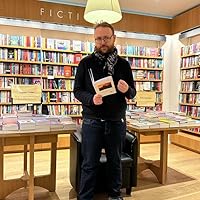
Over the course of several years, Simon Armitage has written hundreds of poems for various projects, commissions, collaborations and events, which stand outside of his mainstream collections but now form a substantial body of work in their own right. They vary from single poems, such as 'Zodiac T Shirt', written to be performed at the launch of Beck's Song Reader , to the suite of ten poems about Branwell Brontë written at the time of the writer's bicentenary. Some have been published - such as the Walking Home and Walking Away poems - but the majority has not, and together they cover an eclectic array of subjects including sculpture, the environment, travel, drama, and media. Sandettie Light Vessel Automatic represents the nature and scale of Armitage's work - it is an important reflection of his public engagement as a poet and the astonishing range of his interests and talents.
Simon Armitage, whose The Shout was a finalist for the National Book Critics Circle Award, has published ten volumes of poetry and has received numerous honors for his work. He was appointed UK Poet Laureate in 2019
Armitage's poetry collections include Book of Matches (1993) and The Dead Sea Poems (1995). He has written two novels, Little Green Man (2001) and The White Stuff (2004), as well as All Points North (1998), a collection of essays on the north of England. He has produced a dramatised version of Homer's Odyssey and a collection of poetry entitled Tyrannosaurus Rex Versus The Corduroy Kid (which was shortlisted for the TS Eliot Prize), both of which were published in July 2006. Many of Armitage's poems appear in the AQA (Assessment and Qualifications Alliance) GCSE syllabus for English Literature in the United Kingdom. These include "Homecoming", "November", "Kid", "Hitcher", and a selection of poems from Book of Matches, most notably of these "Mother any distance...". His writing is characterised by a dry Yorkshire wit combined with "an accessible, realist style and critical seriousness."
I’d call this collection a conglomeration of poetry, because the range and style of the work is so varied it’s hard to characterize. I confess I didn’t read enough of the end notes to explain the title, although I do understand that these were poems from all sorts of random projects that were too small to earn their own books.
I was aware that Armitage was named the British Poet Laureate in 2019 and now I see why. His range is astounding. My favorite poems ran from terrifying and disturbing war poems (which I normally do not want to read) to whimsical, tender, and even funny poems. Occasionally, he did lose me with work I found either too esoteric or so dependent on British culture that I didn’t get them. With such a wealth of good poems, I can forgive a few “not my taste” poems.
As a night owl poet myself, I laughed when I got to “The Lives of Poets,” which begins, “They rise early, just after lunchtime….”
One favorite section features poems for each character in Peter and the Wolf. Prokofiev created a musical theme for each character, fitting instruments to the personalities. Armitage uses poetry to point out how the instruments and characters merge into one. “The Cat” ends,
“….But the wind in the reed as it lives and breathes, as it preens and purrs, comes slinking forward with claws for fingers and draped in furs.”
In contrast, he rips our hearts out with war poems from several wars, from The Great War to more recent blood baths. He places “Warriors” on the border of Kuwait and begins the final stanza
“....What happens thereafter, either I won’t say, or can’t. To survive, good infantrymen keep their emotions locked and imaginations screwed shut.”
For the British or the Anglophile or the radio 4 addict, the very title of this collection, from the shipping forecast, is likely to be a fragment of a much loved poem. So Armitage's poems have a lot to live up to.
I very much enjoyed the collection, assisted by the extensive web of introduction and notes. It may seem ironic that more might be written to introduce or explain or set in context than the lines of the poem itself, but this serves to show how much poetry carries. All of the work here is commissioned but the contexts are so different: a poem written to absorb air pollution in corporeal form, marking 40 years of the Yorkshire Sculpture Park (complete with elaborate conceit about a mittel Europa city of Ysp, very funny), poems in the Northumberland National Park which exist there only as audio, whose playing is to be triggered by technology when you find the right spot, The Not Dead series for a film about returning soldiers and their trauma. It's all recognisable Armitage but still fresh, still moving.
I've tended to think of Simon as a bit lame and boring, which is probably a side-effect of having to memorise Bitesize articles about his poems for GCSE and also the fact that he's poet laureate and British. This book is also made up of commissioned poems, which makes it even less promising, and means that some of the poems annoyingly don't really make sense without reading the notes at the back. But this book has made to concede that he can write good poems, which easily jump between funny and serious, and actually make sense while being worth going back to. Probably one of the few poets I've really enjoyed seeing perform live.
I first came across the work of Simon Armitage in a BBC programme broadcast in 1996 about the Humber Bridge in which he describes the bridge as an 'art installation of sorts', expressing his delight that it is 'spanning the mudflats of Humberside or the East Riding of Yorkshire, as I like to think of it'. This poetic description is as much about the concrete, wire and steel, as it is about the space between and enamoured me to his approach to poetry, it's descriptive properties and how even the shortest of sentences have meaning and punch. 'Sandiette' is another extension of his art and not just for the hint to the 'Shipping Forecast' for avid Radio 4 listeners. Each poetic offering engages the reader at many levels from the complex of 'The Not Dead' and 'Warriors' to the everyday in 'Brink'. It is entertaining and thought-provoking and accessible, particularly with the many pages of notes explaining how each project came about. It is the kind of poetry collection to come back to; to open at any page where a fascinating insight into Armitage's view of the world will be found. Fascinating, pleasure poetry.
Although I am interested in Armitage, not least because he is the new Poet Laureate, I confess I acquired this new collection because of its title. What could speak of England more than the Shipping Forecast? But England is written here. I left it years ago, and anyway Armitage's England, of Pennine hills and Yorkshire stone, is not my England, which is London bus stops and parades of shops, the flat blue hills of Bedfordshire, and the Thames sauntering under its bridges at Reading. He listens to soldiers, and makes war poetry. He has put poems in stones, and in the electronic air. I had thought, extrapolating too much from my own experience as we all do, that you had to leave England to see it clear. That you had to escape the chatter about house prices, and parking, and "transport chaos" - and Brexit. Not so. In fact the only false note for me was struck by the Brexit poem "The Brink". This year I've read two Brexit novels, by Jonathan Coe and Linda Grant, and seen a Brexit play (Ibsen's 'Rosmersholm', since you ask), and I would have preferred all of them to be "about" something else. But enough of this churlishness. There are probably novels I've read and appreciated that are really "about" the Repeal of the Corn Laws, and I never realised. So, to me in a dry valley in Tajikistan, the wet English hills speak, in these poems.
A superb compendium of various recent projects from the Poet Laureatte, not least the excellent The Not Dead and The Great War - An Elegy. There are also many site-specific groups of poems, including those set into landscape, and many which make a facet of their impermanence (In Praise of Air, Stanza Stones, etc).
Particular high points for me included Making a Name - for me one of the best poems SA has ever written, the abiding image of Lazarus of the light at the end of the tunnel, and the now-you-see-me tower of metaphors that is Hey Presto.
Indispensible and as great a place to jump on the SA train as any other.
Just joyful. A really varied and engrossing collection of poems across a range of topics. I was was expecting it to be forced and contrived since these are poems that Simon Armitage wrote as Poet Laureate but they’re his usual mixture of subtle, funny descriptions and slightly surreal examinations of human existence. I especially liked the section on his fictional adventures in Ysp, a made up country in the Balkans.
Picked this up at Greenbelt Festival, summer 2022, at which Armitage did a reading. It's previously read his The Death of King Arthur, and loved it, but wasn't sure what he'd be like in person, not what his other poetry would be like. He was stunning, trading that line between humorous, profound, moving and modern, with a wealth of subtle and wry poems, as represented here. Will be back for more. Hint: the introductory notes to the poems are at the back.
Great collection of poems, although I recommended doing what I did - I read the context behind each poem first from the back pages, as each of them was written for something specific, for example, a piece of art or an event. I particularly like the ones about Branwell Brontë and the Yorkshire Sculpture Park.
Not a bad collection. It's very varied with a few gems but a a lot of more difficult material. The end notes were a godsend and helped tie the whole collection together. I almost preferred these mini essays to a lot of the poetry.