

What do you think?

From Fire, by Water: My Journey to the Catholic Faith
Sohrab Ahmari was a teenager living under the Iranian ayatollahs when he decided that there is no God. Nearly two decades later, he would be received into the Catholic Church. In From Fire, by Water, he recounts this unlikely passage, from the strident Marxism and atheism of a youth misspent on both sides of the Atlantic to a moral and spiritual awakening prompted by the Mass. At once a young intellectual’s finely crafted self-portrait and a life story at the intersection of the great ideas and events of our time, the book marks the debut of a compelling new Catholic voice.
“Sohrab Ahmari is emerging as one of the finest minds and writers of his generation, and the story of his conversion recounted here will stay with the reader for a very long time.” —Archbishop Charles J. Chaput, from the Foreword
"[A] striking memoir." —Ross Douthat, The New York Times
“Lives — indeed, as I believe, eternal destinies — will be changed by this book. I wish every angry young man who hates God could read this moving, challenging personal confession of a still-young man who has been where they are, and who gained wisdom and release.” —Rod Dreher, The American Conservative
“If I could, I would order a copy for everyone graduating college this year. An urgent and compelling account of the search for truth.” —Ed Condon, Catholic News Agency
“The author’s extraordinary gift for writing truly approaches, as best as one can at any given time, a true account of the incomparable beauty of the reality he recounts.”
—Raymond Leo Cardinal Burke
“Relentlessly honest, deeply moving, Sohrab Ahmari’s story of his intellectual and spiritual journey from dismissive disbelief to vibrant Catholic faith — a journey propelled by some intriguing companions, including Nietzsche, Camus, and Koestler — is food for both mind and soul and an important testimony to the invigorating power of truth.” —George Weigel, Author, Witness to Hope and The End and the Beginning
“This book is a testimony of Eucharistic triumph. God seeks us and will transform us if we let Him. Sohrab Ahmari’s beautiful memoir will help all of us trust in God alone better.” —Kathryn Jean Lopez, Editor-at-Large of National Review
“Remarkable. . . . From Fire, by Water is a spiritual memoir perfectly suited to our time.” —Jonathan V. Last, Commentary
“[B]rave, honest and often very dramatic . . . a powerful story, powerfully told.” — The Tablet
“Ahmari’s memoir took me to places I have never been, and gave me a fresh look at people and places that seemed very familiar. Most especially, Ahmari’s book explored a restless human heart, searching and seeking, until, quite unexpectedly, coming to rest in the Lord.” —JD Flynn, Catholic News Agency
“Buy Sohrab’s superb book for its story of personal faith but also its revelations of life under a farcical theocracy.”
—Tim Stanley, The Catholic Herald
“If you're going to write a book about your religious conversion it'd better be a great yarn. And if you're going to write a memoir while you’re still in your early thirties you'd better be a great writer. In From Fire, by Water, Sohrab Ahmari has both boxes checked. . . . Ahmari is a precise and evocative writer, which makes From Fire, by Water easy reading and good reading.”
—Matthew Hennessey, The University Bookman
“Memoirs written by people who are still in their thirties are almost never of interest to anyone. Sohrab Ahmari’s, however, is a grand exception.” —Robert P. George, McCormick Professor of Jurisprudence, Princeton University
“A thought-provoking story . . . a breath of fresh air . . .The author is a gifted wordsmith, ably portraying a variety of colorful scenes and scenarios — physical and philosophical.”
—Lela Gilbert, Newsmax
“[A] forthright and well-written spiritual memoir.”
—Hannah Niemeier, The New Criterion
“His book offers a long, candid, and unsparing look at the young Ahmari, at the Shi'ite Muslim society into which he was born in Iran, and the secular America where he came into maturity.”
—Philip F. Lawler, Catholic Culture
“From Fire, By Water is a book that I would place in the hands of any young, over-confident, over-zealous skeptic. It's a book that college-age kids need to read as they flirt, perhaps for the first time, with new ideas that sound avant-garde and rebellious for rebellion's sake, but only end up disappointing.”
—Andrew Walker, The Public Discourse
“[E]loquent prose and a compelling story.”
—Madeleine Kearns, National Review
“An arresting sort of modern-day permutation of St. Augustine’s Confessions. Like Augustine’s spiritual autobiography, Ahmari’s compellingly written memoir is punctuated with soul-aches and poignant lamen...
“Sohrab Ahmari is emerging as one of the finest minds and writers of his generation, and the story of his conversion recounted here will stay with the reader for a very long time.” —Archbishop Charles J. Chaput, from the Foreword
"[A] striking memoir." —Ross Douthat, The New York Times
“Lives — indeed, as I believe, eternal destinies — will be changed by this book. I wish every angry young man who hates God could read this moving, challenging personal confession of a still-young man who has been where they are, and who gained wisdom and release.” —Rod Dreher, The American Conservative
“If I could, I would order a copy for everyone graduating college this year. An urgent and compelling account of the search for truth.” —Ed Condon, Catholic News Agency
“The author’s extraordinary gift for writing truly approaches, as best as one can at any given time, a true account of the incomparable beauty of the reality he recounts.”
—Raymond Leo Cardinal Burke
“Relentlessly honest, deeply moving, Sohrab Ahmari’s story of his intellectual and spiritual journey from dismissive disbelief to vibrant Catholic faith — a journey propelled by some intriguing companions, including Nietzsche, Camus, and Koestler — is food for both mind and soul and an important testimony to the invigorating power of truth.” —George Weigel, Author, Witness to Hope and The End and the Beginning
“This book is a testimony of Eucharistic triumph. God seeks us and will transform us if we let Him. Sohrab Ahmari’s beautiful memoir will help all of us trust in God alone better.” —Kathryn Jean Lopez, Editor-at-Large of National Review
“Remarkable. . . . From Fire, by Water is a spiritual memoir perfectly suited to our time.” —Jonathan V. Last, Commentary
“[B]rave, honest and often very dramatic . . . a powerful story, powerfully told.” — The Tablet
“Ahmari’s memoir took me to places I have never been, and gave me a fresh look at people and places that seemed very familiar. Most especially, Ahmari’s book explored a restless human heart, searching and seeking, until, quite unexpectedly, coming to rest in the Lord.” —JD Flynn, Catholic News Agency
“Buy Sohrab’s superb book for its story of personal faith but also its revelations of life under a farcical theocracy.”
—Tim Stanley, The Catholic Herald
“If you're going to write a book about your religious conversion it'd better be a great yarn. And if you're going to write a memoir while you’re still in your early thirties you'd better be a great writer. In From Fire, by Water, Sohrab Ahmari has both boxes checked. . . . Ahmari is a precise and evocative writer, which makes From Fire, by Water easy reading and good reading.”
—Matthew Hennessey, The University Bookman
“Memoirs written by people who are still in their thirties are almost never of interest to anyone. Sohrab Ahmari’s, however, is a grand exception.” —Robert P. George, McCormick Professor of Jurisprudence, Princeton University
“A thought-provoking story . . . a breath of fresh air . . .The author is a gifted wordsmith, ably portraying a variety of colorful scenes and scenarios — physical and philosophical.”
—Lela Gilbert, Newsmax
“[A] forthright and well-written spiritual memoir.”
—Hannah Niemeier, The New Criterion
“His book offers a long, candid, and unsparing look at the young Ahmari, at the Shi'ite Muslim society into which he was born in Iran, and the secular America where he came into maturity.”
—Philip F. Lawler, Catholic Culture
“From Fire, By Water is a book that I would place in the hands of any young, over-confident, over-zealous skeptic. It's a book that college-age kids need to read as they flirt, perhaps for the first time, with new ideas that sound avant-garde and rebellious for rebellion's sake, but only end up disappointing.”
—Andrew Walker, The Public Discourse
“[E]loquent prose and a compelling story.”
—Madeleine Kearns, National Review
“An arresting sort of modern-day permutation of St. Augustine’s Confessions. Like Augustine’s spiritual autobiography, Ahmari’s compellingly written memoir is punctuated with soul-aches and poignant lamen...
225 pages, Hardcover
First published January 1, 2019
About the author
Sohrab Ahmari
10 books184 followersSohrab Ahmari is a founder and editor of Compact: A Radical American Journal. Previously, he spent nearly a decade at News Corp., as op-ed editor of the New York Post and as a columnist and editor with the Wall Street Journal opinion pages in New York and London.
In addition to those publications, his writing has appeared in The New York Times, The Washington Post, Times Literary Supplement, The New Statesman, The Spectator, the Chronicle of Higher Education, Dissent, and The American Conservative, for which he is a contributing editor.
Born in Tehran, Iran, he lives with his wife and two children in Manhattan.
In addition to those publications, his writing has appeared in The New York Times, The Washington Post, Times Literary Supplement, The New Statesman, The Spectator, the Chronicle of Higher Education, Dissent, and The American Conservative, for which he is a contributing editor.
Born in Tehran, Iran, he lives with his wife and two children in Manhattan.
Ratings & Reviews
Friends & Following
Create a free account to discover what your friends think of this book!
Community Reviews
Displaying 1 - 30 of 93 reviews

February 24, 2019
My native land smelled of dust mingled with stale rosewater. There was enjoyment in Iran and grandeur of a kind, to be sure. But when it wasn't burning with ideological rage, it mainly offered mournful nostalgia. Those were its default modes, rage and nostalgia. I desired something more. ...Sohrab Ahmari was the spoiled darling of his intellectual, liberal Iranian family. Immigrating to Utah, he was rapidly disillusioned about his ideas of a secular, rational, modern America. Searching for meaning, he discovered Nietzsche, as so many have done. Ironically, that began a very long process that ended in the Catholic Church.
The Iranian way was irrational. It wasn't modern. "Rational" and "modern" were my watchwords from a very young age. I had fuzzy notions of what these terms meant, but this merely magnified my enthusiasm for them. If the Western way was better than the non-Western, then America was best of all. America was the vanguard of Western-ness. The fact that all our leaders constantly denounced the evils of "Waa-shang-ton" was sure proof of this. America stood at the forefront of the modern and the rational, and that was where I belonged.
If you had told me, before I set out, that decades later I would find the heart of the West somewhere entirely different—in events that took place on a dusty, blood-stained hilltop on the outskirts of ancient Jerusalem—I would have cackled in disbelief.
As well as being a personal journey, this book almost serves as an overview of modern man's search for meaning. Ahmari moves from Nietzsche to the existentialists to Marxism and politics. His own experiences under the Iranian regime and with life in general reveal flaws in all these philosophies even as he devotes himself to secularism with ever increasing fervor. And it is through these cracks that Ahmari experiences epiphanies which gradually lead to recognition of the truth of Jesus' sacrifice as necessary for salvation.
This is a very readable book and I was fascinated by the continual backdrop of Iranian culture which so often informed Ahmari as to the truth or falseness of different philosophical theories. I really loved the last fourth of the book when names like Robert Alter, Pope Benedict XVI, and Augustine began popping up. Now we were in the same wheel house of intellectual and philosophical influences.
I also found Ahmari's deep understanding of the Fall and Christ's passion and sacrifice to deepen my own understanding. I reread the last part of the book twice for this very reason. Ahmari feels bad because he denied Christ for many years past when he should have converted, but to see his matter-of-fact embrace of such facts provides a witness that is all the more powerful for knowing his story.
Highly recommended.

January 31, 2019
Born to secular minded Iranian parents in the years that followed the Islamic Revolution of 1979, Sohrab Ahmari migrates with his mother to the United States at the age of 13. The story details Ahmari’s journey from hardline Marxist-Atheist, to Orthodox Catholic.
It is a gripping read, largely because of Ahmari’s engaging writing style, clarity of thought and wilful expression. The book is bisected with digressions on the different literary works that dominated his journey. From Nietzsche’s Zarathustra, to the Communist Manifesto; from Michel Foucault, to Jesus of Nazareth by Joseph Ratzinger. His intellectual journey unfolds in a very believable and consistent manner, slowly leading him towards his eventual conversion.
Though reason and logic are decisive, emotion and imagination are similarly central. In the memoir’s most moving passage, he recounts the experience of his first Catholic mass. He was bitterly hungover, ashamed of his vulgar behaviour the previous evening. As the priest raised the Host to the air, Ahmari began to weep. First slowly, then choking sobs. An image of Pope Benedict causes him to resume weeping. The majesty and authority of the Church overawed him in that moment and he was never able to turn away from the pull of Catholicism.
This is a beautifully written memoir, one I would recommend to believer and non-believer alike about how an Iranian-American atheist, became a Catholic.
It is a gripping read, largely because of Ahmari’s engaging writing style, clarity of thought and wilful expression. The book is bisected with digressions on the different literary works that dominated his journey. From Nietzsche’s Zarathustra, to the Communist Manifesto; from Michel Foucault, to Jesus of Nazareth by Joseph Ratzinger. His intellectual journey unfolds in a very believable and consistent manner, slowly leading him towards his eventual conversion.
Though reason and logic are decisive, emotion and imagination are similarly central. In the memoir’s most moving passage, he recounts the experience of his first Catholic mass. He was bitterly hungover, ashamed of his vulgar behaviour the previous evening. As the priest raised the Host to the air, Ahmari began to weep. First slowly, then choking sobs. An image of Pope Benedict causes him to resume weeping. The majesty and authority of the Church overawed him in that moment and he was never able to turn away from the pull of Catholicism.
This is a beautifully written memoir, one I would recommend to believer and non-believer alike about how an Iranian-American atheist, became a Catholic.

April 14, 2019
This is not a Muslim conversion memoir. Yes, Islam shows up quite a bit in the discussion, as it must in any book that discusses cultures in the Middle East. But Sohrab Ahmari’s conversion was from atheist materialism, the religion of Marx, Nietzsche, and Foucault, to Christianity. True, he had converted to that new religion as a teenager, earlier abandoning formal observance of an inculcated Shiite Islam. So Islam, the politics of Islam, and politics in general do show up here. Mostly, though, this book is an simply a well-written and compelling personal narrative of the author’s search for, and finding of, the triune God, and adopting His worship in the form embodied in the Roman Catholic Church.
Ahmari, a prominent newspaper editor who has worked for, among other publications, the "Wall Street Journal" and the "New York Post," is quite well known in journalistic circles. He gained extra prominence through how he announced that he was converting—on Twitter, in July of 2016, after an elderly French priest, Father Jacques Hamel, was murdered by two Muslims, who killed him with a knife while he was celebrating Mass. Ahmari, in retrospect, regrets this method of announcement, since given the limitations of Twitter, the story that was picked up and spread around the world was that a “Muslim writer” was converting, and Ahmari was by this time most definitely not Muslim. “I didn’t convert publicly to score a point for Team Jesus against Team Muhammad, but that was how some were interpreting my decision.” Still, that’s water under the bridge, and Ahmari has written From Fire, by Water to illuminate why he converted.
That he’s well connected helped him get his story out. Archbishop Charles Chaput, of whom I am a big fan since he is one of the few hierarchs of the Roman Church willing to actually fight for actual Roman Catholicism, wrote a brief forward. The book itself isn’t very long, but Ahmari does an outstanding job of drawing people and times, with never a wasted or ill-chosen word.
He begins by evoking his youth in Tehran, in the 1990s, including the milieu and his family. The milieu, Khomeini’s Iran, was one of corrupt ideological rigidity, pervaded with the apocalyptic fatalism so characteristic of Shiite Islam. As to his family, his father was one of those types common among modern liberals of every culture—an undisciplined, egotistical, self-centered man, full of baseless pride, and not only lacking in, but affirmatively rejecting, all virtues as bourgeois and outdated, among them loyalty, discipline, industriousness, honor, and courage. No surprise, his father rejected religion, casting himself as a cut-rate Holden Caulfield (the protagonist of one of the stupidest books of he twentieth century). His mother was a paler version of the same; Ahmari has much less to say about her, so she is not a vividly drawn character. His parents divorced when Ahmari was quite young, although they hid this from their son, and his father stayed in his life until Ahmari departed for the United States in 1998.
His maternal grandparents, in whose home he lived, were also very important to Ahmari’s formation. They were upper-class Iranians who were enthusiastic for the 1979 revolution, then were surprised at the totalitarian nature of the new regime. So they retreated into their home, where his grandfather spent his days exemplifying the common Muslim trait of an inferiority complex vis-à-vis the West, “transcribing thousand-year-old Persian manuscripts . . . to prove, once and for all, that Iranians had originated all the pivotal scientific insights that the Western usurpers claimed for themselves.”
None of this is to say Ahmari’s childhood was unhappy; quite the contrary—although, as with most childhoods, that may have more to do with the author’s personality and outlook than the substance of his circumstances. As Ahmari notes, “All Iranians had to perfect the art of living double lives in those days. Parents had to be especially cautious.” If they were not, the state might punish the parents when their unacceptable beliefs were revealed by the children. (This is characteristic of all totalitarian states, and is becoming a problem for American conservatives as well, though here the punishing entity is less the state than employers and schools.) Still, Ahmari watched banned Western movies; his parents and their friends drank alcohol; and in general, the family led a double life, not unlike, no doubt, many similar Iranian families of the time, “intellectuals,” as they called themselves. To the extent the family had any religion, it was, as Ahmari incisively relates, “a kind of liberal sentimental ecumenism.” What Ahmari wanted to be, as he grew up, was an “intellectual,” too. So, as a teenager, he became that most annoying of caricatures—the atheist teenager convinced of his own unique insight and daring. He baited his Quran teachers at school, but not enough to get himself into real trouble, or his parents, who anyway were hard to punish, since they lived in a twilight zone, not dependent on state favor to make a living.
This might have led him to a marginal life like his father, who was an architect but could not openly practice since he had failed to register for the draft as a young man. But what was to become of Ahmari was irrevocably altered when he and his mother left for America. They moved to Utah, helped by an uncle, and to poverty. Ahmari did not fit in—an atheist uninterested in Mormons or sports, and unfamiliar with how he was expected to act around girls, and therefore, like Seyyid Qutb, initially very shocked by loose American morals. Qutb’s reaction led to him endorsing a blend of Leninism and updated Kharijite Islam, starting the Muslim Brotherhood, and getting hanged by Nasser; Ahmari’s took him in the opposite direction. Nietzsche became his new god. Ahmari decided he would fight against both the “liberal-egalitarian last men” and the source of their weakness, Christianity. (Nowadays he might be attracted by the silly thought of the reactionary Dark Enlightenment, who though they don’t usually acknowledge their debt to Nietzsche, often take the same tack.) This led to majoring in philosophy in college, where he preened himself (by his own account—he doesn’t spare himself much in this book) by writing “shallow nonsense,” adopted existentialism, and became a “quite literally, a card-carrying Communist,” when he was eighteen.
Ahmari joined up with a Trotskyite organization (buying into the myth that Trotsky was, as Ahmari’s mother believed, “the one good guy in the whole sordid business”). Ideological struggle was the order of the day; such things as human charity merely perpetuated the system, thus Ahmari and his compatriots embodied the old joke about Communists loving humanity, just not individual human beings. Still, he had Mormon roommates, who left the Bible out to read, something that intrigued him when he picked it up. After college, he joined Teach for America, where he met men and women wholly committed to improving education—mostly leftist, true, but with some people who thought for themselves and rejected ideological compulsion analogous to that of the Islamic Republic, such as “diversity” training. He also made a new friend, an Israeli-American, who showed to Ahmari the importance of giving order to troubled students, emphasizing character and virtue as the antidote to poverty, not leftist nostrums. This began to “disabuse me of my leftist certainties,” and Ahmari began to read more broadly, including author such as Václav Havel, and Arthur Koestler, in "Darkness at Noon."
After graduating, Ahmari took a teaching job in Salem, near Boston (yes, that Salem, though he doesn’t mention the witches). Like many young men, he took to drinking and partying too much, along with other forms of roughly-limned debauchery. I have not read Augustine’s "Confessions," but the narrative is roughly parallel, with a strong element of “Lord, make me pure, but not yet.” Ahmari led this life, which while not edifying hardly sounds like the worst life of sin ever, but did things like stopping in a church after a weekend of shame, feeling overcome by the Mass and spiritual longing, and talking to a priest, but then falling back into his old ways again. Ahmari seems very introspective about his path, and perhaps beats himself up too much. For the reader, though, the introspection is informative, including Ahmari’s thoughts on why he did not return to the religion of his birth—both because “the Islamic Republic had ruined Islam for me,” and because “Islam was much more than a Hejazi cult of conquest . . . but it was that, too.”
He went to law school in 2009 (the traditional choice for smart people who don’t know what else to do). By this point Ahmari, though still putatively atheist, seems to have become in politics what amounts to a classical liberal. He also started his public writing career, at the same time as Iran’s failed Green Revolution—and began reading Leo Strauss, a far cry from Leon Trotsky. So instead of practicing as a lawyer, in 2012 he began working for the "Wall Street Journal." Like Strauss, Ahmari was now highly respectful of Christianity, not because it was true, rather because it was the magnificent foundation of the West. But from Strauss, Ahmari took that relativism was bad, whether in political thought or religious thought, and that Truth was a legitimate goal. At the same time, from Leon Kass, Ahmari absorbed the key distinction between science and scientism, and that religious belief did not conflict with the former. Other readings, such as Robert Alter’s translation of the Pentateuch, and Pope Benedict XVI’s "Jesus of Nazareth," were also influential in Ahmari’s journey.
Despite making Christian friends in London, and attending Anglican and other services, “Evangelical Protestantism, for all its Spirit-infused hand raising and arm swaying, struck me as profoundly abstract.” And it, like all Protestantism, lacks a source of authority. Ahmari was also attracted by the seeming unchangeability of the Roman Church, that it “didn’t need to bend herself to the vacuous fads” of the time. (Ahmari ignores, with a convert’s modesty and deference, that Pope Francis is very busy doing exactly that.) So he came to the Brompton Oratory and asked a priest for instruction, and was received into the Catholic Church at the end of 2016.
In other words, Ahmari is the type of person to whom the awe-inspiring intellectual rigor of Roman Catholicism appeals. This is true of most or all Roman Catholic converts, and I grasp it fully, myself growing up a very well-informed Roman Catholic, and finding that its rational delineation of the answers to all questions resonates with my own grid-like approach to life, where everything fits in its place, or if it does not, its misplacement is obvious. This approach has its limitations, which is why I and my family are about to be received into the Orthodox Church, but Ahmari’s sincerity and humility is compelling.
At this point, finishing the book, I had one question, and a set of thoughts about Islam in the modern world. My question is where does Ahmari’s wife, whom he met in 2012 and married in 2014, fit in? He mentions her, in glowing terms, but nowhere are we told whether she has accompanied him on his spiritual journey. Probably this is just to maintain her privacy, but the reader is curious, and if she is not following him on the journey, wonders how that might have affected the two of them, and how he might be dealing with any resulting problems.
My thoughts about Islam’s role are more complex. Since Christianity is the enemy of the moral relativism and nihilism from which Ahmari converted, as also is Islam, this brings up what may be an important question in the wars to come—what is, and what can be, the relationship between Christianity and Islam? (Naturally, here I mean real Christianity, not insipid megachurch Moralistic Therapeutic Deism, which is part of the problem.) As I have noted before, destroying the grip of modernity, both the organized Left and the more amorphous materialism and relativism against which Ahmari reacted, isn’t enough. To renew the society of the West, we will have to remake the underlying culture, which has become largely rotten, even aside from the dominance of the Left. True, it’s the dominance of the Left that has largely ruined it (though simple wealth and the wheel of Time may also have much to do with it), but as when a boulder kills the grass, removing the boulder doesn’t mean fresh grass grows—you may just get weeds. Logically, Islam should be an ally in the wars to come and in the subsequent rebuilding of society. In their objection to liquid modernity, to the evils of the Left, to the oppression of so-called liberal democracy that really means forced conformity and subjection to the evil doctrines of the Left, Muslims agree with Christians. They share the same moral beliefs that are anathema to our rulers, and which are increasingly persecuted by our rulers, by denial of employment, social mobbing, and directed violence. Yet no alliance has arisen, for which I can think of three possible explanations.
One is that that there are simply not that many Muslims in America. True, but all people with strong opinions and beliefs punch above their weight in the public sphere, so that doesn’t really seem like it’s the answer. A second is that Muslims are turned off by hostility to Muslims evinced by many Christians, especially since the massive global wave of Muslim terror over the past twenty years. This is more plausible, because it’s true that a lot of Christians express such hostility. The problem is that some of that hostility is uneducated bigotry, and some of it is wholly justified by both history and Muslim theology, which is triumphalist and necessarily requires subjugation of all non-Muslims, thus leading to the well-known phenomenon of Islam’s bloody borders. Therefore, mutual hostility will always exist. A third is that many Muslims, especially those who claim to represent the “Muslim community,” have tasted the sweetness of the odious doctrine of intersectionality, wherein groups are rated as deserving based on their supposed oppression, and for not-very-intelligent reasons Muslims rank high. Therefore, the Left offers them money and treats, at the expense of groups deemed to be oppressors (straight white males most of all, followed by straight white females, whose demonization will shortly bear poisoned fruit, but that is another topic). Everybody delights in being treated as an honored former victim now being exalted. Moreover, this offers an exemption for Muslims from persecution—any Christian who, for example, noted in his corporate workplace that gay “marriage” is a sin would be instantly fired, but not a Muslim, both because the Left sees him as oppressed and therefore virtuous, and because he can cry “victim” and receive an audience, whereas a Christian cannot.
These latter two differences drive a wedge between Christians and Muslims. In Europe, where most Muslims are far more triumphalist and endorse harsher (yet wholly mainstream) versions of Islam, cooperation between Christians and Muslims is impossible, and anyway outside of Hungary and Poland the Christians are desiccated. I don’t think that’s true of Muslims in America, and once Christians here realize that war against their enemies, metaphorical or actual, is the only possible solution to preventing their permanent violent suppression, allying with Muslims would seem like an obvious play. Whether Muslims would be receptive I don’t know; perhaps when the Left turns their fangs on them, stripping them of the immunity they have enjoyed so far and demanding they celebrate whatever sexual perversion is today’s flavor or also face the punishment meted out to Christians, it’ll become more likely. Certainly Muslims are willing to fight—in fact, as shown by recent British Muslim objections to the forced sexualization of schoolchildren and their conscription into advancing the homosexual agenda, they’re more willing to fight than Christians, no surprise since while too many Christians eagerly disown the awesome Crusades, no Muslim would ever disown the sword that Muhammad wielded against the enemies of Islam. We should draw our swords in unison; we can worry about later comity later.
What Ahmari would say to this, I have no idea. He’s still tweeting, in a measured manner, mostly along conservative, but not radically traditional, lines. But he’s a young man, and my bet is that a man of his unique background, and high talents, will find a place to use both background and talents in the troubled times looming ahead. And aside from these political concerns, his memoir is spiritually enriching. You can read it without worrying about swords.
Ahmari, a prominent newspaper editor who has worked for, among other publications, the "Wall Street Journal" and the "New York Post," is quite well known in journalistic circles. He gained extra prominence through how he announced that he was converting—on Twitter, in July of 2016, after an elderly French priest, Father Jacques Hamel, was murdered by two Muslims, who killed him with a knife while he was celebrating Mass. Ahmari, in retrospect, regrets this method of announcement, since given the limitations of Twitter, the story that was picked up and spread around the world was that a “Muslim writer” was converting, and Ahmari was by this time most definitely not Muslim. “I didn’t convert publicly to score a point for Team Jesus against Team Muhammad, but that was how some were interpreting my decision.” Still, that’s water under the bridge, and Ahmari has written From Fire, by Water to illuminate why he converted.
That he’s well connected helped him get his story out. Archbishop Charles Chaput, of whom I am a big fan since he is one of the few hierarchs of the Roman Church willing to actually fight for actual Roman Catholicism, wrote a brief forward. The book itself isn’t very long, but Ahmari does an outstanding job of drawing people and times, with never a wasted or ill-chosen word.
He begins by evoking his youth in Tehran, in the 1990s, including the milieu and his family. The milieu, Khomeini’s Iran, was one of corrupt ideological rigidity, pervaded with the apocalyptic fatalism so characteristic of Shiite Islam. As to his family, his father was one of those types common among modern liberals of every culture—an undisciplined, egotistical, self-centered man, full of baseless pride, and not only lacking in, but affirmatively rejecting, all virtues as bourgeois and outdated, among them loyalty, discipline, industriousness, honor, and courage. No surprise, his father rejected religion, casting himself as a cut-rate Holden Caulfield (the protagonist of one of the stupidest books of he twentieth century). His mother was a paler version of the same; Ahmari has much less to say about her, so she is not a vividly drawn character. His parents divorced when Ahmari was quite young, although they hid this from their son, and his father stayed in his life until Ahmari departed for the United States in 1998.
His maternal grandparents, in whose home he lived, were also very important to Ahmari’s formation. They were upper-class Iranians who were enthusiastic for the 1979 revolution, then were surprised at the totalitarian nature of the new regime. So they retreated into their home, where his grandfather spent his days exemplifying the common Muslim trait of an inferiority complex vis-à-vis the West, “transcribing thousand-year-old Persian manuscripts . . . to prove, once and for all, that Iranians had originated all the pivotal scientific insights that the Western usurpers claimed for themselves.”
None of this is to say Ahmari’s childhood was unhappy; quite the contrary—although, as with most childhoods, that may have more to do with the author’s personality and outlook than the substance of his circumstances. As Ahmari notes, “All Iranians had to perfect the art of living double lives in those days. Parents had to be especially cautious.” If they were not, the state might punish the parents when their unacceptable beliefs were revealed by the children. (This is characteristic of all totalitarian states, and is becoming a problem for American conservatives as well, though here the punishing entity is less the state than employers and schools.) Still, Ahmari watched banned Western movies; his parents and their friends drank alcohol; and in general, the family led a double life, not unlike, no doubt, many similar Iranian families of the time, “intellectuals,” as they called themselves. To the extent the family had any religion, it was, as Ahmari incisively relates, “a kind of liberal sentimental ecumenism.” What Ahmari wanted to be, as he grew up, was an “intellectual,” too. So, as a teenager, he became that most annoying of caricatures—the atheist teenager convinced of his own unique insight and daring. He baited his Quran teachers at school, but not enough to get himself into real trouble, or his parents, who anyway were hard to punish, since they lived in a twilight zone, not dependent on state favor to make a living.
This might have led him to a marginal life like his father, who was an architect but could not openly practice since he had failed to register for the draft as a young man. But what was to become of Ahmari was irrevocably altered when he and his mother left for America. They moved to Utah, helped by an uncle, and to poverty. Ahmari did not fit in—an atheist uninterested in Mormons or sports, and unfamiliar with how he was expected to act around girls, and therefore, like Seyyid Qutb, initially very shocked by loose American morals. Qutb’s reaction led to him endorsing a blend of Leninism and updated Kharijite Islam, starting the Muslim Brotherhood, and getting hanged by Nasser; Ahmari’s took him in the opposite direction. Nietzsche became his new god. Ahmari decided he would fight against both the “liberal-egalitarian last men” and the source of their weakness, Christianity. (Nowadays he might be attracted by the silly thought of the reactionary Dark Enlightenment, who though they don’t usually acknowledge their debt to Nietzsche, often take the same tack.) This led to majoring in philosophy in college, where he preened himself (by his own account—he doesn’t spare himself much in this book) by writing “shallow nonsense,” adopted existentialism, and became a “quite literally, a card-carrying Communist,” when he was eighteen.
Ahmari joined up with a Trotskyite organization (buying into the myth that Trotsky was, as Ahmari’s mother believed, “the one good guy in the whole sordid business”). Ideological struggle was the order of the day; such things as human charity merely perpetuated the system, thus Ahmari and his compatriots embodied the old joke about Communists loving humanity, just not individual human beings. Still, he had Mormon roommates, who left the Bible out to read, something that intrigued him when he picked it up. After college, he joined Teach for America, where he met men and women wholly committed to improving education—mostly leftist, true, but with some people who thought for themselves and rejected ideological compulsion analogous to that of the Islamic Republic, such as “diversity” training. He also made a new friend, an Israeli-American, who showed to Ahmari the importance of giving order to troubled students, emphasizing character and virtue as the antidote to poverty, not leftist nostrums. This began to “disabuse me of my leftist certainties,” and Ahmari began to read more broadly, including author such as Václav Havel, and Arthur Koestler, in "Darkness at Noon."
After graduating, Ahmari took a teaching job in Salem, near Boston (yes, that Salem, though he doesn’t mention the witches). Like many young men, he took to drinking and partying too much, along with other forms of roughly-limned debauchery. I have not read Augustine’s "Confessions," but the narrative is roughly parallel, with a strong element of “Lord, make me pure, but not yet.” Ahmari led this life, which while not edifying hardly sounds like the worst life of sin ever, but did things like stopping in a church after a weekend of shame, feeling overcome by the Mass and spiritual longing, and talking to a priest, but then falling back into his old ways again. Ahmari seems very introspective about his path, and perhaps beats himself up too much. For the reader, though, the introspection is informative, including Ahmari’s thoughts on why he did not return to the religion of his birth—both because “the Islamic Republic had ruined Islam for me,” and because “Islam was much more than a Hejazi cult of conquest . . . but it was that, too.”
He went to law school in 2009 (the traditional choice for smart people who don’t know what else to do). By this point Ahmari, though still putatively atheist, seems to have become in politics what amounts to a classical liberal. He also started his public writing career, at the same time as Iran’s failed Green Revolution—and began reading Leo Strauss, a far cry from Leon Trotsky. So instead of practicing as a lawyer, in 2012 he began working for the "Wall Street Journal." Like Strauss, Ahmari was now highly respectful of Christianity, not because it was true, rather because it was the magnificent foundation of the West. But from Strauss, Ahmari took that relativism was bad, whether in political thought or religious thought, and that Truth was a legitimate goal. At the same time, from Leon Kass, Ahmari absorbed the key distinction between science and scientism, and that religious belief did not conflict with the former. Other readings, such as Robert Alter’s translation of the Pentateuch, and Pope Benedict XVI’s "Jesus of Nazareth," were also influential in Ahmari’s journey.
Despite making Christian friends in London, and attending Anglican and other services, “Evangelical Protestantism, for all its Spirit-infused hand raising and arm swaying, struck me as profoundly abstract.” And it, like all Protestantism, lacks a source of authority. Ahmari was also attracted by the seeming unchangeability of the Roman Church, that it “didn’t need to bend herself to the vacuous fads” of the time. (Ahmari ignores, with a convert’s modesty and deference, that Pope Francis is very busy doing exactly that.) So he came to the Brompton Oratory and asked a priest for instruction, and was received into the Catholic Church at the end of 2016.
In other words, Ahmari is the type of person to whom the awe-inspiring intellectual rigor of Roman Catholicism appeals. This is true of most or all Roman Catholic converts, and I grasp it fully, myself growing up a very well-informed Roman Catholic, and finding that its rational delineation of the answers to all questions resonates with my own grid-like approach to life, where everything fits in its place, or if it does not, its misplacement is obvious. This approach has its limitations, which is why I and my family are about to be received into the Orthodox Church, but Ahmari’s sincerity and humility is compelling.
At this point, finishing the book, I had one question, and a set of thoughts about Islam in the modern world. My question is where does Ahmari’s wife, whom he met in 2012 and married in 2014, fit in? He mentions her, in glowing terms, but nowhere are we told whether she has accompanied him on his spiritual journey. Probably this is just to maintain her privacy, but the reader is curious, and if she is not following him on the journey, wonders how that might have affected the two of them, and how he might be dealing with any resulting problems.
My thoughts about Islam’s role are more complex. Since Christianity is the enemy of the moral relativism and nihilism from which Ahmari converted, as also is Islam, this brings up what may be an important question in the wars to come—what is, and what can be, the relationship between Christianity and Islam? (Naturally, here I mean real Christianity, not insipid megachurch Moralistic Therapeutic Deism, which is part of the problem.) As I have noted before, destroying the grip of modernity, both the organized Left and the more amorphous materialism and relativism against which Ahmari reacted, isn’t enough. To renew the society of the West, we will have to remake the underlying culture, which has become largely rotten, even aside from the dominance of the Left. True, it’s the dominance of the Left that has largely ruined it (though simple wealth and the wheel of Time may also have much to do with it), but as when a boulder kills the grass, removing the boulder doesn’t mean fresh grass grows—you may just get weeds. Logically, Islam should be an ally in the wars to come and in the subsequent rebuilding of society. In their objection to liquid modernity, to the evils of the Left, to the oppression of so-called liberal democracy that really means forced conformity and subjection to the evil doctrines of the Left, Muslims agree with Christians. They share the same moral beliefs that are anathema to our rulers, and which are increasingly persecuted by our rulers, by denial of employment, social mobbing, and directed violence. Yet no alliance has arisen, for which I can think of three possible explanations.
One is that that there are simply not that many Muslims in America. True, but all people with strong opinions and beliefs punch above their weight in the public sphere, so that doesn’t really seem like it’s the answer. A second is that Muslims are turned off by hostility to Muslims evinced by many Christians, especially since the massive global wave of Muslim terror over the past twenty years. This is more plausible, because it’s true that a lot of Christians express such hostility. The problem is that some of that hostility is uneducated bigotry, and some of it is wholly justified by both history and Muslim theology, which is triumphalist and necessarily requires subjugation of all non-Muslims, thus leading to the well-known phenomenon of Islam’s bloody borders. Therefore, mutual hostility will always exist. A third is that many Muslims, especially those who claim to represent the “Muslim community,” have tasted the sweetness of the odious doctrine of intersectionality, wherein groups are rated as deserving based on their supposed oppression, and for not-very-intelligent reasons Muslims rank high. Therefore, the Left offers them money and treats, at the expense of groups deemed to be oppressors (straight white males most of all, followed by straight white females, whose demonization will shortly bear poisoned fruit, but that is another topic). Everybody delights in being treated as an honored former victim now being exalted. Moreover, this offers an exemption for Muslims from persecution—any Christian who, for example, noted in his corporate workplace that gay “marriage” is a sin would be instantly fired, but not a Muslim, both because the Left sees him as oppressed and therefore virtuous, and because he can cry “victim” and receive an audience, whereas a Christian cannot.
These latter two differences drive a wedge between Christians and Muslims. In Europe, where most Muslims are far more triumphalist and endorse harsher (yet wholly mainstream) versions of Islam, cooperation between Christians and Muslims is impossible, and anyway outside of Hungary and Poland the Christians are desiccated. I don’t think that’s true of Muslims in America, and once Christians here realize that war against their enemies, metaphorical or actual, is the only possible solution to preventing their permanent violent suppression, allying with Muslims would seem like an obvious play. Whether Muslims would be receptive I don’t know; perhaps when the Left turns their fangs on them, stripping them of the immunity they have enjoyed so far and demanding they celebrate whatever sexual perversion is today’s flavor or also face the punishment meted out to Christians, it’ll become more likely. Certainly Muslims are willing to fight—in fact, as shown by recent British Muslim objections to the forced sexualization of schoolchildren and their conscription into advancing the homosexual agenda, they’re more willing to fight than Christians, no surprise since while too many Christians eagerly disown the awesome Crusades, no Muslim would ever disown the sword that Muhammad wielded against the enemies of Islam. We should draw our swords in unison; we can worry about later comity later.
What Ahmari would say to this, I have no idea. He’s still tweeting, in a measured manner, mostly along conservative, but not radically traditional, lines. But he’s a young man, and my bet is that a man of his unique background, and high talents, will find a place to use both background and talents in the troubled times looming ahead. And aside from these political concerns, his memoir is spiritually enriching. You can read it without worrying about swords.
April 1, 2019
Not a bad read - but frustrating in parts. Really feel for the guy, abandoning various erroneous progressive views and thinking he's finally discovered the correct ideology, uhh, *checks notes* hawkish neoconservatism and respect for "judeo-christian" values, whatever those are.
Thankfully the book ends on a positive note, namely his appreciation for Pope Benedict XVI's writings, the Latin Mass, and the one gracious English Oratorian who instructed him in the Faith.
Thankfully the book ends on a positive note, namely his appreciation for Pope Benedict XVI's writings, the Latin Mass, and the one gracious English Oratorian who instructed him in the Faith.

October 16, 2022
ENGLISH: A good description of the process by which the author, a believer in Islam as a child, then an atheist, finally ended up becoming a Catholic.
ESPAÑOL: Buena descripción del proceso por el que el autor, que empezó de niño creyendo en el Islam, pasó a ser ateo, y acabó convirtiéndose en católico.
ESPAÑOL: Buena descripción del proceso por el que el autor, que empezó de niño creyendo en el Islam, pasó a ser ateo, y acabó convirtiéndose en católico.

March 21, 2019
Like so many books about coming to faith, the bulk mostly relates to the lifestyle of the writer before conversion. In Ahmari's case this is interesting because it's primarily through reading that he found his way, albeit fairly slowly. And it wasn't Christian authors that started him moving, but atheist ones, and those who rebelled against God.
Never greatly connected to his Islamic faith while growing up in Iran, he lost all faith for a couple of decades, and had to slowly claw his way to what his conscience was telling him all along.
While the journey is always interesting, and his summaries of what he learnt and then had to unlearn from various books is good, we don't hear enough about what life is like now as a Catholic Christian, how it works out in the everyday, in his work, and public life. The book seems to end quite abruptly.
There's also a late chapter on him doing some research amongst boat people which doesn't seem quite to connect to the rest of the book, for me.
Never greatly connected to his Islamic faith while growing up in Iran, he lost all faith for a couple of decades, and had to slowly claw his way to what his conscience was telling him all along.
While the journey is always interesting, and his summaries of what he learnt and then had to unlearn from various books is good, we don't hear enough about what life is like now as a Catholic Christian, how it works out in the everyday, in his work, and public life. The book seems to end quite abruptly.
There's also a late chapter on him doing some research amongst boat people which doesn't seem quite to connect to the rest of the book, for me.

October 16, 2022
I enjoyed very much the first chapters about the author's childhood in Iran, his environment of family and closed friends and its intellectual stimulus, against the backdrop of politics and religion in Iran.
His arrival to the United States and his college years, though important in his path of conversion, were less interesting for me to read. Once he starts describing his approach to the faith, I picked up the book with more interest.
Now I want to read The Creed in slow motion by Ronald Knox.
His arrival to the United States and his college years, though important in his path of conversion, were less interesting for me to read. Once he starts describing his approach to the faith, I picked up the book with more interest.
Now I want to read The Creed in slow motion by Ronald Knox.
December 27, 2019
Highly Intelligent THINKING Intellectually Incline Journey Across Numerous Ideology SMACKED By The GRACE OF GOD Into Roman Catholic Conversion! Awesome Thoughtfulness Contained Within Book From Doubt Into Leap Of Faith In Christ!

March 15, 2026
Read for my Conservative Christianity class! Sohrab Ahmari's memoir of how he became Catholic. Ahmari is a good writer and this book has a great flow to it; I zoomed through/enjoyed almost all of it. Ahmari was born in Iran to a Shia family and went to the US with his mother as a child. Ahmari became an atheist, an existentialist, a communist, a libertine, a theist, and eventually a Catholic.
I've known Sohrab Ahmari from Twitter and such as a "postliberal", a conservative who believes in going beyond liberal democracy, at least up to a point. His conservative views in this book (political, moral and religious) are underdeveloped and poorly argued, at times irritating. I don't want to be too harsh; after all this is a memoir, not a work of political philosophy. But still, I'm knocking off some points for being a bit half baked. It also feels a bit cliche; terrible thing to say about someone's conversion story I know. But still, it felt like it followed a script almost; follow a bunch of philosophies that you later reject, live a life of debauchery, until finally, you find the truth. Nothing wrong with this per se, but I feel like I've read it before.
Overall, I really did enjoy this though. The first part about his childhood in Iran was fascinating, probably the peak of the book.
I've known Sohrab Ahmari from Twitter and such as a "postliberal", a conservative who believes in going beyond liberal democracy, at least up to a point. His conservative views in this book (political, moral and religious) are underdeveloped and poorly argued, at times irritating. I don't want to be too harsh; after all this is a memoir, not a work of political philosophy. But still, I'm knocking off some points for being a bit half baked. It also feels a bit cliche; terrible thing to say about someone's conversion story I know. But still, it felt like it followed a script almost; follow a bunch of philosophies that you later reject, live a life of debauchery, until finally, you find the truth. Nothing wrong with this per se, but I feel like I've read it before.
Overall, I really did enjoy this though. The first part about his childhood in Iran was fascinating, probably the peak of the book.

December 19, 2019
The author's account of the development of his spiritual life, from his childhood in Iran, through his emigration to the United States and American education and on to the present. Raised a Shiite Muslim but in a family that came out of the educated middle class of pre-revolutionary Iran, he lost whatever faith he had in Islam and so was an atheist by the time he emigrated with his mother to the USA. He discovered Nietzsche, reading "Thus Spoke Zarathustra" which reinforced his unbelief. He veered into Marxism and in college got involved in extreme left wing politics. Throughout he also alludes to a lifestyle involved in heavy drinking, partying, and dissoluteness. The rest of the book talks about how he discovered Christianity, moved away from said left wing political views and atheism, culminating with his conversion to Roman Catholicism. Well written, the book reads almost like a novel.
November 18, 2019
This is a conversion story of a man born in Iran who eventually becomes a Roman Catholic. When I first heard the author interviewed on a podcast, I was initially hooked by the Muslin turned Christian narrative. But, as Ahmari takes great pains to explain, this is not a book of conversion from Islam to Christianity. It is the story of a man who was lost in the desert of atheism and modernity finally accepting the Truth and Love of God. "At no point did I consider taking up the religion that the accident of birth had assigned me. The Islamic Republic had ruined Islam for me, and the argument that radical Islamism was a gross distortion of an otherwise peaceful and reasonable faith never persuaded me."
This book is fascinating to me because Ahmari is clearly well read. He was reading and absorbing many high level books throughout his adolescence. This is good, but without a proper teacher to guide him through his intellectual pursuits, he was left with an incomplete view of the world. This is why along his life, his world view dramatically changes with the largest book that he reads. Nietzsche, Marx, Dostoyevsky, Sartre, etc. all lead him down various winding roads as he struggles to find himself. The peak example of this for me is when he leaves the Worker’s Alliance (a socialist group) "on the grounds that the party paid insufficient attention to the discoveries of the postmodernists."
However, as he ages and finally begins to meet people who are positive role models for him, his pride begins to crack just enough to read some contrary opinions. On the political side, it's Strauss of all people who helps break down his convictions. On the religious side, it is Pope Benedict XVI. In both instances, Ahmari begins to realize that his youthful pride of believing he knew everything had led him dangerously astray.
All in all, it's a well written book that systematically refutes postmodern "thought." If you're looking for a feel good religious conversion book in the style of Dr. Scott Hahn with a Muslim flare, this isn't it.
I'd recommend it to anyone who, like the author once did, believes that anything written before 1900 is nonsense. Or more likely, I recommend to anyone who hopes to one day help one of these lost souls find their way back to God.
This book is fascinating to me because Ahmari is clearly well read. He was reading and absorbing many high level books throughout his adolescence. This is good, but without a proper teacher to guide him through his intellectual pursuits, he was left with an incomplete view of the world. This is why along his life, his world view dramatically changes with the largest book that he reads. Nietzsche, Marx, Dostoyevsky, Sartre, etc. all lead him down various winding roads as he struggles to find himself. The peak example of this for me is when he leaves the Worker’s Alliance (a socialist group) "on the grounds that the party paid insufficient attention to the discoveries of the postmodernists."
However, as he ages and finally begins to meet people who are positive role models for him, his pride begins to crack just enough to read some contrary opinions. On the political side, it's Strauss of all people who helps break down his convictions. On the religious side, it is Pope Benedict XVI. In both instances, Ahmari begins to realize that his youthful pride of believing he knew everything had led him dangerously astray.
All in all, it's a well written book that systematically refutes postmodern "thought." If you're looking for a feel good religious conversion book in the style of Dr. Scott Hahn with a Muslim flare, this isn't it.
I'd recommend it to anyone who, like the author once did, believes that anything written before 1900 is nonsense. Or more likely, I recommend to anyone who hopes to one day help one of these lost souls find their way back to God.

April 28, 2020
An interesting, enthralling, and compassionate memoir that reads almost like a novel. Sohrab Ahmari’s journey is a journey in many different senses. It’s a journey from totalitarian Iran to freedom in America. It’s a journey from indifference to far leftism/nihilism to morality. But most importantly, it’s a journey from atheism to Christianity.
I am not a Catholic by any means and I wasn’t born in a place like Iran, where failure to practice Islam is punishable by death. I've also never gone down the dark roads of Nietzscheism, Marxism, or Nihilism like Sohrab did, but this book hit home for me. I, like many others, have had my own struggles and ebbs and flows with religion over the years, so this book was a comforting journey for me to take. Comforting because I appreciate seeing a rational minded person use reason and his own life's journey to explain his devotion and belief in Christ.
A few quotes I highlighted:
On totalitarianism and abandoned morality:
"Whether they called themselves Communist or National Socialist, modern totalitarians were kindred spirits, united by the faith that man was infinitely malleable. Once people acceded to that premise, they could abide any crime—be it the extermination of six million Jews, man-made famine in Ukraine, or the terrorist depredations of Islamist movements. The slogans differed, but the real-world results were all too similar...It was wrong to think that belief in God was impossible after Auschwitz; rather, Auschwitz was possible because God had been pronounced dead and all the old “thou shalts” declared null and void."
On Western ideas being founded on rights from God:
"The democratic West started from different premises—namely, that the human person is rights-bearing and possessed of an inherent dignity that rulers couldn’t transgress."
Science vs. Scientism and how ultimately, they fail to provide all the answers we seek:
"Kass defined scientism as “a quasi-religious faith that scientific knowledge is the only knowledge worthy of the name; that scientific knowledge gives you an exhaustive account of the way things are; and that science will transcend all the limitations of our human condition, all of our miseries”,...Scientists could paint a detailed picture of the origins of the cosmos, the galaxies, and our solar system. But they couldn’t answer the why questions, the ones posed by “the fear of God and the fear of death”, as Kass put it: Why did the universe explode out of an infinitely dense point some 13.8 billion years ago? Why did life emerge 10 billion years later, on a planet that orbits an unremarkable star surfing the outer edges of an unremarkable spiral galaxy? Why was there something at all instead of nothing?...It substituted facts, the product of empirical inquiry, for the truth, which was greater than any collection of facts. It was truth that allowed us to order facts into a cohesive view of the cosmos and of humanity’s place in it. Some things could be true—spiritually true, morally true, even mystically true—yet inaccessible by empirical methods...There was a grave moral danger to scientism, as well. Though science and facts revealed a great deal about the workings of the universe, they were no guide to the moral life. They could neither account nor substitute for my conscience, the inner measure that judged my acts against a universal standard of conduct."
On Utopias:
"Every attempt at achieving perfect justice and liberation on human terms was bound to fail, because it would inevitably run up against fallen human nature. No scientific discovery, no communications technology, no newfangled theory of secular salvation, no system of government, however admirable and well conceived—none of these things could ever “fix” what was wrong with the world. Sin—not “misconduct” or “aberrant behavior” or “structures of oppression” or what have you—sin, in the biblical sense of an affront to the divine order and a rejection of divine love, was a permanent feature of human life."
And most importantly:
"All false doctrines, Augustine said, seek to negate man’s responsibility for sin."
I am not a Catholic by any means and I wasn’t born in a place like Iran, where failure to practice Islam is punishable by death. I've also never gone down the dark roads of Nietzscheism, Marxism, or Nihilism like Sohrab did, but this book hit home for me. I, like many others, have had my own struggles and ebbs and flows with religion over the years, so this book was a comforting journey for me to take. Comforting because I appreciate seeing a rational minded person use reason and his own life's journey to explain his devotion and belief in Christ.
A few quotes I highlighted:
On totalitarianism and abandoned morality:
"Whether they called themselves Communist or National Socialist, modern totalitarians were kindred spirits, united by the faith that man was infinitely malleable. Once people acceded to that premise, they could abide any crime—be it the extermination of six million Jews, man-made famine in Ukraine, or the terrorist depredations of Islamist movements. The slogans differed, but the real-world results were all too similar...It was wrong to think that belief in God was impossible after Auschwitz; rather, Auschwitz was possible because God had been pronounced dead and all the old “thou shalts” declared null and void."
On Western ideas being founded on rights from God:
"The democratic West started from different premises—namely, that the human person is rights-bearing and possessed of an inherent dignity that rulers couldn’t transgress."
Science vs. Scientism and how ultimately, they fail to provide all the answers we seek:
"Kass defined scientism as “a quasi-religious faith that scientific knowledge is the only knowledge worthy of the name; that scientific knowledge gives you an exhaustive account of the way things are; and that science will transcend all the limitations of our human condition, all of our miseries”,...Scientists could paint a detailed picture of the origins of the cosmos, the galaxies, and our solar system. But they couldn’t answer the why questions, the ones posed by “the fear of God and the fear of death”, as Kass put it: Why did the universe explode out of an infinitely dense point some 13.8 billion years ago? Why did life emerge 10 billion years later, on a planet that orbits an unremarkable star surfing the outer edges of an unremarkable spiral galaxy? Why was there something at all instead of nothing?...It substituted facts, the product of empirical inquiry, for the truth, which was greater than any collection of facts. It was truth that allowed us to order facts into a cohesive view of the cosmos and of humanity’s place in it. Some things could be true—spiritually true, morally true, even mystically true—yet inaccessible by empirical methods...There was a grave moral danger to scientism, as well. Though science and facts revealed a great deal about the workings of the universe, they were no guide to the moral life. They could neither account nor substitute for my conscience, the inner measure that judged my acts against a universal standard of conduct."
On Utopias:
"Every attempt at achieving perfect justice and liberation on human terms was bound to fail, because it would inevitably run up against fallen human nature. No scientific discovery, no communications technology, no newfangled theory of secular salvation, no system of government, however admirable and well conceived—none of these things could ever “fix” what was wrong with the world. Sin—not “misconduct” or “aberrant behavior” or “structures of oppression” or what have you—sin, in the biblical sense of an affront to the divine order and a rejection of divine love, was a permanent feature of human life."
And most importantly:
"All false doctrines, Augustine said, seek to negate man’s responsibility for sin."

January 10, 2020
Recommended to me by Fr. Christopher. What an interesting account of conversion from Islam to atheism to Roman Catholicism.
It’s cool that a year ago this would not have been on my reading list, but now here I am having finished and understood a good chunk of it. I still have a lot to learn, and this book helped me to appreciate the ones that are helping me along.
It’s cool that a year ago this would not have been on my reading list, but now here I am having finished and understood a good chunk of it. I still have a lot to learn, and this book helped me to appreciate the ones that are helping me along.

October 2, 2019
I ended up reading this book twice, and I would recommend that. There was just so much going on, so many changes (changes in Iranian government, parents’ divorce, move to America, ideological move into atheism and Marxism, becoming a teacher, a writer, an Evangelical Christian, a Catholic), and it’s a short book! I just needed to get through it to see the arc of the entire story. Reading it a second time allowed me to enjoy his wonderful writing without being confused about the narrative.

May 9, 2022
Another conversion story to love. Chapter 10 felt jarring and out of place, but other than that an excellent addition to the high school reading list.
March 4, 2026
fascinating, highly recommend

March 4, 2024
Excellent memoir by Sohrab Ahmari which covers his early life, move to America, and later conversion to Roman Catholicism. His chapter on his time with Syrian refugees was especially good.

September 7, 2019
“From Fire, by Water” is the story of Sohrab Ahmari’s journey to find the truth. Beginning in Shi’i Iran, he details his journey through Islam, Nietzschean Atheism, Marxism, and even briefly Evangelical Protestantism, until he finally found the fullness of the truth in the Catholic faith. The story is part autobiography, part philosophical treatise. What Ahmari seeks to do is not just recount his life story, but to highlight pivotal events that reveal important truths about the world and what the truth really is.
Ahmari’s story begins in Iran, during the early years of the Islamic republic (80s to early 90s). There, he recounts how he became enamoured with American culture from afar, and was overjoyed when he learned that he and his mother were going to immigrate to Utah. Once he gets there, however, he begins to become disillusioned with American culture, especially its Christian ethos. At this point, he had already ceased to believe in God and identified as an Atheist. He began delving into the philosophy of Friedrich Nietzsche, from whom he obtained the first real taste of worldly philosophy. When he reaches university, he becomes an avowed Marxist, and remains one for several years, until a series of events forces him to see the bankruptcy of Marxist dialectic. From there, he began to see the Christian story as more reasonable, until a series of events finally takes him to the Brompton Oratory in London. It is there where he finally receives Christ and is baptized into the Catholic Church.
Reading through this memoir, one feels a journey that is reminiscent of Saint Augustine’s in the “Confessions.” Ahmari explored all sorts of religious and philosophical opinions under the sun, and time and time again, he found them lacking. Interwoven into his narrative are his critiques of all these worldview alternatives. Beginning with Islam, he notes the moral hypocrisies of Islamic societies such as Iran, as well as how such a system stifles the human spirit:
“There is good and beauty in Islam, to be sure (the sacrifice of Hussein at Karbala most readily comes to mind). But in broad swaths of the Islamic world, the religion of Muhammad is synonymous with law and political dominion without love or mercy. Islam is, as the French philosopher Pierre Manent has written, a “starkly objective” faith. Where it spreads, a set of authoritative norms and a political community follow. To assent to the law and the community is to assent to Islam. There is little room for the individual conscience and free will, for the human heart, for reason and intellect.” (pg. 63).
As one reads on, one finds critiques of various other worldviews. Of Mormonism, he states that the basic premise of the Mormon faith is too self-evidently absurd to be taken seriously. His fascination with various atheistic philosophies takes a while longer to fade, but soon he sees their absurdity. One particularly telling anecdote is when he is forced to take part in TFA diversity training. He very quickly realizes how problematic it is to label someone as “privileged” or “oppressed” simply on account of their race, gender or sexual orientation, since doing so ignores a whole host of other factors that are relevant to a person’s life situation. Before long, he finds himself re-examining the Marxism he had imbibed in light of the evidence, and discovered that what books written from a Marxist perspective say about history differs starkly from the actual history (pgs. 124-137).
Most poignantly, there is his gradual discovery of Christianity and how it explains the real nature of the human condition and the only true cure for it. His first exposure to the Gospel came when he read the life of Jesus in a King James Bible left by his Mormon roommates back in Utah. There, he finds the story of Jesus’ sacrificial death very moving, but is turned off by the idea of the resurrection (pgs. 106-110). He revisits this same story again years later, when he reads two very important books which cause him to see the reasonableness of the Biblical story: Robert Alter’s “The Five Books of Moses,” Pope Benedict XVI’s “Jesus of Nazareth.” Reading these two books showed how all of humanity’s woes come from sin, and all of our sins have their root in the original transgression of Adam and Eve (Genesis 3). Furthermore, reading these books showed how the solution to humanity’s ills is the cross of Christ, in which is found freedom from sin, and healing of the soul. He observes how submission to Christ brought about real freedom, as contrasted with the world’s view of freedom:
“Too much autonomy was as likely to yield despotism as the hideous statist projects of the last century. True freedom, Benedict taught, was something else. It was ‘freedom in the service of the good’, freedom that allowed ‘itself to be led by the Spirit of God’. To know what God wants and to bring oneself into conformity with the transcendent order of the universe, then, was freedom. That was the essence of Israel’s joy, what set it apart from the pagans with their idols and god-emperors. The Christian, however, had the added joy of knowing the ‘face’ of the law: self-sacrificial love. The road to the fullest freedom ran through the Cross.” (pg. 167)
One final element of Ahmari’s journey is worth noting, and that is his brief foray into Protestantism. Ahmari recounts how while living in London, he attended an Evangelical Anglican church called Holy Trinity Brompton. There, Ahmari found an expression of Christianity that was both admirable in its sincerity, and contagious in its enthusiasm. However, he found the theological underpinnings of that church to be lacking. The emphasis on a “personal relationship with Jesus” left him wondering why church would be necessary at all, especially Jesus’ instructions for the church to engage in discipline (Matthew 18). He also found that the Protestant doctrine of Sola Fide could not explain his experiences with human sin:
“And what about sin and salvation? It was the mystery of evil and the reality of the conscience that had compelled me to assent to the Christian faith in the first place. Afterward, I could square the ‘reformed’ notion that I was already saved with my sin-racked conscience, which told me the opposite. Salvation by faith alone, which evangelicals trumpeted at every turn, ran counter to common sense and, taken to its logical terminus, led to predestination without free will. That didn’t seem right either.” (pgs. 194)
These questions eventually led him to the Brompton Oratory, where he was exposed to Catholic teaching and the Mass (this was his second time going to a Catholic mass, as the first time hadn’t left as much of an impression). As he explored Catholicism, he found that it made full sense of the Biblical teaching regarding salvation and the church, and after a period of catechesis, he was finally baptized into the Church.
This was the part of his story that resonated with me the most, because I too was a Protestant for a while before I returned to the Catholic Church. Although I briefly flirted with Atheism during my teenager years, I never went deep into it. It was always evident to me that if there was such a thing as truth, it was to be found in Christianity. However, which “denomination” best represented authentic Christianity was a trickier question. The same questions which plagued Ahmari (as well as the questions of authority, historical continuity, and internal consistency) eventually led me to the same conclusion, which is that Catholicism is true.
Because of the varied experiences that Sohrab Ahmari presents in “From Fire by Water,” readers of all backgrounds will resonate with his story. Whether one is a Catholic, a Protestant, a Muslim or an Atheist, one will find his story both engaging and relatable, and I definitely recommend this book.
Ahmari’s story begins in Iran, during the early years of the Islamic republic (80s to early 90s). There, he recounts how he became enamoured with American culture from afar, and was overjoyed when he learned that he and his mother were going to immigrate to Utah. Once he gets there, however, he begins to become disillusioned with American culture, especially its Christian ethos. At this point, he had already ceased to believe in God and identified as an Atheist. He began delving into the philosophy of Friedrich Nietzsche, from whom he obtained the first real taste of worldly philosophy. When he reaches university, he becomes an avowed Marxist, and remains one for several years, until a series of events forces him to see the bankruptcy of Marxist dialectic. From there, he began to see the Christian story as more reasonable, until a series of events finally takes him to the Brompton Oratory in London. It is there where he finally receives Christ and is baptized into the Catholic Church.
Reading through this memoir, one feels a journey that is reminiscent of Saint Augustine’s in the “Confessions.” Ahmari explored all sorts of religious and philosophical opinions under the sun, and time and time again, he found them lacking. Interwoven into his narrative are his critiques of all these worldview alternatives. Beginning with Islam, he notes the moral hypocrisies of Islamic societies such as Iran, as well as how such a system stifles the human spirit:
“There is good and beauty in Islam, to be sure (the sacrifice of Hussein at Karbala most readily comes to mind). But in broad swaths of the Islamic world, the religion of Muhammad is synonymous with law and political dominion without love or mercy. Islam is, as the French philosopher Pierre Manent has written, a “starkly objective” faith. Where it spreads, a set of authoritative norms and a political community follow. To assent to the law and the community is to assent to Islam. There is little room for the individual conscience and free will, for the human heart, for reason and intellect.” (pg. 63).
As one reads on, one finds critiques of various other worldviews. Of Mormonism, he states that the basic premise of the Mormon faith is too self-evidently absurd to be taken seriously. His fascination with various atheistic philosophies takes a while longer to fade, but soon he sees their absurdity. One particularly telling anecdote is when he is forced to take part in TFA diversity training. He very quickly realizes how problematic it is to label someone as “privileged” or “oppressed” simply on account of their race, gender or sexual orientation, since doing so ignores a whole host of other factors that are relevant to a person’s life situation. Before long, he finds himself re-examining the Marxism he had imbibed in light of the evidence, and discovered that what books written from a Marxist perspective say about history differs starkly from the actual history (pgs. 124-137).
Most poignantly, there is his gradual discovery of Christianity and how it explains the real nature of the human condition and the only true cure for it. His first exposure to the Gospel came when he read the life of Jesus in a King James Bible left by his Mormon roommates back in Utah. There, he finds the story of Jesus’ sacrificial death very moving, but is turned off by the idea of the resurrection (pgs. 106-110). He revisits this same story again years later, when he reads two very important books which cause him to see the reasonableness of the Biblical story: Robert Alter’s “The Five Books of Moses,” Pope Benedict XVI’s “Jesus of Nazareth.” Reading these two books showed how all of humanity’s woes come from sin, and all of our sins have their root in the original transgression of Adam and Eve (Genesis 3). Furthermore, reading these books showed how the solution to humanity’s ills is the cross of Christ, in which is found freedom from sin, and healing of the soul. He observes how submission to Christ brought about real freedom, as contrasted with the world’s view of freedom:
“Too much autonomy was as likely to yield despotism as the hideous statist projects of the last century. True freedom, Benedict taught, was something else. It was ‘freedom in the service of the good’, freedom that allowed ‘itself to be led by the Spirit of God’. To know what God wants and to bring oneself into conformity with the transcendent order of the universe, then, was freedom. That was the essence of Israel’s joy, what set it apart from the pagans with their idols and god-emperors. The Christian, however, had the added joy of knowing the ‘face’ of the law: self-sacrificial love. The road to the fullest freedom ran through the Cross.” (pg. 167)
One final element of Ahmari’s journey is worth noting, and that is his brief foray into Protestantism. Ahmari recounts how while living in London, he attended an Evangelical Anglican church called Holy Trinity Brompton. There, Ahmari found an expression of Christianity that was both admirable in its sincerity, and contagious in its enthusiasm. However, he found the theological underpinnings of that church to be lacking. The emphasis on a “personal relationship with Jesus” left him wondering why church would be necessary at all, especially Jesus’ instructions for the church to engage in discipline (Matthew 18). He also found that the Protestant doctrine of Sola Fide could not explain his experiences with human sin:
“And what about sin and salvation? It was the mystery of evil and the reality of the conscience that had compelled me to assent to the Christian faith in the first place. Afterward, I could square the ‘reformed’ notion that I was already saved with my sin-racked conscience, which told me the opposite. Salvation by faith alone, which evangelicals trumpeted at every turn, ran counter to common sense and, taken to its logical terminus, led to predestination without free will. That didn’t seem right either.” (pgs. 194)
These questions eventually led him to the Brompton Oratory, where he was exposed to Catholic teaching and the Mass (this was his second time going to a Catholic mass, as the first time hadn’t left as much of an impression). As he explored Catholicism, he found that it made full sense of the Biblical teaching regarding salvation and the church, and after a period of catechesis, he was finally baptized into the Church.
This was the part of his story that resonated with me the most, because I too was a Protestant for a while before I returned to the Catholic Church. Although I briefly flirted with Atheism during my teenager years, I never went deep into it. It was always evident to me that if there was such a thing as truth, it was to be found in Christianity. However, which “denomination” best represented authentic Christianity was a trickier question. The same questions which plagued Ahmari (as well as the questions of authority, historical continuity, and internal consistency) eventually led me to the same conclusion, which is that Catholicism is true.
Because of the varied experiences that Sohrab Ahmari presents in “From Fire by Water,” readers of all backgrounds will resonate with his story. Whether one is a Catholic, a Protestant, a Muslim or an Atheist, one will find his story both engaging and relatable, and I definitely recommend this book.

May 10, 2019
I enjoy reading conversion stories, and was really looking forward to this one since Julie Davis over at Happy Catholic recommended it so highly. It was okay, but maybe it was too much head and not enough heart. The author was born in Iran, and the insight into life in Iran for families who were not followers of Ayatollah Khomeini was good, lbut after he and his mother emigrated to the United States it becomes just another story of a young man's quest for truth. I thought he spent way too much time on his college fling with half-baked Marxism. On the whole, it is a good, but not great, story of how one man found his way to the Catholic Church.

June 6, 2019
I found this book unintentionally. When reading his journey, I gets a clear view from the outside into Christianity, real christianity. Even an atheist from the Ayatollah controlled Iran , when intellectually honest, will NOT deny the Truth about the Catholic Faith, and the fact that it is the REAL Church established by Jesus Christ through his Apostles 2000 years ago. Ahmari's jourrney is heartbreaking, I cried as my heart broke when he recounted what he saw and experienced as an undercover journalist. Those words still haunt me. It was an education to me, and a glance into an ugly world that we ignore all the time. Please read it, you will find it enlightening, although hearbreaking at times.

April 26, 2019
Fascinating autobiography.
“Sohrab Ahmari was a teenager living under the Iranian ayatollahs when he decided that there is no God. After emigrating to the United States, he went through various world-view transformations--moving from atheism, to nihilism, to Marxism, to Post-Modern deconstructionism, becoming a classical liberal, and ultimately converting to Catholicism.”-book review
“Then again, spreading goodwill, making human connections, acting charitably-- these were ideological constructs that helped perpetuate the system. Charity blunted social antagonisms, when the Marxist’s task was to sharpen them.” - p. 100
“Wherever Marx’ - economic ideas had been implemented, the gulag, the killing field, the torture chamber, and the man-made famine were never far behind. Why, then, did I cling to Marxism for year?...To espouse Marxism-- the ideology of the late, unmourned Evil Empire-- was that much more countercultural and, I thought, cool.” -p. 102
In Seattle: “The city’s progressive bent meant that socialist activism was a more fruitful enterprise here than it had been in Utah...Equity sold well. The only thing that seemed to be missing was the working class, whose mantle the party claimed. Though I didn’t give it much thought then, it was obvious that the full-time socialist life was possible only for the children of the upper-middle class.” -p. 111
Inspired by the anti-communist book Darkness at Noon: “Man needed the ‘steadying brakes’ of God’s laws and the sacrifice of One who stands in for all of history’s victims and perpetrators. The old ‘thou shalts’ and the heartbreaking sacrifice that I read about in Saint Matthew’s Gospel were a bulwark against totalitarianism, perhaps the only durable ones. The God who revealed himself in the moral law, and who condescended to be scourged and crucified by his creation-- this God was a liberator. To restrain man’s hand against man, he had to be bound by some absolute authority outside himself. Unbounded by such an Absolute Order, man would follow the siren song of political evil and use any means in pursuit of political ends.” -p. 136
“All human history and all the best art and literature through the ages and across nations told this one story: of the inexorability of sin and the yearning for sacrificial expiation.” -p. 163
“The worldly, ‘reasonable’, do-as-you-like-without-God alternative always led to slavery. One form of this temptation promised to fill every belly so long as man cashiered God. That was Marxism… Another form of the temptation was ‘the worship of well-being’. That was the temptation in advanced technological nations. Left unchecked, the appetite for ‘rationality’ and ‘well-being’ could lead to a dystopian society of the abortion clinic and the euthanasia facility and the test-tube baby.” -p. 166
“I savored the Mass of the Faithful… It was nearly unbearable to recall that I had spent a third or more of a lifetime worshipping idols-- the idol of ‘history’, the idol of ‘progress’, and above all the idol of self-- when the true God was this gentle, this self-giving.” -p. 198
“Sohrab Ahmari was a teenager living under the Iranian ayatollahs when he decided that there is no God. After emigrating to the United States, he went through various world-view transformations--moving from atheism, to nihilism, to Marxism, to Post-Modern deconstructionism, becoming a classical liberal, and ultimately converting to Catholicism.”-book review
“Then again, spreading goodwill, making human connections, acting charitably-- these were ideological constructs that helped perpetuate the system. Charity blunted social antagonisms, when the Marxist’s task was to sharpen them.” - p. 100
“Wherever Marx’ - economic ideas had been implemented, the gulag, the killing field, the torture chamber, and the man-made famine were never far behind. Why, then, did I cling to Marxism for year?...To espouse Marxism-- the ideology of the late, unmourned Evil Empire-- was that much more countercultural and, I thought, cool.” -p. 102
In Seattle: “The city’s progressive bent meant that socialist activism was a more fruitful enterprise here than it had been in Utah...Equity sold well. The only thing that seemed to be missing was the working class, whose mantle the party claimed. Though I didn’t give it much thought then, it was obvious that the full-time socialist life was possible only for the children of the upper-middle class.” -p. 111
Inspired by the anti-communist book Darkness at Noon: “Man needed the ‘steadying brakes’ of God’s laws and the sacrifice of One who stands in for all of history’s victims and perpetrators. The old ‘thou shalts’ and the heartbreaking sacrifice that I read about in Saint Matthew’s Gospel were a bulwark against totalitarianism, perhaps the only durable ones. The God who revealed himself in the moral law, and who condescended to be scourged and crucified by his creation-- this God was a liberator. To restrain man’s hand against man, he had to be bound by some absolute authority outside himself. Unbounded by such an Absolute Order, man would follow the siren song of political evil and use any means in pursuit of political ends.” -p. 136
“All human history and all the best art and literature through the ages and across nations told this one story: of the inexorability of sin and the yearning for sacrificial expiation.” -p. 163
“The worldly, ‘reasonable’, do-as-you-like-without-God alternative always led to slavery. One form of this temptation promised to fill every belly so long as man cashiered God. That was Marxism… Another form of the temptation was ‘the worship of well-being’. That was the temptation in advanced technological nations. Left unchecked, the appetite for ‘rationality’ and ‘well-being’ could lead to a dystopian society of the abortion clinic and the euthanasia facility and the test-tube baby.” -p. 166
“I savored the Mass of the Faithful… It was nearly unbearable to recall that I had spent a third or more of a lifetime worshipping idols-- the idol of ‘history’, the idol of ‘progress’, and above all the idol of self-- when the true God was this gentle, this self-giving.” -p. 198

October 26, 2021
In From Fire, by Water, Ahmari reflects on how he came to the West from Iran, arriving first a hardened leftist but opening, as the years progressed, to the startling prospect that perhaps he didn’t know everything. Although he’d embraced American culture while in Iran as a way to rebel against the mullahs, whom he’d grown to hate along with their religion and the very idea of God — he was disheartened by the fact that most Americans were not the uber-cool intellectual liberals he’d admired from afar, but often ordinary people more interested in football and fishing than ideology. Ahmari’s budding cynicism and love for reading led him deeper into existentialist thinkers and the postmodern left, but at the same time his real-world observations were making him question the validity of those beliefs. He’d had a disappointing experience with the Workers Alliance organization he’d joined to fight for the sake of the proletariat in America, and his time as an elementary school teacher forced him to rethink, when he saw the affects of relativism made visible in the chaos of his students’ lives. His own internal house was nothing to admire, absorbed as he was by the party culture, and in his many mornings of hangover misery, he longed for something else. Ahmari was especially inspired by a fellow teacher, an Israeli who frequently challenged Ahmari’s assumptions in both beliefs and values. Expanding his studies beyond the philosophers of nihilism, Ahmari began to understand that the ideas he’d prized as modern were in fact very old, merely now dressed up in new clothes, and that they’d led people and civilizations into darkness time and again. He rebelled, he looked for clarity, and his rejection would ultimately bring him to the Catholic church. Although Ahmari’s recollection of how he came to the Church is a bit rushed — beginning with a casual read of the Gospel of Mark, and captivating his being in full when he witnessed the Eucharist for the first time — given that it transpired over nearly a decade, this story of an honest young man coming to grips with himself proved absolutely fascinating

Read
May 20, 2024Sohrab Ahmari is perhaps the most interesting commentator in American politics today. A big part of that is because he's "been everything." What I mean by that is that he's basically held every single political position over the course of his life (before he even turned 40!) This book starts out with his upbringing as the only child of upper-middle-class cosmopolitan Iranians who were nominally Muslim but did not take the faith seriously. Ahmari decided that he did not believe in Allah when he was 12 years old and became a staunch atheist. He then moved with his mother to Utah and became, in order:
-A goth teen that loved Nine Inch Nails
-A Nietzschean
-A literal card-carrying Marxist Trotskyite
-A postmodernist/poststructuralist
-A "free markets and free people" Straussian neoconservative
-A Catholic postliberal
This book takes us through all the phases of his life. Every goth teen says "It's not a phase!" But being goth was a phase for him. So was being a Trotskyite. And so on. But it appears that being Catholic is here to stay. It is the structure that he so desperately needed his whole life, the bulwark against postmodern relativism. I am not Catholic, but I found this memoir to be a fascinating read, and I admire his commitment to Catholicism. Besides the parts where he talks about his life as the son of cosmopolitan Iranian intellectuals, or about the various ideologies he cycled through in college, there are also good biological elements that flesh the book out, like the tale of his experience at Teach for America in Brownsville, Texas, in which he sparred with an Israeli colleague over foreign policy and pedagogy, and his experience going undercover at a house of asylum seekers in Turkey.
I'm not going to rate this book because it's a memoir that was written with conviction. It exists outside the rating system.
-A goth teen that loved Nine Inch Nails
-A Nietzschean
-A literal card-carrying Marxist Trotskyite
-A postmodernist/poststructuralist
-A "free markets and free people" Straussian neoconservative
-A Catholic postliberal
This book takes us through all the phases of his life. Every goth teen says "It's not a phase!" But being goth was a phase for him. So was being a Trotskyite. And so on. But it appears that being Catholic is here to stay. It is the structure that he so desperately needed his whole life, the bulwark against postmodern relativism. I am not Catholic, but I found this memoir to be a fascinating read, and I admire his commitment to Catholicism. Besides the parts where he talks about his life as the son of cosmopolitan Iranian intellectuals, or about the various ideologies he cycled through in college, there are also good biological elements that flesh the book out, like the tale of his experience at Teach for America in Brownsville, Texas, in which he sparred with an Israeli colleague over foreign policy and pedagogy, and his experience going undercover at a house of asylum seekers in Turkey.
I'm not going to rate this book because it's a memoir that was written with conviction. It exists outside the rating system.

Read
August 14, 2021I come from a similar background to Sohrab, in the sense that I'm an immigrant from a Muslim-majority country that's quite strict.
Ever since 9/11, television has always given light to characters like Sohrab who "smartened up to the Islamic dogma". And as a young believing Muslim child watching this, I always kind of wanted to be like them. I'm still not sure if it was because I didn't truly believe in my family's religion, or if I wanted to stop feeling like the enemy in my own country anymore.
Anyways, people like Sohrab interest me because I wonder why exactly I didn't become like them. How come I haven't converted to the Western world to such an extent that I left my religion and culture? How come I can't assimilate?
So I read this book to see how he came to the conclusion he did, and I quickly realized it was because that's just not where my heart is. The issue Sohrab had with Islam, I don't have or cannot see. Also, Sohrab, when he needed to find a spirituality again, could only find it within Catholicism because he was already a convert to Western civilization. I wasn't.
Anyways, this is a good book. Well written, and a lot of reflection done on what motivated the various phases he took during his youth.
Ever since 9/11, television has always given light to characters like Sohrab who "smartened up to the Islamic dogma". And as a young believing Muslim child watching this, I always kind of wanted to be like them. I'm still not sure if it was because I didn't truly believe in my family's religion, or if I wanted to stop feeling like the enemy in my own country anymore.
Anyways, people like Sohrab interest me because I wonder why exactly I didn't become like them. How come I haven't converted to the Western world to such an extent that I left my religion and culture? How come I can't assimilate?
So I read this book to see how he came to the conclusion he did, and I quickly realized it was because that's just not where my heart is. The issue Sohrab had with Islam, I don't have or cannot see. Also, Sohrab, when he needed to find a spirituality again, could only find it within Catholicism because he was already a convert to Western civilization. I wasn't.
Anyways, this is a good book. Well written, and a lot of reflection done on what motivated the various phases he took during his youth.

July 14, 2019
Born in 1985, the author's parents were fairly secular Muslims navigating life in Iran's Islamic theocracy. His parents eventually divorced and his mother and he moved to a small town in Utah where his uncle had put down roots. Not being the outdoor type, Mr. Ahmari didn't fully appreciate Utah's outdoor beauty and experienced some culture shock in his new home. During his college years, he was an atheist and a Marxist social justice warrior. He enjoyed trying to shock and irritate his roommates, two LDS returned missionaries. However, one day he picked up a copy of the Bible they had left laying around the apartment. He was quite moved when he read the account of Jesus' trial, crucifixion, and resurrection. Although he did not abandon his Marxist atheism immediately, the story planted a seed that would eventually lead him to become a member of the Roman Catholic Church. I quite enjoyed this book. An interesting story that is easy and enjoyable to read. The author also has a good sense of humor.

January 21, 2020
Quite beautiful writing. A memoir of conversion showing how a bright young man who seemed lost found comfort in faith. The book is worth reading for the writing alone, and the interesting life story of Mr. Ahmari. The author was born in Iran to secular parents, eventually immigrating to the US where he flirted with existentialism and socialism. The author recounts the hypocrisy of the religious authorities in Iran but also the emptiness of a uncaring secular culture. I found it interesting how the author being raised in Shia Islam had predisposed him to stories of martyrdom. The author does not make himself out to be an angel, in the book he struggles with substance addiction and less than ideal sexual mores. I found the author's exploration (and eventual rejection) of so many of the intellectual in vogue philosophies deep and satisfying. In the end, the author's rejection of these faddish philosophies, and terrible life habits and finding comfort in the church is deeply moving. A good memoir even for non-believers.

September 2, 2023
I decided to read this out of curiosity about Sohrab Ahmari's life path, after listening to a recent podcast conversation with him and Vox's THE GRAY AREA host Sean Illing. Having been raised and educated in a strict Catholic tradition and having lived nearly all of my adult life as an atheist, I'm always interested in how it works the other way around, atheists "finding" the one true faith. Meh. I wasn't impressed. He's a good writer, and I don't question his sincerity. But I find conversion tales by formerly debauched non-believers too self-serving, and always much too "holier-than-thou." Such is the case here, unfortunately. I just don't buy it. The Catholic Church is far too embedded in American politics today and has far too much influence, especially in red states such as Nebraska where I live. I'm for a very strict separation of church and state, and this the Catholic Church (and numerous others) doesn't respect. Apologists like Ahmari, opinionizing from the media bully pulpit of the WSJ and elsewhere, are endangering our fragile democracy, and this should be resisted.
October 29, 2019
In this moderately engaging memoir Ahmari charts his conversion from secular Iranian to Catholic Christian. The tale itself is unremarkable--selfish young man comes to the end of himself and realizes his need for redemption. "Accidents" of geography led him to the Roman church, which he has managed to misidentify as the one "original church."
Ahmari has of course come into ill repute recently for poorly conceived (and, let's say it, unchristian) attacks on David French and French's brand of classic liberalism. This memoir will not convince anyone that Ahmari is right in this debate, but a look at his background does shed some light on why he has come to the conclusions he has reached. If I had escaped a repressive "Islamic republic" I might feel similarly, though I'd be wrong.
In sum, great sin lead to a great salvation (obviously the highlight of the book), followed by a bit of a downer as Ahmari falls into papal trap.
Ahmari has of course come into ill repute recently for poorly conceived (and, let's say it, unchristian) attacks on David French and French's brand of classic liberalism. This memoir will not convince anyone that Ahmari is right in this debate, but a look at his background does shed some light on why he has come to the conclusions he has reached. If I had escaped a repressive "Islamic republic" I might feel similarly, though I'd be wrong.
In sum, great sin lead to a great salvation (obviously the highlight of the book), followed by a bit of a downer as Ahmari falls into papal trap.
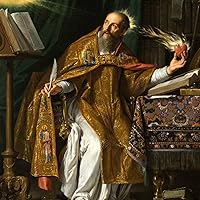
April 19, 2023
This was a really well written book. Sohrab Ahmari is an excellent writer. Never does the narrative extend unnecessarily anecdotes that might be interesting to Ahmari but no one else. There is no sentimentalism. He deals with weighty issues such as existential against with a light touch, even creating several moving passages.
Many (most) books are too long. This one unfortunately is too short. I wanted more. I felt the ending was rushed. I wanted the narrative to linger over Ahmari's conversion. He covers it, and he provides details, yet it still feels clipped.
One questions I was left with upon completing the book was, did Ahmari rush into Catholicism the same way he rushed into existentialism, Marxism, and post-modernism--to wit, swallowing all creeds and beliefs whole hog only to realize later blindspots he had willfully ignored. I guess time will tell. I know from his work at Compact Magazine he's still going strong with his faith, so it seems for the time being he did not.
Many (most) books are too long. This one unfortunately is too short. I wanted more. I felt the ending was rushed. I wanted the narrative to linger over Ahmari's conversion. He covers it, and he provides details, yet it still feels clipped.
One questions I was left with upon completing the book was, did Ahmari rush into Catholicism the same way he rushed into existentialism, Marxism, and post-modernism--to wit, swallowing all creeds and beliefs whole hog only to realize later blindspots he had willfully ignored. I guess time will tell. I know from his work at Compact Magazine he's still going strong with his faith, so it seems for the time being he did not.
Displaying 1 - 30 of 93 reviews