

What do you think?

A alma da marionete
Do consagrado autor de Cachorros de palha e Missa negra, uma reflexão sobre a liberdade humana. Diante da possibilidade de ser livre, todos querem a liberdade. Será? Baseamos nosso conceito de existência na ideia de que temos o domínio de nossas ações, de nossa consciência e de nosso mundo, mas somos escravizados pela suposta liberdade ilimitada diante de nós, sem perceber que a vida humana é pautada pela ansiedade de decidir como viver. John Gray une conceitos de gnosticismo, ficção científica e ocultismo, e costura tradições religiosas, filosóficas e fantásticas para questionar a ideia de liberdade humana. Uma reflexão instigante e original, que mostra que a liberdade é uma ilusão e que, tal como ocorre às marionetes, os humanos sonham em fugir do martírio de fazer escolhas.
179 pages, Kindle Edition
First published March 1, 2015
About the author
John Gray
530 books2,159 followersLibrarian Note: There is more than one author in the GoodReads database with this name.
John Gray is an American relationship counselor, lecturer, and author. In 1969, he began a nine-year association with Maharishi Mahesh Yogi before beginning his career as an author and personal relationship counselor. In 1992 he published the book Men Are from Mars, Women Are from Venus, which became a long-term best seller and formed the central theme of his subsequent books and career activities. His books have sold millions of copies.
John Gray is an American relationship counselor, lecturer, and author. In 1969, he began a nine-year association with Maharishi Mahesh Yogi before beginning his career as an author and personal relationship counselor. In 1992 he published the book Men Are from Mars, Women Are from Venus, which became a long-term best seller and formed the central theme of his subsequent books and career activities. His books have sold millions of copies.
Ratings & Reviews
Friends & Following
Create a free account to discover what your friends think of this book!
Community Reviews
Displaying 1 - 30 of 157 reviews

December 17, 2021
The Self-Help Delusion
In our era free will inevitably gets tangled up in the libertarian idea of freedom of choice. But of course even the most ardent neo-conservative will append the qualification “within the law,” thus justifying the most overwhelming constraints on that very choice. This is Gray’s opening gambit in what is an intriguing survey of relevant literature about what free will is and what to do with it.
Traditionally, Gray points out, freedom is a spiritual concept referring to the state of the soul, a freedom from internal conflict, a peace within oneself and with the world. This is consistent with Christian thought but had actually been first advanced as a proposition by the Ancient Greek Stoics. So true freedom can be found even in a slave if he is wise. As Gray summarises: “What those who follow these traditions want most is not any kind of freedom of choice. Instead, what they long for is freedom from choice.”
The source of this aversion to choice is not mystical or aberrant but a matter of common sense. Choice implies uncertainty, not about the facts but about what criteria, what values, should be applied in any factual situation. Those values come from elsewhere - families, one’s social circle, etc. - and are subject to judgment about which apply and in what combination. In turn that judgment is inevitably influenced, usually determined, by desires of various sorts. Without desire judgment would be unnecessary. So desire is inherent to choice. And desire comes from elsewhere, either provoked by others to a mimetic envy, or as a primal urge originating in one’s genes, hormones, or random life-experiences.
Consequently the empirical evidence for free will, or even its desirability, is scanty and consists primarily in illusory metaphysical tales. Most of these involve evil as a character actor - the Demiurge of creation in Gnosticism, the Devil as God’s rival in Christianity, the Sitra Ahra, the Other Side, as the realm of ill-meaning demons in Cabalistic Judaism, the Iblis in Islam which exploits human weakness incessantly, and the Karmic force of predestination in Buddhism which directs and demands re-incarnation.
Despite the variations, all these tales agree that evil is irresistible by the individual. Freedom can only be achieved by sacrificing, submitting, or escaping free will itself with the assistance of whatever higher power is available. Thus the possession of free will implies its absence, while its loss makes it present, but paradoxically without choices on which to exercise it. The concept of free will simply evaporates except as a linguistic premise. It is self-contradictory.
These diverse traditions belie the dominant world-views of our time: the Scientific view of the world (that it can be improved by human thought), and the Romanticist view (that it can be improved by strength of human will). Essentially these tales have cherry-picked from ancient wisdom in a manner which turns freedom into a buzzword for violence and exploitation. The issue is not that these tales are illusory but that they claim privilege over other tales and exclude the others from human consciousness.
The Scientific and Romanticist tales can be maintained only by ignoring the overwhelming evidence of human corruption. What the Scientific and Romanticist tales have inherited from those of perennial wisdom is their tendency toward dogmatism and prejudice. Science pretends to be doing good in the world by increasing knowledge, for example. But most of what Science produces is either wrong or dangerous. And Romanticism has generated a plague of idealisms - the political, technological and social ideologies of the large scale; and personal ambitions on the level of the individual. These are causing untold suffering and planetary destruction.
It is obvious that neither Science nor Romanticism can credibly claim to be grounded in freedom. Nor can they claim to increase freedom as personal peace and harmony with the world in any meaningful way. The combination of the two, frequently within the same mind, have created a toxic mix of delusion, that is to say corrupt illusion, which promises to create a new species of humanity - better, smarter, longer-lived, and more socially adapted than at present.
The eradication of evil and the creation of inner peace through a dedicated technological commitment to an improvement in the species is the order of the day. But there’s a glitch: “Eradicating evil may produce a new species, but not the one its innocent creators had in mind.” Transcending oneself is a risky venture. We don’t know how to do that either through machines, therapies, or genetics. Some might suggest that it is an act of hubris fuelled by that very common evil of human pride masquerading under the banner of freedom.
Like all metaphysical presumptions, free will is a self-confirming hypothesis. Affirming it makes it so because we act as if it were real and attribute the consequences to judgment rather than to the desire which dominates judgment, or better yet to the desire which determines what we find necessary to judge at all. Any such presumption becomes harmful when it is treated as more than an illusion. It’s also awfully hard to overcome.
Illusions, like the language in which they must be expressed, are necessary for the self-reflexive consciousness of human existence. Our ability with language means that we are compelled to live within it and the illusions it facilitates. We have no choice in the matter. In any case we would likely end our lives if we didn’t have them to buffer our suffering, the suffering we cause, and existential dread we cannot confront.
So the issue of free will is really a red herring according to Gray: “What seems to be singularly human is not consciousness or free will but inner conflict – the contending impulses that divide us from ourselves.” Free will distracts us from the ethical and psychological lessons contained in ancient wisdom about the limitations of human ability. Perhaps our greatest step toward resolving that inner conflict is an ‘unknowing’ of many of our most precious illusions.
Postscript 19Dec21: For more on Free Will see: https://www.goodreads.com/review/show...
In our era free will inevitably gets tangled up in the libertarian idea of freedom of choice. But of course even the most ardent neo-conservative will append the qualification “within the law,” thus justifying the most overwhelming constraints on that very choice. This is Gray’s opening gambit in what is an intriguing survey of relevant literature about what free will is and what to do with it.
Traditionally, Gray points out, freedom is a spiritual concept referring to the state of the soul, a freedom from internal conflict, a peace within oneself and with the world. This is consistent with Christian thought but had actually been first advanced as a proposition by the Ancient Greek Stoics. So true freedom can be found even in a slave if he is wise. As Gray summarises: “What those who follow these traditions want most is not any kind of freedom of choice. Instead, what they long for is freedom from choice.”
The source of this aversion to choice is not mystical or aberrant but a matter of common sense. Choice implies uncertainty, not about the facts but about what criteria, what values, should be applied in any factual situation. Those values come from elsewhere - families, one’s social circle, etc. - and are subject to judgment about which apply and in what combination. In turn that judgment is inevitably influenced, usually determined, by desires of various sorts. Without desire judgment would be unnecessary. So desire is inherent to choice. And desire comes from elsewhere, either provoked by others to a mimetic envy, or as a primal urge originating in one’s genes, hormones, or random life-experiences.
Consequently the empirical evidence for free will, or even its desirability, is scanty and consists primarily in illusory metaphysical tales. Most of these involve evil as a character actor - the Demiurge of creation in Gnosticism, the Devil as God’s rival in Christianity, the Sitra Ahra, the Other Side, as the realm of ill-meaning demons in Cabalistic Judaism, the Iblis in Islam which exploits human weakness incessantly, and the Karmic force of predestination in Buddhism which directs and demands re-incarnation.
Despite the variations, all these tales agree that evil is irresistible by the individual. Freedom can only be achieved by sacrificing, submitting, or escaping free will itself with the assistance of whatever higher power is available. Thus the possession of free will implies its absence, while its loss makes it present, but paradoxically without choices on which to exercise it. The concept of free will simply evaporates except as a linguistic premise. It is self-contradictory.
These diverse traditions belie the dominant world-views of our time: the Scientific view of the world (that it can be improved by human thought), and the Romanticist view (that it can be improved by strength of human will). Essentially these tales have cherry-picked from ancient wisdom in a manner which turns freedom into a buzzword for violence and exploitation. The issue is not that these tales are illusory but that they claim privilege over other tales and exclude the others from human consciousness.
The Scientific and Romanticist tales can be maintained only by ignoring the overwhelming evidence of human corruption. What the Scientific and Romanticist tales have inherited from those of perennial wisdom is their tendency toward dogmatism and prejudice. Science pretends to be doing good in the world by increasing knowledge, for example. But most of what Science produces is either wrong or dangerous. And Romanticism has generated a plague of idealisms - the political, technological and social ideologies of the large scale; and personal ambitions on the level of the individual. These are causing untold suffering and planetary destruction.
It is obvious that neither Science nor Romanticism can credibly claim to be grounded in freedom. Nor can they claim to increase freedom as personal peace and harmony with the world in any meaningful way. The combination of the two, frequently within the same mind, have created a toxic mix of delusion, that is to say corrupt illusion, which promises to create a new species of humanity - better, smarter, longer-lived, and more socially adapted than at present.
The eradication of evil and the creation of inner peace through a dedicated technological commitment to an improvement in the species is the order of the day. But there’s a glitch: “Eradicating evil may produce a new species, but not the one its innocent creators had in mind.” Transcending oneself is a risky venture. We don’t know how to do that either through machines, therapies, or genetics. Some might suggest that it is an act of hubris fuelled by that very common evil of human pride masquerading under the banner of freedom.
Like all metaphysical presumptions, free will is a self-confirming hypothesis. Affirming it makes it so because we act as if it were real and attribute the consequences to judgment rather than to the desire which dominates judgment, or better yet to the desire which determines what we find necessary to judge at all. Any such presumption becomes harmful when it is treated as more than an illusion. It’s also awfully hard to overcome.
Illusions, like the language in which they must be expressed, are necessary for the self-reflexive consciousness of human existence. Our ability with language means that we are compelled to live within it and the illusions it facilitates. We have no choice in the matter. In any case we would likely end our lives if we didn’t have them to buffer our suffering, the suffering we cause, and existential dread we cannot confront.
So the issue of free will is really a red herring according to Gray: “What seems to be singularly human is not consciousness or free will but inner conflict – the contending impulses that divide us from ourselves.” Free will distracts us from the ethical and psychological lessons contained in ancient wisdom about the limitations of human ability. Perhaps our greatest step toward resolving that inner conflict is an ‘unknowing’ of many of our most precious illusions.
Postscript 19Dec21: For more on Free Will see: https://www.goodreads.com/review/show...

December 12, 2021
This was an unexpected gift, with a card saying, “You read far too many novels!” I dispute the concept, but the book is short, so I read it in a couple of sessions, out of a combination of curiosity and contrarianism.
It’s hard to say what I got from it. There are plenty of interesting ideas, but without the narrative arcs of a novel, it’s hard to see the shape of it and assemble my thoughts in a meaningful or memorable way. It’s a long time since I graduated from university, and it felt like a study text.
Ideas
Puppets don’t have freedom, but they have no consciousness, so that’s fine.
Except that gives them freedom from self-reflective thought.
Furthermore
“Human beings are marionettes: puppets on genetic strings, which by an accident of evolution have become self-aware.”
Do we have less autonomy than puppets?

Image: Who is controlling who? (Source)
This leads to a lengthy exploration of Gnosticism, which is apparently an element of many belief systems, not just some flavours of Christianity: esoteric knowledge beyond the assumed laws of nature.
Many philosophers are cited, some of whom I’d not even heard of. Short quotes are worthy of a thesis, and probably have been, and some are explored in more detail than others.
“Far from death being the supreme evil, it lightens the burden of life. Nothing could be worse, he [TF Powys] believed, than living for ever.”
In a similar vein, an anonymous 1967 study suggested that societal order depends on the possibility of war, which is certainly what the leaders of Oceania believed in Orwell’s 1984 (see my review HERE).
The Aztecs get plenty of coverage, much of it around the observation that the Romans killed for entertainment, but the Aztecs did so to create meaning.
“Unable to exorcise violence within themselves, humans have chosen to sanctify it.”
From ancient civilisations, on to tech, robots, and AI. Globalisation parallels the rise of the surveillance state, which is itself a variant of Bentham’s Panopticon.
“The Panopticon is an example of the cult of reason in action… Universal surveillance would be the basis for social control.”
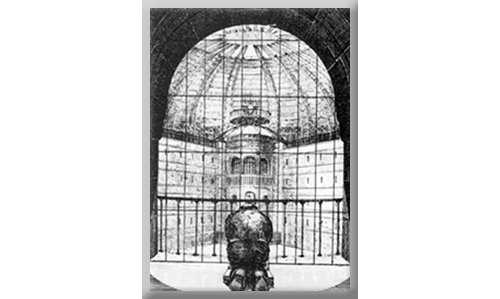
Image: The prisoner’s perspective of the Panopticon (Source)
Technology has freed us from the rhythm and limits of nature, but now, climate change is reconnecting us to natural limits.
The conclusion is that Gnosticism has quietly conquered the world:
“Belief in the liberating power of knowledge has become the ruling illusion of modern humankind.”
Has it? I think you need a very fuzzy definition of “knowledge” when fake news, quackery, and conspiracy theories seem to get ever more air time and column inches (but this was published in 2015).
Novels have a place
Despite the accompanying note, this quotes a lot of novels, especially speculative fiction. Several of my favourites are mentioned at length, and are more enjoyable and thought-provoking than this. The include:
• EM Forster’s The Machine Stops. See my review HERE.
• John William’s Augustus. See my review HERE.
• Several stories by JL Borges. See my overview review HERE.
In a lighter vein
A few days later, I saw this cartoon, which suggests there is freedom in the lack of free will. It also nails the prevalent lie that anyone can do or be anything if they try hard enough.

Image: If nothing you do makes a difference, it doesn't matter what you do. Perhaps. (Source)
It’s hard to say what I got from it. There are plenty of interesting ideas, but without the narrative arcs of a novel, it’s hard to see the shape of it and assemble my thoughts in a meaningful or memorable way. It’s a long time since I graduated from university, and it felt like a study text.
Ideas
Puppets don’t have freedom, but they have no consciousness, so that’s fine.
Except that gives them freedom from self-reflective thought.
Furthermore
“Human beings are marionettes: puppets on genetic strings, which by an accident of evolution have become self-aware.”
Do we have less autonomy than puppets?
Image: Who is controlling who? (Source)
This leads to a lengthy exploration of Gnosticism, which is apparently an element of many belief systems, not just some flavours of Christianity: esoteric knowledge beyond the assumed laws of nature.
Many philosophers are cited, some of whom I’d not even heard of. Short quotes are worthy of a thesis, and probably have been, and some are explored in more detail than others.
“Far from death being the supreme evil, it lightens the burden of life. Nothing could be worse, he [TF Powys] believed, than living for ever.”
In a similar vein, an anonymous 1967 study suggested that societal order depends on the possibility of war, which is certainly what the leaders of Oceania believed in Orwell’s 1984 (see my review HERE).
The Aztecs get plenty of coverage, much of it around the observation that the Romans killed for entertainment, but the Aztecs did so to create meaning.
“Unable to exorcise violence within themselves, humans have chosen to sanctify it.”
From ancient civilisations, on to tech, robots, and AI. Globalisation parallels the rise of the surveillance state, which is itself a variant of Bentham’s Panopticon.
“The Panopticon is an example of the cult of reason in action… Universal surveillance would be the basis for social control.”
Image: The prisoner’s perspective of the Panopticon (Source)
Technology has freed us from the rhythm and limits of nature, but now, climate change is reconnecting us to natural limits.
The conclusion is that Gnosticism has quietly conquered the world:
“Belief in the liberating power of knowledge has become the ruling illusion of modern humankind.”
Has it? I think you need a very fuzzy definition of “knowledge” when fake news, quackery, and conspiracy theories seem to get ever more air time and column inches (but this was published in 2015).
Novels have a place
Despite the accompanying note, this quotes a lot of novels, especially speculative fiction. Several of my favourites are mentioned at length, and are more enjoyable and thought-provoking than this. The include:
• EM Forster’s The Machine Stops. See my review HERE.
• John William’s Augustus. See my review HERE.
• Several stories by JL Borges. See my overview review HERE.
In a lighter vein
A few days later, I saw this cartoon, which suggests there is freedom in the lack of free will. It also nails the prevalent lie that anyone can do or be anything if they try hard enough.
Image: If nothing you do makes a difference, it doesn't matter what you do. Perhaps. (Source)

December 28, 2015
A brief and essayistic digest of Gray's analysis—he views western modernity as deludedly self-satisfied in its unwitting recapitulation of the Gnostic heresy that humanity can be God—and his aesthetic—his is an austere and gentlemanly nihilism, such as one finds in Borges or Sebald. There is little new here for those who have read Straw Dogs or Black Mass, but Gray's opening tour of modern literary Gnosticism from Kleist to Dick is fun, like a good lecture, and it put a few more books on my reading list (Giacomo Leopardi, T. F. Powys) even as I enjoyed its review of books and authors I already admire (Schulz's Street of Crocodiles, Lem's Solaris—though not Dick, whom I've never liked or been able to read).
I must say, though, that Gray's literary history follows very closely, even down to the specific examples and the governing marionette metaphor, Victoria Nelson's own analysis of contemporary cultural Gnosticism in her wonderful 2003 book, The Secret Life of Puppets, a work Gray oddly does not mention. Likewise, "Gnosticism is the hidden theology of modern secular progressive thought" is a thesis first developed, if I am not mistaken, by the philosopher Eric Voegelin, who also goes uncredited here, despite the book's many references and annotations.
The book's concluding chapters detail a realistic appraisal of humanity's future prospects: in short, the west will enter an anti-humanistic culture of intelligent machines and docile, tech-pacified people, with a periphery of unincorporated violence in the less technologically developed world. Likely, if depressing, enough. Gray's counsel is neither Marxian revolution nor Nietzschean anarchy, both of which he dismisses as outmoded radicalisms that have proven themselves unworkable or worse; instead, he recommends a pursuit of "inner freedom," like that of the Stoics (or the Taoists, whom he does not mention here but who feature in Straw Dogs).
But the most arresting part of Gray's inquiry comes in the middle of the book, in his long discussion, and at least partial defense, of the Aztec or Mexica civilization, including its practice of human sacrifice. According to Gray, modern liberal society may congratulate itself on its supposed peacefulness, but in reality we only deny our capacity for violence even as we live behind walls policed by very violent agencies, from the coerced foreign labor that brings us cheap consumer goods to the endless proxy wars raging around the globe, in which people are slaughtered and their environments permanently despoiled for the sake of resources our techno-societies require or for the empowerment of the states in which we live. The Aztecs, Gray seems to say, were at least honest with themselves in formalizing a ritual, i.e., human sacrifice, that both expressed and contained their capacity to do harm, which all humans share. Gray sees it as no accident that their civilization was so orderly and aesthetically refined aside from this gruesome rite; the regulated release of disordered emotion, the ritual frenzy, in fact, enabled the elegance and control. Some contrast with our own disordered society, with all its disavowed killing, is certainly implied.
This kind of thinking, which disturbs but which cannot be dismissed, and which is not easily summed up in the usual arguments of the Left 0r Right, is the reason I read Gray. The Soul of the Marionette is not his best book among those I've read—Straw Dogs is more poetic and philosophically rich, and Al Qaeda and What It Means to Be Modern more timely in this age of ISIS, as it convincingly argues that Islamic radicalism is not a medieval throwback or some "discourse of the Other" but is rather another modern or even modernist movement of revolutionary violence, like fascism and Marxism-Leninism before it. But the present book's literary focus will interest readers seeking to understand our world through fiction; I do recommend that they go beyond Gray's bibliography, however, and also seek out the aforementioned Victoria Nelson and Eric Voegelin.
I must say, though, that Gray's literary history follows very closely, even down to the specific examples and the governing marionette metaphor, Victoria Nelson's own analysis of contemporary cultural Gnosticism in her wonderful 2003 book, The Secret Life of Puppets, a work Gray oddly does not mention. Likewise, "Gnosticism is the hidden theology of modern secular progressive thought" is a thesis first developed, if I am not mistaken, by the philosopher Eric Voegelin, who also goes uncredited here, despite the book's many references and annotations.
The book's concluding chapters detail a realistic appraisal of humanity's future prospects: in short, the west will enter an anti-humanistic culture of intelligent machines and docile, tech-pacified people, with a periphery of unincorporated violence in the less technologically developed world. Likely, if depressing, enough. Gray's counsel is neither Marxian revolution nor Nietzschean anarchy, both of which he dismisses as outmoded radicalisms that have proven themselves unworkable or worse; instead, he recommends a pursuit of "inner freedom," like that of the Stoics (or the Taoists, whom he does not mention here but who feature in Straw Dogs).
But the most arresting part of Gray's inquiry comes in the middle of the book, in his long discussion, and at least partial defense, of the Aztec or Mexica civilization, including its practice of human sacrifice. According to Gray, modern liberal society may congratulate itself on its supposed peacefulness, but in reality we only deny our capacity for violence even as we live behind walls policed by very violent agencies, from the coerced foreign labor that brings us cheap consumer goods to the endless proxy wars raging around the globe, in which people are slaughtered and their environments permanently despoiled for the sake of resources our techno-societies require or for the empowerment of the states in which we live. The Aztecs, Gray seems to say, were at least honest with themselves in formalizing a ritual, i.e., human sacrifice, that both expressed and contained their capacity to do harm, which all humans share. Gray sees it as no accident that their civilization was so orderly and aesthetically refined aside from this gruesome rite; the regulated release of disordered emotion, the ritual frenzy, in fact, enabled the elegance and control. Some contrast with our own disordered society, with all its disavowed killing, is certainly implied.
This kind of thinking, which disturbs but which cannot be dismissed, and which is not easily summed up in the usual arguments of the Left 0r Right, is the reason I read Gray. The Soul of the Marionette is not his best book among those I've read—Straw Dogs is more poetic and philosophically rich, and Al Qaeda and What It Means to Be Modern more timely in this age of ISIS, as it convincingly argues that Islamic radicalism is not a medieval throwback or some "discourse of the Other" but is rather another modern or even modernist movement of revolutionary violence, like fascism and Marxism-Leninism before it. But the present book's literary focus will interest readers seeking to understand our world through fiction; I do recommend that they go beyond Gray's bibliography, however, and also seek out the aforementioned Victoria Nelson and Eric Voegelin.

February 7, 2016
This was a very odd book. I kept reading and reading, thinking, I have never looked at the world quite like this guy does, which is what made it interesting. Really, that is one of the benefits of reading, isn't it? You get to look at the world through other eyes.
I actually think this quote from page 9 rather sums up his point of view:
Many people today hold to a Gnostic view of things without realizing the fact. Believing that human beings can be fully understood in the terms of scientific materialism, they reject any idea of free will. But they cannot give up hope of being masters of their destiny. So they have come to believe that science will somehow enable the human mind to escape the limitations that shape its natural condition. Throughout much of the world, and particularly in western countries, the Gnostic faith that knowledge can give humans a freedom no other creature can possess has become the predominant religion.
[end quote]
The author seemed to me to have a jaundiced vision of the world and the book has a curmudgeonly feel to it. But , you know what, it was still fun to read, just because of the novelty of his ideas (for me, anyway---since I am no philosopher).
I actually think this quote from page 9 rather sums up his point of view:
Many people today hold to a Gnostic view of things without realizing the fact. Believing that human beings can be fully understood in the terms of scientific materialism, they reject any idea of free will. But they cannot give up hope of being masters of their destiny. So they have come to believe that science will somehow enable the human mind to escape the limitations that shape its natural condition. Throughout much of the world, and particularly in western countries, the Gnostic faith that knowledge can give humans a freedom no other creature can possess has become the predominant religion.
[end quote]
The author seemed to me to have a jaundiced vision of the world and the book has a curmudgeonly feel to it. But , you know what, it was still fun to read, just because of the novelty of his ideas (for me, anyway---since I am no philosopher).

June 1, 2018
Ομολογώ εξαρχής τη μεγάλη μου αδυναμία στον John Gray. Η περίπτωσή του είναι διακριτή στον χώρο της σύγχρονης πολιτικής φιλοσοφίας, καθώς ξεφεύγει από την πεπατημένη των ομογάλακτών του που "αλληθωρίζουν" -εκστατικά και άκριτα συνήθως- προς κάποια/όποια ιδεολογία. Εν αρχή… διαβόητος για την υποστήριξή του στη Θάτσερ, σταδιακά μετεστράφη σε αντίπαλο του Neo-Liberal consensus, χωρίς όμως να προσχωρήσει σε κάποια ιδεολογία ή πολιτικό σχηματισμό, ακολουθώντας έναν μοναχικό δρόμο κριτικής στάσης.
Και στο συγκεκριμένο βιβλίο (όπως και στα εξαιρετικά προηγούμενά του), ο Βρετανός φιλόσοφος επιδίδεται ανηλεώς στην αγαπημένη του ενασχόληση: την αποδόμηση των παγιωμένων αντιλήψεων και στερεοτύπων του Διαφωτισμού, του Νεωτερικού κόσμου, της ψηφιακής εποχής. Αντιλήψεις περί ελεύθερης βούλησης, ελευθερίας εν γένει, αυτο-βελτίωσης του ανθρώπου αλλά και προόδου της ανθρωπότητας, γραμμικής πορείας προς ένα ελπιδοφόρο μέλλον στο οποίο οι θυσίες του παρόντος αναπόφευκτα θα μας οδηγήσουν (ιστορικισμός) και λοιπές ουτοπικές εξαγγελίες, αναλύονται και αποκαθηλώνονται χωρίς φόβο, αλλά και δίχως εμπάθεια.
Τελικά, αυτό που απολαμβάνω στον σπουδαίο διανοητή είναι εκείνο για το οποίο έχει πολλάκις επικριθεί, ακόμα και από συνοδοιπόρους: Καίτοι παίρνει θέση, δεν προτείνει εναλλακτικές, αρνούμενος να προσφέρει λύση/απάντηση/νόημα (και ως προς αυτό, μου θυμίζει τον μεγάλο Μ. Foucault, ο οποίος εκ πεποιθήσεως αρνείτο να προτείνει λύσεις, πρεσβεύοντας πως δεν είναι αυτός ο ρόλος του Διανοούμενου) - οι ex cathedra οδηγίες δεν έχουν θέση σε έναν κόσμο κενό νοήματος όπου τα ατελή ανθρώπινα όντα ενοικούν με τις ψευδαισθήσεις τους, αδυνατώντας να ξεφύγουν από τις εσωτερικές τους αντινομίες, τον φαύλο κύκλο της βίας και τη θλιβερή απουσία αυτογνωσίας τους που ως αποτέλεσμα έχει να εκπίπτουν συνεχώς της Χάριτος, προσομοιάζοντας στη μυθική μορφή του Σισύφου.
Και ποιος ο ρόλος του Διανοούμενου λοιπόν; Σίγουρα δεν είναι η παρουσίαση ενός ακόμα μύθου ενοποιητικού, καθαρτήριου και ελπιδοφόρου– αυτοί περίσσεψαν και η χρεία τους δεν είναι πλέον πειστική. Δεν είναι η εκφορά λόγου ανακουφιστικού, λυσιτελούς και αποκαλυπτικού – ενός ακόμα χρησμού που θα οδηγήσει τα "στρατεύματα του μέλλοντος" προς τη Χιλιετή βασιλεία του Θεού/ Κόμματος/ Αγοράς ή -του τελευταίου προπυργίου της Νεωτερικής Βεβαιότητας- της Επιστήμης.
Ίσως αυτό απογοητεύσει όλους όσοι -κυρίως νεότερες ηλικίες- προσέλθουν στα βιβλία του με τη λογική του εκκλησιάσματος που αναζητά απαντήσεις. Κρίμα, διότι δεν θα τις βρουν εδώ. Τι θα βρουν; Ερωτήματα - αμείλικτα, καταιγιστικά, αυτο-υπονομευτικά. Αυτό, νομίζω, είναι αρκετό.
Και στο συγκεκριμένο βιβλίο (όπως και στα εξαιρετικά προηγούμενά του), ο Βρετανός φιλόσοφος επιδίδεται ανηλεώς στην αγαπημένη του ενασχόληση: την αποδόμηση των παγιωμένων αντιλήψεων και στερεοτύπων του Διαφωτισμού, του Νεωτερικού κόσμου, της ψηφιακής εποχής. Αντιλήψεις περί ελεύθερης βούλησης, ελευθερίας εν γένει, αυτο-βελτίωσης του ανθρώπου αλλά και προόδου της ανθρωπότητας, γραμμικής πορείας προς ένα ελπιδοφόρο μέλλον στο οποίο οι θυσίες του παρόντος αναπόφευκτα θα μας οδηγήσουν (ιστορικισμός) και λοιπές ουτοπικές εξαγγελίες, αναλύονται και αποκαθηλώνονται χωρίς φόβο, αλλά και δίχως εμπάθεια.
Τελικά, αυτό που απολαμβάνω στον σπουδαίο διανοητή είναι εκείνο για το οποίο έχει πολλάκις επικριθεί, ακόμα και από συνοδοιπόρους: Καίτοι παίρνει θέση, δεν προτείνει εναλλακτικές, αρνούμενος να προσφέρει λύση/απάντηση/νόημα (και ως προς αυτό, μου θυμίζει τον μεγάλο Μ. Foucault, ο οποίος εκ πεποιθήσεως αρνείτο να προτείνει λύσεις, πρεσβεύοντας πως δεν είναι αυτός ο ρόλος του Διανοούμενου) - οι ex cathedra οδηγίες δεν έχουν θέση σε έναν κόσμο κενό νοήματος όπου τα ατελή ανθρώπινα όντα ενοικούν με τις ψευδαισθήσεις τους, αδυνατώντας να ξεφύγουν από τις εσωτερικές τους αντινομίες, τον φαύλο κύκλο της βίας και τη θλιβερή απουσία αυτογνωσίας τους που ως αποτέλεσμα έχει να εκπίπτουν συνεχώς της Χάριτος, προσομοιάζοντας στη μυθική μορφή του Σισύφου.
Και ποιος ο ρόλος του Διανοούμενου λοιπόν; Σίγουρα δεν είναι η παρουσίαση ενός ακόμα μύθου ενοποιητικού, καθαρτήριου και ελπιδοφόρου– αυτοί περίσσεψαν και η χρεία τους δεν είναι πλέον πειστική. Δεν είναι η εκφορά λόγου ανακουφιστικού, λυσιτελούς και αποκαλυπτικού – ενός ακόμα χρησμού που θα οδηγήσει τα "στρατεύματα του μέλλοντος" προς τη Χιλιετή βασιλεία του Θεού/ Κόμματος/ Αγοράς ή -του τελευταίου προπυργίου της Νεωτερικής Βεβαιότητας- της Επιστήμης.
Ίσως αυτό απογοητεύσει όλους όσοι -κυρίως νεότερες ηλικίες- προσέλθουν στα βιβλία του με τη λογική του εκκλησιάσματος που αναζητά απαντήσεις. Κρίμα, διότι δεν θα τις βρουν εδώ. Τι θα βρουν; Ερωτήματα - αμείλικτα, καταιγιστικά, αυτο-υπονομευτικά. Αυτό, νομίζω, είναι αρκετό.

August 11, 2021
ΜΠΟΥΜ.
Ο φύσει απαισιόδοξος άνθρωπος κρυφοχαίρεται όταν ένας οξύνους στοχαστής τού κλείνει το μάτι επιβεβαιώνοντας, με «αποδείξεις και ονόματα», σε κάθε περίπτωση με φιλοσοφικό υπόβαθρο και δυνατή εγγραμματοσύνη, τα κακά όνειρα που βλέπει για τον κόσμο και την ανθρωπότητα. Το «αποδείξεις και ονόματα» είναι, βέβαια, ψέματα. Κανένας σοβαρός στοχαστής δεν στέκεται εγκάθετος και αμετακίνητος στις ιδέες του, πόσο μάλλον δε δίνει απαντήσεις∙ η εργασία του είναι να χώνει το μαχαίρι στην πληγή και να την ανοίγει ακόμα περισσότερο. Τα χυμένα εντόσθια μετά, ας τα κάνει ο καθένας ό,τι θέλει.
Με ζουμ σε πολιτισμούς ανά τους αιώνες και στοχευμένες ματιές στον κόσμο των ιδεών διάσημων φωτεινών μυαλών, ο Γκρέυ ρίχνει μια χειροβομβίδα στην ησυχία, την τάξη και την ασφάλεια που ψευδαισθητικά βιώνουμε. Πάει μακριά και προκαλεί ίντριγκα και άμεση έξοδο από το bubble όπου βρισκόμαστε, διαλέγοντας την πιο αιρετική των οδών.
Υπάρχει ένα κομματάκι του νου που δεν το έχουμε κατακτήσει. Θέλουμε όμως. Πιστεύουμε σε μια οικουμενική αλήθεια, σε μια οικουμενική ηθική, τις οποίες οπωσδήποτε πρέπει να τις κατακτήσουμε κι αυτές. Επιμένουμε στην εξιχνίαση κάθε μυστηρίου, δε θέλουμε ασάφειες και αδιευκρίνιστα σημεία. Την φτενή ελευθερία μας, τη θέλουμε ολόκληρη. Έχουμε ελεύθερη βούληση τελικά; Είμαστε μαριονέτες αλλά θέλουμε να γίνουμε υπερμαριονέτες. Πιστεύουμε ότι η όλο και μεγαλύτερη κατάκτηση της γνώσης μάς κάνει μεγάλους παιχταράδες στο παιχνίδι της εξέλιξης. Θέλουμε όλα να τα μάθουμε, όλα να τα κατακτήσουμε. Όλα να τα ερμηνεύσουμε και όλα να γυρίζουν γύρω μας. Ε λοιπόν, σκατά στα μούτρα μας.
---------------------------
Μετά από όλα αυτά, μου έχει ανοίξει ειλικρινά η όρεξη για επιστημονική φαντασία, κάτι που δεν περίμενα ποτέ να πω. Να λοιπόν τι κάνουν τα βιβλία –ορισμένα βιβλία. Σε στέλνουν παραθέριση σ' άλλη γη σ' άλλα μέρη, και σίγουρα όχι από κει που'ρθες. Μη ξεγελαστείτε όμως ότι σε κάνουν καλύτερο άνθρωπο. Κρίνοντας από εμένα, βιβλία σαν και αυτό, με κάνουν χειρότερο άνθρωπο. Δηλαδή να πιστεύω όλο και λιγότερο στον άνθρωπο.
Ιδιοφυής ο John Gray, αξίζει να ασχοληθείτε. Αν θέλετε.
Ο φύσει απαισιόδοξος άνθρωπος κρυφοχαίρεται όταν ένας οξύνους στοχαστής τού κλείνει το μάτι επιβεβαιώνοντας, με «αποδείξεις και ονόματα», σε κάθε περίπτωση με φιλοσοφικό υπόβαθρο και δυνατή εγγραμματοσύνη, τα κακά όνειρα που βλέπει για τον κόσμο και την ανθρωπότητα. Το «αποδείξεις και ονόματα» είναι, βέβαια, ψέματα. Κανένας σοβαρός στοχαστής δεν στέκεται εγκάθετος και αμετακίνητος στις ιδέες του, πόσο μάλλον δε δίνει απαντήσεις∙ η εργασία του είναι να χώνει το μαχαίρι στην πληγή και να την ανοίγει ακόμα περισσότερο. Τα χυμένα εντόσθια μετά, ας τα κάνει ο καθένας ό,τι θέλει.
Με ζουμ σε πολιτισμούς ανά τους αιώνες και στοχευμένες ματιές στον κόσμο των ιδεών διάσημων φωτεινών μυαλών, ο Γκρέυ ρίχνει μια χειροβομβίδα στην ησυχία, την τάξη και την ασφάλεια που ψευδαισθητικά βιώνουμε. Πάει μακριά και προκαλεί ίντριγκα και άμεση έξοδο από το bubble όπου βρισκόμαστε, διαλέγοντας την πιο αιρετική των οδών.
Υπάρχει ένα κομματάκι του νου που δεν το έχουμε κατακτήσει. Θέλουμε όμως. Πιστεύουμε σε μια οικουμενική αλήθεια, σε μια οικουμενική ηθική, τις οποίες οπωσδήποτε πρέπει να τις κατακτήσουμε κι αυτές. Επιμένουμε στην εξιχνίαση κάθε μυστηρίου, δε θέλουμε ασάφειες και αδιευκρίνιστα σημεία. Την φτενή ελευθερία μας, τη θέλουμε ολόκληρη. Έχουμε ελεύθερη βούληση τελικά; Είμαστε μαριονέτες αλλά θέλουμε να γίνουμε υπερμαριονέτες. Πιστεύουμε ότι η όλο και μεγαλύτερη κατάκτηση της γνώσης μάς κάνει μεγάλους παιχταράδες στο παιχνίδι της εξέλιξης. Θέλουμε όλα να τα μάθουμε, όλα να τα κατακτήσουμε. Όλα να τα ερμηνεύσουμε και όλα να γυρίζουν γύρω μας. Ε λοιπόν, σκατά στα μούτρα μας.
---------------------------
Μετά από όλα αυτά, μου έχει ανοίξει ειλικρινά η όρεξη για επιστημονική φαντασία, κάτι που δεν περίμενα ποτέ να πω. Να λοιπόν τι κάνουν τα βιβλία –ορισμένα βιβλία. Σε στέλνουν παραθέριση σ' άλλη γη σ' άλλα μέρη, και σίγουρα όχι από κει που'ρθες. Μη ξεγελαστείτε όμως ότι σε κάνουν καλύτερο άνθρωπο. Κρίνοντας από εμένα, βιβλία σαν και αυτό, με κάνουν χειρότερο άνθρωπο. Δηλαδή να πιστεύω όλο και λιγότερο στον άνθρωπο.
Ιδιοφυής ο John Gray, αξίζει να ασχοληθείτε. Αν θέλετε.

September 18, 2015
Full confession: I love John Gray. I read Silence of the Animals and Straw Dogs before this. So going in, I'm already primed to like this book. It didn't disappoint. Some of the stuff was just a clearer exposition of points he makes in his other books. Like how science wants to be anti-religion but it really is just another of the many branches of Christianity/Gnosticism. His chapters on robots were excellent. Humans don't want to make simulated versions of themselves. They want perfected versions of humanity that can work without sleep, that never commit crimes, that don't make bad choices. But it's exactly those features that make life worth living. The myth that we can use scientific and technical progress to improve humanity is Gray's thing. It's in all his books. It's what I love. In this book he's not just questioning progress, he's suggesting that progressive attempts to improve humanity aren't even a good thing in the first place. Very well done once again, John Gray.

December 23, 2024
Şükrü Erbaş’ın Sitem Taşları kitabının sonunda bir soru cevap kısmı vardır ve sorulardan biri şudur,
“Sizce insanların en abartılmış meziyeti nedir?
“Dürüstlük” diye cevap verir yazar.
Nedense bana çok samimi ve ‘dürüstçe’ gelmişti bu cevap;
İçten içe herkesin bu kavrama çok takıldığını, bunun için zorladığını, bunun bir kurtuluş reçetesi, arınma ve cennet kapısının şifresi olduğunu düşünmesi fikri bana hep ironik ve komik gelmiştir. Bu kavramın yanına ‘Âhlaki disiplini’ de koyardım ama buradan çok linç yedim o sebepten şimdilik askıda kalsın.
Kitaba gelecek olursak, gözümü ovarlarken bir Bilge tarafından elime tutuşturuldu ve sanırım haftam başlamış oldu; ( uzun süredir benden sağlıklı arkadaş seçiminde başarısızım)
Kitap tam olarak, İnsanın özgür iradesini, seçimlerini ve hayatın büyük sorularını masaya yatırıyor. Ama bunu sıkıcı bir akademik dille yapmıyor; aksine, sayfalarda gezinirken bazen bir filozofun, bazen bir bilim insanının, bazen de bir masal anlatıcısının yanında buluyorsunuz kendinizi. Mary Shelley’den Philip K. Dick’e, Antik Yunan düşüncesinden modern teknolojiye kadar uzanan geniş bir yelpazede ilerleyen bu anlatı, her bölümde doğru ve yanlışı yıkarak ilerliyor ki bence doğru ve yanlış üzerine kurgulanmış bir dünyada diğer seçeneklerin görünmezliğinden bahsediyor.
En çok ilgimi çeken bölümlerden biri “Golem ve Döngüsel Tapınağın Kalıntıları” oldu. Burada insanın tanrısal bir yaratıcı rolüne soyunma arzusundan bahsediliyor. Frankenstein’ın canavarından Golem mitine kadar, insanın üstün bir varlık yaratma tutkusu, doğanın sınırlarını zorlama çabasıyla iç içe. Bu bölümü okurken kendime şu soruyu sordum: Biz gerçekten yaratıcı mıyız yoksa sadece var olanı yeniden şekillendiren becerikli birer taklitçi mi? Pinokyo, roman yazma, müzik bestelemek ve diğerlerinden farklıyım hissi bile tanrısal bir öykünme gibi, tuhaf..
Bir diğer etkileyici bölüm, Philip K. Dick ve onun karmaşık dünyasına ayrılmıştı. Dick’in yaşadığı gerçeklik algısı sorunları, bize insan zihninin ne kadar kırılgan ama bir o kadar da yaratıcı olabileceğini gösteriyor. Yazarın hayatta yaşadığı deneyimler, kitaplarına sirayet eden o benzersiz hikayeleri doğurmuş. Belki de bu bölüm, kendi hayatımıza dönüp bakmamız gerektiğini hatırlatıyor: Acılarımızı, korkularımızı ve düş kırıklıklarımızı nasıl birer ilhama dönüştürebiliriz? Veya dönüştürmeli miyiz, burada muhteşem Oblomovculuk çıkıyor karşımıza, sen ne güzel bir ruh haliydin Oblomov..
Aztekler üzerine yazılan sayfalar ise ayrı bir dünyaya kapı açıyor. İnsan kurban etme ritüelleri, düzen ve kaos arasındaki ince çizgi, modern insanın anlayışını zorlayan ama derinlerde bir yerlerde tanıdık gelen bir öykü anlatıyor. Burada fark ettim ki insanlık tarihi, hem dehşet verici hem de büyüleyici bir yansıma: Düzen adına yapılan kaos ve kaos adına yaratılan düzen.
Son olarak, kitabın ana temalarından biri olan “özgürlük” üzerine birkaç kelam etmek isterim. Kitap, özgürlüğün bir yanılgı mı yoksa bir insanlık ideali mi olduğu sorusunu sıkça soruyor. Ve bence bu sorular, cevaptan daha önemli. Çünkü insanın yolculuğu, cevapları bulmak kadar, doğru soruları sormakla da şekilleniyor. Açıkçası bu konularda zihnimde yüzlerce mıhlanmış soru varken bu kitapla binlercesini de ekleyen herkeslere selamlar sevgiler efendim.
“Sizce insanların en abartılmış meziyeti nedir?
“Dürüstlük” diye cevap verir yazar.
Nedense bana çok samimi ve ‘dürüstçe’ gelmişti bu cevap;
İçten içe herkesin bu kavrama çok takıldığını, bunun için zorladığını, bunun bir kurtuluş reçetesi, arınma ve cennet kapısının şifresi olduğunu düşünmesi fikri bana hep ironik ve komik gelmiştir. Bu kavramın yanına ‘Âhlaki disiplini’ de koyardım ama buradan çok linç yedim o sebepten şimdilik askıda kalsın.
Kitaba gelecek olursak, gözümü ovarlarken bir Bilge tarafından elime tutuşturuldu ve sanırım haftam başlamış oldu; ( uzun süredir benden sağlıklı arkadaş seçiminde başarısızım)
Kitap tam olarak, İnsanın özgür iradesini, seçimlerini ve hayatın büyük sorularını masaya yatırıyor. Ama bunu sıkıcı bir akademik dille yapmıyor; aksine, sayfalarda gezinirken bazen bir filozofun, bazen bir bilim insanının, bazen de bir masal anlatıcısının yanında buluyorsunuz kendinizi. Mary Shelley’den Philip K. Dick’e, Antik Yunan düşüncesinden modern teknolojiye kadar uzanan geniş bir yelpazede ilerleyen bu anlatı, her bölümde doğru ve yanlışı yıkarak ilerliyor ki bence doğru ve yanlış üzerine kurgulanmış bir dünyada diğer seçeneklerin görünmezliğinden bahsediyor.
En çok ilgimi çeken bölümlerden biri “Golem ve Döngüsel Tapınağın Kalıntıları” oldu. Burada insanın tanrısal bir yaratıcı rolüne soyunma arzusundan bahsediliyor. Frankenstein’ın canavarından Golem mitine kadar, insanın üstün bir varlık yaratma tutkusu, doğanın sınırlarını zorlama çabasıyla iç içe. Bu bölümü okurken kendime şu soruyu sordum: Biz gerçekten yaratıcı mıyız yoksa sadece var olanı yeniden şekillendiren becerikli birer taklitçi mi? Pinokyo, roman yazma, müzik bestelemek ve diğerlerinden farklıyım hissi bile tanrısal bir öykünme gibi, tuhaf..
Bir diğer etkileyici bölüm, Philip K. Dick ve onun karmaşık dünyasına ayrılmıştı. Dick’in yaşadığı gerçeklik algısı sorunları, bize insan zihninin ne kadar kırılgan ama bir o kadar da yaratıcı olabileceğini gösteriyor. Yazarın hayatta yaşadığı deneyimler, kitaplarına sirayet eden o benzersiz hikayeleri doğurmuş. Belki de bu bölüm, kendi hayatımıza dönüp bakmamız gerektiğini hatırlatıyor: Acılarımızı, korkularımızı ve düş kırıklıklarımızı nasıl birer ilhama dönüştürebiliriz? Veya dönüştürmeli miyiz, burada muhteşem Oblomovculuk çıkıyor karşımıza, sen ne güzel bir ruh haliydin Oblomov..
Aztekler üzerine yazılan sayfalar ise ayrı bir dünyaya kapı açıyor. İnsan kurban etme ritüelleri, düzen ve kaos arasındaki ince çizgi, modern insanın anlayışını zorlayan ama derinlerde bir yerlerde tanıdık gelen bir öykü anlatıyor. Burada fark ettim ki insanlık tarihi, hem dehşet verici hem de büyüleyici bir yansıma: Düzen adına yapılan kaos ve kaos adına yaratılan düzen.
Son olarak, kitabın ana temalarından biri olan “özgürlük” üzerine birkaç kelam etmek isterim. Kitap, özgürlüğün bir yanılgı mı yoksa bir insanlık ideali mi olduğu sorusunu sıkça soruyor. Ve bence bu sorular, cevaptan daha önemli. Çünkü insanın yolculuğu, cevapları bulmak kadar, doğru soruları sormakla da şekilleniyor. Açıkçası bu konularda zihnimde yüzlerce mıhlanmış soru varken bu kitapla binlercesini de ekleyen herkeslere selamlar sevgiler efendim.
July 7, 2015
Neither as stimulating as Straw Dogs, nor as wide-ranging and challenging on contemporary issues as I had hoped. Little on AI (despite the title), nothing on the paradoxical issues of political freedom and the fundamentalist challenge (particularly since Gray is such a trenchant critic of idealism). The point about science as the child of Gnosticism is well made and probably needs reiterating regularly. The passage about Aztec sacrifice and its relation to our own culture was definitely arresting and I looked for more of this in what is essentially little more than a tour d'horizon of ideas which I suspect may have cropped up during research for his other books.

June 19, 2019
The book is challenging. It jumps around some, alluding to various other writers on this and that and I didn’t find a clear, succinct statement about his overall thesis. Taking on the history of Western philosophy, Gray starts with Plato-Socrates, continues with Christianity-Gnosticism, and then moves on to the enlightenment, modern-day science and now the world of algorithms. For Gray, the differences in these thought traditions are superficial. What they have in common is an arrogance of sorts. It’s a belief in the supremacy of mind and its ability to take control of human destiny. It’s about a certain kind of freedom from the material world. For Plato, it’s about a world of perfection and a transcendence (freedom) from this world via knowledge. (1) The monotheistic faiths and the Gnostics expressed a variation of the same. For the religious faiths, it was about submergence to God’s will; for the Gnostics, it was an “exiting from the natural world.” (2)
Though focused on this-world concerns, the scientific and enlightenment tradition is, Gray argues, equally inflicted with a Socratic-Gnostic hubris in which “freedom was achieved by the possession of a special kind of knowledge.” “Modern rationalism is another version of this religion,” Gray writes. Just as the Tibetan prayer wheel magically sends pleas for good fortune into the winds, modern thinkers have developed “a state-of-the-art prayer-wheel, an electronic device containing inspirational texts on the progress of humanity, powered by algorithms that show this progress is ongoing.” Or, as a variation of the same mindset, Gray refers to the Pinker-like statistics that show a decline in human violence. But while this “seeming exactitude of statistics…has a compelling charm,” Gray writes that these numbers “are morally dubious, if not meaningless.” (3) Even so, the march of progress continues with “techno-enthusiasts” pushing artificial intelligence, transforming humans to “closely resemble machines” so that “a technologically enhanced species will join in the ongoing evolutionary advance.”
I struggled with the book’s title and subtitle and the opening discussion about the soul of the marionette. The meaning of this book is not altogether clear. In thinking about this some more, my best guess is that his point is that the Gnostics took freedom in one direction (freedom from this world), and the secular humanists-scientists took it in a different direction (freedom to remake this world). Both attempt to eliminate problems with this world, either via escape or domination.
Gray ends his book by discussing the marionette’s resistance to gravity and he employs some of Taoist principles to put a wrap on his thesis. The essence of human life is living with competing beings. The freedom of one confronts the freedom of the other. Tension and conflict go with the nature of things. The moral lesson is not to deny this reality, but to cultivate “the practice of mutual non-interference.” Is this the soul of the marionette? Gray is practical and he doesn’t want to complicate things. “The purpose of such ‘negative freedom,” Gray writes, “is to protect human beings from each other.” The divide between the freedom of one from the freedom of the other is that point of balance that minimizes resistance and, thereby, allows the movement of each.
(1) “In Socrates,” Gray writes, “this belief in the saving power of knowledge expressed a metaphysical faith: if a wise person was bound to be good, it was because they identified themselves with a perfect order of things that existed beyond the realm of the senses. If you read only conventional histories of philosophy, you would never know that the saint of rationalism consulted oracles, looked for meaning in dreams and obeyed an inner guide that he described as ‘the voice of God.’ Socrates never altogether renounced ancient Greek shamanism; but his intimations went far beyond such beliefs and practices. Claiming he knew nothing for sure, he never doubted that the world was rational. Lying at the bottom of the Socratic faith in reason is a mystical equation of the true and the good. Its origins forgotten or denied, this became the basis of western rationalism – the hollowed-out version of Socrates’ teaching that Nietzsche mockingly called Socratism.”
(2) The Gnostics, Gray writes, “did not deny that order existed in the world; but they viewed this order as a manifestation of evil to which they refused to submit….humans can escape this slavery by acquiring a special kind of knowledge. Gnosis is the Greek world for knowledge, and for Gnostics knowledge is the key to freedom.” That knowledge, though, was about a transcendent world and that freedom was about an escape from this imperfect material world. In Gnosticism, Gray writes, “evil and ignorance are one and the same; when gnosis is attained, evil vanishes – at least for the adept.”
(3) Gray writes of the Aztec human sacrifice in a way that I found confusing, though his overall point was clear enough. The killing was “not about improving the world, still less to fashion some higher type of human being. The purpose of the killing was what they affirmed it to be: to protect them from the senseless violence that is inherent in a world of chaos.” Gray’s explanation that sacrifice was about “making meaning” (his words) seemed understated, if not breezy. Fear and placating the gods seem more relevant. But his main point makes sense. “Barbarians,” he writes, “may have something to teach those who think themselves civilized, and in this case, they show how tenuous are the assumptions on which western thinkers base their hopes of peace. Even the greatest realists among these thinkers base their account of the order in society on an account of human motivation that is far removed from reality.”
Though focused on this-world concerns, the scientific and enlightenment tradition is, Gray argues, equally inflicted with a Socratic-Gnostic hubris in which “freedom was achieved by the possession of a special kind of knowledge.” “Modern rationalism is another version of this religion,” Gray writes. Just as the Tibetan prayer wheel magically sends pleas for good fortune into the winds, modern thinkers have developed “a state-of-the-art prayer-wheel, an electronic device containing inspirational texts on the progress of humanity, powered by algorithms that show this progress is ongoing.” Or, as a variation of the same mindset, Gray refers to the Pinker-like statistics that show a decline in human violence. But while this “seeming exactitude of statistics…has a compelling charm,” Gray writes that these numbers “are morally dubious, if not meaningless.” (3) Even so, the march of progress continues with “techno-enthusiasts” pushing artificial intelligence, transforming humans to “closely resemble machines” so that “a technologically enhanced species will join in the ongoing evolutionary advance.”
I struggled with the book’s title and subtitle and the opening discussion about the soul of the marionette. The meaning of this book is not altogether clear. In thinking about this some more, my best guess is that his point is that the Gnostics took freedom in one direction (freedom from this world), and the secular humanists-scientists took it in a different direction (freedom to remake this world). Both attempt to eliminate problems with this world, either via escape or domination.
Gray ends his book by discussing the marionette’s resistance to gravity and he employs some of Taoist principles to put a wrap on his thesis. The essence of human life is living with competing beings. The freedom of one confronts the freedom of the other. Tension and conflict go with the nature of things. The moral lesson is not to deny this reality, but to cultivate “the practice of mutual non-interference.” Is this the soul of the marionette? Gray is practical and he doesn’t want to complicate things. “The purpose of such ‘negative freedom,” Gray writes, “is to protect human beings from each other.” The divide between the freedom of one from the freedom of the other is that point of balance that minimizes resistance and, thereby, allows the movement of each.
(1) “In Socrates,” Gray writes, “this belief in the saving power of knowledge expressed a metaphysical faith: if a wise person was bound to be good, it was because they identified themselves with a perfect order of things that existed beyond the realm of the senses. If you read only conventional histories of philosophy, you would never know that the saint of rationalism consulted oracles, looked for meaning in dreams and obeyed an inner guide that he described as ‘the voice of God.’ Socrates never altogether renounced ancient Greek shamanism; but his intimations went far beyond such beliefs and practices. Claiming he knew nothing for sure, he never doubted that the world was rational. Lying at the bottom of the Socratic faith in reason is a mystical equation of the true and the good. Its origins forgotten or denied, this became the basis of western rationalism – the hollowed-out version of Socrates’ teaching that Nietzsche mockingly called Socratism.”
(2) The Gnostics, Gray writes, “did not deny that order existed in the world; but they viewed this order as a manifestation of evil to which they refused to submit….humans can escape this slavery by acquiring a special kind of knowledge. Gnosis is the Greek world for knowledge, and for Gnostics knowledge is the key to freedom.” That knowledge, though, was about a transcendent world and that freedom was about an escape from this imperfect material world. In Gnosticism, Gray writes, “evil and ignorance are one and the same; when gnosis is attained, evil vanishes – at least for the adept.”
(3) Gray writes of the Aztec human sacrifice in a way that I found confusing, though his overall point was clear enough. The killing was “not about improving the world, still less to fashion some higher type of human being. The purpose of the killing was what they affirmed it to be: to protect them from the senseless violence that is inherent in a world of chaos.” Gray’s explanation that sacrifice was about “making meaning” (his words) seemed understated, if not breezy. Fear and placating the gods seem more relevant. But his main point makes sense. “Barbarians,” he writes, “may have something to teach those who think themselves civilized, and in this case, they show how tenuous are the assumptions on which western thinkers base their hopes of peace. Even the greatest realists among these thinkers base their account of the order in society on an account of human motivation that is far removed from reality.”

June 25, 2023
"İçlerindeki şiddetten kurtulamayan insanlar bu şiddeti kutsallaştırmayı seçti. Bu -hiç yalansız ve tereddütsüz- düzen sorununa Azteklerin bulduğu çözümdü. Ritüelleşmiş cinayet, insanlar arasındaki her türden barışın parçası olan vahşetin cisimleşmiş hâliydi. (...) Aztekler modern insanın kitle katliamının evrensel barış getirebileceği yollu kibirli düşüncesini paylaşmıyorlardı."
Yeterli mi?
Yeterli mi?

June 19, 2015
Judge this book by its cover. It's as depressing and provocative as its bad art suggests.* At its best, it's a musing meander among gloomy writers of yesteryear, some superb (Heinrich von Kleist, Bruno Schulz), some simply alcoholic or insane in interesting ways (Guy Debord; Philip Dick). There are also dark nuggets of the celebrated Gray gloom, of which I can't resist inserting a couple here:
Of course, being the polemicist he is, he can't stop making sense. I admire his contradictions, particularly his insight that "Science is a method of inquiry, not a view of the world." and his robust appreciation for the very human quest for meaning that religion delivers dependably if not convincingly. His comment on the obscure novels of T. F. Powys
Despite such entertainments, I'd guess this book is one for the fans. If you want a shorter version, check out the Guardian podcast, or the summary of the same.
_____________
* Not necessarily an insult. A friend told me he thought the cover looked like one of my own cartoons. And yes, this is a plug for a piece of flotsam.
Our successors may not be rebellious robots but more highly evolved decendents of computer worms. The prospect of the world being taken over by electronic viruses may seem to have evolution upside down; but that is so only if you view evolution from a human point of view.Let's rub that one in:
Evolution has no attachment to the attributes modern thinkers imagine are essentially human – self-awareness, rationality and the like. Quite the contrary: by enabling the increase in human power that has taken place over the past few centuries, these very attributes may bring about humanity's obsolescence… Humans may turn out to be like the Neanderthals, a byway in evolution. Aiming to remake the world in its own image, humankind is bringing into being a world that is post-human. However it ends, the Anthropocene will be brief.Not surprisingly, Gray concludes that the most effective kind of human freedom is "some version of the inward variety prized by the thinkers of the ancient world… it is only the freedom that can be realized within each human being that can be secure." That's what counts as hope, as an ethic to aspire toward. "Rather than trying to impose sense on your life, you will be content to let meaning come and go."
Of course, being the polemicist he is, he can't stop making sense. I admire his contradictions, particularly his insight that "Science is a method of inquiry, not a view of the world." and his robust appreciation for the very human quest for meaning that religion delivers dependably if not convincingly. His comment on the obscure novels of T. F. Powys
Powys, on the other hand, cherished mortality. Far from death being the supreme evil, it lightens the burden of life. Nothing could be worse, he believed, than living for ever.echoes my own wry areligious conviction.
Despite such entertainments, I'd guess this book is one for the fans. If you want a shorter version, check out the Guardian podcast, or the summary of the same.
_____________
* Not necessarily an insult. A friend told me he thought the cover looked like one of my own cartoons. And yes, this is a plug for a piece of flotsam.

January 23, 2016
Cutting the strings of human exceptionalism
John Gray covers familiar ground, eloquently. He plunders obscure writers and leans heavily on his knowledge of history to build an argument that deconstructs human exceptionalism and to dispel the notion that people, society and culture progress in some linear fashion. His thesis is that humans create the illusion of order because the alternative — embracing the certainty that we are mortal and meaningless creatures (“flawed, intermittently lucid animals”) in an indifferent world — fills many of us with paralyzing dread. That created sense of order was once overseen by invented gods, then an invented god and now by science (which, in a sense, elevates human ingenuity to the status of an invented god). Regardless of how it is embodied, the underlying impulse is to create a sense of purpose and progress that he, of course, considers false.
The title is based on a short story that brings to life the crux of the issue. Which is truly free, the marionettes (who have no control over their actions and are free to simply allow external forces to work upon them) or the person at the end of the strings (who, ostensibly, must constantly impose — and question the veracity and quality — of their plan). In the case of humans, our sense of self (the part of us that thinks we are unique) can be thought of as the puppet master while our physical bodies are the puppets. We look to our puppet master concept of existence (that we exert meaningful agency upon our actions, our selves and our world) when in fact we are enslaved by the unlimited freedom facing us because, as Gray puts it, “human life is spent anxiously deciding how to live.” In fact, the gulf between thought and action is what drives us to distraction and depression because as humans, “what they long for is freedom from choice.”
Through this filter, he takes apart our proclivity for celebrating as progress the questionable achievements humanity, noting that “humanity is only a name for a ragtag animal with no capacity to take charge of anything.” Rather than exceptional, or even particularly cunning, “…what seems to be singularly human is not consciousness or free will but inner conflict.”
Some might find this bleak view of our species and our place in apathetic world disconcerting; I find it inspiring, giving us a roadmap for a true form of freedom. “If you have this negative capability, you will not want a higher form of consciousness; your ordinary mind will give you all you need. Rather than trying to impose sense on your life, you will be consent to let meaning come and go.”
Beautifully written, challenging, exquisitely thought out – fans of Gray will not be disappointed.
John Gray covers familiar ground, eloquently. He plunders obscure writers and leans heavily on his knowledge of history to build an argument that deconstructs human exceptionalism and to dispel the notion that people, society and culture progress in some linear fashion. His thesis is that humans create the illusion of order because the alternative — embracing the certainty that we are mortal and meaningless creatures (“flawed, intermittently lucid animals”) in an indifferent world — fills many of us with paralyzing dread. That created sense of order was once overseen by invented gods, then an invented god and now by science (which, in a sense, elevates human ingenuity to the status of an invented god). Regardless of how it is embodied, the underlying impulse is to create a sense of purpose and progress that he, of course, considers false.
The title is based on a short story that brings to life the crux of the issue. Which is truly free, the marionettes (who have no control over their actions and are free to simply allow external forces to work upon them) or the person at the end of the strings (who, ostensibly, must constantly impose — and question the veracity and quality — of their plan). In the case of humans, our sense of self (the part of us that thinks we are unique) can be thought of as the puppet master while our physical bodies are the puppets. We look to our puppet master concept of existence (that we exert meaningful agency upon our actions, our selves and our world) when in fact we are enslaved by the unlimited freedom facing us because, as Gray puts it, “human life is spent anxiously deciding how to live.” In fact, the gulf between thought and action is what drives us to distraction and depression because as humans, “what they long for is freedom from choice.”
Through this filter, he takes apart our proclivity for celebrating as progress the questionable achievements humanity, noting that “humanity is only a name for a ragtag animal with no capacity to take charge of anything.” Rather than exceptional, or even particularly cunning, “…what seems to be singularly human is not consciousness or free will but inner conflict.”
Some might find this bleak view of our species and our place in apathetic world disconcerting; I find it inspiring, giving us a roadmap for a true form of freedom. “If you have this negative capability, you will not want a higher form of consciousness; your ordinary mind will give you all you need. Rather than trying to impose sense on your life, you will be consent to let meaning come and go.”
Beautifully written, challenging, exquisitely thought out – fans of Gray will not be disappointed.

November 16, 2019
İçinde bulunduğumuz çağda, aslında dogmalara karşı çıkma gayesiyle ortaya çıkmış bilimin kendisinin dogma haline geldiği fikriyle ilk kez okulda, Feyerabend’in makaleleriyle tanışmıştım. Çok ilgimi çeken, değer verdiğim bu görüşle ilk kez okuduğum John Gray’de de rastlamak mutlu etti beni. Bilime karşı olduğum için değil; dogma, dogma olduğu için.
Kuklanın Özgürlüğü, gnostizm ekseninde insan yaşamı, yapay zeka çalışmaları, özgürlük ve bilinç, din gibi farklı konularda yazarın kendi fikirlerinin derlendiği bir kitap. Bu açıdan konu bütünlüğünün olmaması başta beni biraz rahatsız etti. Fikirlerini çok etkileyici buldum, hepsine katılmasam da. Özellikle kendisi ateist bir yazar olarak dinlere olan yaklaşımı oldukça rasyoneldi, sık sık seküler düşüncenin dinle karşılaştırmasını yapıyordu; bu objektif değerlendirmelere pek rastlayamadığımız bir alan, yazarın bireysel fikrine göre birini yerin dibine sokma diğerini göklere çıkartma eğilimi olur genelde. Gray bu konuda her iki tarafa da mesafesini koruyabilmiş, bu açıdan da takdirimi kazandı.
Kuklanın Özgürlüğü, gnostizm ekseninde insan yaşamı, yapay zeka çalışmaları, özgürlük ve bilinç, din gibi farklı konularda yazarın kendi fikirlerinin derlendiği bir kitap. Bu açıdan konu bütünlüğünün olmaması başta beni biraz rahatsız etti. Fikirlerini çok etkileyici buldum, hepsine katılmasam da. Özellikle kendisi ateist bir yazar olarak dinlere olan yaklaşımı oldukça rasyoneldi, sık sık seküler düşüncenin dinle karşılaştırmasını yapıyordu; bu objektif değerlendirmelere pek rastlayamadığımız bir alan, yazarın bireysel fikrine göre birini yerin dibine sokma diğerini göklere çıkartma eğilimi olur genelde. Gray bu konuda her iki tarafa da mesafesini koruyabilmiş, bu açıdan da takdirimi kazandı.

January 6, 2022
Three of us decided to read this book quickly after a fourth had put it down perplexed and frankly somewhat aggravated by the time spent. We agreed that each would sum up the message in a short, colloquial phrase rather than try to over-intellectualise things.......mine came in two parts, "don't sweat the small stuff.......and.........enjoy what makes you feel fulfilled". Needless to say, I was not an honours student in philosophy.

July 19, 2021
John Gray is so good. Still not as good as Straw Dogs, which I would highly recommend.

September 19, 2018
He begins with a story by Heinrich Kleist, in which he states that a puppet inhabits a world of enviable freedom. It is precisely the lack of self-awareness that makes the puppet free; throughout history, freedom has meant an inner condition in which normal consciousness has been transcended. Freedom is, for Kleist, a state of the soul in which conflict has been left behind. What Kleist wants is freedom from choice, not freedom of choice. Kleist goes on to give a Gnostic reading of the chapter of Genesis. A gnostic reading would regard the eating of the apple as the fall of man; but not a fall into sin. It was a fall into the dim world of everyday consciousness. After becoming conscious, humankind can then rise into a state of conscious innocence and when this happens, it will be the final chapter in the history of the world.
- Gnostics viewed the experience of choosing as confirming that humans are flawed. Real freedom would be a condition in which humans no longer laboured under the burden of choice - a condition attainable only upon death. Throughout the world, particularly in western countries, the Gnostic faith that knowledge can give humans a freedom no other creature can possess has become the predominant religion. Gnosticism turns on two articles of faith: humans are sparks of consciousness confined in a material world (they saw that the order was a manifestation of evil to which they refused to submit) AND humans can escape this slavery by acquiring a special kind of knowledge.
- Giacomo Leopardi believed that everything that exists is a type of matter; “that matter thinks is a fact. It is a fact because we ourselves think; and we do not know, we are not aware of being, we are not capable of knowing, of perceiving anything but matter.” It is usually thought that a materialist must reject religion, but this was not his view. Certainly religion was an illusion, but he knew that humans cannot live without illusions. For Leopardi, the human animal was a thinking machine. This is the true lesson of materialism. Aware that they are trapped in the material world, they cannot escape from this confinement except in death. The good life begins when they accept this fact. Mind was not something (as it was for the Gnostics) injected into matter from somewhere beyond the physical world. Matter was intelligent, constantly mutating, producing new forms, some of them self-aware. For Leopardi evil is integral to the way the world works; but when he talks of evil eh does not mean any kind of malign agency of the sort that Gnostics imagined. Evil is the suffering that is built into the scheme of things. Nature is neither malign not benevolent, but simply indifferent. Humans are machines that through a succession of random chances have become self-aware. Inner freedom - the only kind possible, he believed - is achieved by accepting this situation.
- It would be foolish to question the increase of scientific knowledge that enables us to imagine machines that can become conscious as we humans are. Will we accept them as similar to us? Like Kleist, modern thinkers have imagined that humans can achieve a state of freedom by eating further of the Tree of Knowledge so that they can become fully conscious beings. Once this has occurred, humans will be truly free, they say. But a fully conscious marionette would not be a human anymore - it would be a God. Taking for granted that self-awareness is the definite attribute of humans that set us apart from the rest of the animals, they pass over the fact that many of the parts of human life that are most distinctiely human have very little to do with conscious thought. Science, art, and human relationships emerge from processes of which we can be only dimly aware. ““When thinking machines first arrive in the world they will be the work of flawed, intermittently lucid animals whose minds are stuffed with nonsense and delusion. Mutating under the pressure of entropy, the machines humans have invented will develop faults and flaws of their own. Soon they will no longer be aware of parts of their own minds; repression, denial and fantasy will cloud the empty sky of consciousness. Emerging from an inner world they cannot fathom, antagonist impulses will govern their behaviour. Eventually these half-broken machines will have the impression that they are choosing their path through life. As in humans, this may be an illusion; but as the sensation takes hold, it will engender what in humans used to be called a soul.”
- How is the puppet to live? You might think a puppet can have no choice in the matter. But the uber-marionette - a puppet-like creature that as a result of the accidents of evolution has become self-aware - is bound to live as if it decides what it does. But when the puppet acts, it cannot help feeling that it is free. The belief that humans fail to lead the good life because of ignorance, first thought up by Socrates, reappears in modern thinking. Socrates thought, and people now think, that with an increase in scientific knowledge there will be an increase in human goodness. The Greek tragedians expressed a more truthful version of human experience: no amount of virtue or reasoning can ensure that human beings live a worthwhile life. Judaism contains something akin to the Greek sense of tragedy: despite the fact that he ended by accepting God’s will, Job’s questioning of divine justice posed a challenge to any belief in ultimate moral harmony. These older moralities are superior to modern moralities in that they understand that humankind can never overcome its inherent limitations. It is only in recent times that human beings have come to see themselves as potentially godlike. Ancient thinkers were more intelligent as well as more honest. (Rose-tinted glasses?) They knew that human action can change the world, sometimes for the good. They also knew that civilisations rise and fall; what has been gained will be lost, regained and then lost again in a cycle as natural as the seasons. Living before the triumph of Christianity, Augustus and Aurelius did not imagine that history had any overall meaning. There was no hidden thread of redemption or improvement in the passage of events. Reared on a curdled brew of Socratism and scraps of decayed Christianity, modern thinkers condemn this is a counsel of despair. In the ancient world it expressed health and clarity of mind. If you want to reject any idea of God, you must accept that ‘humanity’ - the universal subject that finds redemption in history - also does not exist.
- As Kleist portrays them, marionettes have an advantage over humans; they can defy gravity. In the story, human beings become free when they become fully conscious. For these godlike creatures, there can be nothing that is mysterious. This is a very old faith; Gnostics, Socrates, Modern rationalism, evangelists for evolution, trans-humanists, techno-futurists all promote the project of expelling mystery from the mind. Gnosticism has conquered the world. Belief in the liberating power of knowledge has become the ruling illusion of modern humankind. Most want to believe that some kind of explanation or understanding will deliver them of their conflicts. Yet being divided from yourself goes with being self-aware. This is the truth at the Genesis myth: the fall is not an event at the beginning of history but the intrinsic condition of self-conscious beings. Only creatures that are as flawed and ignorant as humans can be free in the way humans are free. We do not know how matter came to dream our world into being; we do not know what, if anything, comes when the dream ends for us and we die. We yearn for a type of knowledge that would make us other than we are, though what we cannot say. Accepting the fact of unknowing makes possible an inner freedom very different from that pursued by Gnostics. If you have this negative capability (the belief that you cannot really know why you do what you do) you will not want a higher form of consciousness; your ordinary mind will give you all you need. Rather than trying to impose sense on your life, you will be content to let meaning come and go. Instead of becoming an unfaltering puppet, you will make your way in the stumbling human world. Uber-marionettes do not have to wait until they can fly before they are free. Not looking to ascend into the heavens, they can find freedom in falling to earth.
- Gnostics viewed the experience of choosing as confirming that humans are flawed. Real freedom would be a condition in which humans no longer laboured under the burden of choice - a condition attainable only upon death. Throughout the world, particularly in western countries, the Gnostic faith that knowledge can give humans a freedom no other creature can possess has become the predominant religion. Gnosticism turns on two articles of faith: humans are sparks of consciousness confined in a material world (they saw that the order was a manifestation of evil to which they refused to submit) AND humans can escape this slavery by acquiring a special kind of knowledge.
- Giacomo Leopardi believed that everything that exists is a type of matter; “that matter thinks is a fact. It is a fact because we ourselves think; and we do not know, we are not aware of being, we are not capable of knowing, of perceiving anything but matter.” It is usually thought that a materialist must reject religion, but this was not his view. Certainly religion was an illusion, but he knew that humans cannot live without illusions. For Leopardi, the human animal was a thinking machine. This is the true lesson of materialism. Aware that they are trapped in the material world, they cannot escape from this confinement except in death. The good life begins when they accept this fact. Mind was not something (as it was for the Gnostics) injected into matter from somewhere beyond the physical world. Matter was intelligent, constantly mutating, producing new forms, some of them self-aware. For Leopardi evil is integral to the way the world works; but when he talks of evil eh does not mean any kind of malign agency of the sort that Gnostics imagined. Evil is the suffering that is built into the scheme of things. Nature is neither malign not benevolent, but simply indifferent. Humans are machines that through a succession of random chances have become self-aware. Inner freedom - the only kind possible, he believed - is achieved by accepting this situation.
- It would be foolish to question the increase of scientific knowledge that enables us to imagine machines that can become conscious as we humans are. Will we accept them as similar to us? Like Kleist, modern thinkers have imagined that humans can achieve a state of freedom by eating further of the Tree of Knowledge so that they can become fully conscious beings. Once this has occurred, humans will be truly free, they say. But a fully conscious marionette would not be a human anymore - it would be a God. Taking for granted that self-awareness is the definite attribute of humans that set us apart from the rest of the animals, they pass over the fact that many of the parts of human life that are most distinctiely human have very little to do with conscious thought. Science, art, and human relationships emerge from processes of which we can be only dimly aware. ““When thinking machines first arrive in the world they will be the work of flawed, intermittently lucid animals whose minds are stuffed with nonsense and delusion. Mutating under the pressure of entropy, the machines humans have invented will develop faults and flaws of their own. Soon they will no longer be aware of parts of their own minds; repression, denial and fantasy will cloud the empty sky of consciousness. Emerging from an inner world they cannot fathom, antagonist impulses will govern their behaviour. Eventually these half-broken machines will have the impression that they are choosing their path through life. As in humans, this may be an illusion; but as the sensation takes hold, it will engender what in humans used to be called a soul.”
- How is the puppet to live? You might think a puppet can have no choice in the matter. But the uber-marionette - a puppet-like creature that as a result of the accidents of evolution has become self-aware - is bound to live as if it decides what it does. But when the puppet acts, it cannot help feeling that it is free. The belief that humans fail to lead the good life because of ignorance, first thought up by Socrates, reappears in modern thinking. Socrates thought, and people now think, that with an increase in scientific knowledge there will be an increase in human goodness. The Greek tragedians expressed a more truthful version of human experience: no amount of virtue or reasoning can ensure that human beings live a worthwhile life. Judaism contains something akin to the Greek sense of tragedy: despite the fact that he ended by accepting God’s will, Job’s questioning of divine justice posed a challenge to any belief in ultimate moral harmony. These older moralities are superior to modern moralities in that they understand that humankind can never overcome its inherent limitations. It is only in recent times that human beings have come to see themselves as potentially godlike. Ancient thinkers were more intelligent as well as more honest. (Rose-tinted glasses?) They knew that human action can change the world, sometimes for the good. They also knew that civilisations rise and fall; what has been gained will be lost, regained and then lost again in a cycle as natural as the seasons. Living before the triumph of Christianity, Augustus and Aurelius did not imagine that history had any overall meaning. There was no hidden thread of redemption or improvement in the passage of events. Reared on a curdled brew of Socratism and scraps of decayed Christianity, modern thinkers condemn this is a counsel of despair. In the ancient world it expressed health and clarity of mind. If you want to reject any idea of God, you must accept that ‘humanity’ - the universal subject that finds redemption in history - also does not exist.
- As Kleist portrays them, marionettes have an advantage over humans; they can defy gravity. In the story, human beings become free when they become fully conscious. For these godlike creatures, there can be nothing that is mysterious. This is a very old faith; Gnostics, Socrates, Modern rationalism, evangelists for evolution, trans-humanists, techno-futurists all promote the project of expelling mystery from the mind. Gnosticism has conquered the world. Belief in the liberating power of knowledge has become the ruling illusion of modern humankind. Most want to believe that some kind of explanation or understanding will deliver them of their conflicts. Yet being divided from yourself goes with being self-aware. This is the truth at the Genesis myth: the fall is not an event at the beginning of history but the intrinsic condition of self-conscious beings. Only creatures that are as flawed and ignorant as humans can be free in the way humans are free. We do not know how matter came to dream our world into being; we do not know what, if anything, comes when the dream ends for us and we die. We yearn for a type of knowledge that would make us other than we are, though what we cannot say. Accepting the fact of unknowing makes possible an inner freedom very different from that pursued by Gnostics. If you have this negative capability (the belief that you cannot really know why you do what you do) you will not want a higher form of consciousness; your ordinary mind will give you all you need. Rather than trying to impose sense on your life, you will be content to let meaning come and go. Instead of becoming an unfaltering puppet, you will make your way in the stumbling human world. Uber-marionettes do not have to wait until they can fly before they are free. Not looking to ascend into the heavens, they can find freedom in falling to earth.

October 3, 2018
The big takeaways
• The Gnostic world view holds a much greater influence today than people realize
• Paranoia and Conspiracy Thinking are a type of Gnosticism
• All of this is a search for meaning, and people will go to extreme lengths to find meaning
• In order find meaning in a meaningless world illusions are necessary
• In a sense humans are puppets but there is no puppet master
• Meaning is a conundrum
He starts off with a story about watching marionettes and uses that to say that some believe once humans get enough knowledge they will become their own puppet master and transcend this humdrum life. And I guess that is kind of the point of ancient Gnosticism.
The Gnostic world view holds a much greater influence than people realize in that faith in “knowledge” as a liberating force is a given. After all “The more you know” and “Knowledge is power”. And he gives enough examples to make a good case, like Ray Kurzweil. From Wikipedia
During the Singularity, Kurzweil predicts that "human life will be irreversibly transformed"
Yeah right and we will all be uploaded to a digital dream land where we will all be Neo from the Matrix. Like I said, plenty of nut jobs that think we can technology our way to enlightenment
In order find meaning in a meaningless world, illusions are necessary and there is a fair amount on people holding onto illusions like religion or politics or conspiracy theories. Not because of the evidence but because they offer an explanation. And “knowing” is a wonderful thing, even if what is known is not really accurate.
He talks about Philip K Dick some and it fits the theme, but it felt a little tacked on since there are probably loads more examples of paranoia out there. Still it is does tie Gnosticism and Paranoia together and it is always nice to think about PKD.
(Philip K Dick) ...With its vision of the world as being ruled by an evil demiurge Gnosticism is , in effect, the metaphysical version of paranoia. Paranoid delusion is often a reaction against insignificance – the sense, often well founded, of counting for nothing in the world. Dick’s paranoia was of this kind. By seeking a sense of significance, he became familiar with the dark side of a world where nothing is without meaning. Pg. 53
He also covers Aztec human sacrifice and contends that it was really all part of a search for meaning, and people will go to extreme lengths to find meaning. While the audacity of the Aztecs shocks us now, the rest or the “civilized world” has killed even more and really they are all in pursuit of meaning.
It is the stories we tell ourselves that minimize, downplay, or are downright lies that justify our violence. One observation is that Aztecs were just more honest about it while the modern world manages to export violence and war, so there is still horrible death and cruel torture but we just don’t see it now. Almost like there is a conservation of violence so while we talk about how our age is the most peaceful, somewhere else it is atrocious.
If violence has dwindled in advanced societies, one reason may be that they have exported it. Then again, the idea that violence is declining in the most highly developed countries is questionable. Judged by accepted standards, the United States is the most advanced society in the world. It also has the highest rate of incarceration...around a quarter of all prisoners are held in America. Pg. 95
I also liked his thought that the stories we tell ourselves and the way we explain ourselves are pretty weak. We find a way to look at things and call it evidence and then construct a narrative from pretty thin thinking.
The stories we tell ourselves are like messages that appear on Ouija boards. If we are authors of lives, it is only in retrospect. Pg. 137
Slightly related, I wonder if people use psychology or even astrology in the same way. Any tool will do to retroactively justify ourselves?
One story we tell is that humans are the most advanced but his trivia on Descartes is a depressing counter example
...Chimps react to the death of those they care for in much the same ways as humans do. It is objected that these animals have no clear understanding of the kind of creature they are or what it means to die. In this regard, however, they are no different from humans. …
...Descartes believed that animals other than humans are insensate machines...[he] used to throw animals out the window and observe their reactions. Looking at behavior of this kind, one might reasonably conclude that humans are the senseless machines.
Pg. 151
This reminds me of “The Age of Empathy: Nature's Lessons for a Kinder Society by Frans de Waal”
Another illusion addressed is that we are in control. He thinks we act in response to forces we don’t recognize or even acknowledge. I wish he had fleshed that out some more, or maybe I just read too fast to get the full impact. But structurally it ties the title into his message that we humans are like puppets but strangely there is not puppet master (neither a good nor an evil string puller).
Ancient religions accepted that humans can never overcome their limitations and accepted lack of meaning. He sees the Genesis Fall not as the start of human problems but a recognition of our true nature. And he ends the books nicely and ties everything in a nice bow.
Most want to believe that some kind of explanation or understanding will deliver them from their conflicts. Yet being divided from yourself goes with being self-aware. This is the truth of the Genesis myth: the Fall is not an event at the beginning of history but the intrinsic condition of self- conscious beings.
Accepting the fact of unknowing makes possible an inner freedom very different from that pursued by Gnostics. If you have this negative capability, you will not want a higher form of consciousness; your ordinary mind will give you all you need. Rather than trying to impose sense on your life, you will be content to let meaning come and go. Instead of becoming an unfaltering puppet, you will make your way into the stumbling human world.
Uber marionettes do not have to wait until they can fly before they are free. Not looking to ascend into the heavens, they can find freedom in falling to earth. Pg. 165
• The Gnostic world view holds a much greater influence today than people realize
• Paranoia and Conspiracy Thinking are a type of Gnosticism
• All of this is a search for meaning, and people will go to extreme lengths to find meaning
• In order find meaning in a meaningless world illusions are necessary
• In a sense humans are puppets but there is no puppet master
• Meaning is a conundrum
He starts off with a story about watching marionettes and uses that to say that some believe once humans get enough knowledge they will become their own puppet master and transcend this humdrum life. And I guess that is kind of the point of ancient Gnosticism.
The Gnostic world view holds a much greater influence than people realize in that faith in “knowledge” as a liberating force is a given. After all “The more you know” and “Knowledge is power”. And he gives enough examples to make a good case, like Ray Kurzweil. From Wikipedia
During the Singularity, Kurzweil predicts that "human life will be irreversibly transformed"
Yeah right and we will all be uploaded to a digital dream land where we will all be Neo from the Matrix. Like I said, plenty of nut jobs that think we can technology our way to enlightenment
In order find meaning in a meaningless world, illusions are necessary and there is a fair amount on people holding onto illusions like religion or politics or conspiracy theories. Not because of the evidence but because they offer an explanation. And “knowing” is a wonderful thing, even if what is known is not really accurate.
He talks about Philip K Dick some and it fits the theme, but it felt a little tacked on since there are probably loads more examples of paranoia out there. Still it is does tie Gnosticism and Paranoia together and it is always nice to think about PKD.
(Philip K Dick) ...With its vision of the world as being ruled by an evil demiurge Gnosticism is , in effect, the metaphysical version of paranoia. Paranoid delusion is often a reaction against insignificance – the sense, often well founded, of counting for nothing in the world. Dick’s paranoia was of this kind. By seeking a sense of significance, he became familiar with the dark side of a world where nothing is without meaning. Pg. 53
He also covers Aztec human sacrifice and contends that it was really all part of a search for meaning, and people will go to extreme lengths to find meaning. While the audacity of the Aztecs shocks us now, the rest or the “civilized world” has killed even more and really they are all in pursuit of meaning.
It is the stories we tell ourselves that minimize, downplay, or are downright lies that justify our violence. One observation is that Aztecs were just more honest about it while the modern world manages to export violence and war, so there is still horrible death and cruel torture but we just don’t see it now. Almost like there is a conservation of violence so while we talk about how our age is the most peaceful, somewhere else it is atrocious.
If violence has dwindled in advanced societies, one reason may be that they have exported it. Then again, the idea that violence is declining in the most highly developed countries is questionable. Judged by accepted standards, the United States is the most advanced society in the world. It also has the highest rate of incarceration...around a quarter of all prisoners are held in America. Pg. 95
I also liked his thought that the stories we tell ourselves and the way we explain ourselves are pretty weak. We find a way to look at things and call it evidence and then construct a narrative from pretty thin thinking.
The stories we tell ourselves are like messages that appear on Ouija boards. If we are authors of lives, it is only in retrospect. Pg. 137
Slightly related, I wonder if people use psychology or even astrology in the same way. Any tool will do to retroactively justify ourselves?
One story we tell is that humans are the most advanced but his trivia on Descartes is a depressing counter example
...Chimps react to the death of those they care for in much the same ways as humans do. It is objected that these animals have no clear understanding of the kind of creature they are or what it means to die. In this regard, however, they are no different from humans. …
...Descartes believed that animals other than humans are insensate machines...[he] used to throw animals out the window and observe their reactions. Looking at behavior of this kind, one might reasonably conclude that humans are the senseless machines.
Pg. 151
This reminds me of “The Age of Empathy: Nature's Lessons for a Kinder Society by Frans de Waal”
Another illusion addressed is that we are in control. He thinks we act in response to forces we don’t recognize or even acknowledge. I wish he had fleshed that out some more, or maybe I just read too fast to get the full impact. But structurally it ties the title into his message that we humans are like puppets but strangely there is not puppet master (neither a good nor an evil string puller).
Ancient religions accepted that humans can never overcome their limitations and accepted lack of meaning. He sees the Genesis Fall not as the start of human problems but a recognition of our true nature. And he ends the books nicely and ties everything in a nice bow.
Most want to believe that some kind of explanation or understanding will deliver them from their conflicts. Yet being divided from yourself goes with being self-aware. This is the truth of the Genesis myth: the Fall is not an event at the beginning of history but the intrinsic condition of self- conscious beings.
Accepting the fact of unknowing makes possible an inner freedom very different from that pursued by Gnostics. If you have this negative capability, you will not want a higher form of consciousness; your ordinary mind will give you all you need. Rather than trying to impose sense on your life, you will be content to let meaning come and go. Instead of becoming an unfaltering puppet, you will make your way into the stumbling human world.
Uber marionettes do not have to wait until they can fly before they are free. Not looking to ascend into the heavens, they can find freedom in falling to earth. Pg. 165

August 10, 2016
It took me a while to decide whether to buy this book, finding the slim text in the bookshop where I often buy slim texts for a train road home. I've read another of his books, which I found thought-provoking and so purchased it on that basis, in addition to flicking through the book (more than I might usually). I'm interested in observations of what people are like, particularly notions of consciousness. "Thought-provoking" by the way means just that, not agreement or argument.
Gray's method seems to be to present a theme of thought from (mostly) obscure, and often troubled writers in the context of Gnosticism, a field of personal interest and academic study. The method possibly discloses the things he likes to read, or search out, which is no bad thing for a speculative tome.
At any rate, he talks about Gnosticism in the context of good and evil, an opposite he attaches to Christianity, with some plausibility. He mentions the Demiurge – a being presumed by Gnostics to have created the world and to be of evil disposition. The battle between good and evil is an idea he speculatively links with Zoroastrianism and identifies as part of the thought surrounding early Christianity, including its notional founder. One thinks of the parousia in this context. The ex-Manichaean Augustine gets a mention as well.
The Demiurge creates the world or rules it, if you like. God, however described, is either absent – a distance away – has lost interest in his creation, or has died. Although Gray doesn't spend time on this, tt's worth noting that many Christian groups await the parousia today, as do some social revolutionaries in a way, and particular perspectives can be taken regarding climate change and Middle-East politics as triggers for the return of Jesus of Nazareth. Although the groups that proclaim this kind of thing are products of the last two centuries, it's not an unusual idea: both sides in the English Civil War were expecting the End of Days, to the benefit of their side of course, and post-war, groups like the Fifth Monarchy Men sought to implement "godly rule" according to such presuppositions.
What Gray seeks to do with this is to suggest, however obliquely, that freedom is circumscribed for human beings and that it may not be desired at all by many, as far as making a choice goes, or whether they want to be conscious. He doesn't closely define "freedom" or "consciousness" other than to use a metaphor of a marionette, as per the title, and I probably would have liked a bit more definition, but really this is a speculative account, a kind of shooting-the-breeze with various facts or ideas thrown in. Having said that, if you're interested in consciousness or think people have choices then this can set you thinking, hopefully. I liked the Gnostic theme and thought he had grasped a key element.
I wouldn't say it was a pleasant or enjoyable read and my rating reflects the thoughts provoked by reading it rather thasn startling prose or anything, but it's enough to make me think I should read more of his output (Black Mass is the only other piece). A train read it wasn't so it was completed sitting in a hotel restaurant for a couple of hours after dinner, following an early start at home.
Gray's method seems to be to present a theme of thought from (mostly) obscure, and often troubled writers in the context of Gnosticism, a field of personal interest and academic study. The method possibly discloses the things he likes to read, or search out, which is no bad thing for a speculative tome.
At any rate, he talks about Gnosticism in the context of good and evil, an opposite he attaches to Christianity, with some plausibility. He mentions the Demiurge – a being presumed by Gnostics to have created the world and to be of evil disposition. The battle between good and evil is an idea he speculatively links with Zoroastrianism and identifies as part of the thought surrounding early Christianity, including its notional founder. One thinks of the parousia in this context. The ex-Manichaean Augustine gets a mention as well.
The Demiurge creates the world or rules it, if you like. God, however described, is either absent – a distance away – has lost interest in his creation, or has died. Although Gray doesn't spend time on this, tt's worth noting that many Christian groups await the parousia today, as do some social revolutionaries in a way, and particular perspectives can be taken regarding climate change and Middle-East politics as triggers for the return of Jesus of Nazareth. Although the groups that proclaim this kind of thing are products of the last two centuries, it's not an unusual idea: both sides in the English Civil War were expecting the End of Days, to the benefit of their side of course, and post-war, groups like the Fifth Monarchy Men sought to implement "godly rule" according to such presuppositions.
What Gray seeks to do with this is to suggest, however obliquely, that freedom is circumscribed for human beings and that it may not be desired at all by many, as far as making a choice goes, or whether they want to be conscious. He doesn't closely define "freedom" or "consciousness" other than to use a metaphor of a marionette, as per the title, and I probably would have liked a bit more definition, but really this is a speculative account, a kind of shooting-the-breeze with various facts or ideas thrown in. Having said that, if you're interested in consciousness or think people have choices then this can set you thinking, hopefully. I liked the Gnostic theme and thought he had grasped a key element.
I wouldn't say it was a pleasant or enjoyable read and my rating reflects the thoughts provoked by reading it rather thasn startling prose or anything, but it's enough to make me think I should read more of his output (Black Mass is the only other piece). A train read it wasn't so it was completed sitting in a hotel restaurant for a couple of hours after dinner, following an early start at home.

June 23, 2020
I found this little philosophical-literary essay quite mordant and charmingly dark. Gray is a world-weary and genteel pessimist espousing resignation and stoical acceptance. The windmills at which he tilts are an insidious Gnosticism undergirding modern rationalist thinking, and the idea of linear, progressive history as found in all sorts of places, including Christianity, transhumanism, liberal meliorism, Romanticism, scientific progress, and probably Apple's product release calendar. Gray identifies as Gnostic the belief that humans can escape their condition by increasing knowledge. He further excoriates the idea that humans can heal the rift in their hearts and develop a unified consciousness devoid of violence or internal conflict. In Gray's view, man is inherently violent, inherently at war with himself, and inherently deluded about his place in the world.
The sugar in which the medicine is delivered here is a wide-ranging and eclectic literary survey that explicates Gray's ideas from deep reads of writers like Heinrich von Kleist, Joseph Powys, Philip K. Dick, Giacomo Leopardi, Joseph Glanvill, Stanislaw Lem, Thomas Hobbes, Arkady and Boris Strugatsky, Ray Kurzweil, and Guy Debord, along with an extended excursus into Aztec society to describe how the beautiful and cultivated order of Tenochtitlan was built upon frenzies of bloodletting. As Gray tells it, Aztec society was more sane than ours in accepting that human order is a thin sheen on the surface of an endless sea of chaos, and there's no hope of calming that sea.
The vision is largely a negative creed of resignation to cycles of rising and falling civilization and acceptance of our clouded and divided natures. Gray does have some positive things to say about ancient systems of philosophy and ethics, inasmuch as they teach us to keep our expectations low. He also celebrates the necessity of illusions: they give shape to our perceptions of the world and imbue our lives with meaning. Gray cautions us against exorcising all mystery from our lives, lest we find ourselves locked into a paranoid universe of our own making.
Overall, I found his vision to be internally coherent and not uncheerful: there's a charm in being able to see through the muck of the world and declaring it all rubbish without falling into despair. On one level, I don't really disagree with any of his assessments. That said, his vision feeds my tendency to apathy or acedia, and I worry it is telling me too much what I want to hear. From Gray's point of view, there's no reason to try to make the world a better place, because our efforts are doomed to ultimate failure. But that's taking too long of a view when it comes to the immediate problem of human suffering: who cares if civilization will fall and rise again in centuries, when people are hurting and dying today and we can mitigate it by our actions now, even in some small way? I would add a postscript to Gray's philosophy: yes, everything is doomed to be ever thus, and all of our hopes and dreams are delusions of a self-divided ape consigned to blood, fire, and confusion; however, the delusion that we should offer a little aid to our fellow sufferers is a welcome one and should be encouraged.
The sugar in which the medicine is delivered here is a wide-ranging and eclectic literary survey that explicates Gray's ideas from deep reads of writers like Heinrich von Kleist, Joseph Powys, Philip K. Dick, Giacomo Leopardi, Joseph Glanvill, Stanislaw Lem, Thomas Hobbes, Arkady and Boris Strugatsky, Ray Kurzweil, and Guy Debord, along with an extended excursus into Aztec society to describe how the beautiful and cultivated order of Tenochtitlan was built upon frenzies of bloodletting. As Gray tells it, Aztec society was more sane than ours in accepting that human order is a thin sheen on the surface of an endless sea of chaos, and there's no hope of calming that sea.
The vision is largely a negative creed of resignation to cycles of rising and falling civilization and acceptance of our clouded and divided natures. Gray does have some positive things to say about ancient systems of philosophy and ethics, inasmuch as they teach us to keep our expectations low. He also celebrates the necessity of illusions: they give shape to our perceptions of the world and imbue our lives with meaning. Gray cautions us against exorcising all mystery from our lives, lest we find ourselves locked into a paranoid universe of our own making.
Overall, I found his vision to be internally coherent and not uncheerful: there's a charm in being able to see through the muck of the world and declaring it all rubbish without falling into despair. On one level, I don't really disagree with any of his assessments. That said, his vision feeds my tendency to apathy or acedia, and I worry it is telling me too much what I want to hear. From Gray's point of view, there's no reason to try to make the world a better place, because our efforts are doomed to ultimate failure. But that's taking too long of a view when it comes to the immediate problem of human suffering: who cares if civilization will fall and rise again in centuries, when people are hurting and dying today and we can mitigate it by our actions now, even in some small way? I would add a postscript to Gray's philosophy: yes, everything is doomed to be ever thus, and all of our hopes and dreams are delusions of a self-divided ape consigned to blood, fire, and confusion; however, the delusion that we should offer a little aid to our fellow sufferers is a welcome one and should be encouraged.

February 4, 2018
You should read Straw Dogs: Thoughts on Humans and Other Animals instead of this one, but you should read this one too if you liked Straw Dogs. Gray continues to advocate the idea that humans are not in control of their own future and progress is not inevitable like modern science promises.
He makes an interesting analogy with gnosticism, the religion that posits an evil demiurge to solve the problem of evil. Like the followers of that religion, the followers of today's science recognize that humanity is flawed and the world problematic but they hope that eventually humanity might transcend into something better. Of course Gray disagrees.
Although I am very sympathetic to Gray's views, I don't really buy his arguments about violence not decreasing. I also don't think that progress is impossible like he thinks. I agree though with most of the other parts of the book. The attacks on scientism, the analysis of the dangers of technology, the role of chaos and luck on human lives and his views on evolution are important. He also seems to be an encyclopedia of weird literature and weird historical events that made the book much more interesting.
The most interesting idea of the book for me however was a tiny little paragraph concerning rationality. Gray says: "Rationalists like to think the unconscious part of the mind is a relic of our animal ancestry, which further evolution will enable us to leave behind. But far more than conscious thought, it is our animal mind that makes us what we are. Science, art and human relationships emerge from processes of which we can be only dimly aware. The creative powers that are most essentially human would not necessarily be enhanced if humans were more fully conscious. Like the golems of medieval legend, a robot that possessed only conscious knowledge would be even more witless than its human creators." Even though we fail to notice it because there are infinite premises, rationality tends to lead to singular results. This is usually a good thing but it is a very bad when it comes to creativity and ways of living. If we all had the same values (premises), life would be -even more- unbearable. This idea reminds me of Feyerabend, though I am not familiar enough with him.
He makes an interesting analogy with gnosticism, the religion that posits an evil demiurge to solve the problem of evil. Like the followers of that religion, the followers of today's science recognize that humanity is flawed and the world problematic but they hope that eventually humanity might transcend into something better. Of course Gray disagrees.
Although I am very sympathetic to Gray's views, I don't really buy his arguments about violence not decreasing. I also don't think that progress is impossible like he thinks. I agree though with most of the other parts of the book. The attacks on scientism, the analysis of the dangers of technology, the role of chaos and luck on human lives and his views on evolution are important. He also seems to be an encyclopedia of weird literature and weird historical events that made the book much more interesting.
The most interesting idea of the book for me however was a tiny little paragraph concerning rationality. Gray says: "Rationalists like to think the unconscious part of the mind is a relic of our animal ancestry, which further evolution will enable us to leave behind. But far more than conscious thought, it is our animal mind that makes us what we are. Science, art and human relationships emerge from processes of which we can be only dimly aware. The creative powers that are most essentially human would not necessarily be enhanced if humans were more fully conscious. Like the golems of medieval legend, a robot that possessed only conscious knowledge would be even more witless than its human creators." Even though we fail to notice it because there are infinite premises, rationality tends to lead to singular results. This is usually a good thing but it is a very bad when it comes to creativity and ways of living. If we all had the same values (premises), life would be -even more- unbearable. This idea reminds me of Feyerabend, though I am not familiar enough with him.

November 22, 2017
An unorthodox case is presented in the book which is that modern scientific thinkers are products of a brew of Socratism and scraps of decayed christianity. Gray unrelentingly pushes one’s brain into deep thinking leading to a general re-evaluation of once well-established ideas. Though the book can lead to varying conclusions, it shall always stimulate the reader to enter a dynamic conversation with the writer. Some may find the book severing all hopes of optimism and pushing one into a chasm of defeat that is negatively embellished by pessimism and defeat resulting from the inability to change. Others, myself included, may find it a book that directly addresses and discloses our human nature, and by that building within us a capacity that makes us not expect from humans what may be rather beyond humans.
I find it a rather deeply introspective text. It does indeed stimulate into thought even those who think that they have assessed and evaluated many life perspectives.
This book discloses the very deep nature of human which is: Our inherent internal conflict. Our delusion that we are not lacking. Our delusion that we are guided by high morality. Our self-deluded thought of uniqueness. Our defeated endeavor to be mini-gods.
I highly recommend this book along with Gray’s other two Books “Straw Dogs...” and “The silence of animals”
4 stars because I am contemporaneously reading Behave by Sapolsky, and looking at Gray’s book from a neuroscientific perspective can find it rather devaluing to some forms of human uniqueness that are indeed unique.
I find it a rather deeply introspective text. It does indeed stimulate into thought even those who think that they have assessed and evaluated many life perspectives.
This book discloses the very deep nature of human which is: Our inherent internal conflict. Our delusion that we are not lacking. Our delusion that we are guided by high morality. Our self-deluded thought of uniqueness. Our defeated endeavor to be mini-gods.
I highly recommend this book along with Gray’s other two Books “Straw Dogs...” and “The silence of animals”
4 stars because I am contemporaneously reading Behave by Sapolsky, and looking at Gray’s book from a neuroscientific perspective can find it rather devaluing to some forms of human uniqueness that are indeed unique.

May 21, 2015
I did not find this as strong or as ground-breaking as Straw Dogs or Black Mass, but I still found it enjoyable, quotable, and necessary in this day and age. I particularly appreciated the segment of Aztec sacrifice and comparable modern behaviors as well as Gray furthering his thoughts on A.I. and darwinism.
I do have to say though that while I totally agree with Gray on being opposed to letting the christian/humanist Axis of Magic Tropes govern public discussion, I maintain the difference that I view these two goofy universal views in the opposite way. He prefers the older Christian view for at least knowing it can't answer real world issues without their own custom built mystical outside arbiter-and while I do understand this argument philosophically I think that the deluded self-righteous humanist is at least less likely to want to regulate who you sleep with and what you write about. Which, as a point or practicality, makes them superior on a day to day basis.
I do have to say though that while I totally agree with Gray on being opposed to letting the christian/humanist Axis of Magic Tropes govern public discussion, I maintain the difference that I view these two goofy universal views in the opposite way. He prefers the older Christian view for at least knowing it can't answer real world issues without their own custom built mystical outside arbiter-and while I do understand this argument philosophically I think that the deluded self-righteous humanist is at least less likely to want to regulate who you sleep with and what you write about. Which, as a point or practicality, makes them superior on a day to day basis.

July 19, 2026
Het dikste dunne boekje ooit. Man praat met veel te dure woorden, zonder enige uitdrukking van twijfel, over onderwerpen die we nooit zullen begrijpen 😮💨
December 28, 2019
I like reading John Gray, even though I don't agree with his bleak philosophy. But he's a remarkable thinker. He's like some prophet of old that speaks of doom but nobody listens. He's quite unique, although he shouldn't be, because he takes materialism and Darwinism to its logical conclusion: that human beings are nothing but biological machines shaped by natural selection to fit their environment of tree tops and savannahs. Most Darwinists, and who isn't a Darwinist these days, don't do that. They are humanists. They don't accept that human beings are marionettes of the forces of nature, not much more advanced than monkeys, or bees and ants. They usually believe human beings have a special capacity to find out the truth, and that knowledge and technology set them free. In fact destine them for a grand future of ever more progress, leading to some kind of final explanation and understanding of everything. But humanism, and its successor trans-humanism, is a modern mix of Gnosticism and Christianity, not something that follows from science at all.
Modern man thinks that after killing God (to speak with Nietzsche) humanity can take his place, as a god-like creature. But, says Gray, 'if you want to reject any idea of God, you must accept that 'humanity'- the universal subject that finds redemption in history – also does not exist.'
In The Soul of the Marionette Gray argues the interesting point that real marionettes (the Pinocchio kind) are free, because they are not burdened with the illusion of free will. They don't have to make choices how to lead their lives. They just go with the flow. They are 'graceful automatisms', like animals, who live on instinct and experience real freedom, even if they don't have it. Human beings don't have it either, but are always anxious and frustrated by their battles with fate, because their consciousness makes them think that they do have free will.
Nietzsches ubermensch doesn't exist. But we are uber-marionettes. Creatures who know they are self-aware machines. Who claim science has explained their mind, but that special knowledge will allow them to rise above it. But science is just a method of inquiry about physical reality (the world that we perceive). There's no guarantee at all that it can give us a complete picture of everything. A complete explanation of existence. Consciousness (our subjective world of sensations) remains a mystery in the universe. As Gray writes: 'we do not know how matter came to dream our world into being; we do not know what, if anything, comes when the dream ends for us and we die'. If we want to have inner freedom it's better to 'accept our unknowing and make our way in the stumbling human world'.
I see Gray's reasoning (if materialism is true, the universe is a meaningless mechanism and people are deluded marionnettes and witless cogs in the machine) as valid, but instead of ridiculing Darwinist, new-atheist humanists, I see it as an argument ad absurdum. We are part of the universe, and we obviously have meaning and purpose (we're not illusions), and we do have reason to think that we can create real, universal knowledge, so materialism and darwinism must be wrong. Or rather, they're right as far as science goes, but they don't give us the complete picture. If meaning emerges in the universe, it, or at least its possibility, must always have been there, in the way it's made. The complete picture would have to contain consciousness as a fundamental element.
Modern man thinks that after killing God (to speak with Nietzsche) humanity can take his place, as a god-like creature. But, says Gray, 'if you want to reject any idea of God, you must accept that 'humanity'- the universal subject that finds redemption in history – also does not exist.'
In The Soul of the Marionette Gray argues the interesting point that real marionettes (the Pinocchio kind) are free, because they are not burdened with the illusion of free will. They don't have to make choices how to lead their lives. They just go with the flow. They are 'graceful automatisms', like animals, who live on instinct and experience real freedom, even if they don't have it. Human beings don't have it either, but are always anxious and frustrated by their battles with fate, because their consciousness makes them think that they do have free will.
Nietzsches ubermensch doesn't exist. But we are uber-marionettes. Creatures who know they are self-aware machines. Who claim science has explained their mind, but that special knowledge will allow them to rise above it. But science is just a method of inquiry about physical reality (the world that we perceive). There's no guarantee at all that it can give us a complete picture of everything. A complete explanation of existence. Consciousness (our subjective world of sensations) remains a mystery in the universe. As Gray writes: 'we do not know how matter came to dream our world into being; we do not know what, if anything, comes when the dream ends for us and we die'. If we want to have inner freedom it's better to 'accept our unknowing and make our way in the stumbling human world'.
I see Gray's reasoning (if materialism is true, the universe is a meaningless mechanism and people are deluded marionnettes and witless cogs in the machine) as valid, but instead of ridiculing Darwinist, new-atheist humanists, I see it as an argument ad absurdum. We are part of the universe, and we obviously have meaning and purpose (we're not illusions), and we do have reason to think that we can create real, universal knowledge, so materialism and darwinism must be wrong. Or rather, they're right as far as science goes, but they don't give us the complete picture. If meaning emerges in the universe, it, or at least its possibility, must always have been there, in the way it's made. The complete picture would have to contain consciousness as a fundamental element.

October 15, 2015
'modern rationalism renews the central error of christianity - the claim to have revealed the good life for all humankind’
‘unable to exorcize violence within themselves, humans have chosen to sanctify it’
‘alone among the animals, humans seek meaning in their lives by killing and dying for the sake of nonsensical dreams. chief among these absurdities, in modern times, is the idea of a new humanity.'
‘by intervening in societies of which they know nothing, western elites are advancing a future they believe is prefigured in themselves - a new world based on freedom, democracy and human rights. the results are clear - failed states, zones of anarchy and new and worse tyrannies; but in order that they may see themselves as world-changing figures, our leaders have chosen not to see what they have done’
‘the belief that there is some hidden cabal directing the course of events is a type of anthropomorphism - a way of finding agency in the entropy of history’
‘we think we have some kind of privileged access to our own motives and intentions. in fact we have no clear insight into what moves us to live as we do. The stories we tell ourselves are like the messages that appear on Ouija boards. if we are the authors of our lives, it is only in retrospect’.
‘there is nothing to say that when all the work of reason is done, only one view of the world will remain. there may be many that fit everything that can be known. in that case you might as well choose the view of the work you find most interesting or beautiful. adopting a world view is more like selecting a painting to furnish a room than testing a scientific theory'.
‘whether or not a creature is self aware, it inhabits a world it has in some measure created’
‘rationalists like to think the unconscious part of the mind is a relic of our animal ancestry, which further evolution will enable us to leave behind. But far more than conscious thought, it is our animal mind that makes us what we are. science, art and human relationships emerge from processes of which we can only be dimly aware. the creative powers that are most essentially human would not necessarily be enhanced if humans were more fully conscious’
'belief in the liberating power of knowledge has become the ruling illusion of modern humankind. most want to believe that some kind of explanation or understanding will deliver them from their conflicts. yet being divided from yourself goes with being self-aware. this is the truth in the genesis myth: the fall is not an event at the beginning of history but the intrinsic condition of self-conscious beings.'
'accepting the fact of unknowing makes possible an inner freedom very different from that pursued by Gnostics. if you have this negative capability, you will not want a higher form of consciousness your ordinary mind will give you all you need. rather than trying to impose sense on your life, you will be content to let meaning come and go.'
‘unable to exorcize violence within themselves, humans have chosen to sanctify it’
‘alone among the animals, humans seek meaning in their lives by killing and dying for the sake of nonsensical dreams. chief among these absurdities, in modern times, is the idea of a new humanity.'
‘by intervening in societies of which they know nothing, western elites are advancing a future they believe is prefigured in themselves - a new world based on freedom, democracy and human rights. the results are clear - failed states, zones of anarchy and new and worse tyrannies; but in order that they may see themselves as world-changing figures, our leaders have chosen not to see what they have done’
‘the belief that there is some hidden cabal directing the course of events is a type of anthropomorphism - a way of finding agency in the entropy of history’
‘we think we have some kind of privileged access to our own motives and intentions. in fact we have no clear insight into what moves us to live as we do. The stories we tell ourselves are like the messages that appear on Ouija boards. if we are the authors of our lives, it is only in retrospect’.
‘there is nothing to say that when all the work of reason is done, only one view of the world will remain. there may be many that fit everything that can be known. in that case you might as well choose the view of the work you find most interesting or beautiful. adopting a world view is more like selecting a painting to furnish a room than testing a scientific theory'.
‘whether or not a creature is self aware, it inhabits a world it has in some measure created’
‘rationalists like to think the unconscious part of the mind is a relic of our animal ancestry, which further evolution will enable us to leave behind. But far more than conscious thought, it is our animal mind that makes us what we are. science, art and human relationships emerge from processes of which we can only be dimly aware. the creative powers that are most essentially human would not necessarily be enhanced if humans were more fully conscious’
'belief in the liberating power of knowledge has become the ruling illusion of modern humankind. most want to believe that some kind of explanation or understanding will deliver them from their conflicts. yet being divided from yourself goes with being self-aware. this is the truth in the genesis myth: the fall is not an event at the beginning of history but the intrinsic condition of self-conscious beings.'
'accepting the fact of unknowing makes possible an inner freedom very different from that pursued by Gnostics. if you have this negative capability, you will not want a higher form of consciousness your ordinary mind will give you all you need. rather than trying to impose sense on your life, you will be content to let meaning come and go.'

August 17, 2021
Sometimes I will read an entire book in order to find that one paragraph that makes my reading worthwhile. Here is the paragraph:
"We think we have some kind of privileged access to our own motives and intentions. In fact we have no clear insight into what moves us to live as we do. The stories we tell ourselves are like messages that appear on Ouija boards. If we are authors of our lives, it is only in retrospect (137)."
Gray's inquiry asks the right questions. The driving analogy, the marionette, works to show that we perceive divine, demiurge forces give us a lift and dance, they help make us lighter than gravity, enhance our humanity in a Gnostic kind of way because stark materialism is simply too bleak of an explanation.
The range of reading Gray references to make his points I found helpful and interesting. He gleans many sources that I was unfamiliar with and I appreciate that--it is one of the reasons why I read--to have a wide range of experience with different authors and sources. Also, I found his final pages prescient.
Why? He connects his section on the savage ways of the Aztecs and their ritual sacrifices as slight compared to mass slaughter that contemporary cultures conduct in the name of Freedom. As I write this, the United States withdrawal of troops from Afghanistan occurs. That twenty years war, begun by Bush in the name of extending freedoms, belies the savagery that occurred and has now allowed a religious authoritarian movement (the Taliban) to assert control. Gray might ask, how is it that the U.S. is more 'civilized' than the Aztecs? To feed its war machine, expeditionary forces invade another sovereign nation on the other side of the planet.
Inner freedom of thought remains only for the more "adventuresome" individuals, according to Gray, because the violence exerted by authoritarianism is surging. Our lip service to freedom is embarrassing.
It takes guts to write a sentence like this: "Belief in the liberating power of knowledge has become the ruling illusion of modern humankind."
"We think we have some kind of privileged access to our own motives and intentions. In fact we have no clear insight into what moves us to live as we do. The stories we tell ourselves are like messages that appear on Ouija boards. If we are authors of our lives, it is only in retrospect (137)."
Gray's inquiry asks the right questions. The driving analogy, the marionette, works to show that we perceive divine, demiurge forces give us a lift and dance, they help make us lighter than gravity, enhance our humanity in a Gnostic kind of way because stark materialism is simply too bleak of an explanation.
The range of reading Gray references to make his points I found helpful and interesting. He gleans many sources that I was unfamiliar with and I appreciate that--it is one of the reasons why I read--to have a wide range of experience with different authors and sources. Also, I found his final pages prescient.
Why? He connects his section on the savage ways of the Aztecs and their ritual sacrifices as slight compared to mass slaughter that contemporary cultures conduct in the name of Freedom. As I write this, the United States withdrawal of troops from Afghanistan occurs. That twenty years war, begun by Bush in the name of extending freedoms, belies the savagery that occurred and has now allowed a religious authoritarian movement (the Taliban) to assert control. Gray might ask, how is it that the U.S. is more 'civilized' than the Aztecs? To feed its war machine, expeditionary forces invade another sovereign nation on the other side of the planet.
Inner freedom of thought remains only for the more "adventuresome" individuals, according to Gray, because the violence exerted by authoritarianism is surging. Our lip service to freedom is embarrassing.
It takes guts to write a sentence like this: "Belief in the liberating power of knowledge has become the ruling illusion of modern humankind."
December 5, 2017
The reviews promised "thought-provoking," and that it was, to say the least. Gray ties together ideas from religion, science, science fiction, literature, and philosophy to essentially ask the questions - what is human freedom, and do we possess it? The book answers the second question better than the first, as freedom, like other concepts discussed, are ill-defined. Gray argues that humans are not free, but that they really do not want to be, based on the way they place so much emphasis on meaning and knowledge. Gray suggests at the end, rather briefly, that the release of such needs is actually the most freeing thing. This is suspect, but Gray takes the reader on an interesting path to his conclusions.
The book feels aimless at points, and I do not think Gray tied the many ideas together enough to provide his conclusion with enough force. But, taken as pericopes, many of the sections of the book make for phenomenal stand alone reads. Overall, an interesting book.
The book feels aimless at points, and I do not think Gray tied the many ideas together enough to provide his conclusion with enough force. But, taken as pericopes, many of the sections of the book make for phenomenal stand alone reads. Overall, an interesting book.
June 21, 2021
Beautifully written book and very insightful. John Gray is very convincing with his reservations that so called human progress and increased scientific/rational knowledge will liberate us from inherent human flaws. He reminds us that history is littered with examples contradicting this. He pokes fun at people who think that new machines, technology and knowledge can free them from the frailties of their bodies, the limitations of the material world and their unconscious irrationality. He equates them to modern day Gnostics. Yet our society is structured on the illusion that man can re-engineer the Earth's environment, not taking into account its limited resources, and the arrogant belief that we can reorganise our societies by simply following rational principles, theories and ideologies. I highly recommend this book.

May 8, 2017
The book is an excellent, if oblique, inquiry into human free will. And it's conclusion is refreshing and uplifting. I definitely suggest a read...and further exploration of books by John Gray.
My full review is posted here:
http://thesentienttraveler.com/review...
My full review is posted here:
http://thesentienttraveler.com/review...
Displaying 1 - 30 of 157 reviews