

What do you think?

The New Silk Roads: The Present and Future of the World
From the internationally bestselling author of The Silk everything you need to know about the present and future of the world'Masterly mapping out of a new world order' Evening Standard'Frankopan is a brilliant guide to terra incognita' The TimesPeter Frankopan's highly anticipated follow-up to the 'Book of the Decade', The New Silk Roads takes a fresh look at the network of relationships being formed along the length and breadth of the Silk Roads today.The world is changing dramatically and in an age of Brexit and Trump, the themes of isolation and fragmentation permeating the western world stand in sharp contrast to events along the Silk Roads, where ties have been strengthened and mutual cooperation established.Following the Silk Roads eastwards from Europe through to China, by way of Russia and the Middle East, The New Silk Roads provides a timely reminder that we live in a world that is profoundly interconnected. In this prescient contemporary history, Peter Frankopan assesses the global reverberations of these continual shifts in the centre of power – all too often absent from headlines in the west.This important – and ultimately hopeful – book asks us to reread who we are and where we are in the world, illuminating the themes on which all our lives and livelihoods depend.
323 pages, Kindle Edition
First published November 15, 2018
Ratings & Reviews
Friends & Following
Create a free account to discover what your friends think of this book!
Community Reviews
Displaying 1 - 30 of 867 reviews

February 12, 2019
I am under-whelmed and disappointed with The New Silk Roads.
For one, I was expecting something more profound. Rather, the author just gives us a list of news stories from the last 3-4 years and expects this to carry the book. Where is the analysis? Where are the opinions? The book basically regurgitates multiple points of view without actually adding anything new.
I am sorely disappointed. Avoid this book.
For one, I was expecting something more profound. Rather, the author just gives us a list of news stories from the last 3-4 years and expects this to carry the book. Where is the analysis? Where are the opinions? The book basically regurgitates multiple points of view without actually adding anything new.
I am sorely disappointed. Avoid this book.

May 14, 2019
This is the modern version of Peter's wonderful history of Silk roads, so really should be read after reading the first one. Peter reckons that Russia, China, and Iran are forming the new challenge to the American top slot of the lone superpower in the world, with Turkey and Pakistan forming their scouts who will engage with the Americans to test its patience. China is effectively gearing up for a fight for the top spot after spending billions in many poor countries selling their alternate ideology of helping them with real money and asking for nothing back, well I guess once the fight is on they will ask these countries to support them.
It also seems to be that the new Nexus is a lot more united together as opposed to the Western opponents with their very toxic democracies.
If I had read his book a few months ago I would have questioned some of his assertions, but in the light of the current Iranian embargo by the Americans, I am inclined to accept his narrative.
It also seems to be that the new Nexus is a lot more united together as opposed to the Western opponents with their very toxic democracies.
If I had read his book a few months ago I would have questioned some of his assertions, but in the light of the current Iranian embargo by the Americans, I am inclined to accept his narrative.

November 17, 2018
Conceived originally as a kind of postscript or epilogue to The Silk Roads that Frankopan released to much acclaim in 2015, this is more extended essay than full book. Covering the period from 2015 to 2018 as well as theorising about what may happen in the future, this is an intelligent, well-argued, evenhanded piece on the global financial, political, and cultural world of today. He's one of those writers who make you think: oh I get it now. He does this not by simplifying ideas but by writing in a clear, well-organised style, each argument backed with pertinent evidence.
The construction of history and contemporary journalism somewhat necessitates the framing of issues within specific boxes: time periods, countries, genres, etc. But what Frankopan effectively attempted in his first book is continued in this volume: highlighting the interconnectedness of the world, the way one change here can influence something there that might initially seem entirely unrelated or too distanced by geography or time. It's a pertinent reminder that not only is change normal, but that it is essential to look globally as well as locally when thinking about how humanity is going to develop in the coming decades.
Regardless of whether you take his conclusions on board, this is a fascinating and important evaluation of the status quo, and one which offers valuable warnings or perhaps encouragement for the future, depending on the way you choose to see it.
A must read for understanding the world as it is and as it will be.
ARC via Netgalley
The construction of history and contemporary journalism somewhat necessitates the framing of issues within specific boxes: time periods, countries, genres, etc. But what Frankopan effectively attempted in his first book is continued in this volume: highlighting the interconnectedness of the world, the way one change here can influence something there that might initially seem entirely unrelated or too distanced by geography or time. It's a pertinent reminder that not only is change normal, but that it is essential to look globally as well as locally when thinking about how humanity is going to develop in the coming decades.
Regardless of whether you take his conclusions on board, this is a fascinating and important evaluation of the status quo, and one which offers valuable warnings or perhaps encouragement for the future, depending on the way you choose to see it.
A must read for understanding the world as it is and as it will be.
ARC via Netgalley

June 10, 2020
A caleidoscope of sources but light on personal touches and overall analysis - 2,5 stars rounded down
The Silk Roads: A New History of the World from Peter Frankopan is one of my favourite non-fiction read, big history done well and in a surprising manner. This follow up on the modern world in comparison dissapoints.
The sources and facts are plentiful but a synthesis and some kind of meaningful extrapolation to the near future lacks. We have open door conclusions like “America first is not as easy as it seems” and “no one knows if the promised amounts for the belt and road initiative will be fully matched by real investments”. While reading the book I also lacked some kind of on the ground perspective from Frankopan. I think this book would have gained in strength if you’d get some kind of feel of what normal people going through these major economic changes experience and feel. Now it is not even that evident that the author has visited the countries the book revolves around often.
The road and belt initiative and the general economic shift to the East and particularly China is a fascinating development. Besides a sobering recap of the shopping spree through the West, there are some whopping infrastructure investments summed up. Some of these projects seem very sensible and build energy security and better ways of reaching end customers, while others feel more graft and prestige oriented. For instance a $2.3 billion airport in Asjchabad, Turkmenistan, able to process 17 million passengers a year was realised while in 2015 there were only 105.000 travellers. Or what to think of a railroad in Laos which would add 60% of GDP to the national debt.
In some restructuring of debt China has either taken over control of the facilities or has agreed to a landswap to settle the outstanding amount, which makes you wonder how long the win-win mantra will be upheld in tougher circumstances. Finally some perspective on the rise of the silk road countries is welcome: the income in Kyrgyzstan per person is only slightly above $1.000 per person and 1/4 of that of Angola for instance.
Counter to this is an introspective EU, focussed on Brexit and president Trump. America losing 70% of it’s career diplomats in 2017 and 40% of key roles in the executive branch of government being unfulfilled after a year of Trump’s election doesn’t spell out much good for the soft power of America that has for so long dominated the international order. Albeit the military power of the US is enormous, China is making clear forays into controlling the South Chinese sea and is building up capabilities in fields like cyber and AI at a breakneck pace.
Finally the translation of this book to Dutch seems very literal, broken promises, sharply aware or a ship that has set sail are not things you can just say one on one in Dutch in a natural manner.
Also somewhere Magube as president of Zimbabwe popped up.
All in all this is a sloppy finishing touch to a work that lacked depth and a personal touch.
Often I had the feeling I was reading an Economist report instead of a personal reflection from the author.
The Silk Roads: A New History of the World from Peter Frankopan is one of my favourite non-fiction read, big history done well and in a surprising manner. This follow up on the modern world in comparison dissapoints.
The sources and facts are plentiful but a synthesis and some kind of meaningful extrapolation to the near future lacks. We have open door conclusions like “America first is not as easy as it seems” and “no one knows if the promised amounts for the belt and road initiative will be fully matched by real investments”. While reading the book I also lacked some kind of on the ground perspective from Frankopan. I think this book would have gained in strength if you’d get some kind of feel of what normal people going through these major economic changes experience and feel. Now it is not even that evident that the author has visited the countries the book revolves around often.
The road and belt initiative and the general economic shift to the East and particularly China is a fascinating development. Besides a sobering recap of the shopping spree through the West, there are some whopping infrastructure investments summed up. Some of these projects seem very sensible and build energy security and better ways of reaching end customers, while others feel more graft and prestige oriented. For instance a $2.3 billion airport in Asjchabad, Turkmenistan, able to process 17 million passengers a year was realised while in 2015 there were only 105.000 travellers. Or what to think of a railroad in Laos which would add 60% of GDP to the national debt.
In some restructuring of debt China has either taken over control of the facilities or has agreed to a landswap to settle the outstanding amount, which makes you wonder how long the win-win mantra will be upheld in tougher circumstances. Finally some perspective on the rise of the silk road countries is welcome: the income in Kyrgyzstan per person is only slightly above $1.000 per person and 1/4 of that of Angola for instance.
Counter to this is an introspective EU, focussed on Brexit and president Trump. America losing 70% of it’s career diplomats in 2017 and 40% of key roles in the executive branch of government being unfulfilled after a year of Trump’s election doesn’t spell out much good for the soft power of America that has for so long dominated the international order. Albeit the military power of the US is enormous, China is making clear forays into controlling the South Chinese sea and is building up capabilities in fields like cyber and AI at a breakneck pace.
Finally the translation of this book to Dutch seems very literal, broken promises, sharply aware or a ship that has set sail are not things you can just say one on one in Dutch in a natural manner.
Also somewhere Magube as president of Zimbabwe popped up.
All in all this is a sloppy finishing touch to a work that lacked depth and a personal touch.
Often I had the feeling I was reading an Economist report instead of a personal reflection from the author.

September 13, 2018
This isn't so much a book in its own right as an updated addendum to Frankopan's The Silk Roads. Essentially a long essay or thought piece, it reviews recent developments to 2018 in the sphere of global politics and broadly argues that whereas the old Silk Road nations are moving towards collaboration and constructive partnerships, the west is fragmenting and isolating: think Brexit or Trump's America First war cries. Of course, Frankopan is more nuanced than that... Worth a read for a top-level view of what's driving the world today.

July 5, 2020
Peter Frankopan is so on top of his subject that what he wrote in this book, published in 2018, is acutely more relevant than it was at the time he wrote it. So often books on contemporary politics fall rapidly out of date, but not this one.
Frankopan’s essential thesis is that China is actively stimulating development of new wealth for itself and others through massive investment projects across much of the world, not just central Asia.
The rising wealth of China is affecting the whole world. China is reaching across Asia, into Africa, the Americas, Europe and the Caribbean to build Silk Roads of the future, investing in transport and other infrastructure that will give China access to the resources it needs for economic growth and open new markets in which to sell goods. As its wealth grows, so does its assertion of political power.
The obsessive focus on the White House and Brexit has meant other parts of the world have been ignored and the big picture lost from view.
Frankopan conveys an acute awareness that a new world is rapidly taking shape, as Chinese power and influence grows mostly according to plan; the US lurches unpredictably from error to error and Europe is struggling to retain coherence.
As I write, China has just acted to suppress dissent in Hong Kong; continues to build defence capacity in disputed seas on the Pacific and along the Indian border in the Himalayas; and is cranking up a mighty stoush with the Australian government, attempting to control Australian decision making. From where we sit, its growing threat to our economy and water resources become more alarming by the week (yes, Chinese State-owned companies have been allowed to buy water resources in parts of Australia where water is a scarce and increasingly precious commodity).
He remarks ‘the fact is that across many parts of the developed world in the west, politicians, voters and governments are taking steps to diminish cooperation with each other, to disengage from agreements that were made in the past and which now appear unwanted, imperfect and, indeed counterproductive. The hopeful optimism of working towards common interests and mutual benefits has given way to suspicion and distrust and, more importantly, toward action designed to allow each other to go their own way’. The west is in danger of becoming less and less relevant.
This should be essential reading for anyone aiming to understand the contemporary world. The author hopes that improved understanding of geopolitics can help to see opportunities for collaboration and cooperation and help frame better decision making.
I would love to agree with him, but I don't see many signs for optimism.
Frankopan’s essential thesis is that China is actively stimulating development of new wealth for itself and others through massive investment projects across much of the world, not just central Asia.
The rising wealth of China is affecting the whole world. China is reaching across Asia, into Africa, the Americas, Europe and the Caribbean to build Silk Roads of the future, investing in transport and other infrastructure that will give China access to the resources it needs for economic growth and open new markets in which to sell goods. As its wealth grows, so does its assertion of political power.
The obsessive focus on the White House and Brexit has meant other parts of the world have been ignored and the big picture lost from view.
Frankopan conveys an acute awareness that a new world is rapidly taking shape, as Chinese power and influence grows mostly according to plan; the US lurches unpredictably from error to error and Europe is struggling to retain coherence.
As I write, China has just acted to suppress dissent in Hong Kong; continues to build defence capacity in disputed seas on the Pacific and along the Indian border in the Himalayas; and is cranking up a mighty stoush with the Australian government, attempting to control Australian decision making. From where we sit, its growing threat to our economy and water resources become more alarming by the week (yes, Chinese State-owned companies have been allowed to buy water resources in parts of Australia where water is a scarce and increasingly precious commodity).
He remarks ‘the fact is that across many parts of the developed world in the west, politicians, voters and governments are taking steps to diminish cooperation with each other, to disengage from agreements that were made in the past and which now appear unwanted, imperfect and, indeed counterproductive. The hopeful optimism of working towards common interests and mutual benefits has given way to suspicion and distrust and, more importantly, toward action designed to allow each other to go their own way’. The west is in danger of becoming less and less relevant.
This should be essential reading for anyone aiming to understand the contemporary world. The author hopes that improved understanding of geopolitics can help to see opportunities for collaboration and cooperation and help frame better decision making.
I would love to agree with him, but I don't see many signs for optimism.

April 16, 2019
55th book for 2019.
Too many facts; not enough analysis.
2-stars.
Too many facts; not enough analysis.
2-stars.

March 3, 2019
Peter Frankopan’s “The Silk Roads: A New History of the World” was one of my favourite books of 2016.
A hugely ambitious history of the world told very deliberately from a viewpoint centred on the areas of Central Asia, the Middle East and Southern Russia (and the trade routes that linked them) rather than the usual Eurocentric view and also written very much from a top down political/military/economic viewpoint of great people and events rather than as a social history, the book proceeded chronologically but with each chapter Road themed (the road to Furs, Revolution, Gold, Empire etc.). I found it an excellent book – albeit I thought the final chapter (which tried to look at this region – particularly the Central Asian “stans”) was by far the weakest – perhaps something that should have served as a warning to me.
This book started out as an additional chapter to a new edition of the earlier book, but turned into a book in its own right.
Its key aim is to examine contemporary developments in the region of the earlier book – with a particular but not exclusive focus on China and Russia, and how their developments are in turn playing out in countries like Pakistan, Iran and the Central Asian ex-Soviet republics.
A key area which both binds the region together and the book – is China’s “One Belt and Road” initiative which very consciously seeks to re-instigate a modern day Silk Road on both land (the Belt) and sea (the Road) – and to extend that Road much further afield including even Africa, South and Central America and the Caribbean.
The author repeatedly contrasts the ambitious and focused foreign policy of China (and Russia) – with their global ambitions to build infrastructure alongside alliances – with what he sees as the introspective and aimless drifting of Western and Central Europe (with the drift into nationalism and away from Union) and the unpredictability and contradictory foreign policy of Trump-era US (with its repudiation of alliances).
The concept of the book is an excellent one – the execution a different matter.
The book starts reasonably strongly with a chapter (like the previous book all chapter titles are Road themed) showing how much of European and American business and culture (from trophy buildings to luxury brands to sports teams) is now owned by Silk-Road countries, but then loses its way in a second chapter with rather unconvincing claims for the string of alliances being built among Central Asian companies (much of which seems taken from press releases of rather meaningless proclamations of intent on cross-country visits). A third chapter concentrates on the Belt and Road, before the last two chapters look at the rivalry between the US and the region and how this may play out in future.
Too much of the book (in fact to be honest pretty well all of it) consists of page after page of summarised newspaper and internet articles. Almost 50 pages of closely typed references speak to the assiduous research that has taken place, but, in too many cases, there is a lack of really clear synthesis or critical analysis of the articles.
Further I felt the book lacked any real colour or anecdote to bring it alive. It was even unclear to me, at least from the text, that the the author had even regularly visited the region while researching the book – he seems to have been more of an Internet Explorer and spent more time on Twitter than in Turkmenistan.
Overall I have to unfortunately conclude that the author is a brilliant writer as an historian (his Byzantine-centric view of the Crusades was my first book of this year), but of middling ability as a current affairs commentator.
Although the theme and premise of the book is valid and critically important – it would I think have been much better covered in a combination of an Economist Special Report (which would have bought rigour and structure to the factual analysis) and some Sunday-glossy style articles (to provide some real colour)
A hugely ambitious history of the world told very deliberately from a viewpoint centred on the areas of Central Asia, the Middle East and Southern Russia (and the trade routes that linked them) rather than the usual Eurocentric view and also written very much from a top down political/military/economic viewpoint of great people and events rather than as a social history, the book proceeded chronologically but with each chapter Road themed (the road to Furs, Revolution, Gold, Empire etc.). I found it an excellent book – albeit I thought the final chapter (which tried to look at this region – particularly the Central Asian “stans”) was by far the weakest – perhaps something that should have served as a warning to me.
This book started out as an additional chapter to a new edition of the earlier book, but turned into a book in its own right.
Its key aim is to examine contemporary developments in the region of the earlier book – with a particular but not exclusive focus on China and Russia, and how their developments are in turn playing out in countries like Pakistan, Iran and the Central Asian ex-Soviet republics.
A key area which both binds the region together and the book – is China’s “One Belt and Road” initiative which very consciously seeks to re-instigate a modern day Silk Road on both land (the Belt) and sea (the Road) – and to extend that Road much further afield including even Africa, South and Central America and the Caribbean.
The author repeatedly contrasts the ambitious and focused foreign policy of China (and Russia) – with their global ambitions to build infrastructure alongside alliances – with what he sees as the introspective and aimless drifting of Western and Central Europe (with the drift into nationalism and away from Union) and the unpredictability and contradictory foreign policy of Trump-era US (with its repudiation of alliances).
The concept of the book is an excellent one – the execution a different matter.
The book starts reasonably strongly with a chapter (like the previous book all chapter titles are Road themed) showing how much of European and American business and culture (from trophy buildings to luxury brands to sports teams) is now owned by Silk-Road countries, but then loses its way in a second chapter with rather unconvincing claims for the string of alliances being built among Central Asian companies (much of which seems taken from press releases of rather meaningless proclamations of intent on cross-country visits). A third chapter concentrates on the Belt and Road, before the last two chapters look at the rivalry between the US and the region and how this may play out in future.
Too much of the book (in fact to be honest pretty well all of it) consists of page after page of summarised newspaper and internet articles. Almost 50 pages of closely typed references speak to the assiduous research that has taken place, but, in too many cases, there is a lack of really clear synthesis or critical analysis of the articles.
Further I felt the book lacked any real colour or anecdote to bring it alive. It was even unclear to me, at least from the text, that the the author had even regularly visited the region while researching the book – he seems to have been more of an Internet Explorer and spent more time on Twitter than in Turkmenistan.
Overall I have to unfortunately conclude that the author is a brilliant writer as an historian (his Byzantine-centric view of the Crusades was my first book of this year), but of middling ability as a current affairs commentator.
Although the theme and premise of the book is valid and critically important – it would I think have been much better covered in a combination of an Economist Special Report (which would have bought rigour and structure to the factual analysis) and some Sunday-glossy style articles (to provide some real colour)
February 3, 2026
The New Silk Roads tells us that global history is now about the resurgence of Asia rather than the decline of Europe alone. Author Peter Frankopan has had this reader think that power, wealth, and innovation are once again flowing eastward. Once again? Read the history of China and India prior to the age of European colonialism. Economic powerhouses.
China at present sits to the fore as an economic force and a strategic one. Trade corridors, the New Silk roads, are the infrastructure and finance routes that China is financing and building on mostly its own terms. Frankopan presents this not as some sudden rupture, but as a return to historical norms. The West, by contrast, appears to be either complacent and inward looking or not knowing what to do. Europe hesitates and seems to be divided on how to react. The United States fares worse, and is portrayed as distracted by its own internal conflict and short-termism. Its military dominance masks its seemingly economic fragility and certainly its political decay. Frankopan suggests that the USA is consuming its own at both the financial and institutional level. China has for a long time planned many years ahead, with what seems a patient and almost pragmatic approach.
Ignoring these shifts is a strategic failure of historical proportions, states Frankopan. The future, he implies, will be shaped in Beijing and Delhi. I am less sure as to India. IMO their history proves that they will be a huge economy again, they are now, but they seem to me as a reader of their history that their inherent caste system is too entrenched in their DNA to assist with the discipline that the Chinese people show.
The final few paragraphs make pragmatic reading. Frankopan ends by invoking the King of Zhao, who warned that “a talent for following the world of yesterday is not sufficient to improve the world of today.” Those final pages argue that understanding global change, not resisting it, is the only realistic path forward. The Silk Roads are not merely rising, but they are reshaping the world in ways that echo their ancient role. Frankopan’s point is that history’s centre of gravity is shifting, whether the West acknowledges it or not. The challenge is to adapt with clear eyes rather than cling to pining for the past.
I was loaned this book, never intending to read something now 6 year old but I have to admit it has articulated well my own thoughts as to the so called Chinese century we live in. I am certainly not keen on the demise of democratic ideas and ideals as I see abroad from the comfort of my own safe and secure lounge but in the end all empires fall and fade away. A book that was food for thought.
(As a 2nd edition read, I was surprised at the spelling mistakes and grammatical errors considering this was a Bloomsberry publication.)
China at present sits to the fore as an economic force and a strategic one. Trade corridors, the New Silk roads, are the infrastructure and finance routes that China is financing and building on mostly its own terms. Frankopan presents this not as some sudden rupture, but as a return to historical norms. The West, by contrast, appears to be either complacent and inward looking or not knowing what to do. Europe hesitates and seems to be divided on how to react. The United States fares worse, and is portrayed as distracted by its own internal conflict and short-termism. Its military dominance masks its seemingly economic fragility and certainly its political decay. Frankopan suggests that the USA is consuming its own at both the financial and institutional level. China has for a long time planned many years ahead, with what seems a patient and almost pragmatic approach.
Ignoring these shifts is a strategic failure of historical proportions, states Frankopan. The future, he implies, will be shaped in Beijing and Delhi. I am less sure as to India. IMO their history proves that they will be a huge economy again, they are now, but they seem to me as a reader of their history that their inherent caste system is too entrenched in their DNA to assist with the discipline that the Chinese people show.
The final few paragraphs make pragmatic reading. Frankopan ends by invoking the King of Zhao, who warned that “a talent for following the world of yesterday is not sufficient to improve the world of today.” Those final pages argue that understanding global change, not resisting it, is the only realistic path forward. The Silk Roads are not merely rising, but they are reshaping the world in ways that echo their ancient role. Frankopan’s point is that history’s centre of gravity is shifting, whether the West acknowledges it or not. The challenge is to adapt with clear eyes rather than cling to pining for the past.
I was loaned this book, never intending to read something now 6 year old but I have to admit it has articulated well my own thoughts as to the so called Chinese century we live in. I am certainly not keen on the demise of democratic ideas and ideals as I see abroad from the comfort of my own safe and secure lounge but in the end all empires fall and fade away. A book that was food for thought.
(As a 2nd edition read, I was surprised at the spelling mistakes and grammatical errors considering this was a Bloomsberry publication.)

December 28, 2018
3.5-informative-yet-underwhelming- starred-read

January 7, 2023
Már Frankopan első könyvénél is eszembe jutott, hogy azért pirinyót túl van értékelve ez a srác. Oké, fogott egy divatos és aktuális geopolitikai jelenséget – a Kelet felemelkedését, amit sokan hajlamosak összemosni a Nyugat alkonyával, mintha a kettő szükségszerűen együtt járna. Holott dehogy. Mindenesetre valamiféle átrendeződés vitathatatlan, a súlypontok elmozdulnak (mint az rendesen szokásuk), és ez egyeseket félelemmel, másokat reménykedéssel tölt el. Akárhogy is, van miért foglalkoztasson minket a dolog. Ezt az egészet pedig összekapcsolta a Selyemút történetével, ami jó húzásnak bizonyult: a tényekre épülő lineáris történelmi elbeszélés adott egy szilárd vázat, amibe az író belekapaszkodhatott. Most viszont Frankopan a jövőről beszél, következésképpen nincs szilárd váz, nincs kapaszkodó.
Hangsúlyozom, nem azzal van a gond, amit Frankopan mond. Pláne mert amit mond, az voltaképpen egyetlen evidenciában összefoglalható: „A jövő bonyolult.” Amivel nyilván nehéz vitatkozni. A kijelentés, hogy a XXI. század Ázsia évszázada lesz, akár igaz is lehet, de azért vannak kérdőjelek. Gazdasági növekedésük persze bámulatos, de hát ne feledjük, hogy pont azért lehet az, mert volt honnan növekedni. Ráadásul az egész folyamat tele van kétértelműségekkel, amelyek szimbóluma lehetne a türkmenisztáni Asgabat repülőtere, ami hatalmas, páratlan és bámulatos, Közép-Ázsia ékköve, és képes akár 17 millió utast is átereszteni magán per év. Csak sajnos az van, hogy az istennek se akar 17 millió utas megjelenni Asgabatban -2015-ben alig százezren méltóztattak erre vetemedni.Ráadásul az egész miskulancia süllyed el a homokba, mert rosszul alapozták le.
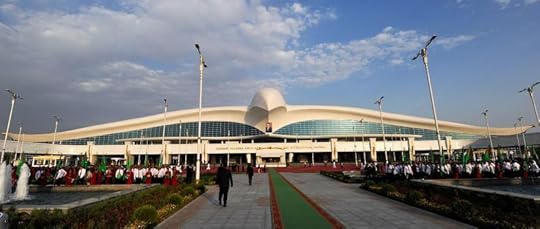
(Nesze neked, sólyom alakú repülőtér. Ilyen erővel lehetne vakond alakú is.)
Tény, hogy Kínának (úgy fest) retek sok pénze van. Az is tény, hogy a választóitól se kell megkérdeznie, mit tegyen vele. Ez a pénz most számolatlanul ömlik azokhoz az országokhoz, akikkel Kína szövetséget kíván kötni*. Nyilván ez egy olyan befolyásszerzés, amivel a Nyugat momentán nem tud, vagy nem is akar versenyezni. Ugyanakkor egyáltalán nem biztos, hogy a helyzet tragikus. Itt van például a Selyemút. Tegyük fel, hogy Kína orbitális összegeket feccöl egy hipermodern euroázsiai szupersztráda létrehozásába – ha ez így lesz, abból alighanem a szabadkereskedelem egésze profitálni fog. Másfelől (mint maga Frankopan is megjegyzi) hangzatosak a Selyemút jelentőségéről szóló lózungok, de a szárazföldi szállítás költségei a tengeri szállításhoz képest ötszörösek, szóval konténerhajóval elvinni egy kínai zacskós levest Görögországba valószínűleg száz év múlva is sokkal olcsóbb mulatság lesz, mint ugyanezt vasúton meg kamionon megtenni. Amiből az is következik, hogy a szabadkereskedelmet továbbra is az fogja kontrollálni, aki az óceánokat uralja, és ez egy ideig még az USA. Az egészhez pedig tegyük hozzá azt is, hogy valószínűleg senki sem függ annyira az áruk szabad áramlásától, mint Kína, szóval leginkább ő érdekelt a béke fenntartásában. Már csak azért is, mert egy valag pénzzel tartoznak neki mindenféle országok (az élen az USÁ-val), egy esetleges háborúban pedig az egészre keresztet vethetnének.
A veszélyek inkább közvetettek. Az egyik, hogy ezek a potens, látszólag átgondolt stratégiai céllal bíró aktív államok (elsősorban Kína, de idevehetjük Oroszországot, Iránt és Törökországot is) eredményei azt sugallják, hogy nem a liberális demokrácia a siker egyetlen útja – ugyanezt el lehet érni autoriter módszerekkel is. Ez pedig azt a mocskos kis gondolatot ülteti el egyes zsebdiktátorok fejében, hogy akár ők is örök időkig kormányon maradhatnak, feltéve, hogy a megfelelő gazdi lábához dörgölőznek. Mert amíg ugye az EU-nak mindenféle jogállamisági igényei vannak (micsoda dolog!), addig Putyin bácsi az ilyesmivel édeskeveset törődik, neki elég, ha megbízhatóan vétózunk, amikor kell.
A másik veszély pedig az, hogy ebben a bizonytalan helyzetben a Nyugat rossz válaszokkal áll elő. Bizonytalannak vagy agresszívnek mutatkozik, ezzel pedig eszkalálja a valóban meglévő feszültségeket. Ennek elkerülésére pedig akkor van leginkább esély, ha levetkőzi saját paranoiáit. Mert az óvatosság fontos, ám ha egy ország túlságosan belemerül a félelembe, akkor hamarosan valóra is váltja azokat.
Na, hát érdekes dolgok ezek, tényleg. Nem kötök bele abba sem, hogy Frankopan néhány megállapítását a megjelenés óta bekövetkezett események talán zárójelbe tették**(***) – ennek minden geopolitikus áldozatul esik, ha belekontárkodik a jövőbe. A baj sokkal inkább szerkezeti. Hogy esik a könyv szétfele. Nem érzem, hogy jól lenne tagolva, nem érzem, hogy lenne eleje meg vége – inkább tűnik az egész egy rendkívül hosszúra nyúlt, csapongó utószónak a szerző előző kötetéhez. Szó se róla, releváns információk sorjáznak egymás után, gond csak azzal van, hogy időnként mintha Frankopan is elveszne köztük. Jó tudni, hogy Pakisztán és Kína milyen gyümölcsöző szerződéseket kötött egymással, de elég ebből kettőt-hármat bemutatni, nem kell feltétlenül hatot. Az is érdekes, mit nyilatkozik az üzbég külügyi államtitkár a megbonthatatlan kazah-üzbég barátságról, csak hát amikor látjuk, hogy két napra rá már tök mást mond, akkor elmélázunk azon, hogy a politikusok nyilatkozataiból megtudunk-e bármi érdemlegeset a geostratégiákról, vagy az egész csak a politikusok hajlékonyságáról hordoz információt.
Lehet, túl szigorú vagyok vele, mert különben nem unatkoztam közben. Csak hát muszáj voltam arra gondolni, hogy ugyanebből az alapanyagból Tim Marshall milyen pakk kötetet kerekített: átláthatót, feszeset, jól felépítettet. Tényleg becsülöm Frankopant a tudása miatt, nem kétséges, ez a tudás érdemes arra, hogy megtalálja az utat az olvasóhoz. Csak valahogy gatyába kéne rázni a szerkezetet, mert nekem ez így csálé. Ha ezzel megvan, jöhet újra hozzám javítóvizsgázni.
* Tegyük hozzá, ez a pénz nem ingyen van. Kína (mint minden birodalom) akar valamit. Az általa biztosított összegek pedig gyakran olyan adósságcsapdába taszítják az érintett államokat, ahonnan lehetetlennek tűnik kimászni. Másfelől momentán a kínai gazdaság is behúzni látszik a kéziféket, és ilyen körülmények között kérdés, hogy ezek az összegek meddig ömlenek ilyen mennyiségben.
** Pikáns volt azokat a passzusokat olvasni, ahol a szerző az oroszok káprázatos Armata harckocsijáról, meg az orosz hadsereg dinamikus robotizálásáról beszél. Mert ugye Ukrajnában meg mit látunk? Hát Armata harckocsit pont nem. Viszont első világháborút idéző húsdarálót igen, ahol a ruszki vezérkar még mindig a „lehengerlő” gyalogosrohamoktól várja a megváltást. Nesze neked robotika.
*** Ha már oroszok. Nyilván Frankopan azt se láthatta előre, hogy Putyin felrúgja az asztalt Ukrajnában. Ami egy teljesen új helyzetet idézett elő: egyfelől a Nyugat a vártnál jóval határozottabban zárt össze (hogy ennek lesz-e valami hozadéka a jövőben, az nyitott kérdés), másfelől viszont Oroszország is gyengébbnek bizonyult a vártnál, ami azért világosan jelzi az autoriter rezsimek akut problémáit.
Hangsúlyozom, nem azzal van a gond, amit Frankopan mond. Pláne mert amit mond, az voltaképpen egyetlen evidenciában összefoglalható: „A jövő bonyolult.” Amivel nyilván nehéz vitatkozni. A kijelentés, hogy a XXI. század Ázsia évszázada lesz, akár igaz is lehet, de azért vannak kérdőjelek. Gazdasági növekedésük persze bámulatos, de hát ne feledjük, hogy pont azért lehet az, mert volt honnan növekedni. Ráadásul az egész folyamat tele van kétértelműségekkel, amelyek szimbóluma lehetne a türkmenisztáni Asgabat repülőtere, ami hatalmas, páratlan és bámulatos, Közép-Ázsia ékköve, és képes akár 17 millió utast is átereszteni magán per év. Csak sajnos az van, hogy az istennek se akar 17 millió utas megjelenni Asgabatban -2015-ben alig százezren méltóztattak erre vetemedni.Ráadásul az egész miskulancia süllyed el a homokba, mert rosszul alapozták le.
(Nesze neked, sólyom alakú repülőtér. Ilyen erővel lehetne vakond alakú is.)
Tény, hogy Kínának (úgy fest) retek sok pénze van. Az is tény, hogy a választóitól se kell megkérdeznie, mit tegyen vele. Ez a pénz most számolatlanul ömlik azokhoz az országokhoz, akikkel Kína szövetséget kíván kötni*. Nyilván ez egy olyan befolyásszerzés, amivel a Nyugat momentán nem tud, vagy nem is akar versenyezni. Ugyanakkor egyáltalán nem biztos, hogy a helyzet tragikus. Itt van például a Selyemút. Tegyük fel, hogy Kína orbitális összegeket feccöl egy hipermodern euroázsiai szupersztráda létrehozásába – ha ez így lesz, abból alighanem a szabadkereskedelem egésze profitálni fog. Másfelől (mint maga Frankopan is megjegyzi) hangzatosak a Selyemút jelentőségéről szóló lózungok, de a szárazföldi szállítás költségei a tengeri szállításhoz képest ötszörösek, szóval konténerhajóval elvinni egy kínai zacskós levest Görögországba valószínűleg száz év múlva is sokkal olcsóbb mulatság lesz, mint ugyanezt vasúton meg kamionon megtenni. Amiből az is következik, hogy a szabadkereskedelmet továbbra is az fogja kontrollálni, aki az óceánokat uralja, és ez egy ideig még az USA. Az egészhez pedig tegyük hozzá azt is, hogy valószínűleg senki sem függ annyira az áruk szabad áramlásától, mint Kína, szóval leginkább ő érdekelt a béke fenntartásában. Már csak azért is, mert egy valag pénzzel tartoznak neki mindenféle országok (az élen az USÁ-val), egy esetleges háborúban pedig az egészre keresztet vethetnének.
A veszélyek inkább közvetettek. Az egyik, hogy ezek a potens, látszólag átgondolt stratégiai céllal bíró aktív államok (elsősorban Kína, de idevehetjük Oroszországot, Iránt és Törökországot is) eredményei azt sugallják, hogy nem a liberális demokrácia a siker egyetlen útja – ugyanezt el lehet érni autoriter módszerekkel is. Ez pedig azt a mocskos kis gondolatot ülteti el egyes zsebdiktátorok fejében, hogy akár ők is örök időkig kormányon maradhatnak, feltéve, hogy a megfelelő gazdi lábához dörgölőznek. Mert amíg ugye az EU-nak mindenféle jogállamisági igényei vannak (micsoda dolog!), addig Putyin bácsi az ilyesmivel édeskeveset törődik, neki elég, ha megbízhatóan vétózunk, amikor kell.
A másik veszély pedig az, hogy ebben a bizonytalan helyzetben a Nyugat rossz válaszokkal áll elő. Bizonytalannak vagy agresszívnek mutatkozik, ezzel pedig eszkalálja a valóban meglévő feszültségeket. Ennek elkerülésére pedig akkor van leginkább esély, ha levetkőzi saját paranoiáit. Mert az óvatosság fontos, ám ha egy ország túlságosan belemerül a félelembe, akkor hamarosan valóra is váltja azokat.
Na, hát érdekes dolgok ezek, tényleg. Nem kötök bele abba sem, hogy Frankopan néhány megállapítását a megjelenés óta bekövetkezett események talán zárójelbe tették**(***) – ennek minden geopolitikus áldozatul esik, ha belekontárkodik a jövőbe. A baj sokkal inkább szerkezeti. Hogy esik a könyv szétfele. Nem érzem, hogy jól lenne tagolva, nem érzem, hogy lenne eleje meg vége – inkább tűnik az egész egy rendkívül hosszúra nyúlt, csapongó utószónak a szerző előző kötetéhez. Szó se róla, releváns információk sorjáznak egymás után, gond csak azzal van, hogy időnként mintha Frankopan is elveszne köztük. Jó tudni, hogy Pakisztán és Kína milyen gyümölcsöző szerződéseket kötött egymással, de elég ebből kettőt-hármat bemutatni, nem kell feltétlenül hatot. Az is érdekes, mit nyilatkozik az üzbég külügyi államtitkár a megbonthatatlan kazah-üzbég barátságról, csak hát amikor látjuk, hogy két napra rá már tök mást mond, akkor elmélázunk azon, hogy a politikusok nyilatkozataiból megtudunk-e bármi érdemlegeset a geostratégiákról, vagy az egész csak a politikusok hajlékonyságáról hordoz információt.
Lehet, túl szigorú vagyok vele, mert különben nem unatkoztam közben. Csak hát muszáj voltam arra gondolni, hogy ugyanebből az alapanyagból Tim Marshall milyen pakk kötetet kerekített: átláthatót, feszeset, jól felépítettet. Tényleg becsülöm Frankopant a tudása miatt, nem kétséges, ez a tudás érdemes arra, hogy megtalálja az utat az olvasóhoz. Csak valahogy gatyába kéne rázni a szerkezetet, mert nekem ez így csálé. Ha ezzel megvan, jöhet újra hozzám javítóvizsgázni.
* Tegyük hozzá, ez a pénz nem ingyen van. Kína (mint minden birodalom) akar valamit. Az általa biztosított összegek pedig gyakran olyan adósságcsapdába taszítják az érintett államokat, ahonnan lehetetlennek tűnik kimászni. Másfelől momentán a kínai gazdaság is behúzni látszik a kéziféket, és ilyen körülmények között kérdés, hogy ezek az összegek meddig ömlenek ilyen mennyiségben.
** Pikáns volt azokat a passzusokat olvasni, ahol a szerző az oroszok káprázatos Armata harckocsijáról, meg az orosz hadsereg dinamikus robotizálásáról beszél. Mert ugye Ukrajnában meg mit látunk? Hát Armata harckocsit pont nem. Viszont első világháborút idéző húsdarálót igen, ahol a ruszki vezérkar még mindig a „lehengerlő” gyalogosrohamoktól várja a megváltást. Nesze neked robotika.
*** Ha már oroszok. Nyilván Frankopan azt se láthatta előre, hogy Putyin felrúgja az asztalt Ukrajnában. Ami egy teljesen új helyzetet idézett elő: egyfelől a Nyugat a vártnál jóval határozottabban zárt össze (hogy ennek lesz-e valami hozadéka a jövőben, az nyitott kérdés), másfelől viszont Oroszország is gyengébbnek bizonyult a vártnál, ami azért világosan jelzi az autoriter rezsimek akut problémáit.

March 3, 2019
I haven’t had the benefit of reading the author’s The Silk Roads and am not encouraged to do so from reading what is essentially an appendix / update to it. I found this hard going. It feels like he has gone through news reports from the last three years and just listed everything that’s happening. I didn’t find much in the way of analysis. In summing up, Frankopan warns western readers not to focus solely on China, Russia and Iran when looking for reasons why the world is presently a more unstable place. Instead, they should look closer to home, particularly in the US. That’s an opinion that can be read in many newspapers around the world just now.
With thanks to Bloomsbury Publishing and NetGalley for a review copy.
With thanks to Bloomsbury Publishing and NetGalley for a review copy.
April 19, 2019
If the genre of “political Sinophile erotica” did not previously exist then I would like to congratulate Mr. Frankopan on being its founder. I purchased the book hoping to find a thought-provoking update to Frankopan’s interesting 2015 book The Silk Roads: A New History of the World. What I found was a hastily-crafted distillation of that previous book which takes Frankopan’s admiration of China and anti-Americanism to brave new heights without offering any really new or useful analysis of the current situation in the Silk Road countries.
At the beginning of the book, Frankopan notes that he originally intended the work as a postscript to his previous book. That is exactly what he should have done. Instead, what he produced was a goulash that is part book report, part love letter to China, and part jeremiad against the United States and Donald Trump. At a quarter of its ultimate length, the book may have been the interesting update I was hoping for. In its ultimate form, however, I cannot recommend this book to anybody looking for a serious analysis of the subject matter unless you, too, share Frankopan’s infatuation with China or his visceral hatred of the United States.
Physically, the book is divided into five chapters. In reality, the book is divided into four themes. The first theme is an entirely-too-long compilation of recent joint statements released by Central Asian state media organizations. Frankopan exhaustively summarizes every announcement of Central Asian bilateral cooperation made during the past few years. In statement after statement, country X and country Y pledge billions of dollars and exchange meaningless platitudes that promise to improve relationships and “widen and deepen cooperation” along some line of effort. Proposals to build pipelines, proposals to build infrastructure, proposals to work together to achieve peace and harmony and etc. I haven’t the patience to count all the instances of the word “proposal” in this book but if it is less than 1,000, I would be surprised.
This litany of proposals is supposed to illustrate the connectivity and cooperation that is happening in the region. However, as he does with virtually everything else in this book, especially China’s Belt and Road announcements, Frankopan takes these “proposals” at face value. If you added all of these proposals up, you would probably find that a significant proportion of the world’s GDP has been committed to developing Central Asia alone. If proposals were dollars (or yuan) then Central Asia would be drowning in cash. The fact is that most of these proposals are (in some cases literally) pipe dreams. It is very easy to make grandiose plans and say nice words. Putting those plans into action, much less financing them, is much more difficult. Frankopan does make a feeble acknowledgment of this but then dismisses it by saying that if even a portion of these proposals is fulfilled then the region will be drastically advanced. A reader can easily get the gist of this chapter by skimming a few pages or, better yet, reading a couple of the source documents themselves. No need to torture yourself with more.
The second theme of the book is a shameless panegyric to China. Frankopan made his Sinophilia clear in his previous book but, in this work, his admiration for China goes beyond awe and approaches sexual arousal. The reader can well imagine the author having to take frequent breaks for cold showers during the writing of this section in order to tame his passions.
The majority of the chapter is dedicated to championing China’s Belt and Road Initiative, or BRI. Frankopan breathlessly extolls China’s brilliance in offering generous financing and construction offers to help countries around the world build ports, roads, power stations, and other much-needed infrastructure projects. In paragraph after paragraph, Frankopan shows how the clever Chinese are outmaneuvering the moribund West from Australia to Zimbabwe by “enhancing cooperation,” providing “win-win scenarios” and promoting “mutual understanding.” This soft power play is apparently winning China friends and influencing people on an unprecedented scale and is paving the way for China’s “peaceful” rise and superpower status.
In his gushing praise of the BRI, Frankopan commits the same sin to which most Sinophiles, and many Sinophobes, seem to fall victim: holding the belief that China has a grand, 500-year strategy and is playing 12-dimensional chess while the West is playing checkers. Frankopan seems to believe that each piece of the BRI is a deeply-considered action designed to give China some kind of strategic or economic advantage. It never seems to occur to Frankopan that China may just be shooting from the hip, attempting to both purchase influence around the world while simultaneously finding new projects where it can employ its massive construction industry now that domestic demand is drying up. The fact that many of the BRI projects do not make economic sense and will inevitably result in economic losses seems to be a problem that Frankopan doesn’t wish to address.
Frankopan seems to believe that, when it comes to the BRI, not only is there such a thing as a free lunch, but China will pay you to eat it. China’s use of the BRI to force countries into debt bondage, its failure to employ local labor in construction of the projects, and its purchase of enormous swaths of land in developing countries are all regrettable but necessary complications. Western imperialism BAD! Chinese imperialism GOOD!
The third theme of the book is a jeremiad against the United States. In this section, Frankopan uses Donald Trump’s foreign policy ignorance as a foil for China’s strategic brilliance. The United States has, for the past 74 years, devoted an enormous amount of effort and treasure to creating and maintaining the current stable and prosperous international order. However, Frankopan attempts to convince the reader that, with a few short tweets, Donald Trump has wrecked the entire structure. Further, Frankopan argues that, rather than attempting to overturn the current international order in its favor, China is dedicated to upholding the current structure. To him, it is “…obvious that, far from being a subversive power seeking to undermine the international liberal order… China is, in fact, conspicuous in the way it works within institutions…”
No, Mr. Frankopan, it is not obvious. Anybody who has battled against China’s flouting of WTO rules and norms, its aggressive use of non-tariff barriers, its onerous technology sharing requirements, its belligerent, State-sponsored commercial espionage program, its Finlandization of its ASEAN neighbors, or its support for brutal authoritarian regimes can tell you. These are not the actions of a government intent on upholding the existing liberal international order.
In his defense, Frankopan does briefly wag a finger at China for such actions as creating the world’s largest concentration camp to detain and “re-educate” its Uighur minority and illegally seizing and militarizing vast swaths of the South China Sea. However, as Frankopan concedes with a literary shrug, China has security needs, too!
As a side note, I find Frankopan’s obvious scorn for Donald Trump to be confusing. Given his respect for Central Asia’s autocratic leaders, his esteem for Vladimir Putin, and his reverence for Xi Jinping, Frankopan should be a natural admirer of Trump. Why does Trump, who once declared Kim Jong Un to be “my friend”, deserve such short shrift? Is it because he is an American? Or because he has taken actions detrimental to China’s interests? Or possibly both?
The final theme of the book is supposed to be a look into the future. However, Frankopan is a much better historian than he is a futurist. This part of the book was hastily written and even contains some obvious errors, like the statement that SpaceX is using Russian RD-180 engines on its rockets. (SpaceX uses proprietary engines. The United Launch Alliance does use the RD-180 on its Atlas V booster, but only until a replacement is developed.) The rest is a stream-of-consciousness mishmash where Frankopan delves into artificial intelligence, bashes the United States again, defends the Iranian regime, loves on China one last time, and then finally, blessedly, brings the book to a conclusion.
There is a place in the international political affairs genre for dissenting voices that don’t parrot the classic Western talking points. Frankopan made a bold contribution with his previous work. This book, however, does not live up to its predecessor’s analytical rigor. Instead, it takes its predecessor’s already harsh anti-Occidentalism into levels of hysterical screeching. There are better treatments of the subject matter - I suggest you read them instead.
At the beginning of the book, Frankopan notes that he originally intended the work as a postscript to his previous book. That is exactly what he should have done. Instead, what he produced was a goulash that is part book report, part love letter to China, and part jeremiad against the United States and Donald Trump. At a quarter of its ultimate length, the book may have been the interesting update I was hoping for. In its ultimate form, however, I cannot recommend this book to anybody looking for a serious analysis of the subject matter unless you, too, share Frankopan’s infatuation with China or his visceral hatred of the United States.
Physically, the book is divided into five chapters. In reality, the book is divided into four themes. The first theme is an entirely-too-long compilation of recent joint statements released by Central Asian state media organizations. Frankopan exhaustively summarizes every announcement of Central Asian bilateral cooperation made during the past few years. In statement after statement, country X and country Y pledge billions of dollars and exchange meaningless platitudes that promise to improve relationships and “widen and deepen cooperation” along some line of effort. Proposals to build pipelines, proposals to build infrastructure, proposals to work together to achieve peace and harmony and etc. I haven’t the patience to count all the instances of the word “proposal” in this book but if it is less than 1,000, I would be surprised.
This litany of proposals is supposed to illustrate the connectivity and cooperation that is happening in the region. However, as he does with virtually everything else in this book, especially China’s Belt and Road announcements, Frankopan takes these “proposals” at face value. If you added all of these proposals up, you would probably find that a significant proportion of the world’s GDP has been committed to developing Central Asia alone. If proposals were dollars (or yuan) then Central Asia would be drowning in cash. The fact is that most of these proposals are (in some cases literally) pipe dreams. It is very easy to make grandiose plans and say nice words. Putting those plans into action, much less financing them, is much more difficult. Frankopan does make a feeble acknowledgment of this but then dismisses it by saying that if even a portion of these proposals is fulfilled then the region will be drastically advanced. A reader can easily get the gist of this chapter by skimming a few pages or, better yet, reading a couple of the source documents themselves. No need to torture yourself with more.
The second theme of the book is a shameless panegyric to China. Frankopan made his Sinophilia clear in his previous book but, in this work, his admiration for China goes beyond awe and approaches sexual arousal. The reader can well imagine the author having to take frequent breaks for cold showers during the writing of this section in order to tame his passions.
The majority of the chapter is dedicated to championing China’s Belt and Road Initiative, or BRI. Frankopan breathlessly extolls China’s brilliance in offering generous financing and construction offers to help countries around the world build ports, roads, power stations, and other much-needed infrastructure projects. In paragraph after paragraph, Frankopan shows how the clever Chinese are outmaneuvering the moribund West from Australia to Zimbabwe by “enhancing cooperation,” providing “win-win scenarios” and promoting “mutual understanding.” This soft power play is apparently winning China friends and influencing people on an unprecedented scale and is paving the way for China’s “peaceful” rise and superpower status.
In his gushing praise of the BRI, Frankopan commits the same sin to which most Sinophiles, and many Sinophobes, seem to fall victim: holding the belief that China has a grand, 500-year strategy and is playing 12-dimensional chess while the West is playing checkers. Frankopan seems to believe that each piece of the BRI is a deeply-considered action designed to give China some kind of strategic or economic advantage. It never seems to occur to Frankopan that China may just be shooting from the hip, attempting to both purchase influence around the world while simultaneously finding new projects where it can employ its massive construction industry now that domestic demand is drying up. The fact that many of the BRI projects do not make economic sense and will inevitably result in economic losses seems to be a problem that Frankopan doesn’t wish to address.
Frankopan seems to believe that, when it comes to the BRI, not only is there such a thing as a free lunch, but China will pay you to eat it. China’s use of the BRI to force countries into debt bondage, its failure to employ local labor in construction of the projects, and its purchase of enormous swaths of land in developing countries are all regrettable but necessary complications. Western imperialism BAD! Chinese imperialism GOOD!
The third theme of the book is a jeremiad against the United States. In this section, Frankopan uses Donald Trump’s foreign policy ignorance as a foil for China’s strategic brilliance. The United States has, for the past 74 years, devoted an enormous amount of effort and treasure to creating and maintaining the current stable and prosperous international order. However, Frankopan attempts to convince the reader that, with a few short tweets, Donald Trump has wrecked the entire structure. Further, Frankopan argues that, rather than attempting to overturn the current international order in its favor, China is dedicated to upholding the current structure. To him, it is “…obvious that, far from being a subversive power seeking to undermine the international liberal order… China is, in fact, conspicuous in the way it works within institutions…”
No, Mr. Frankopan, it is not obvious. Anybody who has battled against China’s flouting of WTO rules and norms, its aggressive use of non-tariff barriers, its onerous technology sharing requirements, its belligerent, State-sponsored commercial espionage program, its Finlandization of its ASEAN neighbors, or its support for brutal authoritarian regimes can tell you. These are not the actions of a government intent on upholding the existing liberal international order.
In his defense, Frankopan does briefly wag a finger at China for such actions as creating the world’s largest concentration camp to detain and “re-educate” its Uighur minority and illegally seizing and militarizing vast swaths of the South China Sea. However, as Frankopan concedes with a literary shrug, China has security needs, too!
As a side note, I find Frankopan’s obvious scorn for Donald Trump to be confusing. Given his respect for Central Asia’s autocratic leaders, his esteem for Vladimir Putin, and his reverence for Xi Jinping, Frankopan should be a natural admirer of Trump. Why does Trump, who once declared Kim Jong Un to be “my friend”, deserve such short shrift? Is it because he is an American? Or because he has taken actions detrimental to China’s interests? Or possibly both?
The final theme of the book is supposed to be a look into the future. However, Frankopan is a much better historian than he is a futurist. This part of the book was hastily written and even contains some obvious errors, like the statement that SpaceX is using Russian RD-180 engines on its rockets. (SpaceX uses proprietary engines. The United Launch Alliance does use the RD-180 on its Atlas V booster, but only until a replacement is developed.) The rest is a stream-of-consciousness mishmash where Frankopan delves into artificial intelligence, bashes the United States again, defends the Iranian regime, loves on China one last time, and then finally, blessedly, brings the book to a conclusion.
There is a place in the international political affairs genre for dissenting voices that don’t parrot the classic Western talking points. Frankopan made a bold contribution with his previous work. This book, however, does not live up to its predecessor’s analytical rigor. Instead, it takes its predecessor’s already harsh anti-Occidentalism into levels of hysterical screeching. There are better treatments of the subject matter - I suggest you read them instead.

April 21, 2019
I loved the original Silk Road by Frankopan--this book is a pointless update. It's just a survey of what is happening with Chinese and Middle eastern trade policy.

March 7, 2019
This is more or less a postscript to Peter Frankopans' The Silk Road, released in 2016. Whilst the first book My review was quite an in depth history of the Silk Roads stemming from the East and their trade relations with the rest of the World, the conclusion never really covered the modern day that well. This latest book, coming in at just over three-hundred pages was released late in 2018 and it essentially deals with how the East (the China, Iran, Pakistan, India and Moscow and Caucasus States alliance/axis) is really on the rise, with trade agreements between these countries, instigated by the slowly Industrial power-house China is becoming, or has become. Whilst the US under Trump has become more and more protectionist in imposing trade tariffs against countries such as China and Iran, much to their detriment in the long term, China is open to negotiating trade deals with all the Asian countries, instead of isolating itself. This is the 'New Silk Roads', the modern version if you like of the old trade in spices, silks, slaves that, arguably helped the West develop. Today it is about Oil and Natural Resources, Arms and Weaponry, Modern Tech and so on.
Whilst this is quite a short book, I do suggest reading the first book initially (even that is over 600 pages long), and maybe I would suggest also having some interest in Economics too. It is Economic heavy, and I did have to re-read certain paragraphs, not that it is that academically written, but I believe you need to have some understanding of the political situation in the world today, especially of the role of China and Iran (and no lesser India and Russia too). And obviously Donald Trump and his dangerous agenda. Alliances are the key in our modern world, and Peter Frankopan suggests towards the end of the book that whilst the West today is floundering, the Asian Countries are developing much more rapidly and posing a 'threat' that is replacing that of the US due to their isolationist outlook. Good book, but heavy going, and I would recommend to Political, History and Economic students, as well as to the average lay reader who shows an interest in the future of our World. 4 stars, but the first chapter was quite heavy going. Afterwards it became more interesting with the rise of China and the role of Iran and the Middle East.
Whilst this is quite a short book, I do suggest reading the first book initially (even that is over 600 pages long), and maybe I would suggest also having some interest in Economics too. It is Economic heavy, and I did have to re-read certain paragraphs, not that it is that academically written, but I believe you need to have some understanding of the political situation in the world today, especially of the role of China and Iran (and no lesser India and Russia too). And obviously Donald Trump and his dangerous agenda. Alliances are the key in our modern world, and Peter Frankopan suggests towards the end of the book that whilst the West today is floundering, the Asian Countries are developing much more rapidly and posing a 'threat' that is replacing that of the US due to their isolationist outlook. Good book, but heavy going, and I would recommend to Political, History and Economic students, as well as to the average lay reader who shows an interest in the future of our World. 4 stars, but the first chapter was quite heavy going. Afterwards it became more interesting with the rise of China and the role of Iran and the Middle East.
December 24, 2018
3.5/5 The author's Silk Roads is one of the best and most refreshing books on world history that I have read and so I had to read this one too. This book was conceived as an epilogue to Silk Roads and then was finally published as a separate book.
As a friend commented, this reads like "stitched headlines" from the recent years (published in 2018) with a focus on China (and Central Asia). The book described the rise of Asian countries and its implications pretty well. The One Belt One Road intiative has been covered in quite some detail. So has the USA vs China rivalry and the various shifting political alignments. One thing is for clear, it is not a unilateral world any more. Even less so with a lunatic at the helm of USA who doesnt believe in international institutions.
Like the Silk Roads, there are some great facts and insights that made this worth reading. But, on the other hand wish this had the length and depth of Silk Roads too.
As a friend commented, this reads like "stitched headlines" from the recent years (published in 2018) with a focus on China (and Central Asia). The book described the rise of Asian countries and its implications pretty well. The One Belt One Road intiative has been covered in quite some detail. So has the USA vs China rivalry and the various shifting political alignments. One thing is for clear, it is not a unilateral world any more. Even less so with a lunatic at the helm of USA who doesnt believe in international institutions.
Like the Silk Roads, there are some great facts and insights that made this worth reading. But, on the other hand wish this had the length and depth of Silk Roads too.

November 27, 2018
The follow up to The Silk Roads: A New History of the World, which became a bestseller Here, Frankpan picks up the story and looks at the present. The focus is on economics, trade and political developments. Western economies have become inert, their growth has been overtaken and the dynamism is in the east. While much attention has been paid to the rise of populism across the world, that masks what are arguably more important goings on that are covered in this book. The news media really needs to have a greater emphasis on Asia as a whole, and less on Trump's latest tweet. What happens in China will deeply effect the rest of the world due to the interconnected financial markets, and trade that is deeply dependent on China. The next global crash could very well start in China. While the United States remains the global hegemon, its foreign policy has become confused under the Trump administration. It is virtually impossible to predict what Trump will do next. The State Department loses funding and many posts are unfilled. This is at a time when China and Russia have been court allies. Rivalries abound between Saudi Arabia and Iran, India and Pakistan, Many of the countries around China Pakistan is an exception. We do not know how Trump's trade war with China will turn out.
At the time of writing, there is a major incident between Russia and Ukraine, and it is unknown how the situation will be resolved. But it is a result of Russia's undeclared (and forgotten) war in Ukraine that has been waging since he annexation of Crimea. Russian aggression needs to be countered.
There are pop culture trends that also point the direction of the new silk roads, although they aren't mentioned in this book. K-pop has rapidly become one of the most popular music genres in the world (I doubt if anyone saw that coming). Pewdiepie, for a long time the world's most subscribed YouTube channel, is about to be dethroned by T series, an Indian music service. The rapid growth of the internet in India, a country where more people have access to a mobile phone than a flushing toilet, Both K-pop and T series indicative of the trends in this book, but they are cultural trends. What happens in culture is more significant than political events. I wish Frankopan had written about the cultural shifts.
Although an important issue that is not covered in this book is migration. Despite the rise of the new silk roads, migrants in their millions still look west rather than east and Europe is the preferred destination. The migrant crisis has been disaster for Europe. The increase in terrorist attacks is one of the many problems.
How does the future look? Right now, half the world is now middle class or wealthier, which is a remarkable development that everyone needs to know, as it ought to be headline news everywhere. The dramatic reductions in poverty over the last 50 years has now led us here. That needs to be taken into account going forward. But automation (not covered in this book) threatens to put millions out of work. Predicting the future has always been a tricky business, but technological developments and risk posed by automation has to be one of the big political issues that is discussed in election cycles. For more, I suggest reading 21 Lessons for the 21st Century.
At the time of writing, there is a major incident between Russia and Ukraine, and it is unknown how the situation will be resolved. But it is a result of Russia's undeclared (and forgotten) war in Ukraine that has been waging since he annexation of Crimea. Russian aggression needs to be countered.
There are pop culture trends that also point the direction of the new silk roads, although they aren't mentioned in this book. K-pop has rapidly become one of the most popular music genres in the world (I doubt if anyone saw that coming). Pewdiepie, for a long time the world's most subscribed YouTube channel, is about to be dethroned by T series, an Indian music service. The rapid growth of the internet in India, a country where more people have access to a mobile phone than a flushing toilet, Both K-pop and T series indicative of the trends in this book, but they are cultural trends. What happens in culture is more significant than political events. I wish Frankopan had written about the cultural shifts.
Although an important issue that is not covered in this book is migration. Despite the rise of the new silk roads, migrants in their millions still look west rather than east and Europe is the preferred destination. The migrant crisis has been disaster for Europe. The increase in terrorist attacks is one of the many problems.
How does the future look? Right now, half the world is now middle class or wealthier, which is a remarkable development that everyone needs to know, as it ought to be headline news everywhere. The dramatic reductions in poverty over the last 50 years has now led us here. That needs to be taken into account going forward. But automation (not covered in this book) threatens to put millions out of work. Predicting the future has always been a tricky business, but technological developments and risk posed by automation has to be one of the big political issues that is discussed in election cycles. For more, I suggest reading 21 Lessons for the 21st Century.
September 30, 2019
The entire book could easily be described as a summary of geopolitical events of the past years, with the distinct bias of a liberal intellectual.
The author goes through the rise of China as economic superpower and the opportunities it offers. A fan of globalization despite the costs for the masses of the Western world, he cares little about the problems it causes. China might as well buy every relevant Western industry and he'd be ok with it, so long that it's in line with his ideological purity of an ever open world.
Very little attention to the threat China poses in terms of human rights, censorship and repression, he's obsessed with big financial numbers that justify endless concessions. For those unconvinced about his economic arguments (he's a historian anyway), he then goes on a rant ''Orange Man Bad''.
The mediocrity of the liberal intellectual is exposed once he starts whining about Russian meddling and yet chastises Trump's sanctions against Russia because they push the latter closer to China. Damned if you do, damned if you don't.
Unsatisfied, he exposes even his own ignorance about US immigration history, bringing in the controversy of detained children at the border as something unprecedented and inhumane. Forget the fact that immigrants from Europe to America were kept in quarantine in places like Ellis Island, in far, far less humane conditions. Forget the fact it had nothing to do with his whole argument anyway.
In conclusion, an Ivy League/Oxbridge type that sees non-Western nations outplaying the US and the EU at their own game, the ''rule-based order'', while lamenting the end of it. A good read if you want to know why the West is falling behind: it's because of a leadership class like this writer.
The author goes through the rise of China as economic superpower and the opportunities it offers. A fan of globalization despite the costs for the masses of the Western world, he cares little about the problems it causes. China might as well buy every relevant Western industry and he'd be ok with it, so long that it's in line with his ideological purity of an ever open world.
Very little attention to the threat China poses in terms of human rights, censorship and repression, he's obsessed with big financial numbers that justify endless concessions. For those unconvinced about his economic arguments (he's a historian anyway), he then goes on a rant ''Orange Man Bad''.
The mediocrity of the liberal intellectual is exposed once he starts whining about Russian meddling and yet chastises Trump's sanctions against Russia because they push the latter closer to China. Damned if you do, damned if you don't.
Unsatisfied, he exposes even his own ignorance about US immigration history, bringing in the controversy of detained children at the border as something unprecedented and inhumane. Forget the fact that immigrants from Europe to America were kept in quarantine in places like Ellis Island, in far, far less humane conditions. Forget the fact it had nothing to do with his whole argument anyway.
In conclusion, an Ivy League/Oxbridge type that sees non-Western nations outplaying the US and the EU at their own game, the ''rule-based order'', while lamenting the end of it. A good read if you want to know why the West is falling behind: it's because of a leadership class like this writer.

December 30, 2018
Littered with typos and poorly edited, I can only assume there was a rush to get this out in time to get it in the hardback displays for Christmas. It requires revision for the paperback edition because this is a shoddy and irritating oversight from an eminent scholar.
It is also littered with statistics and only ever reaches the level of a quasi analysis of the current state of play in international relations. For much of the book, I found myself saying “yes that’s right” - which always worries me. I’m no expert on international relations or foreign affairs, but I knew 80% of the content already, and the chapters meander unhelpfully so the book as an entity is more a selection of barely complimentary tapas dishes than a balanced meal, and I sense that isn’t what the author intended.
It lacks argument and clear structure, the facts, insights and snippets of speeches are interesting - particularly in relation to the Trump Administration’s approach to foreign policy and its contrast to China’s (to the US’s detriment). Ultimately, it feels half-baked and in need of another six months’ refinement and reflection.
If this was a book that led us up to, say, 2016, with some brief musings on the Trumpocalypse at the end, it would have been the better for limiting itself. If one is to take us right to the present day, it should have an insight more valuable than China = strategic; US = chaotic and isolationist. No shit.
It is also littered with statistics and only ever reaches the level of a quasi analysis of the current state of play in international relations. For much of the book, I found myself saying “yes that’s right” - which always worries me. I’m no expert on international relations or foreign affairs, but I knew 80% of the content already, and the chapters meander unhelpfully so the book as an entity is more a selection of barely complimentary tapas dishes than a balanced meal, and I sense that isn’t what the author intended.
It lacks argument and clear structure, the facts, insights and snippets of speeches are interesting - particularly in relation to the Trump Administration’s approach to foreign policy and its contrast to China’s (to the US’s detriment). Ultimately, it feels half-baked and in need of another six months’ refinement and reflection.
If this was a book that led us up to, say, 2016, with some brief musings on the Trumpocalypse at the end, it would have been the better for limiting itself. If one is to take us right to the present day, it should have an insight more valuable than China = strategic; US = chaotic and isolationist. No shit.

August 2, 2019
Not so much of a stand-alone non-fiction book but rather an extended (and revised) epilogue to the excellent The Silk Roads: A New History of the World. But even if you jumped straight in - there is still plenty to enjoy. I reckon it offers very fine journalist writing with an essential & insightful digest of the recent affairs (2016/17 onwards). Peter is a fantastic storyteller and he really helps to ‘join the pieces’ together and allow to see the patterns in time.
I would wish more people read this book with some level of attention paid to the premises and conclusions if offers.
PS: this was my first completed Audible book as well!
I would wish more people read this book with some level of attention paid to the premises and conclusions if offers.
PS: this was my first completed Audible book as well!

December 26, 2021
It pains me to give it one star but goddamn.
I started hate reading this after page 100 because of how repetitive it was.
It feels like you’re literally just reading 290 pages of news headlines.
The most exciting part of this book was the introduction.
Disappointed because this is the first book I read by Peter Frankopan. Heard a lot of great things about his previous novel but this one did not deliver at all.
I started hate reading this after page 100 because of how repetitive it was.
It feels like you’re literally just reading 290 pages of news headlines.
The most exciting part of this book was the introduction.
Disappointed because this is the first book I read by Peter Frankopan. Heard a lot of great things about his previous novel but this one did not deliver at all.

November 5, 2021
O sursă excelentă de informații despre (pe scurt și ultra-simplificat):
- noua rețea a conexiunilor economice și intereselor politice și militare- mult mai compexă decât vechile drumuri ale mătăsii, cu China în centrul de comandă, cu puncte strategice în Africa și America de Sud (pentru resurse sau pentru acces la căi maritime), cu proprietăți în America de Nord și Europa de Vest și, mai ales, cu parteneriate cu dușmanii Americii - Rusia, Iran, Turcia;
- jocuri duble ale tuturor, de la Arabia Saudită și Pakistan, care, din motive diferite, trebuie să fie prietene și cu SUA, și cu China, până la cei doi mari rivali, care nu pot fi atât de combativi (cel puțin deocamdată) pe cât se declară (de dragul propagandei și populismului);
- concentrarea resurselor în alte zone decât Occidentul (de ex. în China pentru indutria IT, în Asia Centrală și statele arabe pentru petrol, în Rusia, Ucraina pentru grâu etc.);
- transformarea țărilor sărace în piețe de desfacere pentru economia chineză și în datornice față de sistemul de creditare chinezesc; prin urmare, existența unui risc al datoriilor neperfomante și al unui balon al creditării chinezesc (care ar avea un impact devastator și pentru alte sisteme financiare, mai ales pentru Marea Brtanie);
- interesul Americii și al Rusiei de a-și vinde armele în țări extrem de bogate (ca Arabia Saudită) sau în țări angrenate deja în conflicte disperate (ca Pakistanul), un interes despre care se vorbește mai rar decât despre cel de a exploata resursele naturale din zonele respective (sau vecine, mai degrabă - vezi Irak, Afganistan);
- haosul instaurat de Trump, care a destabilizat enorm poziția SUA și a ajutat creșterea influenței Chinei și Rusiei (deși establishmentul american susține că deozrdinea internațională avantajează America - cred că e mai mult discurs de damage control);
- poziția aproape irelevantă a Uniunii Europene, a vechii civilizatii occidentale, în acest nou tablou mondial. Poziție care nu devine mai puțin fragilă dacă se continuă tratarea Chinei ca inamic. Cu ce e mai rea o investiție chinezească decât una de la un fond privat de investiții, se întreabă Frankopan. Va trebui să citesc despre fondurile de investiții ca să îmi pot da seama daca e posbil ca (și) ele să aibă interesul de a declanșa un război la un moment dat (pot doar să presupun că se investește în industria atât de profitabilă a armamentului, dar nu știu nimic despre aceste fonduri).
Mai e de adăugat ca această carte (aflată la a doua ediție) a fost scrisă cât Trump era încă președinte și nu aveam încă o pandemie (pornită din China). Deci mă aștept și la o a treia ediție (și aș citi-o). Singurul minus pe care i l-am găsit a fost că a inclus excesiv de multe citate absolut politicianiste din Trump, Xi, Putin etc., populisme despre colaborarea și prietenia între popoare și interesul comun și aș fi preferat, în schimb, mai multă analiză personală din partea autorului, chiar dacă asta însemna o doză mai mare de subiectivism. Ce-i drept, avem de-a face cu un istoric, și încă unul care pare serios, deci e de înțeles efortul de a rămâne obiectiv.
- noua rețea a conexiunilor economice și intereselor politice și militare- mult mai compexă decât vechile drumuri ale mătăsii, cu China în centrul de comandă, cu puncte strategice în Africa și America de Sud (pentru resurse sau pentru acces la căi maritime), cu proprietăți în America de Nord și Europa de Vest și, mai ales, cu parteneriate cu dușmanii Americii - Rusia, Iran, Turcia;
- jocuri duble ale tuturor, de la Arabia Saudită și Pakistan, care, din motive diferite, trebuie să fie prietene și cu SUA, și cu China, până la cei doi mari rivali, care nu pot fi atât de combativi (cel puțin deocamdată) pe cât se declară (de dragul propagandei și populismului);
- concentrarea resurselor în alte zone decât Occidentul (de ex. în China pentru indutria IT, în Asia Centrală și statele arabe pentru petrol, în Rusia, Ucraina pentru grâu etc.);
- transformarea țărilor sărace în piețe de desfacere pentru economia chineză și în datornice față de sistemul de creditare chinezesc; prin urmare, existența unui risc al datoriilor neperfomante și al unui balon al creditării chinezesc (care ar avea un impact devastator și pentru alte sisteme financiare, mai ales pentru Marea Brtanie);
- interesul Americii și al Rusiei de a-și vinde armele în țări extrem de bogate (ca Arabia Saudită) sau în țări angrenate deja în conflicte disperate (ca Pakistanul), un interes despre care se vorbește mai rar decât despre cel de a exploata resursele naturale din zonele respective (sau vecine, mai degrabă - vezi Irak, Afganistan);
- haosul instaurat de Trump, care a destabilizat enorm poziția SUA și a ajutat creșterea influenței Chinei și Rusiei (deși establishmentul american susține că deozrdinea internațională avantajează America - cred că e mai mult discurs de damage control);
- poziția aproape irelevantă a Uniunii Europene, a vechii civilizatii occidentale, în acest nou tablou mondial. Poziție care nu devine mai puțin fragilă dacă se continuă tratarea Chinei ca inamic. Cu ce e mai rea o investiție chinezească decât una de la un fond privat de investiții, se întreabă Frankopan. Va trebui să citesc despre fondurile de investiții ca să îmi pot da seama daca e posbil ca (și) ele să aibă interesul de a declanșa un război la un moment dat (pot doar să presupun că se investește în industria atât de profitabilă a armamentului, dar nu știu nimic despre aceste fonduri).
Mai e de adăugat ca această carte (aflată la a doua ediție) a fost scrisă cât Trump era încă președinte și nu aveam încă o pandemie (pornită din China). Deci mă aștept și la o a treia ediție (și aș citi-o). Singurul minus pe care i l-am găsit a fost că a inclus excesiv de multe citate absolut politicianiste din Trump, Xi, Putin etc., populisme despre colaborarea și prietenia între popoare și interesul comun și aș fi preferat, în schimb, mai multă analiză personală din partea autorului, chiar dacă asta însemna o doză mai mare de subiectivism. Ce-i drept, avem de-a face cu un istoric, și încă unul care pare serios, deci e de înțeles efortul de a rămâne obiectiv.

October 7, 2020
อ่านได้สักพักถึงรู้ว่าไม่ได้พูดเรื่องประวัติศาสตร์เส้นทางสายไหมนี่หว่า 5555 ถ้าคนชอบความสัมพันธ์ระหว่างประเทศคงอ่านสนุกอยู่มั้งครับ แต่ตั้งใจอ่านพาร์ทประวัติศาสตร์ อ่านจบแล้วกลายเป็นการเมืองร่วมสมัย เลยเศร้าหน่อยๆ

June 28, 2022
من به خاطر موضوع پایاننامهی ارشدِ پایاننیافتهی خودم به موضوع زیرساختهای حملونقل علاقه داشتم و اخبار مرتبط را پیگیری میکردم. این موضوع اهمیتش از سرمایهگذاری سنگین چین در «ابتکارِ» «کمربند و راه» شروع شد و این کتاب هم به همین طرح یا «ابتکار» میپردازه. منتهی، خوب، تمرکز من بیشتر روی هند بود که به جنوب آسیا گسترش پیدا میکرد. این کتاب خیلی کم به جنوب آسیا نگاه میکنه، که البته نامعقول هم نیست، چون هند کلاً وارد این ابتکار نشد و با سوءظن به اون نگاه میکنه.
این کتاب درواقع گزارشی است از اخبار پیرامون «کمربند و راه» و برای همین هم هست که ۱۵۰ صفحه متن داره و ۴۰ صفحه ارجاعاتی که قریب به اتفاقشون به اخبار است.
کتاب بسیار بهروزه، ولی همین بهروزبودن تاریخمصرفدارش میکنه. کتاب قبل از پایان دورهی ترامپ نوشته شده و نگاه منتقدانهای به او داره.
از بلاتکلیفی و سوءظن همراه با بیعملی غربیها در مقابل این طرح میگه، ولی همین دیروز گویا در اجلاس جی۷، بایدن و شرکا برنامهای چندصدمیلیارددلاری برای انجام پروژههای زیرساختی در مقابله با این طرح در سرتاسر دنیا اعلام کردهاند. البته این اولینباری نیست که غربیها چنین برنامههایی را اعلام میکنند. گویا اروپا هم سال گذشته از طرحی مشابه پردهبرداری کرده بود. منتهی نکتهی مهم در تفاوت طرح چین و طرح غربیها اینه که سرمایهگذاریهای چین را خود دولت پیش میبرد، ولو بهصورت نامتمرکز. ولی در غرب سیاستمدار فقط میتونه به بخش خصوصی فشار بیاره که برو و سرمایهگذاری کن. غرب، درهرحال، مجبوره هزینه و فایدهی اقتصادی طرحها را بسنجه. چین دستش از این جهت بسیار بازتره و برای همین هم در پروژههایی سرمایهگذاری میکنه که کس دیگهای حاضر به انجامش نیست. نکتهی دیگه اینکه چین میتونه پنهانکاری زیادی بکنه، ولی شفافیت و مستندسازی نقطهی قوت غربیها است. اوایلی که من سعی میکردم دربارهی کمربند و راه تحقیق کنم، حتی وبسایت درستودرمانی که توضیح بده قضیه چیه وجود نداشت و مطمئن نیستم که الان هم وجود داشته باشه. قضیه در سطوح اداری و سیاسی برگزار میشه و نه سرمایهگذار و نه کشورهای سرمایهپذیر نیازی به مطلعشدن مردمشان از جزئیات ماجرا ندارند و اساساً اهل شفافیت هم نیستند.
از ایران و حسن و ممجواد هم بارها نام میبره.
ولی، بههرحال، باید توجه داشت که با وجود قلم بیطرفانهی نویسنده، ما مجبوریم پنجرهی خودمان را به دنیا داشته باشیم. حتی در هند هم که زبان انگلیسی جزو زبانهای رسمی است، امکان ارتباط اقتصادی و تاثیرگذاری بر مردم فقط از طریق شناخت محلی و فرهنگ و زبان محلی ممکن است. گویا ما حتی از عراق هم شناخت چندانی نداریم و برای همین سرمایهگذاریها شکست میخوره یا به موفقیتی که باید دست پیدا نمیکنه. ولی با این دیوار آهنینی که تحریمها و انزواگرایی از دو طرف بلند کردهاند، اینها بیشتر شبیه خواب و خیال میمونه.
این کتاب درواقع گزارشی است از اخبار پیرامون «کمربند و راه» و برای همین هم هست که ۱۵۰ صفحه متن داره و ۴۰ صفحه ارجاعاتی که قریب به اتفاقشون به اخبار است.
کتاب بسیار بهروزه، ولی همین بهروزبودن تاریخمصرفدارش میکنه. کتاب قبل از پایان دورهی ترامپ نوشته شده و نگاه منتقدانهای به او داره.
از بلاتکلیفی و سوءظن همراه با بیعملی غربیها در مقابل این طرح میگه، ولی همین دیروز گویا در اجلاس جی۷، بایدن و شرکا برنامهای چندصدمیلیارددلاری برای انجام پروژههای زیرساختی در مقابله با این طرح در سرتاسر دنیا اعلام کردهاند. البته این اولینباری نیست که غربیها چنین برنامههایی را اعلام میکنند. گویا اروپا هم سال گذشته از طرحی مشابه پردهبرداری کرده بود. منتهی نکتهی مهم در تفاوت طرح چین و طرح غربیها اینه که سرمایهگذاریهای چین را خود دولت پیش میبرد، ولو بهصورت نامتمرکز. ولی در غرب سیاستمدار فقط میتونه به بخش خصوصی فشار بیاره که برو و سرمایهگذاری کن. غرب، درهرحال، مجبوره هزینه و فایدهی اقتصادی طرحها را بسنجه. چین دستش از این جهت بسیار بازتره و برای همین هم در پروژههایی سرمایهگذاری میکنه که کس دیگهای حاضر به انجامش نیست. نکتهی دیگه اینکه چین میتونه پنهانکاری زیادی بکنه، ولی شفافیت و مستندسازی نقطهی قوت غربیها است. اوایلی که من سعی میکردم دربارهی کمربند و راه تحقیق کنم، حتی وبسایت درستودرمانی که توضیح بده قضیه چیه وجود نداشت و مطمئن نیستم که الان هم وجود داشته باشه. قضیه در سطوح اداری و سیاسی برگزار میشه و نه سرمایهگذار و نه کشورهای سرمایهپذیر نیازی به مطلعشدن مردمشان از جزئیات ماجرا ندارند و اساساً اهل شفافیت هم نیستند.
از ایران و حسن و ممجواد هم بارها نام میبره.
ولی، بههرحال، باید توجه داشت که با وجود قلم بیطرفانهی نویسنده، ما مجبوریم پنجرهی خودمان را به دنیا داشته باشیم. حتی در هند هم که زبان انگلیسی جزو زبانهای رسمی است، امکان ارتباط اقتصادی و تاثیرگذاری بر مردم فقط از طریق شناخت محلی و فرهنگ و زبان محلی ممکن است. گویا ما حتی از عراق هم شناخت چندانی نداریم و برای همین سرمایهگذاریها شکست میخوره یا به موفقیتی که باید دست پیدا نمیکنه. ولی با این دیوار آهنینی که تحریمها و انزواگرایی از دو طرف بلند کردهاند، اینها بیشتر شبیه خواب و خیال میمونه.

March 30, 2023
2,5*
Пътищата на коприната са важни (щем - не щем) и трябва да следим за тяхното развитие. Това в общи линии е тезата на Франкопан, която той изказва в началото и в края на книгата си. Тя е в пъти по-кратка от предхождащата я "The Silk Roads" и за разлика от нея е обърната към настоящето и бъдещето, а не към миналото.
Според мен Франкопан е много по-силен като историк, отколкото като геополитик. В малкото страници на "The New Silk Roads" има натрупано огромно (несъразмерно даже) количество информация, призвана в подкрепа на основната теза, но честото прескачене от проблем на проблем, от държава на държава, от икономика в социология и политология ме обърка и на няколко пъти напълно изгубих аналитичната нишка.
Друга важна особеност е, че книгата е писана преди Ковид пандемията и еп. 2 на Войната в Украйна от 2022 г. Отправна точка на изследването са куриозите около президентския мандат на Тръмп, които (ако няма втори такъв) бързо слязоха от дневния ред на американската и световната политика (това са рисковете на политологичната професия!).
Накратко, надявам се Франкопоан да се върне към попрището на историческата наука.
Пътищата на коприната са важни (щем - не щем) и трябва да следим за тяхното развитие. Това в общи линии е тезата на Франкопан, която той изказва в началото и в края на книгата си. Тя е в пъти по-кратка от предхождащата я "The Silk Roads" и за разлика от нея е обърната към настоящето и бъдещето, а не към миналото.
Според мен Франкопан е много по-силен като историк, отколкото като геополитик. В малкото страници на "The New Silk Roads" има натрупано огромно (несъразмерно даже) количество информация, призвана в подкрепа на основната теза, но честото прескачене от проблем на проблем, от държава на държава, от икономика в социология и политология ме обърка и на няколко пъти напълно изгубих аналитичната нишка.
Друга важна особеност е, че книгата е писана преди Ковид пандемията и еп. 2 на Войната в Украйна от 2022 г. Отправна точка на изследването са куриозите около президентския мандат на Тръмп, които (ако няма втори такъв) бързо слязоха от дневния ред на американската и световната политика (това са рисковете на политологичната професия!).
Накратко, надявам се Франкопоан да се върне към попрището на историческата наука.

December 4, 2020
Nakon odlične knjige Putevi svile, Peter Frankopan, potaknut pohlepom i instant uspjehom, napisao je loš i nepotreban nastavak.
200 stranica rekla-kazala, (polu) informacija na razini prepisivačkih portala, neprobavljiva pljuvačina na Trumpa i njegovu administraciju, besciljno nabrajanje svih infrastrukturnih projekata Kine, Indije, Kazahstana, Uzbekistana i inih. Sreća jedino što nije opširna ccc 200 st. , pa se brzo pročita.
Samo zbog prethodne knjige dajem 2*.
200 stranica rekla-kazala, (polu) informacija na razini prepisivačkih portala, neprobavljiva pljuvačina na Trumpa i njegovu administraciju, besciljno nabrajanje svih infrastrukturnih projekata Kine, Indije, Kazahstana, Uzbekistana i inih. Sreća jedino što nije opširna ccc 200 st. , pa se brzo pročita.
Samo zbog prethodne knjige dajem 2*.

July 31, 2021
اصلا در حد و اندازههای جلد اولش (راههای ابریشم) نبود. این جلد فقط در ستایش نقشهی «یک کمربند یک جاده»ی چین و محکوم کردن غرب و به خصوص آمریکا بود و این مضمون جابهجا تکرار میشد. این جلد هم پر بود از منابع و مراجع. اما منابع و مراجع بیشتر جمع آوری اخبار و گفتههای سران کشورهای مختلف جهان بود. اصلا به تنوع جلد اول نبود. فقط از گذار گرانیگاه جهان از غرب به شرق گفته بود و برخلاف عنوان کتاب که از آینده جهان میگوید از پیامدهای تبدیل چین به گرانیگاه جهان هم حرف چندانی نگفته بود... ۵۰ صفحه اخر را به زور خواندم. کتاب ۱۵۰ صفحه بود و ۵۰ صفحه منابع مراجع. کلهم تو ۳۰-۴۰ صفحه میتوانست جمعش کند. حرف چندانی برای گفتن نداشت.

December 27, 2019
The worst book I’ve read in 2019 ☹
The book reads very much like disparate news clips from the Economist with little, if any, analysis added, peppered heavily with quotations that are loosely tied around the unconvincing thesis that Asian countries are significantly ramping up collaboration among each other.
In fact, as the author himself suggests later in the book, those “collaborations” are rather tenuous, based mostly on words than deeds (Chinese ventures mostly being the significant exception) and come as a reaction to the recent US foreign policy that has alienated friends and foes alike. If anything China and Russia as regional powers are stepping into the vacuum created by the US retreat in the region. To speak of a genuine collaboration (let alone to write a book on it) seems therefore misleading to say the very least.
Shallow piece of work that I wouldn’t have expected to come from the pen of an Oxford professor.
The book reads very much like disparate news clips from the Economist with little, if any, analysis added, peppered heavily with quotations that are loosely tied around the unconvincing thesis that Asian countries are significantly ramping up collaboration among each other.
In fact, as the author himself suggests later in the book, those “collaborations” are rather tenuous, based mostly on words than deeds (Chinese ventures mostly being the significant exception) and come as a reaction to the recent US foreign policy that has alienated friends and foes alike. If anything China and Russia as regional powers are stepping into the vacuum created by the US retreat in the region. To speak of a genuine collaboration (let alone to write a book on it) seems therefore misleading to say the very least.
Shallow piece of work that I wouldn’t have expected to come from the pen of an Oxford professor.

December 11, 2022
I think the book in one aspect did focused on collecting facts, data, and survey without adequate interpretation and analysis. To be fair, in later chapters, Frankopan did try to put his view and add some analysis. But, the main flaw in the book, I think, is the discussion was not focused on the New Silk Roads, instead, huge pages were dedicated in laboring the point of rising China, and how United States attempt in vain trying to contain China. The discussion on the New Silk Road were very general without any meaningful and useful analysis. The definition given were too wide, almost meaningless where it covers all transport and communication development in the world including Europe and the Caribbean. The book is suitable for leisure reading, without much contemplation, but if you seek to find meaningful analysis on the New Silk Roads, its histories, development, and future, this is not the book.

August 21, 2019
This is the companion volume to the earlier historical work by the author. It works as a contemporary analysis in the age of Brexit and Trump. As a futures work it is far less convincing. I think that this is because it struggles to escape from the present, and falls into the trap of seeing the future as the same as the present, only more so.
I am very taken by the analysis of the present. In many respects, the opening of this book continues the story of the previous book. The previous book more or less comes to today. This books starts in the recent past and updates us on where we are today. It charts the movement in the locus of the world economy back eastwards again. It establishes the Heart of the World as a central component in our story. It highlights the role of trade and economic interdependence as the basis upon which out prosperity rests. In a globalised world, our gaze shifts back to where it was before the Industrial Revolution.
The rise of Asia has been at the expense of the western nations. More precisely, at the expense of the working and middle classes of the western nations. And they don't like it. The author sees this as the underpinnings of both Trump and his 'America First' philosophy, and Brexit nd the 'Taking Back Control' philosophy. The rivalry between the US and China pre-dates Trump, but Trump has given the rivalry a sharper edge. On reflection, this process can be seen in the alarms of the 1980s, when the fear was that Japan would dominate the western nations. That didn't happen, but the fear remains.
This provides the key to the future. We have a resurgent China, a Russia that has found itself after the Communist interlude, and more assertive Iran, and a more dynamic India. This is the lens, according to the author, through which we shall view the future. I am not so sure. It may be a bit early to write off Europe and North America just yet. The dynamism that brought them to prominence three hundred years ago is still there. Africa is another area that has the opportunity to develop its potential in this century. We cannot write off Africa either. However, it is hard to dispute that Asia will loom large in our emergent futures. The question is whether we should resist or accommodate that rise?
My inclination is to accommodate rather than to resist. Not everyone agrees. It will be interesting to see how this tussle plays out in the coming years. What we can say for certain is that we occupy a point of change, and that the future is likely to be quite different from the past.
I am very taken by the analysis of the present. In many respects, the opening of this book continues the story of the previous book. The previous book more or less comes to today. This books starts in the recent past and updates us on where we are today. It charts the movement in the locus of the world economy back eastwards again. It establishes the Heart of the World as a central component in our story. It highlights the role of trade and economic interdependence as the basis upon which out prosperity rests. In a globalised world, our gaze shifts back to where it was before the Industrial Revolution.
The rise of Asia has been at the expense of the western nations. More precisely, at the expense of the working and middle classes of the western nations. And they don't like it. The author sees this as the underpinnings of both Trump and his 'America First' philosophy, and Brexit nd the 'Taking Back Control' philosophy. The rivalry between the US and China pre-dates Trump, but Trump has given the rivalry a sharper edge. On reflection, this process can be seen in the alarms of the 1980s, when the fear was that Japan would dominate the western nations. That didn't happen, but the fear remains.
This provides the key to the future. We have a resurgent China, a Russia that has found itself after the Communist interlude, and more assertive Iran, and a more dynamic India. This is the lens, according to the author, through which we shall view the future. I am not so sure. It may be a bit early to write off Europe and North America just yet. The dynamism that brought them to prominence three hundred years ago is still there. Africa is another area that has the opportunity to develop its potential in this century. We cannot write off Africa either. However, it is hard to dispute that Asia will loom large in our emergent futures. The question is whether we should resist or accommodate that rise?
My inclination is to accommodate rather than to resist. Not everyone agrees. It will be interesting to see how this tussle plays out in the coming years. What we can say for certain is that we occupy a point of change, and that the future is likely to be quite different from the past.
Displaying 1 - 30 of 867 reviews