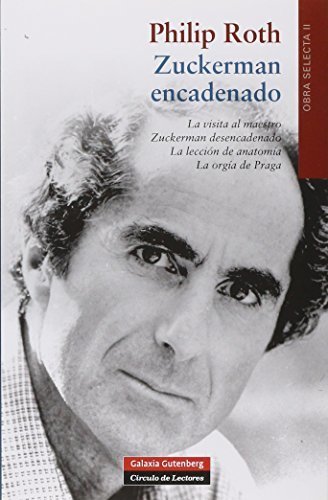
Only in the last five years have I read enough Roth to recognize and appreciate his talent and prodigious creativity. Years ago when I encountered Portnoy’s Complaint, I thought it merely a clever, entertaining book, and it didn’t inspire me to read more. After reading The Ghost Writer, Everyman, American Pastoral, Nemesis, The Plot Against America, The Human Stain (and several others) I’ve come to see that the common denominator is a vigorous, sinewy prose, driven by mordant wit distilled from outrage and ego. Roth does not use metaphor and simile as Updike does, but there’s the same vital engagement with the profusion of things, people, thoughts, actions. While there may be some quibble about obsessiveness in Roth’s writing, the reader finds that even as Roth’s fictional character is circling a subject, Roth has made of this a vortex that can draw in everything. Roth’s own sensibility, his filter on the world—which he further refines in the use of first-person surrogates who either tell their own story or someone else’s story (in these instances, it is Nathan Zuckerman)—has as its existential fount and locus a mid-20th century childhood in Newark, New Jersey, where he was the oldest son in a middle-class Jewish family.
So much for my general appreciation of Roth, a writer whom I perceive as having been admirably, unstintingly dedicated to craft over a 50-year career, even if, as he appears to indicate via his personae, there was nothing else he wanted to do. In this present volume, with novellas spanning a six-year period, Roth employs a persona, Nathan Zuckerman, both near and far enough from Roth himself to permit creative license to alter (embroider, exaggerate, twist, re-imagine) facts and extrapolate fictions true to Roth’s own existential core. The underlying lifestory of Nathan Zuckerman is not unlike Roth’s, and probably there is something of Roth in this young, brash, querulous, charming, offensive, eager Zuckerman. Like Roth, Zuckerman is at first a promising, then a successful writer, trying to figure out—and deal with—what his writing means to him and to the world at large.
In The Ghost Writer, a young Zuckerman (who’s only thus far written short stories) is confronted with a situation that allows him a way to respond to demands from his father that his work reflect/depict Jews in a favorable light. There is seldom anything completely straightforward in Roth’s storytelling; Zuckerman presents an initial filter/distortion and there are further screens/events through which to discern the nub about which the story is unfolding. This is the seemingly obsessive vortex to which I referred, in which everything is absorbed. In this instance, Zuckerman imagines for himself a chance to tell his father (and a buttinsky judge) that his fiction cannot be questioned because he’s married to Anne Frank herself. This fictional daydream is a flight from the reality that Zuckerman faces, which is to write in dedicated manner like his idol, a reclusive, well-respected writer whose wife finally (or again, as if for the umpteenth time…?) explodes and walks out in frustration at his neglect...
Zuckerman Unbound treats of the phenomenon of success (contrasted strongly with neglect, envy, and paranoia) as Zuckerman is just beginning to reap the benefits of his successful bestseller Carnovsky (a correlate to Roth’s own Portnoy’s Complaint), which makes him rich and recognized. The same concern about the depiction of Jews underlies Zuckerman’s angst, and—when an obsessive fan begins to blackmail Zuckerman with threats against his mother—he is forced to worry about the way relatives and strangers may react to his parents. There is considerably more humor in this novel than in The Ghost Writer, and Zuckerman/Roth gains great traction from playing up readers’ inability to understand how fiction is not autobiography.
In The Anatomy Lesson, Roth ratchets up Zuckerman’s doubt and guilt, has it metastasize as a back and neck pain that wholly incapacitates him. Even Zuckerman’s harem of female caregivers cannot offset his frustration about being unable to write, his discipline and need to write shattered by a pain that lays him out flat on his back. He is still playing in his mind his brother’s assertion that his novel Carnovsky killed his father, and it makes him wonder if the pain is some sort of penance/punishment. Alcohol, pot, and opioids escalate, and Zuckerman fixates on the idea that he wants to become a doctor. In his quest to change himself, he impersonates a pornographer, making up for himself the role of editor of small-time rag Lickety-Split, conjuring First Amendment court cases, a swinger’s club, even a family. Wildly oscillating behavior sends Zuckerman to the hospital, where as he recovers from his physical injuries and withdraws from his addictions, he observes and serves others in the clinic.
In the novella (and the screenplay) Prague Orgy, Zuckerman’s becomes involved in a scheme to retrieve from communist Czechoslovakia the unpublished Yiddish writings of a Jew killed during WWII. Zuckerman recounts his visit to Prague, where artists and writers have been neutered, any real art a threat to their survival. Driven underground, artists dissipate themselves in alcohol and sex, staying just this side of clandestine agents of the state. Zuckerman secures the manuscript, but it’s taken from him by police, agents of the Ministry of Art, and he’s given the bum’s rush back to the States. In the screenplay, Zuckerman’s failed effort is given more explicit purpose, that it was (or is perceived to be) a means to make his own art meaningful.
These four novellas cover a lot of terrain in Roth’s examination of the ways Zuckerman and his readers respond to his fiction. The self-doubt (and the deprecating, pratfall comedy) is not evident in the later Zuckerman of American Pastoral, where his role is to serve as a focusing conduit, much as Marlow served Conrad. In Zuckerman Unbound, Roth stays very close to home, and he is able to have it both/several ways, playing out his own concerns via a surrogate, making fun and creating alternate realities for his own lived experience, denying full identification with Zuckerman’s conflicts because he is, after all, just a fictive persona, and received critical theory holds that author and persona are not the same (wink, wink), or maybe not...