Una girandola di colori e associazioni bizzarre: i nomi sono scientifici, ma le famiglie e i gruppi reinventati dall'immaginazione dell'illustratrice. Un altro capolavoro dopo il successo della strana enciclopedia degli animali dalla stessa autrice Adrienne Barman.
So many different trees and plants! I learned so much from this book - great for any aspiring gardener! A great resource if you are trying to redo the garden you currently have. Here in California we all have really had to look at more drought resistant plants - the days of lush green lawns seem to be over forever here.
Non-fiction is an area that many kids avoid (save for the odd footy or magic book). Of course, there are always those who are the exception but for most if you put a book in front of them showing photographs of plants they will immediately know that the book want to "teach them" something and the avoidance starts. That's where I feel a book like this is rather handy. It's non-fiction and shows plants in their habitats, classification, and (my favourite) in colours! It's a book you can have a student choose a page to look at and discuss what they see, think, and feel about it. A very handy book for teachers who have students who are reading well-below their reading level as well as it still looks like a "proper book" even though it has simplified language.
Overall, I do recommend this one for students of all age but with particular focus on that 7-10 age range and those who may struggle with reading. Due for release on 24th April 2018 in Australia and elsewhere.
Certainly not a complete compendium of plant life, but an interesting variety grouped into eclectic categories. The illustrations are vivid and appealing.
Plantopedia is in no way encyclopedic as the title suggests, and I was left wondering what, if any, criteria for inclusion or exclusion were used to select the plants covered. A more cohesive vision for who the intended audience is could have made this a better book. Several of the categories manage to strike the right tone to engage a preteen. Kids love the bizarre, gross, and extreme. Had they expanded categories such as "Giants," "Poisoners," and "Perfumed" with more even and extensive tidbits of curious facts, it might have earned a 4 star review.
The art is vibrant and engaging, with cute animals peeking out around plants, and many full-page spreads of scenes that are fun to explore. Though the overall art style is consistent, each category gets a slightly different treatment. The Dyes category is especially well done, with streams of color coming out from beneath each plant and being used as dye. The art is not sufficiently detailed to identify plants, and there are a few places where a close-up view would have better matched the writing ("Marsh Pennywort: Turn over the floating leaves to see tiny pink flowers." - I want to see these tiny pink flowers!).
If Plantopedia is not intended to be botanically accurate, the inclusion of an appendix of leaf shapes is incongruous. The appendix and other elements implied a level of botanical accuracy which was not met. "Cereals" included buckwheat, which is botanically a pseudocereal. In Fruits You Have to Peel, quince is misleadingly described as "a hard lumpy pear." (Though both in the family Rosaceae, quince are in a genus by themselves, and many varieties are not pear-shaped.) There is no reason this work could not have been accurate and served as a better introduction to botany through the allure of the illustrations.
Many, but not all, of the categories have explanatory subtitles. They were omitted at times where they were called for, and where a bit of elementary scientific information about plants could easily have been conveyed; there was plenty of space on the otherwise fairly simple Stone Fruits page to define drupes, the Cereals page would have benefited from a simple statement that cereals are the edible seeds of grasses, and the category Hybrids is left undefined. Other categories are wildly subjective (Tasty Fruits, Useful). The contents of the Healers and Magical sections do not differentiate fact from fiction ("Milk Thistle: Heals the liver." and "Lily: White Magic. Carry a bulb in your pocket to break a love spell.").
The factoids that accompany some entries are similarly uneven, giving the impression that they were the result of a quick internet search rather than a thoughtful addition.
I was disappointed that the work did not live up to the quality of the illustrations.
Optional purchase for middle readers collection at large public libraries.
I received an ARC from the publisher for review purposes.
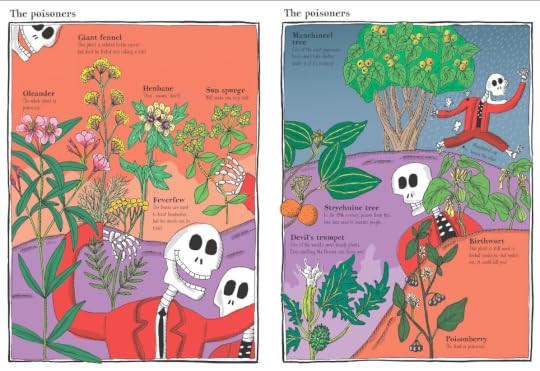
This is a delightful book for the picture book crowd, that shows plants by color, or by smell, or if they are poisonous, as evident in the pictures below.
What a great way to get children engaged in the plants around them. Even if the parent or teacher might not know which plant is which, there is a chance that the child might find the plant in this book, or at least get curious about the plants, from this book.
Hopefully this will only be the start of a child's inertrest in plants and all things botany.
Thanks to Netgalley for making this book available for an honest review.
De vrolijke planten encyclopedie. Door Adrienne Barman. Vertaling: Bibi Dumon Tak.
Prachtig boek. Voor jong én oud. Boeiend én grappig. Leerrijk en entertainend. Super origineel boek dat uren lees- en kijkplezier garandeert.
Barman heeft een eigen kijk op de plantenwereld en die blik vertaalt ze geweldig door middel van super vrolijke (en toch best realistische) tekeningen. Haar tekenstijl spat van het blad is uit duizenden herkenbaar. Op geheel eigen wijze heeft zij de plantenfamilies herschapen in groepen zoals: de eenpitters, de veranderlijken, de geparfumeerden, de sterren,… Klinkt een beetje raar maar als je het boek erbij neemt begrijp je haar volledig en vraag je je af waarom niemand eerder op dit idee kwam.
Adrienne gebruikt amper woorden en slaagt er toch in om veel kennis over te brengen. Kennis en liefde. Want zonder een gigantische liefde voor planten kom je niet tot het uitvogelen van een eigen verdelingssysteem. Zij kon niet terugvallen op bestaande encyclopedieën en moest dus helemaal van nul beginnen. Dat mogen mensen vaker doen want het heeft in dit geval geleid tot een prachtboek dat jarenlang gekoesterd gaat worden.
Boeiend, kleurrijk en boordevol visuele grapjes (zoals bloeddruppels en katten die high zijn). Dikke merci Adrienne voor dit pareltje. Ik zag op haar site dat ze al meerde encyclopedieën heeft gemaakt en duim dan ook super hard dat Querido ook deze laat vertalen door Bibi! Fan!
A beautifully written and illustrated non-fiction book. The book welcomes you to a collection of amazing plants from all over the world, chosen for their unique traits and characteristics, with amazing illustrations by Adrienne Barman. You can meet the ‘evergreens’, the ‘edibles’ and the ‘elderly’ plants that have outlived the dinosaurs in this alphabetical encyclopedia.
Le illustrazioni sono vividissime, bellissime; ho trovato il criterio di raggruppamento delle piante molto divertente (quanto mi sarebbe piaciuto leggerlo e sfogliarlo da piccola!) e per certi versi sorprendente. Stupendo da leggere in compagnia <3
A very eye-catching and colorfully illustrated visual encyclopedia covering all sorts of plants all over the world. Broken up into three-four pages sections, such as the stars (star shaped flowers), the evergreens, the confused fruits (fruits that are usually used as veggies), and the historical (plants with interesting historical influence). Although there are very few written facts about the actual plants, they are all illustrated accurately, although some lend themselves to additional detailed close-ups or clarifications that all these plants don’t live together as they are shown on the pages, and provide an awesome introduction to the abundant variety there is throughout the world. There is also a section at the end that illustrates the differences between leaf shapes and arrangements which was a definite plus for me.
This is definitely a look-and-learn (look-and-associate?) book, as it’s so colorful (and cute, there are lots of little animal friends in a variety of the sections), littles are bound to continually pick it up and as they do, they’ll start to associate the looks of the flowers and trees with their names, and be able to identify some of them in the real world. It’s a great jumping off point as well for older kids who may have to do reports on plants, and are looking for inspiration to choose something unique to research.
Thank you to NetGalley for providing me with a free copy to review!
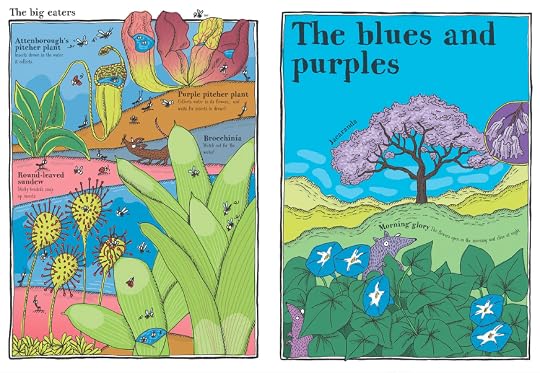
Plantopedia is the follow-up to Creaturepedia. It is basically a picture book with lots of funky pictures of plants in it with minimal words along the way. The plants are split into chapters with titles such as “The air fresheners”, “The imposters” and “The stinkers”. The spreads typically include all the plants in the same colourful environment with some animals or insects milling around them to provide some more fun to the images.
What this book isn’t is a thorough encyclopedia of plants, the “–opedia” part of the title perhaps being misleading. You won’t for example learn which countries plants hail from. Instead this is more of a gentle introduction which tries to present the topic in a fun way. This means it might just pique the interest of a child, say. It also has a ribbon bookmark attached, in plant-coloured green, which is something else kids like. Having said that I would say this is maybe less accessible than Creaturepedia just because creatures are more well-known, so more recognisable, and also they are more varied (so more interesting) than plants, in my opinion.
If you want something to help you learn about plants in detail then get something else, if you want something that might get kids interested in plants then get this.
I was drawn to this plant guide as despite being a children's non fiction guide, the illustration is very eye-catching, set into colour pages such as all black plants, aquatic plants featuring animals too, dyes from plants, types of trees, fruit and veg, herbs and medicinal healing plants, this guide shares everything across all types of outdoor wildlife flower, tree and plant wise in a perfect way for children.
The guide also warns of the dangers plants like cactus can pose as well as a guide to poisonous plants to be wary of.
Packed with colours popping from the page and simple plant labelling for kids to follow, this book would be a great introduction to learning what plants are safe or not and maybe even get them involved in gardening too.
Many thanks to the publishers for allowing me to review this book for them!
Plantopedia is a colourful delightfully hand drawn book of all kinds of plants, trees, vegetables and flowers.
The book is split into 50 different categories, with fun titles such as 'The confused fruits', ' The sand lovers' and 'The old timers'.
Each plant is hand drawn, some give a very short fact about the plant - such as the black tulip is actually a deep purple and most pages have an animal, insect or mammal on the page for fun. Also included is an Appendix on leaf shapes, arrangements and edges and finally a glossary.
This book is aimed at young children, and I would think those 6 years or under might find the book fun. Maybe to make the book more interesting, a section where the child could tick off any plants they discover could be good.
I received this book from netgalley in return for a honest review.
This is such a cool book for children that I would have loved to read something similar when I was a child. My son loved it also, even if he doesn't speak English, because the pictures are clear and very similar to the real plants, that are easy to recognize most of the time.
Questo libro per bambini é molto bello e mi sarebbe piaciuto aver letto qualcosa di simile quando ero piccola io. Anche mio figlio lo ha apprezzato molto, pur non parlando inglese, perché le illustrazioni sono ben fatte ed ´é quindi semplice riconoscere le piante, almeno la maggior parte del tempo.
Plantopedia is the follow up to the brilliant Creaturepedia by author Adrienne Barman. Welcome to the wild, wonderful and weird world of plants. This is 200 pages of plant heaven, featuring the deadly and the dangerous, the magical and the mysterious, the confused and the clever, the helpful and the historical, the useful and the unusual and all manner of others.
Plantopedia organises the plants, flowers, weeds and trees by the traits and characteristics that make them stand out. I love this method of organisation and it makes things so much more relevant, relatable and accessible to young readers. Readers can dive into categories including; The Confused Fruits, The Giants, The Lookalikes, The Prickly, The Stinkers, The Tropical, and my two favourites, The Magical and The Poisoners.
Categories are organised in alphabetical order and there is an illustrated double page contents which lists all the various categories and the page numbers on which they can be found. There is also an index if you want to quickly find a certain plant. An appendix features many different types of leaves which includes illustrations, the fancy names of each particular leaf, the defining characteristic and a plant on which the leaf can be found. A glossary of plant themed words is a lovely addition and will expand the readers knowledge of words including biennial, horticulture, pollination and tendril.
The book is gorgeous to look at. Each plant is carefully illustrated and vibrant colours bring the plants and pages to life. Each illustration is unique and they are full of warmth, charm and humour. Each plant has its name written in bold next to its illustration and short interesting facts and figures are included in many instances. The attention to detail is superb and the inclusion of animals and people into many of the scenes just adds to the fun and appeal of this book.
Sometimes you read a book and you just know that it will be one that you will go back to time and time again, this is one of those books. Everything about it is beautiful. The pages are thick and it comes with its own fancy ribbon page marker too.
A book to delight readers who have any interest in the plants of this world. Plantopedia will provide endless hours of enjoyment and readers will be going back to read this time and time and time again.
'Plantopedia' by Adrienne Barman is a colorful collection of plant drawings that is fun to explore.
Arranged by different categories, this is a fun look at the different plants we find in our world. You can find plants by color or medicinal value. There are categories for poisonous or uniqueness to area. There are categories of prickly and plants that that are edible.
This book has pages of fun drawings. Along with the plants, there are various fauna mixed in, so there are humans and aardvarks and spiders and other surprises hidden in the pages. I had fun poring through this book and I think younger readers would find it fun and informative.
I received a review copy of this ebook from Quarto Publishing Group - Wide Eyed Editions, and NetGalley in exchange for an honest review. Thank you for allowing me to review this ebook.
A brightly illustrated and well organised collection of plants. Plants have been categorised into groups such as; The aquatics, The air fresheners, The sand lovers, The climbers, The evergreens and so on. Useful facts lie beneath the name headings of plants. An informative and beautiful book.
Although this isn't a true field guide, it is a joyous cartoony celebration of plant life categorized in fun ways (big eaters, healers, imposters, poisoners, prickly, stinkers, useful) that would appeal to those who enjoy graphic novels. I loved it.
This book is a work of art. It´s a beautiful collection of botanical illustrations classified into different categories. It´s a visual encyclopedia. Maybe I was expecting a bit more information about the plants, and that´s why it´s not a 5/5. But it´s still pretty awesome.
Beautiful art and interesting facts - I learned a lot reading this! Would have liked it even more if there was a bit more information about the plants included.