Three sisters – beautiful, cultured and aristocratic, born into immense wealth during the reign of Queen Victoria. Their dramatic lives are here unfolded in a rich historical biography certain to appeal to fans of Downton Abbey, ‘Georgiana’ and Stella Tillyard’s ‘Aristocrats’.
Mary, Madeline and Pamela – the three Wyndham sisters – were painted by John Singer Sargent in 1899. For The Times it was, quite simply, ‘the greatest picture of modern times’. But these beautiful, fin de siecle gentlewomen came to epitomize a vanished world. The languor of their pose reflects the leisured, gilded, existence of the late Victorian aristocracy that was to be dealt a deathblow by the First World War.
Yet the lives of these three Wyndham sisters were far more turbulent than their air of calm suggests. Brought up in artistic circles, their childhood was liberal and romantic. Their parents were intimate friends with the Pre-Raphaelites and the girls grew to become leaders of the aesthetic movement. Bowing to convention, they made excellent marriages but found emotional support from others – Mary with Arthur Balfour and the poet Wilfrid Scawen Blunt; Pamela with Liberal statesman and ornithologist Edward Grey. Their liaisons shocked society, while the First World War devastated their way of life.
‘Those Wild Wyndhams’ is their first ever biography, and is based on the many letters they have left behind – compelling, humorous and brilliantly illuminating. This sparkling debut by Claudia Renton captures them and their age in an unforgettable piece of historical and political biography.
In 1898, John Singer Sargent began the portrait of three sisters: Mary, Madeline and Pamela Wyndham. The Wyndham Sisters was heralded as Sargent’s masterpiece, with the Prince of Wales calling it, “The Three Graces.” In this book, the author chronicles the times of these three cultured, beautiful and aristocratic women, who as members of The Souls, mixed with those in positions of political influence, as well as artistic circles.
This book straddles both the Victorian and Edwardian age. Parents Percy (youngest son of Lord Leconfeld) and Madeline (from a prominent Irish family, but without a fortune) had a marriage full of affection and love –although, as life always is, not without its difficulties. Their eldest child was daughter Mary, followed by sons George and Guy. The two youngest daughter, Madeline (always known as Mananai, after childish attempts to say her name) and Pamela, were close in age and naturally paired off together. Although the boys were educated at Eton, like many parents at that time, a good education was not thought essential for girls at that time. Mary was almost self-taught and governesses gave basic lessons.
Throughout this biography, we follow the marriages, love affairs, scandals and tragedies of the sisters. The sisters were involved with just about everyone in aristocratic, political and artistic circles – we are taken from the desert in Egypt, to the pomp of India during the Raj and to scandals which rocked the Souls (Harry Cust and Nina Welby) and society (Oscar Wilde and Bosie Douglas). The author does a great job of noting the political events that are important throughout the book, but always keeping the book personal and not overshadowing the characters. However, one world changing event which did completely dominate and change the world of the Wyndham’s, and their friends and acquaintances, were the cataclysmic events of the First World War - which comes near the end of the book. You gather that while those who lost early in the war were obviously mourned, the terrible loss of life led to a real stunned sense of disbelief by the end of the war. A whole generation of men were wiped out and the losses changed the Wyndham family, as it did so many others, at that time.
Overall, this is an excellent biography. It is well written, never sight of the personal over the historical, but keeping a good sense of perspective. Very enjoyable and paints a picture not only of three very interesting women, but also of a whole era.
The Wyndham Sisters, 1899 by John Singer Sargent: (l-r) Madeline (1869-1941), Pamela (1871-1928) and Mary (1862-1937). Photograph: Alamy
Description: Three sisters – beautiful, cultured and aristocratic, born into immense wealth during the reign of Queen Victoria. Their dramatic lives are here unfolded in a rich historical biography certain to appeal to fans of Downton Abbey, ‘Georgiana’ and Stella Tillyard’s ‘Aristocrats’.
Mary, Madeline and Pamela – the three Wyndham sisters – were painted by John Singer Sargent in 1899. For The Times it was, quite simply, ‘the greatest picture of modern times’. But these beautiful, fin de siecle gentlewomen came to epitomize a vanished world. The languor of their pose reflects the leisured, gilded, existence of the late Victorian aristocracy that was to be dealt a deathblow by the First World War.
Yet the lives of these three Wyndham sisters were far more turbulent than their air of calm suggests. Brought up in artistic circles, their childhood was liberal and romantic. Their parents were intimate friends with the Pre-Raphaelites and the girls grew to become leaders of the aesthetic movement. Bowing to convention, they made excellent marriages but found emotional support from others – Mary with Arthur Balfour and the poet Wilfrid Scawen Blunt; Pamela with Liberal statesman and ornithologist Edward Grey. Their liaisons shocked society, while the First World War devastated their way of life.
‘Those Wild Wyndhams’ is their first ever biography, and is based on the many letters they have left behind – compelling, humorous and brilliantly illuminating. This sparkling debut by Claudia Renton captures them and their age in an unforgettable piece of historical and political biography.
I have finished reading Those Non-wild Wyndhams. What can I say but for the first half of the book the girls were spoilt over indulged with more money than sense individuals. The cover praise claims "Hilarious, Heartbreaking and Completely Absorbing" well I couldn't find anything hilarious in the book. True enough there was sadness in the death of a little child and the horrors of the First World War in the second part of the book. But it wasn't very absorbing. It was well written but I didn't find anything to match the statement "three sisters at the heart of power", whose and what power? Being in a sort of close relationship with Arthur Balfour doesn't really make for being in the heart of power. The daughter Mary had a flying fling with Wilfred Blunt and goody for her. Compared to the Scarlet Sisters I read earlier these ladies seemed very mild. Yes those sisters lived in the U.S and the morals there were not as strict, however, the times were the same. If you know anything about the Wyndhams Pamela was said to be spoilt compared to the others, however, I can't see her being more aloof than the other two. She fits herself in with her breeding, that is to say, her upbringing. They were all products of their environment which was of the extreme moneyed class and weren't fit for anything more than sitting around, gossiping, and having pointless parties and throwing money around for idle pleasures that gave no enjoyment really for anything or anybody until they reach near middle age where they get spiked by conscience and help with charities. All in all they weren't heartless just mindless well meaning three sisters. I won't say avoid this book, by all means read it and take from it what you will.
[Review June 2022]: I decided to dnf this book at 40% (which in reality is probably about 50% due to the very large notes section at the back). The book is very long and detailed in its descriptions - too much so for me. The cutesy names the people gave themselves and each other grated on me, and there was a kind of horrible fascination about how awful and simply cruel and immoral some of them were towards each other, often their supposed 'loved ones'. Also, I know little of English politics of this period, which meant the descriptions of people's government roles, their govt. parties, and some of the events that happened, were somewhat confusing, and meant little to me.
There are sections of interest in the book, but other parts where I was bored and was forcing myself to keep reading. So I decided that 40% was enough. I felt I'd read enough to rate it 2 'okay' stars. Well-researched, no doubt, but unfortunately my interest wasn't held enough to wade through the whole thing. Back to the library it goes......
There are quite a few books with this type of topic-sisters and the trouble they can cause and the families they drive crazy. I’m not saying that Amy of them are necessarily kardashian level, but they probably would be similar it’s just comparison in history. The Mitford sisters would be a more likely family of female siblings in this case. Regardless I’ve read several and own several and they are always enjoyable to read of their antics and their constant cases of the vapors. (And yes I said that in my best southern accent, yes that southern accent that Siri refuses to recognize). This book is probably one of my lesser favorites. Just not as much happening but I was listening to this at work so I may have missed some bits. If you are a fan of families and their goings on from say the late 1800s or early 1900s give this book a look or an ear. It’s definitely worthy of a read. I’m still debating my star rating.
The Wyndhams were society people with a slightly bohemian outlook. They mixed with the great and the good and gathered likeminded folk around them to create their own set. This biography is the story of their lives from the late 19th century to the aftermath of the First World War and beyond. It's interesting enough but nothing special. I didn't find the Wyndhams particularly remarkable by today's standards but I suppose they were quite scandalous at times.
The Wyndham sisters - Mary, Madeline and Pamela - occupied a special place in the pre-war British aristocracy - the tip of the top, one might say. Born into wealth and privilege, they were young, beautiful, educated yet bohemian, enchanting. They were the central hub of the 'Souls', the exclusive and eccentric intellectual clique that numbered many of the era's most celebrated names amongst its ranks - Lord Curzon, Arthur Balfour, Margot Asquith, Violet Manners, Wilfrid Scawen Blunt. And yet like so many of their era, this 'golden age' of the later Victorian/early Edwardian period was not to last for them.
As much as it is a biography of the three sisters this is a book about a vanished world, the kind of carefree upper-class existence that is still seen as so mysterious and alluring today, as the popularity of television shows like Downton Abbey attest. The sisters moved in exalted circles, mixing casually with figures of power and influence, from the arts to politics, so the book is populated with a fascinating and well-known cast of characters. They embodied much of the contradictions of their time, the bohemian attitudes and the rigid social mores, unthinking privilege and noblesse oblige, the imperial triumph of the later Victorian period giving way to the tragedy of the trenches.
It is an enjoyable book, although given the sisters' social positions and wide circle of acquaintances, there are a lot of names to get straight in one's head, especially so when names and titles change upon inheritance! I also found the narrative shifts from one sister to another occasionally jarring, particularly when this involved a chronological shift as well. It could perhaps have done with somewhat tighter editing to correct some of this. But as I said, an enjoyable book and well worth reading for anyone interested in the Edwardian aristocracy of Downton Abbey.
This was one of those biographies that started out really well but kind of faded for me. I was fascinated by the early history of the Wyndhams and the many family tentacles that reached into power and politics during the late Victorian period, particularly Margaret (eldest sister) and her relationship with Arthur Balfour - whippings and all!!! That archetypical bedhopper Wilfred Blunt turned up yet again, I don't seem to be able to read a bio without coming across him. This time he managed to have an affair with both mother and daughter - though at different times, at least he had that much discretion.
However, as the book moved from Victorian to Edwardian and into the years leading up to the First World War, the story began to be a bit fragmented and for me, lost its sparkle. Is this because the sisters themselves were submerged in domestic detail? I'm not sure. The fact is that at this point their brothers and men-folk were more interesting, and it felt to me that the biographer was struggling to keep them centre stage.
Don't get me wrong, this was a good read, it was well-written and it was clearly thoroughly researched. But ultimately, just a little bit lack-lustre.
I love biographies, especially about women. I gave this one 3 chapters and it is not written well. Instead of focusing on the subjects, there are a lot of other contemporary people and events which are not vital to the actual lives of the 3 women. For example: why are there whole paragraphs which includes at least 5 different historical facts or people which for some reason the author feels is important to include. JUST IS Not a good read for me.
I think this book tried to do too much, and somehow it was boring despite being jam packed with historical events. I also didn't find this family to be particularly wild, just spoiled and aristocratic (and full of imperial politics that made the world worse). And as a book, it simply covered way too much time and followed way too many people with very similar names.
And like, this came up as a recommendation because I love John Singer Sargent, so it's not the book's fault that I went into it with certain expectations. That said, it would have been a much better narrative had it been more tightly focused on the sisters' lives in that specific time period of the painting, rather than going back through their parents and then covering like a hundred years till WW2 started.
Overall this was really interesting! I don’t know where I first heard of The Souls - maybe a book about Sargent, or the BYTs and the Coterie - but I’m glad I finally found a copy of this and read it. I definitely got bogged down in all the political stuff, but the early years and then the WWI parts were really interesting.
Any family and its group of friends that includes not one, but three private secretaries to the Queen, plus other notables grabs my attention every time. Through in a fabulous portrait by John Singer Sargent, stir in a descendant owning the fabled Island of Mustique and well, I just had to read it! I’m still wondering how I missed it when it came out. The Story
Back in the “other” ’90s–the 1890s, the so-called Gilded Age and into the Edwardian era at the start of the 20th Century there was a group known in society as “The Souls.” Their children became “The Coterie,” and after the First World War they morphed into “The Bright Young Things,” This is their story. The three Wyndham sisters, the men they married, the men they flirted with, the men they committed indiscretions with, the children the begot and the good works that they did are all here. But that makes it sound boring and it was anything but! Even I, who has a pretty fair grasp of the families involved, needed a family tree and photographic chart to keep them all strait while listening to the audio version.
The sitters of Sargent’s famous Wyndham sisters, Mary, Lady Elcho (later Countess of Wemyss), Madeline, Mrs. Charles Adeane, and Pamela, Mrs. Edward Tennant (later the Baroness Glenconner) were the three sisters at the heart of the”The Souls.” They sacrificed sons on the altar of the King and Empire in World War I. They had the ear of politicians of the day. Their descendants entertained or advised royalty.
The women themselves lived life under their own rules. One was tried and true to her husband, happy with him from day one. One adored being with her children. One was a writer. All managed to do what they wanted while managing the migrations of family from one house to the other, while having to constantly manage and recruit servants, and put up with husband’s whims and occasional disparagement. My Thoughts
I have such a book hangover that I cannot do justice to this book in a review. The families are fascinating–some times in ways they shouldn’t be, but mostly in good ways. This was one of the most interesting collective biographies I’ve ever read. I am purchasing a copy so that I can keep it and possibly do a better job of sorting out the families! It is enough to say that from these women descended some fascinating men–sons and grandsons who made their own mark. Two rather notoriously, and one quietly, behind the scenes. I leave it to you to decide if they are enough proof of how fascinating these sisters were. I am only sorry that I let it languish on my TBR for so many years. From Mary, Lady Elcho/Lady Wemyss came:
Queen Elizabeth II with her Private Secretary, Martin Charteris (later Baron Charteris of Amisfield), grandson of Mary Wyndham. From Pamela came:
the “Brightest” of The Bright Young Things, her son, Stephen Tennant (left) and his brother, David, who started a notorious debauched club in London. Her grandson, Colin, Lord Glenconner, owned Mustique island and was a close friend of Princess Margaret.
3.5 The Sargent p0rtrait on the cover drew me into this story of the Wyndham family from the English aristocracy. The subtitle says "the three sisters at the heart of power", but the book is about the entire extended family. Fairly interesting family (though spoiled beyond measure), but more interesting was the British history.
I totally loved this book. I read it twice. So far. I think it portrays the real life of a certain slice of society at a certain time in history and touches on many issues that you don't often read about. I would LOVE to find more books like this. If anyone has a recommendation, please let me know. Thanks.
The Wyndham sisters were memorably depicted in the famous Sargeant portrait, now owned by the Met in New York, which was dubbed the Three Graces by its many admirers. The portrait is reproduced on the cover of this interesting biography. The Wyndham family was at the center of the circle of English rich and elite at the end of the 19th century. Following their lives brings one in contact with the powerful and influential in both politics and the arts and provides a fascinating insight into the rarefied drawing rooms (and bedrooms) of the ruling class. It also depicts the downfall of this world of opulence and the devastating effect of World War I on old attitudes and the gilded age. The book is absorbing and useful in putting the world of teas and soirees in the context of changing social values and turmoil. The large cast of characters and the habit of naming the numerous offspring after their elders makes following the complicated relationships difficult at times. But Renton provides a sensitize account of this time of change and the effect of it on one of the most influential families of the period. A good read for history buffs.
As some other reviewers mentioned, this was an enjoyable, beautiful read, and yet something was missing. It was so subtle that the reader would almost miss it since the writing is so well-done. But I believe what was missing was the author making the family come alive for the reader. I never felt I truly knew them, so I couldn't get emotionally involved in their triumphs and sorrows. This biography was so good on so many levels, which is what makes me a bit harsh in my review, as I believe it could have been even better. Still, overall it was a good read, if not compelling.
I am reviewing the Audible version of this book. It’s narrated by Claudia Renton herself, and she’s a surprisingly good narrator. She perfectly (pronounce that word with the poshest accent you can possibly muster) captures the life and times of these sisters and their set with a sang froid upper crust detached sort of voice, all which could not be more impeccable, like cut glass and gold rimmed china and great vases of white flowers and gold fruit forks. The book is very long and detailed, which is both a blessing a curse. There are lots and lots and lots of people named Womby and Bim and Yvo and Bumble and Gumby and Gumbo. I made up some of those names. Can you tell which ones? I kept getting confused. Everything before the First World War was Pre-Raphaelite and decadence and adultery. The First World War, however, was tragic and sad and heartbreaking - each sister lost multiple men they loved, including their own children. Interestingly, Pamela Tennant (sister #3), who was the wildest and most narcissistic of the sisters (and so creepily incestuous with her own children that it was gossiped about at the time) was the ancestor of Colin Tennant, crazy ass unstable friend of Princess Margaret and owner of the pleasure island Mustique. I do think his great-great-granny and his great great aunts would have approved of the happenings on Mustique (see Lady in Waiting: My Extraordinary Life in the Shadow of the Crown); they weren’t called “wild Wyndhams” for nothing, and the question might be asked: is wildness genetic, or entitlement? Perhaps both.
Since I had been reading so much about royalty, I stumbled on this book and decided to read it. At times, it gets kind of dull and confusing to keep up with who was who and the now minor political intrigues of the times. What I found most interesting was the drastic change that happened post WWI. These families just flitted from home to home, blabbering and gossiping in their salons, screwed around on their spouses quite openly, and their cliques had fancy names. "The Souls" They were the far more educated Khardashians of their day. After willing handing over their sons to die in droves, this wealthy generation suddenly found themselves a little less fat in the wallet. Like Downton Abbey, the reader witnesses how the monied class had to start finding a job and stop living off the government dole.
Pamela seemed a bit like a weirdo or at least had some sort of mental issues. I cannot otherwise think of an excuse for a grown woman to throw a temper tantrum by throwing herself down on the carpet and biting it, especially in view of her hoity toity guests.
Mary was by far the most interesting and most mature. She lost two sons and yet somehow kept her wit and somewhat zany ways about her until the end. I'm not sure exactly how these people were truly in power. They just ran with the same cliques. The closest connection was between Mary and Arthur Balfour but even then, it was not like her viewed her as any sort of key confidante. If you want to read something like that I recommend the biography of Clementine Churchill. Al in all, good read if one is interested in the era and it's people.
I had visited Stanway House several years ago but first heard about Lady Elcho/ Wymess when reading Angela Thirkell’s Barsetshire series I went to see the John Singer Sargeant exhibition at the Tate earlier this year ( although sadly this portrait was not included in the exhibition) , so when I saw this book I was very interested in reading it and it did not disappoint Other than the eldest daughter Mary who lived at Stanway and the fact that her parents were patrons and friends of Edward Burnes-Jones and his family, I knew nothing about the Wyndham family
The book is fascinating.The family were incredibly well-connected ( not unusual for the Aristocracy at that time) but involved in both politics and the Arts, being members of the Souls I had no idea that they were related to Margot Asquith and the Tennant family
Recommended to anyone interested in late Victorian/ early 20th century politics , as told from different point of view The section on the First World War and reading their sons’ letters home was very moving
Excellent read. A historical account of the Wyndham family — an upper-crust powerful family — during Victorian times in England that focuses primarily on the lives of Mary, Mannanai, and Pamela (the three sisters) as the country moves from the mid-to-late 19th century and into the 20th. High up in the echelons of society, these women and their families were in influential political and societal circles and so as great biographies do, Renton's book paints a comprehensive picture of contemporary politics and power plays. Additionally, the scandals, affairs, romances, and losses of these women make the narrative move quickly — I actually took the book with me on vacation as a "beach read." Renton does assume a certain knowledge of certain political events and the hierarchy of British society at the time, but most of that is either easy to figure out from context, or from a quick (and interesting!) Google search. Recommend it highly.
Mary, Madeline, and Pamela Wyndham, born into immense wealth, were the A-listers of their day, the Kardashians of Victorian England. This biography delves deep into correspondence, news articles, every scrap of gossip or fact ever saved about the three Wyndham sisters and their privileged lives, their strategic marriages, their affairs and scandals. Descriptions of life at Clouds, their family estate, are really something. At about 350 pages, this book may cause readers to bog down a little--I did--really, how much do we need to know or care about? As a study of the day, though, this book is a masterpiece. Renton traces the spiderweb of politics and societal connections surrounding one of Britain's great families. Pre World War I lifestyles of the rich and famous seem to be of endless interest thanks to Downton Abbey, and of course since this world faded into extinction with the Great War, its exoticism comes under the magnifying glass of historical study. Adult.
Wealth and dubious privilege. This ensemble biography covers three generations of an affluent, upper class British-Irish family at the waning of the British Empire and the decline of the aristocracy’s power. David Lloyd George’s tenure as Prime Minister sees the expansion of social programs, often through the direct taxation of the aristocracy. The First World War sees the British aristocratic class bear an outsize share of the war losses—five cousins among the Wyndham cousins alone. All of this the Wyndham sisters must bear with the proverbial stiff, upper lip. Two of the sisters marry, not for love, but for position. I find what women have historically done with circumscribed power, fascinating. One wonders what they might have achieved had they been permitted a formal education, career, or the franchise. The author’s realism does not permit the reader any kind of nostalgia for the gilded cage in which these women lived.
This entire review has been hidden because of spoilers.
I have been fascinated by the Wyndham sisters ever since I saw John Singer Sargent's gorgeous painting of them at the Met, so I was excited at the opportunity to learn more about them. And I did learn a great deal from this book. It is well written and clearly well researched. I had a hard time keeping track of the members of this huge family and all their friends - made worse by the fact that they used the same names over and over again. The family tree at the front of the book was invaluable in that endeavor. These three beautiful, wealthy women were deeply interested in the politics of the day, so much of the book is devoted to late 19th/early 20th century British politics. That was less interesting to me, but I totally understand the inclusion. Now I have to get back to the Met and gaze and their portrait for a while!
A fantastic look at real-life history through the period of upheaval of the English patrician society. The Victorian period was challenging in terms of feeling empathy for this entitled aristocracic family as they socialized so blithely above the real world. But as the Empire begins to evaporate along with the influence of the House of Lords, followed by the decimating effects of the War, the extent of the upheaval of English society can sadly be felt.. Remarkable that this wealthy family touched so many key political figures of the day. And that such a collection of letters and firsthand accounts survived and could be assembled so seamlessly.
Three sisters, subjects of a famous Sargent portrait, mirror the Edwardian aristocracy in its heyday ... Mary, Lady Elcho, muse of the “Souls;” “Mananai” Adeane, the happily married one; and Pamela Tennant, later the wife of Foreign Secretary Edward Grey ... their family, the Wyndhams, was decimated by World War I, with the ladies sadly lingering into the twilight of the period between the wars ...”portrait” of an era ... contains an excellent bibliography ...
I love this time in history and the cover reminded me a lot of the Biltmore time period. I just could not get through this book though. Every time I tried,I stopped after 10 minutes. I finally have up on it. It was not the authors fault. I liked all the photos throughout and she researched a ton. I think it was that I could not see a reason to care about this family. They were just another rich family during that time. There was nothing unique to me.
Enjoyable book, but I wondered why the author didn't discuss Lady Mary's connection with Angela Thirkell. (She included a Thirkell novel, High Rising, in her bibliography.) The connection between Ms. Thirkell's marvelous Lady Emily of High Rising became ever more clear with every paragraph about Lady Mary and Stanway. And I was left wondering if E. F. Benson (who DID base his Dodo books on Margot Tennant) found some inspiration for Lucia in Pamela.
I checked this book out when Outreach first reopened and the only books I could access were on the shelves at Ridgedale. I tried to become engaged with the characters. The book is well written, but there are simply too many other non-fiction works that I want to read more and I could not figure out why this family out of all the wealthy British aristocracy was deserving of a gigantic book. Kristi & Abby Tabby




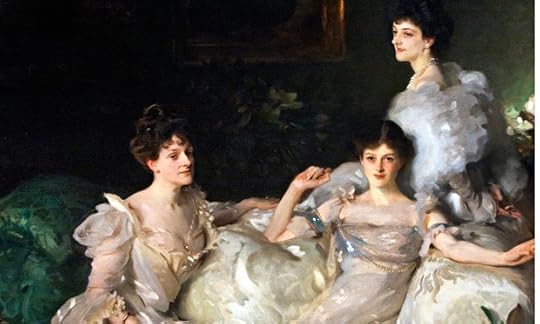 The Wyndham Sisters, 1899 by John Singer Sargent: (l-r) Madeline (1869-1941), Pamela (1871-1928) and Mary (1862-1937). Photograph: Alamy


