

What do you think?

Rough Magic: Riding the World's Loneliest Horse Race
For fans of Helen Macdonald’s H Is for Hawk, this is the extraordinary debut memoir of a young woman who traveled to Mongolia to compete in the world’s longest, toughest horse race, and emerged as its youngest and first-ever female winner.
At the age of nineteen, Lara Prior-Palmer discovered a website devoted to “the world’s longest, toughest horse race”—an annual competition of endurance and skill that involves dozens of riders racing a series of twenty-five wild ponies across 1,000 kilometers of Mongolian grassland. On a whim, she decided to enter the race. As she boarded a plane to East Asia, she was utterly unprepared for what awaited her.
Riders often spend years preparing to compete in the Mongol Derby, a course that recreates the horse messenger system developed by Genghis Khan, and many fail to finish. Prior-Palmer had no formal training. She was driven by her own restlessness, stubbornness, and a lifelong love of horses. She raced for ten days through extreme heat and terrifying storms, catching a few hours of sleep where she could at the homes of nomadic families.
Battling bouts of illness and dehydration, exhaustion and bruising falls, she decided she had nothing to lose. Each dawn she rode out again on a fresh horse, scrambling up mountains, swimming through rivers, crossing woodlands and wetlands, arid dunes and open steppe, as American television crews chased her in their Jeeps.
Told with terrific suspense and style, in a voice full of poetry and soul, Rough Magic captures the extraordinary story of one young woman who forged ahead, against all odds, to become the first female winner of this breathtaking race.
At the age of nineteen, Lara Prior-Palmer discovered a website devoted to “the world’s longest, toughest horse race”—an annual competition of endurance and skill that involves dozens of riders racing a series of twenty-five wild ponies across 1,000 kilometers of Mongolian grassland. On a whim, she decided to enter the race. As she boarded a plane to East Asia, she was utterly unprepared for what awaited her.
Riders often spend years preparing to compete in the Mongol Derby, a course that recreates the horse messenger system developed by Genghis Khan, and many fail to finish. Prior-Palmer had no formal training. She was driven by her own restlessness, stubbornness, and a lifelong love of horses. She raced for ten days through extreme heat and terrifying storms, catching a few hours of sleep where she could at the homes of nomadic families.
Battling bouts of illness and dehydration, exhaustion and bruising falls, she decided she had nothing to lose. Each dawn she rode out again on a fresh horse, scrambling up mountains, swimming through rivers, crossing woodlands and wetlands, arid dunes and open steppe, as American television crews chased her in their Jeeps.
Told with terrific suspense and style, in a voice full of poetry and soul, Rough Magic captures the extraordinary story of one young woman who forged ahead, against all odds, to become the first female winner of this breathtaking race.
288 pages, Hardcover
First published May 7, 2019
About the author
Lara Prior-Palmer
1 book51 followersLara Prior-Palmer is a writer and athlete. In 2013, at age 19, she became the first woman to win the Mongol Derby, the world's longest horse race, as well as the youngest person ever to complete it. She is the niece of British equestrian Lucinda Green.
Ratings & Reviews
Friends & Following
Create a free account to discover what your friends think of this book!
Community Reviews
Displaying 1 - 30 of 809 reviews

May 22, 2019

Image from The Adventurists
Many of the people I’ll meet on the steppe hold horses as sacred. There are more love songs about horses than about women in Mongolia—for example, ponies come last in races are sung commiseration songs because no one wants them to feel bad. Your horse is an extension of you. A Mongol without a horse is like a bird without wings—goes the proverb. Even horses’ skulls are sacred. They’re made into musical instruments, whose sounds comfort mourning souls.What has 25 legs and covers 1,000 kilometers? Why, the Mongol Derby, of course. Ring any bells? Ummm, me neither. Unless one is particularly attuned to the worlds of equestrian sports or extreme competitions we would be unlikely to have heard of it. Lara Prior-Palmer had heard of it, but had not paid much attention. The entry fee was exorbitant (about $13K US), which led her to expect that she would not be able to even think of attempting it until she was in her thirties, if then. A bored teen, a year out of high school, recently sacked from her au pair gig in Austria, her applications for other adventures producing a resounding silence, she was trolling about for her next thing, whatever might quell the inner buzz that grows louder and louder until it drowns out everything but a way forward, any way forward. She was looking on-line for something to quiet the din, when it reappeared.
The passing London underground train shook the building as I leaned into the photograph—long-maned ponies streaming over green steppes, space poured wide and free—in Mongolia. The open-voweled sounds of the word matched the freedom of the country conjured in my mind. I couldn’t place Mongolia in history, nor could I place it on the map.She read on, learning that thirty riders had already signed up, that riders switch ponies every 40 Km, that the race was held in a Pony Express style that recalled Chingiss Khan’s postal system, and that it was deemed “the world’s longest and toughest horse race.” She clicked the box.
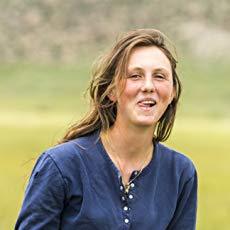
Lara Prior-Palmer - image from her Amazon page
What are the things we might look for in a memoir of this sort? One would hope for a look at an exotic place from a perspective familiar to readers, presuming most readers to be Westerners. Given that it is a sports competition, we would hope for a look at the particulars of this race, what, if anything, sets it apart from other competitions? You’ve gotta figure that a 1,000 kilometer horse race would have to also be a journey of self-discovery, and there is at least some of that in here. Not to say that it was intended. The writing of this book began on the plane ride home to England from Ulaanbaatar, and was intended mostly as a large note-taking effort to better allow Lara to recall the event. Encouraged to expand her 25,000 words to book length by folks to whom she showed her writing, Prior-Palmer did just that, working on the manuscript, off and on, for about five years. It helps if the author can bring some talent, maybe an appreciation of beauty in her writing.

A Mongolian ger (yurt) - image from Phys.org
Tough to get more exotic than Mongolia for most of us. And while you may be familiar with some of the weather the riders encounter, hot, cold, wind, hail, rain, you have probably not done so while engaged in a grueling horse race. Prior-Palmer fills us in on a host of local details. You will learn of the proper seating arrangements in a Mongolian ger (pronounced ‘gaire’), get a heads up on the proper behavior when encountering an ovoo, (a local shrine consisting of accumulated placed stones, and offerings), and marvel at car parts placed in trees to help gain the assistance of local deities in assuring that the subject vehicle remains in good working order. There are observations on Mongolian history and lore. One local historical figure was Molon Bagsh, an itinerant philosopher who supposedly predicted many of the wonders of the modern age from his perspective in the early 1900s. She offers a bit on the deep respect Mongolians have for their equine partners.
One strand of Mongolian philosophy has it that my chest, not my brain, is the seat of my consciousness. It contains my heimori (wind-horse)—an inner creature whose power needs maintaining. When you rub a racehorse’s sweat into your forehead or ride a great, quick pony, you strengthen your heimori and improve your destiny.(You might want to towel off after that.) There are plenty more such, and they are delightful.
The race itself occupies most of her consciousness. There is plenty of detail on how it is run, the accommodations, the horses, referred to here almost primarily as ponies. (BTW, to be a horse there is a height bar, 14.2 hands, or about four feet ten inches. Shorter than that, you are a pony. Mongolian equines tend to the shorter end of the bell curve.) The selection process. Which pony to choose? Based on what? Loving the ponies who were eager to fly, but having to cope with some which were far from enthusiastic. The relationships among the riders is pretty significant, particularly Lara’s relationship with an American rider, one Devan Horn, portrayed as a braggadocious Texan, certain that she will prevail. What begins as a bit of competitiveness becomes an all-consuming quest to see to it that this person is denied that victory. Her bonding, or not, with other riders, and non-riders (newspeople, veterinarians, race managers) is an ongoing subject. There are connections made or almost made during the race that highlight interpersonal challenges Lara must resolve, at least temporarily. It is difficult, and not at all necessary, to separate her coping with the race from her dealings with the locals. Riders often stay in the homes of residents, and Lara recalls some charming, as well as clueless interactions.

Ponies in waiting - image from The Adventurists
Bear in mind that Lara was barely 19 years old when she undertook this adventure. Her age is certainly a factor in her degree of unpreparedness. While a good chunk of who we all are is well set by such an age, it takes plenty more years for the rest of the permanent us to form. What we see here is Lara as a work-in-progress. One element that manifests stronglyis the sort of stiff-upper-lip found in explorers and adventurers.
I suppose we think of pain as associated with an event—an accident, for example. We don’t imagine it going on forever. I found no space for pain and its expression in daily life.She is also someone uncomfortable around public feelings.
I shiver a little, relieved to be away from Clare. [a rider with whom Lara had spent some time during the competition] I find emotions contagious, swear I can catch them like flu. I’ve always been wary of upset and sickness. Aged seven, I dubbed people crybabies as though it were a life sentence and I winced in repulsion if someone missed school for sickness. I refused to let such a thing happen to me. Although later on I used sickness to save me from school, I still had no empathy for the unwell and the upset. Why would I try to imagine how Clare feels when I’m appalled she’s displayed the emotional hold the Derby has on her. Such is the strangeness of my selfishness.We get some background on family influences that fed her drive. Her Aunt Lucinda was an Olympian, having competed in equestrian events. Her favorite, no nonsense, phrase for just get on with it being “Crack On!” Her grandfather, a military general, was fond of “Just do it.” Firmed up for competition and adventure by such, she was much less able to cope with more emotional challenges.
…my real fears aren’t the broken bones or the missing ponies. My real fears are long-term affairs like school, marriage, and jobs. Anything requiring a commitment longer than a ten-day race. Maybe because millions of people manage these commitments, they go unnoticed. Ordinary jobs and relationships—spread over humdrum time—are rarely thought of as brave or strong.And therein, among other such contemplations, is where we find some of the distance that Lara travels personally. Over the course of the book we see some development that maybe Lara herself does not quite perceive. Learning to see things from someone else’s perspective, learning to consider other ways to value things and actions. Her sense of not quite knowing who she is persists. It’s just I haven’t decided if I’m woodland-wild or fireside-tame, and probably never will. But she has certainly gained in building on the self-reflective muscle she finds inside.
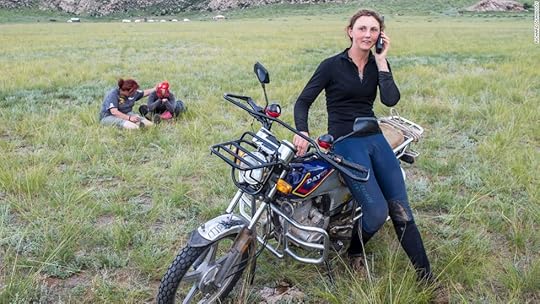
Lara accepting a congratulatory call after her victory – Devan Horn in the background will have to wait for another chance-image from CNN
A pointed element of self-realization is her change from seeing the race as an adventure, hoping mostly just to finish, to feeling the fire of competitiveness that was there all along, and not just to be able to stick it to Devan. There certainly must have been some part of Lara that chose a competitive adventure over the many others that the world offers. And she becomes more aware of that part of herself. She grew up in a culture that scorns overt ambition, and public presentations of self-confidence, so there was plenty of reason for her to suppress or hide her very real competitiveness.
We read of sporting victories in the newspapers, but what about all we cannot see? It’s easy to forget the thudded moments of hopelessness involved in a journey, one’s deepest difficulties slowly made clear.In addition to coping with some inner parts of herself undergoing a bit of examination, Prior-Palmer suffered some of the misfortunes that were visited on other contestants: bruises, dehydration, being tossed from her mount, having to get help retrieving it, becoming ill on the (for her) six-day race. And then there were self-imposed problems, being unprepared in sundry ways, like not bringing a map, not getting the recommended vaccinations, never having ridden even a one-day race, let alone one that could last ten days, or not providing for some sanitary needs.
There is some contemplative poetic writing in Prior-Palmer’s memoir. Particularly when she writes of her feeling of oneness with her ponies.
For two and a half hours my focus is whole. He moves fluently, and I note the quiet warmth of his company. You make no eye contact when riding, but we’re in communication, working a shared form, like shoaling fish. Horses have always been siblings to me, pressing their noses against my back and breathing out winter breath, slowly trusting. From his silence and the morning I draw something, something like strength…Instead of loneliness I feel loveliness. Everything in the hour is familiar. The pony hurries on beneath me, persuading his way into my heart.

Image from CNN
A thread in the book consists of passages from The Tempest, one of the reading materials she brought with her, to illustrate this or that. The arrival of the storm-driven characters in Shakespeare’s final play, washed clean in a way, pops to mind as she is caught in downpour on the steppe. A passage in which Ariel sings about a sea change in the play connects with Lara feeling transformed while riding a pony she names The Lion. It is a lovely element, but still felt a bit forced. There was plenty going on without it. The book’s title is drawn from The Tempest as well, which seemed workshop-y and less than organic, at first, given that the “rough magic” referred to in the play has to do with the bard’s ability to present fiction as reality. But on further consideration, if we forget the Shakespearean bit for a moment, “Rough” certainly works as a description of the event, and “Magic” is certainly appropriate or the magical ending of the competition, and some of Lara’s perceptions. So, never mind.
Since the race, Prior-Palmer, now 24, has been to University and worked on this book in fits and starts. She feels her experience gave her a better ability to consider alternate viewpoints. But she did not feel particularly changed by the race itself at the time. She remained very much who she was, an adventure-seeking, athletic, bright, articulate young woman with a world of possibilities ahead of her and a world-class achievement already in the bag.
Review posted – May 31, 2019
Publication date
-----May 7, 2019 - hardcover
-----April 28, 2020 - Trade paperback
==========In the summer of 2019 GR reduced the allowable review size by 25%, from 20,000 to 15,000 characters. In order to accommodate the text beyond that I have moved it to the comments section directly below.


June 4, 2019
The race was said to be the most difficult in the world. Seven days spent traversing the Mongolian steppes on wild ponies. Not my cuppa, but fun to experience through someone else. Lara, at loose ends decided this was something she needed to do, despite the costly entry fee. She prepares little, and becomes a nineteen year old underdog, though she soon has others pulling for her.
There are vivid descriptions of the Mongolian steppes, many allusions and quotes from Genghis Kahn. We meet dome of the other racers, and one young woman whom Lara is determined to beat. There are funny incidents, much self reflection, but the prose is witty, self deprecating. The story is fast paced, never boring and a joy to read. Humans, love of horses, and the endurance it takes to even race in such an event, let alone win. Which by the way is not a spoiler because this is known from the get go.
There are vivid descriptions of the Mongolian steppes, many allusions and quotes from Genghis Kahn. We meet dome of the other racers, and one young woman whom Lara is determined to beat. There are funny incidents, much self reflection, but the prose is witty, self deprecating. The story is fast paced, never boring and a joy to read. Humans, love of horses, and the endurance it takes to even race in such an event, let alone win. Which by the way is not a spoiler because this is known from the get go.

May 2, 2019
NOW AVAILABLE!!!
there is a 1,000 kilometer horse race in mongolia called the mongol derby with the reputation of being “the world’s longest, toughest horse race.” human riders mount a series of 25 wild ponies, swapping ‘em out every 40 kilometers “to ensure the endurance [falls] on the humans, not the horses.” participants train rigorously, obtain sponsorships to offset the enormous entrance fees, prepare themselves for the physical and psychological hardships of being on horseback for more than a week; through the heat and the rain and the aches and exhaustion of what is a frequently solitary trek over mongolia’s unforgiving terrain. despite all these preparatory measures, many riders do not make it to the finish line due to illness, injury, or fatigue. long story short - attempting this race requires commitment, dedication and sacrifice.
or, you know, you could just sorta wing it.
this is a memoir written by the nineteen-year-old woman who entered the derby on a whim, prepared not at all; didn’t train, didn’t get the required vaccinations, didn’t even bring a change of pants and somehow not only won the race, but was both the youngest and also the first female to ever win.
and this book is how a person like that writes a memoir, or an account of this race. it’s not quite either of these approaches; it’s a little flighty, a little flitty — it’s where that kind of mind goes when it’s largely unoccupied and let off its tether for long solitary hours. the book is full of sentences like this: Why do humans put so much thought into some decisions yet plunge into others like cavalier penguins? Are we met with a sudden urge to avoid the direct path to middle age and subsequent visions of growing old in a lonely world of cats?
parts of this book feel like the script for some “girls can be forrest gump, too!” sequel — not because the author is slow, but because of how unlikely her even finishing the race was, considering her level of preparedness — I had never ridden more than 20 kilometers at once, let alone with a GPS, and, as established, I didn’t know how to use one anyway. not only did she enter on a whim, she entered after the deadline had passed, didn’t read much of the fine print, only half-filled out the medical forms and yet at every turn, logic looked the other way, fortune was feeling generous, and history was made by someone who forgot to take the pills that would stop her period and wound up bleeding all over her pony.
despite embodying (and playing up a little, i suspect) the whole ‘god watches over drunks and fools’ angle — Wolves, snakes, and mountain lions can’t eat me because I’m not yet aware they roam these parts, she’s a little more savvy than some simpleton chasing a balloon; she manages to talk her way into paying less than half of the entrance fee, cadge gear off of fellow riders, and she’s got a deeply-ingrained competitive streak, so despite her somewhat-cultivated veneer of padded innocence:
there’s a flint of steely stubbornness at her core.
still, every single thing about her involvement in this race is haphazard - she remembers to bring some medicine, but removes the pills from their packets "in a fit of boredom," flinging them altogether in one bag so she doesn’t know which are antibiotics and which are water purifying pills and which are ibuprofen, etc, so she just swallows whatever’s on top and hopes for the best.
it sounds slapsticky, but it’s not written slapsticky. okay, sometimes it is slapsticky:
I got entangled in my backpack first thing the next morning, which required the rescue of three crew members...
it's a fun rompy read, but if you are looking for a book about the history of the race, or a book of sports writing, or one getting to the core of what makes a champion athlete tick, this might not deliver that for you. it's a hodgepodge rummage sale memoir-daydream that is weird and fun and that was enough for me and maybe it will be enough for you!!

 come to my blog!
there is a 1,000 kilometer horse race in mongolia called the mongol derby with the reputation of being “the world’s longest, toughest horse race.” human riders mount a series of 25 wild ponies, swapping ‘em out every 40 kilometers “to ensure the endurance [falls] on the humans, not the horses.” participants train rigorously, obtain sponsorships to offset the enormous entrance fees, prepare themselves for the physical and psychological hardships of being on horseback for more than a week; through the heat and the rain and the aches and exhaustion of what is a frequently solitary trek over mongolia’s unforgiving terrain. despite all these preparatory measures, many riders do not make it to the finish line due to illness, injury, or fatigue. long story short - attempting this race requires commitment, dedication and sacrifice.
or, you know, you could just sorta wing it.
this is a memoir written by the nineteen-year-old woman who entered the derby on a whim, prepared not at all; didn’t train, didn’t get the required vaccinations, didn’t even bring a change of pants and somehow not only won the race, but was both the youngest and also the first female to ever win.
and this book is how a person like that writes a memoir, or an account of this race. it’s not quite either of these approaches; it’s a little flighty, a little flitty — it’s where that kind of mind goes when it’s largely unoccupied and let off its tether for long solitary hours. the book is full of sentences like this: Why do humans put so much thought into some decisions yet plunge into others like cavalier penguins? Are we met with a sudden urge to avoid the direct path to middle age and subsequent visions of growing old in a lonely world of cats?
parts of this book feel like the script for some “girls can be forrest gump, too!” sequel — not because the author is slow, but because of how unlikely her even finishing the race was, considering her level of preparedness — I had never ridden more than 20 kilometers at once, let alone with a GPS, and, as established, I didn’t know how to use one anyway. not only did she enter on a whim, she entered after the deadline had passed, didn’t read much of the fine print, only half-filled out the medical forms and yet at every turn, logic looked the other way, fortune was feeling generous, and history was made by someone who forgot to take the pills that would stop her period and wound up bleeding all over her pony.
despite embodying (and playing up a little, i suspect) the whole ‘god watches over drunks and fools’ angle — Wolves, snakes, and mountain lions can’t eat me because I’m not yet aware they roam these parts, she’s a little more savvy than some simpleton chasing a balloon; she manages to talk her way into paying less than half of the entrance fee, cadge gear off of fellow riders, and she’s got a deeply-ingrained competitive streak, so despite her somewhat-cultivated veneer of padded innocence:
I didn’t think about rain, so I don’t have a change of clothes. No pajamas. No second pair of jodhpurs. Just a spare pair of socks and a pair of knickers. “Oh dear, I’m going to have to sleep naked.”
It wasn’t necessary for me to say that aloud, but I don’t think anyone noticed.
there’s a flint of steely stubbornness at her core.
still, every single thing about her involvement in this race is haphazard - she remembers to bring some medicine, but removes the pills from their packets "in a fit of boredom," flinging them altogether in one bag so she doesn’t know which are antibiotics and which are water purifying pills and which are ibuprofen, etc, so she just swallows whatever’s on top and hopes for the best.
it sounds slapsticky, but it’s not written slapsticky. okay, sometimes it is slapsticky:
I got entangled in my backpack first thing the next morning, which required the rescue of three crew members...
it's a fun rompy read, but if you are looking for a book about the history of the race, or a book of sports writing, or one getting to the core of what makes a champion athlete tick, this might not deliver that for you. it's a hodgepodge rummage sale memoir-daydream that is weird and fun and that was enough for me and maybe it will be enough for you!!
come to my blog!
June 3, 2019
Review originally appeared on Open Letters Review.
Impulsivity is an intimate friend of the teenager. This emotional siren lures newly-minted adolescents into making rash decisions, most stereotypically taking the form of raucous parties and torrid love affairs. And though we all go through our own form of the teenage phase, most of us wouldn't, on a whim, choose to ride the world's longest and most demanding horse race to assert our individuality. But it seems someone had to be first.
The Mongol Derby is a 1,000 kilometer feat of endurance. Participants ostensibly travel in the hoof prints of Genghis Khan's postal couriers who, in the 13th century, pounded their way across the picturesque Mongolian steppe using a similar system of horse stations to the ones redeveloped for the race. This trek is to be made over the course of ten days with limitations on ride time per day and with strict rules on how hard they can push their horse in order to protect the welfare of the animals. The riders are given one horse per stretch and considering these horses are still semi-wild, achieving a partnership will be easier said than done. This won't be their only challenge as they will face brutal weather conditions, rough terrain, and the wildcard element of the human and non-human residents of the steppe. Getting injured or facing setbacks are less potential risks and more like certainties with hurdles and partners such as these.
This is the kind of race that takes months – even an entire year – to prepare for with not just physical training, but also by acquiring a whole host of supplies within a designated weight limit. To have a shot at winning, it also requires familiarizing oneself with the vastness of the landscape and the myriad of potential obstacles to completion. Yet Lara Prior-Palmer, the 2013 winner applied only two months ahead of the race. With her unlikely win, she became not only the first woman to claim the top spot but also the youngest competitor to ever complete the Derby.
In her new memoir Rough Magic: Riding the World's Loneliest Horse Race, Prior-Palmer describes this experience. She begins with an admission of the disconcertingly low level of foresight she gave to her decision to participate. Most fundamentally, she lacked the steep admission fee (now up to £11,375 for the 2020 race). Most oddly, though she is the niece of a well-known equestrian, she did not have abundant experience on horseback. None of this ended up being a deterrent. She defied the odds even early on, managing to piece together the bare bones requirements at the 11th hour.
With all the odds stacked against her, one must question why someone as underprepared as our young author would take on this challenge. It's a puzzle she subtly tries to solve for herself throughout the book with tones ranging from the contemplative to the outright exhausted. But although her choice to join the race was impulsive, her resolve remains steadfast as she navigates from station to station.
The wide open space ahead seems to satisfy an itch early on, but the loneliness of the race unexpectedly drives her inward. In true teenage fashion, it pushes her into the realm of the poetic, at least partially inspired by the copy of The Tempest stuffed in her pack. This tone does not dominate her storytelling, instead mimicking the checkpoints she reaches. At times, we're fully invested in mechanics of the ride and then, every so often, she invites us into her inner world.
Lara's mind is full of thoughts of home as one would expect from someone not far removed from their childhood years, but she frequently compares this mental image to her current surroundings. The complete dissimilarity of place and experience to anything having come before in her life makes for a stark contrast. Mongolia comes out favorably in these match-ups, with Prior-Palmer providing historical and cultural context to help the reader feel as immersed in the place as she is. As she allows herself to sink into the landscape, Lara finds in the race not only something to keep her busy for ten days in August, but a sense of her own purpose:
The race did seem to lend me some faith in my placement in this world, and that faith released an energy my teenage sloth-self had let go of. I felt it fueling me for months afterward.
Coming-of-age storytellers take note: here is your model heroine. Across time, adolescents have sought to define what they are by first defining what they are not. Lara Prior-Palmer canters away from the known world and all the expectations of her it contains. And though her teenage qualities at first glance appear to foretell her failure, it seems that perhaps Lara's spontaneity and youth are her greatest assets. For her, the race was never about winning, but about the freedom it would provide. In fact, the finish line provides less motivation than does her toughest competitor, Texan Devan Horn who is nearly obsessively determined to win. But instead of marrying herself to the future by clinging to a picture of herself coming in first, she lives firmly in the present moment. This allows her to better cope with obstacles, however clumsily, as they come along.
Readers will be grateful for her investment in the present, but also her choice to faithfully write down the events of each day in her Winnie the Pooh notebook. Her recorded experiences combine with the wisdom of hindsight to create the pure magic of this book. In writing it, we can feel the author, now aged 24, returning to this defining the experience in her mind's eye and retrospectively defining it for the lasting impact it has clearly had on her life. This memoir is a glance behind at trodden ground and acknowledgment of the course to come. Each pony gallops across the in-between.
Impulsivity is an intimate friend of the teenager. This emotional siren lures newly-minted adolescents into making rash decisions, most stereotypically taking the form of raucous parties and torrid love affairs. And though we all go through our own form of the teenage phase, most of us wouldn't, on a whim, choose to ride the world's longest and most demanding horse race to assert our individuality. But it seems someone had to be first.
The Mongol Derby is a 1,000 kilometer feat of endurance. Participants ostensibly travel in the hoof prints of Genghis Khan's postal couriers who, in the 13th century, pounded their way across the picturesque Mongolian steppe using a similar system of horse stations to the ones redeveloped for the race. This trek is to be made over the course of ten days with limitations on ride time per day and with strict rules on how hard they can push their horse in order to protect the welfare of the animals. The riders are given one horse per stretch and considering these horses are still semi-wild, achieving a partnership will be easier said than done. This won't be their only challenge as they will face brutal weather conditions, rough terrain, and the wildcard element of the human and non-human residents of the steppe. Getting injured or facing setbacks are less potential risks and more like certainties with hurdles and partners such as these.
This is the kind of race that takes months – even an entire year – to prepare for with not just physical training, but also by acquiring a whole host of supplies within a designated weight limit. To have a shot at winning, it also requires familiarizing oneself with the vastness of the landscape and the myriad of potential obstacles to completion. Yet Lara Prior-Palmer, the 2013 winner applied only two months ahead of the race. With her unlikely win, she became not only the first woman to claim the top spot but also the youngest competitor to ever complete the Derby.
In her new memoir Rough Magic: Riding the World's Loneliest Horse Race, Prior-Palmer describes this experience. She begins with an admission of the disconcertingly low level of foresight she gave to her decision to participate. Most fundamentally, she lacked the steep admission fee (now up to £11,375 for the 2020 race). Most oddly, though she is the niece of a well-known equestrian, she did not have abundant experience on horseback. None of this ended up being a deterrent. She defied the odds even early on, managing to piece together the bare bones requirements at the 11th hour.
With all the odds stacked against her, one must question why someone as underprepared as our young author would take on this challenge. It's a puzzle she subtly tries to solve for herself throughout the book with tones ranging from the contemplative to the outright exhausted. But although her choice to join the race was impulsive, her resolve remains steadfast as she navigates from station to station.
The wide open space ahead seems to satisfy an itch early on, but the loneliness of the race unexpectedly drives her inward. In true teenage fashion, it pushes her into the realm of the poetic, at least partially inspired by the copy of The Tempest stuffed in her pack. This tone does not dominate her storytelling, instead mimicking the checkpoints she reaches. At times, we're fully invested in mechanics of the ride and then, every so often, she invites us into her inner world.
Lara's mind is full of thoughts of home as one would expect from someone not far removed from their childhood years, but she frequently compares this mental image to her current surroundings. The complete dissimilarity of place and experience to anything having come before in her life makes for a stark contrast. Mongolia comes out favorably in these match-ups, with Prior-Palmer providing historical and cultural context to help the reader feel as immersed in the place as she is. As she allows herself to sink into the landscape, Lara finds in the race not only something to keep her busy for ten days in August, but a sense of her own purpose:
The race did seem to lend me some faith in my placement in this world, and that faith released an energy my teenage sloth-self had let go of. I felt it fueling me for months afterward.
Coming-of-age storytellers take note: here is your model heroine. Across time, adolescents have sought to define what they are by first defining what they are not. Lara Prior-Palmer canters away from the known world and all the expectations of her it contains. And though her teenage qualities at first glance appear to foretell her failure, it seems that perhaps Lara's spontaneity and youth are her greatest assets. For her, the race was never about winning, but about the freedom it would provide. In fact, the finish line provides less motivation than does her toughest competitor, Texan Devan Horn who is nearly obsessively determined to win. But instead of marrying herself to the future by clinging to a picture of herself coming in first, she lives firmly in the present moment. This allows her to better cope with obstacles, however clumsily, as they come along.
Readers will be grateful for her investment in the present, but also her choice to faithfully write down the events of each day in her Winnie the Pooh notebook. Her recorded experiences combine with the wisdom of hindsight to create the pure magic of this book. In writing it, we can feel the author, now aged 24, returning to this defining the experience in her mind's eye and retrospectively defining it for the lasting impact it has clearly had on her life. This memoir is a glance behind at trodden ground and acknowledgment of the course to come. Each pony gallops across the in-between.

June 24, 2019
In 2013, when she was 19, Prior-Palmer won the Mongol Derby horse race: the first Briton and youngest competitor to do so. I thought her memoir couldn’t fail to be exciting, but I was wrong. A book I should have raced through was instead an agonizing crawl over many weeks. Moreover, the voice, which initially seemed quirky and jolly-ol’-English enough to keep me reading, grated. I should have given up on this one early on.
In a nutshell: spoiled rich English girl (the family seat of Appleshaw in Wiltshire; the large family with double-barreled surname; Aunt Lucinda Green, who teaches equestrian skills) doesn’t know what to do with herself so signs up for 1000-km horse race on a whim, and doesn’t realize she actually wants to win – and, crucially, beat the Texan gal, Devan Horn – until over halfway through. The book becomes mildly more interesting at this point, but not properly gripping until well over four-fifths of the pages have turned.
The Tempest tie-in never convinced me, but my biggest problem was that the author comes across as ditsy and ever so young, and I could spot every point in the book where her editor, looking over a draft, wrote, “make this verb more interesting” or “add in an unusual metaphor here” or “insert context re: Mongolia.” And Prior-Palmer certainly obliges, but in such a way that the Mongolian information feels shoehorned in and the language jars. (Examples: “I feel the world collapsing slowly, like one of my failed banana cakes. A hoarse laugh shovels out of my throat.” and “We spun through the air like crumpets journeying out of a toaster.”)
In a nutshell: spoiled rich English girl (the family seat of Appleshaw in Wiltshire; the large family with double-barreled surname; Aunt Lucinda Green, who teaches equestrian skills) doesn’t know what to do with herself so signs up for 1000-km horse race on a whim, and doesn’t realize she actually wants to win – and, crucially, beat the Texan gal, Devan Horn – until over halfway through. The book becomes mildly more interesting at this point, but not properly gripping until well over four-fifths of the pages have turned.
The Tempest tie-in never convinced me, but my biggest problem was that the author comes across as ditsy and ever so young, and I could spot every point in the book where her editor, looking over a draft, wrote, “make this verb more interesting” or “add in an unusual metaphor here” or “insert context re: Mongolia.” And Prior-Palmer certainly obliges, but in such a way that the Mongolian information feels shoehorned in and the language jars. (Examples: “I feel the world collapsing slowly, like one of my failed banana cakes. A hoarse laugh shovels out of my throat.” and “We spun through the air like crumpets journeying out of a toaster.”)

May 28, 2019
I have mixed feelings about this book. The setting and perspective are great: a memoir by the first female and youngest winner of the Mongol Derby, an endurance horse race.
The writer’s style is hit and miss. A little too cursory, too eager to float into lines of poetry when action is needed.
My biggest beef is turning the author’s main competition, another young woman and first time racer, into a villain after barely laying eyes on her. This woman’s chief sin being that she arrived prepared, confident, and ambitious. And so our protagonist hates her. How childish. How petty for a woman who continually portrays herself as independent-minded.
Although we know who wins, the ending still feels like a let down.
Overall an interesting read but not the riveting horseback adventure I’d hoped for.
The writer’s style is hit and miss. A little too cursory, too eager to float into lines of poetry when action is needed.
My biggest beef is turning the author’s main competition, another young woman and first time racer, into a villain after barely laying eyes on her. This woman’s chief sin being that she arrived prepared, confident, and ambitious. And so our protagonist hates her. How childish. How petty for a woman who continually portrays herself as independent-minded.
Although we know who wins, the ending still feels like a let down.
Overall an interesting read but not the riveting horseback adventure I’d hoped for.
May 9, 2019
This author tries so hard to come across as edgy, philosophical and unique that her story gets lost in the image she’s trying to write herself in, and is lacking in substance.

January 17, 2019
ROUGH MAGIC is the debut memoir of Lara Prior-Palmer. The story focuses on her last-minute entry and race in The Mongol Derby of 2013.
With the motion of a carefree spinning of a globe and haphazardly pointing to the next place to find adventure, 19 year-old Lara Prior-Palmer clicked on the “flashing” pick me Google tab and applied to enter the “world’s longest and toughest horse race”.
The Mongol Derby is a race of endurance run over 1,000 kilometers (621.371 miles) on 25 different semi-wild horses over a ten-day period. Riders come from all over the world to take on the challenge. They are restricted to the race hours of 7am - 8:30pm and any racers riding outside this time parameter are assessed time penalties on the day following.
There are many rules of the race pertaining to rider and horse. The author seems fated to compete in this race. Prior-Palmer enters with just a few weeks left in the application period. Warnings of needed experience, vaccinations, training, to run the race all go unnoticed by the author. The exorbitant entry fee is initially an impediment, but with Prior-Palmer’s usual aplomb she is able to easily overcome this potential roadblock and any other restriction to entry.
Lara Prior-Palmer has no fear and an overabundance of innocence and joie de vivre. These attributes work in her favor as she takes on the Mongolian landscape, its grueling race and her stubborn competitors.
As Prior-Palmer’s race is recounted, I come to admire the bravery of the writer as it is juxtaposed with the whimsicality of the writing. Much respect is given to one so young on the far side of the world taking on the world’s toughest horse race, alone.
The author is my new hero and example. From her I will remember to, even at my age, dare to do something different and unexpected—the end result may be very rewarding, but above all life will have been lived!
I thank Catapult publishers for my ARC in exchange for a review. This is my favorite book of 2019 thus far.
With the motion of a carefree spinning of a globe and haphazardly pointing to the next place to find adventure, 19 year-old Lara Prior-Palmer clicked on the “flashing” pick me Google tab and applied to enter the “world’s longest and toughest horse race”.
The Mongol Derby is a race of endurance run over 1,000 kilometers (621.371 miles) on 25 different semi-wild horses over a ten-day period. Riders come from all over the world to take on the challenge. They are restricted to the race hours of 7am - 8:30pm and any racers riding outside this time parameter are assessed time penalties on the day following.
There are many rules of the race pertaining to rider and horse. The author seems fated to compete in this race. Prior-Palmer enters with just a few weeks left in the application period. Warnings of needed experience, vaccinations, training, to run the race all go unnoticed by the author. The exorbitant entry fee is initially an impediment, but with Prior-Palmer’s usual aplomb she is able to easily overcome this potential roadblock and any other restriction to entry.
Lara Prior-Palmer has no fear and an overabundance of innocence and joie de vivre. These attributes work in her favor as she takes on the Mongolian landscape, its grueling race and her stubborn competitors.
As Prior-Palmer’s race is recounted, I come to admire the bravery of the writer as it is juxtaposed with the whimsicality of the writing. Much respect is given to one so young on the far side of the world taking on the world’s toughest horse race, alone.
The author is my new hero and example. From her I will remember to, even at my age, dare to do something different and unexpected—the end result may be very rewarding, but above all life will have been lived!
I thank Catapult publishers for my ARC in exchange for a review. This is my favorite book of 2019 thus far.

May 14, 2019
2.5 stars rounded up to 3.
What an odd little book. In a perfect world, this would have been one of my top reads of the year. It has everything I love: travel, horses, and traveling with horses. However, the writing style just didn't click with me and I never truly felt engaged with the narrative. Don't get me wrong, there are some gems of passages in here. They are, however, the exception and not the rule.
One such example is when Lara starts ruminating on why, historically and evolutionary, there's always been such a special bond between women and horses. She takes the easy way out and parrots Freud in giving an explanation when it is so, so much deeper than that. My theory, and it's just that, a theory born out of being a woman who spent her childhood and teenage years around horses, is that somewhere in the veil of time, women and horses formed a kinship because a) both are social creatures and b) both are forced to deal with the whims of men who dominated over them. Women found freedom on horseback and horses found an ally. They were, in essence, kindred spirits. Dogs may be man's best friend but horses are women's.
/soapbox
All in all, I'm scratching my head over what I missed and why everyone is tripping over themselves to praise this book. It left me going "huh" moreso than being heartwarmed.
What an odd little book. In a perfect world, this would have been one of my top reads of the year. It has everything I love: travel, horses, and traveling with horses. However, the writing style just didn't click with me and I never truly felt engaged with the narrative. Don't get me wrong, there are some gems of passages in here. They are, however, the exception and not the rule.
One such example is when Lara starts ruminating on why, historically and evolutionary, there's always been such a special bond between women and horses. She takes the easy way out and parrots Freud in giving an explanation when it is so, so much deeper than that. My theory, and it's just that, a theory born out of being a woman who spent her childhood and teenage years around horses, is that somewhere in the veil of time, women and horses formed a kinship because a) both are social creatures and b) both are forced to deal with the whims of men who dominated over them. Women found freedom on horseback and horses found an ally. They were, in essence, kindred spirits. Dogs may be man's best friend but horses are women's.
/soapbox
All in all, I'm scratching my head over what I missed and why everyone is tripping over themselves to praise this book. It left me going "huh" moreso than being heartwarmed.

May 20, 2019
Disappointing, esp. after the rave reviews. Gave up after 200 pages, should have quit sooner. Disjointed sloppy style without any of the dramatic momentum to be expected from a story like this. It’s probably the case that she was just too young to properly appreciate and represent this remarkable experience.

July 14, 2019
Rough Magic is a coming of age story, an interrogation of naked ambition, and a self-conscious meditation on English colonialism, all wrapped up in a thrilling tale of a 19-year-old girl entering and winning the most difficult horse race in the world. Lara Prior-Palmer’s underdog story couldn’t have been any more pitch-perfect if it were scripted: she entered the Mongol Derby on a complete whim, underestimated its difficulty, was dismissed by the other competitors early on, but still rallied to become the first woman to win the race and the youngest person ever to finish. But it’s far from the conventional sports memoir, as winning is never really the point, or even the goal, for Lara, whose motivation for entering the race is hazy even to herself.
This book’s greatest strength is something that often irritates me in memoirs: that Lara doesn’t have much distance from the experience she’s writing about (she won the race in 2013, her memoir was published in 2019). Had she waited 15 or 20 years to tell this story, it could have been more polished, more articulate, but that sophistication would have come at the detriment of its charm, its passion, its frenetic energy. Perhaps the most successful thing about this book is that due to her lack of emotional distance from it, Lara doesn’t place her own character development front and center; instead she takes us through the race step by agonizing step, showing us rather than telling us about the physical and psychological toll it was taking. This entire memoir cleverly circles the question ‘is naked ambition in and of itself a virtue or a vice?’ (a character trait she sees reflected in her main competitor, Devan) – and the few moments where Lara zeroes in on it have the emotional punch they’ve earned.
And then, shortly after:
All that said, this book isn’t the easiest to settle into; Lara Prior-Palmer’s prose is almost a perfect reflection of her flighty, restless nature – she jumps from one thought to another with no preamble, she constructs an elaborate metaphor unnecessarily and follows it a bit too long. But there were also lines that I adored, that I found especially resonant (more than enough to compensate for the more awkward passages), like:
So while I don’t think this was a perfect book (not that anything is a perfect book), I do think it was a really special one that I enjoyed reading immensely, that filled me with anxiety and excitement in equal measure. Lara Prior-Palmer is a fascinating, sympathetic, strong and vulnerable person who doesn’t spare herself for a second on the page, making this story as personal as it is informative about the Mongol Derby. I’d highly recommend Rough Magic if you like horses, coming of age stories, underdogs, memoirs about young women, or any combination of the above.
This book’s greatest strength is something that often irritates me in memoirs: that Lara doesn’t have much distance from the experience she’s writing about (she won the race in 2013, her memoir was published in 2019). Had she waited 15 or 20 years to tell this story, it could have been more polished, more articulate, but that sophistication would have come at the detriment of its charm, its passion, its frenetic energy. Perhaps the most successful thing about this book is that due to her lack of emotional distance from it, Lara doesn’t place her own character development front and center; instead she takes us through the race step by agonizing step, showing us rather than telling us about the physical and psychological toll it was taking. This entire memoir cleverly circles the question ‘is naked ambition in and of itself a virtue or a vice?’ (a character trait she sees reflected in her main competitor, Devan) – and the few moments where Lara zeroes in on it have the emotional punch they’ve earned.
“Our pace slowed. I began imagining Clare and Kirsten catching us. Nothing is swift as thought—I felt it jumping through me. But riding in a big group just wasn’t efficient. It was a simple thought, and when it came, I knew the race had me.”
And then, shortly after:
“What if I wanted to win for myself, without wanting to beat Devan or please Charles or any other audience? It’s a lonely thought; I wish I were strong enough for it.”
All that said, this book isn’t the easiest to settle into; Lara Prior-Palmer’s prose is almost a perfect reflection of her flighty, restless nature – she jumps from one thought to another with no preamble, she constructs an elaborate metaphor unnecessarily and follows it a bit too long. But there were also lines that I adored, that I found especially resonant (more than enough to compensate for the more awkward passages), like:
“I’m just so used to swallowing myself as I speak that I can’t help seeing self-assuredness as indulgent.”
So while I don’t think this was a perfect book (not that anything is a perfect book), I do think it was a really special one that I enjoyed reading immensely, that filled me with anxiety and excitement in equal measure. Lara Prior-Palmer is a fascinating, sympathetic, strong and vulnerable person who doesn’t spare herself for a second on the page, making this story as personal as it is informative about the Mongol Derby. I’d highly recommend Rough Magic if you like horses, coming of age stories, underdogs, memoirs about young women, or any combination of the above.

May 28, 2019
"Riding is a dance that demands each muscle in your body answer to an ever-shifting floor"
Put aside the fact that the outcome of this race is known before Lara Prior-Palmer begins her story, here is proof positive that it is the journey, not the arrival, that is most important. How Lara, a woefully under prepared 19-year-old decides to participate in a horserace that traces the Mongolian course of Genghis Khan's pony express, 1,000 kilometers with no preplanned route, is the stuff of almost mythic stamina and excitement. At times I was reminded of Cheryl Strayed's Wild, as both young women embark on their quests with little or no preparation, but merely a will to complete it.
At first, she just doesn't want to come in last, but somewhere along the line the race grabs hold of her, and she becomes a competitor, not the least reason of which being peeved at the arrogance of the frontrunner, a Texan who has been trained and prepared and even before they've saddled for the first leg, has flashed her impending victory to ABC cameras. What truly sets this book apart is the writing, Lara's ability to describe her experience through gorgeous literary prose. Her descriptions of the landscape, the different "stations" where the riders change horses and are refreshed, her acceptance of the "Mongolian hospitality" and affection for these nomadic people, and most significantly, her connections to each of her mounts -- wild ponies each with a distinct personality and mindset of how to proceed. Important to the story is the Race Rule that at each leg a pony's heartbeat return to resting within a specified amount of time, so that the effort rests on the part of the rider not the animal. The fact that her choice of reading material is a copy of The Tempest, which provides the book's title. She also conjures her famous Aunt, Lucinda Prior-Palmer, an Olympic equestrienne, whose advice throughout her life has provided a beacon, if it is at sometimes grudging and/or hilarious.
Wherever Lara's life takes her henceforth, I hope she continues with her story, since it can't help but be fascinating.
Put aside the fact that the outcome of this race is known before Lara Prior-Palmer begins her story, here is proof positive that it is the journey, not the arrival, that is most important. How Lara, a woefully under prepared 19-year-old decides to participate in a horserace that traces the Mongolian course of Genghis Khan's pony express, 1,000 kilometers with no preplanned route, is the stuff of almost mythic stamina and excitement. At times I was reminded of Cheryl Strayed's Wild, as both young women embark on their quests with little or no preparation, but merely a will to complete it.
At first, she just doesn't want to come in last, but somewhere along the line the race grabs hold of her, and she becomes a competitor, not the least reason of which being peeved at the arrogance of the frontrunner, a Texan who has been trained and prepared and even before they've saddled for the first leg, has flashed her impending victory to ABC cameras. What truly sets this book apart is the writing, Lara's ability to describe her experience through gorgeous literary prose. Her descriptions of the landscape, the different "stations" where the riders change horses and are refreshed, her acceptance of the "Mongolian hospitality" and affection for these nomadic people, and most significantly, her connections to each of her mounts -- wild ponies each with a distinct personality and mindset of how to proceed. Important to the story is the Race Rule that at each leg a pony's heartbeat return to resting within a specified amount of time, so that the effort rests on the part of the rider not the animal. The fact that her choice of reading material is a copy of The Tempest, which provides the book's title. She also conjures her famous Aunt, Lucinda Prior-Palmer, an Olympic equestrienne, whose advice throughout her life has provided a beacon, if it is at sometimes grudging and/or hilarious.
Wherever Lara's life takes her henceforth, I hope she continues with her story, since it can't help but be fascinating.

November 12, 2021
Memoir of the author’s experience of competing in the Mongol Derby, a 1000km (621 mi) race on the steppe. Each competitor rides 25 semi-wild ponies over six to ten days. Each pony is examined by a veterinarian at each stage and penalties are assessed if its heartrate is too high. The author describes her competitors, the beauty of the landscape, the harsh conditions of the race, and her inner thoughts. She throws in a good dose of Mongolian history along the way. It is written in a poetic style, sprinkled with humor and drama. I quite enjoyed reading about this unique experience, while learning more about the host country.

November 17, 2019
"I am racing for the finish and racing for something else, a thing that changes with the wind, a thing I may never know nor think nor really see, only circle around, like a startled horse inspecting a coiled snake."
Lara Prior-Palmer found herself with some time on her hands a year after graduating from high school. On a whim she signed up for the Mongol Derby, a 621 mile horse race, that mirrors Mongolia's a Pony Express style postal system. The race was thought of as “the world’s longest and toughest horse race.”
I had such high hopes for this book and had been looking forward to reading it for months. I had inadvertently assumed that this book would be the story of how an underdog came to overcome all odds and win a most grueling race. I thought it would be a story of determination triumphing over seasoned veterans. Instead, it was the story of a seemingly rudderless millennial puttering along where the win blew.
"...my real fears aren't the broken bones or the missing ponies. My real fears are long-term affairs like school, marriage, and jobs. Anything requiring a commitment longer than a ten-day race."
The amount of navel gazing that went on was endless. Prior-Palmer herself admitted in one point of the story that she was unsure if she persisted in order to beat her biggest competitor, to impress her latest crush on the race path, or whether she wanted to win for the sake of winning.
I wanted a story of courage, self-confidence, and tenacity. Instead, it seems like Prior-Palmer won out of sheer luck and happenstance. I always root for the underdog but her first world concerns amongst a life of privilege didn't take me to new heights or understandings.
Lara Prior-Palmer found herself with some time on her hands a year after graduating from high school. On a whim she signed up for the Mongol Derby, a 621 mile horse race, that mirrors Mongolia's a Pony Express style postal system. The race was thought of as “the world’s longest and toughest horse race.”
I had such high hopes for this book and had been looking forward to reading it for months. I had inadvertently assumed that this book would be the story of how an underdog came to overcome all odds and win a most grueling race. I thought it would be a story of determination triumphing over seasoned veterans. Instead, it was the story of a seemingly rudderless millennial puttering along where the win blew.
"...my real fears aren't the broken bones or the missing ponies. My real fears are long-term affairs like school, marriage, and jobs. Anything requiring a commitment longer than a ten-day race."
The amount of navel gazing that went on was endless. Prior-Palmer herself admitted in one point of the story that she was unsure if she persisted in order to beat her biggest competitor, to impress her latest crush on the race path, or whether she wanted to win for the sake of winning.
I wanted a story of courage, self-confidence, and tenacity. Instead, it seems like Prior-Palmer won out of sheer luck and happenstance. I always root for the underdog but her first world concerns amongst a life of privilege didn't take me to new heights or understandings.

April 23, 2021
This story should have been compelling - the youngest winner of the world's toughest horse race and does have some drama when Lara realises here inner competitive streak and realises she may beat her Texan nemesis and win the thing. But the rest of it is padded out with so much writing like below that it makes the book an awful read:
'Unzip my skin and you might find luminescent blue rubber ready for a swim. I am not really human. And nor, I am sure, is anyone else.'
If anyone knows what on earth this means, please follow up on this post...
'Unzip my skin and you might find luminescent blue rubber ready for a swim. I am not really human. And nor, I am sure, is anyone else.'
If anyone knows what on earth this means, please follow up on this post...

April 11, 2019
This was a really interesting read about the youngest and first female winner of the Mongolian horse derby. I was sent a preview of the book through a marketing email and the preview... was the whole book. I don’t know if that was an error or what, but I really enjoyed it and enjoyed being inside the author’s head as she treks across the open spaces of Mongolia, contemplating her place in the world.

September 12, 2024
Follow Lara as she rides the steppes of Mongolia - becoming one with her horses.

June 5, 2019
The Mongol Derby is touted as the world's most challenging horse race. Carried out over 1000km and 25 legs (with 25 different horses), 30 participants compete across the wild landscape of Mongolia in a gruelling feat of endurance.
Lara Prior-Palmer entered the competition on a whim in 2013, having finished school and with no travel plans (or sponsor) and ended up participating in the race as the youngest ever participant at 19 years old.
The style and short, snappy chapters of this memoir mimic the rapid pace of the race itself. 3 stars only because the story felt a bit stretched out and thin in places.
Thank you Netgalley and Penguin Random House UK / Ebury Publishing for the advance copy, which was provided in exchange for an honest review.
Lara Prior-Palmer entered the competition on a whim in 2013, having finished school and with no travel plans (or sponsor) and ended up participating in the race as the youngest ever participant at 19 years old.
The style and short, snappy chapters of this memoir mimic the rapid pace of the race itself. 3 stars only because the story felt a bit stretched out and thin in places.
Thank you Netgalley and Penguin Random House UK / Ebury Publishing for the advance copy, which was provided in exchange for an honest review.

June 15, 2020
While the Mongolian setting and race itself were extremely interesting, I just could NOT stand the writer of this memoir. Lara Prior-Palmer enters this race on a whim after one quick internet search, enters far past the deadline and is accepted anyway, hardly prepares for it beforehand, doesn't bother learning anything about Mongolia or how to navigate with a GPS beforehand, and, most grievously, treats the race with an utter lack of passion or respect.
You would think this would be the perfect setup for an underdog story; that Lara would not know anything about what it would take to race a race like this and maybe a) train up extra hard to catch up to the skill level of everyone else or b) come in nonchalant about the race and be humbled by the sheer amount of endurance such a race would take. Neither of these things happen. During most of the race, Lara is so apathetic about the entire experience that she doesn't bother to learn any of the things required to ride such a race. Because she refused to learn how to work her GPS until she absolutely had to, she spent much of the race literally following other racers who did know how to navigate. She would always have the Mongolian herders choose her next horse for her, either not having the know how or not caring to do so herself. She would often ask for tips and handouts from the race operators and documentary people, even stealing a map after being told not to when she loses her own.
All of which would have been annoying but tolerable if she had expressed even one ounce of passion or respect for this race, but she never ever does. Even after winning the race (on a technicality), she says "This is not the blooming Olympics - it's a joke race." This line really sums up her attitude the entire time. Reading this, I'm not glad this "underdog" won. More than anything, I feel terrible for the other racers who entered on time, who did what they were supposed to do pre-race like get their vaccinations (Lara didn't), who trained far longer for this, who agonized over what gear to take (Lara threw hers together pretty haphazardly, even throwing pills together into one bag so even she couldn't identify them.), who learned how to navigate properly, and who I'm sure generally had more passion and respect for this race as a whole than Lara did.
This combined with Lara's pseudo-philosophical ramblings made what should have been an exciting event into an infuriating chore to read. I will be looking into more books on Mongolia and would look forward to any OTHER books written on this race by other authors, but I certainly wouldn't recommend this one.
You would think this would be the perfect setup for an underdog story; that Lara would not know anything about what it would take to race a race like this and maybe a) train up extra hard to catch up to the skill level of everyone else or b) come in nonchalant about the race and be humbled by the sheer amount of endurance such a race would take. Neither of these things happen. During most of the race, Lara is so apathetic about the entire experience that she doesn't bother to learn any of the things required to ride such a race. Because she refused to learn how to work her GPS until she absolutely had to, she spent much of the race literally following other racers who did know how to navigate. She would always have the Mongolian herders choose her next horse for her, either not having the know how or not caring to do so herself. She would often ask for tips and handouts from the race operators and documentary people, even stealing a map after being told not to when she loses her own.
All of which would have been annoying but tolerable if she had expressed even one ounce of passion or respect for this race, but she never ever does. Even after winning the race (on a technicality), she says "This is not the blooming Olympics - it's a joke race." This line really sums up her attitude the entire time. Reading this, I'm not glad this "underdog" won. More than anything, I feel terrible for the other racers who entered on time, who did what they were supposed to do pre-race like get their vaccinations (Lara didn't), who trained far longer for this, who agonized over what gear to take (Lara threw hers together pretty haphazardly, even throwing pills together into one bag so even she couldn't identify them.), who learned how to navigate properly, and who I'm sure generally had more passion and respect for this race as a whole than Lara did.
This combined with Lara's pseudo-philosophical ramblings made what should have been an exciting event into an infuriating chore to read. I will be looking into more books on Mongolia and would look forward to any OTHER books written on this race by other authors, but I certainly wouldn't recommend this one.

June 13, 2019
What an inspiring memoir, full of adventure, poetry, and sheer willpower, Lara shares her journey to victory - the dehydration, the determination, entering oblivion and not only coming out the other side, but coming out victorious as the first woman, and youngest ever champion.
I loved the incorporation of Mongolian culture and history. "The prophet in Mongolia is often called an uzmerch, 'someone who sees'.”
Before entering the race, Lara didn't have it all figured out but felt this desire within herself to do something different, something great. A desire I'm sure many of us can relate to, and that's why you root for Lara - the conditions are rough but there's magic there too! "Endings fade, but the force behind a story lives on".
*With thanks to the publisher for the review copy*
I loved the incorporation of Mongolian culture and history. "The prophet in Mongolia is often called an uzmerch, 'someone who sees'.”
Before entering the race, Lara didn't have it all figured out but felt this desire within herself to do something different, something great. A desire I'm sure many of us can relate to, and that's why you root for Lara - the conditions are rough but there's magic there too! "Endings fade, but the force behind a story lives on".
*With thanks to the publisher for the review copy*

November 25, 2019
This was my selection for the sport prompt for Nonfiction November. It's a strangely compelling, odd mixture of reporting about the unique race, philosophy, Mongolian history, and the utter strangeness of the author.

May 18, 2019
"I could not pull out of the race … so I let the terror energize me instead. Asked afterwards if I would dare attempt the race again, I’d reply that I could never again be scared enough to do so. The supernatural power of fearing the unknown stunned me into a state of readiness." — Rough Magic, Lara Prior-Palmer
What a thrill, what a journey! Prior-Palmer writes with the galloping speed of a restless somebody and the unyielding ambition of a true underdog. By turns a tale of tribulation and triumph, suspense and spirit, the emotional journey of Rough Magic ignites an immortal spark of inspiration that refuses to burn out. While I felt this memoir lost its momentum in certain parts — as is often the case with me and many memoirs — the imagery and emotion of Prior-Palmer's writing conveys a velocity of its own that made the story incredibly exciting.
What a thrill, what a journey! Prior-Palmer writes with the galloping speed of a restless somebody and the unyielding ambition of a true underdog. By turns a tale of tribulation and triumph, suspense and spirit, the emotional journey of Rough Magic ignites an immortal spark of inspiration that refuses to burn out. While I felt this memoir lost its momentum in certain parts — as is often the case with me and many memoirs — the imagery and emotion of Prior-Palmer's writing conveys a velocity of its own that made the story incredibly exciting.

June 20, 2019
This book felt like a real slog instead of a chronicle of a 7 day race. The book could have been far shorter and accomplished a better telling of the tale. The sentences tried (and failed) to be lyrical - I wish Lara had tried to be less poetic. Disappointing ending (not even fully explained as to what kind of penalty the other rider got), disappointing main character (she haphazardly floats through life in the most annoying way). In fact, even Lara's winning of the Derby seems haphazard. Lara's disdain for her fellow rider Devan was also disappointing and inexplicable at the same time. If the book didn't have a logical progression of pre-race followed by days 1-7 of the race, I fear the author's unmoored style would have been even more unreadable. For me, this is one book I should have quit.

June 8, 2019
The Mongol Derby is the world hardest horse race. The aim is to ride 600s mile across the Mongolian plains, that was once the home of the army of Genghis Khan. The ride takes 10 days and they are restricted in the time they can ride each day and how hard they can push their horses too. The riders swap horses at regular intervals, transferring saddles onto a new horse that they have seen before at each urtuu they stop at.
Her race began in 2009, and there are around 30 to 40 entries each year to travel across this beautiful landscape and they will travel across lush valleys, woodlands, rivers, mountains and the steppe that this part of the world is famous for. Riding for that distance takes its toll on the competitors and the race will be lucky to see half of the starters actually complete it. On a whim Lara Prior-Palmer decided to enter the race and sent off her application, secretly hoping that she wouldn’t get in. They accepted and even knocked down the entry fee when they realised that her aunt was the Lucinda Green of Badminton Trails fame.
Prior-Palmer was totally unprepared and being a late entry meant that she had missed all the preparation that the organisers recommend for the race. On top of that, she would be one of the youngest competitors at the age of 19. The disclaimer on the website is fairly blunt:
We want to point out how dangerous the Mongol Derby is. By taking part in this race you are greatly increasing your risk of severe physical injury or even death.
She’d missed that originally and it was too late to cancel or take any of her vaccinations. However, it was time to catch a plane and head around the world to the city of Ulaanbaatar to meet the other competitors and have the pre-race briefing. It was slowly dawning on her just what she’d taken on. Next, they were heading out onto the steppe to acclimatize and final prep for the race. Then before she knew it, it was time to start, there was a blessing from the Lama and they were off.
So she begins 10 days of racing against the other competitors, the landscape and herself. Even though it is the first person past the finishing line who will win, there are time penalties for pushing your horse too hard and disqualification is certain cases. They have to navigate using the maps and GPS to each of the urtuu’s where they swap to their next pony after the vets have examined their previous one. The pony you choose next can make or break that leg. The landscape is endlessly challenging with marmot holes to trip horse and rider. At the end of the first day she is second to last.
Riding for that amount of time would be tough enough on a seasoned rider who knew the horse, but for each leg , they choose an animal that they have never seen before, let alone ridden. By the start of the third day, her legs felt like lead. Only seven more days to go… The leader of the Derby was a girl from Texas, called Devan, and she didn’t seem to want to be relinquishing the lead any time soon. Some drop out of the race and slowly she start to catch the leader, even setting a record for the highest number of legs completed in one day. She never thought she’d finish but she might be in with a chance at this.
I like horses but have only been brave enough to go on one once. At first glance, this wouldn’t normally my sort of thing, but this is a good example of taking a chance on a book because sometime you can be surprised. This account of the frantic dash across the Mongolian steppe is nicely balanced between a personal account of the race and a memoir of her life with a light dusting of travel writing. She is quite naive, forgetting all manner of things, does almost zero preparation and makes other errors that would cost someone else the race. What she does have though is grit and determination as well as a desire, not necessarily to win, but to upset the applecart and defy all expectations. Even though I knew what the result was from the blurb, I still turned the final pages in a frantic rush as both competitors head into the final stages of the race. It is what good non-fiction should be, a strong narrative about a subject that you may not know about with a personal angle. Well worth reading.
Her race began in 2009, and there are around 30 to 40 entries each year to travel across this beautiful landscape and they will travel across lush valleys, woodlands, rivers, mountains and the steppe that this part of the world is famous for. Riding for that distance takes its toll on the competitors and the race will be lucky to see half of the starters actually complete it. On a whim Lara Prior-Palmer decided to enter the race and sent off her application, secretly hoping that she wouldn’t get in. They accepted and even knocked down the entry fee when they realised that her aunt was the Lucinda Green of Badminton Trails fame.
Prior-Palmer was totally unprepared and being a late entry meant that she had missed all the preparation that the organisers recommend for the race. On top of that, she would be one of the youngest competitors at the age of 19. The disclaimer on the website is fairly blunt:
We want to point out how dangerous the Mongol Derby is. By taking part in this race you are greatly increasing your risk of severe physical injury or even death.
She’d missed that originally and it was too late to cancel or take any of her vaccinations. However, it was time to catch a plane and head around the world to the city of Ulaanbaatar to meet the other competitors and have the pre-race briefing. It was slowly dawning on her just what she’d taken on. Next, they were heading out onto the steppe to acclimatize and final prep for the race. Then before she knew it, it was time to start, there was a blessing from the Lama and they were off.
So she begins 10 days of racing against the other competitors, the landscape and herself. Even though it is the first person past the finishing line who will win, there are time penalties for pushing your horse too hard and disqualification is certain cases. They have to navigate using the maps and GPS to each of the urtuu’s where they swap to their next pony after the vets have examined their previous one. The pony you choose next can make or break that leg. The landscape is endlessly challenging with marmot holes to trip horse and rider. At the end of the first day she is second to last.
Riding for that amount of time would be tough enough on a seasoned rider who knew the horse, but for each leg , they choose an animal that they have never seen before, let alone ridden. By the start of the third day, her legs felt like lead. Only seven more days to go… The leader of the Derby was a girl from Texas, called Devan, and she didn’t seem to want to be relinquishing the lead any time soon. Some drop out of the race and slowly she start to catch the leader, even setting a record for the highest number of legs completed in one day. She never thought she’d finish but she might be in with a chance at this.
I like horses but have only been brave enough to go on one once. At first glance, this wouldn’t normally my sort of thing, but this is a good example of taking a chance on a book because sometime you can be surprised. This account of the frantic dash across the Mongolian steppe is nicely balanced between a personal account of the race and a memoir of her life with a light dusting of travel writing. She is quite naive, forgetting all manner of things, does almost zero preparation and makes other errors that would cost someone else the race. What she does have though is grit and determination as well as a desire, not necessarily to win, but to upset the applecart and defy all expectations. Even though I knew what the result was from the blurb, I still turned the final pages in a frantic rush as both competitors head into the final stages of the race. It is what good non-fiction should be, a strong narrative about a subject that you may not know about with a personal angle. Well worth reading.

May 9, 2019
I wanted and expected very much to like this, because a story about a long distance horse race in Mongolia is just cool. And the race does sound like an amazing experience, but something about the writing didn't work for me. The tone just sounded very....young, or maybe her self descriptions just reminded me of how I wrote about myself when I had a Livejournal and was preoccupied with telling my own story. This would have been more effective for me with much more focus on the race and less on her teenage identity. It sometimes reads as a kind of fever dream with loosely poetic prose jumping around between the physical experience of the race and the introspective and socially awkward mental space she seems to inhabit regardless of what she's in the middle of doing.
tl;dr: this could have been way cooler. I'd still like to ride this race, though.
tl;dr: this could have been way cooler. I'd still like to ride this race, though.

April 4, 2020
Read this one for round 1 of the booktube prize. You can see my thoughts here: https://youtu.be/5QGUMOHG3Ts

June 6, 2019
Lara Prior-Palmer signed up for the Mongol Derby—famously the world’s toughest horse race—on a whim, a month before the start date. Other competitors had been preparing for a year, building their endurance and stamina. She won it. At nineteen, she was the youngest rider, and the first woman, ever to do so. Although her book about the experience is technically, I suppose, a sports memoir(!), what’s most evident throughout Rough Magic is the kind of mental or spiritual transformation she finds herself undergoing. When she starts the race, she’s casual and unconcerned, in it for the fun of spending an August in Mongolia, a why-not kind of person. By the time she’s halfway through, she discovers quite suddenly that she cares. The compelling bones of Rough Magic are the paths she took in her own head to get to that place.
Even, or especially, by her own account, Prior-Palmer is a vague and drifty sort of person. Her family seems to think of her as semi-permanently away with the fairies. But that’s a common disparagement to throw at young women (her father’s friend refers to her as “Avatar”, which she tells us in a way that I think is meant to be ironic and self-aware, but which I actually found quite disturbing–what kind of adult man gives his friend’s kid a nickname deriving from her social awkwardness, then uses it to her face?) In any case, that blinky personality serves to mask more interesting things. One of these is that Prior-Palmer is ambitious, and she acknowledges that she’s been raised to find naked ambition vaguely suspect. Her impetus to win the race comes from being deeply, personally irked by an American woman called Devan, who, only a year older, takes the race with deadly seriousness. Some readers seem to feel betrayed by Prior-Palmer’s immediate antipathy towards Devan, seeing it, I think, as yet another instance of women competing instead of coming together in supportive sisterhood. But it rings very true: there’s little that can spur a person more than seeing herself reflected at a frustrating angle in someone else.
Of course, there’s plenty about the nitty-gritty of the race: the Derby is so difficult in part because it has twenty-five stages and each one is ridden on a different Mongolian pony, which are rounded up into small herds at each checkpoint. Prior-Palmer differentiates each of her mounts with a nickname, which helps the reader keep track as well. She’s great on the confusions of navigating on a seemingly featureless steppe (the GPS tracker is frequently unhelpful), negotiating a place to stay with the local semi-nomadic herders when she gets caught between checkpoints at nightfall, and the cultural cruces that make communication difficult. (She also glances at the particular hazards of being a woman traveling alone, even in a bad-ass competitive way: one local assaults her, and a group of boys attack her pony while she’s riding.) If you’re interested in the logistics of cross-country horse racing, Rough Magic has you covered. But it’s also a very compelling twist on the current crop of memoirs by young women; Prior-Palmer’s psychological growth isn’t often foregrounded, but the reader is ever aware that the Derby is permanently changing her. Very worthwhile indeed.
Rough Magic was published by Ebury on 6 June.
If you like what I do, why not
Even, or especially, by her own account, Prior-Palmer is a vague and drifty sort of person. Her family seems to think of her as semi-permanently away with the fairies. But that’s a common disparagement to throw at young women (her father’s friend refers to her as “Avatar”, which she tells us in a way that I think is meant to be ironic and self-aware, but which I actually found quite disturbing–what kind of adult man gives his friend’s kid a nickname deriving from her social awkwardness, then uses it to her face?) In any case, that blinky personality serves to mask more interesting things. One of these is that Prior-Palmer is ambitious, and she acknowledges that she’s been raised to find naked ambition vaguely suspect. Her impetus to win the race comes from being deeply, personally irked by an American woman called Devan, who, only a year older, takes the race with deadly seriousness. Some readers seem to feel betrayed by Prior-Palmer’s immediate antipathy towards Devan, seeing it, I think, as yet another instance of women competing instead of coming together in supportive sisterhood. But it rings very true: there’s little that can spur a person more than seeing herself reflected at a frustrating angle in someone else.
Of course, there’s plenty about the nitty-gritty of the race: the Derby is so difficult in part because it has twenty-five stages and each one is ridden on a different Mongolian pony, which are rounded up into small herds at each checkpoint. Prior-Palmer differentiates each of her mounts with a nickname, which helps the reader keep track as well. She’s great on the confusions of navigating on a seemingly featureless steppe (the GPS tracker is frequently unhelpful), negotiating a place to stay with the local semi-nomadic herders when she gets caught between checkpoints at nightfall, and the cultural cruces that make communication difficult. (She also glances at the particular hazards of being a woman traveling alone, even in a bad-ass competitive way: one local assaults her, and a group of boys attack her pony while she’s riding.) If you’re interested in the logistics of cross-country horse racing, Rough Magic has you covered. But it’s also a very compelling twist on the current crop of memoirs by young women; Prior-Palmer’s psychological growth isn’t often foregrounded, but the reader is ever aware that the Derby is permanently changing her. Very worthwhile indeed.
Rough Magic was published by Ebury on 6 June.
If you like what I do, why not

May 20, 2019
Magical, brilliant, evocative. I've never highlighted so many wondrous passages before.
Given Ms Prior-Palmer's self-deprecation of her performance in school, you don't really expect such a wonderfully descriptive, and achingly evocative narrative. Lara enters the world's toughest horse race on a whim, as she seems to do most things in her short life. Her fellow competitors have been preparing for a year, she barely has a month. She's not even a born horsewoman, although she has ridden a bit, at weekends when down at the cottage they have near her famous aunt (who's away half the time). So preparation to ride 8 hours a day for two weeks is not founded on a secure base.
She combines the unfolding of the race itself with flashbacks of her past, and anecdotes about other people, or writings from Mongolians authors and poets. It's a charming combination, and it works.
Oh, how it works! I can't recall any other book where I've highlighted so many gorgeous turns of phrase.
She has a talent for bringing landscape to life on the page like no other I've read. I think the secret of her success is: she lives in the moment. She goes with the flow. She understands the flow. Lara is aware of her surroundings, both in the race and at home, whatever forward or back motion it brings. It seems to suit the half-tamed Mongolian horses (about the size of Shetland ponies), and their owners, who recognise her ability to blend with them. We are treated to pictures of the rest of the competitors; the most hardened, experienced and focused of them is probably least in tune with either their surroundings or the horses.
Even the food is interesting. I'm glad I didn't have to eat it.
Magical, brilliant, evocative. It's compulsive reading for travellers, lovers of wild spaces, and horse-lovers. Maybe not for gourmands.
And I particularly like the inclusion of some recommended reading by Mongolian authors.
I wonder if the hardcover edition has photos?
Given Ms Prior-Palmer's self-deprecation of her performance in school, you don't really expect such a wonderfully descriptive, and achingly evocative narrative. Lara enters the world's toughest horse race on a whim, as she seems to do most things in her short life. Her fellow competitors have been preparing for a year, she barely has a month. She's not even a born horsewoman, although she has ridden a bit, at weekends when down at the cottage they have near her famous aunt (who's away half the time). So preparation to ride 8 hours a day for two weeks is not founded on a secure base.
She combines the unfolding of the race itself with flashbacks of her past, and anecdotes about other people, or writings from Mongolians authors and poets. It's a charming combination, and it works.
Oh, how it works! I can't recall any other book where I've highlighted so many gorgeous turns of phrase.
She has a talent for bringing landscape to life on the page like no other I've read. I think the secret of her success is: she lives in the moment. She goes with the flow. She understands the flow. Lara is aware of her surroundings, both in the race and at home, whatever forward or back motion it brings. It seems to suit the half-tamed Mongolian horses (about the size of Shetland ponies), and their owners, who recognise her ability to blend with them. We are treated to pictures of the rest of the competitors; the most hardened, experienced and focused of them is probably least in tune with either their surroundings or the horses.
Even the food is interesting. I'm glad I didn't have to eat it.
Magical, brilliant, evocative. It's compulsive reading for travellers, lovers of wild spaces, and horse-lovers. Maybe not for gourmands.
And I particularly like the inclusion of some recommended reading by Mongolian authors.
I wonder if the hardcover edition has photos?

December 18, 2019
I had never heard of The Mongol Derby and was very interested in learning about it from this book. It is the world's longest and most dangerous horse race and was inspired by Genghis Kahn's ancient messenger system. Each participant rides 25+ ponies for around 25 miles each. The total length of the race is 1,000 kilometers (around 621 miles) of varying terrain over 10 days for 14 hours a day. The ponies are semi-wild ones donated by the locals. The riders have to navigate to various checkpoints using GPS. Not many people have finished it so it's pretty amazing that this 19-year-old author decided to do it on a whim and won, becoming the first woman and the youngest person ever to win it.
I'm glad that I read this, but it wasn't as riveting, descriptive or heartfelt as I expected. The age difference between myself and the author may have played a part in my disconnect with the book. I'd love to see this story retold through a film in the hands of an experienced director/writer team who would be more skilled at building a thrilling narrative.
I'm glad that I read this, but it wasn't as riveting, descriptive or heartfelt as I expected. The age difference between myself and the author may have played a part in my disconnect with the book. I'd love to see this story retold through a film in the hands of an experienced director/writer team who would be more skilled at building a thrilling narrative.
November 21, 2019
Rough Magic clearly had a lot of marketing brain-power poured into it, but a nice cover and an intriguing description could not hide that fact that Lara Prior-Palmer's narration is completely unlikable. It is so hard to root for someone who is not even invested in what they're trying to do, and actively looks down on the people who care and have been training for months. Her storytelling is fractured and navel-gazing, and she's generally derisive about the people around her. I know other reviews mention that about halfway through the race, Prior-Palmer actually starts to care, but that is way too little too late. Sorry girl, but I don't actually want you to win. This one really rubbed me the wrong way, so DNF'd at 27%.
Displaying 1 - 30 of 809 reviews