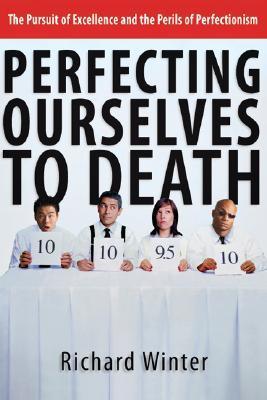
Honored as a "Year's Best Book for Preachers" by Preaching magazine. Perfect body. Perfect clothes. Perfect family. Perfect house. Perfect job. We strive for excellence in all areas of our lives. And there's nothing wrong with a healthy, mature pursuit of excellence. But what begins as healthy and normal can sometimes become neurotic and abnormal, leading to debilitating thoughts and In Perfecting Ourselves to Death, Richard Winter explores the positive and negative effects of perfectionism on our lives. He looks at the seductive nature of perfectionism as it is reflected in today's media. He examines the price and perils of perfectionism. And he explores the roots of perfectionism, delving into what originally awakens this drive in us. After analyzing the negative feelings and defeatist behaviors that unhealthy perfectionism births, he provides practical strategies for how to change. "The important thing to see," writes Winter, "is that we are to strive to become better people, not just to be content with who we are or how we measure up to the standards of the culture around us." For Christians this means becoming more like Christ in every area of our lives. Here is the "perfect" book for those who struggle with perfectionism and for those pastors, counselors and friends who want to understand and help perfectionists.
This book felt like it was speaking directly to me. I have just recently been trying to grow through my struggles with perfectionism and this was the perfect starting place. If you have any perfectionistic tendencies, whether mild or high, I'd definitely recommend this read.
At first, not as practical as I thought it would be - As I think on it a little longer I see that this is just as it should be. What good would it be to give a perfectionist more things to DO to make themselves better.. haha. This book it more like a text describing the different types of perfectionism, what is healthy and not healthy.. and then points the christian reader back to the truth that we do not have to be perfect. mistakes are OK. It is not the end of the world if things are not done right, or our way. If things happen we don't expect... We will survive. The bottom line is that we are accepted and made whole in Christ, not in what others think (the image we hold up to), or even in our own mind... (our ideals). We have everything we need and its OK if we rest awhile - make mistakes, forgive people and you know what -- That makes Us and the rest of the people around us feel much more perfect :) and we can actually feel closer in the arms of the father when we know we don't need to earn anything, be any certain way - we can just be Ourselves. Imperfect yet Perfect. Brilliant.
The premise of this book is that our society has become one where we are expected to be "perfect". We have images of perfection projected at us from every angle and begin to expect that upon ourselves.
Winter uses this book to try to help us understand the roots of our perfectionistic tendencies and become healthy in our perfectionism. I picked up the book intrigued by the premise and because I agreed with his analysis of our society. However, I found the book as a whole to be an okay mix of pop psychology and some practicals that I didn't find particularly compelling.
A good conversation starter on the topic of our perfectionism and driven tendencies as a society, but not where I would finish
Although the start of the book is slow, this book ends up being a brilliant diagnosis into the brain of a perfectionist (or this one at least).
It has taught me some self-awareness to my condition and allowed me to have a framework with which I can discuss it with others (it is surprising how many people think they know what perfectionism entails).
I love how this book dives into both the psychological/sociological and theological aspects of perfectionism. The author did a good job of presenting research on perfectionism while using a biblical perspective to give a framework to the psychology behind this issue.
I really liked this one, I’d recommend it to any christian who struggles with perfectionism. I’d love to meet the author too, maybe have a coffee or something.
3.5... my CM recommended me to read this book and I feel very neutral towards it. I think it will be super helpful for conversations with students, but I didn't personally take a whole lot from it? Who knows... maybe I'm more of a perfectionist than I think and am just playing it down???
Netušil som, že môže existovať aj umiernený perfekcionista. Dokonca som zistil, že človek ktorý je z nášho pohľadu lenivý, bordelár, prípadne chronický odkladač, je vlastne prílišný perfekcionista, ktorý rezignoval sám na seba. Veci nemôžu byť, tak dokonalé, ako si ich predstavuje a preto sa im vyhýba. V knihe je na môj vkus príliš často spomína kresťanský boh.
I didn’t realise that I really struggle with perfectionism until the start of this month. I was fed up with my negative thought processes - a voice in my head berating me for how I spoke or behaved or performed after certain situations: spending time with acquaintances/friends I know moderately well; interviews; presentations; speaking up in a group of people whom I don’t know well; playing a musical instrument/singing in public.
I thought I was going mad, and, having opened up to someone, he strongly suggested I read this book.
This book is by no means a ‘quick-fix’ for perfectionists and is a little dated, but is just what I needed to read to gain further insight into why I often think like that. I now know that perfectionism can be caused by a number of different factors, but namely they all stem from a desire to be in complete control over situations (rather than trusting that God is in control over situations) and a desire for others to think highly of us (rather than having confidence that in Christ, God fully accepts us and thinks we’re wonderful, regardless of what others think of us).
Winter’s book is thorough, accessible, not patronising, Biblically grounded and sympathetic. I know I'll come back to some sections again and again.
Worth reading if you, or someone you know, often discloses an ‘all or nothing’ approach to tasks, is often dissatisfied with their performance, cannot accept compliments, struggles with self-loathing, is constantly frustrated with the behaviour of other people around them, and/or has an acute fear of failure, rejection and displeasing others.
Do you struggle with thoughts that criticize you constantly? How about others? Do you struggle with OCD or anxiety? Do you constantly wonder what others will think about what you say, what you do, what you wear, what you look like? What about God? Are you constantly in a state of anxiety that He will give up on you? Do you struggle with pride? Do you view your way as always best? Do you feel that you have nothing to learn? Do fail your desire for perfection? Do you think you are near perfection at all?
This book is for you! Seeking to be the perfect person is a life of misery for you and others, and giving up is also a life of misery. Thankful for this book! Richard Winter simply lays out the many ways that perfection manifests itself in people’s lives. An unhealthy pursuit of perfection does not produce the fruit of a healthy person, it is only when we accept that we are not perfect, only Jesus Christ is. When we see this we can let go of this life of fear and pride! Great book, I would recommend this to anyone struggling with any of the questions I asked at the beginning! God has used this book in my life, He has helped me see new things that I never noticed about my own inner thought life and tendencies.
Overall, I found this book to be helpful and interesting; it deals with a topic that I believe many people in 21st century deal with. Perfectionism runs rampant among our culture, and it frequently seeps into Christianity in the form of performance-based religion.
This book is very factual and helpful in presenting basics about perfectionism, but it put me off a little bit because it reads much more like an academic paper. Winter also spends very little time actually talking about dealing with the problem of perfectionism, so I don't think it's anything that is highly applicable. I do, however, think it is good at diagnosing problems within our culture and looking at how perfectionism forms through many different lenses.
I wouldn't say that I'm a perfectionist, but I do have some of those tendencies. I struggled more with trying to be perfect earlier in life but that flame was quickly extinguished when I experience failure... and more and more failure. And as Richard continues on this writing and eventually gets to the greatest point. That failure is imminent and as a Christian it's expected but temporary. Perfection is on the horizon but is only achieved through death and being saved from destruction and being made perfect through Jesus.
I read it kinda fast, and I thought it was fine. I thought he was repetitive at times, but balanced and integrated in his presentation of info. He’s clear from the beginning about what he’s assuming, but stays open handed as he writes. Not the most eloquent writing, but it was informative! The chapters on guilt vs shame and on how the media shapes our view of what perfect means were most helpful. It wasn’t my favorite, but I don’t know if there’s anything objectively wrong with it.
A helpful analysis of perfectionism, with a number of insights I hadn't previously grasped. It's a bit of a slow start but, as a Christian, I found the latter chapters particularly useful. I'm sure that many who aren't Christians would also find the approach of this book both accessible and intriguing.
Great. If you're down with a integrative/Kuyperian approach to counseling this book is for you. Dr. Winter is not afraid of "plundering the egyptians" to see what Christians can learn and apply from broad psychology. I think pastors would benefit greatly from this work as they learn to triage what falls in their wheelhouse for pastoral care before referring people onto faith based specialists.
Some books are worth quoting, writing down, and talking about. And we do that to minimize the common experience of ‘forgetting’ This is one of those books to me; it helps me not forget who I am, what I naturally do, and where I’m headed to. And when these questions are sorted out, the question of ‘what to do’ is now answered.
Great book which shows how dangerous perfectionism is. Perfectionism is seen by media, ads, in churches, in family homes, and in our own hearts. It leads to emptiness and no hope. It’s great being perfect but morally none of us are and with our skillset even the best could have always gotten better.
My thoughts are highly subjective for this book. I just finished reading Hiding From Love a few months ago, and I thought it had a much deeper and richer analysis of the human soul. Having said that, Perfecting Ourselves to Death is a solid entry into understanding perfectionistic tendencies and takes a honest look into whether perfectionism is really helping us and the people around us.
This book was great. It felt exposing in similar ways to the Enneagram. I have never used the word perfectionist so describe myself, but came to grips with why I react the way I do when it comes to other people’s’ ‘expectations’ of me. Really challenging and encouraging read!
I really enjoyed this! A very good portrayal if the thinking of a perfectionist. It was very helpful to be able to visualize what I'm doing in my brain and relate to the feeling expressed. My only complaint is just desire more on how to deal with perfectionism and strategies for coping with it.
This book provides very helpful portraits of people who fall on a spectrum of perfectionism, outlines the outcomes of severe perfectionism, and offers truth and hope.
Wow, do I relate to this book. It's an excellent study on perfectionism as it relates to both psychology and faith. I would highly recommend this to anyone who struggles with perfectionism
Me gustó mucho la parte fibal del libro en la que explica la diferencia del concepto de perfección que tenemos generalmente en la mente y la perfección bajo la perspectiva bíblica.
An excellent book on the subject of perfectionism that helped me have categories of perfectionism and which ones apply to me. A good book that I will likely refer back to in the future.