

What do you think?
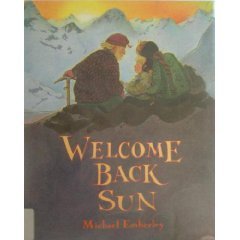
Welcome Back Sun
Full color pictures help capture a Norwegian family's life during the murketiden, the time between September and March when the sun almost disappears in the mountain villages of Norway.
32 pages, Library Binding
First published January 1, 1993
About the author
Michael Emberley
55 books29 followersMichael Emberley is the illustrator of numerous books for children. He lives in Ireland.
Ratings & Reviews
Friends & Following
Create a free account to discover what your friends think of this book!
Community Reviews
Displaying 1 - 21 of 21 reviews

December 7, 2023
Sweet story of a family in the dreary time of Norway in the winter.
April 7, 2012
Welcome Back, Sun by Michael Emberley tells the story of the sun's return to a small Norwegian village after a long dark winter. A mother and daughter hate the winter darkness. Finally, with the father and other townspeople, they climb Mount Gausta to greet the returning, long-missing sun.
Emberley's evocative illustrations portray both the lengthy, depressing darkness of Winter and the brilliant brightness of the returning Spring. My favorite images are hating murketiden, gathering branches, leaving town, families on the ridge, opened buds and the cover.
This reminds me of Lucia and the Light, though the emphasis here is on the legend, the "murky time", and the connections of family and friends. While I enjoyed this tale, I prefer the folktale elements in [book: Lucia and the Light}. This could be useful as a different seasons book, and for a look at the darkness experienced by people living in the far northern mountain valleys. 3.5 stars.
For ages 6 to 8, Norway, winter, spring, family, multi-cultural, folk-tales, and fans of Michael Emberley.
Emberley's evocative illustrations portray both the lengthy, depressing darkness of Winter and the brilliant brightness of the returning Spring. My favorite images are hating murketiden, gathering branches, leaving town, families on the ridge, opened buds and the cover.
This reminds me of Lucia and the Light, though the emphasis here is on the legend, the "murky time", and the connections of family and friends. While I enjoyed this tale, I prefer the folktale elements in [book: Lucia and the Light}. This could be useful as a different seasons book, and for a look at the darkness experienced by people living in the far northern mountain valleys. 3.5 stars.
For ages 6 to 8, Norway, winter, spring, family, multi-cultural, folk-tales, and fans of Michael Emberley.
September 20, 2016
The story is set in the mountain villages of Norway tucked away in the valleys between the high peaks. Between the months of September and March, the sun almost completely disappears. And the murky period is called murketiden by local people. Unable to bear the darkness and coldness during the time, a Norwegian girl and her family finally set out to find the sun. They follow the legend, in which a young girl who longed to see bright sunshine so much that she climbed up the mountains, called the sun out, and led it down into the valley.
The story itself is quite simple without too much plots. Its geographical background in Norwegian contributes to its diversity as children’s literature. Although it does not dive in the cultural values of Norway, it gives outsider a glance at the Norwegian family’s life during the murketiden. The flat plots are illustrated in a strong way with the evocative pictures. I really enjoy the illustration of this book. The contrast between the fainted images at the beginning and the colorful images at the end shows the transformation from despair to hopeful period. I would recommend this book to first to third grade children who are interested in Norway.
The story itself is quite simple without too much plots. Its geographical background in Norwegian contributes to its diversity as children’s literature. Although it does not dive in the cultural values of Norway, it gives outsider a glance at the Norwegian family’s life during the murketiden. The flat plots are illustrated in a strong way with the evocative pictures. I really enjoy the illustration of this book. The contrast between the fainted images at the beginning and the colorful images at the end shows the transformation from despair to hopeful period. I would recommend this book to first to third grade children who are interested in Norway.

April 23, 2011
Soft illustrations and a gentle heart-warming telling of a day in the life of this young Norwegian girl and her parents during winter. Living between high mountains and far north of the equator, there are weeks where there is almost no light at all during the day.
Inconceivable to children in El Paso whose experience is so different without access to books to help them realize not everyone lives like we do.
Inconceivable to children in El Paso whose experience is so different without access to books to help them realize not everyone lives like we do.

April 30, 2021
I would give it four stars, but it is factually inaccurate about the sun. Oslo, for example, is below the arctic circle, and it gets some sun every day of the year. And nowhere does the sun wait until late March to come up. Even with mountains hiding the sun, once you're past the vernal equinox you are going to have pleny of light. If it's gone 4 months of the year (which is incredibly far North) that puts the sun coming up in Late February.
July 27, 2016
When the winter blues finally hit me I take out this book, gather some children and we read it together. It always makes me feel better, reassured, that the winter will end, and warmer days are coming!

November 29, 2012
This is a great little story that details a little bit about what it is like to live in the north with no sun during the winter.

September 11, 2015
Gorgeous illustrations and story
September 11, 2019
It was a really nice folklore story. I think it would be best received by children ages 7-10.

April 19, 2021
A magical telling of the return of the sun to a small, mountainous, Norwegian town by a young girl. Lovely, old-fashioned illustrations illuminate the classic tale.

Read
November 29, 2022Picture book about the sun coming back to a village above the arctic circle. Nice seasonal read.
February 22, 2026
I’ve always loved children’s books and this one is so beautifully illustrated and written. It’s intended for my youngest grandson, and I had to take it to bed and read before I gave it to him.

August 5, 2023
In the Norway mountains there are villages that have very little sunlight in the months of September to March. This story is about a girl and her parents waiting through what they call Murketiden for the sun's return. They follow the tradition of a legend of climbing the mountain when it nears time for the sun to rise higher in the sky, bringing spring with it. The story is told in a lovely lyrical manner, with fabulous illustrations, about welcoming the sun back.
This book is more for older children as it is very wordy for younger ones unless greatly simplified by the adult reader.
This book is more for older children as it is very wordy for younger ones unless greatly simplified by the adult reader.

April 23, 2009
This is a fascinating story about a village in Norway, tucked into a mountain valley, who experiences the long, dark winters and celebrates the return of the sun. It's a nice story, with expressive illustrations that convey the feeling of dimness and darkness as well as the brilliance of the light when the sun finally returns.
May 16, 2013
My kids found this book very interesting. They had a hard time imagining a place where the sun does not come out for months at a time! It is an enjoyable book and it sparked an interesting conversation.

November 17, 2014
If the goal was to make a book that's as long and dreary as an interminable dark Nordic winter - success!
-My dad
Are you still trying to read this book to me? I'll be across the room, playing with something, instead of lying next to you, hanging on every word like I usually do.
-Me
-My dad
Are you still trying to read this book to me? I'll be across the room, playing with something, instead of lying next to you, hanging on every word like I usually do.
-Me

May 25, 2012
Beautiful images of light and a lovely story that even the minimally sun-starved among us can relate to.
October 17, 2013
Yup, I teared up after reading this little gem...

May 17, 2012
Grades 1-5. Deep in a mountain valley in scandenavia, the sun vanishes for much of the year.
Displaying 1 - 21 of 21 reviews