Jump to ratings and reviews
Rate this book

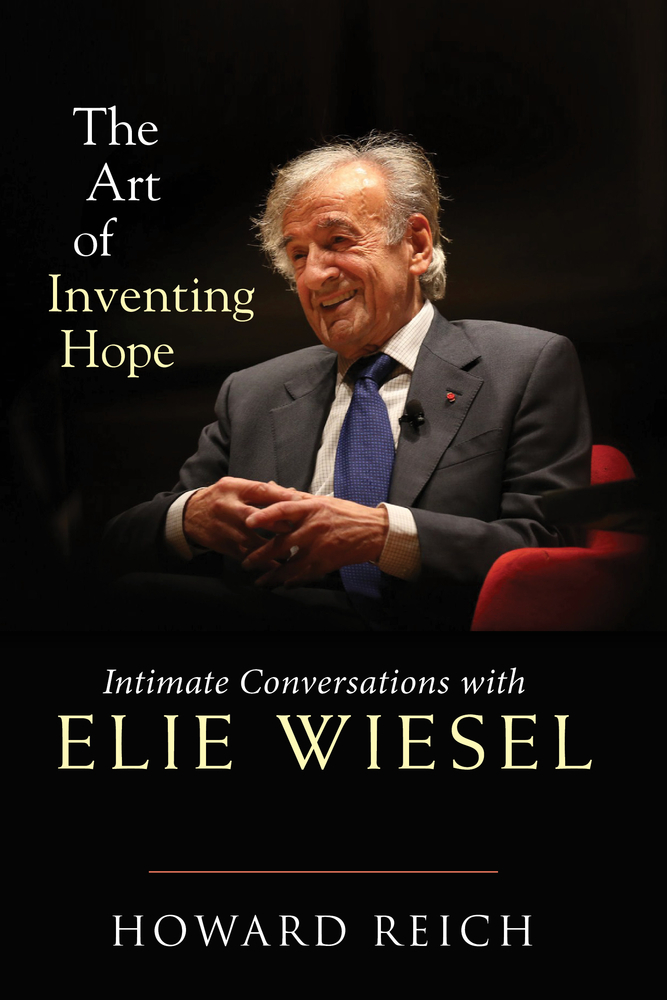
The Art of Inventing Hope: Intimate Conversations with Elie Wiesel

Rate this book
The Art of Inventing Hope  offers an unprecedented, in-depth conversation between the world’s most revered Holocaust survivor, Elie Wiesel, and a son of survivors, Howard Reich. During the last four years of Wiesel’s life, he met frequently with Reich in New York, Chicago and Florida—and spoke with him often on the phone—to discuss the subject that linked Reich’s father, Robert Reich, and Wiesel were both liberated from the Buchenwald death camp on April 11, 1945.
What had started as an interview assignment from the Chicago Tribune  quickly evolved into a friendship and a partnership. Reich and Wiesel believed their colloquy represented a unique exchange between two generations deeply affected by a cataclysmic event. Wiesel said to Reich, “I’ve never done anything like this before,” and after reading the final book, asked him not to change a word.
Here Wiesel—at the end of his life—looks back on his ideas and writings on the Holocaust, synthesizing them in his conversations with Reich. The insights on life, ethics, and memory that Wiesel offers and Reich illuminates will not only help the children and grandchildren of Holocaust survivors understand their painful inheritance, but will benefit everyone, young or old.

177 pages, Hardcover

Published May 7, 2019

20 people are currently reading
205 people want to read

About the author

Howard Reich

12 books3 followers

Ratings & Reviews

What do you think?
Rate this book

Friends & Following

Create a free account to discover what your friends think of this book!

Community Reviews

5 stars
74 (39%)
4 stars
79 (42%)
3 stars
28 (14%)
2 stars
4 (2%)
1 star
2 (1%)
Displaying 1 - 30 of 30 reviews
Profile Image for Quo.
342 reviews
August 12, 2020
I learned of The Art of Inventing Hope: Intimate Conversations with Elie Wiesel via commentary by Howard Reich, the Arts Critic for the Chicago Tribune, the book's author. Both Elie Wiesel and Howard Reich had parents who were victims of the Holocaust & both Wiesel and Reich's own father were incarcerated at Auschwitz & later Buchenwald, though they never met, with both surviving their confinement & battling memories of the Nazi death-camps throughout their lives. Reich's mother also was haunted by her concentration camp experiences, while Elie Wiesel's parents & little sister died in the camps.


Within much of the book, Elie Wiesel serves as a kind of therapist to Howard Reich, attempting to assist him in dealing with "survivor's guilt", which afflicts children such as Wiesel & Reich himself, who was afraid to push his parents to discuss the repressed horror of such life-changing experience but who also felt that he could have done more to assist them in coping with the aftermath of imprisonment in a place like Auschwitz. Wiesel contends that only the guilty should feel guilt, also commenting that "I did nothing in camp to survive, being too weak & too timid."

Wiesel, who was awarded a Nobel Peace Prize in 1986, acknowledged the dark sentiments children of survivors are confronted with but offered a different view than some:
They participate in a different dynamic, a role reversal in which the survivor parent needs protection & the child oddly finds himself or herself attempting to provide it, children taking responsibility--emotional & otherwise--for the situation they & their parents are in. In a strange way, the child becomes the parents' parent, protecting the parent from the after-effects of a tragedy that's difficult to discuss & yet impossible to escape.
Instead, Elie Wiesel suggests that even if one's parents or grandparents are gone, one must recreate them with heart & mind, gathering what's left of the memories. For, "they may be gone physically but not metaphysically", so that "the survivor should use the surplus of love he or she feels, and not just on Jews." This is wonderfully concrete & uplifting counsel, offered not just to Howard Reich but to all of us.


Mr. Reich asks Wiesel how the Holocaust was allowed to occur, especially in a country of mostly educated, cultured Europeans & he points to a general human fear of "the other", with a recent survey of 53,000 people taken in 102 countries covering 96 languages & dialects, indicating that 26% were deeply anti-Semitic, though 70% of them had never met a Jew. Beyond that, 54% had never even heard of the Holocaust.

According to Wiesel, the killing of the Jews goes back to the time of the pharaohs but during WWII, the Nazis even killed Jews who had converted to Christianity. Thus, the Holocaust was somehow different, with Nazi Germany turning hatred of the Jews into an obsession & the Nazis creating a "calculus of death", continuing to murder Jews even when it was clear that the war was lost.

As to why so few seemed to see it coming? There is an interesting comment, one I first heard about in Elie Wiesel's Night, relating that in his own village of Sighet in present-day Romania, a man known as "Moishe the Beadle", who had somehow escaped from a concentration camp in 1944 warned his townsfolk about the Nazi mass murder of Jews. No one, Wiesel included, believed the man, just considering him meshuggah, Yiddish for mad or insane. It just seemed too unreasonable that such a thing could occur, even in spite of past pogroms visited on Jews. In effect, the people of Sighet, as well as most others, simply lacked sufficient imagination to envision the Holocaust.


It is felt that there is in fact a quality known as "active pessimism", which can still lead to change. Likewise, Wiesel's religious views are rather ambiguous because he intones that "the Messiah came too late & the creation of Israel came too late." He quotes Kafka: "When the Messiah will come, it will not be on the last day but the day after that." Call that "gallows' humor" if you wish but I rather enjoyed the quote. Nevertheless, Israel is absolutely indispensable to Jewish identity.

In spite of the Holocaust & continuing anti-Semitism, The Art of Inventing Hope is in fact a hopeful book, as the title implies. There is a quote from a French poet & Holocaust survivor: "I am so weak that a pebble can kill me but as long as I breathe, I am immortal." Wiesel declares that "in moments of grace, words can attain the quality of deeds." And, at least for Jews, "hope is more than just an aspiration; it is an imperative."

Ultimately, reprisal is a lost cause, in a way a 2nd loss for those who practice it. For, "hatred is a disease, especially when the hater sees aspects of those he hates in himself." There is no such thing as either collective guilt or collective innocence, according to Elie Wiesel.

To be honest, Wiesel's thoughts were quite uplifting, while often the commentary of Howard Reich, especially his staunch defense of Netanyahu & the Israeli settler mentality with regard to continuing to force Palestinians from their homeland to allow for the expansion of Israel. I found The Art of Inventing Hope quite an interesting book to read, especially considering the inspirational life of Elie Wiesel following his survival from the charnel houses that claimed so very many lives.
Profile Image for Pam.
4,625 reviews67 followers
November 3, 2019
The Art of Inventing Hope: Intimate Conversations with Elie Wiesel is by Howard Reich. This outstanding work will long remain one of my favorite books on Holocaust history. I have long been an admirer of Elie Wiesel and this book just makes that admiration more intense. Howard Reich has let us into his private thoughts with Elie Wiesel and has given us an in-depth look at Elie Wiesel’s thoughts separate from his own books. This is done with such emotion and such a sense of respect and admiration that the reader is left in awe.
Along with Elie Wiesel’s comments and beliefs that are exposed with this book, we also get a look at Howard Reich’s own family history or what little he knows of it. As those interested in Holocaust history, we often forget that not everyone who survived the Holocaust has made their story known, not even to their children. Although many more are sharing their stories now, they still represent a minute number compared to those who survived. Although it is understandable that they would not talk about it, it is also a shame that they did not get the chance nor see the need for it. For those who did and do tell their stories, it has to be extremely difficult to do so. Those memories must be horrific to remember much less tell anyone about.
Their conversations cover a number of items of importance. However, the chapters on “We Are Witnesses”, “ How did our parents stay sane”, and “How do we speak of this.” Are possibly the most meaningful to me and the most troubling. As an educator, I always told my students that they were now witnesses and I have tried to do that as well. In hearing survivors speak, I often wondered how they managed to stay sane while in the camps or in hiding. It is something I simply can’t imagine. Of course, “Why we speak of this” appeals to the ultimate teacher in me. The thought that this event is not remembered as it should be and possibly will be forgotten except as a footnote in history sincerely upsets me. This is an important time in history and we should be compelling all students to learn the lessons it teaches.
The book was one that I had to stop and think about the chapters before going on to the next. It was not one to be rushed through nor read in one sitting, although I could have. It was emotional and yet at the same time uplifting. One could just imagine being the person sitting in the room listening to these great men speak. It was truly inspiring. It is a book which should be talked about as well as read. It is perfect for a reading circle who is interested in Holocaust topics. I would love to be able to hear Howard Reich speak about his book; but unfortunately, distance is an issue.
Profile Image for David.
1,630 reviews173 followers
August 19, 2019
If you've read books by Elie Wiesel like Night, and haven't read The Art of Inventing Hope: Intimate Conversations with Elie Wiesel yet, you definitely want to add this one. Author Howard Reich was a journalist with the Chicago Tribune when he got an assignment to interview Elie Wiesel. This was particularly meaningful to him as his father was also a Holocaust survivor who had been liberated on April 11, 1945 from the Buchenwald death camp along with Mr. Wiesel. Growing up, his father said little about his experiences until it was too late. Likewise his mother, also a Holocaust survivor, said little until her later years when she developed memory problems. So he was excited about meeting and talking with one of the most recognized and revered Holocaust survivors; little did he know that this would develop into regular meetings and friendship and partnership that would go on for over four years until Elie Wiesel's death in 2016. The result of all of those conversations about his life, his ideas, his writings, and his insights on life, ethics, and memory. This is a very well-written (Elie Wiesel, upon reading the draft manuscript, told the author to not change a word), intimate, and thought-provoking look at the life of one of the best of humanity.
88 reviews3 followers
September 15, 2019
Howard Reich is the art critic for the Chicago Tribune. He is also the son of Holocaust survivors. When his mother begin to show signs of PTSD in her declining years that were mysterious to the author he begin to ask questions about the Holocaust and ended up writing several articles, a documentary, and a book. Because of this, when the Chicago Tribune wanted to honor Elie Wiesel they asked Reich to do the onstage interview. From this a connection between Elie Wiesel, a concentration camp survivor and Howard Reich a conversation begin that lasted for years and this book was one of the results. In spite of all that he lost and all that he suffered, Elie Wiesel was an unbelievably hopeful and optimistic person. They discuss many aspects of what it is to survive an event so horrific and what it is to be the second and third generation of such survivors.

This book is very thought provoking. The important lesson here is that in all circumstances there is hope and we must never lose hope. We must say no when it first presents itself as an option. I appreciate too, the lesson that there are times when respectful silence is the best course of action.

It is difficult to summarize this book. It should be read. It’s very valuable.
Profile Image for Liza Wiemer.
Author 5 books741 followers
September 25, 2019
Incredible. Thought-provoking. Captivating. Important. Timeless.
Imagine having the opportunity to sit down and ask Elie Wiesel some of life's toughest question. Not just once, but many times over a four-year period. Howard Reich had that opportunity and he shares those conversations in THE ART OF INVENTING HOPE: Intimate Conversations with Elie Wiesel.

The audiobook was phenomenal and the narrator did an outstanding job, so much so that I forgot that I wasn't listening to Howard, but someone who was performing as Howard. Outstanding choice.

Without a doubt readers—or listeners—will walk away with gems. One in particular important message is that when we hear a story, even if we are not at the event, we become witnesses. That is why it's crucial to read books on the Holocaust, speak to survivors and their descendants. We become a crucial link to "Never again!"

I am grateful that I also own a copy of this book. Reading it once is not enough. I have no doubt that this wisdom-filled book will speak to me in different ways each time I read it.

Highly recommend!
Profile Image for Drick.
903 reviews25 followers
October 6, 2019
Howard Reich is the son of Holocaust survivors and Elie Wiesel is a survivor of the HOlo;caust. Both Wiesel and Reich's father were freed by the Allies in Buchenwald. Late in life realized he did not know what had happened to his parents, but a traumatic reenactment by his mother started him on a path to greater understanding. Through a series of fortuitous circi=umstances he met and developed a friendship with Elie Wiesel and what followed was about 4 years of conversations which are summarized in this book.

The conversations ranged from the experiences of the Holocaust and after, the meaning of hope, faith and the role of Israel in history and in the world today, The conversations were insightful and deeply moving, as well as deeply troubling, realizing the depths to which human evil can go. While I have read Wielesl's account of Auschwitz and Buchenwald in his book Night, this book has prompted me to seek out more of his writings to learn for them.
152 reviews3 followers
October 10, 2019
Deeply moving examination of the Holocaust through the eyes of an amazing Holocaust survivor and the wonderful author who is the child of Holocaust survivors. It is the culmination of a four-year relationship and friendship that lasted until Wiesel's death. A must-read for anyone wanting to experience a personal side of Elie Wiesel, but also to better understand the impact of this major event on individuals and the world.
Profile Image for Relstuart.
1,247 reviews111 followers
March 4, 2023
Fascinating consideration of what it was like to be a child of parents that survived concentration camps or being on the run during the holocaust.

The author noted his mother always stayed up at night sitting in the living room periodically checking the window out the front of their house. He never saw his mom go to bed and as far as he was aware, she never slept in the bed with his father the whole time he was growing up. As a child he just assumed it was normal. It wasn't until much later he learned she escaped a National Socialist ghetto and was on the run for years as a child/young teen during WWII. She spent every night watching in case someone was going to come looking to kill her or her family.
8 reviews
March 12, 2021
To read Night by Elie Wiesel tells you what he experienced.

To read this book tells you how if affected him and how his life has been shaped by it (along with other survivors). A truly fascinating look inside the effects of the Holocaust. These books have made me think a lot more about injustice and what I can do about it with my life. I can no longer turn a blind eye to atrocities around the world. Something must be done to help suffering people. The world must listen, hear cries for help and ACT. Thank you Elie Wiesel for your voice and for being the voice of the forgotten. Rest in peace.
316 reviews15 followers
May 2, 2025
The author, Howard Reich, was a music critic for the Chicago Tribune for many years and the son of Holocaust survivors. He didn't really become interest in the Holocaust, however, until he had the assignment to cover Elie Wiesel, who was going to speak in Chicago. Thus started a long friendship. The book is a record of their conversations. Much of it has to do with children of Holocaust survivors. While interesting and well written, for me the chief value of the book was motivating me to read more of Elie Wiesel's works.
319 reviews1 follower
March 13, 2022
An excellent book about the Holocaust and the survivors and their heirs. This is a discussion on the forever impact of the Holocaust by author of Night, Elie Wiesel and Chicago Tribune columnist and son of survivors, Howard Reich.
The book is very real and informative. It made me fear about our world today and learned that the world did not really learn anything from those awful days of WWII.
Much inspiration. A lot to think about, and do.
Profile Image for DC.
928 reviews
August 21, 2019
This book presents us with the many paradoxes that surround anyone's understanding of the Holocaust - that is a cental theme of the text. (I don't mean contradictions like whether it happened or not; it did.) It is over, but still happening. It leads us both towards faith and towards disbelief.

That's really what this book is - something so beautiful and so sad. So hopeful and so bleak.
Profile Image for Eric.
159 reviews6 followers
December 30, 2019
A good resource for someone interested in what it is like to be a child of Holocaust survivors. Wiesel's words are as comfortable as ever. This is a slim volume, and not where a newcomer to Weisel's story should start. In fact it is written by Howard Reich, a music critic for the Chicago Tribune, who discovered his family's history relatively late in life.
Profile Image for Vanessa Ehrlich.
405 reviews4 followers
January 30, 2020
Howard Reich brings us into the room with him as he spends hour after hour with Eli Wiesel. You feel like you you know Eli Wiesel as a friend, professor and Jewish hero. I have heard Howard speak and his personal story as the child of survivors is also poignant and informing. I reccommend this book as a wonderful introduction to Eli Wiesel.
Profile Image for Micebyliz.
1,263 reviews
Read
March 3, 2025
i just reread this book last night for some sustenance in these dark times. Mostly i cried because i wish there were someone now who had the moral gravitas to speak out as he did. We are all floundering under the water without lifejackets.
It's a wonderful book and it bears rereading many times as do many of Wiesel's books. They are a comfort and a call to action. First though, i need a hug.
Profile Image for Lynne.
853 reviews
October 10, 2019
I was a bit disappointed in that the author spent a lot of time on his own autobiography...from the title and promos, it seemed it would be even more of Wiesel's thoughts.

Two of the chapters stand out and make the book worthwhile: "Moment of grace" and "The art of inventing hope"...
Profile Image for Erin Woodall.
476 reviews
July 13, 2021
Elie Wiesel always seemed to try to do things positively. Even his answers to the questions he stayed severe he was comfortable. He has an interesting view on the horrors that happened at the camps. I'm so glad he talks and shares but does not encourage hate.
Profile Image for Sorina.
60 reviews2 followers
March 15, 2024
Second read of this magnificent book in preparation for our live event with Howard Reich on 29 March. Just as rich and insightful as the first. The last chapters particularly apt for today's complex context.
Profile Image for Roberta Westwood.
1,034 reviews12 followers
November 9, 2024
Thought provoking

A very interesting dialogue between generations. For me, it put the experience of holocaust survivors into perspective. I have read all Elie’s books, and have a great appreciation for them, so welcomed this alternate genre. Highly recommended.
14 reviews
June 16, 2019
The perspectives provided in this book further illuminated my understanding of the Holocaust. Looking forward to reading more of Wiesel’s own work in the future!
Profile Image for Philip.
1,074 reviews5 followers
July 29, 2019
There are no answers. The saddest and most disgusting commentary on humanity. It continues even today.
Profile Image for Karen.
805 reviews22 followers
October 3, 2019
Elie Wiesel's words in conversation are explored and explained in this text. The authors's beautiful writing and Elie Wiesel's magnificent thoughts are both sad and uplifting at the same time.
Profile Image for Sariqd.
14 reviews2 followers
June 28, 2020
Enjoyed reading how the author's perceptions of his own family changed upon hearing Elie Wiesel's experiences.
2 reviews
February 23, 2024
Such an unexpected gift, a way to appreciate the mindset of a man who experienced the unimaginable and enabled the world to bear witness.
Profile Image for Sue Putnam.
23 reviews16 followers
May 21, 2019
Many reasons why not to lash back at the attacker.....
And what to do and who to be instead.
Inspiring!
Profile Image for Missy.
18 reviews
April 23, 2022
Deeply moving. The world is a darker place without Elie Wiesel. I will read anything pertaining to him, his life, his thoughts. But I also enjoyed reading the author’s thoughts alongside Wiesel’s and seeing the relationship between the two men. I grieve not only for the author’s loss of his mentor and friend but also the world’s loss.
Displaying 1 - 30 of 30 reviews

Can't find what you're looking for?

Get help and learn more about the design.