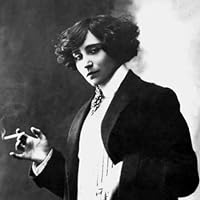
Colette was the pen name of the French novelist and actress Sidonie-Gabrielle Colette. She is best known, at least in the English-speaking world, for her novella Gigi, which provided the plot for a famous Lerner & Loewe musical film and stage musical. She started her writing career penning the influential Claudine novels of books. The novel Chéri is often cited as her masterpiece.
I treasure my Collette books because, independent of anything else, she is one of my grandmother's very favorite authors, and my grandmother gave me this, her entire Colette collection. I read them all right away, of course, Every week she would ask me, "have you read Mitsou? What did you think?" And every week I would tell her, "Grandma, you didn't give me Mitsou." We argued about it for two years before she finally found her actual Mitsou and sent it to me.
Sadly, though, I can not tell her what I think of it honestly, because the truth is this: every single scene of Mitsou's life as a dancehall performer, and the author's as a traveling actress, is an amusingly sepia-toned echo of my experiences as a stripper (other than the traveling aspect). The freezing dressing rooms, the quick changes, the inevitability of one's own and others' states of undress. The fun and difficulty of the costumes. The camaraderie among people who probably wouldn't be hanging out with each other otherwise. The glamour and sordid decadence the audience seems to imagine of our lives, vs the total ordinariness you actually find there.
But, of course, these are not the kind of beautiful truths that I can share with her. Maybe someday, a few years after I've stopped dancing, I'll let her in on some of them. She's good at accepting things when they're over.
Why has this been out of print in English (or at least the United States) for so long? "Mitsou" is a novella about an actress during the first World War while "Music-Hall Sidelights" is a collection of sketches from the world of the musical theater at the dawn of the motion picture.
Colette's writing in this period varies widely from the divine The Vagabond to the abysmal Minne and this collection is something of a lost treasure. The writing of "Mitsou" occasionally touches on the brilliance of the former. "Music-Hall Sidelights" occasionally has the tone of the Dialogues de Bêtes but at its best captures some of the weariness of Vagabond as well. (It may even be that the narrator of the first few stories is our Renée Néré, but not in the more literal sense of it being an actual sequel.)
It's a shame that this book seems to have been forgotten. These aren't masterpieces, but they are delectable bites of fiction perfect for a rainy afternoon at a beach house or a long train ride. They're also something of an end of an era for Colette in which every novel had an "Annie", a "Claudine", an admirer, and a distant patriarchal authority.
Gloriously evocative of France between the wars, as only Colette can write it… because she lived it. Seedy music-halls and callow soldier boys converge in a collection of short bites and the genuinely beautiful ‘Mitsou’. Fragile descriptive strokes and hot-breathed passion. Exquisite.