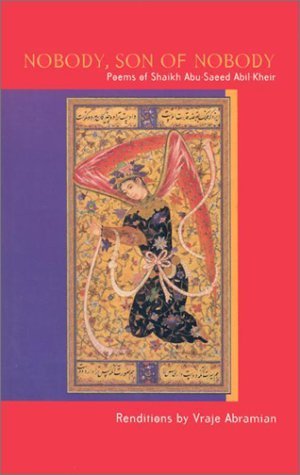
Readers who swoon within the love-intoxicated poetry of Rumi must read the poetry of Shaikh Abil-Kheir. This renowned but little-known Sufi mystic of the 10th century preceded Rumi by over two hundred years on the same path of annihilation into God. He referred to himself as -- Nobody Son of Nobody his expression of the reality that his life was subsumed in the Divine, and that the individual self had disappeared in the heart of God: Under this cloak is nothing but God. Introduce me as Nobody, Son of Nobody. These are 195 short selections translated from the original Farsi. These poems deal with the longing for union with God, the desire to know the Real from the False, the inexpressible beauty of Creation when seen through the eyes of Love, and the many attitudes of heart, mind and feeling that are necessary to those who would find the Beloved -- The Friend -- in this life.
Shaikh Abu-Said Abil-Kheir was one of the earlier Sufi poets. He lived more than two centuries before Mevlana Jelaluddin Rumi yet, like Rumi, much of his mysticism follows a similar path of annihilation in divine Love.
Abu-Said's poetry ranges from the ecstatic and celestial, to struggles with abandonment. His poetry has an immediacy and even a sort of devoutly wry petulance that can draw comparisons with the great Bengali poet, Ramprasad.
Abu Said referred to himself as “Nobody, Son of Nobody,” to convey the mystic's sense of having completely merged or disappeared into the Divine, leaving no trace of the ego behind.
He lived in Mayhana in what is modern day Turkmenistan, just north of Iran and Afghanistan in Central Asia.
Love came and emptied me of self, every vein and every pore, made into a container to be filled by the Beloved. Of me, only a name is left, the rest is You my Friend, my Beloved.
I read this book early in my exploration of Sufi poetry — and I was hooked! Abu Said Abil-Kheir’s poetry ranges from the ecstatic and celestial, to struggles with abandonment. His poetry has an immediacy and even a sort of devoutly wry petulance. This book remains a personal favorite of mine.