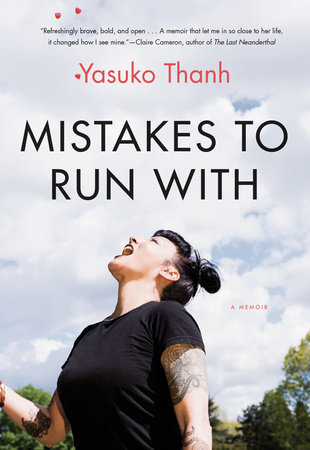
I hate to use the word "harrowing" and I feel like it could fit with Yasuko's account of her life, but I feel like it's not the right word. The definition of harrowing is acutely distressing and Mistakes to Run with is completely distressing; but at the same time, it's kind of like, there's this sense that.. she chose all of this. Which, for the reader, makes it feel like.. umm, okay.. so what... I see your story... annnnd?.. What's the purpose here, Ms. Thanh?
Yasuko Thanh is no doubt a very smart and capable woman, but no one put her out there in these streets. She put herself out in these streets chasing "something" down - which is a common situation among young girls and women, after all - everybody's looking for something.
Through my lens, reading her stories, it seems like only white folks get to capitalize on shit like this and books of this nature. It's distressing really, to watch someone chasing something down that they're not sure of. What's the purpose of this book to the reader? Reading about the author going to work each day, doing a job that she chose, even if your work is sex work, with the stresses of your work, there's stress at every job, knowing that you know it's dangerous and that you're not being forced to do it. Technically, you could leave anytime you want and have the supports of a family who would like you to do better. You just don't want that. It's distressing to watch someone chase down mistakes and a life/lifestyle that they're not even sure they want. It's distressing watching someone participate in a style of life, that they themselves have no purpose for or are even actually, really into. It's secondary stress.
It's crazy because I read this book twice - I read it two weeks ago and had no fucking idea what I had read after I read it. At the end of the first read, I was like - WHAT!? What was the purpose of her doing any of this? Doing crazy shit for crazy shit's sake? I was also saying to myself: No girl, maybe you misread some this... Of course, there are other underlying issues at play like her OCD and seemingly addictive personality, etc... but it's not a book about that, which is also weird. Those situations just seemed like additional circumstances of the stories she's telling. I didn't understand the point at first reading. I'd be lying if I said that I fully comprehend what was happening here at second reading, outside of the fact that at around 45 years of age she finally understood the need for independence, which was given only a blip of acknowledgment in the last chapter.
You know, it's interesting because her memoir brought me back to some of the behavioural issues existing in some of the girls I went to high school with. Maybe I'm being judgmental, but it really just played out like okay, here's this crazy story, for no reason. It felt like privilege at play. I think that it goes without saying that many other women and people of colour and teenagers of colour don't have the luxury of running away and leaving their families behind to pursue their own nonsensical interests. Many women forced to participate in the sex trade don't have the luxury of a choice and we can blame the Canadian government for that because they should really just legalize and regulate sex work so bitches can have security. Like, the fuck! It's time.
All things considered, this memoir reeked of privilege. Too many people are just too busy fighting to get half of what people like Yasuko get for free; freedom, the ability to travel around to various locations, the freedom to not have a work history and somehow inherit a bread and breakfast from dead rich relatives. This may be fucked up to say; but I believe it to be the truth and Yasuko even acknowledges this sentiment in the first chapter of the book where she talks about her black/native co-worker, working the track who would only make a FRACTION of what Yasuko would make being out there for like an hour. My viewpoint informs my reading and as a black female reader I couldn't ignore the fact that this book wasn't sharing anything with me, it was just telling me madness. Interesting, slightly entertaining madness, but madness nonetheless. She ain't talk about how she gave back to her communities; she ain't talk about how she struggled to maintain sobriety or that that was even really a thought to her. Not saying that these missing pieces make the book worthless, it's just that for consumption and reading purposes, it makes the book limited and makes its possibility for growth or future reference, stunted.
After reading this book twice it's harrowing, the circumstances that she described around her sex work and drug use, but there's no higher point. It's all just a story for story's sake and honestly, you can take it or leave it. I could see it as a movie tho.