Krasznahorkai László új regényének hőse és elbeszélője egy New York-i könyvtáros, bizonyos Hermann Melvill. A vezetéknévről lemaradt e betű nem akadályozza meg a a név vámszedőit, hogy folyton Melville-utódként zaklassák, aki pedig csak megkeseredett - és csak majdnem - névrokona a Moby-Dick írójának. Nem segít a helyzetén az sem, hogy véletlenül ugyanúgy dolgozott korábban vámtisztviselőként, mint a neves előd, és ugyanarra felé is lakik Manhattanben, ahol a regényíró géniusz. Miközben az érthető kényszer alatt egyre többet megtud a nagy Melville-ről és ennek nyomán egyéb, számára korszakalkotó zsenikről, lázas monológjában megosztja velünk gondolatait a metropoliszról, a művészetről és arról is, hogy mit jelent szerinte az igazi könyvtár, ahol a könyvek olvasatlanok, és amely örökre zárva van: "az eszményi könyvtár, mit tudom én, 53 millió könyvvel, az ott van, mint egy kincs, amihez nem nyúlhatna senki, hisz az értékét épp azáltal őrzi, hogy mindig készen áll rá, hogy a saját értékén álljon, más szóval hogy készen álljon, és kész." A regény mottója: "A valóság nem akadály." És valóban nem az: Krasznahorkai szuggesztív óriásmondatai olyanok, mint a Manhattan-sziget sziklájára épült felhőkarcolók: lényük mintha a lehetetlen legyőzésére születtek volna.
László Krasznahorkai is a Hungarian novelist and screenwriter who is known for critically difficult and demanding novels, often labelled as postmodern, with dystopian and bleak melancholic themes. He was awarded the Nobel Prize in Literature in 2025.
He is probably best known through the oeuvre of the director Béla Tarr, who has collaborated with him on several movies.
Apart from the Nobel Prize, Krasznahorkai has also been honored with numerous literary prizes, among them the highest award of the Hungarian state, the Kossuth Prize, and the 2015 Man Booker International Prize for his English-translated oeuvre.
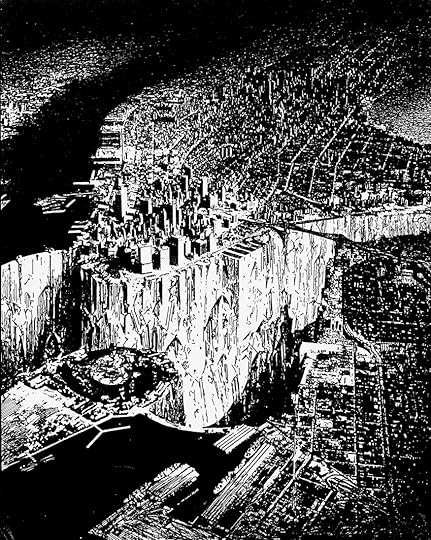
Winner of the Nobel Prize for Literature 2025 The subtitle of this novella is "Entering the Madness of Others", and what we get is the account of an employee at the New York Public Library named herman melvill (no typo) who slowly spirals towards a mental breakdown. An admirer of, you guessed it, Herman Melville, melvill starts to literally follow Melville's paths while walking through Manhattan, a sort of twisted flaneur à la Walter Benjamin aimlessly walking in another man's shoes while ruminating and building up resentment - and soon also imitating the routes of Malcolm Lowry, who was in turn a fan of Melville. The novella particularly offers many references to Lowry's auto-fictional Lunar Caustic. At an exhibition, melvill discovers the work of architect Lebbeus Woods, who aimed to free his art form of conventional limits, much as a certain László Krasznahorkai.
The whole text is written in a single sentence presented as an excerpt from a notebook and evoking a mental maelstrom that is trapping the narrator in his own head. It's not Krasznahorkai's best work as it rambles on and often fails to captivate this reader.
"An inexorable, visionary book by the contemporary Hungarian master of apocalypse who inspires comparison with Gogol and Melville." said Susan Sontag about The Melancholy of resistance, ok, said Laszlo Krasznahorkai, I’ll give you melville, here’s one, herman is his name (lower case), he’s a librarian in New York City who hates readers and dreams of never giving any book to them, also he’s obsessed with his namesake to the point of losing his wife and he will give you a long rant with no full stops and barely taking a breath, just a stream of consciousness of a bitter man who really shouldn’t be writing it down because nobody in their right mind would want to read it anyways when there exists the Divine comedy or Homer, but this might be his first(last?) book in the Dream Library of his where nobody checks out anything while he slowly descends into madness and Susan will never read this book…
Lebbeus Woods lower manhattan
And if you didn't get my review, no worries, I didn't get what this novella tried to do either. But then Laszlo says himself:
"...just as with Melville’s sentences, beyond a certain point there is no further advance to be made toward a full understanding, of course a path of understanding exists but you may advance unobstructed only a certain distance, then comes a point where you can go no further, where you would have to make an acrobatic leap to arrive at perfect understanding, a leap that you are not capable of making, or at least I am not, so you merely abide at this point, and peer in the direction where perfect understanding awaits, peer with deepest awe in that direction, and this gives you the strength to endure your life, to put up with the fact that your life can at best only be a passionate admiration of theirs, but it is precisely this awareness of the distance between you and them, the existence of this distance, that gives importance to your life by giving importance to life itself..."
I can't say I tried very hard to understand it and I never thought about it after I closed the book.
where you would have to make an acrobatic leap that you are not capable of making, or at least I am not, so you merely abide at this point, and peer in the direction where perfect understanding awaits, peer with deepest awe in that direction, and this gives you the strength to endure your life, to put up with the fact that your life can at best only be a passionate admiration of theirs, but it is precisely this awareness of the distance between you and them, the existence of this distance, that gives importance to your life by giving importance to life itself,
Can a meditation be frenetic? This certainly is both. It is a wonderful torrent of clauses and digressions which lead, not to The Zoo Story but somewhere in the neighborhood. This is the Confession of a nebbish librarian, he grows increasingly self-deprecating and this grey clerk become steadily more manic and elaborates on his erudition, his psychogeography in the nominally unassuming manner of retracing the walks of authors and, oh, his name is herman melvill (sic) and yes he lived on the same street as the Author and oh he did work for a stint with the Customs Office. The announcements grow more harried, and the coincidences lead to more revelation however tacit. His attachment to authors grows from mere scholarship to something eschatological.
I loved this and it certainly compelled me to return to Moby-Dick or, The Whale and Under the Volcano. If I'm honest, I don't think I can imagine a greater endorsement.
'...yes, we ourselves dwell in that ceaseless apocalypse that we need not wait for, but need to recognise is already here, and has been present all along'
… yes we ourselves dwell in that ceaseless apocalypse that we need not wait for, but need to recognize is already here, and has been present all along, this is what Lowry must have felt as he transported us in Under the Volcano into the immediate vicinity, the awesome grandeur and ever-present danger, of the two baleful volcanoes Popocatepetl and Iztaccihuatl, and this is what Melville kept writing about obsessively for his lone self till the end of his life, and Woods in his notebooks, which will indeed find their place on the most splendid and coveted shelf in the Permanently Closed Library, when the time comes for us to build it, and this is no joke, I am not just jabbering, I mean it seriously, as I have already written, and, for my part, especially after these recent weeks, ever since my new tribulations began, my Calvary, if I may call them that, I have actually been considering myself a day laborer, a spadeworker on this Library Palace, or shall I say again, its palace keeper?, now at last I dare to write this down, at least in lower case letters, ...
Spadework for a Palace is John Batki's translation of László Krasznahorkai's 2018 single-sentence c100 page novel 'Aprómunka egy palotaért'.
The 2017 book The Manhattan Project, was a collaboration between László Krasznahorkai, his translator John Batki and the photographer Ornan Rotem, a literary diary presented as twelve chance encounters or coincidences alongside a photographic essay. This covered Krasznahorkai's time in New York in 2014-6, undertaking a fellowship at the Cullman Center for Scholars and Writers at the New York Public Library.
As Krasznahorkai remarked near the book's start: Readers of The Melancholy of Resistance in America, and perhaps everywhere else in the world, like to believe that I am some kind of specialist on whales, and by extension, naturally, an expert on Herman Melville, and he ended up, by a series of coincidences, retracing Melville's steps in Manhattan, and also retracing Malcolm Lowry's retracing of Melville's steps, as Lowry documented via his auto-fictional stand-in Bill Plantagenet in Lunar Caustic.
During this time, Krasznahorkai also encountered, and was enraptured by, the work of artist/architect Lebbeus Wood.
And the author also included in the book some rather cantankerous and ungracious moans about his hosts at the New York Public Library.
The reason for this lengthy preamble to the review of another book is that at the end of The Manhattan Project, Krasznahorkai that his research also inspired a planned novella, Spadework for a Palace, which at that time had not been published even in the Hungarian. And this is that book.
The parallels are immediately clear - indeed I would argue that each book derives its value from the other. The narrator of Spadework for a Palace is one 'herman melvil' (the lower case not a typo in my review) who gets mistaken for the author:
I am not related to their famous author, but all my life they've been bothering me about him, just because our names are to similar and thanks to one or two other trivial items, it's always the same thing, people love to discover so-called interconnections, they're always contriving them, to to hell with them, when they come across someone whose name is melvill their ears prick up, then the repulsive reporters arrive, followed by Columbia grad students with their troubled eyes, and yes, that's exactly what happened, they found me, they gave me deep and meaningful looks, claiming that it wasn't because of that, but yes it was, I knew, it was because of my name, only because of that, though you could have heard a pin drop when they learned that I too resided on East 26th Street, and that I, too—and this in fact was a true coincidence—that I, too, had worked for a while at the Customs Office, yes, they could point out that both he and I worked as customs officials, but so what, I worked there only for a little while, that has no significance whatsoever, and anyway I happen to be a librarian—I almost had myself saying a born librarian—who is simply accumulating notes about his connectedness with the Earth,…
And while he disavows any particular interest in his more famous near-namesake, he too ends up retracing the steps of Melville and those of Lowry's own retracement.
In a nod to Krasznahorkai's own dissatisfaction with the New York Public Library, melvil is indeed a 'born librarian' but a very grouchy and misanthropic one (the whole novel is in the form of a single-sentence Bernhardian rant), whose nemeses are any readers who dare to sully the hallowed halls of the institution. Indeed, melvil's life's project turns out to be the concept of the Permanently Closed Library, one that will gather and archive all books, but which will admit no one to actually read the books.
Like Krasznahorkai, melvil also becomes a devotee of Lebbeus Woods and the English language novel's cover (actually not the one on Goodreads for this edition, but the last time I updated a cover I nearly got thrown off as a Librarian) is one of his works.
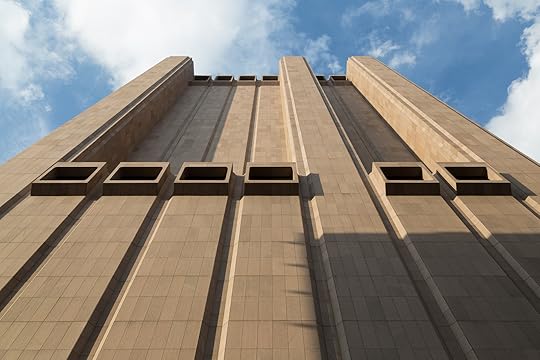
However, the original Hungarian cover was of the building at 33 Thomas Street in New York, often known as the Long Lines building, which is where melvil finds the ideal place for his Permanently Closed Library:
Now this novel, and its photoessaystic companion, were built on "chance encounters or coincidences", and one struck me here. Both books have someone wandering around Manhattan while musing, and the gold-standard for such books is arguably Teju Cole's Open City.
I've never seen Krasznahorkai refer to this book, but Cole's Julius also encounters Melville on his wanderings, the first time when he visits Trinity Church on Broadway, only to find it locked:
About two hundred years later, when a young man from the Fort Orange area came down the Hudson and settled in Manhattan, he decided he would write his magnum opus on an albino Leviathan. The author, a sometime parishioner of Trinity Church, called his book The Whale; the subtitle, Moby-Dick, was added only after the first publication. This same Trinity Church had now left me out in the brisk marine air and given me no place in which to pray. There were chains on all the gates, and I could find neither a way into the building nor anyone to help me.
I recalled this resemblance when I read The Manhattan Project, but to add to the coincide, Julius also comments on the Long Lines building, in terms which explain its attraction to melvil:
It was a windowless tower, a giant concrete slab rising into the sky, with little more than a few ventilation openings, which resembled periscopes, to indicate that this was a building rather than a dense brick fabricated by a gargantuan machine … Those few workers who used the building, I imagined, must after a few years become moles, their circadian rhythms completely distorted, their skin de-pigmented to the point of transparency. Long Lines, which I continued to stare at, as though it had drawn me into a trance, seemed like nothing so much as a monument or a stele.
As for my overall view:
This isn't Krasznahorkai at his finest, and melvil is certainly no Korin, the narrator of the author's finest New York set novel (although a New York that bears little resemblance to the real thing - more like Kafka's Amerika), the brilliant War & War (tr. George Szirtes). As a stand-alone work this is relatively insubstantial. But put together with The Manhattan Project (and I'd strongly recommend reading both) it does make for a fascinating diptych. 4 stars
listen sometimes you just have to read a book to realize you're not very smart and this was one of them. i understood what it was going for and even though the book is short, didn't feel like there was a payoff at the end of it.
This novella tells you what you’re getting with its subtitle: “Entering the Madness of Others.” It takes the form of a neurotic monologue by a librarian who has this obsession for three figures: the writers Herman Melville and Malcolm Lowry, and the architect Lebbeus Woods. From them he takes inspiration to embark on the creation of a huge library, a Serene Palace of Knowledge, which he intends to be permanently closed to the public, where millions of books are to sit untouched. And his name is also Herman Melville by the way—it’s just a coincidence!
It’s a fun, strange chaotic ride of a narrative, the whole thing sort of stretches out and can be read as one long sentence. It’s essentially a story of interconnectedness. The comic tone and mad exuberance and great writing was a pleasure. A great one for fans of Thomas Bernhard, César Aira, and Beckett. It’s so good.
László Krasznahorkai is quite simply the best living Hungarian writer of fiction, and Spadework for a Palace, while something of a bagatelle, only reinforces my assessment of him. Except for a few direct quotes, the 96-page novelette is a single sentence which is, curiously, not all that difficult to read. It consists of a plan by a librarian to build a perfect library -- one in which all the books are present, but there are no services for readers. In fact, there is no entrance.
The librarian is named herman melvill [sic] who is fascinated by the 19th century American writer with a similar name. Most of the book recounts melvill's walks in lower Manhattan, dreaming of Herman Melville, of Malcolm Lowry's Lunar Caustic (which in turn talks about a similar obsession with Melville), and an American architect named Lebbeus Woods, who also frequented Lower Manhattan.
[…]well, anyway, the point is that Melville had enchanted, stunned, and dazzled me just as Woods dazzled me with his visions, which I have absorbed, but without ever arriving at full understanding, and I have also discovered why, because in the case of Woods’s drawings, just as with Melville’s sentences, beyond a certain point there is no further advance to be made toward a full understanding, of course a path of understanding exists but you may advance unobstructed only a certain distance, then comes a point where you can go no further, where you would have to make an acrobatic leap that you are not capable of making, or at least I am not, so you merely abide at this point, and peer in the direction where perfect understanding awaits, peer with deepest awe in that direction, and this gives you the strength to endure your life, to put up with the fact that your life can at best only be a passionate admiration of theirs, but it is precisely this awareness of the distance between you and them, the existence of this distance, that gives importance to your life by giving importance to life itself, well, at this point I could just as well end my notes, since with this, I may have said my say, told everything I’d intended to tell, in any case I won’t have anything more grandiloquent than this to say, but I will not stop here[…] (p.62)
Read Spadework for a Palace by László Krasznahorkai. His fiction is basically immaculate and this is no exception.
This short monologue (in fact an incredibly long monologue - only short in terms of prose) is written in a way that prompts delusions and mental illness - yet it is drawing attention to fascinating depths, to universal discoveries that make your heart tremble and to the lives and works of three 20th century creators that would have definitely eluded me. Hence I am not only grateful to Krasznahorkai for yet another bite of his congenial textual treats but also for making me acquainted with Melville, Lowry and Lebbeus Woods.
So fun to find a book in which those gigantic windowless communications buildings (AT&T in Manhtattan, Verizon in Brooklyn, likely many others elsewhere) play a central role. Crazy, fast-pased, funny read!
Spiderwebs and labyrinths are often used to describe Krasznahorkai's writing and for good reason. They repeat patterns and pathways that invoke doom. But this isn't horror writing in any way and Krasznahorkai's recent focus on being connected to nature is a reiteration of the Buddhist denial of permanence. Experience, in Husserl's terms, is a major focus here. And like Husserl - it's walking that moves the narrator closer to his trinity of subjects not just in spatial terms but in more so related to the lingering residue of presence that he seeks after finding biographies of his subjects insufficient to bring that presence closer to him. What Krasznahorkai does so powerfully is well known - he makes his reader relate to his characters. Svankmajer does this as well - in Faust - where the protagonist sips beer and puts on his makeup before his eventual damnation. Bela Tarr also showed this to great effect in his film of Satantango that shows everyman townsfolk bilked and led to perdition by real-estate conmen. Like Knock in Nosferatu - also a real-estate man turned minion of hell - this central theme of Krasznahorkai is reiterated here. I'll repeat - this is not a horror novel - it is instead a depiction of madness in the form of swirling the drain reality. This insanity is much like a bardo - a Buddhist hell that is brought on by personal choices. Krasznahorkai describes the world as the field of satanic destruction - but this evil doesn't function like the Christian devil that temps and taunts - instead the evil is natural - so destruction is banausic - it will kill you and you are in its path for certain. This is made as clear as possible by the narrator's desire to create a Permanently Closed Library at ALL and ANY cost. This desire is what drives him mad - his taste is powerful enough to be able to discern quality - but his desire to see that quality maintained results in a pernicious will to protect that quality by keeping it away from those that would sully the experience. This is exemplified by his wife who has recently left him, a budding socialist who attends gallery openings to show off her dress, and nothing more. Like a petulant child that pins butterflies to a box to errantly attempt to preserve nature - his walled-in books bring him les joy in experience than the joy that is denial of this experience to others affords - what is more of a bardo than that? Maybe I'm projecting - but when New York real-estate conmen are invoked to illustrate the worst level of human scum possible it draws a pretty strong conclusion that I will certainly not bother to name. If you've read this before you read Moby Dick - you'll have a slightly less-informed experience. But if that results in you reading Moby Dick - than you can thank Krasznahorkai for this book and Meleville's as well.
This might be the easiest experience reading Krasznahorkai I've had - not just because it's short - but rather because it's economic. There's a stream of consciousness that is always present in his writing - but possibly the translator or the writer himself provides a clear and cohesive tone throughout. The narrator is amazingly lucid and even apologizes for his lack of literary prowess - so again - the everyman is our protagonist. Our narrator is named Melville, and his hero is Melville - but unlike these two Melville's who never realized any significant appreciation in their life - Krasznahorkai is very different. He ranks among the greatest living writers in my estimation at least. He has the oneiric glow of Schultz and the skill in prose of Kosztolanyi. Read in a single setting - I didn't so much read this as I experienced its prowess.
Nem tudom, érdemes-e úgy nekilátni ennek a kisregénynek (vagy hosszabbra nyúlt elbeszélésnek – ahogy vesszük), hogy „egybeolvassuk” a szerző előző könyvével. Hajlok rá, hogy nem. A Manhattan-terv ilyen stratégiával olyasféle formát ölt, mintha valami „Így készült” lenne, trailer a nagy mű előtt – és ha ehhez képes a „nagy mű” csak egy nyúlfarknyi izé, akkor az olvasónak óhatatlanul az a benyomása támadhat, hogy vajúdtak a hegyek, és lám, egy egeret szültek. Meg aztán az említett előző mű egyszerűen túl sok dolgot elspoilerez, mintegy mellékesen leírja azokat a jeleneteket, amelyek az Aprómunká…-ban dramaturgiai gócpontként köszönnek vissza. Ez azért elég különös. Mondhatni, gyengítik az irodalmi élmény erejét. (Bár cserébe megvilágítanak valamit, amit írói műhelytitoknak nevezhetünk. Esetleg.)
Szóval talán (talán!) meg kell próbálni ezt a nyolcvan oldalt úgy olvasni, mintha A Manhattan-terv nem is lenne. És akkor ez egy igen kerek, valahonnan valahová tartó szöveg a Könyvtár Őréről, az emberről, aki úgy óvná meg a kultúrát a tömegtől (mert a tömeg, ha hozzáfér, elhordja és szétcincálja, mint a hangyák), hogy elzárja előle. Elitista breviárium, jelentés az elefántcsonttoronyból – amit csak külön kiemel a Krasznahorkai-mondat jellegzetes struktúrája, a végtelen bővítményanakonda, ami önmagában megköveteli, hogy az olvasó ne csak turista legyen a könyvben, hanem áldozzon rá időt és erőt: csimpaszkodjon bele a mondatba elöl, és ne hagyja, hogy holmi külvilág lependerítse onnan. Én szeretem ezt a mondatot. Szeretek csimpaszkodni belé. Kortárs irodalmi rodeó.
Ha önmagában nézem tehát, jó szövegnek találom. Csak hát ugye kérdés, hogy lehet-e, kell-e, érdemes-e úgy olvasni valamit, mintha előtte nem olvastunk volna el valami mást.
A classic mad ranter. Lots of unstressed jokes and, thankfully, unstressed parallels with Moby-Dick (and probably Under the Volcano). One especially good one is the way the narrator's constant interconnections between his three objects of obsession (Melville, Lowry, and the conceptual architect Lebbeus Woods) really only ever involve two of them, the third is shoehorned in even by conspiracist standards. In this way it's a better 'internet novel' than most books branded as such; the way we're all half-assed theorists now. Noteworthy that the narrator's big scheme, his 'Palace,' is a library full of inaccessible books. Buddy...
The book is structured as 'one long sentence' (many cheats), which adds velocity to the narrative, but a bunch of run-ons would have done just as well. Not convinced the gimmick adds much--maybe dramatizing the infinite scroll of consciousness: 'There is no steady unretracing progress in this life; we do not advance through fixed gradations, and at the last one pause....Where lies the final harbor, whence we unmoor no more?'
Très amusant monologue d'un homme dont le métier de bibliothécaire est devenu le but final d'un dessein étrange et amusant. Il y a très peu de points, voir presque pas du tout c'est assez effréné, mais très drôle. L'humour y est fin et pince sans rire, bref j'ai beaucoup aimé. Même si comme dans Bartleby, je n'ai pas tout saisi 0__O
…”the astounding meaning of Wood’s message is that the whole works, the entire workings of the universal is destruction and annihilation, devastation and ruination, how on earth can I say this right, in other words there is no dichotomy at work here, no such thing exists, it is imbecilic to talk about antithetical forces, two opposed sides, a reality describable in terms of mutually complementary concepts, silly to talk about good and evil, because all is evil, or else nothing is, for total reality can only be seen as continual destruction, permanent catastrophe, reality is catastrophe, this is what we inhabit, from the most minuscule subatomic particle to the greatest planetary dimensions, everything, do you understand,” …
Every time I return to Krasznahorkai I am astonished by how easily swept up I am in his comic and, here especially, calamitous characters. Like Korin, the suicidal archivist in “War & War” who journeys to America to immortalize a mysterious document by copying it into the internet, in “Spadework for a Palace” Krasznahorkai introduces us to a flat-footed librarian herman melvill, who determines to become a keeper of a permanently closed library in a strange windowless building in downtown Manhattan.
melvill (lower-cased always) studies his namesakes life and works, chasing his own enigmatic eidetic white whale while working at the NYPL. As he enacts his private “research” on his trinity of madness—Herman Melville, Malcolm Lowry, and the architect Lebbeus Woods—he discovers a “universal earth-connectedness” subsisting in the art and writing of the above three mentors, specifically, an answer to the existential location of “WHERE WE ARE.”
We are blind to where we are, says melvill, which is on a rock that harbours by nature a “satanic existence,” one “hostile, anti-human force” that is feebly covered up by sky scrapers, real estate, urban life, all of which produce an illusion of permanence. One wonders why else melvill spadeworks such a fortified palace if not to resist (a melancholic resistance!) against the “ceaseless apocalypse”, the foundational principles of “destruction, annihilation, and devastation.”
This is why Melville wrote “Moby Dick”: to reveal how desperately we attempt to hide what lies dormant in the Earth. Vigilance and resistance against this inevitable catastrophe seems the only things that gives humans a dignity in this world, and here art finds its ultimate definition to give space to this ineffable otherness, to make an “exception.” As Krasznahorkai so beautifully describes it: “art is a cloud that provides shade from the sweltering heat, or a flash of lightning that splits the sky, where, in that shade’s shelter, or that lightning’s flash, the world simply becomes not the same as before, a space is created that’s suddenly very cold, or very hot.”
I was so paranoid that this was going to be one of those books that I would simply be too stupid to “get”. On the complete flip side, the narrator’s rambling rants and inability to stay focused on one topic for more than a sentence or two, combined with the constant promise to return to a topic later only to never fully follow through with it, was so wildly understandable and relatable in a way I was not expecting. The singular sentence becomes meditative almost, and builds into such an addictive flow despite the fragmentation of his thoughts. A really interesting format for a study on absurdism and obsession.
This took forever to read but it’s quite slim and kind of all happens in a single breath, the ravings of a mad librarian but I couldn’t quite connect Lebbeus Wood to Melville the way I was supposed to. Mostly because i don’t know his work, and assumed he was part of the fiction.
i know why this is the case and it's to some extent unavoidable but it bothers me that we live in a world where krasznahorkai is relatively familiar with manhattan geography.
Was a three star book until I read a section out loud to my kids to show them the huge sentences and the nesting-parentheticals structure of the narrative. Hearing it improved my experience, and got us all laughing. A quirky narrator! I love these little golden books from New Directions.
"for total reality can only be seen as continual destruction, permanent catastrophe, reality is catastrophe, this is what we inhabit"
I'm not entirely sure if I liked this book or not. The style of the novel is really frustrating, even suffocating, as almost the whole book consists of a single sentence, an unedited, uncoordinated flow of thoughts by a deeply delusional and neurotic person who corrects and contradicts himself in every single paragraph. That writing style made me feel like I was locked up in the narrator's head which, in this case, was a rather "painful" experience. The book contains some philosophical thoughts on the role of catastrophes and destruction in human society and the role of artists; but for me, these arguments are not supported well enough. My impression was that these are more like statements, than theories. As Krasznahorkai was described by Susan Sontag as the “contemporary Hungarian master of the apocalypse”, I can believe that this philosophy is a recurring element of his novels, but I think that in this book, it is not elaborated enough to give a consistent view of the theory. So, I don't think this book is an optimal introduction to Krasznahorkai's œuvre, however it is unquestionably a very well-written, imposing work.
One of the more profound and intricate short works by Kraznahorkai. I’m always frankly astounded that an author of his caliber and history is able to continue producing works that are so freshly modern while remaining indebted to history. I’ve given a lot of his previous stuff good ratings, but this stands out in a wonderful way. Although most of this book reads as a manifesto for art in calamity, he craftily manages to draw it back into the realm of paranoid fiction by the end. Brilliant, well-structured, and unexpectedly thrilling
Comment un si petit livre peut-il contenir tout cela ? Je le démarre avec délice. Drôle. Intelligent. Grincheux.
Melvill, sans e, rien à voir avec l’écrivain donc, est un bibliothécaire bougon qui n’aime pas les lecteurs. Il nous régale de ses réflexions sur tout : les bibliothèques qui ne doivent pas être ouvertes aux lecteurs, les promoteurs immobiliers : « communauté (la) plus pourrie de l’histoire des rebuts de l’humanité » (dont je fais partie et je ne peux qu’accepter la sentence) sa femme qui, « en tant qu’authentique amatrice d’expos, ne venait pas ici pour admirer des tableaux ou des sculptures, mais pour exhiber le jumpsuit en soie qu’elle avait récemment déniché au Century 21 ».
On est donc entraîné facilement dans le sillage de sa recherche de qui est Herman Melville, son presque homonyme. Il marche littéralement dans ses pas et il retrouve Malcolm Lowry, auteur britannique un peu autodestructeur et très amateur de Melville lui-même. À ces deux figures, l’auteur rajoute Lebbeus Woods, architecte et artiste new-yorkais. C’est à travers ce trio improbable que le narrateur parle de littérature, de Manhattan, d’humanité et d’art. La réflexion devient hallucinante , le lire en étant fiévreuse moi-même n’a pas aidé !
Cette année, j’ai décidé de lire au moins un livre d’un prix Nobel par an, dépassant mon appréhension des livres barbants. Je suis consciente que ce petit livre n’est pas représentatif de l’œuvre de Krasznahorkai. Mais pour moi, il représente bien un prix Nobel : érudit, bien écrit, et on a hâte de le finir.
Je ne m’arrêterai pas là pourtant… il m’a donné envie d’explorer plus.
This novella reminded me of Dostoevsky's Notes from Underground, except here the isolated, maniacal narrator has a name, "the lowercase herman melvill," who describes himself as "a short-statured hunchback librarian with plantar fasciitis" and who, ironically, once worked at the lending services desk of the New York Public Library--ironic because he has a serious aversion to lending books, the "Palace" of the title being short for the Permanently Closed Library Palace he fantasizes about creating, with himself being the sole "spadeworker" laying its foundation--a place where no books can be checked out because its doors will be "closed, yes my God CLOSED, permanently, oh, dear God in heaven, the books unmolested and unread, what a lovely notion even just to dream about," an absurd dream that evolves out of his obsession with the works, thoughts, and lives of Herman Melville, Malcolm Lowry, and Lebbeus Woods--the narrator's "Trinity" who, he felt, had "the inside story" on humankind's connection to the universe, an understanding he felt all should emulate, which meant "that accordingly we had to urgently rearrange our lives," herman interpreting that "rearrange" as "de-range," which is an accurate verb for what he does to his own life and sums up in this book in one long, chaotic sentence.
First lines: "I am not related to their famous author, but all my life they've been bothering me about him, just because our names are so similar and thanks to one or two other trivial items...."
Egyik nagy pozitívuma a könyvnek, hogy vékony :D Egyébként kicsit jobb volt végül az összélmény, mint amit az első fele után hittem. A végére már szinte tetszett, de összességében nagyon távol maradt számomra a korábban olvasott jó Krasznahorkai könyvektől. Ennél még a tipikus mondatfolyam-stílus is zavaróan hatott számomra olykor, pedig ez igazán nem szokott jellemző lenni.