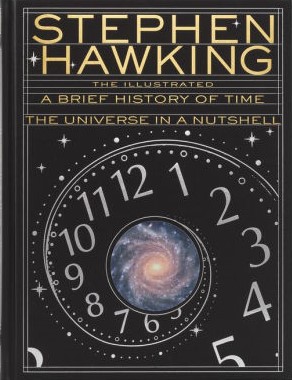
In the years since its publication in 1988, Stephen Hawking's A Brief History of Time has established itself as a landmark volume in scientific writing and an international publishing phenomenon. The book as on the cutting edge of what was then known about the nature of the universe, but since that time there have been extraordinary advances in the technology of observing both the micro- and the macrocosmic worlds. These observations have confirmed many of Professor Hawking's theoretical predictions in the first edition of his book.
Eager to bring to his original text the new knowledge revealed by these many observations, as well as his own most recent research, for this expanded edition Professor Hawking prepared a new introduction to the book, wrote an entirely new chapter on wormholes and time travel, and updated the original text. In addition, this edition is enhanced throughout with more than 240 full-color illustrations, including satellite images, photographs made possible by spectacular technological advances such as the Hubble Space Telescope, and computer-generated images of three- and four-dimensional realities. A classic work that now brings to the reader the latest understanding of cosmology, The Illustrated A Brief History of Time is the story of the ongoing search for the tantalizing secrets at the heart of time and space.
The Universe in a Nutshell
In this book, Stephen Hawking takes us to the cutting edge of theoretical physics, where truth is often stranger than fiction, to explain in layman's terms the principles that control our universe.
Like many in the community of theoretical physics, Professor Hawking is seeking to uncover the grail of science—the elusive Theory of Everything that lies at the hart of the cosmos. In his accessible and often playful style, he guides us on his search to uncover the secrets of the universe—from supergravity to supersymmetry, from quantum theory to M-theory, from holography to duality. He takes us to the wild frontiers of science and lets us behind the scenes of one of his most exciting intellectual adventures as he seeks to "combine Einstein's General Theory of Relativity and Richard Feynman's idea of multiple histories into one complete unified theory that will describe everything that happens in the universe."
With characteristic exuberance, Professor Hawking invites us to be fellow travelers on this extraordinary journey through spacetime. Copious four-color illustrations help clarify this journey into a surreal wonderland where particles, sheets, and strings move in eleven dimensions and where the original cosmic seed from which our universe sprang was a tiny nut.
The Universe in a Nutshell is essential reading for all of us who want to understand the universe in which we live. Like its companion volume, A Brief History of Time, it conveys the excitement felt within the scientific community as the secrets of the universe reveal themselves.
Stephen William Hawking was an English theoretical physicist, cosmologist, and author who was director of research at the Centre for Theoretical Cosmology at the University of Cambridge. Between 1979 and 2009, he was the Lucasian Professor of Mathematics at Cambridge, widely viewed as one of the most prestigious academic posts in the world. Hawking was born in Oxford into a family of physicians. In October 1959, at the age of 17, he began his university education at University College, Oxford, where he received a first-class BA degree in physics. In October 1962, he began his graduate work at Trinity Hall, Cambridge, where, in March 1966, he obtained his PhD degree in applied mathematics and theoretical physics, specialising in general relativity and cosmology. In 1963, at age 21, Hawking was diagnosed with an early-onset slow-progressing form of motor neurone disease that gradually, over decades, paralysed him. After the loss of his speech, he communicated through a speech-generating device initially through use of a handheld switch, and eventually by using a single cheek muscle. Hawking's scientific works included a collaboration with Roger Penrose on gravitational singularity theorems in the framework of general relativity, and the theoretical prediction that black holes emit radiation, often called Hawking radiation. Initially, Hawking radiation was controversial. By the late 1970s, and following the publication of further research, the discovery was widely accepted as a major breakthrough in theoretical physics. Hawking was the first to set out a theory of cosmology explained by a union of the general theory of relativity and quantum mechanics. He was a vigorous supporter of the many-worlds interpretation of quantum mechanics. Hawking achieved commercial success with several works of popular science in which he discussed his theories and cosmology in general. His book A Brief History of Time appeared on the Sunday Times bestseller list for a record-breaking 237 weeks. Hawking was a Fellow of the Royal Society, a lifetime member of the Pontifical Academy of Sciences, and a recipient of the Presidential Medal of Freedom, the highest civilian award in the United States. In 2002, Hawking was ranked number 25 in the BBC's poll of the 100 Greatest Britons. He died in 2018 at the age of 76, having lived more than 50 years following his diagnosis of motor neurone disease.
Both books back to back was a good thing. While the second was decidedly less mathematical than the first, it helped that all the complicated ideas (or, rather, numerous theories) were all fresh in my head. A Brief History of Time is stuff that can be introduced by a zillion TV documentaries nowadays, of course, but the benefit of the book is that it explains exactly why we know so much of what we know. This can, and frequently does, involve some higher thinking, which Stephen does an admirable job of dumbing down for us. He also takes us on the journey of scientific discovery through the ages, introducing great thinkers and explorers of every era, their triumphs, hits and misses, to show us where we are today, what we know, and why. But there's a great, great many aspects to our world and even universe that are understood and explained with a better answer than simply, 'because'. The depth and breadth of knowledge imparted by these two companion books is extraordinary and simply cannot be summed up shortly. It truly takes someone like Stephen Hawking to condense the universe into a nutshell! He does so with tremendous power, clarity, and more than a little humor.
Abas grāmatas ļoti interesantas, uzzināju daudz, lai gan pārlasot noteikti saprastu vēl vairāk. Autoram arī laba humora izjūta un tendences likt derības ar citiem zinātniekiem, kas deva smieklīgus iestarpinājumus pa vidu teorijai.
Fascinating. This is a book that I have wanted to read for a while. I was so happy when I found this combined copy of both books. Stephen Hawking may have been an asshole to some, but no one can question his genius mind. His witty, dry humor also makes this more of an enjoyable read.
The formatting of this book is well thought out and makes it enjoyable to read. I especially love the inset illustrations to help explain the concept of the universe and time.
Highly recommend that everyone checks this one out at least once in their life.
Stephen Hawking is a brilliant man whose greatest contribution to society is not his science, but his ability to write about difficult concepts in simple language. His sense of humor is greatly appreciated. Hawking makes learning fun!
And that all of my science credits for my BA consist of studying the biographies of Copernicus, Galileo, and Einstein.
This stuff is COMPLICATED, y'alls.
I read Brief History of Time in high school as an assignment for Non-western Civilization from one of the best teachers I ever had. Still not sure how the assignment tied in with the class but I suppose that's neither here nor there. It was something that always stuck with me and when I saw the opportunity to buy an illustrated version coupled with a second book by Hawking for super cheap at my Borders' closing sale, I snatched it up.
In both books, Dr. Hawking explains amazingly complex concepts in an easily comprehensible (if not necessarily understandable) way which seems to break things down as simply as possible. On it's own, I would give "Brief History" 5 Stars. The book starts with a fairly clear thesis and moves step by step describing all the points it intended to hit. And the illustrations are a nice bonus. It should be noted that this text was updated from the original version published in the late 80's. I'm not sure if it differs any from the version I read in the late 90's but there definitely seemed to be a few concepts I don't recall from the first time around. But over all, Brief History is pretty understandable, and eye opening once you can wrap your mind around the concepts involved.
Perhaps part of the problem comparing the two books is that relativity as a theory is over 100 years old. It seems to be something that most averagely (not a word I know) educated people have a basic grasp up, so the elaborations in Brief History are easier to follow. Then the book gets into string theory. Which I seem to recall understanding once upon a time. Kinda. And then the second book elaborates on that, and moves from there to "branes" and ten dimensional space and imaginary time and a whole lot of much more modern theory is thrown at you all at once. Plus, Hawking acknowledges in the prologue to "Universe in a Nutshell" that he conceived that book as one that has, more or less, stand alone chapters which refer to each other but don't build a story flow as it were. There's a whole lot going on in that book and a lot of it, even if I read it over a few times, flew right over my head. Though a part of me feels I could really grasp everything it discusses if I push myself to struggle through a reread.
And maybe in about 5-10 years I'll feel up to it. I'm keeping the book so it'll always be on the shelf. And I'll willingly admit, perhaps it's not fair to not give this book a full 5 star rating based on my own ignorance and inability to understand what seems like the easiest explanation of very complicated ideas. But as I said before...this stuff is COM-PLI-CATED!
Some nice updates since the publication of Brief History of Time, which I loved, but not much here for those of us looking for some satisfying extension of his earlier primer on theoretical physics. His treatment of string theory piqued my curiosity, but ultimately led me to check out Brian Greene's Elegant Universe for a more extensive treatment of string theory. I'm reading that now, and I'm seeing that Greene is a little better at finding the best metaphors for elucidating abstractions like these. Didn't like the computer-generated graphics that served as illustrations. Really I read this because the library didn't have his newest book called The Grand Design.
Disappointments aside, Hawking does have a gift for explaining these theories and their bizarre implications for the general reader. I can't imagine anyone less trained than myself to grasp the science behind these concepts; fortunately, no background in upper math or physics is presupposed. What I get is an almost dizzying sense of awe and wonder and, yes, giddiness over the mind-bending, trippy, conceptual gymnastics Hawking presents.
One of the greatest minds, a reminder that it's easy to dismiss someone based on their ability to communicate or their disadvantages. I work in a Neuro theatre and often deal with people who due to illness or injury find it hard to respond, wonder how they feel I treated them. As for the book, love science and find black holes fascinating even if I had to read the book several times to understand exactly what professor Hawking meant.
This book is gorgeous. Let's get that out of the way. The illustrations and photos go a long way to engage the reader in a way that draws them further into the subject. The language is accessible for anyone who might be interested in reading. Often science books use language that seems to want to repel people from being interested in the subject it's discussing where with this book, you get the sense that Hawking really wants people, and children to learn and understand the concepts that he's explaining. A lot has been made out of intelligence and how children who don't understand or are interested in science or mathematics are not intelligent, where in reality we have to consider how the subject are being explained to them, and reevaluate how differently people perceive the world around them and learn.
One size does not fit all.
And yet, this book is a joy to read. I love taking one chapter at a time, and I don't feel like I'm reading an academic book at all. Science becomes an art, like fiction, interesting and marvelous. Granted, I always did enjoy science, but I think everyone enjoys science. There isn't a person on the face of the planet that isn't curious about the world they live in and how it works.
I can't wait to hand this book over to my children when they're a little older, and just watch it get read over and over again.
Got sucked into this one rather like into a black hole. After having my mind stretched nearly to the point of having all preconceived notions torn apart, I emerge into an "elsewhere", as if into a parallel universe (or some other place and time of our own).
In other words, I learned a few things from this book. Really readable for the armchair astronomer/physicist, and highly suitable for those more interested in the ideas of physics without having to perform the mechanics of it (although, a large part of me wants to look at that too). That said, some entry-level interest in these things, and certainly a great degree of patience with some of the more complicated matter are required to persevere through this book. Several concepts/fields still remain fuzzy and require further exploration for me (e.g., the intricacies of quantum mechanics and string-theory), but overall this is fascinating stuff.
What is more, the computer-generated illustrations were remarkable and often, though not always, helpful.
This review is for "A Brief History of Time". I'm just getting started in "The Universe in a Nutshell"
This was way harder to read than I would've thought, being a worldwide "popular science" bestseller. It's probable that most people bought that book and just kept it on their coffee table to impress visitors. Some stuff about black holes and the life of the universe simply blew my mind. In the later chapters, I had a hard time distinguishing proper science form boundless speculations, but I guess that's the state of the art in quantum physics meeting general relativity (whew!). Other chapters made me wish I was smarter, or at least better to envision n-dimensional objects! Call me Codename: pea-brain (nerdy joke).
Life, the universe, and everything. We know the answer (42), but have we learned to ask the question? In these two books, conveniently collected into one exceedingly well-produced volume, Stephen Hawking sets forth the fundamental thinking underlying modern cosmology. From this vantage point, he also probes some of those deeper questions which naturally follow from the empirical study.
The first of the selections is A Brief History of Time, Hawking’s bestselling primer on astrophysics. Though the title would suggest, well, a history book, the possible origins of the universe occupy only a portion of the discussion. Hawking first lays out the scientific developments which culminated in those theories, detailing the changes from Ptolemy’s geocentric model to Newtonian mechanics to the revolutionary discoveries made at the start of the 20th century. Of these latter two in particular are of great interest: Einstein’s general theory of relativity, which relates to the gravitational interactions of objects on an astronomical scale, and quantum mechanics, the formulas developed by Heisenberg and his colleagues at Copenhagen to explain the interactions of subatomic particles. Both theories completely overthrew the conventional wisdom which had preceded them, both agree to a high degree of accuracy with empirical observation – and both are mutually exclusive to the other. “These two theories are known to be inconsistent with each other,” Hawking writes, “they cannot both be correct.” He goes on to state that one of the main goals of contemporary physics is the search for a quantum theory of gravity that will resolve the inherent contradictions between the two.
With these tools of the trade, incomplete though they are, in hand, Hawking then does turn his attention to their implications on the origin and development of the universe. Much of the discussion centers around singularities – termination points on the space-time continuum at which infinite density results in infinite temperature, the cessation of time, and a complete breakdown of all known laws of science. Hawking handles two examples: localized instances of the phenomenon resulting from the collapse of large stars, termed “black holes,” and the postulated explosion by which the universe might have begun – the “Big Bang.” In treating this last, he is careful to point out that though our current understanding of the laws of physics might take us right up the moment of the Bang, they are rendered meaningless at the singularity itself and thus we cannot speak scientifically about what might have come “before” (if the notion of time would even still apply) or speculate as to possible causes. But Hawking also introduces another possibility, that there might be no beginning singularity at all. In this case, space-time could be viewed as a finite, unbounded expanse, like the surface of a ball but in four dimensions instead of three. Thus, the universe had no beginning, no moment of creation, and by implication, no creator. While difficult to imagine, the math apparently is plausible, and while Hawking doesn’t explicitly endorse this view, he does give it serious consideration.
In The Universe in a Nutshell, Hawking continues his discussion of advanced physics studies and their implications on the observable world. Having laid the foundations in the previous book, here he tackles a number of topics, from string theory to time travel, in chapters than can be read more or less independently. Collected as the two are here in one volume, Universe reads more like a set of extended appendices to Brief History, which probably aids comprehension as well as presentation. The information presented, though informative and interesting, doesn’t have the same impact as those fundamental principles handled in the former work. Nevertheless, the latter does provide a primer to several trendy topics as well as provide ammunition for a few good physics puns (braaaaaaaanes), and thus is worth at least a glance. The modular nature of the discussion makes skimming easy, if that happens to be one’s aim.
Hawking’s prose is consistent throughout both volumes, lucid and engaging and liberally sprinkled with humor. The narrative will move, mostly seamlessly, from scientific explication to philosophical speculation, but is never didactic in the first case and never dogmatic in the second. Though easy to read and follow (Brief History contains just one equation – guess which one), this conversational tone does have its drawbacks. Hawking’s work is an excellent introduction for the layman, but has less to offer the acolyte. Those who have studied physics at the university level will find the collection a good refresher, but not plumbing any uncharted waters. Another detriment stems from the lack of mathematical proofs: Hawking’s conclusions must of necessity be taken for granted. While most of the fundamental theories discussed are universally accepted, many of the conjectures the author makes are not, and without being able to consider the step-by-step reasoning the reader must simply take them on faith. I understand the reasoning here – the book is a primer, not a college text – but I did find myself wishing some of the sweeping claims were given more support.
That being said, both of those complaints can be rectified by further study, and Hawking does provide a long list of references. For what it is – an introduction to the problems and theories that shape modern physics – Hawking’s work succeeds admirably. I highly recommend that anyone wishing to tackle the subject start with this particular edition (ISBN 978-0-307-29122-6). Not only do you get two books in one, but the whole volume is filled with charts and diagrams that illustrate otherwise difficult-to-picture concepts. Whatever one’s worldview might be, the questions of the origin and design of the universe must be a central component, and the contributions of modern science to the discussion cannot be ignored. This volume is an excellent way to dive into that discussion.
These books are still pretty hard to follow (especially the History of Time) but the illustrations do help a lot. I think the big problem is that the math helps you understand, and most people reading the book don't have the math skills required to follow it. My math is a bit rusty, but i still think it would help me to have an appendix or something showing the mathematical support for the ideas. Maybe not, but without it the discussions seem almost like fantasy.
(My copy is "The Universe In A Nutshell" only. Identical cover but does not include "A Brief History Of Time", as shown in the photo...Different version, perhaps?)I had originally purchased a copy of "A Brief History of Time" many years ago at a used bookstore and it just sat on my bookshelf collecting dust. It looked a bit overwhelming to read. Then, about 4 or 5 years ago I had purchased this illustrated "sequel", (which is really more of a revised/abridged version to the original, in my opinion) that I had found brand new and as hardcover on Amazon. I gotta say, I was blown away by the amount of knowledge crammed inside this 200 page coffee-table style book. The full color illustrations throughout the pages in this book make what you're reading all the more fascinating. Stephen Hawking explains the mysteries of the universe in a way that the layman can comprehend. He "dumbs" it all down for the rest of us in a way that makes astrophysics fun and easier to understand. Science has only just begun to unlock the door to the many secrets of our expansive and ever expanding universe, and Stephen Hawking is one of the few greats who had the key . You get a crash course in Einstein's general relativity, quantum theory, The Big Bang theory, black holes, possible advanced civilizations, time travel, space travel among the stars by the use of wormholes, and so much more! So, if once upon a time you were one of those kids who fell asleep during science and astronomy lectures in high school, who has now become interested in astrophysics as an adult but have so little free time; then this book is for you. I just heard the sad news that Stephen Hawking died this morning at age 76. He had been physically debilitated most of his life by Lou Gehrig's Disease. He will be missed. RIP
There are many styles of reading. One can skim a book once, then use it as reference in the future. Or one can carefully pour over every word, trying to absorb every possible nuance that an author weaves through his work. I think neither approach is appropriate for most readers of this book.
The central theme of this book is the human quest for understanding, with a sub-theme of balancing the anthropic principle: "Intelligent beings should not be surprised if they observe that their universe satisfies the conditions that are necessary for their own existence." General relativity and quantum mechanics allow for many different universal configurations, but most make intelligence, at least as we know it, impossible. It does not take deep scientific knowledge to understand this. However, Hawking takes great care to prevent a backlash from this understanding: Did the universe begin the way it did for the sole purpose of allowing creatures like us to exist? If we take the anthropic principle too far, we are using science to support divine creation and thus undermining the quest to understand nature.
The book is divided into topical chapters (Space and Time, Black Holes, the Uncertainty Principle, etc.) There is also a second, less clearly defined division: the history of human understanding of the universe, support for one of Hawking's theories (the no boundary principle), and finally a hopeful conclusion. While the conclusion is pithy, it very effectively sums up Hawking's hope for the future: Not only will humanity someday discover the unified law of nature, but soon enough this understanding will common to all humanity, just as Newtonian physics is taught to school children today. "Then we shall all, philosophers, scientists and just ordinary people, be able to take part in the discussion of the question of why it is that we and the universe exist."
This book can be technical, and one could drive themselves mad trying to understand every concept. However, I think Hawking does a good job explaining things in ways most people can understand, to a point. About halfway through the book, he seems to give up on this, perhaps thinking, if you have made it this far, you are either versed enough in physics to keep up, or you have resigned yourself to never really getting it, and thus he devotes less energy to dumbing the content down too much. However, the book does not drag. It is entertaining all the way through. Hawking is witty and fun-loving, laying out some of his hijinks, and being self-deprecating to the point of being high and mighty, a very clever trick. It is profound and entertaining. The only thing keeping it 4 stars instead of 5 is the fact that I feel like I will always be missing something by not being an expert in cosmology.
I'm torn about this book. On the one hand, it's a needed addition to the world to have an approachable tome on quantum theory and relativity. And the addition of illustrations helps *some*, though not as much as you'd think.
The problem, I have to say, lies with Stephen Hawking himself. I have to say that the guy comes off as an egotistical asshole through his writing. Let me break this down into a few points:
1) He is *not* a very clear author. As a scientist myself, I am used to going through highly technical papers. Stephen Hawking is *no* Carl Sagan, nor Bill Nye. He lacks the ability to see when he's gone too deep down the rabbit hole and left his readers behind.
2) His frequent references to himself are annoying, especially when he makes sure to reference how he disproved someone else's theory. He only once admits to his own mistakes in the book, while has over a dozen places where he sings his own praises.
3) He includes biographies of Einstein, Galileo and Newton in the back which are written, it seems, with the single goal of shining a bad light on them. I can't help but think this is one more attempt to make every scientist in the world, EXCEPT Stephen Hawking, look bad.
4) His choice of illustrations is weak. Many times they do nothing whatsoever to add to the clarity of the point being made.
All in all, I'm glad I read it, for both the clarification on a few points that I gained, but more so because I walked away with the exact OPPOSITE view of Stephen Hawking than he was attempting to instill. To whit: Stephen Hawking, by telling me how great he is and how awful other scientists are, has proven what a jerk he himself is.
A highly readable overview of cosmology that's good for high school physics students or anyone interested in theories about the universe. I would also include elementary students in that recommendation but Hawking at a couple of different points mentions Penthouse magazine and gambling and hell and I just don't think that's age appropriate for 10 year olds. The illustrations are largely unneeded as Hawking's writing is pretty descriptive on its own. Also, many of the pictures don't really add anything to his explanations. For instance, in the section discussing the arrow of time there's a big picture of a cosmic-y looking hourglass that takes up an entire page. I think it would be better to show examples of the equations used to formulate some of the theories he mentions. Sure most people, myself included, wouldn't know what all the symbols and numbers represented exactly but at least they could get used to looking at these ideas in a more precise and meaningful format.
Stephen Hawking is one of the greatest scientists of our generation. And this book shows not only his breadth of knowledge, but also his uncanny ability to explain even the most esoteric of concepts in simple, sometimes humorous language.
Though the book is slightly outdated, it is a good primer for "what scientists believe about the universe today." It is a survey, so many times it does not go too in depth. There were many chapters that left me scratching my head. I had to read other books to fill in those gaps--i.e. how we know about subatomic particles, what they're like, and how they got their names.
Most importantly for me is how a man who's lived with ALS for most of his life has accomplished so much. I seriously admire Stephen Hawking.
I've only read the first of the two books in this volumne but BHofT literally blew my mind. I'm glad I bought the illustrated version because the graphs and diagrams helped me to understand a lot of the concepts that would otherwise have been incomprehensible. I admit there were times when the technical aspects of the book found me nodding off and there were more than a few pages that I had to read at least 3 times before I understood what the hell it was talking about...but overall this book totally changed my outlook on the universe. How many books can you say that about?
I definitely enjoyed A Brief History of Time more than The Universe in a Nutshell. I found it more accessible and enjoyable to read. But I learned a lot of stuff reading both of these and I'm really glad I chugged my way through them. The illustrations in this edition really made it easier to follow along to. I think if I'd read this in a purely text book, I would have gotten lost. The pictures give a nice break to those of us reading a little out of our depth.
Stephen Hawking is a great genius . The man who is always thinking and spending his time to know the aspect's of Time , Light , speed , e.t.c. This is a great book which explained and questioned a lot . For many of the questions we don't have precise answer related to Universe ,Galaxy, Star , Bigbang theory. I have questioned a lot to myself like Anything can travel faster than light, if it happens how would be the time relativity for that object.
Remarkable as usual. The interesting parts are covered in the first part of the book. Also, you will be able to discern whether Big Bang was really a big bang or just a mere fantasy! Moreover Hawking tried to answer the entropy principle, thermodynamics and Arrow of Time that always goes in one direction. This is an amazing book to read if you want to study some base level understanding of Cosmology and Celestial Bodies!
A cosmological perspective which help us to understand the evolution of cosmos and our place on it. This is it! A comprehensive vision of reality that give us knowledge of our own reality. This precious work is a real must!
This was a amazing book to read if you are interested in science beyond a basic level. I found my self captivated for hours reading this book. Even so it still it took me a couple of times to read to fully understand everything that goes on.
I can't help but think how really small we are in the universe. Excellent. Saw Mr Hawking's speak at Cal State LA many years ago. Was overwhelmed by him.
A Brief History of Time and The Universe in a Nutshell are both books on Theoretical Physics written by Professor Stephen Hawking. This volume combines both of them into one book. It is a very attractive book; with a hardcover, silvered edges for the pages, and a bookmark ribbon.
A Brief History of Time was originally published back in 1988, but this book takes the text from a reprint that came out in 1996. It discusses Einstein’s Theories and ideas in ways that a layman can understand. It contains a lot of illustrations to demonstrate the points being made. There are very few equations besides the Energy-Mass Equivalence first formulated by Einstein. It discusses things that are yet to come in the world of Theoretical Physics, but it also talks about the Hubble Space Telescope which was sent into orbit in 1990 if I remember correctly. A Brief History of Time builds on itself, going in an organized fashion. First, it discusses the very large with Einstein’s General Theory of Relativity. It moves on to Quantum Mechanics as described by the Heisenberg Uncertainty Principle. The book states that the evidence points to there being a beginning of time and the Cosmic Background Radiation shows that it was very hot. The book as a whole is like a snapshot of Theoretical Physics from 1996. It talks about what we know and how we know it, along with what we don’t know and what would be required to find out about it. Finally, A Brief History of Time has the biographies of three esteemed scientists from history. It has Albert Einstein, Isaac Newton, and Galileo.
The book immediately jumps to The Universe in a Nutshell. I have only one real problem with it and it is more of a nitpick than anything; it restarts the page numbering. After a while, I got used to it, but initially, it bothered me. The Universe in a Nutshell is similar to A Brief History of Time in that it discusses our knowledge of the universe from a Theoretical Physicist. There are a lot more illustrations and a lot less text. The Universe in a Nutshell was originally published back in 2001, so both of them are slightly dated. On the one hand, they were published a pretty long time ago, but on the other hand, I don’t know if there were any significant advancements or developments in Physics since then. The Large Hadron Collider was built, but other than that, nothing comes to mind. Have we detected Gravitons? Anyway, The Universe in a Nutshell contains more equations. It shows the Black Hole Entropy formula, the Schwarzchild Radius formula, and several other equations that contain the Planck Constant.
So the book is really good. It shows a lot of formulae and other things like that, bringing a person up to speed on a lot of different aspects of Physics. Professor Hawking had a wry wit and a great sense of humor. Unfortunately, he is gone, but that is the way of the world we live in.
This edition contains both of Stephen Hawking's most popular titles: A BRIEF HISTORY OF TIME and THE UNIVERSE IN A NUTSHELL. I think, all together, this was a solid 4-star read, but I feel I need to review the two books separately:
1. A BRIEF HISTORY OF TIME - is a necessary read for all those curious about physics, space, and how the universe works. Seamlessly melding scientific history with technical explanations, Hawking serves what we know of our universe and how it was formed in bite size morsels: wonderfully described and easily understood.
I was familiar with many of the concepts and theories presented in this book, but it's always nice to review and learn things from a different perspective. I particularly enjoyed the discussion of melding general relativity and quantum mechanics in relation to the early universe. Concepts like "virtual particles" and "imaginary time" were somewhat lost on me though Additionally, I found most of the illustrations in my edition to be unnecessary fluff that did not provide scientific insight.
2. THE UNIVERSE IN A NUTSHELL seeks to explore concepts on the cutting edge of theoretical physics. Many of the science described in A BRIEF HISTORY OF TIME were repackaged into a somewhat more digestible intellectual bite and the illustrations supported the scientific explanations extremely well. The concepts that seemed to be glanced over in the first book were delved into with more detail and consideration, giving a greater depth to the current state of theoretical physics research and our understanding of the universe. I find Hawking's tongue-in-cheek humor to be quite endearing, particularly when discussing politics and religion in relation to physics. His views are relatively clear, but it is not the main concern. He did not become overly preachy like some other authors I've read pertaining to this subject.
Overall, dive into both A BRIEF HISTORY OF TIME and HISTORY IN NUTSHELL (probably best to do it in that order as well) and learn all about how we know the universe works and how it might work. You'll come away from the experience with a completely different perspective!


![Profile Image for Saranya [catching up].](https://i.gr-assets.com/images/S/compressed.photo.goodreads.com/users/1777133106i/187457635._UX200_CR0,0,200,200_.jpg)