Jump to ratings and reviews
Rate this book

Salvage #1

Ocalona

Rate this book
Z powodu zmian klimatycznych znaczne obszary na powierzchni Ziemi zostały zniszczone. Załoga statku kosmicznego „Parastrata” jest jak plemię żyjące w kosmosie. Zasady religijne są obowiązującym prawem: mężczyźni dowodzą, kobiety nie mogą zabierać głosu, wielożeństwo jest normą, karą za złamania reguł jest śmierć. Według obowiązujących wierzeń Ziemia jest miejscem przeklętym, nieczystym, zabijającym duszę – tylko mężczyźni są dość silni, by móc ją odwiedzać.
Szesnastoletnia Ava – córka kapitana „Parastraty” – nigdy nie była w pełni akceptowana przez pozostałych członków załogi. Jej dziadek był mieszkańcem Ziemi, matka zmarła, gdy dziewczyna miała kilka lat; niektórzy uważają, że ciąży na niej klątwa. Kiedy Ava zakochuje się i łamie obowiązujące zasady, musi opuścić pokład. Wyrusza w niebezpieczną, pełną przygód podróż. Czy nauczy się żyć w nowym świecie? Czy kiedykolwiek wróci do domu?

460 pages, Paperback

First published April 1, 2014

75 people are currently reading
12068 people want to read

About the author

Alexandra Duncan

20 books378 followers
Alexandra Duncan is a writer and librarian. Her young adult science fiction novels Salvage, and Sound, , and Blight are available through Greenwillow Books. Her short fiction has appeared in several Year's Best Science Fiction & Fantasy anthologies and The Magazine of Fantasy and Science Fiction. She lives with her husband and four cats in the mountains of Western North Carolina.
You can visit her online at www.alexandra-duncan.com

Ratings & Reviews

What do you think?
Rate this book

Friends & Following

Create a free account to discover what your friends think of this book!

Community Reviews

5 stars
908 (27%)
4 stars
1,075 (32%)
3 stars
881 (26%)
2 stars
313 (9%)
1 star
141 (4%)
Displaying 1 - 30 of 519 reviews
Profile Image for Emily May.
2,223 reviews321k followers
March 2, 2014

2 1/2 stars
I wanted to like this book so badly. So badly. How many well-written feminist sci-fis truly exist for young adult/teen readers? I bet I can count them on one hand. And when I say "feminist", I don't mean the kind that take away all women's rights, call the book a "dystopia" and say "ooh, look at all the unfairness to them there womenfolk". I'm talking about those that explore in some kind of depth the prejudice women face for their sexuality or for their desire to work in male-dominated environments, while still not resorting to painting cliched pictures of both the women and the men. This book tried to do that, which is partly why I'm giving it two and a half stars instead of any less. Even though there were some parts I skimmed. Even though I wouldn't say I ever really enjoyed Salvage.

It tried so hard.

Duncan writes beautifully. Apparently this is a debut novel and, I have to say, it's a cut above most debuts I pick up. But it is a slow, heavily descriptive book full of science-y technical language that lost me, rather than intrigued me as other sci-fi books have managed to do. It's also way too long. I don't mind reading big books. In fact, sometimes I love a book so much that I wish it was 2000 pages long. But this book isn't long because it has a lengthy story to tell, it's long because it's weighted down by mind-numbing, overly-descriptive passages. If this book was boring to a 22-year-old who has to read books about politics most days of the week, how can we expect it to hold the attention of most teen readers?

On top of that, the author invents a new language style. I like the idea behind this because it makes you believe that these are an entirely different kind of people, living in a time different from ours. But combined with everything else, it made each paragraph drag. If you had a problem with the language in Blood Red Road, then you should maybe steer clear of this. I actually didn't mind the language in BRR because it was paired with a compelling narrative and plot that moved at a relatively fast pace. This was not.

The first fifty pages of Salvage are the hardest to slog through. Then it picks up a bit after some drama happens - the protagonist, Ava, faces banishment and death for having sex with a man she wasn't married to - but then I found it became dull again. I also think Ava's transition from miss well-behaved to "Feminist and Proud" happened too fast and clumsily - I struggled to believe in it. But points for intent.

The book gets more points for the realistic conversations between the young women about sex, and for the realistic way sex itself is portrayed. After reading a whole bunch of three-orgasms-on-my-first-time New Adult romances, it was refreshing to get a first time sex scene portrayed realistically, though not graphically (thought some of you might like to know that). But, you see what I mean? The potential for this book was huge.

There needs to be more feminist YA books. Especially in the typically male sci-fi genre. Teens are constantly exposed to woman-shaming, slut-shaming ideas in the media and in high school - the YA market is perhaps the one that needs these kind of books the most. But I'd be surprised if a lot of readers can make it through this.
Profile Image for Giselle.
1,006 reviews6,596 followers
Read
June 9, 2014
DNF

I'm finding the writing too distracting and I just can't, especially for a 500+ page book. It's more the language used than the writing itself. It's narrated using a futuristic/sci-fi language with a lot of odd terms and slang that are thrown left and right for us to figure out on our own. It made reading it frustrating rather than atmospheric or whatever it was trying to be. Maybe it's just one of those that take a bit to get you immersed in the world and dialect, but the last few books I read were total flops and I just have no patience at the moment.

And like, check out the names of some of the characters in this book: “Solidarity with the Stars” and “Luck Be with Us on This Journey”… O_O I get the whole "it has to be out-there to fit a futuristic sci-fi setting" but come on.

Anyways, aside from the names it wasn't terrible - at least not so far - but I just didn't care for this writing style.
Profile Image for Richard Derus.
4,191 reviews2,265 followers
March 17, 2018
Rating: 4* of five

The Publisher Says: Ava, a teenage girl living aboard the male-dominated, conservative deep space merchant ship Parastrata, faces betrayal, banishment, and death. Taking her fate into her own hands, she flees to the Gyre, a floating continent of garbage and scrap in the Pacific Ocean.

I think that's pretty damn skimpy, so here's the flap copy as well:

Her life is a shadow of a life. Her future is not her own to fashion. Her family is a tangle of secrets. She cannot read. She cannot write.

But she is Parastrata Ava, the Captain's eldest daughter, the so girl of a long-range crew—her obligations are grave and many.

And when she makes a mistake, in a fragrant orchard of lemons, the consequences are deaadly.

There are some who would say, There but for the Mercies go I.

There are some who would say Parastrata Ava is just a silly earthstruck girl who got what was coming to her.

But they don't know the half of it.

My Review: Well now, wasn't this a long damn book. Luckily I liked it, so it wasn't a looooooooonnnnnnnnnnnnnggggg damn book.

Feminist dystopian SF as a category description doesn't have me in a lather of urgency to read a book. It might be more likely to lather me up now, since Duncan's gift for poetical description is deployed to create such a series of parallel worlds. The Crewe of Parastrata, Ava's birthplace and homeland, are misogynistic patriarchal violence addicts. The strange society of the Gyre, where Ava finds lovingkindness, is worthy of an entire book of its own. The horrifying megamega-megalopolis of Mumbai, 170 MILLION strong, made me claustrophobic, and the modren tecknowledgee was more like what we'll have in 2020 than futuristic...my one big complaint.

But listen, if your Firefly love was at least partly rooted in its unique linguistic take on the future (if you DIDN'T love Firefly you wouldn't be my friend and therefore shouldn't be bothered by reading this review), this book will scratch the bump left by its short life. Like Firefly as well is the more-or-less libertarian bent of this book's worlds. It's completely impossible to closely govern a dense population the size of Mumbai, no matter how high your tech.

The pleasures of reading lovely sentences are sometimes lessened by those sentences serving a slow-paced story. For my part I found the leisurely pace of the novel added to my sense of getting to know the worlds Duncan was giving me in some depth. Some things still managed to get sprung on me. I found Ava's about-face from Obedient Girl to Power Ranger a bit unfounded, for example. But in the end, it was a small cavil in the larger picture of empowerment and growth.

In my quest never to ossify above the neck, I choose a genre to read a book in that I normally avoid like it gots the cooties. YA is one of those genres for me. This YA novel was a pleasant surprise, and it contained a message that I would very much like any teenaged girl in today's world to receive. No one will empower you. Empower yourself and refuse to listen to "no."
Profile Image for Kathylill .
162 reviews191 followers
December 27, 2013
Book, you are awesome.

You remember those famous intro words to Star Trek TNG?

Space: the final frontier. These are the voyages of the starship Enterprise. Its five-year mission: to explore strange new worlds, to seek out new life and new civilizations, to boldly go where no man has gone before.

Well, Salvage shows us not the bright, chromed future of Star Trek, but a gritty one minus the aliens. Small nomadic tribes of hunter-gatherers, marked by powerful kinship bonds, fixed status and rigidly defined social expectations tumble on their patched-up ships through space. The future of humanity in space is shaped by a preindustrial, heavily patriarchal society with predominant roles for custom and habit, polygynous households, strict gender roles where the division of labor is influenced by age, gender, and status. Those tribes have powerful collective memories sanctioned by rituals, songs and legends. Sounds like a interesting premise, right? It is.

I was utterly engrossed in the intense description of this life. It’s an unhurried meditation on society. Ava is illiterate as are all women on this ship. Every once in a while the ship on which her father is the captain returns to Earth and meets up with other tribes the nearby trade space station. At sixteen, she learns she has to go through with the arranged marriage to someone on a different ship. Ava escapes her fate. Now on Earth Ava has to come to terms with not only what happened to her but also an overpopulated, technological advanced earth suffering from environmental issues, weather conditions and pollution. On an enclave built in the middle of the pacific ocean out of garbage, Great Pacific Garbage Patch/Gyre, she starts to heal, to see her own worth, learns to read and write, learns even to pilot a ship by herself.

This is young adult science fiction done right. Ava’s journey from her starship, to the Babylon 5 space station, to a garbage island reminiscent of Waterworld to Mumbai, a city overpopulated by 170 million people, takes her not only to different places but introduces us to different societies and ways of life. Ava is a survivor and she grows beyond the limiting confines of the circumstances in which she was born. She crept through the bowels of hell and came out free. One other thing: I was relieved by the lack of silly romances or stupid love triangles. There is romance, there even are two young men, but it is just the way it is, not overdone.

This book feels very much like a stand-alone but I hope this is not the last we have heard of Ava and her friends.
589 reviews1,061 followers
Read
March 27, 2014
See more reviews at YA Midnight Reads

DNF at 27%

After the recent bad luck I've been having with all genres other than contemporary, Salvage is no exception. So after just a little over a fifth in, I decided that there is probably no point. And by the looks of my friend's reviews, I am correct. Duncan is by no means a bad author. In fact, I quite enjoyed her writing--it's very sophisticated yet easy to read through. Nonetheless, a series of major turn-offs in the first few chapters cemented my decision of DNFing this.

1. The names. This was like my warning bell. A little quibble that resulted in more and more as the story progressed. So in the sci-fi/dystopian world that Duncan has created, the characters' names are something like: "Luck Be With Us On This Journey" and "Solidarity With The Stars". Just because it's a dystopian novel does not mean that people are going to have lines of a poem/song for their name. It miiight be possible but c'mon, that's getting unbelievable and WTF-ery.

2. The jargon. Imagine painting a house but you've never seen one before. There is someone telling you to draw a roof, walls and windows etc but you have no idea what roofs and walls and windows are and how to draw those, either. You are lost and frustrated. And finally, they explain: draw a triangle and two small squares in the large square. In Salvage, there's immediately jargon and weird terminology coming into play which felt suffocating. It took quite some time to work out what the characters were referring to and made it even harder to get "into" the book.

3. Stating the obvious. This has happened quite a few times when I was reading Salvage. The characters really loved stating obvious things or things that pretty much everyone on Earth already knows. Here's just an example:
"Your hair looks darker when it's wet," Luck says.

No SHIT. Everyone's hair looks darker when it's wet.

4. Instant-love. So the book opens up with our main character, Ava, who is going to get married. She believes it will be to her friend's brother, Luck--she's only met Luck once, but has grown a crush on him. So one night before the marriage, she bumps into Luck and after just a few minutes...they have sex.

Like what. Why. I do not compute.

I do not recommend this book as I found it a waste of time--especially since it's a whooping 520 pages (and certainly does not need that many.) But of course, if you don't mind instant-love (and a love triangle further along the track, apparently), jargon and odd terms, not to mention pretty unlikable characters, go for it.

~Thank you Greenwillow Books for sending me this copy!~

Profile Image for Keertana.
1,141 reviews2,275 followers
February 14, 2014
WARNING: THIS BOOK HAS A LOVE TRIANGLE!

I really wish someone had told me about that BEFORE I read it, or even better, requested it. Just MAYBE this would have been a good instance to include in the synopsis that there was a LOVE TRIANGLE present. If there's anything I hate more than a love triangle, it's an unexpected love triangle.

And today is Valentine's Day too. I see what you did to me there, World. I see it.

ANYWAY, getting past that LOVE TRIANGLE (*rages*) Salvage was only moderately decent. I might as well call myself a critic of science-fiction/fantasy because of how picky I am about the genres and Duncan's debut doesn't live up to the mark. Ava, our protagonist, starts her journey on the space ship where she lives in a dominant patriarchal society. So dominant, in fact, that the women are kept illiterate and expected to perform household duties. Futuristic? Um, try prehistoric. While I appreciated that this divide was starkly outlined, evident even in mythology that told of women misbehaving and causing disaster when given too much freedom, the feminist growth arc Ava undergoes after leaving her home behind left much to be desired.

On her home ship, Ava is told that she is to be a bride soon. Ava hopes - desperately - that it is Luck, the brother of her friend, Soli, who she has only met once. When they meet again, Ava and Luck's feelings for each other are strongly existent, despite the time they've spent apart. Unfortunately, however, a tragic series of accidents leads to Ava being thrown off her space ship and back down to a polluted, dying Earth. If you couldn't already tell from my description of Romance #1, it's little more than insta-love. Yet, Luck does see Ava as a woman capable of learning the tasks of men and Ava, after living a sheltered life submissive to men, is naturally drawn to Luck who sees her as more than a mere child-bearer. On Earth, however, Ava must attempt to survive and her primary objective to find her aunt who resides in Mumbai.

Once on Earth, the narrative of this novel drags, becoming increasingly boring. In fact, I am almost positive I spaced (no pun intended!) out on more than a few occasions. As such, I can only be 99.9% certain in my claim that the world-building on this futuristic Planet Earth is limited. While the evidence of its decline is glaringly obvious, I remain puzzled about the nascence of the communities aboard space ships, not to mention why there is such a large population still on Earth when they could be living in space. Moreover, what made the communities aboard these space ships believe that they needed to go backwards in time after making so much modern-day progress in the women's movement? I wish Duncan had spent more time exploring these corrupt politics aboard these ships instead of focusing on the romance story line. After Amy Kathleen Ryan's Sky Chasers Trilogy, I've realized that the scope to be explored aboard a space ship is far more than most authors would lead their readers to be believe and, on that front, I was disappointed by Salvage.

Nevertheless, on Earth Ava does come to recognize the inconsistencies with her previous life. While her transition into a bad-ass feminist is rushed, it is still present which is a relief. Ava forges many strong bonds with characters she meets on her journey to find her aunt in Mumbai, but I wish those secondary characters could have come into their own a little more instead of the focus remaining solely on Ava's characterization. Once in Mumbai, though, my issues began to arise with Duncan's setting itself. I've been to Mumbai and though the landmarks mentioned are accurate, as are the mention of elephants, I found that the rich atmosphere of Indian culture that pervades every part of India to be missing. In The Lost Girl, Sangu Mandanna does a brilliant job of capturing the essence of Bangalore, the city where part of her novel takes place. Sadly, the essence of Mumbai isn't portrayed the way I'd have liked it to be in Salvage and instead of connecting to a setting I'd been to, I felt distanced from it instead. (Of course, this is a personal qualm I have as I've been to India many times, so I'm sure most readers will not struggle with this.)

Of course, Mumbai brings us to Love Interest #2 and, honestly, I just did not see this coming. I don't know why. I figured that since this novel is a stand-alone and Ava was so hung up on Luck throughout the novel, there couldn't be anyone else for her. WRONG. I saw Love Interest #2 as a genuinely sweet FRIEND to Ava, so to find that this character was actually a love interest in disguise shocked me. It's a sweet romance, but one I found rather unnecessary to the plot line as it is given such minimal screen time. Instead, it is the friendship that is developed well and I wish this novel could have remained that way. Not because I'm Team Luck, but because I'm Team Ava. I enjoyed the conclusive ending of this novel, though, and am thankful the love triangle is wrapped up quite neatly and very tastefully, actually empowering Ava.

Ultimately, though, Salvage is a character-driven novel where I didn't feel much for the characters. I love the world Duncan has created and I wish she had spent more time detailing this universe to the reader and exploring intriguing plot devices within the different nooks and crannies of her richly imagined future. Instead, I found myself flipping these pages rather dully, looking up with excitement from time to time but mostly reading this as a disengaged individual. Salvage isn't a spectacular debut and for fans of science-fiction, I wouldn't recommend this. On the other hand, though, if you're just looking for an innovative new read, this novel does the trick.
Profile Image for Beth.
Author 62 books6,732 followers
September 24, 2013
Salvage Alexandra Duncan's debut illustrates a richly detailed world that vividly shows a possible future of Earth where society has both regressed and progressed, where the struggles of humanity have become more dire, but where love still remains. Everything--from the world to the characters--felt viscerally real. 
Profile Image for Saniya.
361 reviews898 followers
Want to read
August 17, 2013
With one life-altering decision, a sixteen-year-old girl from an isolated community in space is exiled to the over-populated and crumbling Earth.

Thats it? Thats the blurb? LOL, I might read this just to figure the story out.
Profile Image for aimee (aimeecanread).
613 reviews2,667 followers
June 9, 2014


How could I have resisted a gorgeous, intriguing cover like that? Of course, the cover had lured me to give this book a shot. I didn't finish this book. At around 22%, I just about gave up on the book completely.

That doesn't mean this was a bad book! It just wasn't a book for me. With its elegant, descriptive and poetic writing, it was no wonder Salvage had not really interested me. I do appreciate and love how authors can write this beautifully, but I much prefer simple writing to get me into the story and the characters. Other people might find this type of writing to be the book's asset, even.

In addition to this writing, Salvage also had some odd terms and names. They're not your ordinary, odd-spelled names--they're practically sentences in themselves. Could you picture yourself naming your child something like Luck Be with Us on This Journey? To sum it up, it was the writing style that led this book to my DNF shelf.

I also find the heroine to be quite immature. She made decisions too quickly and never bothered to think of the consequences. I guess this is also why the romance moved on a bit too fast for my liking.

If you're a fan of this type of writing, you can go on and find more redeeming qualities from this novel. I don't think I got far enough to find any of Salvage's better aspects. I did like where the plot was going by the time I stopped--things were heating up and were getting exciting--but I just couldn't go on with this type of writing.
Profile Image for Giselle.
1,111 reviews908 followers
April 7, 2016
An Electronic Advanced Reader Copy was provided by the publisher via Edelweiss for review. Quotes have been pulled from an ARC and may be subject to change.

Morgan, a so girl who lives on the ship Parastrata, doing chores that women need to do. Cooking, cleaning, taking care of the small ones. When her father arranges a marriage between her and one from the æther ship, she makes a mistake. Seeing her childhood crush, Luck was a mistake because does something that is scandalized and has her cast away from the ship forever. Will she be able to pick up the pieces and move on with her own life? How will she when all she knows is the ship life?

Women are meant to be breeders, to serve the men. They also don't think or read. But Morgan wants these things. She wants to solve problems and become a fixer. Having a character that is so thoroughly innocent and grows up to be stronger and independent is just wonderful to see. When the Epic Reads ladies said these would be

A renaissance culture set in the deep turn of space, Salvage is one incredible journey. Unique and fulfilling, I thought it was beautifully written.
Profile Image for Katie Walton.
264 reviews6 followers
January 3, 2014
Polygamists. In. Space.

What?!?!?! I didn't realize I had preconceived notions about what to expect from a society confined to a space ship, but then Alexandra Duncan started ripping them away and instead she gives me polygamists- in space.

Ava has lived her entire life in deep space, traveling along merchant routes with her Crewe. The women of the ship must all work constantly to be virtuous, productive and demure. Ava's pretty good at living by the rules, and almost as good at breaking them without getting caught. When Ava eventually does get caught it brings an abrupt end to life as she knows it.

This one is for the junior anthropologists, the sociologists and the space cadets. Sci-fi fans will eat this up and come back begging for seconds!!

This isn't just a book, this is a journey through hardship and love and personal growth. This book stands out in part because it stands alone, the whole complex and sordid plot fits into one volume. Oh but I hope there's more to come. I yearn to discover Miyole's story and after you read this, I'm betting you will too!!


I like this book and I appreciate Harper Collins, Greenwillow Books and Edelweiss providing a free e-arc.
Profile Image for Tina.
269 reviews175 followers
Read
April 28, 2016
Blog | Pinterest | Twitter | Booktube | Booklikes | Instagram | Google+ | Tumblr

Ten Likes/Dislikes:

1. (+) Ava, the protagonist - Oh, Ava. From the very first pages I was intrigued because she was haughty about being so girl and I knew that wasn't going to last. I was also intrigued by her curiosity, her boldness despite the harsh society in which she lived. And this determination carries throughout the book. I said something similar of the main character in Tin Star, but I'll say it again: It's hard not to respect and admire a character who goes through such tough circumstances and comes out alive and well and able to take care of not only herself, but another dependent.

2. (+) World-building - What distinguishes Salvage from other literary science fiction novels with empowering themes is its very unique settings. From the rigid gender-oriented decks of the Parastrata and some of the less rigid decks of other ships to the floating, kind community of the Gyre to futuristic Mumbai, this book is like no other YA novel that I've read in terms of the scope of its settings. It's also very easy to imagine the different jobs that someone could have in the various societies. And if Duncan ever chose to expand on this universe, I certainly wouldn't complain. There's a lot of world-building here, and a lot more that could still come too because it's so well-developed.

3. (+) Plot - The plot is part romance as Ava blossoms into a young woman with sexual urges, feels ashamed of her own sexuality, but learns to accept it against everything that she's been taught; part transformation story as Ava goes from being so girl on her father's ship to being a wanted refuge to being a capable, hard-working girl who has to take care of herself and another; part survival story as Ava has to fend for herself without ever having been taught how to read or write or do work that's practical on Earth; part space opera as it's clear that the Parastrata is not an isolated merchant ship but a small part of a larger organization of ships engaged in colonial trade (and that this is only the tip of the iceberg, so to speak, in terms of the world-building, if Duncan ever chose to expand on this world).

4. (+) Romance - What I, a romance junkie, liked most about the romance here was that it never interfered with who Ava was. It was always about choice, despite others trying to strip that from Ava. Even when the book does focus on romance, it doesn't take long for us to know the consequences - to feel that underlying tension - or realize what's looming on the horizon... and what romance is there is sweet and kind and tender.

5. (+) Discussion - This line says it all: "This is literary science fiction with a feminist twist, and it explores themes of choice, agency, rebellion, and family." What first drew me to this novel was the comparison to Atwood's Handmaid's Tale, especially since I had never seen a teen novel refer to that work. This book has a beautiful empowering feel and plenty to discuss on the above topics... and privilege. Duncan expertly points out the differences in class among all the societies that she's created and it's all so very real.

6. (+/-) Explanation - This was just a small distraction I'd had while reading. I wanted to know how the Parastrata came to be so rigid in its gender roles and origin stories and the like - like how Margaret Atwood's The Handmaid's Tale talks of how the women basically woke up one day and their rights were taken away, and slowly but surely this terrifying society was built & reliance on baby-bearing born. Of course Ava's character was not in much of a position to know this information, but that doesn't mean that I as a reader wouldn't crave it. Especially with such a highly advanced world (colonies? The Earthen technology) and well developed settings. Also is there no governing society with laws to ensure that these kind of infringements happen? I mean, all the merchant ships - if they are transporting goods to colonies, wouldn't there be some regulation? And the other crewes recognize how strange Parastrata's very rigid patriarchal society is. Anyway, none of this took away my enjoyment of the novel.

7. (+) Characters - This book is mostly character-oriented story for Ava, and not the rest, but it does take the time to develop other characters. And despite the fact that it's about Ava growing from her starting point in a severely male-dominated society, very rigid gender roles and all, it is the female characters that rule the day in this book. (For me at least and I loved the different strengths Duncan portrayed in them.)

8. (+) Writing - Science fiction novels sometimes have dry, futuristic writing, but not so here. Alexandra Duncan does a fantastic job at incorporating sensual details. She's also invented some brilliant slang for the futuristic world that never seemed too much to me and was easy to understand from the get-go. Readers who are wary of dialects ought to try an excerpt of the novel to see if it works for them too.

9. (+/-) Pacing - The one thing that kept me from enjoying this novel as much as I could have was its slow pacing. There's always something happening, to be sure, like world-building and character building and etc. etc. But since so much happens to Ava in the course of the novel, and with many different societies to explore, I felt the 500 page weight as I was reading.

10. (+) The Cover - Admittedly, I think this cover could depict the book and its unique settings better, but then again, they're so unique, I can imagine how hard that would be... and this cover is gorgeous as it is. Very eye-catching, some sci-fi, and a tagline that works to show the book as a whole.

Such unique settings (Parastrata the ship, the Gyre, and futuristic Mumbai!) and SO MUCH TO DISCUSS. If you're a teacher, it'd be GREAT to give this novel to your kids. This is the sort of novel that I wish I'd read in high school. I'm definitely going to look out for more from this author. Wonderful literary science fiction that I'd recommend to fans of Matched, Tin Star, and Across the Universe among others.

On the audience: The feel of this book - literary, personal growth, empowering, mostly focused on MC - reminds me of the feel in Not a Drop to Drink - there might be some crossover crowd there, despite the different topics. The epic scope of the world, plus the multiple plot threads, reminds me of Tin Star. Ava's character growth - the emphasis on choice and free will too - and some bits of the romance reminds me of that freeing feel in Matched. Ava's struggle to learn how to fit in Earthen society, compared to the sheltered world she'd known, might appeal to fans of Under the Never Sky, with Aria's character arc. There are also the obvious comparisons to Across the Universe and Starglass. The Edelweiss page also suggested that Salvage fit fans of The Handmaid's Tale - which I count myself among - and I would mostly agree with that assertion... but the timelines are kind of switched -- Offred's past is Ava's future, and there's more focus on how things came to be that way in THT. Still the comparison rings true.
Profile Image for Elena.
577 reviews179 followers
May 21, 2015
3.5

I loved the concept, but unfortunately I wasn't as engrossed as I wanted to be.
Profile Image for Carol (StarAngel's Reviews) Allen.
1,692 reviews634 followers
August 13, 2019
***3.5 Stars***

It took me so long to get into this book which turned out to be so confusing at first with the strange language of "so" and "some" being added but I trucked on and eventually was able to block the words out and understand the story.
Profile Image for Kara Babcock.
2,110 reviews1,595 followers
July 9, 2016
There is something to be said for aspirational science fiction. I singled out The Martian as such. And despite its beginnings, there is definitely much that is inspirational about Salvage. It took a while for that to come into focus. At the start of the book, I was intrigued but not impressed. Alexandra Duncan manages to portray a believable world aboard a spaceship where the patriarchy has gone into overdrive. It could happen, and there are interesting cultural flourishes I’ll touch on in a moment. Still, like I said: not impressed. Why read another book about how the Earth has gone to shit and men are treating women even more poorly than they do now? Why not read a book where women are even more kickass than they already are and are sorting things out like they can totally do? Science fiction can give that to us.

Nevertheless, I’m not going to criticize Salvage for not being what I imagined it should be. When I look at what this novel actually is, and the story Duncan actually tells, there is a lot to like about it. Ava is a complex protagonist, likeable and unlikeable in turns as she grows and comes out of the shell erected around her by the cult of her upbringing. The characters who surround her are not always as complicated, nor is the worldbuilding much to remark upon; however, Duncan makes up for this in a richness of language, description, and emotional beats.

Once I realized the Parastrata is a cult, rather than an example of the wider society, Salvage got much, much better. It’s an awesome twist telegraphed very nicely throughout the first few chapters. Essentially it means we need to look at Ava like someone who needs deprogramming from intensive brainwashing—all the more so because she grew up in this atmosphere. Her flaws suddenly have this additional layer to them: she is hesitant not just because she is unsure of herself but because she has been raised that women should act a certain way. While indubitably social commentary on our own socialization of women, it’s also a fascinating depiction of the way insular societies like cults can dramatically skew the perspective someone has on the world.

Ava goes on to meet people from various classes of society on Earth, from the entrepreneurial merchant trader Perpetué and her daughter, Miyole, to Rushil, to Soraya. In each of these cases, Ava apprehends a new way of looking at the world. She also learns more about herself, for as each character challenges her ingrained worldview, she must decide which aspects of their philosophy to make her own, and which ones to reject. We all do this every day of our lives, of course, but in Ava the process is much more obvious, for she is in constant flux and crisis as a result of her flight from the Parastrata.

I wish the characters had felt like more than mentors and examples, though. (Miyole is an exception, and with good reason.) Rushil probably annoys me the most. He seems shoehorned in as a love interest and alternative to Luck. I get that it’s important for Ava to face a choice and to choose the vast, unknown newness of life on Earth (and potentially Rushil) over the certainty but circumscribed life on AEther with Luck. That climactic moment when Ava must choose, after spending much of the book pining after, then searching for, her once-beloved, is very powerful. Nevertheless, Rushil’s attraction to Ava and their burgeoning romance feels a little too contrived for me. Similarly, Soraya basically functions as another mother figure for Ava, or maybe a kind of older sister: a responsible guardian, wise enough to give Ava some space and some leeway but also to impose a few rules. We don’t see much in the way of her flaws or cracks.

The wider world of Salvage, too, suffers from this kind of glistening indistinctness. Earth is apparently in a bad way, probably from global warming and other environmental mismanagement (stupid humans), but it’s still livable. Parastrata has exaggerated the toxic nature of the planet, especially for women, and Mumbai seems like a thriving urban centre. But that’s about all. In particular, Duncan does little to outline the state of technology. There are apparently colonies elsewhere … in the solar system? Other systems? It’s vague. Similarly, there are spaceships capable of traversing such distances, as well as smaller ships capable of suborbital flight. But we get little sense of technological progress beyond that. Sometimes vagueness is good; there’s nothing wrong with letting the reader imagine or work it out for themselves, and an overwhelming amount of extraneous detail just becomes pointless infodumping. Nevertheless, Duncan errs too much in favour of such reserve.

There are some moments in this I just love. Ava rising to the occasion to take care of Miyole. The way that Duncan depicts how traditional schooling doesn’t always recognize or value hands-on skills like Ava’s, preferring instead to emphasize the academic and the intellectual—and Ava’s understandable frustration at this attitude. The feeling of betrayal when Ava discovers that her grandfather joined the Parastrata crew as an anthropologist and fathered her mother essentially as a way to stick around rather than through any attachment. The corresponding feeling of relief when she discovers Soraya nevertheless feels responsible and even warm to Ava.

So there are many feelings simmering beneath the surface of Salvage, and I have many feelings as a result. It’s a compelling, straightforward narrative with a lot to recommend for the journey its main character undergoes. As I mentioned, Duncan’s treatment of language is interesting and evocative: she sprinkles in enough neologisms to give you a taste of a closed-off society’s cultural drift without so much that you feel overwhelmed. For all these great aspects, Salvage strikes me as quite rough. I borrowed Sound from the library as well, and I’m intrigued to see how Duncan’s writing has evolved with her second novel.

Update: Sound review

Creative Commons BY-NC License
This entire review has been hidden because of spoilers.
Profile Image for Olga Kowalska (WielkiBuk).
1,694 reviews2,908 followers
July 11, 2016
It is not an easy task to create a young adult novel, in dystopian future with feminist ideas in it. Yet, Alexandra Duncan managed to do so pretty well.
It is a fascination story, symbolic and full of interesting concepts, too chaotic at times, but still exciting for younger readers.
------------------
Wykreowanie wiarygodnej fabuły science fiction, łączącej tak popularny gatunek jak powieść młodzieżowa z przesłaniem feministycznym to nie jest łatwe zadanie dla pisarza. Alexandra Duncan podjęła się trudnego wyzwania i wyszła z niego niemal zwycięsko. Powieść ma swoje pomniejsze wady – czasami zbyt odbiega od głównych wątków, meandruje i gubi się, by za chwilę wrócić na główny tor – niemniej wyróżnia się na tyle pozytywnie spośród jednolitych, podobnych do siebie powieści young adult, że warto poświęcić jej uwagę. Żywe, prawdziwe postacie i dopracowany świat z ustalonymi prawami to najmocniejsze strony „Ocalonej”. Do tego intrygujący koncept i mądre przesłanie dla wszystkich młodych kobiet, które nie boją się wyjść swoim pragnieniom naprzeciw.
Początek interesującej serii, na której kontynuację zdecydowanie warto czekać, bo Alexandra Duncan udowodniła, że w literaturze młodzieżowej jeszcze nie każdy temat został wyczerpany.
Profile Image for Kelly.
1,328 reviews526 followers
February 17, 2020
I really enjoyed reading this book. At first i was confused by the author's writing but then after a while I got used to it and found it really original. The world building was pretty good and I liked getting to know these "crewes" even though the one she lived in was really unfair to women. At least, there were some great characters i enjoyed getting to know and the storyline was interesting. I wasn't bored.

The thing i didn't like though was

Overall, I liked reading this book but i wish we had an epilogue.
Profile Image for Jasprit.
527 reviews862 followers
July 8, 2014
Salvage was one of the toughest books to read, the beginning was what I struggled with the most. There was so much detail to get my head around and the way that everyone spoke in Ava’s world just took so much effort to understand. But I’d read a review which mentioned something which happened very early on, so I really wanted to know what the consequences would be next. I could understand why these two characters would assume that they were going to be married to one another and why they would do what they did and for me it wasn’t as if their feelings were insta love, okay we didn’t really know both characters properly but their feelings for each other seemed genuine to me. I didn’t like the way characters had to live in this world taking on wives and making them pregnant and moving on to the next. But I believed that Ava and Luck could have something which was stronger than what everyone else had and that maybe they wouldn’t follow down that same route that was expected of everyone else.

Despite not liking this world that Ava was bought up in Upside, I was glad to see Ava was given the chance to make the most out of her life away from Space side. It did take some time adjusting to a whole different lifestyle, but when you’ve been instilled ideas from a young age, it’s kind of hard to look past everything else. But thankfully Ava did manage to grow into her own character and fully grasp and take advantage of what was available to her. Also this is when we were introduced to two fantastic characters in Perpetue and Miyole. Perpetue and Miyole were exactly what Ava needed, they both took her on no questions asked and when she was still suffering from what had happened above. I was too still kind of freaking out about it. But for me this is also when the book picked up for me incredibly, we got to experience Ava on an incredible journey trying to make a life for herself, but being able to through help in unexpected places such as Rushil. Rushil was the sweetest person ever, he took Ava in when she was a complete stranger and helped her when things were tight for him too. It was easy to see that there could be a possible love triangle looming, and in parts it did confuse me at times, as I wanted Ava to find luck, I believed that there was so much more left to them, and so I didn’t want her wasting time around Rushil. But then slowly Rushil started winning me over, that I was like Luck who? And also I’m easily swayed by a character with tattoo sleeves! But then when Ava went on to try and find Luck I wanted her to find him and be with him all over again. I do believe that some readers would be annoyed by this love triangle, but the two potential love interests weren’t in the picture together at all, it was more pinning for a character who wasn’t there and overlooking the best thing possible right in front of you. But at the end of the day I think Ava made the best decision possible.

Despite this love triangle I was relatively able to enjoy Salvage; I enjoyed the chapters that Duncan wrote in Mumbai and the culture that Ava was able to take in. I also enjoyed the fact that Ava was given this chance to experience it, as otherwise I didn’t think that Ava would have been happy at all. Salvage was a book which could be a hard slog at times, but a book which I’m grateful I did give a go, so that I was able to experience the sisterly relationship emerge between Miyole and Ava and the watch Ava become the better person through sweet gestures that she had never had before.

This review can be found on The Readers Den
Profile Image for Soumi.
Author 2 books380 followers
Read
January 27, 2014
3.5 stars

Good overall, though failed to live up to my expectations. It has its merits and demerits. The author did an laudable chore in describing futuristic Mumbai, but the story was dragged more than it required, causing me to die several times in boredom. Review to come.
Profile Image for Dark Faerie Tales.
2,274 reviews565 followers
December 22, 2013
Review courtesy of Dark Faerie Tales

Quick & Dirty: Salvage is a good book, but judging on all the praise in the Amazon description, I had higher hopes and was not very impressed.

Opening Sentence: The morning before our ship, Parastrata, docks at the skyport, I rise early.

The Review:

Salvage is the story of a girl ostracized from her ship in space. Forced away from her love interest and onto the harsh earth, she must learn to survive the gravity of the planet, take care of an orphaned girl, and learn to love again.

Ava’s crewe has a sort of language that they share, like English with different grammar and wording. At first, the ship’s dialect was confusing. It was hard to get into any of the first chapters because I understood nothing — although I began to see what was happening by page thirty something, before that I was not really getting it. For example, Ava is “so girl”. Since typically “so” isn’t used as a job/saying of respect, you can see what I mean.

Let’s talk about her first love interest, Luck. In my opinion they fell for each other way to fast. They hung out together as young children (smallones) for about a month, maybe less, before Luck disappeared on the Æther with his own crewe. Now they are meeting again, and somehow both of them are still starstuck? It doesn’t happen that way, and no one is in love so much that fast, even if they do believe they are to be married. Their parents, both captains, have supposedly bethrothed them, but still. Ava’s feelings of grief were well done; I just didn’t feel anything along with her. By the end of the book, the only feeling I had for Luck was irritation, and I can’t spoil why for you…

Rushil, on the other hand, I did enjoy. At least their relationship takes more than a few pages to develop! He also has flaws, secrets in his past, and in my eyes it works in his favor: Luck was to perfect, not a very believable character. I’m definitely rooting for team Rushil. I have to say, this isn’t really a love triangle, because the whole book ended with a sense of finality and Ava choosing one of them. This doesn’t need a sequel, though it could have one made, but the plotline was wrapped up nicely with a bow on top.

The whole dystopian setting wasn’t that incredible. Yes, there is space travel. Yes, earth is different from present earth. No, I wasn’t intrigued by its history (which is what a really fabulous future world should do)! My feelings for this book were in no way bad — just eh, the whole way through. The ending was slightly more entertaining but moved rather fast.

Altogether Salvage was an okay novel, but nothing I would reread later on. The cover may be gorgeous but the content didn’t live up to it. I had such high hopes starting this one and I felt a little let down by the end. Perhaps if you don’t have high hopes, you will be impressed? I don’t know, but you might as well try it out. Worse comes to worse, you have a beautiful book cover to display from your shelf!

Notable Scene:

This is different, a slower burn what builds and builds, as if our lips our amplifying the charge between us the longer we stay linked. I never thought anyone would touch me this way again, never thought my heart could carry the charge. I give deeper to the kiss, lost in the unexpected heat of it.


FTC Advisory: Greenwillow Books/Harper Collins provided me with a copy of Salvage. No goody bags, sponsorships, “material connections,” or bribes were exchanged for my review.
Profile Image for Sarah | Kerosene.Lit.
1,138 reviews655 followers
March 25, 2016
I'm quite torn by this book. Despite my three star rating, I really did enjoy this futuristic exploration of survival on Earth. Salvage follows the escape of Ava, a young woman aboard the merchant spaceship, Parastrata, who is sentenced to death by her crew.

In a male-dominated environment, the Parastrata women are treated as unfit, obedient housemaids, with the sole purpose of performing chores and providing children. Although Ava harbours the natural ability of a mechanic, such tasks are restricted to men, forcing her to suppress her knowledge and, instead, tend to farm animals. Aside from being a story of survival in a corrupted society, Salvage is also a story about a young teenager learning and embracing her choices as a female, despite the messages ingrained from birth.

But, here's the thing: The world was utterly confusing.

Salvage immediately introduces a variety of terminology with zero explanation, which even after reading paragraphs multiple times, I could not comprehend. After reading the language used in different contexts, I was better able to understand the parallel to modern day words, but because of this, the beginning of the story was extremely confusing. And while some phrases resembled poorly written English, others were overly simplified to the point that was equally as confusing.
"[...] he'll ask how I know what the fix is. And then it'll come out someone's taught me fixes."
As to why there are humans living in space, Salvage never really provided a clear-cut explanation, aside from the history of wanting to remain pure. Aside from accepting trades, association with Earth is frowned upon, especially by women, and I'm not quite sure how, or why, this started. With this being a futuristic setting, I'm confused as to what caused society to travel to space and revert back to archaic customs by obliterating the opportunity for women to use their brain.

Thankfully, although the romance features a love triangle, both love interests were respectable. The relationship between Ava and Luck, a neighbouring crew member, was a completely unrealistic representation of love, however. I was more in favour of the slower burn relationship with Rushil, a boy she encounters after her escape on Earth.

In fact, I enjoyed all the characters met on Earth. Each, in their own way, lead Ava in a more positive direction, one that allows her to strengthen her self-worth. The moments on Earth, which make a large portion of Salvage, were my personal favourite, especially the descriptive scenery of Mumbai. I do think more explanation could have been provided of Earth, though, as I am still confused about the living conditions of certain areas.

But, even after all that, I'd still recommend Salvage. Despite being a long book, I was continually interested in the story and characters. I thought the ending contained a perfect message, as well, and I am definitely looking forward to the companion novel, Sound.
Profile Image for Zoe.
427 reviews1,103 followers
March 11, 2016


Salvage was one of my more anticipated novels of 2014, and it's a shame that it didn't work for me as much as I wanted / expected it to.

Ava lives on the spaceship Parastrata, where women have limited rights and not much freedom. When Ava meets a fellow passenger, Luck, the unexpected happens and she falls in love. Enraged by the fact that she's fallen in love before she's been married, Ava is banished to a fragile Earth; where her only choice for survival is to travel to a Mumbai and find her aunt.

I think the writing was my main problem with Salvage. The writing is over-descriptive, making the story and the plot constantly drag.

On top of the book's wordiness, Duncan also invents a new lingo used by the ship passengers. Unfortunately, this lingo is never explained, leaving me in a perpetual state of confusion.

The world-building is another weak spot in the story, and, even after finishing, I was still left with so many unanswered questions about the world that Duncan created.
• Why - originally - did these people even go on a ship anyway?
• How was it technologically possible for people to build ships that stay in space long-term...and are suitable for living?
• Why is Earth failing during this time?
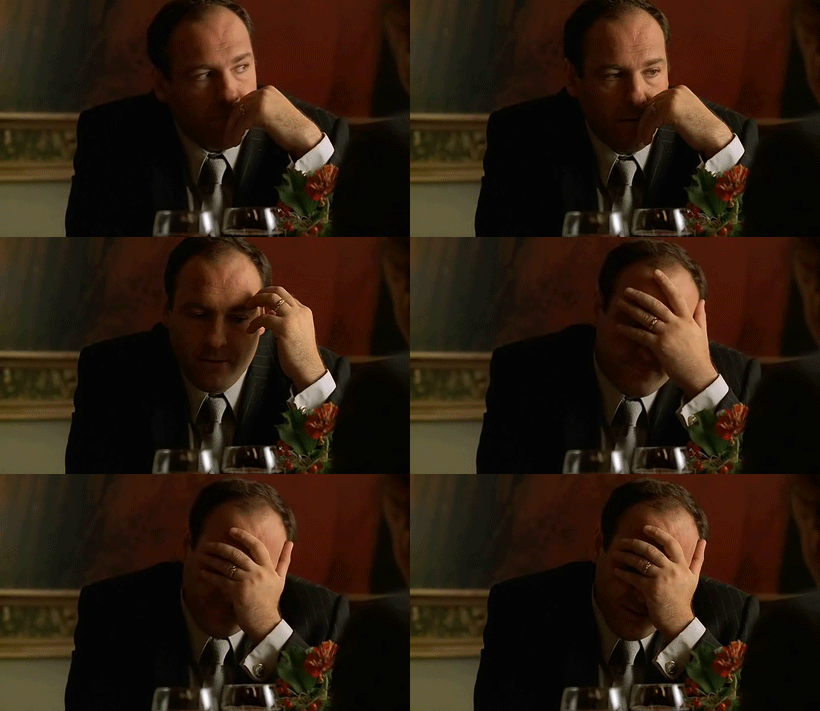
To top it all off, there is both instalove and a love triangle. On page 10, Ava meets Luck. Two pages later, she declares she's in love with him. And then on page thirty, they have sex together, despite the fact that the following day Ava is Ava's wedding day.

Once Ava is banished to Earth, she meets another guy, who she also claims she "loves."


Unfortunately, while the premise was amazing, the execution wasn't nearly as strong. In the end, Salvage just wasn't for me.
Profile Image for Jen Ryland (jenrylandreviews & yaallday).
2,060 reviews1,033 followers
Read
March 5, 2014
I'm not a big reader of sci-fi, so I went into this book with some trepidation, but I really enjoyed it. It's a beautifully written coming-of-age story set first in space, then on an floating island of flotsam in the Pacific, then in a futuristic Mumbai.

The first ten chapters or so take place aboard the Parastrata, a space merchant ship that houses an oppressive, patriarchal little community, complete with arranged polygamous marriage.

I wasn't really sure I was up for reading 500 pages of that, but then -- BAM! - a few chapters in, our heroine is banished and the interesting part of the book begins. Alone and undereducated, Ava will have to make her way in an unfamilar world, deal with her shame at being cast out by her community, unravel some family secrets, and learn that she can be strong and also accept help from others.

This book is long and while it's not fast-paced or filled with action, I was never bored. There are some truly heartrending moments along Ava's journey of discovery. And I thought the narrative had a beguiling, almost dreamy quality, and featured intelligent, inventive worldbuilding that reminded me a bit of Ship Breaker by Paolo Bacigalupi.

If you love a good coming-of-age story and/or love futuristic stories, definitely try this one out!

Thanks to Greenwllow/Harper for allowing me to read an advance copy of this book for possible review.
Profile Image for Kristen.
437 reviews618 followers
Want to read
November 6, 2013
I am about midway through this book and have set it aside for now. I don't know exactly what I was expecting but it wasn't what I got.

This book did not read science fiction to me barely at all. Felt more like a character and society study. There is nothing wrong with that but it just isn't my favorite type of book. I felt a lack of tension and story arc and it felt just like following the main character, Ava, along on her growth as a person. She is raised in a very stifling community that treats women as if they are inferior. We see Ava struggle with this and try to overcome her society's view on herself and women as a whole.

I wanted a fun space opera type of book and this was not like that at all. I don't blame the book for that...just wasn't the book for me.

Ava is an interesting character and she really goes through a lot of hardships. I found the difficulty of her growth and life realistic.

The writing was well done and made the story easy to read though I felt a bit bored as I got further into the story.

There is mild romance at the beginning. I couldn't say after midway but it was very insta-love but somewhat realistic because of the way Ava and Luck have been raised and their ideals on what a relationship should be like.

I have put this aside for now. I'm not sure I'll finish or DNF yet. I do think that for the right reader this book will be an amazing voyage into a girls growth and self discovery.
Profile Image for Carissa.
Author 2 books29 followers
June 2, 2017
SALVAGE is my new favorite book of the year.

Breathtakingly, achingly beautiful, this is literary science fiction at its best. I said it on twitter, but I'll say it again here: if you are a fan of FIREFLY or THE HANDMAID'S TALE, you should probably drop everything and read this book right now.

As other reviewers have noted, Duncan is a master world-builder. From the close, rigid, puritan culture of the spaceship on which Ava is born; to the rag-tag jumble of community adrift on the Gyre; to the gritty, colorful streets of future Mumbai -- each setting was crafted with an attention to detail that is simply astounding.

The characters are complex, each deeply motivated (again, Duncan is a master at this), and endearing. Ava is a heroine to root for from page one. She's plucky despite being born to an oppressive society, and it's beautiful to watch her both grow into and rail against the freedom she suddenly finds herself in.

Yes the book is on the long side for typical YA. And yes some of Ava's dialect/jargon can be difficult to understand at first. This is not an easy beach read. But do not let this deter you!! SALVAGE is a stunning, thought-provoking story that will linger with you long after you finish the last page.
Profile Image for J.R. Johansson.
Author 8 books496 followers
February 27, 2014
SALVAGE was refreshing in a totally unexpected way. I felt like I was reading something totally new and I don't get to experience that very often. The characters were awesome and I loved Ava's character ARC. She learns and grows and goes through SO much! It was like reading Space Opera meets Little House on the Prarie at moments and Waterworld at others. It was a wild ride and I loved every minute of it!
Profile Image for Alyssa.
1,069 reviews855 followers
August 4, 2014
***Review posted on The Eater of Books! blog***

Salvage by Alexandra Duncan
Publisher: Greenwillow
Publication Date: April 1, 2014
Rating: 4 stars
Source: eARC from Edelweiss

Official Summary:

Salvage is a thrilling, surprising, and thought-provoking debut novel that will appeal to fans of Across the Universe, by Beth Revis, and The Handmaid's Tale, by Margaret Atwood. This is literary science fiction with a feminist twist, and it explores themes of choice, agency, rebellion, and family. Ava, a teenage girl living aboard the male-dominated, conservative deep space merchant ship Parastrata, faces betrayal, banishment, and death. Taking her fate into her own hands, she flees to the Gyre, a floating continent of garbage and scrap in the Pacific Ocean. This is a sweeping and harrowing novel about a girl who can't read or write or even withstand the forces of gravity. What choices will she make? How will she build a future on an earth ravaged by climate change? Named by the American Booksellers Association as a Spring 2014 Indies Introduce Pick.

What I Liked:

I honestly was not sure if I would enjoy this book for several reasons, but I am really glad that I ended up really liking it! At first, while reading the beginning, I was like, there is NO WAY this book and I are going to get along. But Duncan has constructed a really beautiful novel!

There are several parts to this book. The first part is spent on the Parastrata, a merchant ship that flies in space. There is a society living on this ship - in fact, Ava has never NOT been on the ship. But trouble brews when she is given away as a bride, to a male on the Æther ship. She hoped it would be her childhood friend Luck (and he hoped so as well). They do something unforgivable, and everything falls apart. They are separated, and both are to die. But Ava escapes, and ends up on Earth.

The next part deals with Ava's adjustment to Earth, away from her ship, from her lost love Luck. She is taken in by a lovely woman and her daughter (the daughter's name is Miyole). She meets a boy named Rushil. She searches for her mother's sister. She learns to read and write (poorly, but she learns somewhat). But where does she belong?

At first, I HATED the first part, the beginning, on the ship. I hate the society on the Parastrata! It's sexist and totally debilitating for women. Women can't learn to read or write or be anything except laundresses and farmers. They are married off to the man of their father's choosing. Oh, and it's a polygamist society. No no no. So, I really did NOT like the society. I thought I would hate this book.

BUT, that's just it: Duncan does an AMAZING job of building and creating the society on the Parastrata. It's obvious that readers are supposed to hate the sexist society (unless you're a sexist, then I suppose you'll enjoy the first part - disgusting). I even thought I hated Ava, because she has no spine or backbone or willpower. BUT, then I realized: this is just how brilliant Duncan's writing is. Ava can't see fault in her society. She can't see how women have no rights in her society. She can't understand, because she doesn't know better. Ava doesn't have that seed of rebellion that many dystopia novels feature (not that this book is a dystopia). She only comes to change her way of thinking because she is forced out of her ship, and she goes to Earth (which was literally the LAST thing she wanted to do).

So, yeah. I loved the worldbuilding and the writing style. Duncan does a really good job of creating the world on the Parastrata, as well as life on Earth. It's polluted, dirty, garbage-filled, and there are definitely environmental themes in this book. YAY for that! And Duncan's writing style is really flowing and lovely. Sometimes it seems a little dry and boring, but it definitely fits the story.

The story is rather long and drags a bit, because you feel like nothing is happening. However, I like the journey - it's Ava journey, her discovery of who she is as a woman, as a real person who is appreciated for her talents (and not her ability to make children). It sounds cliche to say that this book was all about a character's quest to find herself, but in this book's case, it's totally accurate. Sometimes, I can understand the excessive length, because many, many scenes are necessary, to show Ava's changing views and growth as a character.

The romance is pretty obvious, in this book. There aren't too many males in this book, especially males around Ava's age, so when you spot this one guy, or this other one, or this other one, it's pretty obvious that he will be a potential love interest. I will say that there are two - I already mentioned Luck and Rushil. But there is NOT a love triangle in this book - not in the physical sense. The romance is important, because it shows that Ava is capable of making her own choice for herself.

Feminism is a pretty big thing in this book. Ava comes from a very repressive society, where there aren't many males, and the males that are present have many wives and many children and all of the knowledge, strength, and power. But when Ava goes to Earth, she is shown how awful and messed-up her society is. She learns of choice and empowerment, which is really important. I like the strong presence of feminism in this book, but it's also really subtle.

Overall, I enjoyed the plot of this book, Ava's journey. This book is great as a standalone, so I hope it stays that way. The worldbuiling is probably the best/most well-done part of the book. I hope that if others read this book, they enjoy and appreciate the undertones and themes of the novel!

What I Did Not Like:

This book is very long, and sometimes, you really FEEL the length of the book. Meaning, sometimes I felt like this book was unnecessarily long. Length usually doesn't bother me, when the book is really engrossing. AT TIMES, this book was not engrossing enough, so the length was daunting. I think Duncan could have cut this one down by maybe fifty pages (or more), honestly.

Otherwise, overall, I was pretty happy. Make sure you read what I said about the beginning of the book, on the ship. I HATED the society on the Parastrata, but it's that necessary evil that you hate, but at the same time, you totally appreciate it how WELL Duncan builds it and MAKES you hate it.

Would I Recommend It:

I would recommend this book mostly to science fiction fans. If you're looking for an amazing, heartstopping romance, try something else. If you want constant, nonstop action, try something else. If you want a heroine with a backbone from start to finish, try something else. My point is, this book is NOT for everyone (like every book, but this one definitely is not). Science fictions will appreciate this one, and fans of feminist literature. It's an excellent (debut) novel!

Rating:

4 stars. I enjoyed this book! It is truly a remarkable debut novel (though that sounds really cliche), and I'm glad I had the opportunity to read and review it.
Profile Image for Krys.
821 reviews165 followers
February 13, 2015

Salvage is the first book by Alexandra Duncan. It is a Young Adult Science Fiction novel with a pro-female message. I read it in the last few days and wanted to get my thoughts here before they are gone. This novel wasn’t perfect, but it had something that kept me reading until the end. So, that is definitely saying something.

I did not, however, love this book. I wanted to, but I didn’t. Which, now that I think about it, is sort of a shame.

Ava is a 17-year-old young woman on the space ship Parastrata. She is an outcast among her own people both in looks and in ancestry. Three generations ago her grandfather came to the Parastrata, married, and fathered a child. He passed his looks onto his daughter and Ava inherited them years later. It happens from time to time among Ava’s people along with other ships; bringing outside blood into the genetic pool helps to stave off generations of inbreeding. It helps to strengthen the blood. Ava dyes her hair red to blend in, but her darker skin has always been a problem that she cannot change.

Ava’s people are male dominated. The men take care of the inner politics, the engineering, and any contact with Earth. Women are deemed too weak for such tasks since they are susceptible to Earth’s pull that draw them towards the planet like a magnet. Women are also found to be inferior with facts, numbers, and anything intellectual. As such they are relegated to mundane, domestic chores and told to keep their heads down. That Ava can do simple figures and mechanical fixes sets her apart. She hides her abilities, knowing that they are just one more thing that will remind people of her Earth bred genetics.

Ava’s best hope is when another ship’s captain arranges a marriage for her. Thinking that she has been matched as first-wife to Luck, a handsome 19-year-old, she succumbs to his pressure and loses her virginity to him. This one action becomes Ava’s undoing in her community and for her future with Aether, Luck’s ship. Now, she must make a choice to abide by the decision of her people or to run to Earth and maybe eke out a future for herself there.

At times I found myself underwhelmed by the pacing of this book. It’s a long Young Adult novel by normal YA standards. The final copy spans 520 pages and there are times when not a lot happens. I found myself wondering where the novel was going and hoping that the ending would deliver a punch worthy of the novel. As far as the ending goes… I guess I was underwhelmed by that as well. It makes sense given the context of everything that precedes it. However, by the time the ending came, and Ava makes her final, tumultuous decision, I was a little over the whole novel. I think this could have used some editing to improve the pacing.

And, speaking of editing, there is a bad typo in the final copy. For a chapter a character is introduced as Dayo. Her name is that for the first part of the chapter. She disappears for a few pages and shows up as Doya for the rest of the chapter. This would be chapter 24, pages 315 -325 (for anyone who wants to double-check). I have access to an e-arc AND a physical ARC as well, and it’s messed up in all three formats. Pity, you think someone would have noticed this in the time it took to edit a manuscript (probably several times) and then print the hardcovers. I only noticed it because I put the book down and came back to it later. I had to return to the beginning of the chapter to see who Duncan was talking about only to discover the misspelling. It makes me wonder what Duncan intended her name to be?

Ava was an interesting character, with her “right so” language and her Parastrata crew dialect. In truth, it took me a while to get the rhythm of her words since many of them seem out-of-place or unnecessary. She is very polite and passive about her language and it never completely leaves her months later. Besides that, she is a character who does grow throughout the book but she never feels as if she changes. For me, she felt as “different” as she was going to be right from the first page when it was obvious that she was never wholly accepted within her own crew. She also did things on the sly, learning numbers and then remedial math. As such her personal journey is more internal and subtle. As she is exposed to more culture outside of the Parastrata she begins to see that women do not have the limitations that she was reared with. It helps to allow her to become more comfortable in her own skin. Since her growth is so slow I don’t know if that helps with the pacing issue. The first period in the Gyre, a community that salvage garbage for scrap, is probably the time where she makes the most change. I think that might be a result of her spending weeks lying around recovering from gravity illness more than anything. There’s a lot of reflective passages in that part of the book.

One other thing that annoyed me was the sex shaming that was in this book. Granted, it’s completely within the confines of Ava’s society – she loses her virginity and everything spirals out of her control. She is reviled and rejected. For the rest of the book she regrets that decision and silently chastises herself for her own lewd ways. She questions her desires and her commitment to Luck, who may not even be alive any longer. It isn’t until a potential love interest tells her that it is immaterial to him whether she had another lover that she lets go of her own shame. This really bothered me, that Ava had to be told, by a man no less, that she was in the clear with him sexually. It deflated my expectation for a really feminist twist and I was annoyed for the rest of the book.

I’m not blown away with the book, I think that is fairly obvious. The message seemed pretty apparent to me from the first introduction of her crew when my thoughts were simply “Get out!” – A spaceship that subjugates women and forces them into marriages with men who will take multiple brides for their own whims… seems like there are only so many places that the author can go with that. The Ava that we know by the end of the book is leaps and bounds ahead of the Ava from the opening. However, she never completely comes into her own. There is a scene at the end that felt like the beginning of enlightened empowerment but I wanted more. I think I wanted to read Ava five years later, see where her progress has led her then. As this book stands it seemed like everyone helped her along the way, and that lost a bit of the power for me. I wanted more of a bang.

4 out of 5 stars.

- review courtesy of www.bibliopunkkreads.com
Profile Image for Niki Hawkes - The Obsessive Bookseller.
791 reviews1,660 followers
April 24, 2014
Via The Obsessive Bookseller at www.nikihawkes.com

I will admit I wasn’t sure if I was going to enjoy this book. It started off with an interesting concept, but I found it kind of difficult to follow and the language a bit convoluted. Because it was so unlike anything I’d ever read before, I decided to stick with it… And I’m so glad I did. This is definitely not your typical teen read – it followed a story line that almost seemed backwards (which was part of its brilliance), had an odd love-interest conflict (which was oddly refreshing), and as far as I know, is a standalone novel (which is probably why I feel so satisfied with it).

Duncan did a great job building culture and creating a cool atmosphere that was one of my favorite elements of the book. Aboard the transport ships where Ava, the protagonists, grew up, a hierarchal polygamist lifestyle that was once essential to their survival had warped into this weird male-dominated society where she is taught to keep quiet and obey the rules. It was an incredibly oppressive system which was made all the worse by the other women higher up in the pecking order. The intership politics and customs were so feasible that I found that whole portion of the story sufficiently creepy… in a good way. You see, it really made me think about how plausible that society actually was, and appreciate just how good I have it.

As far as character is concerned, although Ava made some really foolish decisions early on, I still admired how her desire to accomplish more than she was allowed was evident right from the start (well, maybe not the start… There was actually a good fifty pages of reminiscing that happened before the story really got going, but I’m choosing to block that out because, odd pacing aside, it was at least interesting). The side characters were unique in their own way, but the focus of this book really was all about Ava.

The earth portion of the story is really when the novel really came alive for me. You see, it was quite remarkable experiencing Earth from an outsider’s perspective (especially since it was an overcrowded, futuristic Earth that had evolved into a melting pot of cultural tradition and technology… It was friggin’ cool). Anyway, watching Ava adapt to a society so different from her own, and to see her growth throughout the story, was easily one of the highlights of this novel.

The more I evaluate this book as a whole, the more I like it. Despite the fact that it was a bit difficult to get into and certain plot-points required a little bit of “just go with it” forgiveness, I thoroughly enjoyed reading it. It’s one of those books that sticks with you long after you’ve read it, and am quite happy I decided to give it a chance.

Recommended Reading: I would probably only hand this to older teens and adults, as it has more mature moments than most books of this genre, (younger readers might find it a bit risqué). I will say this would be an excellent recommendation for someone looking for something “different.”
Displaying 1 - 30 of 519 reviews

Can't find what you're looking for?

Get help and learn more about the design.