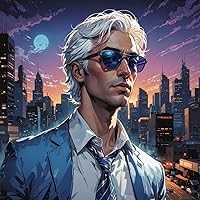
The element Nautrium is predicted to be the most sought after commodity of the 20th century, it's also Lewis Crosswick's opportunity to move up in the world by using his experimental drilling engine to reach buried deposits of the element before his competition. But as the stress of dealing with mechanical breakdowns and unsustainably long hours begins to wear him down, a series of eerie events make Crosswick wonder if he is cracking under the pressure, or if his superstitious minors are correct, and that by drilling into the ancient rock they risk unleashing dark, supernatural forces.
Nothing Returns— a Victorian steampunk horror novella.
Phil McDermott is a highly acclaimed storyteller, author and playwright. He is the creator of the ‘Oracy To Writing Process’; a highly effective approach to raising writing and reading standards in primary schools both here and abroad. He is also the author and storyteller on ‘The Story Emporium’ website and has won awards for the incredibly popular ‘Storyspinner’ series.
For over 20 years Phil has been working as a storyteller, drama and Oracy specialist and teacher training consultant in British schools and in many schools around the world. He has been rated as excellent by OFSTED and positively commented on in many of their reports. He is an expert in the effective use of Oracy as a teaching tool. His work with children includes personal development through Oracy, writing and drama. Critical thinking, creative problem solving and independent learning are key features in his approach.
Phil’s work has been the subject of many authoritative studies including, a study in Birmingham by Eve Bearne, University of Cambridge and Marilyn Mottram, School Effectiveness Adviser, Birmingham, in which they found: ‘oral storytelling can provide a powerful means of giving children a ‘voice’ for their writing. The structure as well as the imaginative content of children’s told and written narratives improved noticeably over the course of one term.’ Hackney learning Trust also conducted a pilot of his Oracy to writing process in 22 primary schools, which resulted in 96% of the children showing significant or major improvement in their literacy levels. More recently his work with boys at a primary school in Dagenham was the subject of a study by Oxford university press.
Phil also has a successful background in the performing arts. His most famous acting role was as Trevor Short, a long running character in the well known BBC British soap opera ‘East Enders’. He has also acted in children’s TV dramas, performed radio plays for the BBC and acted in many stage plays throughout the UK. As a storyteller he has performed at festivals, tours and clubs throughout the UK and Europe.
I used to have an old anthology of spooky stories entitled "Best Ghost Stories" (I think the copyright date was in the late 1800s, but it may have been as late as the 1930s). My favorites were "The Willows," "The Thing in the Hall," and "The Tractate Middoth." This story would be completely at home in that collection. It has the same sort of timelessness, the same terrifying sense of an inexorable march into doom, the same nagging feeling that the protagonist could escape right up until the last, inevitable scene if he would only open his mind to the awful, unnatural reality he faces.
Too many writers of "horror" fall into the trap of too much detail, thinking that lots of gory descriptive prose will make a story scary. A good ghost story, though, requires an incredibly delicate balance. There must be enough detail to sell the yarn, but enough obscurity to bring up that primal human fear of the unknown -- better yet, the idea that we can be absolutely convinced of the truth of our conviction that "there has to be some rational explanation," only to discover at the very end the we totally missed the raw, evil hatred at the core. I think this kind of writing is the most difficult of tasks that a writer can attempt.
This writer has succeeded in striking that balance with a skill and creativity that echoes those classic stories in that vintage tome of mine. The pacing is perfect, the detail sufficiently graphic but also sufficiently vague, the length just right. I cannot recommend this story highly enough!
Nothing remains seems to me a lovecraftian inspiration, which is great. It is very well written and the steampunky style connects well with the setting of the mine and the characters actions and speech. The characterisation is very good, as is the suspense of the story. I was actually quite hooked and I like the novella length. Crosswick is a logical man who is dragged to his wits end with the progression of drilling for nautrium, but somehow the nautrium element becomes a bit lost. We never see its value/effects. The pace is good too, but there's a fatal flaw for me, the ending! It's very chaotic and we'll produced, but geez! it leaves you hanging too much! There's no explanation or resolve in any way!? It helps soak into the dark elements of the book and lives up to its title, but I felt a bit cheated! Regardless I give it four stars for its excellent all round narrative and structure. An ending of value would have seen a five star rating, excellent read! But gutting. I'd read more from the author.
A mine promises a find of a new mineral that will change the face of industry. However, the mine promises more than just a new mineral, but something that should have remained buried.
This is a well-written tale of cosmic horror where the terror grows slowly until the final holocaust of the final chapter brings it all to a gut-wrenching conclusion.
The story was good as far as it went, but the weak and inconclusive ending ruined the work for me. This started out as a steampunk horror story, dark, creepy, and quite enjoyable.
Fantastic lovecraftian steampunk mashup, with an amazing, mounting sense of supernatural menace. I really can't recommend this highly enough. Potatoes.