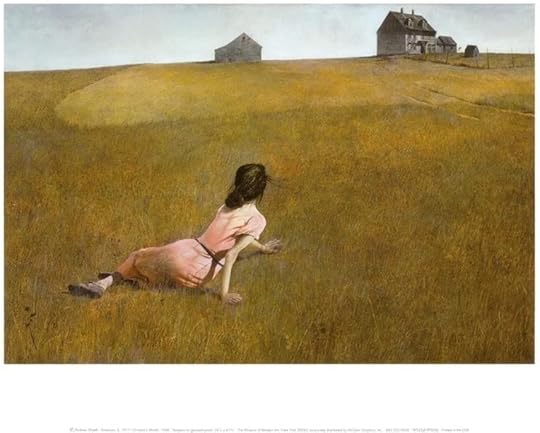
”Over the years, certain stories in the history of a family take hold. They’re passed from generation to generation, gaining substance and meaning along the way. You have to learn to sift through them, separating fact from conjecture, the likely from the implausible. Here is what I know: Sometimes the least believable stories are the true ones.”
Their home at Hathorn Point in Cushing Maine was on land claimed by three men, two brothers, Samuel and William Hathorn, and William’s son Alexander. They packed their belongings and fled Salem, Massachusetts for Maine in the middle of winter. At Hathorn Point, they built a tent made of animal skins to see them through the winter months. Log cabins followed, and eventually a house. A house and land that would be handed down from Christina’s grandmother Mamey, to her mother, and then to their children. A place that would, indeed, become Christina’s world.
Betsy James is 9 years old the first time she appears at Christina’s, and from that day on she remains a recurring, and welcome presence in Christina’s life, and in her home. Betsy acknowledges Christina’s physical barriers as one would acknowledge that her eyes were green, it is simply the way she was made. Christina feels at ease with young Betsy. Now 17, Betsy arrives one day at Christina’s door, and mentions that her friend Andrew would like to paint a picture of her house. It doesn’t surprise Christina that Betsey is there or has brought her friend Andrew, the son of N.C. Wyeth, the famous illustrator, artist, of such books at Treasure Island.
We all know the picture, Christina’s World by Andrew Wyeth, or enough people know it that according to Andrew’s son Jamie Wyeth (also a well-known artist), the two most popular questions at the Museum of Modern Art are ‘Where is the ladies room?’ and ‘Where is Christina’s World?’ It was the first painting I ever loved, and it remains my favourite. For me, it represents the yearning for some elusive home, to belong to something bigger than ourselves, and yet hesitant, timid, afraid to try for something that is right there and simultaneously seems so out of our reach. A wistfulness. A desire restrained by uncertainty; a tug on our heartstrings for home, the pull of our longing for more.
”He did get one thing right: Sometimes a sanctuary, sometimes a prison, that house on the hill has always been my home. I’ve spent my life yearning toward it, wanting to escape it, paralyzed by its hold on me. (There are many ways to be crippled, I’ve learned over the years, many forms of paralysis.) My ancestors fled to Maine from Salem, but like anyone who tries to run away from the past, they brought it with them. Something inexorable seeds itself in the place of your origin. You can never escape the bonds of family history, no matter how far you travel. And the skeleton of a house can carry in its bones the marrow of all that came before.”
Christina was born with a degenerative disease, which hampered her mobility even as a young child, leaving her frequently stumbling and falling. Eventually it would progress from occasionally stumbling to the point where it was easier not to try to walk. Some believe she had a form of polio, more recent studies indicate it might be Charcot-Marie-Tooth disease, however she was never diagnosed during her lifetime. Needless to say, it made life on a farm difficult even in her younger years. Perhaps it made her dreams as a young woman more fragile. Her wish to be seen for herself, a woman with wants and desires, and not simply for her misshapen, unreliable body.
Christina Baker Kline has woven together a story based on some facts, much research, and with A Piece of the World delivers a tender, poignant account of the story behind the painting that rings true. What Andrew Wyeth wrought on canvas, Christina Baker Kline has portrayed with her prose.
The night I fell in sorrow
I knew I was alone
A dozen good-time friendships
But my heart is still unknown
I couldn't reach for rescue
I hid myself from you
I couldn't stand to see me
From your point of view
I knew I'd disappoint you
If I showed to you this child
Who is crying out inside me
Lost in the wild
I feel you behind me
Laughing in the water
Wash away the tears
I feel you behind me
But how did you find me here?
David Wilcox - How Did You Find Me Here?