Here is the definitive account of the Valley of the Kings, visited by millions of tourists and famous throughout the world as the burial place of the great New Kingdom pharaohs. Some eighty tombs were dug in the valley at the height of Egyptian power more than 3,000 years ago, their chambers stocked with incredible treasures and decorated with magnificent wall paintings. It was here, in 1922, that Howard Carter stumbled upon the virtually intact tomb of the boy-king, Tutankhamun. Recently the valley has made international headlines with the discovery of the burial chapels of Ramesses the Great's many sons; The Complete Valley of the Kings is the first book to publish an account of these remarkable findings. Reeves and Wilkinson, both acknowledged authorities on the valley, bring together the art, archaeology and history in one exciting account.
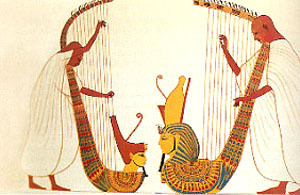
Page 59: James Bruce In the steps of Pococke, in 1768, followed James Bruce, a Scotsman hailing from Kinnaird who visited Luxor and likewise crossed the river to explore the Valley of the Kings. The royal tombs he describes as 'magnificent, stupendous sepulchres', sited in 'a solitary place', Like his predecessors, Bruce visited the tomb of Ramesses IV; but his principal claim to fame is his description - hardly his discovery, since the tomb already lay open and was probably among those entered by Sicard - of the tomb of Ramesses III (KVll), which .l..o uld henceforth be known as 'Bruce's Tomb', For Bruce, the principal feature of this tomb were the scenes, 'in fresro. [of] three harps, which merited the utmost attention, whether we consider the elegance of these instruments in their form, and the det ail of their parts, . . _ or confine ourselves to the reflection that to how great a perfectlon music must have arrived, before an artist oould have produced so complete an instrument' In view of their fame, it is ironic that the highly embellished renderings of the royal harpists which appear in Bruce's TrQL-eis to Discover the Source of the Nile, first published in Edinburgh in 1790. should offer such a poor impression of the originals; indeed. a later traveller in the valley. William George Browne (who was to be brutally murdered e1l route to Samarkand in 1813), commented wryly that 'his engraved figures seem to be from memory', Accurate or not, they would, nevertheless, immortalize Bruce's name.
3. Tombs of the Kings
4. Decline of a Royal Necropolis
Summer 2013 Egyptian Encounters:
Cleopatra (1963) Film Only CR The Mummy Curse 2* Alexandria: The Last Nights of Cleopatra 4* The Complete Valley of the Kings Revisit: Ancient Egypt by George Rawlinson
This entire review has been hidden because of spoilers.
I seriously underestimated this book. At first, I believed it to be little more than a "coffee table book" with pretty pictures. As I read it, I realized it contained far more. This is an exhaustive chronicling of the tombs in the Valley of the Kings with detailed research and lists of finds, in addition to the dates "discovered" and explored in recent times, including the names of the sponsor and principal archaeologist. I learned so much by reading this and it also make me realize how much there is still left to learn. Reeves and Wilkinson also painfully explore the destruction and desecration of these tombs by grave robbers and by educated men who should have known better but were driven by greed and the desire to "outdo" other First World powers. It ends on a somewhat positive note in that Egypt has finally taken control of the its artifacts and it recognizes the need for more study and preservation to maintain what has already been found. Perhaps museums around the world will find some conscience and begin a process of returning what rightfully belongs to the Egyptians.
He writes as if Hatshepsut was a jumped up regent instead of an actual pharaoh. A lot of the data and theories on her are hopelessly out of date, even for when he was writing the damn thing. Also, at the end in his section on visiting the tombs, he suggests that you use high speed film in the dimly lit tomb and slower exposures outside in the blazing sun. That's the complete opposite of how film cameras work. If you can't be bothered to check basic facts in a scholarly work, what good are you?
An excellent overview of the Valley of The Kings. The tombs and their discovery, discovery and exploration are covered in some detail. The authors look at each tomb individually and have included many fine photographs and plans of all the major tombs. This book was originally published in 1996 and is complete in its coverage up to that date.
The design is a bit busy and cramped, and the organization can be a bit confusing. (In order, the chapters cover the general process of decorating, cutting, and stocking the tomb and preparing the body for burial; the history of the exploration of the valley; a list of royal tombs in chronological order, with nonroyal tombs placed at the end; and the royal mummies, and how they were damaged and shuffled around by robbery and restoration). The sections that Reeves wrote editorialize and speculate too much—the allegations about impropriety between Tawosret and Bay, for instance, are apparently the product of his imagination. Nevertheless, this is a decent survey of the valley, including the religious practices, texts, and symbolism in the tombs. While there are other books about the valley that avoid this one's faults (most significantly The Oxford Handbook of the Valley of the Kings), if you want floor plans of all the major tombs, your only options are this book or Atlas of the Valley of the Kings, which consists of nothing but maps and plans.
Flawed though it may be, from this book I get a sense of the atmosphere in the valley at every critical stage in its history, including the plunder and turmoil during the collapse of the New Kingdom, the series of European expeditions that raced through the valley and the circle of English expatriates who lounged in it during the early 19th century, and Theodore Davis's constant pressure for his hired archaeologists to unearth new tombs at the start of the 20th. At this size, the book can't give more than a taste of each period, but what it provides is very vivid.
unfortunately this should be listed under Nicholas Reeves, the cover of the book shows this clearly.
There was an earlier 1990 edition in English and German of this work and this is the update with new discoveries and such
/////
the great Amazone
Once again, Reeves et al hit the mark!
This volume is filled with great information. I could not imagine touring the Valley of the Kings without having read a similar book. Full of facts and anecdotes, this is an indispensable reference for amateur Egpytologists.
Many scholarly works have been written on the various tombs in the Valley, but those sorts of journals are not easily accessed by the general public. Reeve's book serves as a great index and introduction.
Each location is thoroughly but briefly summarized. The illustrations, both photographic and drawn, are well produced. Many books on Ancient Egpyt are much more beautiful (and expensive!), but the information presented here is hard to beat.
This is a pretty exhaustive study of the Valley of the Kings tombs. It is not for the faint of heart. It is not a picture book, but is. It is not a history book, but it is. It is also not very readable if you haven't been to the Valley. You won't have any perspective if you haven't been there. The reason I read it was because I just got back from Egypt and I wanted to get a better understanding about the Valley of the Kings. What it did was enhance what I saw, gave what I saw a little more meaning. It details all the major tombs in the Valley. History of each, excavation of each, tomb robbing of each, ect. There are some great schematics of the tombs, but again, don't think you could really understand them fully if you haven't been there.
So my suggestion GO AND SEE EGYPT. It is spectacular, a life changing experience.
Although the book is dated (it was published in 1997), this is a wonderfully comprehensive record of the tombs in the Valley of the Kings - including maps, a history of the discovery of each tomb and a detailed analysis of its design and decorations, including photographs. There are additional sections on the discovery of the mummy caches, the workers’ camps, the topography of the region, the traces left by ancient tourists, biographical details of some of the workers and architects, the early archaeologists and an amazing series of photographs of all the royal mummies. I read it from cover to cover, along with a printed map of the Valley and a chronology of the Pharaohs of the 18th, 19th and 20th Dynasties. It was a wonderful follow up to our recent visit to Egypt. Loved it!
An excellent book that goes over every 18th thriugh 20th dynasty tomb from the Valley of the Kings. It provides an historical overlook as well as some current events item. The book was published quite a few years ago though and this version does not have any updates after the turn of the century.



 KV5, still under excavation, is the largest tomb.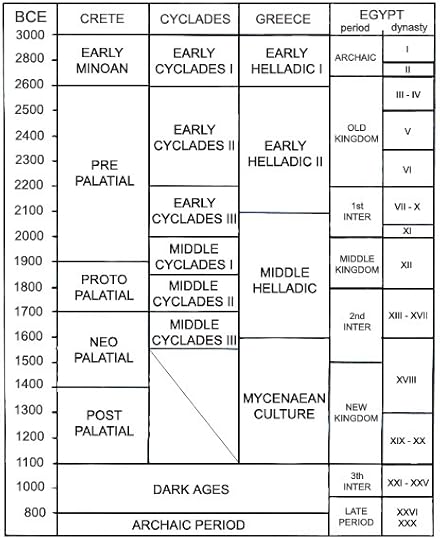
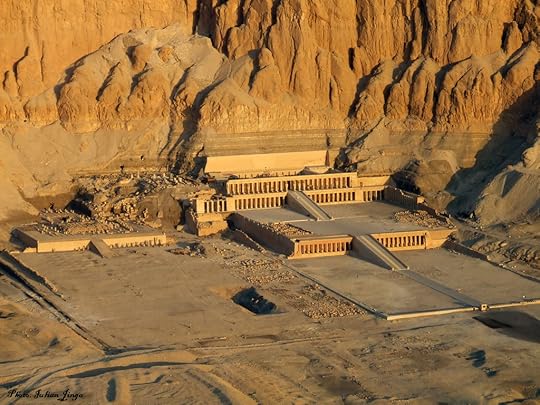 Temple of Hatshepsut at Deir el-Bahari