“You still stand watch, O human star, burning without a flicker, perfect flame, bright and resourceful spirit. Each of your rays a great idea – O torch which passes from hand to hand, from age to age, world without end.” – Karel Capek
Mary Anne is thirteen years old when we first meet her. Her mother, step father Bob Farquhar, brothers Charley, George and Eddie, and baby sister Isobel are crammed into a small home. They are barely making ends meet financially and the children do not go to school.
Bob Farquhar, employed as a compositor and copy corrector at a Fleet Street scandal sheet printing house is suddenly struck with a bad case of heat stroke that would have him laid up for a number of weeks. Mary Anne is dispatched to inform her father’s immediate supervisor, a Mr. Day, of the condition of his employee.
But Mary Anne has other plans.
It is while walking to the printing house that Mary Anne hatches a plan. When she arrives at the printing office, informing Mr. Day that her father is laid up, (a broken leg she says), but that he’s still able to correct the copy if Mr. Day would permit her to pick up the copy each day, she would be sure to deliver it to her father and return it corrected.
Mr. Day is loath to lose the services of Bob, his most reliable employee, so he agrees to this plan and Mary Anne picks up the copy each day, goes home, and secretly corrects it herself, (forging her father’s signature in the process), and delivers it back to the printing house, no one the wiser. Her father is in no shape to do the work himself, so she reasons that the deception is for the greater good of providing much needed money for the family.
She also happens to be drawn to the scandal stories (mostly of current affairs and politics) even though she doesn’t fully appreciate the sarcasm and harsh wit contained therein.
One day Mary Anne’s father confronts her, informing her that Mr. Day had stopped by the house earlier that day, asking after his employee with the “broken leg”. Mary Anne’s father and his employer had quickly concluded that Mary Anne, a thirteen year old girl was indeed correcting the copy herself, and, surprisingly, doing it rather well. Bob tells his daughter that Mr. Day wishes to speak with her regarding this situation, and the next day she arrives at the printing office expecting to be scolded, but instead, Mr. Day informs her that he believes she is highly intelligent and should have a proper education. To this end, he informs her, he will pay for her education at a boarding school for young ladies in Essex.
Mary Anne is taken aback by Mr. Days offer and thanks him for his generosity, but it’s her inner thoughts that reveal what is to come for Mary Anne:
She had done something that she was not supposed to do. She had deceived Mr. Day, and Mr. Day was going to educate her.
It paid, then, to deceive.
The chapters that follow contain the rather fantastic telling of Mary Anne’s turbulent life as she jumps from one lover and life situation “lily pad” to the next. She makes a habit of trading up, all in the name of higher social standing, financial security and lavish lifestyle. The lengths to which this character takes these ambitions is a testament to Daphne du Maurier’s storytelling mastery.
Another aspect of “Mary Anne” that stood out for me was that it appealed to my logophile tastes.
There were the exquisitely crafted du Maurier scenes of a young girl pondering her love of words:
“Words fascinated her, the shape of the curling letters, how some, by repeating themselves more often, had importance. They had difference of sex too. The a’s, the e’s and the u’s were women; the hard g’s, the b’s, and the q’s were all men, and seemed to depend on the others.”
Then there was the exceptional range of unique words used in the story. Here was just a few of my favorites, (all of which I wasn’t previously aware of):
“Whirligig” – When used to describe, “A giddy or flighty person.”
“Gimcrack” – A showy, useless trifle.
“Rusticate” – To stay or sojourn in the country.
“Prink” – To deck or dress for show.
“Squib” – A short and witty saying.
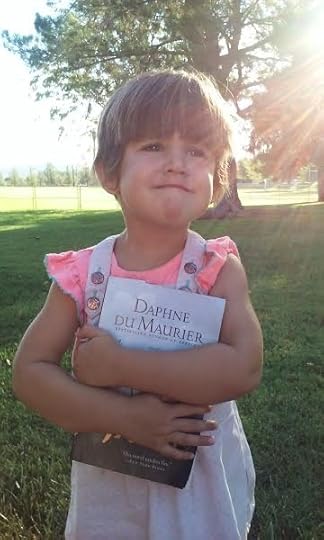
“Mary Anne” is my third Daphne du Maurier novel. I’d previously read “Jamaica Inn” and “Rebecca” and based on how tremendously written those two were, I decided to reach in and pick up another selection among this amazing writer’s extensive body of work.
I’ve come to understand that this novel is less well known than “Rebecca”, “Frenchman’s Creek” and “The Birds.” But this one showed me du Maurier’s ability to craft and exceptionally well told story where the protagonist is placed in multiple, varied settings, a wide variety of households with a parade of different “leading men” along the way. “Mary Anne” demonstrated just how multi-faceted is the genius of this celebrated writer!
A full to brimming five stars!