

What do you think?

When the Earth Had Two Moons: Cannibal Planets, Icy Giants, Dirty Comets, Dreadful Orbits, and the Origins of the Night Sky – A Geologist's Exhilarating Tour
An astonishing exploration of planet formation and the origins of life by one of the world’s most innovative planetary geologists.
In 1959, the Soviet probe Luna 3 took the first photos of the far side of the moon. Even in their poor resolution, the images stunned scientists: the far side is an enormous mountainous expanse, not the vast lava-plains seen from Earth. Subsequent missions have confirmed this in much greater detail. How could this be, and what might it tell us about our own place in the universe? As it turns out, quite a lot. Fourteen billion years ago, the universe exploded into being, creating galaxies and stars. Planets formed out of the leftover dust and gas that coalesced into larger and larger bodies orbiting around each star. In a sort of heavenly survival of the fittest, planetary bodies smashed into each other until solar systems emerged. Curiously, instead of being relatively similar in terms of composition, the planets in our solar system, and the comets, asteroids, satellites and rings, are bewitchingly distinct. So, too, the halves of our moon. In When the Earth Had Two Moons , esteemed planetary geologist Erik Asphaug takes us on an exhilarating tour through the farthest reaches of time and our galaxy to find out why. Beautifully written and provocatively argued, When the Earth Had Two Moons is not only a mind-blowing astronomical tour but a profound inquiry into the nature of life here―and billions of miles from home.
In 1959, the Soviet probe Luna 3 took the first photos of the far side of the moon. Even in their poor resolution, the images stunned scientists: the far side is an enormous mountainous expanse, not the vast lava-plains seen from Earth. Subsequent missions have confirmed this in much greater detail. How could this be, and what might it tell us about our own place in the universe? As it turns out, quite a lot. Fourteen billion years ago, the universe exploded into being, creating galaxies and stars. Planets formed out of the leftover dust and gas that coalesced into larger and larger bodies orbiting around each star. In a sort of heavenly survival of the fittest, planetary bodies smashed into each other until solar systems emerged. Curiously, instead of being relatively similar in terms of composition, the planets in our solar system, and the comets, asteroids, satellites and rings, are bewitchingly distinct. So, too, the halves of our moon. In When the Earth Had Two Moons , esteemed planetary geologist Erik Asphaug takes us on an exhilarating tour through the farthest reaches of time and our galaxy to find out why. Beautifully written and provocatively argued, When the Earth Had Two Moons is not only a mind-blowing astronomical tour but a profound inquiry into the nature of life here―and billions of miles from home.
368 pages, Hardcover
First published January 1, 2008
Ratings & Reviews
Friends & Following
Create a free account to discover what your friends think of this book!
Community Reviews
Displaying 1 - 30 of 101 reviews

January 27, 2023
I was worried about Covid brain being able to process books with actual information, but switching this one to audio did wonders and I finished it in one day of coughy/sneezy/phlegmy/achy (insert 3 more Covidy dwarfs here) misery.
Erik Asphaug really digs planetary science and is unabashedly enthusiastic about it. And he does something I actually appreciate quite a bit — he admits when the theories just don’t fit or are pure conjecture (even if they sound really good) instead of presenting everything as solid undeniable facts. Because let’s face it — we can be good at guessing at the origins of the solar system and the planets billions of years ago, but a lot of fun gorgeous theories are not provable, are they? And a lot of those theories I’ve known about before, but not quite how much of these were conjecture. And yet they are interesting and fun, and Asphaug is very excited about them and makes it very accessible to a casual reader.
And yeah, most of these planetary formation mysteries will probably always remain guesswork, even if educated one, but it’s amazing to picture what Asphaug narrates. The collision of the Earth and Theia producing the Moon, the possibility of their being two moons around the Earth once upon the time, the migration of gas and ice giants, the possible causes for the weirdness of Saturn satellite system, planetoid cannibalism by accretion — all those are fascinating. And some we may figure out with time — the mysteries of Titan, Europa and Enceladus.
Asphaug narrates almost associatively, jumping from topic to topic on what initially may seem like only a tenuous connection, and yet ends up a fascinating planetary journey if you just trust him and go along for the ride. It may be a bit scattered but it really worked for me and my reading style.
Funny side note: what made my sick brain giggle quite a bit was the frequent mentioning of the word “oligarch”(“oligarch: Any of the final planetary embryos after orderly growth, at the beginning of the late stage of giant impacts.”) I still kept picturing criminally rich mafiosi, which entertained tired Covid brain to no avail.
Oh, and on the side of Pluto being or not being a planet, Asphaug is in the planet camp, with excellent reasons to back it up. Little Pluto is happy now.
4.5 stars, rounding up. Asphaug made this disgusting plague more tolerable for me, so I’m eternally thankful.
——————
Also posted on my blog.
Erik Asphaug really digs planetary science and is unabashedly enthusiastic about it. And he does something I actually appreciate quite a bit — he admits when the theories just don’t fit or are pure conjecture (even if they sound really good) instead of presenting everything as solid undeniable facts. Because let’s face it — we can be good at guessing at the origins of the solar system and the planets billions of years ago, but a lot of fun gorgeous theories are not provable, are they? And a lot of those theories I’ve known about before, but not quite how much of these were conjecture. And yet they are interesting and fun, and Asphaug is very excited about them and makes it very accessible to a casual reader.
Earth/Theia collision theory, with the Moon as the possible greatest gift to Earth

And yeah, most of these planetary formation mysteries will probably always remain guesswork, even if educated one, but it’s amazing to picture what Asphaug narrates. The collision of the Earth and Theia producing the Moon, the possibility of their being two moons around the Earth once upon the time, the migration of gas and ice giants, the possible causes for the weirdness of Saturn satellite system, planetoid cannibalism by accretion — all those are fascinating. And some we may figure out with time — the mysteries of Titan, Europa and Enceladus.
Asphaug narrates almost associatively, jumping from topic to topic on what initially may seem like only a tenuous connection, and yet ends up a fascinating planetary journey if you just trust him and go along for the ride. It may be a bit scattered but it really worked for me and my reading style.
Funny side note: what made my sick brain giggle quite a bit was the frequent mentioning of the word “oligarch”(“oligarch: Any of the final planetary embryos after orderly growth, at the beginning of the late stage of giant impacts.”) I still kept picturing criminally rich mafiosi, which entertained tired Covid brain to no avail.
Oh, and on the side of Pluto being or not being a planet, Asphaug is in the planet camp, with excellent reasons to back it up. Little Pluto is happy now.
4.5 stars, rounding up. Asphaug made this disgusting plague more tolerable for me, so I’m eternally thankful.
——————
Also posted on my blog.

November 26, 2019
An amazing exploration of planet formation and the origins of life
In When the Earth Had Two Moons, planetary geologist Erik Asphaug takes us on an exciting tour of our galaxy detailing strangest miracles in space and an examination into the nature of life.
Asphaug explores a variety of planetary forms—including comets, asteroids, moons, and the sun—as he explores the complex and deeply galaxy and beyond. Combining his own research with scientific discoveries, He discusses the origin of life, our own understanding of the universe, on the history and current knowledge of the planets, familiar and unfamiliar moons, and unattached bodies in between. He has added several other interesting titbits like Pluto’s status as a planet or how exploring Jupiter will feel like. As a geologist, he also devotes entire chapters to extraterrestrial topography, plate tectonics, and our pursuit of liquid water throughout the galaxy.
As an academic and as a Professor of Planetary Science at various universities, Asphaug brings his rich experience and amazing insights into writing this book. Asphaug opts for concise explanations over the relatively abstract astrophysics. Having said that, the overly technical language is likely to irritate general readers. Let’s face it, astrology and advanced physics are not easy topics to grasp for lay readers. Hence many readers could find sections of the book a bit too complex to understand.
Overall the book is an exciting tour of the galaxy exploring many topics at once. Though a bit technical at times, it’s still an interesting and entertaining guide to our unknown galaxy. Three and a half stars
Many thanks to the publishers HarperCollins, the author Erik Asphaug and Edelweiss for the ARC.
In When the Earth Had Two Moons, planetary geologist Erik Asphaug takes us on an exciting tour of our galaxy detailing strangest miracles in space and an examination into the nature of life.
Asphaug explores a variety of planetary forms—including comets, asteroids, moons, and the sun—as he explores the complex and deeply galaxy and beyond. Combining his own research with scientific discoveries, He discusses the origin of life, our own understanding of the universe, on the history and current knowledge of the planets, familiar and unfamiliar moons, and unattached bodies in between. He has added several other interesting titbits like Pluto’s status as a planet or how exploring Jupiter will feel like. As a geologist, he also devotes entire chapters to extraterrestrial topography, plate tectonics, and our pursuit of liquid water throughout the galaxy.
As an academic and as a Professor of Planetary Science at various universities, Asphaug brings his rich experience and amazing insights into writing this book. Asphaug opts for concise explanations over the relatively abstract astrophysics. Having said that, the overly technical language is likely to irritate general readers. Let’s face it, astrology and advanced physics are not easy topics to grasp for lay readers. Hence many readers could find sections of the book a bit too complex to understand.
Overall the book is an exciting tour of the galaxy exploring many topics at once. Though a bit technical at times, it’s still an interesting and entertaining guide to our unknown galaxy. Three and a half stars
Many thanks to the publishers HarperCollins, the author Erik Asphaug and Edelweiss for the ARC.

November 24, 2019
An amazing introduction to modern planetary science, by a working specialist in just that. This is my favorite sort of science book, by a scientist who’s enthusiastic about his field. Prof. Aspaug writes really well, and his book is full of (good) surprises. I thought I was fairly well up to date in planetary science, but I learned a lot from his book. Highly, and enthusiastically, recommended.
The author worked hard to make his book accessible to non-technical readers, but you will get more out of it if you have a general background in the topic. Some of his best stuff is in the notes, so be sure to follow those about stuff that you find particularly interesting. He’s the sort of guy I would love to meet, and the sort of professor you would have loved to have in school.
Takeaways from my notes: there are a LOT of unsolved mysteries in the evolution of our solar system — and even more unknowns about exoplanets. Here’s one, still being worked out:
The TRAPPIST-1 exoplanet system: its star is just slightly larger than our Jupiter but 84 times more massive (1/8 the mass of our sun) — and it’s compressed to 10x the density of iron! Details: https://en.wikipedia.org/wiki/TRAPPIS...
This is a dim red dwarf star, expected to burn for trillions of years, or 100 times as long as the current age of our universe. Red dwarves are common and may prove to be the best bet for finding extrasolar life. TRAPPIST-1 alone has at least 3 planets in its habitable zone.
Asphaug is a cheerleader for planetary exploration: it’s cheap, fun, and inspirational. Sure beats warfare as a way for nations to strut their stuff. Which they always have, back to the Greeks and before, and always will. His go-to example is the US moon-landing missions in the 1960s, which used repurposed war-rockets. As did the rest of the US space program, and the Russians, and now the Chinese. All these programs have had (he says) practical spin-offs, which have paid back their costs, and promoted international cooperation. The current ecological crises are a nudge that more cooperative scientific research would be a really good idea.
The author worked hard to make his book accessible to non-technical readers, but you will get more out of it if you have a general background in the topic. Some of his best stuff is in the notes, so be sure to follow those about stuff that you find particularly interesting. He’s the sort of guy I would love to meet, and the sort of professor you would have loved to have in school.
Takeaways from my notes: there are a LOT of unsolved mysteries in the evolution of our solar system — and even more unknowns about exoplanets. Here’s one, still being worked out:
The TRAPPIST-1 exoplanet system: its star is just slightly larger than our Jupiter but 84 times more massive (1/8 the mass of our sun) — and it’s compressed to 10x the density of iron! Details: https://en.wikipedia.org/wiki/TRAPPIS...
This is a dim red dwarf star, expected to burn for trillions of years, or 100 times as long as the current age of our universe. Red dwarves are common and may prove to be the best bet for finding extrasolar life. TRAPPIST-1 alone has at least 3 planets in its habitable zone.
Asphaug is a cheerleader for planetary exploration: it’s cheap, fun, and inspirational. Sure beats warfare as a way for nations to strut their stuff. Which they always have, back to the Greeks and before, and always will. His go-to example is the US moon-landing missions in the 1960s, which used repurposed war-rockets. As did the rest of the US space program, and the Russians, and now the Chinese. All these programs have had (he says) practical spin-offs, which have paid back their costs, and promoted international cooperation. The current ecological crises are a nudge that more cooperative scientific research would be a really good idea.

December 30, 2022
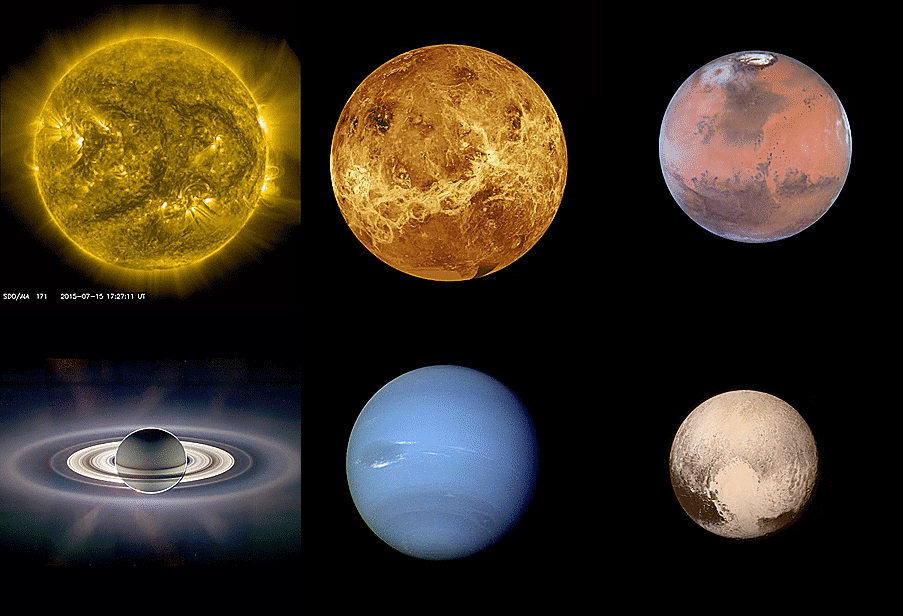
Do you get excited by GUTs?
Did you learn all the names of the major moons in the solar system thanks to Solarquest?
Have you lost sleep over entropy?
Do you know why Titan is the coolest moon?
If so, this book is for you. It’s about the neatest and weirdest things in astronomy, focusing mostly on our solar system, but it goes into exoplanets and star formation as well. The author is an astronomy professor. He appears to go into all the things he loves about astronomy, so it sometimes feels like he is jumping from topic to topic. But it’s fine. There is a clear love and enthusiasm for the subject in the writing that is contagious. Be sure to read the endnotes as well.
The more you learn about the solar system, the more you say, “That’s so weird.” Like, astronomers came up with a reasonable theory to explain Jupiter and its moons … but it doesn’t work with Saturn. This happens over and over. (Then you either go crazy trying to understand the universe or conclude that God is messing with you and laughing.) It’s awesome. He also goes into a lot of theories that haven’t been proven yet, but they’re fascinating to explore and think about.
Astronomy is based heavily in physics, which is described by mathematics, but chemistry, geology, and biology also have a role. It is a science book, but I didn’t find it too technical. Dr. Asphaug uses a lot of analogies and good explanations for all the science. He is also careful to remain neutral about Pluto’s demotion.
I’m glad I didn’t miss out on this book.
Cool stuff:
•The planets in the solar system influence each other in resonance patterns. Earth would not be the same without them.
•We’re still not sure how we got the moon. If it was created by a collision that caused the moon to erupt from the earth, there is no evidence of this third body.
•If the earth had two moons that collided, this could explain why the far side is so different from the near side.
•The age of the earth that we’ve calculated is based on the geology we observe. But it’s very possible that the earth’s mantle and crust went through a re-forming process, meaning the earth could be even older.
•Think of gravity not as a force but as a probability field. If it’s not a true force, that would turn GUTs on their heads.
Clean content

January 31, 2020
This is a very informative book although a bit dry. There is a lot of science but also a lot of conjecture which is precisely what the author intended when writing this book, he says that the more we explore the unknown space the more conjectures we will have to take until we can fix everything in one theorem. The more questions we ask and the more we realize how little we know about how our own moon was built and how our sun burns and wether this same circumstances could be replicated in another solar system the more we will resume exploring space.

September 26, 2022
Mokslo populiarinimo knyga, būtent tokia, kokias labiausiai mėgstu – tiršta informacijos.
Esant tiek žinių ir spekuliacijų apie Didįjį Sprogimą, juodąsias skyles, galaktikų klasterius ir t.t. Saulės sistema gali pasirodyti kaip gana proziška tema – taigi žinom tas planetas, o mėnulį tai išvis matom kasnakt. Vis dėlto kartais užsimirštam, kaip visi tie dalykai yra TOLI vieni nuo kitų ir kokios skurdžios tos mūsų žinios.
Kaip supratau, pats autorius tyrinėja maždaug tai, kaip planetos daužosi vienos į kitas, t.y. planetų sistemų evoliuciją ir pan.
Jei sumėtytum visas planetas į Saulę, perduodant pastarajai jų masę ir judesio kiekio momentą, tai Saulės masė tepadidėtų 0,2%, bet jos judesio kiekio momentas išaugtų iki vieno apsisukimo per dieną (dabar apsisuka kartą per 25 dienas). Tai kodėl Saulė sukasi taip lėtai, palyginus su planetomis?
Kai Saulė buvo jauna – sako autorius – jos magnetinis laukas buvo DAUG stipresnis. Jaunos žvaigždės magnetinis laukas sąveikauja su jonizuotu jos proplanetiniu disku (tom visokiom dulkėm, iš kurių vėliau susilipdė planetos), suteikdamos jam greitį ir nustumdamos toliau nuo Saulės. Šitaip pro-planetos įgijo daugiau judesio momento, o Saulė, atitinkamai, prarado.
Buvo labai įdomu apie kitus Saulės sistemos mėnulius. Iš kur žinome, kad kai kuriuose jų yra vandens? Nes yra ledo! Kaip tai įrodo skysto vandens egzistavimą?
Vėl turbūt visi mokykloj mokėmės apie nepaprastą vandens savybę – kad kietas jis užima daugiau vietos negu skystas, dėl to ledas plūduriuoja, o po juo gali gyventi žuvys:) Ši ypatinga savybė nulemia ir tai, kad, skirtingai negu kitoms medžiagoms (ar daugeliui kitų, neįsivaizduoju), ledą suslėgus jis virsta vandeniu, t.y. pereina į būseną, kuri užima mažiau vietos. Dėl to čiuožia slidės ir pačiūžos (visą svorį sukoncentravus į mažai vietos, ledui atitenka didelis slėgis ir po pačiūžomis jis ištirpsta), dėl to žinome, kad pvz Jupiterio palydove Europoje, kurią dengia keliolikos kilometrų ledo sluoksnis, ta didžiulė masė turėtų taip suslėgti apačioje esantį ledą, kad jam nieko nebeliktų, kaip ištirpti. Kaip įdomu, kas toje sūraus vandens masėje gyvena!!!
Sužinojau apie Tidal Heating (potvyninės jėgos??) – čia kai vienas kūnas ištampo kitą ir pastarasis nuo to sušyla. Šita kosminė joga vyksta su planetų palydovais, kurių orbita ne visai apskrita, o eliptiška, t.y. vienu metu jie būna arčiau planetos, kitu – toliau. Gravitacinė planetos ir palydovo sąveika labiau ištempia palydovus, kai jie arčiau (na, visi žinom, kaip veikia potvyniai, ar ne?), ir mažiau – kai jie toliau. Tai šitas formos keitimas sukelia trintį palydovo viduje ir jį sušildo. Tačiau ilgainiui viskas linksta prie apskritesnių orbitų (nes su jomis mažiau reikalų), tada palydovai tampa “tidally locked”, t.y. išsitempę visada į tą pačią pusę, ir nebešyla. Bent jau aš taip supratau.
Jei norėtume nusileisti ant asteroido, reikėtų elgtis labai atsargiai, nes jie turi gravitaciją, bet labai silpną. Jei numestume kavos pupelių, jos nusileistų ant paviršiaus labai lėtai ir pakeltų didelį dulkių debesį – panašiai kaip dumblingo ežero dugne. Nežinau, man kažkaip miela pasirodė.
Pasirodo, Saulės sistema yra gana keista, palyginus su kitomis atrastomis planetų sistemomis – didelės planetos per toli, o šalia žvaigždės (Saulės) per daug mažų planetų. Kaip tai nutiko? Autorius aiškina planetų migracijas per kosminį biliardą – prasinešęs kosminis kūnas gali sutrikdyti didžiųjų planetų orbitas, jos rėžiasi viena į kitą, pridaro dulkių, dulkės sulėtina planetos judėjimą ir jinai nuspiraliuoja į Saulę, kitos planetos numigruoja toliau, iš dulkių susiformuoja naujos planetos. Net nemėginsiu atpasakoti, bet autorius pristato teoriją, kad Merkurijus-Venera-Žemė-Marsas yra “antrosios kartos” planetos, atsiradusios išsidaužius ankstesnėms gigantėms. Nežinau, kiek pagrįsta, bet man labai gražu.
Kaip atsirado Mėnulis? Autorius teigia, kad Saulės sistemai jau bebaigiant formuotis, į Žemę rėžėsi kita planeta, maždaug Marso dydžio, atskėlė gabalą, ir susimalė kartu su Žeme. Atskeltas gabalas, aišku, išsibarstė dulkėmis aplink Žemę (taigi kurį laiką Žemė turėjo žiedus, beveik kaip Jupiteris), o paskui “susikondensavo” į vieną gabalą – Mėnulį.
BET AR TIKRAI TIK VIENĄ?? Knygos pavadinimas sufleruoja, kad ne. Čia vėl net nemėginsiu atpasakoti, bet trumpai: 1) Iš kur atsirado tas kitas mėnulis? Dalis po smūgio likusių dulkių susikondensavo į kitą kūną Žemės ir mėnulio sąveikoje atsiradusiame Lagranžo taške (neklauskit). 2) Kur dingo tas kitas mėnulis? Lėtai įsiplojo į šitą mėnulį.
Štai, dabai žinome. O jei rimtai, skaitykite knygą, mane labai džiugino.
Esant tiek žinių ir spekuliacijų apie Didįjį Sprogimą, juodąsias skyles, galaktikų klasterius ir t.t. Saulės sistema gali pasirodyti kaip gana proziška tema – taigi žinom tas planetas, o mėnulį tai išvis matom kasnakt. Vis dėlto kartais užsimirštam, kaip visi tie dalykai yra TOLI vieni nuo kitų ir kokios skurdžios tos mūsų žinios.
Kaip supratau, pats autorius tyrinėja maždaug tai, kaip planetos daužosi vienos į kitas, t.y. planetų sistemų evoliuciją ir pan.
Jei sumėtytum visas planetas į Saulę, perduodant pastarajai jų masę ir judesio kiekio momentą, tai Saulės masė tepadidėtų 0,2%, bet jos judesio kiekio momentas išaugtų iki vieno apsisukimo per dieną (dabar apsisuka kartą per 25 dienas). Tai kodėl Saulė sukasi taip lėtai, palyginus su planetomis?
Kai Saulė buvo jauna – sako autorius – jos magnetinis laukas buvo DAUG stipresnis. Jaunos žvaigždės magnetinis laukas sąveikauja su jonizuotu jos proplanetiniu disku (tom visokiom dulkėm, iš kurių vėliau susilipdė planetos), suteikdamos jam greitį ir nustumdamos toliau nuo Saulės. Šitaip pro-planetos įgijo daugiau judesio momento, o Saulė, atitinkamai, prarado.
Buvo labai įdomu apie kitus Saulės sistemos mėnulius. Iš kur žinome, kad kai kuriuose jų yra vandens? Nes yra ledo! Kaip tai įrodo skysto vandens egzistavimą?
Vėl turbūt visi mokykloj mokėmės apie nepaprastą vandens savybę – kad kietas jis užima daugiau vietos negu skystas, dėl to ledas plūduriuoja, o po juo gali gyventi žuvys:) Ši ypatinga savybė nulemia ir tai, kad, skirtingai negu kitoms medžiagoms (ar daugeliui kitų, neįsivaizduoju), ledą suslėgus jis virsta vandeniu, t.y. pereina į būseną, kuri užima mažiau vietos. Dėl to čiuožia slidės ir pačiūžos (visą svorį sukoncentravus į mažai vietos, ledui atitenka didelis slėgis ir po pačiūžomis jis ištirpsta), dėl to žinome, kad pvz Jupiterio palydove Europoje, kurią dengia keliolikos kilometrų ledo sluoksnis, ta didžiulė masė turėtų taip suslėgti apačioje esantį ledą, kad jam nieko nebeliktų, kaip ištirpti. Kaip įdomu, kas toje sūraus vandens masėje gyvena!!!
Sužinojau apie Tidal Heating (potvyninės jėgos??) – čia kai vienas kūnas ištampo kitą ir pastarasis nuo to sušyla. Šita kosminė joga vyksta su planetų palydovais, kurių orbita ne visai apskrita, o eliptiška, t.y. vienu metu jie būna arčiau planetos, kitu – toliau. Gravitacinė planetos ir palydovo sąveika labiau ištempia palydovus, kai jie arčiau (na, visi žinom, kaip veikia potvyniai, ar ne?), ir mažiau – kai jie toliau. Tai šitas formos keitimas sukelia trintį palydovo viduje ir jį sušildo. Tačiau ilgainiui viskas linksta prie apskritesnių orbitų (nes su jomis mažiau reikalų), tada palydovai tampa “tidally locked”, t.y. išsitempę visada į tą pačią pusę, ir nebešyla. Bent jau aš taip supratau.
Jei norėtume nusileisti ant asteroido, reikėtų elgtis labai atsargiai, nes jie turi gravitaciją, bet labai silpną. Jei numestume kavos pupelių, jos nusileistų ant paviršiaus labai lėtai ir pakeltų didelį dulkių debesį – panašiai kaip dumblingo ežero dugne. Nežinau, man kažkaip miela pasirodė.
Pasirodo, Saulės sistema yra gana keista, palyginus su kitomis atrastomis planetų sistemomis – didelės planetos per toli, o šalia žvaigždės (Saulės) per daug mažų planetų. Kaip tai nutiko? Autorius aiškina planetų migracijas per kosminį biliardą – prasinešęs kosminis kūnas gali sutrikdyti didžiųjų planetų orbitas, jos rėžiasi viena į kitą, pridaro dulkių, dulkės sulėtina planetos judėjimą ir jinai nuspiraliuoja į Saulę, kitos planetos numigruoja toliau, iš dulkių susiformuoja naujos planetos. Net nemėginsiu atpasakoti, bet autorius pristato teoriją, kad Merkurijus-Venera-Žemė-Marsas yra “antrosios kartos” planetos, atsiradusios išsidaužius ankstesnėms gigantėms. Nežinau, kiek pagrįsta, bet man labai gražu.
Kaip atsirado Mėnulis? Autorius teigia, kad Saulės sistemai jau bebaigiant formuotis, į Žemę rėžėsi kita planeta, maždaug Marso dydžio, atskėlė gabalą, ir susimalė kartu su Žeme. Atskeltas gabalas, aišku, išsibarstė dulkėmis aplink Žemę (taigi kurį laiką Žemė turėjo žiedus, beveik kaip Jupiteris), o paskui “susikondensavo” į vieną gabalą – Mėnulį.
BET AR TIKRAI TIK VIENĄ?? Knygos pavadinimas sufleruoja, kad ne. Čia vėl net nemėginsiu atpasakoti, bet trumpai: 1) Iš kur atsirado tas kitas mėnulis? Dalis po smūgio likusių dulkių susikondensavo į kitą kūną Žemės ir mėnulio sąveikoje atsiradusiame Lagranžo taške (neklauskit). 2) Kur dingo tas kitas mėnulis? Lėtai įsiplojo į šitą mėnulį.
Štai, dabai žinome. O jei rimtai, skaitykite knygą, mane labai džiugino.

December 23, 2019
The grumpus23 (23-word commentary)
If you have an interest, this is a good presentation of the randomness of the cosmos and how it all came to be.
If you have an interest, this is a good presentation of the randomness of the cosmos and how it all came to be.

December 4, 2019
I enjoyed this well written discussion of planetary development. The author built his thesis from the ground up, literally, starting with what we know about earth and lunar geology before expanding into the solar system and beyond.
He covers recent exoplanet discoveries, linking it back to the many theories about the formation of our own solar system.
A wry sense of humor is in evidence, along with anecdotes that bring the science to life. The footnotes are especially interesting, some of them providing web links to astrophysical articles and images for those who want to delve deeper. For instance, I liked the story of how the first images of the moon's far side were taken by the Russians, using American high res film repurposed from a downed spy balloon, along with the link to Sven's Space page.
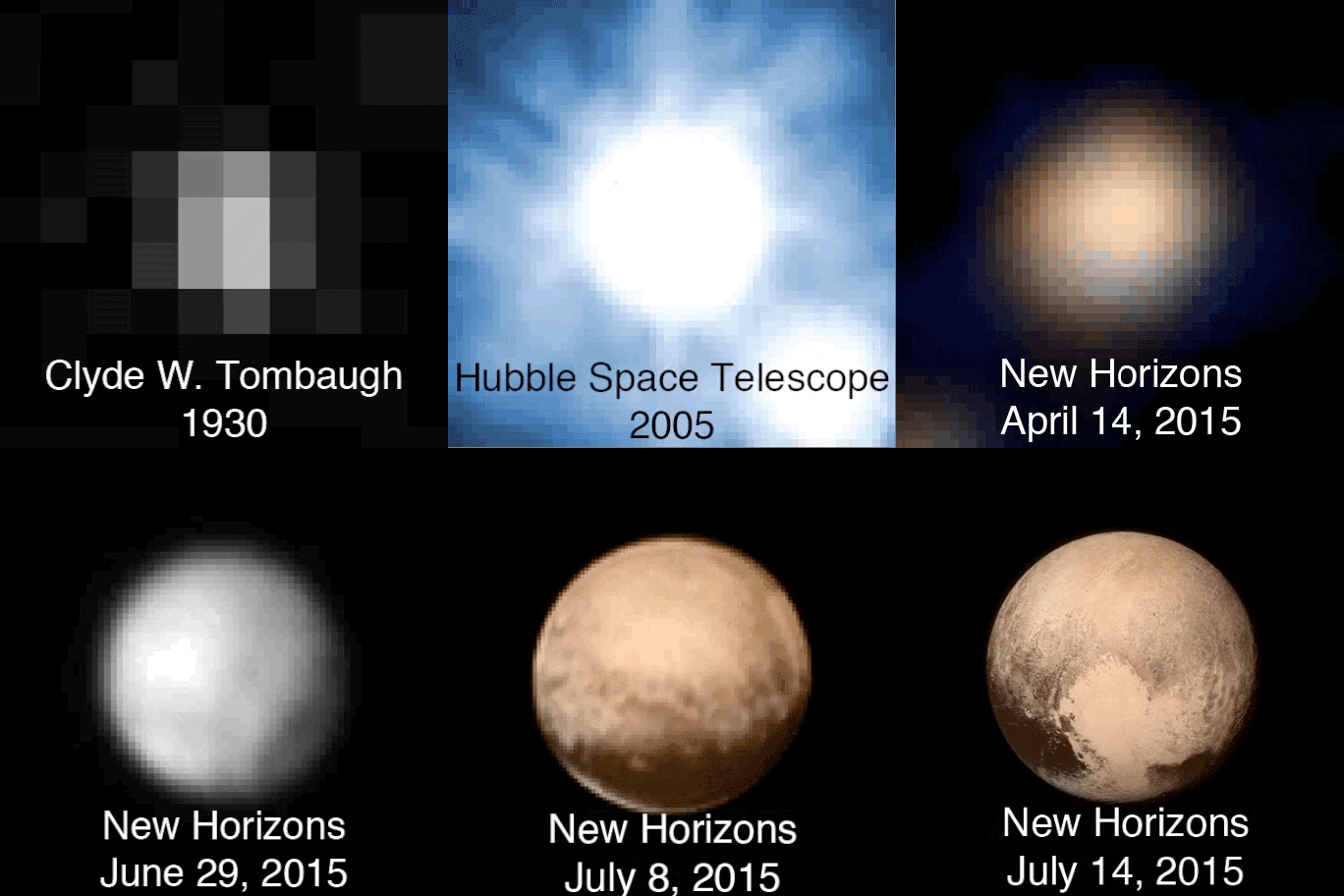
As a Pluto enthusiast (distantly related to Clyde Tombaugh) I also appreciated the respect the author showed to it.
He covers recent exoplanet discoveries, linking it back to the many theories about the formation of our own solar system.
A wry sense of humor is in evidence, along with anecdotes that bring the science to life. The footnotes are especially interesting, some of them providing web links to astrophysical articles and images for those who want to delve deeper. For instance, I liked the story of how the first images of the moon's far side were taken by the Russians, using American high res film repurposed from a downed spy balloon, along with the link to Sven's Space page.
As a Pluto enthusiast (distantly related to Clyde Tombaugh) I also appreciated the respect the author showed to it.

July 11, 2020
Nicely written, well-paced, and well-researched popular science book on astronomy written by one of the leading researchers in the field, an expert on the geology of various solar system bodies and who worked on several unmanned missions, including the Galileo mission to Jupiter, LCROSS (Lunar Crater Observation and Sensing Satellite), and the on-going OSIRIS-REx (an asteroid study and sample return mission on its way to the near earth asteroid Bennu). The book can be read almost as two books, the first half (and portions of the second half or thereabouts) a good general introduction to topics in solar system astronomy (ours and also other star systems, as especially towards the end there is some really nice passages on extrasolar planets), with very approachable and accessible text (well supported by numerous black and white illustrations, a glossary, an index, and an extensive and very readable section of notes at the end of the book, well worth reading). Though I found some of this section for me personally going over some familiar ground there were many new things too and it has the virtue of being written with some of the most recent information by someone currently active in the field (the book was published in 2019).
The second half of or aspect of the book is the author’s theoretical and modeling work in studying a number of origin questions still unanswered (or for which there are competing answers), such as the story of the formation and composition of the Moon, the formation of asteroids, why the satellites of Jupiter and Saturn are so different in terms of numbers and composition, and how the various moons, planets and asteroids in our solar system got their current orbits. Some of these sections can get a little technical but the author patiently explained topics and supported what he talked about with numerous photos and diagrams, many from computer modeling he did.
A lot of time when I write nonfiction reviews I do outlines of what the various chapters talked about (if there aren’t too many; books with say 10 chapters or less, though I find books with more than 10 chapters are often organized into sections and one can talk about sections). For reviewing this book, despite only having ten chapters (seven numbered chapters, plus an introduction, conclusion, and epilogue), I found that a bit of a challenge. As at least one other reviewer has noted, Erik Asphaug, while always engaging (my first time reading the book I read over a hundred pages in one sitting) could bounce around a lot in particular chapters. The different topics flowed, they were interesting, I understood them, but it could be difficult, at least for the chapters at the beginning of the book, to always get a strong sense of theme (towards the end of the book with the chapters on his own research the various chapters were much more thematic).
Having said that, here goes. The introduction is well named, introducing the reader to many general concepts, many more of historical interest, such as the lunar calendar (noting how it can be a challenge, as it “is a living thing: when you try to write it down, it resists,” as “after the twelfth full moon there are eleven days left over, more or less”), the role of computers versus direct visual observation in telescopic astronomy, his noting that this “is a book about the origin of planetary diversity,” a nice introduction to Martian meteorites, and some general thoughts on science.
Chapter 1 introduced the reader to a lot of concepts, all well explained I thought, including the works of Johannes Kepler, astrometry, parallax, ellipses (in terms of orbits, instead of circles), gravity (including Isaac Newton’s work on gravity), the lunar origin theories of George Darwin (son of Charles Darwin), Bode’s Law, what a standard candle is (and what a Cepheid variable star is), general theories on planetary formation, how planets form and are detected around other stars (we know of four thousand exoplanets now!), the importance of the metallicity of a star (metal being any element other than hydrogen or helium), the importance of carbon and oxygen (the second and third most abundant elements in the universe after hydrogen), an introduction to T-Tauri stars (and why they are important for the purposes of this book), and some interesting passages on the possible future of Betelgeuse. Whew!
Chapter 2 was no less interesting and though maybe a little less wide-ranging, covering the works of several ancient Greeks (most notably Eratosthenes), the composition of the Moon, the history of our study and understanding of the composition of the Moon, the lunar observations of Galileo and Robert Hooke (the latter “who first gave us lunar geology”), the science and history of the science of impact craters (as echoed in another book I recently read, _Fire in the Sky_ by Gordon L. Dillow, which I recommend, Asphaug wrote that it “took centuries for the idea of planetary impact cratering to catch on”), some interesting passages on impact craters on the Moon, Venus, and elsewhere and what they say about a number of topics (among other things, if “you know the impact rate and the scaling law that gives you the size of a crater that forms in a given impact, then the craters seen on a planetary body serve as a clock, provided you have a calibration of the impact rate,” something the Moon serves nicely for), and some interesting passages on plate tectonics.
Chapter 3 covered theories of planetary formation (with surprisingly hierarchical theories; “beginning with planetesimals, which accrete into embryos, which grow into a system of Moon- to Mars- sized bodies known as oligarchs), what and how to do crater scaling (using crater formation in a laboratory setting to understand crater formation on astronomical bodies), the different types of giant impacts (which can include hit-and-run collisions), the importance of water in planetary formation, composition, and how impacts play out, the role tidal heating plays in the states of water on an astronomical body (and how tidal heating can occur, introducing such concepts as forced eccentricity caused by mutual gravitational interactions among the various satellites such as say around Jupiter), panspermia (the spreading of life from world to world thanks to hitch hiking on rocks thrown off a planet or a satellite by giant impacts), just in a sentence or two (in support of panspermia), how fossilized diatoms were found high in the Transantarctic Mountains, possibly from debris ejected by the Eltanin impact 2.1 million years ago, a kilometer wide asteroid that hit the Southern Ocean and made a 20-kilometer hole.
Chapter 4 introduced the reader to a number of topics, such as Keplerian shear (the “tendency for adjacent planetesimals to orbit at different speeds”) and what this means for planetary formation, a number of accretion theories (and how they might be different for small bodies and large bodies), lunar crust composition and what an understanding of this means for theories for the formation of the Moon (introducing the concept called KREEP, a layer between the lunar mantle and crust that has elevated amounts of potassium (K), rare earth elements (REE), phosphorous (P), uranium, and thorium), discussion on the objects of the Kuiper Belt (particularly Ultima Thule and Haumea with its two known satellites Hi’iaka and Namaka), quite a bit on Pluto and especially its orbit (using some of the very latest information on Pluto), discussion that Jupiter and Saturn were once in different places in the solar system (and introducing the Nice model, named after the French observatory “where the idea came together”), what giant plant migration meant for the history of the formation of other solar system bodies, what Jupiter can teach us about how satellites form around other gas giant planets in the galaxy, the differences in the satellites in Jupiter and Saturn (Saturn has middle-sized moons, MSMs, while Jupiter does not, and why this might be), the “rabbit hole of weirdness” that is the reality of a number of Saturn’s satellites (such as Iapetus, Mimas, Titan, and Hyperion), and quite a bit on the fascinating moon Titan, with is thick atmosphere, rain, and surface lakes and rivers as well as what a hypothetical mission to explore it might be like.
Chapter 5 talked again about some of the exoplanets known to us as far as types (“super Earths” and “mini Neptunes,” both of which are between 3 to 10 Earth masses and both of which appear to represent most of the planets found so far, though there are other types like “hot Jupiters”), the selection bias that leads most worlds discovered so far to be of these types, some really interesting sections on various meteorites and meteor showers (such as the famed Leonid meteor shower of 1833 and the Orgueil meteorite of 1864, falling in the Pyrenees, the first meteorite to receive widespread scientific attention), the possible role of amino acids from carbonaceous chondrite meteorites in the origin of life, the strange interstellar interloper 1I/’Oumuamua, quite a bit on comets, and more coverage on the physics and geology of planetary impacts (as in two planets hitting each other and possibly merging).
Chapter 6 had a great deal on the formation of the moon and how a planetary impact explains its current composition and structure (most of it owed to the impact and merger of astronomical body called Theia which hit the Earth), how difficult it is to find chemical signatures of Theia, the origins of the two Martian moons, differences and similarities in the formation of Venus, Earth, and Mars, how Mars may have been once “warm, wet” and what it was like, quite a bit on the history of asteroid and comet impacts on Earth (especially discussing the asteroid impact that ended the reign of the dinosaurs 65.5 million years ago as well as the history of this theory), quite a bit on comet formation and structure (and the really complex physics of accretion and impacts, “quite challenging computationally”), and the importance of the discoveries of the first probe to image the lunar farside (Luna 3 in 1959, with some discussion of the Cold War espionage connections of the mission which used “borrowed” American film for a Soviet mission).
Chapter 7 talked a lot about asteroid formation (with concepts like collisional grinding), what the dwarf planets are, the Anna Karenina principle of planetary formation (“All accreted planets are alike; every unaccreted planet is unique in how it was not accreted”), an introduction to the amazing TRAPPIST-1 system of 7 planets, five of which appear to be “within the estimated habitable zone of their star,” an “ultra-cool M-dwarf,” more on how extrasolar planets are detected and observed (and whether the Earth and its companion planets could be detected by aliens), and ruminations on how likely life is in in the universe.
This book covered a lot and especially early on the book could bounce around a good bit. That was fine with me, as where the author bounced to was always interesting. I learned a lot and if anything the book makes me want to read still more on astronomy. Though I wish some of the illustrations were in color (the author even talks about how some were in color and suggests finding them in color), many were excellent and quite a few I had never seen before. I really liked how the very latest findings and theories were included as well, making the book quite up to date.
The second half of or aspect of the book is the author’s theoretical and modeling work in studying a number of origin questions still unanswered (or for which there are competing answers), such as the story of the formation and composition of the Moon, the formation of asteroids, why the satellites of Jupiter and Saturn are so different in terms of numbers and composition, and how the various moons, planets and asteroids in our solar system got their current orbits. Some of these sections can get a little technical but the author patiently explained topics and supported what he talked about with numerous photos and diagrams, many from computer modeling he did.
A lot of time when I write nonfiction reviews I do outlines of what the various chapters talked about (if there aren’t too many; books with say 10 chapters or less, though I find books with more than 10 chapters are often organized into sections and one can talk about sections). For reviewing this book, despite only having ten chapters (seven numbered chapters, plus an introduction, conclusion, and epilogue), I found that a bit of a challenge. As at least one other reviewer has noted, Erik Asphaug, while always engaging (my first time reading the book I read over a hundred pages in one sitting) could bounce around a lot in particular chapters. The different topics flowed, they were interesting, I understood them, but it could be difficult, at least for the chapters at the beginning of the book, to always get a strong sense of theme (towards the end of the book with the chapters on his own research the various chapters were much more thematic).
Having said that, here goes. The introduction is well named, introducing the reader to many general concepts, many more of historical interest, such as the lunar calendar (noting how it can be a challenge, as it “is a living thing: when you try to write it down, it resists,” as “after the twelfth full moon there are eleven days left over, more or less”), the role of computers versus direct visual observation in telescopic astronomy, his noting that this “is a book about the origin of planetary diversity,” a nice introduction to Martian meteorites, and some general thoughts on science.
Chapter 1 introduced the reader to a lot of concepts, all well explained I thought, including the works of Johannes Kepler, astrometry, parallax, ellipses (in terms of orbits, instead of circles), gravity (including Isaac Newton’s work on gravity), the lunar origin theories of George Darwin (son of Charles Darwin), Bode’s Law, what a standard candle is (and what a Cepheid variable star is), general theories on planetary formation, how planets form and are detected around other stars (we know of four thousand exoplanets now!), the importance of the metallicity of a star (metal being any element other than hydrogen or helium), the importance of carbon and oxygen (the second and third most abundant elements in the universe after hydrogen), an introduction to T-Tauri stars (and why they are important for the purposes of this book), and some interesting passages on the possible future of Betelgeuse. Whew!
Chapter 2 was no less interesting and though maybe a little less wide-ranging, covering the works of several ancient Greeks (most notably Eratosthenes), the composition of the Moon, the history of our study and understanding of the composition of the Moon, the lunar observations of Galileo and Robert Hooke (the latter “who first gave us lunar geology”), the science and history of the science of impact craters (as echoed in another book I recently read, _Fire in the Sky_ by Gordon L. Dillow, which I recommend, Asphaug wrote that it “took centuries for the idea of planetary impact cratering to catch on”), some interesting passages on impact craters on the Moon, Venus, and elsewhere and what they say about a number of topics (among other things, if “you know the impact rate and the scaling law that gives you the size of a crater that forms in a given impact, then the craters seen on a planetary body serve as a clock, provided you have a calibration of the impact rate,” something the Moon serves nicely for), and some interesting passages on plate tectonics.
Chapter 3 covered theories of planetary formation (with surprisingly hierarchical theories; “beginning with planetesimals, which accrete into embryos, which grow into a system of Moon- to Mars- sized bodies known as oligarchs), what and how to do crater scaling (using crater formation in a laboratory setting to understand crater formation on astronomical bodies), the different types of giant impacts (which can include hit-and-run collisions), the importance of water in planetary formation, composition, and how impacts play out, the role tidal heating plays in the states of water on an astronomical body (and how tidal heating can occur, introducing such concepts as forced eccentricity caused by mutual gravitational interactions among the various satellites such as say around Jupiter), panspermia (the spreading of life from world to world thanks to hitch hiking on rocks thrown off a planet or a satellite by giant impacts), just in a sentence or two (in support of panspermia), how fossilized diatoms were found high in the Transantarctic Mountains, possibly from debris ejected by the Eltanin impact 2.1 million years ago, a kilometer wide asteroid that hit the Southern Ocean and made a 20-kilometer hole.
Chapter 4 introduced the reader to a number of topics, such as Keplerian shear (the “tendency for adjacent planetesimals to orbit at different speeds”) and what this means for planetary formation, a number of accretion theories (and how they might be different for small bodies and large bodies), lunar crust composition and what an understanding of this means for theories for the formation of the Moon (introducing the concept called KREEP, a layer between the lunar mantle and crust that has elevated amounts of potassium (K), rare earth elements (REE), phosphorous (P), uranium, and thorium), discussion on the objects of the Kuiper Belt (particularly Ultima Thule and Haumea with its two known satellites Hi’iaka and Namaka), quite a bit on Pluto and especially its orbit (using some of the very latest information on Pluto), discussion that Jupiter and Saturn were once in different places in the solar system (and introducing the Nice model, named after the French observatory “where the idea came together”), what giant plant migration meant for the history of the formation of other solar system bodies, what Jupiter can teach us about how satellites form around other gas giant planets in the galaxy, the differences in the satellites in Jupiter and Saturn (Saturn has middle-sized moons, MSMs, while Jupiter does not, and why this might be), the “rabbit hole of weirdness” that is the reality of a number of Saturn’s satellites (such as Iapetus, Mimas, Titan, and Hyperion), and quite a bit on the fascinating moon Titan, with is thick atmosphere, rain, and surface lakes and rivers as well as what a hypothetical mission to explore it might be like.
Chapter 5 talked again about some of the exoplanets known to us as far as types (“super Earths” and “mini Neptunes,” both of which are between 3 to 10 Earth masses and both of which appear to represent most of the planets found so far, though there are other types like “hot Jupiters”), the selection bias that leads most worlds discovered so far to be of these types, some really interesting sections on various meteorites and meteor showers (such as the famed Leonid meteor shower of 1833 and the Orgueil meteorite of 1864, falling in the Pyrenees, the first meteorite to receive widespread scientific attention), the possible role of amino acids from carbonaceous chondrite meteorites in the origin of life, the strange interstellar interloper 1I/’Oumuamua, quite a bit on comets, and more coverage on the physics and geology of planetary impacts (as in two planets hitting each other and possibly merging).
Chapter 6 had a great deal on the formation of the moon and how a planetary impact explains its current composition and structure (most of it owed to the impact and merger of astronomical body called Theia which hit the Earth), how difficult it is to find chemical signatures of Theia, the origins of the two Martian moons, differences and similarities in the formation of Venus, Earth, and Mars, how Mars may have been once “warm, wet” and what it was like, quite a bit on the history of asteroid and comet impacts on Earth (especially discussing the asteroid impact that ended the reign of the dinosaurs 65.5 million years ago as well as the history of this theory), quite a bit on comet formation and structure (and the really complex physics of accretion and impacts, “quite challenging computationally”), and the importance of the discoveries of the first probe to image the lunar farside (Luna 3 in 1959, with some discussion of the Cold War espionage connections of the mission which used “borrowed” American film for a Soviet mission).
Chapter 7 talked a lot about asteroid formation (with concepts like collisional grinding), what the dwarf planets are, the Anna Karenina principle of planetary formation (“All accreted planets are alike; every unaccreted planet is unique in how it was not accreted”), an introduction to the amazing TRAPPIST-1 system of 7 planets, five of which appear to be “within the estimated habitable zone of their star,” an “ultra-cool M-dwarf,” more on how extrasolar planets are detected and observed (and whether the Earth and its companion planets could be detected by aliens), and ruminations on how likely life is in in the universe.
This book covered a lot and especially early on the book could bounce around a good bit. That was fine with me, as where the author bounced to was always interesting. I learned a lot and if anything the book makes me want to read still more on astronomy. Though I wish some of the illustrations were in color (the author even talks about how some were in color and suggests finding them in color), many were excellent and quite a few I had never seen before. I really liked how the very latest findings and theories were included as well, making the book quite up to date.

March 9, 2023
This book does cover the theory that originally, there were Trojan moons, Theia and a proto-earth that all eventually collided into the wonderful system we know and love today, however, most of the book covers how things orbit and collide with other things. TLDR/ everything orbits and sometimes they smash into one another.
I really enjoyed this non-fiction. The author only inserted their story where relevant (some of the theories and models were their own). Sometimes I did get lost and I desired more images and models to picture the events.
I really enjoyed this non-fiction. The author only inserted their story where relevant (some of the theories and models were their own). Sometimes I did get lost and I desired more images and models to picture the events.

March 4, 2020
Summary: Great overview of just this galaxy. It goes through the portion that is covered by space geologists. The major thing is that the title is misleading.
This book tells you what we know about the galaxy to date and gives a pretty good time line of the history of how we know it. This other stuff in the title relates to passing comments. Too bad. Could have had a better more engaging title I think.
p. 32 - "Kepler's own mother had come close to being burned at hte stake as a witch, so he was closely aware of the danger of radical ideas."
p. 53 - Hubble used the brightness of stars to estimate their distance. I think I knew that, but I would not have been able to explain it off the top of my head. Glad to get this section to clarify it all.
p. 76 - I still think it's weird that the Moon reflects the sun's light. I wish he would have gone more into how precisely that works physically. It's Ok. I am sure someone else will speak to it.
p. 77 the use of the eclipse and the knowledge about light allowed them to figure out the distance between the sun and the moon. Aristarchus (some old school greek guy).
p. 79 - The larget number in his day was 10k. Intriguing perspective.
p. 89 - The crater hitting the moon and earth took over a different theory that believed it came from volcanos.
p. 97 - Interesting how they do the math on determining the size of the meteor vs. the crater. I also think it's fascinating how the shocks work precisely. I'd never thought through what it means for something so huge to impact the earth. The two are actually merging, the way you see in cells, not the way a ball bounces off a wall.
p. 111 - "bigger craters form more slowly than smaller ones. So like it hits and then it continues to form. Weird, right?
p. 131 -Very cool to have him talk about what it's like from a pressure perspective on other planets.
p. 173 - Saturn has 1 big moon called Titan and then a lot of tiny moons, while Jupiter has many mid-sized moons. Titan though is as big as all the other mid-sized moons. They think that Saturn's little moons all swallowed up together to create a big one.
p. 176- he makes the argument that it's not actually that expensive to build a space ship.
p. 218 - Darwin thought that the moon was spun out of the earth when it (with the radiant energy of the sun) was spinning a lot faster.
p. 310 There are rocks being ejected from the moon, but they burn up in atmosphere.
p. 312, although the Greeks and Chinese knew about Uranus, Kepler did not.
p. 342 talks about the shock waves that happen and the speeds (5km/s or 3km/s for icy planets). Reference book: Impact Cratering: A geological Process)
This book tells you what we know about the galaxy to date and gives a pretty good time line of the history of how we know it. This other stuff in the title relates to passing comments. Too bad. Could have had a better more engaging title I think.
p. 32 - "Kepler's own mother had come close to being burned at hte stake as a witch, so he was closely aware of the danger of radical ideas."
p. 53 - Hubble used the brightness of stars to estimate their distance. I think I knew that, but I would not have been able to explain it off the top of my head. Glad to get this section to clarify it all.
p. 76 - I still think it's weird that the Moon reflects the sun's light. I wish he would have gone more into how precisely that works physically. It's Ok. I am sure someone else will speak to it.
p. 77 the use of the eclipse and the knowledge about light allowed them to figure out the distance between the sun and the moon. Aristarchus (some old school greek guy).
p. 79 - The larget number in his day was 10k. Intriguing perspective.
p. 89 - The crater hitting the moon and earth took over a different theory that believed it came from volcanos.
p. 97 - Interesting how they do the math on determining the size of the meteor vs. the crater. I also think it's fascinating how the shocks work precisely. I'd never thought through what it means for something so huge to impact the earth. The two are actually merging, the way you see in cells, not the way a ball bounces off a wall.
p. 111 - "bigger craters form more slowly than smaller ones. So like it hits and then it continues to form. Weird, right?
p. 131 -Very cool to have him talk about what it's like from a pressure perspective on other planets.
p. 173 - Saturn has 1 big moon called Titan and then a lot of tiny moons, while Jupiter has many mid-sized moons. Titan though is as big as all the other mid-sized moons. They think that Saturn's little moons all swallowed up together to create a big one.
p. 176- he makes the argument that it's not actually that expensive to build a space ship.
p. 218 - Darwin thought that the moon was spun out of the earth when it (with the radiant energy of the sun) was spinning a lot faster.
p. 310 There are rocks being ejected from the moon, but they burn up in atmosphere.
p. 312, although the Greeks and Chinese knew about Uranus, Kepler did not.
p. 342 talks about the shock waves that happen and the speeds (5km/s or 3km/s for icy planets). Reference book: Impact Cratering: A geological Process)

March 7, 2020
I found the author's nonlinear slapdash method of going from topic to topic with little build to be very much not for my own taste, but I still appreciate that there is a book focused on our solar system rather than all of astronomical physics at large. The chapter outlining how the author helped come up with the theory of the Earth once having two moons and that the impact and loss of the smaller with the larger gave our moon its odd features was very interesting.

Read
July 8, 2020I didn’t rate the book because I’m not smart enough to understand it. It’s true.

August 25, 2022
This is an interesting book about the formation of our solar system. It discusses how a billionaire might fund a mission to land a boat-rover mission to Titan and what that mission might look like, it explores the possibility of extraterrestrial life in the universe (as all books of this kind do) and argues for the author's theory that the event that created the moon actually created two moons, but that one eventually crashed into the other, and this event explains the Moon's strange geography and geology.

January 19, 2020
Sometimes the stars and distant galaxies seem more interesting than our own solar system, but there are many mysteries and much to learn from the astronomical objects in our own back yard. Studying our own planets is key to understanding what may have happened with exoplanets and to understanding the conditions for the development of life. And of course we have much richer sets of data for our own planets than we can possibly ever have for exoplanets. This book stimulated my interest in planetary astronomy and made me want to read more.
But the book itself is flawed. It is written in a decent but unengaging style. It flips back and forth between simplified popular presentation and more technical writing in ways that made it harder to understand and enjoy, but most of all it fails to present its subject matter in way that teaches and aids memory. I would have much preferred a book that had a planned pattern of teaching, building from the simple to the complex so that each chapter adds to the one before, taking the reader on a journey of learning. Without that kind of approach, I felt when I got to the end that I had been exposed to a lot of new material, but I had not really absorbed much of it.
But the book itself is flawed. It is written in a decent but unengaging style. It flips back and forth between simplified popular presentation and more technical writing in ways that made it harder to understand and enjoy, but most of all it fails to present its subject matter in way that teaches and aids memory. I would have much preferred a book that had a planned pattern of teaching, building from the simple to the complex so that each chapter adds to the one before, taking the reader on a journey of learning. Without that kind of approach, I felt when I got to the end that I had been exposed to a lot of new material, but I had not really absorbed much of it.

April 18, 2020
When I was in school, the planetary system was the gold standard for modeling permanence and regularity. We even had a law for predicting where planets could be found. Of course, whether it was a "law" or a coincidence would depend on observations from other planetary systems around other stars, but in 1977, that was not something to worry about.
Well, the returns are now in, and the universe is far stranger than we can imagine, with large planets migrating around the solar system or spiraling into orbits that take a week to travel around their stars. Planets smashing into each other as dust particles build up into boulders build up into embryos that reach a size called "oligarchs" from which the survivors of the age of bombardment can be called "planets" or "moons" (or "plutinos.")
Erik Asphaug's "When the Earth had Two Moons" offers the apogee of "Gosh! Wow! Science" with a tour of the Solar System's pre-history. Long before we had our nine planets, there may have been many more planets orbiting the Sun. Some of those planets - lost Jupiters and Saturns spiraled into the Sun. Others collided and left behind one planet as the "lucky shark" surviving in the ocean. The Earth/Moon system is the result of a collision between proto-Earth and a Mars-sized "oligarch," now called Theia, which struck at just the right angle to deposit a large section of Earth's crust into Earth orbit. This formed the Moon, which has been slowly receding from Earth, so that right now it is at the exact distance to permit full eclipses of the Sun.
When we get reports of Super-Earths, that may simply be an indication that the "Earths" of that system didn't avoid the continuing accretion that could have happened in our system
Asphaug is noted for a pioneering theory of the formation of the Moon. One of the discoveries of the Apollo program was of the Dark Side of the Moon, which had never been observed before. The Moon is tidally locked to the Earth and only ever shows one side to the planet. The Dark Side does not have the familiar "Mares" or dark flat spot we are used to seeing. Instead, it is all mountains and has a thicker crust. Asphaug theorizes that there was a time when the Earth was orbited by two moons. The smaller eventually crashed into what is now the Dark Side, which formed the mountainous terrain we now know to exist.
This is mind-bending stuff. Asphaug's text is accessible to the layman, but I really couldn't figure out how his topics were organized. It seemed that he meandered from one topic to another without any organizing idea.
Nonetheless, this is interesting material and it would be worth buying Asphaug a beer and letting him meander into the night.

March 14, 2020
I have always enjoyed science but have no background in it and rarely read it. As a result, large portions of Asphaug’s work went right over my head. I stuck with it, however, and really enjoyed what I was able to understand. The purpose of the book is to explore some of the latest theories concerning the contents and formation of the solar system. The simple version seems to be that, over time, matter comes together until it becomes too big, then it explodes apart and does it all over again. In the process you get stars, planets, moons, comets, asteroids, and dust of all different shapes and sizes. It’s fascinating to think of how it all happens and especially how long it all takes - billions of years in many cases. The scale is just mind boggling. The frustrating part is that it’s almost all just theory at this point with extremely limited evidence to support it. As the title suggests, the climactic story is an exploration of the author’s theory about the earth having two moons hundreds of millions of years ago. Eventually they slammed together and created the one we have today. It’s a theory based largely on speculative computer models whose parameters could be way off the mark. Despite all the possibility for error, however, my perception of the solar system has changed for the better and my love of the grandeur of space has only increased. From the sounds of it, there are quite a few upcoming missions set to take off in the 2020s that will explore the comets, asteroids, and moons of the solar system. This will provide massive quantities of data to help clarify the picture for us. So long as civilization survives, science will continue bringing us closer to truth and understanding. I thank Mr. Asphaug for his tireless work in illuminating the current state of that quest.

October 21, 2020
So amazing for an intro/101 The Planets geodiversity history etc. - so much that i know nothing about! Definitely was very interested in this from an astrology perspective - where have the planets been, where are they moving to, etc., and I found a lot of helpful stuff. There is a stream-of-conscious style to this book that may be annoying for folks but i really love things written this way - some beautiful writing, and I feel like I learned so much.

September 30, 2020
Very readable and packed full of all kinds of astronomical info!


Read
September 5, 2026Very science, much learn.

December 17, 2025
One of the better books written from the context of astrogeology. It seemed accessible and insightful. It also was very thorough which is difficult to accomplish given the topic and the vast amounts of Data floating out there. Give it a try if you would like to engage on the topic.
November 11, 2023
I just realised that I accidentally selected the audiobook version of this book for my shelf when I should have picked the actual book version, my bad! If it helps the review any, I think this would be a lot worse as an audiobook to be honest for reasons that will become apparent.
I am normally a sucker for books like this - my bookshelf is full of sciencey books about plants, fish, space and other things in between...and some of the chapters in this book were genuinely pretty enthralling and well-written.
A criticism I have though is that, especially in the first half of the book, it just seems to kind of meander from one area to another without a specific focus. I find science books a lot easier to digest if each chapter picks a specific area to focus on and drills down on that area; this book doesn't really do that.
I also think that it could stand to be dumbed down a bit more; this one might be on me, maybe I'm just not knowledgeable enough about maths, gravity, geology , etc to really get what might just be a base level of familiarity with this stuff...still, I would have liked for some things to be explained in some more detail and I found that I was referring to the glossary and the footnotes section way more than I normally would. I would have to imagine this would be way more frustrating if it were actually an audiobook because I would have been constantly pausing to look up whatever he just said.
Probably the most glaring example of this is how the author keeps bringing up that there's some ratio for planets orbiting in the same system that they have to meet to make sure they don't collide with one another; I get that he's basically saying there is some kind of formula you can use to determine if a planet's orbit is going to cross catastrophically with its neighbour, but that's as far as I got. Saying that one planet has a ratio of 3/5 while it's neighbour has 4/7 or whatever means literally nothing to me and it's one of the many things in this book that I just kinda glossed over which I think is unfortunate as the subject matter is legitimately very cool and I would like to know more about it.
All in all - not terrible, but not as good as I think it could be either.
I am normally a sucker for books like this - my bookshelf is full of sciencey books about plants, fish, space and other things in between...and some of the chapters in this book were genuinely pretty enthralling and well-written.
A criticism I have though is that, especially in the first half of the book, it just seems to kind of meander from one area to another without a specific focus. I find science books a lot easier to digest if each chapter picks a specific area to focus on and drills down on that area; this book doesn't really do that.
I also think that it could stand to be dumbed down a bit more; this one might be on me, maybe I'm just not knowledgeable enough about maths, gravity, geology , etc to really get what might just be a base level of familiarity with this stuff...still, I would have liked for some things to be explained in some more detail and I found that I was referring to the glossary and the footnotes section way more than I normally would. I would have to imagine this would be way more frustrating if it were actually an audiobook because I would have been constantly pausing to look up whatever he just said.
Probably the most glaring example of this is how the author keeps bringing up that there's some ratio for planets orbiting in the same system that they have to meet to make sure they don't collide with one another; I get that he's basically saying there is some kind of formula you can use to determine if a planet's orbit is going to cross catastrophically with its neighbour, but that's as far as I got. Saying that one planet has a ratio of 3/5 while it's neighbour has 4/7 or whatever means literally nothing to me and it's one of the many things in this book that I just kinda glossed over which I think is unfortunate as the subject matter is legitimately very cool and I would like to know more about it.
All in all - not terrible, but not as good as I think it could be either.
September 14, 2021
Growing up, I was fascinated with astronomy. When the U.S.A. finally got Explorer into orbit, I spent the evening attempting to tune into its radio signal. I took weekend classes at the planetarium. My physics science project dealt with solar total eclipses. So when I got to college, I took an astronomy class as an elective. That sure cured my interest, the class was awful, probably the worst class of my undergraduate career. This book reminds me of that experience; the title sounds so intriguing, but it's really a difficult read: dry, full of arcane terminology; seemingly disorganized, jumping from topic to topic. It doesn't get into the subject of two moons until toward the conclusion. I still found it interesting, skimming over unknown terminology, or concepts that I had no idea where the author was heading. Mathematics that seemed to arrive at the wrong answer. I was reading for pleasure, and didn't want to invest the time into studying the stuff. The book is recommended if you decide to take the time and effort.

June 5, 2020
I love astronomy. Love reading about the solar system and planets. Love myself a little poetry about the stars. But I hate disorganized messes that try to be poetic books of science. I'm sorry, I remember probably 3 things from this book. The title of the book wasn't even addressed till like the second to last chapter. Major disappointment. If I wanted a poetry book, I'd have picked a poetry book.

March 27, 2022
An accessible book for the non-scientist interested in the origins of the solar system. I hadn't heard of the 2-moon theory before, and wish there was more included on that theory.
Mini-rant - No more endnotes!!!! After 2 chapters of flipping back and forth, I gave up. Endnotes made sense when setting type was a physical task. However, software can easily insert and modify pages for footnotes.
Mini-rant - No more endnotes!!!! After 2 chapters of flipping back and forth, I gave up. Endnotes made sense when setting type was a physical task. However, software can easily insert and modify pages for footnotes.
March 31, 2020
This book lacked focus. The parts that were focused on astronomy directly were good but too much of it was tangents into other areas that dragged.

May 17, 2020
It may not be a bad book, just not easily understandable for people with no knowledge of math and science. It has too much advanced math and chemistry, so eventually I got bored.
January 7, 2020
Aspaug takes the reader on a tour of the solar system, looking at the planets and their moons. he covers much interesting information in this book, but tends to jump from idea to idea making the book kind of a collection of factoids with only a few topics getting more than a few paragraphs of attention. One often feels that a little more detail would have made a more complete story.
"Ruined Structures" talks of planetary formation, concentrating on the elemental composition of the planets and their moons.
"Rocks in a Stream" works its way around to craters on the surface of the moon, Venus and asteroids and their formation, a look at plate tectonics and the Chicxulub crater on Earth.
"Strange Places and Small Things" discusses the formation of planetary satellites through accretion. Interesting information on the satellites of Jupiter and Saturn.
"Systems Inside Systems" looks at planetary formation through the accretion of gas, dust and ice in a protoplanetary disk to form large oligarchs which often collide - physical contact taking on the order of an hour, due to their size - and perhaps merge. The importance of water in supporting life makes Earth the "Goldilock's" planet.
"Pebbles and Giant Impacts" looks at asteroids, which form a belt beyond Mars that is unexpected from certain models of planet formation. Aspaung then looks at early understandings of asteroids and asteroid impacts, and is then on to comets, their composition. Next is impacts when oligarchs collide, sometimes resulting in their forming a single object.
"The Last Ones Standing" talks of Theia, but without introducing the object which is now in the Earth, in the Moon or in the sky depending on the model. He moves on to planetary accretion, the composition of the Earth, Venus and Mars, Near Earth Objects and their impacting Earth, and Moon craters. The far side of the Moon is much different from the side facing Earth - perhaps this is a result of a major impact. On to eclipses, then to Trojan points (Lagrange points) in planetary orbits that can accumulate material. The author participated in the development of a hypothesis that at one time the Earth had a second moon (a Trojan) that impacted the Moon, resulting in it having different composition on two sides.
"A Billion Earths" examines exoplanets, such as those found around the red dwarf TRAPPIST-1 40 light-years away in the constellation Aquarius, with a bit on the probability of finding life.
While Aspaug mentions various mechanisms involved in the formation of objects within the solar system, it is hard to sort them out from his narrative. I would have preferred an approach that looked at the processes and then examined the results. It appears that much of this is still unknown territory, however, and Aspaug quotes astrogeophysicist Harold Jeffreys as viewing the diverse theories in 1929 as "... a lumber-room full of untested hypotheses [in need of] an occasional spring-cleaning and bonfire."
"Ruined Structures" talks of planetary formation, concentrating on the elemental composition of the planets and their moons.
"Rocks in a Stream" works its way around to craters on the surface of the moon, Venus and asteroids and their formation, a look at plate tectonics and the Chicxulub crater on Earth.
"Strange Places and Small Things" discusses the formation of planetary satellites through accretion. Interesting information on the satellites of Jupiter and Saturn.
"Systems Inside Systems" looks at planetary formation through the accretion of gas, dust and ice in a protoplanetary disk to form large oligarchs which often collide - physical contact taking on the order of an hour, due to their size - and perhaps merge. The importance of water in supporting life makes Earth the "Goldilock's" planet.
"Pebbles and Giant Impacts" looks at asteroids, which form a belt beyond Mars that is unexpected from certain models of planet formation. Aspaung then looks at early understandings of asteroids and asteroid impacts, and is then on to comets, their composition. Next is impacts when oligarchs collide, sometimes resulting in their forming a single object.
"The Last Ones Standing" talks of Theia, but without introducing the object which is now in the Earth, in the Moon or in the sky depending on the model. He moves on to planetary accretion, the composition of the Earth, Venus and Mars, Near Earth Objects and their impacting Earth, and Moon craters. The far side of the Moon is much different from the side facing Earth - perhaps this is a result of a major impact. On to eclipses, then to Trojan points (Lagrange points) in planetary orbits that can accumulate material. The author participated in the development of a hypothesis that at one time the Earth had a second moon (a Trojan) that impacted the Moon, resulting in it having different composition on two sides.
"A Billion Earths" examines exoplanets, such as those found around the red dwarf TRAPPIST-1 40 light-years away in the constellation Aquarius, with a bit on the probability of finding life.
While Aspaug mentions various mechanisms involved in the formation of objects within the solar system, it is hard to sort them out from his narrative. I would have preferred an approach that looked at the processes and then examined the results. It appears that much of this is still unknown territory, however, and Aspaug quotes astrogeophysicist Harold Jeffreys as viewing the diverse theories in 1929 as "... a lumber-room full of untested hypotheses [in need of] an occasional spring-cleaning and bonfire."
Displaying 1 - 30 of 101 reviews