Having been the first in my family to go to university and coming from a working class background means I find books like this endlessly fascinating. They help me understand some of the missteps and dead-end pathways I’ve wandered down in life. Don’t get me wrong. I’ve enjoyed some of these very much – but I’ve often had a sense of things happening in my life where I’ve been swept along, rather than my having the kind of control over the direction I was taking that is clear other people have had a much stronger sense of. At first, I assumed this was due to my ‘not having a vocation’ – whatever that might mean. However, the idea of having a vocation now just seems to beg the question.
As they say in this book, the impact of social class on our lives is sticky – and that is something of a problem with how the impact of social class on social mobility is generally defined. Social mobility looks at where you end up. But often the path you take in getting there depends on where you started. The strange side tracks you are compelled to take are often due to simply not having your hand held as others do. The discussion in this book on how people are mentored is fascinating on its own. Working class people often do not have a map of the terrain they find themselves in that is anything like the maps those from other social classes do. They are also much more likely to believe that success and failure is due to ‘natural ability’, and so to give up when things don’t appear to come naturally to us – ironically enough, this is often used against us, since a lifetime of upper class training is designed to make certain dispositions appear completely ‘natural’, even to those who have been trained into them.
This book discusses these issues using some key ideas from Bourdieu. But for most of the book you wouldn’t be able to tell, unless you had a background in Bourdieu’s sociology. Bourdieu focuses on a couple of key ideas in discussing how social class impacts upon people’s ability to move between social classes. One is that there many forms of capital. Not only do people have money – and more money is generally a good thing – but there are other forms of capital too. A couple of the major ones are cultural capital (knowing which shoes to wear to a job interview, knowing when they ask ‘where do you see yourself in five years’ time?’ not to say ‘still in lockdown…’) and social capital – having friends and family and other connections on your side who can provide shortcuts and introductions. Another is habitus – your embodied dispositions. The point being, as the authors explain, that upper class people have dispositions that make them behave like a fish in water when they are brought into an elite job, while others have dispositions that always make them feel out of place. The authors refer to this with a really nice metaphor I hadn’t heard before – the glass slipper. You know, Cinderella’s shoes were a perfect fit for her, but her sisters needed to cut off their toes or their heels to make the shoe fit. The point the authors are making is that if you have the right dispositions, then you can walk around in the shoes as if you were born into them. If not, you hobble and limp. As much as you might try to cover that up, it is always going to remain obvious you are anything but comfortable.
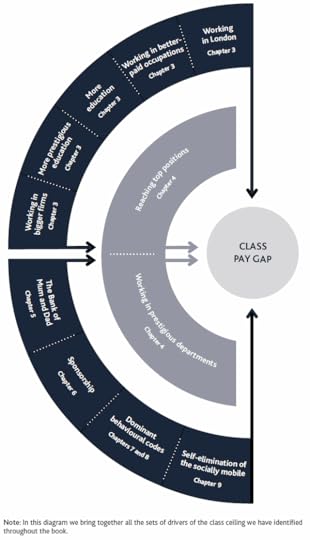
The best of this was where the born-to-rule people in elite jobs pointed out the flaws in the research done by the authors. For example, one asked how they didn’t know that the working class people weren’t, in fact, inherently less intelligent than their upper class peers? This is an inevitable question, since our society views itself as a meritocracy, and so if you win, you deserved to win, and if you lose, it serves you right. The point is that the book is based on extensive data collected by the UK government into the social origin of people and their current occupation. It shows that even when working class people go to the best universities and get the same degrees as upper class people, they still end up with less remuneration. And the pay gap isn’t small. This book seeks to understand why that might be the case. In part it is explained by the fact upper class people speak in a code that isn’t at all easy to copy, or to even understand, if you have not been raised within that environment. One of the case studies involved people who worked at a television studio. The upper class employees were mostly gathered in a single section, those who commissioned programs, and sometimes they would drop references to classical mythology or American literature, that the working class employees basically had no means to understand. When the sociologists were doing their report back on this, one of the managers said that it was a bit rich people from a university complaining that their staff were referencing things they had learned in their own university studies.
Yeah, but… it isn’t at all clear that classic references are particularly necessary when your job is to commission game shows. But if you don’t know who Actaeon was or why he ought to be afraid of his own dogs, well, you are going to feel alienated if the punchline to a joke requires you to know exactly that.
Something that was particularly interesting in this was that there were often fewer hurdles or barriers to working class people moving up the ladder if the job required mostly technical prowess – so, there were more successful working class engineers than accountants, for example. The book discusses an architectural firm where there was no discernible class ceiling. However, the authors make the point that in accounting, where there is a class ceiling, this differentiation only becomes evident when staff move beyond technical prowess and then have to progress on skills beyond their technical abilities. In these cases, the right accent, wearing the right suit, having the right taste in music, and laughing at jokes about Actaeon, provide a tailwind to your career that isn’t always obvious to either yourself or to those around you.
The book also looks at actors and how having the right parents is a distinct advantage in having that as a career too. Acting work is precarious at the best of times, where opportunities can arrive almost at random. Being able to drop everything to take those opportunities is easier if you can rely upon the bank of mum and dad. Also, Received Pronunciation is the ‘standard’ or base accent in the UK, you might never have to put on a Yorkshire accent, but it would be hard to be an actor in the UK and not have to do RP – if RP isn’t your normal accent, then it becomes yet another instance of fitting your foot, one way or another, into the glass slipper.
I really enjoyed this book – it explains in very simple language complex ideas around the sociology of class, and it does so in ways that make the hurdles working class background people face apparent. It also does so in a way that shows the stickiness of one’s background, how it remains with you, even if you do get to move up the corporate ladder. So that unlike the upper class person with the wind at their back, it can feel as if you are always walking into the wind.