

What do you think?

Moon: An Illustrated History: From Ancient Myths to the Colonies of Tomorrow
From the moon’s formation, to its potential for future exploration, this richly illustrated volume presents 100 milestones in lunar history.
With dazzling images on every spread, and illuminating text by astrobiologist Dr. David Warmflash, An Illustrated History chronologically presents 100 milestones in the Moon’s development and exploration. Starting 4.5 billion years ago when the Moon formed, this stunning volume moves from the hypotheses of the Moon’s formation (4.5 billion years ago) to sixth-century BCE predictions of solar eclipses, from the twentieth-century Space Race between the US and the Soviet Union to private space companies and possible future lunar colonies. Find out about lunar calendar systems and cults in the Bible; how lunar brightness was used to estimate stellar distances; how advancing telescopes in the seventeenth century allowed us to eye the Moon more closely; how author Jules Verne inspired the Father of Astronautics; the originals of the Saturn V Moon Rocket; the Apollo missions, and so much more.
With dazzling images on every spread, and illuminating text by astrobiologist Dr. David Warmflash, An Illustrated History chronologically presents 100 milestones in the Moon’s development and exploration. Starting 4.5 billion years ago when the Moon formed, this stunning volume moves from the hypotheses of the Moon’s formation (4.5 billion years ago) to sixth-century BCE predictions of solar eclipses, from the twentieth-century Space Race between the US and the Soviet Union to private space companies and possible future lunar colonies. Find out about lunar calendar systems and cults in the Bible; how lunar brightness was used to estimate stellar distances; how advancing telescopes in the seventeenth century allowed us to eye the Moon more closely; how author Jules Verne inspired the Father of Astronautics; the originals of the Saturn V Moon Rocket; the Apollo missions, and so much more.
224 pages, Hardcover
Published May 7, 2019
Ratings & Reviews
Friends & Following
Create a free account to discover what your friends think of this book!
Community Reviews
Displaying 1 - 13 of 13 reviews

Read
July 27, 2019Moon: an Illustrated History chronologically covers all things lunar from the formation of the moon 4.5 billion years ago to the 20th Century Space Race to the anticipated colonies of 2044.
Astrobiologist Dr. Warmflash brings ancient myths, history and theories about the moon over the centuries in bite-sized (one-page) chapters. Relevant illustrations or photographs are featured on every other page.
A fun and interesting read! - Kathy G.
Astrobiologist Dr. Warmflash brings ancient myths, history and theories about the moon over the centuries in bite-sized (one-page) chapters. Relevant illustrations or photographs are featured on every other page.
A fun and interesting read! - Kathy G.

September 20, 2023
True knowledge exists in knowing that you know nothing.
Socrates
Looking at the History of Earth's Companion
In the book Moon: An Illustrated History by David Warmflash, there's a delightful story that covers over billion years of the Moon's history. It starts by explaining how the Moon was formed in a big, dramatic event and goes all the way to when people first landed on it. The book uses interesting storytelling and lots of pictures to help readers easily learn about how the Moon was made and how it has influenced Earth and its people.
The book starts by talking about a big idea: how the Moon could have been made about 4.5 billion years ago when something huge hit the Earth. Then it tells us how scientists have tried to figure out where the Moon came from, with distinctive thoughts coming and going over many years.
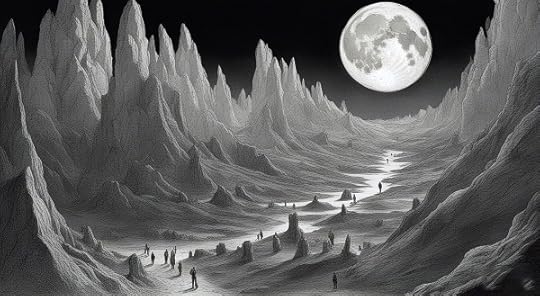
After that, the book talks about important matters that happened within the Moon's history. Like when large area rocks hit it and made craters, and when volcanoes made dark patches on its surface.
Then, the book changes the topic and talks about how people in the past thought about the Moon. They believed in lunar gods, made calendars primarily based on the Moon, and tried to understand such things like eclipses. Some certainly smart folks even said the Moon was round and reflected sunlight, which was a big deal in understanding how our solar system works.
The book does a job of telling the story as people moved from believing in myths about the Moon to understanding it via science. When people started using telescopes to look at the Moon, it was really exciting because they could see things like craters and mountains. This made them surprise if there might be creatures living on the Moon. The book also talks about important people like Galileo, Newton, and Kepler and how their work helped us learn more about the Moon.
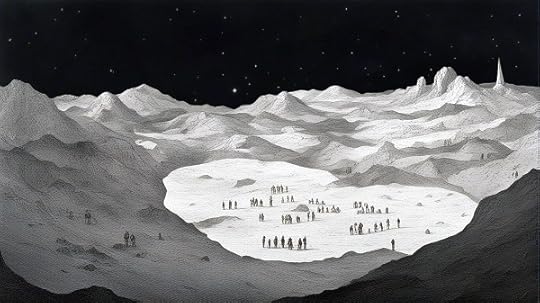
A big part of the book is about the Space Race, which was a time when countries were trying to be the first to reach the Moon. Warmflash makes this story interesting by telling us about the people involved. He tells us about the ups and downs of the Apollo program, from things going very wrong at the start to the amazing moment when humans first walked on the Moon. The book also celebrates all the important science that came from the Apollo missions.
In about 400 pages, Warmflash covers a lot of things. The book is a brief look back at how much people have been interested in the Moon.
Socrates
Looking at the History of Earth's Companion
In the book Moon: An Illustrated History by David Warmflash, there's a delightful story that covers over billion years of the Moon's history. It starts by explaining how the Moon was formed in a big, dramatic event and goes all the way to when people first landed on it. The book uses interesting storytelling and lots of pictures to help readers easily learn about how the Moon was made and how it has influenced Earth and its people.
The book starts by talking about a big idea: how the Moon could have been made about 4.5 billion years ago when something huge hit the Earth. Then it tells us how scientists have tried to figure out where the Moon came from, with distinctive thoughts coming and going over many years.
After that, the book talks about important matters that happened within the Moon's history. Like when large area rocks hit it and made craters, and when volcanoes made dark patches on its surface.
Then, the book changes the topic and talks about how people in the past thought about the Moon. They believed in lunar gods, made calendars primarily based on the Moon, and tried to understand such things like eclipses. Some certainly smart folks even said the Moon was round and reflected sunlight, which was a big deal in understanding how our solar system works.
The book does a job of telling the story as people moved from believing in myths about the Moon to understanding it via science. When people started using telescopes to look at the Moon, it was really exciting because they could see things like craters and mountains. This made them surprise if there might be creatures living on the Moon. The book also talks about important people like Galileo, Newton, and Kepler and how their work helped us learn more about the Moon.
A big part of the book is about the Space Race, which was a time when countries were trying to be the first to reach the Moon. Warmflash makes this story interesting by telling us about the people involved. He tells us about the ups and downs of the Apollo program, from things going very wrong at the start to the amazing moment when humans first walked on the Moon. The book also celebrates all the important science that came from the Apollo missions.
In about 400 pages, Warmflash covers a lot of things. The book is a brief look back at how much people have been interested in the Moon.

January 26, 2025
Interesting read. Appreciated the amount of information, the illustrations and photos. Could've been either a little longer generally, or could've been better with less (but considerably longer) chapters.
Either way, I enjoyed reading this! Learned a lot of new stuff, especially about early astronomy which I found super intriguing.
Either way, I enjoyed reading this! Learned a lot of new stuff, especially about early astronomy which I found super intriguing.

June 29, 2019
Great book for paging through or reading front to back. Lots of context re history and science. I wish this book had been around sooner!

September 3, 2019
In the pages of this illustrated all-about-the-moon book, readers will find narratives on the observation, development, and exploration of the moon. Beginning with the formation of the moon some four and one half billion years ago and moving through millennia of speculation, discovery, and the cold war space race to the futuristic building of a lunar infrastructure, readers will find each illustrated one-page narrative supported with a chart, diagram, illustration, or photograph. An extensive reference listing is included. Readers, especially those with an interest in lunar history, exploration, and the possibilities of future lunar bases will find much to appreciate in this richly-detailed book.
Highly recommended.
Highly recommended.

January 18, 2021
This is a deceptively dense book - very clearly written by an astrobiologist. I found parts of it quite over my head (though the book is also very clearly written for the layman), which made getting through it difficult at times. I suspect I was looking for a more romantic approach to the moon - a collection of folklore (what, with the "Ancient myths" part of the subtitle) from around the world before it delved into a more scientific approach, but there's maybe a page or two devoted to any mythological interpretation of the moon. It's a hard, western-based, science approach to the moon, and I think this would be a great book for any aspiring astronomer, but definitely a hard pass for me.
November 14, 2023
A wonderfully researched and arranged book about our beloved Moon. It compiles mythology from around the globe, the fantastical stories it has inspired, and the scientific revelations that have been made with its aid and eventually the Space Race. The text is easy to understand. Every page is a timespan and is accompanied by photographs, illustrations, or scientific sketches depending on the topic covered for that page spread. It would make a splendid gift for a selenophile or anyone who has ever been dazzled by our celestial body.
November 18, 2019
Three-and-a-half. Picked this up at the library and found it to be interesting and informative with beautiful photos of the moon throughout. There were some sections that were way more interesting than others, but the book only dedicated one page to each event.

January 7, 2024
This was a beautiful photographic book about the moon. The picture quality was exceptional. I also liked learning more in depth about the phases of the moon and its importance as a satelite to Earth and its importance in the solar system.
An easy read. Glad my library had this! Recommended
An easy read. Glad my library had this! Recommended

June 17, 2019
Great overview with major, interesting points mentioned about the Apollo missions and fascinating predictions for the near future.

September 5, 2019
A good look at be many ways and arenas in which humanity has studied, contemplated, observed and visited our Moon neighbor over the centuries.

May 9, 2023
far more of a scientific history than I wanted. I stopped having fun after Pythagoras but I enjoyed the first part
August 16, 2026
Super quick read, imagery is super unique and varies from historical photos to abstract art.
Displaying 1 - 13 of 13 reviews