Jump to ratings and reviews
Rate this book

La storia di Kullervo

Rate this book
Kullervo è forse il personaggio più oscuro e tragico creato da Tolkien. Sfortunato orfano con poteri sovrumani, cresciuto nella casa dell'oscuro mago Untamo, che ha ucciso suo padre, rapito sua madre e che per tre volte ha cercato di uccidere lui quando era ancora un bambino, non ha nulla al mondo se non l'amore della sorella gemella Wanona e la protezione del magico cane Musti. Quando viene venduto come schiavo, il ragazzo giura di vendicarsi, ma scoprirà che nemmeno così si può sfuggire al proprio destino. Per Tolkien questo libro non era solo un tentativo di scrivere leggende originali: Kullervo è anche l'antenato di Túrin Turambar, l'eroe tragico e incestuoso del Silmarillion.

268 pages, Paperback

First published August 27, 2015

364 people are currently reading
7144 people want to read

About the author

J.R.R. Tolkien

780 books77.2k followers
John Ronald Reuel Tolkien: writer, artist, scholar, linguist. Known to millions around the world as the author of The Lord of the Rings, Tolkien spent most of his life teaching at the University of Oxford where he was a distinguished academic in the fields of Old and Middle English and Old Norse. His creativity, confined to his spare time, found its outlet in fantasy works, stories for children, poetry, illustration and invented languages and alphabets.

Tolkien’s most popular works, The Hobbit and The Lord of the Rings are set in Middle-earth, an imagined world with strangely familiar settings inhabited by ancient and extraordinary peoples. Through this secondary world Tolkien writes perceptively of universal human concerns – love and loss, courage and betrayal, humility and pride – giving his books a wide and enduring appeal.

Tolkien was an accomplished amateur artist who painted for pleasure and relaxation. He excelled at landscapes and often drew inspiration from his own stories. He illustrated many scenes from The Silmarillion, The Hobbit and The Lord of the Rings, sometimes drawing or painting as he was writing in order to visualize the imagined scene more clearly.

Tolkien was a professor at the Universities of Leeds and Oxford for almost forty years, teaching Old and Middle English, as well as Old Norse and Gothic. His illuminating lectures on works such as the Old English epic poem, Beowulf, illustrate his deep knowledge of ancient languages and at the same time provide new insights into peoples and legends from a remote past.

Tolkien was born in Bloemfontein, South Africa, in 1892 to English parents. He came to England aged three and was brought up in and around Birmingham. He graduated from the University of Oxford in 1915 and saw active service in France during the First World War before being invalided home. After the war he pursued an academic career teaching Old and Middle English. Alongside his professional work, he invented his own languages and began to create what he called a mythology for England; it was this ‘legendarium’ that he would work on throughout his life. But his literary work did not start and end with Middle-earth, he also wrote poetry, children’s stories and fairy tales for adults. He died in 1973 and is buried in Oxford where he spent most of his adult life.

Ratings & Reviews

What do you think?
Rate this book

Friends & Following

Create a free account to discover what your friends think of this book!

Community Reviews

5 stars
702 (16%)
4 stars
1,260 (28%)
3 stars
1,731 (39%)
2 stars
548 (12%)
1 star
125 (2%)
Displaying 1 - 30 of 633 reviews
Profile Image for Alejandro.
1,303 reviews3,778 followers
June 22, 2016
A relevant reading.


BEFORE THE HOLE IN THE GROUND

This book is publication of the first prose work written by JRR Tolkien, before of this, his usual written format was of poems. Even you can find some of that here, but it’s clear that prose is the predominant style. It’s not a finished work, so at the “end”, you will find notes made by Tolkien where he was planning how to end the story.

This story isn’t based on his “Middle-Earth” universe. In fact, it’s a re-telling of the character of “Kullervo”, part of the Finnish folkore mythology found on The Kalevala epic poetic works.

Tolkien’s wish was to create a mythology for his native England, therefore, he was reading mythology works from other countries like Greece, Rome and Nordic lands, but it seems that the story about the character of Kullervo from the Finnish mythology provoked a huge impact in Tolkien and before of beginning to conceive his own mythology, it was natural to “play” writing a re-telling of mythology events from other cultures.

There is a consensus for the experts in Tolkien’s works that this unfinished first attempt of prose writing by Tolkien was pivotal for his later creation of the character of “Túrin Turambar”, protagonist of the book The Children of Húrin set in the Middle-Earth universe.


THE IMPACT IS STRONG HERE

It’s obvious that in the middle of the several influences for George Lucas for his Star Wars, you can find elements from The Hobbit and The Lord of the Rings, but knowing certain aspects of how Tolkien made the re-telling of Kullervo’s story, you will be able to find relevant elements here that most likely George Lucas read at some point and used in own way for his saga in a galaxy, far, far away.


WHAT'S YOUR NAME AGAIN?!!

If you are Spanish-speaking person, it’s very likely that you may find kinda funny his name… Kullervo, since for me it sounds like “Butt-ervo”, that again, as I mentioned in the Brandon Sanderson’s saga of “Reckoners” about the city of Newcago (a city based on the “old” Chicago), again it’s clear that some linguistic scholar should be consulted when a “new word”, a “new name” is created to check if in some language it sounds funnier that it’s intended.


IT’S BAD TO BE KULLERVO

Kullervo is a very dark character, his life wasn’t anything nice at all, and even it’s like fate was punishing him for things beyond of his own actions. He won’t catch a single break in his story.

Even that until now, The Story of Kullervo was published as a stand-alone work (before was part of Tolkien’s letters), it’s clear that he was pioneering in the kind of character that nowadays are hugely popular: Characters of ambiguous morality, the “hero” of the story but willing to do very bad things to others without any remorse.

I can understand why the powerful tragedy found in The Story of Kullervo can be an appealing inspiration for other writers for their own works. However, the story per se is hard to find it appealing itself, at least for me. Since a tale about a character who always is suffering, everything that happens is tragic, and even when you think that finally there will be some due payback, the suffering instead reaches insanely nasty levels, well, I can’t understand the reason of why writing books with such too sickening series of events without any rest for the protagonist (and the reader (in my case)).

Is it a strong solid bold story? Oh, yes, without any doubt. Even an unfinished single prose work by Tolkien is better than many totally finished book series by others.

It’s just that for me, even an anti-hero (including a villain if it’s presented to be the protagonist of a story) deserves a break, some moments of triumph (true ones).

In my very personal point of view, I can’t see the point of writing stories where everything what happens to the protagonist is bad.

Additionally, the book contains stuff from The Kalevala, that not only helps to illustrate better The Story of Kullervo but brings a good image about general Finnish mythology.


Profile Image for Sean Barrs .
1,121 reviews47.9k followers
March 9, 2016
This was such a tragic thing to read, and not just because of the harrowing nature of the tale; it was also tragic because Tolkien never finished it. It is truly lamentable that he didn’t, as this would have been masterful in its final polished form; it would have been simply brilliant and a true pleasure to read. But, alas, he did not. Woe to Tolkien fans everywhere.

A true Tragedy

I’m deeply saddened by this, but I am glad that, at the very least, we have some of it. The story is complete, but not completely written. The ending is laid down in a series of notes and statements. The truly tragic nature of the tale can be seen, and appreciated somewhat, even if it is a very basic form of representation. The redeeming feature of this edition resides in the fact that it can clearly be seen as an inspiration for Tolkien’s later works; he used this as a platform to propel himself into his own original writings. For that reason alone, is this edition worth reading because it provides insight into his journey as a writer; it shows how this story led him down the road to Middle-Earth.

The introduction eluded me to the fact that this is a tragedy in the true nature of the word; it harbours the features of what Aristotle considered to be tragic. This is hard to actually spot when reading the story itself because of its incompleteness. Therefore, I strongly recommend reading the introduction before actually reading the story. I normally skip introductions myself but, in this case, I most ardently suggest reading it. It added to my understanding of the story, and without it I honestly think I would have enjoyed it less. So, I think it is a bit of a necessity with this work.

Not easily recommended

The quality of the editorial procedure of this book is very high but, overall, I think this is very expensive for what you get. There are only around forty pages of Tolkien’s actual writing in here. The commentaries are helpful, but not completely exhaustive. I think they mainly served to be page fillers, as did Tolkien’s lectures. The two lectures were very similar and almost identical in parts. I think if anything only one should have been included in here. Personally, I think all of Tolkien’s incomplete verse and prose should be published in one volume because editions like this simple are not worth the asking price.

This is not something I recommend to a casual Tolkien reader. The full force of the tale, and its impact on Tolkien as a writer, will only be felt by those that have read The Silmarillion; and, by a lesser extent, The Children of Hurin. This is because without having a prior knowledge of these previous works, it would be hard to comprehend how he drew on this tale to develop his own fantasy world, which is much more beyond the surface value of The Hobbit and The Lord of the Rings Indeed, the tale in itself is not what one would constitute as light reading. It is the sort of thing that needs to be read a multitude of times before it can be fully grasped. This is not because it is complex, but because it feels fragmented and lacks the flow of a final draft. I think with this, the reader has to use their imagination, and see beyond the simple words on the page; they need to try and imagine what this could have looked like had it been finished. The editor, of course, did her best, but short of actually tampering with Tolkien’s writing, majorly, there was nothing else she could do.

Overall, I’m glad I got the chance to read this, the work that inspired Tolkien so greatly. But, I only recommend it to those that have read a lot of Tolkien’s work, and I do think it is very expensive overall. The publishers know that because this is Tolkien, his fans will buy it no matter the cost.

A tragic three stars
Profile Image for Markus.
489 reviews1,960 followers
January 3, 2020
So the not so surprising conclusion to reading this little book remains that Tolkien does little wrong.

From what I've heard in recent years, this is according to many readers a young and aspiring fantasist not really living up to his later self. As soon as I got into it, however, it started looking like just another masterpiece from the master of the modern mythic. Wonderfully edited, too.

Admittedly, it is not as refined nor as polished as his later stories, but would you expect that from what is practically a collection of discarded never-completed notes? For what it is, a fictional and non-fictional glimpse into Tolkien's journey from reading folktales to writing the great epic of our time, it is excellent.

A delightful Yule read in the mountains while the snow fell, the wind howled and the fireplace crackled.
Profile Image for Nicky.
4,138 reviews1,112 followers
March 21, 2016
The Story of Kullervo is definitely a disappointing book, even for someone as interested in Tolkien’s legendarium and influences as I am. The actual content written by Tolkien is fairly slight and incomplete; the same talk is included twice with only minor changes, and the story isn’t that long. If his tale of the children of Hurin is something that really interests you, his interpretation of the Kalavala might be worth a look, but it feels honestly lacklustre. I’ve often felt that the Tolkien estate has been releasing stuff that J.R.R. himself would never have let into the light of day, and I felt that especially here — he loved the material, and he would’ve wanted to do better by it. The Silmarillion is one thing; his commentary on Beowulf was significant enough to be worth publishing, considering how important his ‘The Monsters and the Critics’ essay was. But this?

Still, there are glimmers of interest here; the way Tolkien tried to flesh out the story and fix some of the inconsistencies, like Kullervo’s family. I don’t know enough about the source material to really understand what he was doing with the names, but there are often glimpses of the kind of names and places that appeared in The Silmarillion et al. Musti is a forerunner of Huan, perhaps; Kullervo is a rather graceless model for Túrin…

But overall, I feel like I rather wasted my time here, which is saddening. J.R.R. Tolkien did amazing work, and I think his legacy is being rather diluted by the popular reissue of things like this — it should, of course, be accessible to scholars, biographers, etc. But please stop selling this stuff as a complete work ready for public scrutiny!

Originally posted here.
Profile Image for Coco.
193 reviews33 followers
January 7, 2023
3✨

El relato en sí de "La historia de Kullervo" escrito por Tolkien son en total 40 páginas. No es invención suya este relato, sino que se trata de una historia reescrita por Tolkien a partir de la mitología nórdica. No por ello tiene menos peso, pues recordemos cómo antaño tenía más valía el autor capaz de contar una historia (ya escrita) de la forma más original y no la invención propia.

La historia no es de mis favoritas: es bastante triste y no dan muchas ganas de aproximarse al protagonista, Kullervo. Sin embargo, este relato es estudiado en importancia y contexto del autor y su próximo legendarium (esta fue el primer escrito en sí escrito por su pluma).

Sin embargo, son 180 páginas que, a mi gusto, se repiten en sobre mesía y que se podrían acortar y sintetizar de mejor forma. Dan muchos datos curiosos y la relacionan con personajes de Tolkien posteriores, así como analizan su propia escritura a partir de fotos de esas notas puestas en el ejemplar. Sin embargo, como he dicho, repiten información en multitud de veces.

Así mismo, encontramos un discurso que dio el autor en una conferencia "Sobre el Kalevala" (no es de mis discursos favoritos de él pero tiene su interés). Y, después, se pone el discurso reescrito para años posteriores. Desde mi punto de vista, se podría haber editado este discurso resaltando las partes nuevas que añadió Tolkien en vez de plasmarlo tal cual, pues no dejan de ser las mismas palabras (repetición) con algunas variaciones.

🍁 Y eso es todo por hoy :). ¿Lo conocías? ¿Has leído algo del autor?
Profile Image for Jason Koivu.
Author 7 books1,406 followers
September 23, 2017
A take on a Finnish myth by J.R.R. Tolkien similar to his Silmarillion, only much shorter, narrower in vision, and a good deal more unfinished.

Since my father's side comes from Finland, my ears perk up whenever Finnish things get mentioned. It happens that infrequently. Sort of like how when I grew up in the country and only a handful of cars would drive by our house everyday, so I'd prairie dog it every dang time. Anywho, back to the review...

This edition, edited by Verlyn Flieger, goes the extra length to recoup and curate the essence of Tolkien's attempt at The Story of Kullervo. There is a helpful introduction that sets up the story nicely for the uninitiated. There are reprints of Tolkien's handwritten notes. Following the actually story, which is about 40 pages long, are nearly a hundred pages worth of plot synopses notes and essays regarding Finnish myth. There is more written about the story than the story itself. That's due diligence.

The story is fairly brutal in the good, ol' fashioned sense of the word. Like many old fairy tales, people die often and often in horrible ways. However, in keeping with tradition, Tolkien alludes to the horror rather than give you every bit of the gory details. Sometimes the alluded to scene is so fleeting you have to stop, go back, and reread. On two or three occasions I had a "wait, what?" moment.

The story is not "one for the ages", but it does have that classic and epic mythological feel to it. For story enjoyment, this gets 3 stars from me. But from a production value standpoint, I've bumped the book up a star.
Profile Image for Sud666.
2,330 reviews198 followers
January 10, 2023
The Story of Kullervo was written by J.R.R. Tolkein when he was a student at Oxford. It could be considered his "first work". It is a collection of stories based on his attempts to turn the Finnish epic poem Kalevala, into prose.

It is a strange story and Kullervo is not a pleasant character. Raised as a slave by the murderers of his father, Kullervo's tale is one of mistreatment and violence. Is this a tale that a non-Tolkein reader will like? No. It is far too complicated. However, those with a very good background in the Tolkein works will appreciate the formative story of the latter Lord of the Rings works.
Profile Image for leynes.
1,316 reviews3,685 followers
May 6, 2023
My Tolkien collection keeps growing ... and I'm not complaining. Usually, I tend to stick to Tolkien's work set in Middle Earth but when I found this cute little paperback for 2.50€ I simply had to snatch it up. And I'm glad that I did!

The Story of Kullervo is a book edited by Verlyn Flieger and published by HarperCollins in August 2015. It contains Tolkien's formerly unpublished draft version of "The Story of Kullervo", Tolkien's lecture on the Kalevala (for some weird reason, the lecture is included twice with only minor differences in the text) and Flieger's comments and analysis of the significance of the story in the context of Tolkien's larger canon.

"The Story of Kullervo" was written by Tolkien in 1915 while he was studying at Oxford University. Today, the unfinished manuscript is located in the Bodleian Library at Oxford.
Wherefore have I been created?
Who has made me and has doomed me
Thus 'neath sun and moon to wander
'Neath the open sky forever?
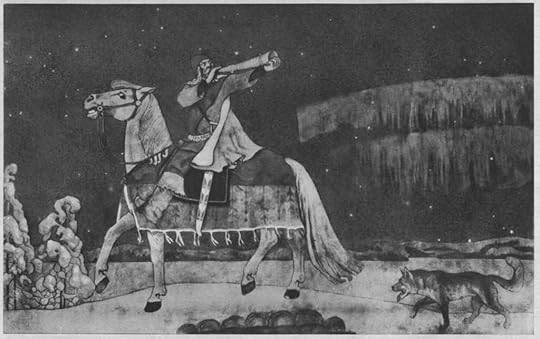
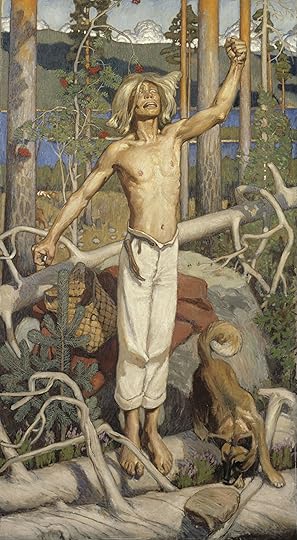
The original story of Kullervo is recounted in songs 31 to 36 of the Finnish (national epos) Kalevala. In it, Kullervo "the luckless one" is the son of Kalervo. Kullervo's family was exterminated, even before his birth, by his uncle Untamo. Only his mother seemed to have escaped. When Kullervo was born, several attempts were made to kill him, but they were unsuccessful because he possessed supernatural powers. So instead he was sold by Untamo as a slave and later swore to take revenge. When Kullervo managed to escape from bondage, he learned that both his parents and his sister were still alive. The sister, however, is considered missing. By chance, the siblings meet without suspecting that they are related. This leads to a love affair between the two. When his sister learns that Kullervo is her brother, she takes her own life in a river. Kullervo subsequently plunges into his own sword.

Tolkien's draft ends with the following words: "The sword says if it had joy in the death of Untamo how much in death of even wickeder Kullervoinen. And it had slaid many an innocent person, even his mother, so it would not boggle over Kullervo. He kills himself and finds the death he sought for."

Readers familiar with Tolkien's work will immediately find parallels between "The Story of Kullervo" and the "Narn i chîn Húrin" (= The Tale of the Children of Húrin), which belongs to the so-called "Lays of Beleriand". Here it is the protagonist Túrin, whose father Húrin was apparently killed in the "Nírnaeth Arnoediad" (= The Battle of the Unnumbered Tears) against the vicious Valar Morgoth. Túrin was forced to leave his pregnant mother, who sent him away from Dor-lómin to protect him from death or enslavement. She sent him to the Elves in Doriath, where he was taken in and raised by King Thingol as if he were his own son. After a quarrel in which Túrin unintentionally killed an Elf, he fled into the woods. In the meantime, his sister had been born and had long since grown into a young woman. So it happened that Túrin met his unknown sister by chance and took her as his wife. She became pregnant by him and finally learned from the dragon Glaurung that Túrin, who had tried to kill the dragon and now lay apparently dead next to it on the ground, was her biological brother. Desperate and dismayed, she threw herself into the waters of the Taiglin, whose gorge the dragon had previously tried to cross. When Túrin awoke from his swoon and learned what had taken place, he threw himself, like Kullervo, into his own sword.

For his own tale, Tolkien chose the following words: "And from the blade rang a cold voice in answer: ‘Yea, I will drink thy blood gladly, that so I may forget the blood of Beleg my master, and the blood of Brandir slain unjustly. I will slay thee swiftly.’ Then Túrin set the hilts upon the ground, and cast himself upon the point of Guthrang, and the black blade took his life." The parallels to the end of "The Story of Kullervo" are uncanny.

Kullervo is the earliest of Tolkien's displaced heroes, orphans and exiles, a succession that will include not only Túrin but also Beren and Frodo. Flieger argues that "The Story of Kullervo" was the fuse that 'set the rocket off in story', as Tolkien wrote to his friend. This very early narrative, incomplete and derivative as it is, ignited Tolkien's imagination and was his earliest prefigurement of some of the most memorable literary figures and moments in his Silmarillion. Flieger argues that without "Kullervo", we might not have the latter, at least not in the form in which we know it. The hapless orphan, the unknown sister, the heirloom knife, the broken family and its psychological results, the forbidden love between lonely young people, the despair and self-destruction on the point of a sword, all transfer into "The Tale of the Children of Húrin", not direct from Kalevala but filtered through The Story of Kullervo.

Flieger concludes: "The Story of Kullervo was Tolkien's earliest attempt at retelling – and in process reorganising – an already-existing tale. As such, it occupies an important place in his canon. Furthermore, it is a significant step on the winding road from imitation to invention, a trial piece by the orphan boy, university undergraduate, returning soldier who loved Kalevala, resonated with Kullervo, and felt the lack of 'something of the same sort that belonged to the English'."
Profile Image for Ajeje Brazov.
950 reviews
November 28, 2018
Questo libro è il risultato della passione, di Tolkien, per un'opera, il Kalevala, poema nazionale finnico, dove Tolkien reinterpreta senza stravolgerla, la storia di Kullervo, uno dei personaggi più oscuri e tragici del poema.

Nel 1911, circa, Tolkien giovane studente nemmeno ventenne, si imbatte proprio nel Kalevala, ne rimane profondamente colpito, soprattutto dal personaggio: Kullervo. Negli anni a seguire, forse dal 1912 al 1916, periodo che lo vedrà anche sotto le armi, si dedica alla scrittura di questo racconto. Purtroppo rimasto incompiuto, però la commistione di pagine in prosa con quelle in versi, rende il tutto così suggestivo ed affascinante.

In appendice al racconto, ci sono tre saggi: i primi due sono le versioni scritte da Tolkien sul Kalevala, per me ridondanti, il curatore doveva sceglierne una sola, ma quale? Ed infine una postfazione del curatore, che però non mi ha entusiasmato, soprattutto perchè ripete le stesse cose scritte nella prefazione, che è corta, concisa e soddisfacente... ma questi son dettagli!

https://www.youtube.com/watch?v=wPtfh...
Profile Image for Bettie.
9,978 reviews5 followers
September 8, 2015
Description: Kullervo son of Kalervo is perhaps the darkest and most tragic of all J.R.R. Tolkien’s characters. ‘Hapless Kullervo’, as Tolkien called him, is a luckless orphan boy with supernatural powers and a tragic destiny.

Brought up in the homestead of the dark magician Untamo, who killed his father, kidnapped his mother, and who tries three times to kill him when still a boy, Kullervo is alone save for the love of his twin sister, Wanona, and guarded by the magical powers of the black dog, Musti. When Kullervo is sold into slavery he swears revenge on the magician, but he will learn that even at the point of vengeance there is no escape from the cruellest of fates.

Tolkien himself said that The Story of Kullervo was ‘the germ of my attempt to write legends of my own’, and was ‘a major matter in the legends of the First Age’. Tolkien’s Kullervo is the clear ancestor of Túrin Turambar, tragic incestuous hero of The Silmarillion. In addition to it being a powerful story in its own right, The Story of Kullervo – published here for the first time with the author’s drafts, notes and lecture-essays on its source-work, The Kalevala – is a foundation stone in the structure of Tolkien’s invented world.


Opening: In the days {of magic long ago} {when magic was yet new}, a swan nurtured her brood of cygnets by the banks of a smooth river in the reedy marshland of Sutse. One day as she was sailing among the sedge-fenced pools with her trail of younglings following, an eagle swooped from heaven and flying high bore off one of her children to Telea: on the second day a mighty hawk robbed her of yet another and bore it to Kemenūme. Now that nursling that was brought to Kemenūme waxed and became a trader and cometh not into this sad tale: but that one whom the hawk brought to Telea he it is whom men name Kalervō: while a third of the nurslings that remained behind men speak oft of him and name him Untamō the Evil, and a fell sorcerer and man of power did he become.

Kullervo marches to war, fresco by Akseli Gallen-Kallela, 1901 – Kullervo goes to war against Untamo and his people.

A snippet from the Finnish Kalevala is the basis for Tolkien's short tragic story.
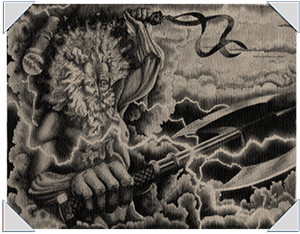


Ukko possessed a weapon, often a hammer called Ukonvasara, sometimes also an axe or a sword, by which he struck lightning
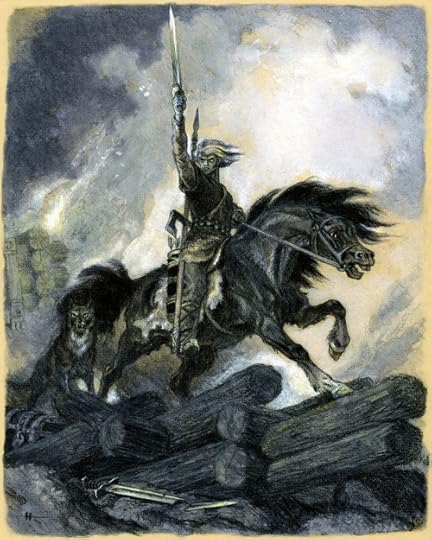
Kullervo finally snaps, drawing his sword and asking it to take his life.
Profile Image for Hazal Çamur.
185 reviews231 followers
Read
January 7, 2018
Eser benim için bir kurgudan öte hitabet, kurmaca unsurları ve ustalık seviyesinde kurgular yaratmak için ustaların neler yaptığını görmek açısından bir kaynak kitabı oldu. Kullervo'nun Hikayesi her ne kadar Turin Turambar öyküsünün atası olsa da, içerdiği makaleler, konuşmalar, araştırmalar ve araştırma biçimlerine olan nokta atışlarıyla işaret ettiği şeyin sadece küçük bir kısmı Turin.

Çok değerli bilgiler içeren, çok değerli saptamalara yer verilmiş ve bugün tanrısallaşmış isimlerin bu seviyeye gelmek için neler ödediğine, ne gibi terler döktüğüne dikkat çeken bir eser. Sadece kurmacası için okunursa beğenilmeyebileceğini düşünüyorum.
Profile Image for Sud666.
2,330 reviews198 followers
July 3, 2017
The Story of Kullervo was Tolkein's take on the Finnish saga the Kalevala.

Kullervo was the precursor to Tolkein's later "dark" characters like Hurin or even Frodo. Kullervo's father is klled, his mother raped and he is the product. Brought up to hate Untamo, his father, Kullervo is alone except for the love of his sister Wanona. He is guarded by the magical powers of a dog named Musti. This is the tale of revenge and destiny.

It is a good tale but is not for everyone. It is not an easy read like his later works (if you found LOTR to be a "difficult" read avoid Kullervo). It is also based off an ancient Finnish myth so much of the story is left to the imagination. Sagas are not meant to be novels. This book also contains a few nice articles about the Kalevala and Tolkein's research and creative goals with the tragic figure of Kullervo.

So I did enjoy this tale, but it is not the most "fun" of stories. It is dark and grim. Most Northern sagas are. I appreciated it for an older Tolkein work. But not likely to pick this one up again.
Profile Image for Marcos GM.
431 reviews284 followers
April 5, 2023
[Esp/Eng]

Fue él quien lo llamó la Tierra de Héroes, o Kalevala, por Kaleva, el antepasado mitológico de todos los héroes.

Una lectura iniciada el día 25 de marzo, el Día internacional de leer a Tolkien, que celebra la (spoiler gordo de El señor de los anillos) destrucción del Anillo Único, y que desde hace años se usa como fecha para celebrar la obra del Profesor. Sabía que era otra de sus obras incompletas, como ya me pasó con La caída de Arturo, y que es el origen de la historia de Los hijos de Húrin. Lo que encontramos es un manuscrito de 13 páginas desarrollando la idea que Tolkien quería escribir, junto con una serie de notas sobre el final (que no escribió en esas 13 páginas), además de una ponencia que realizó sobre la obra y sobre los textos originales.

Hay que decir que según algunos estudiosos esta sería su ópera prima aunque no la publicase en vida. Aunque por consenso general se acepta que es de lo primero que escribió en ficción. Aquí se pueden ver algunas cosas que luego iría puliendo y convirtiendo en marca de la casa. Pero como está basado en unos textos finlandeses, la historia es bastante más truculenta de lo que suele ser la obra de Tolkien. Para muestra 2 textos de cómo actua el héroe:

Cuando ya estaban cerca del patio de la granja, ordenó a los animales que cuando la esposa del herrero viniera para mirar a su alrededor y se agachara para ordeñar, debían agarrarla y machacarla entre sus dientes.

Mientras seguía su viaje, cavilando, una señora mayor, la mismísima Dama del Bosque con su capa azul, salió a su encuentro preguntándole: «¿Adónde vas, oh, Kullervo hijo de Kalervo, con tanta prisa?».
Entonces Kullervo le habló de su deseo de salir del bosque y caminar hasta la tierra de Untamo para vengar con fuego la muerte de su padre y las lágrimas de su madre.


Este héroe no sigue la tradición latina de virtuosismo o nobleza, sino que es huraño, agresivo y no tiene remordimientos hasta el final. Las situaciones que se narran son ciertamente crudas, aunque no son tampoco excesivas. A Kullervo le matan el padre, le separan de su hermana querida y de su madre, le venden como esclavo sin remuneración (algo que se repite varias veces y que me hizo gracia por lo redundante) y una vez allí le tratan muy mal. Cuando se libra de esa situación, de la manera que se lee arriba, decide volver a casa y vengarse. El final sí es relativamente truculento:

Aunque lo que aquí se narra es en buena medida la base de Túrin Turambar, lo que desarrollará después Tolkien está mucho más conseguido, y si en esa obra sientes pesar por el final de todos los personajes, aquí al ser tan breve y tener este carácter dan todos un poco igual. Si hubiese sido desarrollado a texto completo igual lo habría podido arreglar un poco, pero me da la sensación de que tampoco habría cambiado tanto.

La ponencia que viene incluida es muy buena, una pena que de eso no haya registro visual porque seguro que en persona fue muy interesante de ver.


--------------------------------

He called it the Land of Heroes, Kalevala from Kaleva the mythological ancestor of all the heroes.

A reading started on March 25, International Reading Tolkien Day, which celebrates the (big spoiler for The Lord of the Rings) destruction of the One Ring, and which for years has been used as a date to celebrate the work of the Professor. I knew that it was another of his incomplete works, as it happened with The Fall of Arthur , and that it is the origin of the story of The Children of Húrin . What we find here is a 13-page manuscript developing the idea that Tolkien wanted to write, along with a series of notes about the ending (which he did not write in those 13 pages), as well as a presentation he made on the work and on the original texts.

It must be said that according to some scholars this would be his first work even if he did not publish it while he was alive. Although by general consensus it is accepted that it is one of the first things he wrote in fiction. Here you can see some things that he would later polish and turn into a house brand. But since it's based on some Finnish texts, the story is a lot more gruesome than Tolkien's work tends to be. To show this, here are to 2 excerpts of how the hero acts:

Now when he drew nigh the farmyard he laid his commands upon the beasts that when the smith’s wife came to look about her and stooped down to milk them, they should seize her and crunch her in their teeth.

As he fared musing an old dame, even the Blue-robed Lady of the Forest met him asking him ‘Whither O Kullervo son of Kalervo goest thou so hastily?’
Then Kullervo told her of his desire to quit the forest and wander to the homeland of Untamo and with fire avenge his father’s death and his mother’s tears.


This hero does not follow the Latin tradition of virtuosity or nobility, but is sullen, aggressive and unapologetic till the end. The situations that are narrated are certainly crude, although they are not excessive either. Kullervo's father is killed, he is separated from his beloved sister and his mother, sold as a slave without pay (something that is repeated several times and I found it funny because it was redundant) and once there they treat him very badly. When he gets rid of that situation, the way it reads above, he decides to go home and take revenge. The ending is relatively gruesome:

Although what is narrated here is largely the basis of Túrin Turambar, what Tolkien will develop later is much more accomplished, and if in that work you feel regret for the end of all the characters, here being so brief and having this character you don't care much about them. If it had been developed in full text, he might still have been able to fix it a bit, but I get the feeling that it wouldn't have changed that much either.

The presentation that is included is very good, a pity that there is no visual record of that because it was surely very interesting to see in person.
Profile Image for Theo Logos.
1,268 reviews286 followers
April 23, 2022
This short little book has an outsized importance. First, it is one of the distressingly few attempts (in English) to retell the wonderful tales of the Finnish Kalevala in prose form. The Kalevala is an impressive collection of memorable mythology, but its sing song verse form limits its appeal, and prose adaptations of its tales would increase its visibility and popularity in the English speaking world. This is the only one that I have found.

Secondly, for serious fans of J.R.R. Tolkien, this is a vital document for understanding the genesis of his unique writing and mythology. He acknowledged The Kalevala as a major influence on his world, and the story of Kullervo seems to have had a special significance for him. This short story was his first attempt at prose, and was written somewhere between 1912 and 1914, before he started his lifelong project that would eventually be published posthumously as The Silmarillion. As such, this story represents a bridge between The Kalevala and Tolkien's unique world. He would eventually reshape the tragic figure of Kullervo into his own tragic hero , Túrin Turambar, one of the most important figures in The Silmarillion.

In addition to the story, this book includes an academic paper of Professor Tolkien's titled On The Kalevala: or Land of Heroes, an insightful introduction from Verlyn Flieger, the book's editor, notes and commentary, and bibliography. If you love the works of Tolkien or The Kalevala you need to have this book in your collection.
Profile Image for Jen.
3,435 reviews27 followers
May 4, 2016
I really hate giving anything with Tolkien's name on it three stars, but the work he did isn't fully finished and the part that isn't him is kind of boring (the intro) or a bit too in-depth for my taste.

The story was actually very good, even in it's unpolished state. The commentary wasn't horrible, though it didn't really explain fully the brother/sister connection. I wasn't into the essays Tolkien wrote about the story his was based off of and the commentary in the intro was confusing.

This is good for a die-hard Tolkien fan who wants to read everything he wrote or something new by him. If you aren't a huge Tolkien fan, maybe just read the story and skip the intro and essays.

Three stars, sadly. I wanted to like this more. It has inspired me to re-read the Hobbit and LOTR though.

My thanks to NetGalley and Houghton Mifflin Harcourt for an eARC copy of this book to read and review.
Profile Image for Michael.
650 reviews134 followers
December 1, 2021
I guess there's not much I can say in my review that editor Verlyn Flieger doesn't say in her very interesting commentary. To be repetitious, this volume contains Tolkien's 41 page unfinished short story adaptation of an episode from the Finnish poem, The Kalevala; his draft notes and more polished notes for a presentation on the poem to a university society; Flieger's commentary and notes on those presentations; and finally her own essay on Tolkien's story and its significance for his legendarium.

I don't think it's going too far out on a limb to say that this is really going to appeal mainly to Tolkien enthusiasts. But, if you've read beyond The Hobbit and The Lord of the Rings and on into The Silmarillion and The Children of Húrin then you likely will find something here of interest.
Profile Image for Anatoly.
122 reviews66 followers
November 7, 2016
Painful to admit, but I didn't enjoy it at all. It`s an uncompleted work, and it feels like it and more. The writing style was nothing like the Middle Earth books I love and I felt lost so many times, which is even worse when considering the length of this work.
Profile Image for Nikola Pavlovic.
339 reviews48 followers
March 2, 2020
Kalevala > The Story of Kullervo > Túrin Turambar > Silmarillion > The Hobbit > The Lord of the Rings

Knjiga za Tolkinove hard core fanove. Vrlo poucno delo koje ce vam utabati put ka citanju Kalevale, pod uslovom da je vec niste procitali. A sta je Kalevala, koliko je ona bitna i koliko je uticala na samog Tolkina i njegova dela ostaje na vama da otkrijete.
Profile Image for Larnacouer  de SH.
890 reviews198 followers
March 6, 2020
Gözyaşım pıt. 💧

Tolkien ile bir gönül bağınız yoksa kitaptan olabildiğince uzak durun derim zira fikirler, el yazmaları, notlar derken bu epey değerli fakat yalnızca sıkı Tolkien hayranlarına hitap eden bir eser olmuş. Bizim sevip bağrımıza bastığımız şey, herhangi biri için okuması yorucu ve anlamsız gelebilir.

Ben demiş olayım.
Profile Image for Steve.
962 reviews112 followers
June 21, 2016
The story was okay, but this was much more interesting because of the fact that it was written so early in Tolkien's writing career. The writing is very basic, but there are flashes of brilliance here.
Profile Image for Mladen.
Author 26 books94 followers
August 31, 2015
Na knjizi bi trebalo da piše "Tolkinofili napred, ostali stoj!". Šalu na stranu, ovo zaista nije naslov za prosečnog ljubitelja fantastike, jer će činjenica da je u pitanju nedovršena priča (završava se bukvalno u pola rečenice), kao i nesređen tekst (neusklađena imena, delovi koje je Tolkin brisao, itd.) ostaviti istog u krajnje isfrustriranom stanju. Doduše, postoji nekoliko rečenica o tome kako se priča završava, ali to nije to...
Ko očekuje Hobita ili Silmarilion, grdno će se razočarati.
Inače, ovo nije prvo objavljivanje - prethodno je tekst objavljen u Tolkien Studies, ali tržište čini svoje...
Tolkinofili, kako oni koji vole da ga čitaju tako i oni koji vole da naslažu knjige s njegovim imenom na policu, uživaće u još malo njegovog pisanija, koje prati uvod, brojne napomene i objašnjenja, kao i eseji o ovom delu, koje je nastalo pod uticajem finske Kalevale.
U svakom slučaju, tekst je zanimljiv jer je Kulervo značajan kao seme kasnijeg rada. Verovatno najznačajniji uticaj je imao na lik Turina, takođe tragičnog junaka i upošte na Tolkinovu mitologiju i nameru da stvori mitologiju za Englesku koja, kako je smatrao, svoju mitologiju nije sačuvala. Želeo je da Engleskoj podari njenu sopstvenu Kalevalu. Ovim tekstom to svakako nije učinio, ali svime onim što je nakon ovoga usledilo, zaista jeste.
U svakom slučaju, vredno pažnje ako ste vrištavi fan, zaobići u širokom luku ako samo tražite fantastične pričice za uživanje ili ubijanje dosade.
Profile Image for Majo.
334 reviews140 followers
June 21, 2016
Un relato corto y trágico, de los primeros escritos por Tolkien.

Contado a manera de leyenda, relata la historia de Kullervo desde su nacimiento, hasta su muerte, pasando por toda su desdichada vida.
Lamentablemente, el relato no esta acabado. No solo porque no tiene final (la última página no es narrativa, es un boceto del autor sobre como acabar la historia), sino también porque no está pulido. Hay muchas notas sobre cambios de nombres y situaciones.

Estoy segura que, de haber acabado el cuento, sería un clásico maravilloso de Tolkien. Ahora solo es una muestra de como funcionaba el proceso creativo de este magnifico autor.
Profile Image for Marko Vasić.
580 reviews184 followers
February 29, 2024
2024 review (4)

Seven years past the first reading of Tolkien’s version of “The Story of Kullervo”, I couldn’t agree more with all that I’ve noticed in that review. Yet, after all these years of meticulous scrutinisation of Tolkien’s work and collected experience and knowledge regarding his biography and literary inspiration, I would add a few lines about the Tolkien’s version of the legend which originated in mere revolt contra W.F. Kirby’s English translation of Kalevala which Tolkien read cca 1911. Quite interesting is Tolkien’s manner in remodelling of the Finnish deities’ names. Namely, some of these names he took from the genuine epic but switch their onomastics (similar as with the Dwarfish runes in The Hobbit) and some of them he left in their original form and meaning. Tolkien’s version of the legend of Kullervo and the version of the legend from Kalevala dichotomise in a few instances. From this period of time that has passed from the first reading to this re-reading, I can see clearly the utmost importance of this unfinished manuscript regarding the few pivotal characters’ development to emerge in the legendarium which was right around the corner in its nascence:

1. Kullervo’s temper and habitus – in Kalevala he is a boy with golden tresses, inhuman strength and ability to overcome drowning, burning and hanging by his uncle; Tolkien’s Kullervo is “ill-favoured and crooked, broad and illknit and knotty and unrestrained and unsoftened”. The part of his temper will Turin inherit.
2. The name of Kullervo’s sister is unknown in Kalevala; in Tolkien’s version its meaning is the-one-who-weeps (Wanōna) – which is identical to Nienor/Niniel
3. The dog Musti is the spitting image of Huan, Luthien’s companion and three tresses which he will bestow to Kullervo are mere mirror-image of the same in the First Age, when Feanor will ask his niece for that peculiar present as to be incorporated within the Sillmarils.
4. The arms which Kullervo utilises is the similar in both versions, besides Tolkien’s Turambar from the legendarium was bestowed with his sword Gurtang from Thingol and it was previously used by Beleg when its name was Anglachel. The sword/chisel in both versions of the story of Kullervo is personified and can decide the asked doom.
5. Incest is present in both versions, yet Tolkien “vindicated” it in his Turin Turambar saga by the sorcery that dragon Glaurung cast on Niniel.

All in all, this book requires a lot of previous readings (Kalevala, The Silmarillion, Tolkien’s biographies etc.) and certainly is hard morsel for some “transit” Tolkien admirers who merely watched the wretched films or eventually read The Lord of the Rings.


2017 review (3)

Well, this is embarrassing excuse for a publication. Didn’t catch the purpose of it, except publisher's materialistic. Don’t know why Christopher Tolkien gave his permission to the editor of this book (Verlyn Flieger) to publish it, but the book is here. Whole manuscript lasts not even 50 pages. Nevertheless is Tolkien's early-early-early work, while he was still young student-lad, this story was never finished. And is more draft or sketch than story per se. Tolkien was trying to re-tell the story of Kullervo from Finnish epic poem Kalevala, for he was not satisfied with current translation. OK. But, why, by Odin’s sake, somebody would like to read something that was stored into some “forbidden“ desk drawer or even re-cycled from the paper basket? Whole manuscript looks like some student’s draft homework with a lot of commentary of his teacher, explaining the things that ought not to be explained, for those are irrelevant for the story itself. And not to mention “official“ and “non-official“ version of typescript. Struggle was real to get to the last page.

It is known that Tolkien used Kullervo's character as inspiration for Turin Turambar's character, and many similarities are evident between Kullervo's and Turin's life. But, if you really like Silmarillion and Tolkien's work, I recommend you to read Kalevala. Really cute and naive epic poem, but tragic at the end. Just like Turin's saga.
Profile Image for Hannah.
162 reviews50 followers
March 30, 2019
As a huge fan of Tolkien, I found it so interesting to see some of his unfinished work, this book really showed what his writing process was like and I loved reading the analysis from someone who clearly is a fan of Tolkien himself who can describe the meanings of his unpolished work so well.

The story that Tolkien had intended to write, although unfinished, was very important to his later work, it lead to his novel The Children of Hurin (one of his darker novels that I enjoyed immensely) which lead to The Silmarillion, which lead to The Hobbit and Lord of the Rings. You can see in Tolkien's notes exactly what his thought processes were and how they would later develop into his novels that are so cherished today.

This is an interesting read that I would recommend to any hardcore Tolkien fan who wants to immerse their self even more into the world of Middle-Earth and it's creator.
Profile Image for m i l o u ✨ (Grumpy Hobbit).
464 reviews34 followers
October 19, 2015
J.R.R. Tolkien will always be my favorite author

This was another one of those stories that sucked you into that world. Tolkien has a gift. It was indeed a dark story, but I enjoyed it a lot. The only thing I didn't like was that the story was far too short. Way too short!
Profile Image for Linda ~ they got the mustard out! ~.
1,893 reviews139 followers
January 5, 2023
This was a very interesting read, though it probably won't be of much interest to the casual Tolkien reader.

This was Tolkien's first attempt to write a story, at first inspired to "reorganize" the story of Kullervo from the "Kalevala" since the original story jumped all over the place. I'm assuming that's due to the oral tradition in which most mythologies are handed down over the ages. When they're finally written down, there are all sorts of variations and even contradictions.

Kullervo seems to have struck a chord with Tolkien, and we can only guess why now. But he was so obsessed with it and with rewriting it, that he was nearly chucked out of school. And you can see the germs of many things that will later sneak into other stories when he gets around to crafted Middle-earth, most notably Túrin, though they're very different characters. Both tragic, both driven by trauma in their pasts, but Kullervo seems to almost delight in his evil, whereas Túrin keeps stumbling into it despite his best efforts not to.

I do appreciate that Flieger provided Tolkien's story as it was written without footnotes, or inserting/correcting name changes. This way, I wasn't interrupted every other sentence with the decision to look at the notes now or later, and it also made it more clear how Tolkien gradually went from writing was was essentially fanfic to making it into his own story. But I am glad I didn't skip the intro like I usually do, since I wouldn't have known why all these name changes were happening. ... Well, that's not true. I read the HoME. I'm well familiar with Tolkien's name changes. But Christopher took pains to keep the names as consistent as possible in the text, and noting the changes in the footnotes and commentaries. So this was finally an opportunity to see the changes as they happened on page, which was a nice change. But don't worry, there are notes and commentary at the end of each section.

After the story itself comes two lectures that Tolkien wrote and gave on Kullervo and the Kalevala. The second is largely based upon the first and more polished. After those is a final essay the editor, Flieger, that goes over the differences in the Kalevala and Tolkien's version, and possible reasons why the story and character struck such a strong chord with a teenaged Tolkien.
Profile Image for Beth.
227 reviews
May 3, 2020
This is J.R.R. Tolkien's first prose work and his earliest attempt to write tragedy. The story, a retelling of the tale of Kullervo from the Finnish Kalevala, is 40 pages long, primarily prose but with some sections in verse. It pretty much stands alone, so you don’t need to have read The Kalevala to understand it. The rest of the book consists of commentary from Verlyn Flieger and Tolkien’s essay on The Kalevala. (For some reason, an earlier version and a final version of the essay are included; there’s quite a bit of overlap and I’m not sure why Flieger included the earlier version.) The essay is interesting, and I’d like to come back to it when I’ve read The Kalevala.

The dark magician Untamo, Kullervo’s uncle on his father’s side, killed Kullervo’s father and captured his mother. She gave birth Kullervo and his twin sister Wanona. (Wanona's name, which means "weeping," is Tolkien's invention; she has no name in the Kalevala). Making him the dark haired one of the two was also Tolkien's invention, since in the Kalevala they are both described with fair hair.

Untamo later sold Kullervo into slavery in the household of Asemo the Smith. Kullervo escaped from and took  revenge on his new captors and on Untamo, with the help of bears and wolves, his friends. Then he sets out to find Untamo’s halls. Along the way he meets Wanona, but he doesn’t remember her… 

It’s relentlessly dark, and yet it has an emotional distance in the narration that I don’t find in the story of Turin Turambar, especially the longest version in The Children of Húrin. (If anything, The Children of Húrin has more bright spots, but it also has moments that are far more distressing than anything in Kullervo’s story.)

Some bits from Tolkien's essay:
"One repeatedly hears the 'Land of Heroes' [the Kalevala] described as the Finnish National Epic: as if it was of the nature of the universe that every nation, besides a national bank, and government, should before qualifying for membership of the League, show lawful possession also of a National Epic, hallmark of respectability, evidence indeed of national existence. But Finland does not possess one. The Kalevala certainly is not one. It is a mass of conceivably epic material (I can conceive of the epic that would grow from it with difficulty, I must confess); but -- and I think this is the main point -- it would lose all that is its greatest delight, if it were ever one unhappy day to be epically handled. The mere stories, bare events, alone could remain; all that undergrowth, all that rich profusion and luxuriance, which clothe them would have to be stripped away."

"... it is to the quaint tales, the outrageous ghosts, the sorceries and by-tracks of Northern imagination that crop out here and there in the usually intensely clear upper air of the Sagas that the 'Land of Heroes' can most often be likened, not to the haughty dignity and courage, the nobility of mind and of body of which the great Sagas tell.

Yet the queer and the strange, the unrestrained, the grotesque is not only interesting, it is valuable: it is one of the eternal and permanent interests and attractions of men..."
Profile Image for Daniel.
Author 74 books84 followers
November 6, 2019
Povestea tragică a lui Kullervo, fiul lui Kalervo, scrisă de Tolkien ca o reinterpretare a unui basm finlandez, stă la baza unor personaje tragice, precum Túrin Turamba. O povestire scurtă și neterminată, dar deosebită. Volumul conține și un eseu scris de Tolkien despre acestă poveste nordică, precum și un eseu a filologului Verlyn Flieger.

A fost interesant să o citesc și cred că trebuie parcursă de orice iubitor al universului creat de Tolkien pentru că ne oferă o cheie, poate chiar cea mai importantă, spre înțelegerea personajelor și tipologiilor tolkiene.
Profile Image for Brenton.
Author 1 book77 followers
November 15, 2018
I am thrilled to have J.R.R. Tolkien's The Story of Kullervo in print, which includes Tolkien's own reworking of a Kalevala tale, a couple of lectures on the Kalevala, and Verlyn Flieger's critical introduction and a critical essay about the material. Strong editorial work on great Tolkienalia.
I would like to see in the future of publishing more dynamic posthumous publications of "papers" including more folio editions, dynamic footnoting, resource linking, etc. Because that's not available--and because I like the beautifully designed book--I got the paper edition.
I am struck by how the bits of the Kalevala I’ve encountered—what Tolkien calls “a luxuriant animism” (119) have certain kinds of parallels with North American aboriginal folklore I have encountered. Though the myths and folktales closer to home are more logical and didactic (as they are told now), there is not just shared animism and totemic symbolism, but humour, adventure, and a peculiar, evocative sense of space. In the near-century since Tolkien’s lectures, has there been a lot of work done mapping out the religious beliefs embedded in the Kalevala with other sources or a comparative view? Or is there work on the colonial effect on the folklore of this people--one of the last pagan peoples of Europe? I don't know and think there could be space for a book of scholarly essays with a section on Tolkien.
The Story of Kullervo was a delight to read and set off a hundred questions for me.
Profile Image for Daniel A. Penagos-Betancur.
276 reviews54 followers
December 22, 2019
Un Tolkien menos conocido para muchos, pero igual —o más— importante que el escritor, un Tolkien académico y más cercano a su faceta de filólogo y experto en lenguas nórdicas que al creador de mundos y señor de Fantasía. Si bien este es un escrito muy temprano de él, ya muestra talento y muchos de los elementos que va a desarrollar a lo largo de su vida.

Como ya lo dije, este texto hace parte de la producción académica de Tolkien que ha venido siendo publicada desde hace un par de años a la par de sus obras literarias y muestra trabajos mucho más formales que los libros más conocidos de él. Éste particularmente destaca por ser el escrito de este tipo más antiguo que se puede fechar, pues su creación corresponde al periodo entre 1912-1914; cuando un Tolkien de 20-22 años que aún no entraba a la Universidad, ni había estado en la guerra; sentía que algo faltaba dentro del corpus de nación para Inglaterra. El escrito data de un periodo bastante curioso de su vida donde confluyen su interés por aprender finés, la primer etapa de la invención del Quenya y su intención de hacer una versión propia de la historia de Kullervo, una intención que más tarde sería la semilla de uno de los pasajes más importantes de todo su Legendarium, la historia de Turin Turambar.

Para los entendidos en el tema, y como es muy frecuente en temas de Tolkien; este intento de su propia versión de una historia es inconcluso, igual que su versión del Beowulf, La Caída de Arturo y la Leyenda de Sigurd y Gudrun; una constante dentro de su vida que estuvo muy de la mano con su fijación —por llamarlo de alguna manera— por hacer nuevas y mejores versiones de sus escritos, versiones que en la mayoría de ocasiones terminaban igual de inacabadas. Pero si bien este es un elemento constante dentro de su modus operandi, en este caso la parte central del texto contiene un esbozo rápido del final que debía llevar la historia: algo no muy alejado del propuesto por el Kalevala.

Ya he hablado de otros textos del tipo, como lo son Beowulf, La Caída de Arturo y la Leyenda de Sigurd y Gudrun, y los elementos que comparten con el texto presente; pero este posee algo particular que lo aleja de los anteriores y lo hace notablemente diferente. En este caso el libro es editado por Verlyn Flieger: escritora, editora y profesora especializada en mitología comparada y literatura fantástica moderna, lo que lo convierte en un nombre atípico; pues todos los textos de este tipo habían sido editados por Christopher Tolkien —heredero y albacea de su padre—. Este mismo detalle marca otra diferencia sustancial con los demás títulos, pues en este caso Verlyn ha dejado de lado los comentarios al pie de página para dejar los textos enteros y que sean mucho más fluidos para el lector, algo que es de verdad muy tedioso cuando uno lee algo editado por Christopher: sus largas notas sobre hechos que a veces no son importantes.

El texto, que ya había sido publicado en una revista académica junto con el ensayo hecho por la propia Verlyn; viene acompañado además; por dos versiones del mismo ensayo preparado por Tolkien, que presentó en dos momentos diferentes de su vida ante el público. Si bien entre ambas versiones distan bastantes años, y el primero es muy cercano a la época en que se compuso la versión del Kullervo, destaca el amplio conocimiento que exhibía Tolkien sobre el poema fines del que deriva, la composición del mismo e inclusive de la historia propia de Finlandia, algo que me sorprendió bastante descubrir.

Podría escribir más sobre el texto, y quizás no lo haga desde un punto de vista muy neutral, porque para nadie es un secreto que Tolkien es mi autor favorito, que volver a él siempre es para mí algo bello, algo lleno de muchas emociones y algo de lo que siempre se pueden sacar nuevas apreciaciones y conocimientos sobre su obra que tal vez no tenía presentes antes; porque los lectores también maduramos y vamos viendo las cosas desde otras perspectivas diferentes y novedosas conforme 'crecemos'. Pero quiero sobretodo remarcar el hecho de que, no siendo un estudioso de Tolkien —no como de verdad lo quisiera— y con muchas cosas todavía por leer, descubrir, interpretar y volver a leer; este texto me ha mostrado un Tolkien que en parte desconocía, un Tolkien joven, pero capaz de muchas cosas, con un potencial enorme que me da mucha alegría poder ver desarrollado en todo lo que es el corpus de sus escritos más conocidos. Este libro es, sin duda alguna; un punto de inflexión en mi concepción personal de lo que es Tolkien como autor.

No quería dejar pasar este punto que me parece importante; pero no digno de ser central de lo que escribo, pero de todas las reseñas que he leído del libro, ninguna le hace el honor de lo que en verdad es el volumen, creo que, en el fondo; vienen de personas que no entienden de que va el libro, que lo leen pensando encontrar más Tierra Media dentro de sus páginas —y sí que la hay, pero no en la forma en la que estamos acostumbrados— y sienten un poco de frustración por el asunto. Pero creo que hablo más desde la pasión que siento por alguien que me ha dado tanto en la vida, no desde el punto de vista neutral que se debería tener para decir algo del tipo.

En resumidas cuentas: si se siente la Tierra Media como la logramos sentir los Tolkiendili, y se quiere explorar el génesis de tantas cosas; este es el punto indicado para iniciar la búsqueda: el punto donde comenzó Tolkien y donde terminó la era de los Grandes Mitos
Displaying 1 - 30 of 633 reviews

Can't find what you're looking for?

Get help and learn more about the design.