

What do you think?
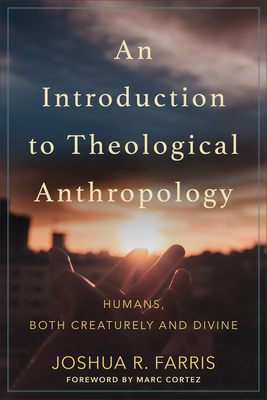
An Introduction to Theological Anthropology: Humans, Both Creaturely and Divine
In this thorough introduction to theological anthropology, Joshua Farris offers an evangelical perspective on the topic. Farris walks the reader through some of the most important issues in traditional approaches to anthropology, such as sexuality, posthumanism, and the image of God. He addresses fundamental questions like, Who am I? and Why do I exist? He also considers the creaturely and divine nature of humans, the body-soul relationship, and the beatific vision.
368 pages, Paperback
Published April 21, 2020
Ratings & Reviews
Friends & Following
Create a free account to discover what your friends think of this book!
Community Reviews
Displaying 1 - 11 of 11 reviews

January 31, 2023
While Farris covers an impressive amount of topics within theological anthropology, I could tell that he privileged substance ontology and philosophical theological perspectives, even when such a connection seemed unnecessary. It made for a dense read. His best chapters in my opinion were those on original sin and gender/sexuality, as they were more readable, more balanced, and delt more with biblical material than other places. In terms of the most thorough treatment in the book, his first chapter on human constitution is nearly 50 pages. If you want a substance dualist's perspective on human constitution, Farris is your guy. Something that this book challenged me to think about more is the metaphysics of sin and redemption. This book is more for the Reformed philosopher than the exegete, which may have contributed to my overall experience.

January 29, 2021
For me, this book was more analytic philosophy than theology. Additionally, I find the recurring language of many “options” and “models” available to us to be off putting as rather rationalistic. Last, I don’t find the balance between Reformed and “catholic” to be quite right; it felt more ecumenical to me instead.
Perhaps I had misapprehensions about what the book intended to do and be. But these are the reasons I didn’t give it more stars.
Perhaps I had misapprehensions about what the book intended to do and be. But these are the reasons I didn’t give it more stars.

August 11, 2026
Brotha you're talking too much. But seriously, really dense book on a cool subject, but the topic digs down to bedrock when the diamonds are found a few layers higher

October 20, 2023
Made me rethink some of my former positions, but usually just asked more questions than it answered.

August 29, 2025
This book sets out its material in a series of ten questions that cover the key issues in anthropology: human nature, human origins, the nature of the imago, free will and agency, original sin, Christology and its relation to anthropology, human culture, human gender and sexuality, death and the intermediate state, and final destiny. Farris argues for a dualistic anthropology but makes clear the intrinsic goodness of the body. However, on other topics (e.g., original sin or human origins) I found his arguments unpersuasive and too dependent on alleged “scientific developments,” especially in the discussion of human origins.
Furthermore, the book is heavily built around analytic theology and philosophical methods, which, as a pastoral theologian, I find at best frustrating and at worse harmful. A continual probing of models and possible questions or arrangements, without actually arriving at a Scripturally based, theologically informed conclusion risks turning the task of theology into an exercise in mind games, instead of a discipline whose sole purpose is to build up the church on her pilgrim journey.
Furthermore, the book is heavily built around analytic theology and philosophical methods, which, as a pastoral theologian, I find at best frustrating and at worse harmful. A continual probing of models and possible questions or arrangements, without actually arriving at a Scripturally based, theologically informed conclusion risks turning the task of theology into an exercise in mind games, instead of a discipline whose sole purpose is to build up the church on her pilgrim journey.

May 14, 2020
If you are at all interested in the topic of Theological Anthropology, of what it means to be human, then you will find this book helpful. Though written from a Reformed position it engages with various traditions and perspectives. While it is quite academic in nature and probably not for an absolute beginner I think an amateur theologian or young Christian would benefit from having their thinking stretched and there is plenty of scope for further research. This book could become a standard textbook. Recommended.
Thanks to NetGalley, Baker Academic and Brazos Press for ARC.
Thanks to NetGalley, Baker Academic and Brazos Press for ARC.

December 13, 2022
A good contemporary book that interacts with modern western conceptions of what a human being is. Farris interacts with greater church tradition, modern scientific thought, and contemporary philosophy to articulate a Scriptural view of what a human being is and the implications there of.
October 13, 2021
Everything about his method is great. Good start to researching theological anthropology. It is definitely a helpful resource.

September 16, 2024
This is another book I was required to read for my class on Theological Anthropology. I never would have read it otherwise, but am glad I did.

July 13, 2026
This book was incredibly dense and informative, but man it was a drag to get through.
June 27, 2022
It can be a bit dry at points and it is pretty technical—clearly an academic work. A bit of it won't over my head. That being said, it is is an important work and a crucial topic. I'll have to go back over it at some point.
Displaying 1 - 11 of 11 reviews