

What do you think?

Star Wars: X-Wing #8
Isard's Revenge
Sleek, swift and deadly, the famed X-Wing fighters have earned their reputation as the Rebel Alliance's ultimate strike force the hard way--first in battle, the last line of defense. Now they must make a deal with the devil herself--an enemy whose ultimate goal is their total annihilation.
It's the kind of mission only Wedge Antilles and the Rogue Squadron would dare to undertake. Against impossible odds they will stage a daring raid into an enemy stronghold--only to be rescued from certain destruction by an unexpected ally.
Ysanne Isard, the ruthless Imperial commander, has appeared on the scene seemingly from out of nowhere. Now she proposes a most unusual alliance, offering to help Wedge rescue his captured comrades from Imperial Warlord Admiral Krennel's sadistic prison camp.
But her offer is not without a price. Wedge must lead Rogue Squadron in Isard's deadly struggle against an enemy made in her own image. It's an offer Wedge would love to refuse, for Isard is certain to betray them. But how can they leave their comrades at Krennel's mercy? The answer they can't--even if it means being caught between Krennel's ruthlessness and Isard's treachery.
Features a bonus section following the novel that includes a primer on the Star Wars expanded universe, and over half a dozen excerpts from some of the most popular Star Wars books of the last thirty years!
It's the kind of mission only Wedge Antilles and the Rogue Squadron would dare to undertake. Against impossible odds they will stage a daring raid into an enemy stronghold--only to be rescued from certain destruction by an unexpected ally.
Ysanne Isard, the ruthless Imperial commander, has appeared on the scene seemingly from out of nowhere. Now she proposes a most unusual alliance, offering to help Wedge rescue his captured comrades from Imperial Warlord Admiral Krennel's sadistic prison camp.
But her offer is not without a price. Wedge must lead Rogue Squadron in Isard's deadly struggle against an enemy made in her own image. It's an offer Wedge would love to refuse, for Isard is certain to betray them. But how can they leave their comrades at Krennel's mercy? The answer they can't--even if it means being caught between Krennel's ruthlessness and Isard's treachery.
Features a bonus section following the novel that includes a primer on the Star Wars expanded universe, and over half a dozen excerpts from some of the most popular Star Wars books of the last thirty years!
352 pages, Paperback
First published April 1, 1999
Ratings & Reviews
Friends & Following
Create a free account to discover what your friends think of this book!
Community Reviews
Displaying 1 - 30 of 150 reviews

June 14, 2012
The penultimate X-Wing novel actually makes for quite good reading; great writing and plenty of action and suspense, with a little drama and romance in the mix. However, the ending (which I won't divulge here) is slightly disappointing, if only because I'm unsure how they could continue the story afterward. I know there is just one more, because I own it; we shall see whether it's any good.

March 23, 2026
Truthfully I didn’t know what to expect out of “Isard’s Revenge”. My first readthrough of Michael Stackpole’s first 4 X-Wing books made me think they were good not great and a second readthrough made me appreciate them some more but it was Aaron Allston’s Wraith Squadron books (X-Wing books 5-7) that really made me see why the X-Wing novels are so beloved among Star Wars EU fans. So returning to Stackpole and with a focus on Ysanne Isard, a villain I don’t care for, made me think a dip in quality was possible.
The dip in writing and character work is definitely noticeable as soon as you start reading the book. While there are some humorous moments (i.e., an awkward conversation about how a new species conceives babies) Stackpole is a lot less humorous than Allston (or maybe his sense of humor just isn’t my cup of tea) which doesn’t help his character work and writing. The writing is just a lot of dry descriptions of the technical aspects of dogfighting, characters delivering exposition, etc. Since a lot of the Rogues’ personal journeys were resolved in Stackpole’s last X-Wing book (“The Bacta War”), the likes of Corran Horn don’t have that much growth or development here (there’s some discussion about Corran debating whether he should have taken Luke up on the offer to become a Jedi but that presumably won’t be resolved until “I, Jedi”). My favorite starfighter pilot Wedge is just kind of “there”, he remains a competent leader but nothing of note or challenging happens with him in this book. The only characters’ personal lives I did care for among the Rogues were Gavin Darklighter’s relationship with Asyr Sei'lar because that actually had some degree of drama due to the political ramifications and bigotry towards their interspecies romance. It did however feel like Stackpole “fridged” the relationship in the end and kicked the resolution to their situation further down the road.
In general I did find the first part of the book to be a drag due to Stackpole not being Allston and a rather repetitive nature of the book’s conflicts to Stackpole’s earlier entries. Luckily the second half of the book saw a steady increase in my interest and enjoyment. Ironically as much as I don’t care for Ysanne Isard as a Star Wars character and had been content with her being “killed” already, her characters (plural) made things interesting. She’s not the first Star Wars villain to continue to cause problems due to cloning (insert “Somehow Palpatine” reference here) nor was this the first time a Star Wars character fought their evil clone (any “Luuke” fans out there?). But it was neat that Isard’s clone’s actions forced the original to team up with the Rogues to take down the clone and her allies as this gave the Rogues a two-front war to fight and forced them to simultaneously work with Isard and prepare for whatever double-cross she had planned. It didn’t do too much to make her anything more than her standard insane and overly evil villain that she was before but it did make for a compelling scenario (plus I did like the Rogues acknowledging some of the Imperials they were collaborating with were decent people and vice versa). Beyond that the set pieces in the climax were fun and I enjoyed seeing Admiral Ackbar channel Thrawn to take down the enemy fleets.
I went into “Isard’s Revenge” expecting a downgrade with Stackpole’s return following the high quality Allston X-Wing books and that was the case. Still, if Allston’s books are equivalent to a full-course and great meal, this was at least a downgrade to a satisfying and somewhat filling (if not completely nutritious) snack. The book has its problems but it ended up being an entertaining way to resolve some things with the Rogues and deliver a few more X-Wing action. It's a solid enough way to tide me over until Allston’s return to the series ( I plan to read “Starfighters of Adumar” in a few months) and seeing how Stackpole will handle more Jedi-oriented action in “I, Jedi”.
The dip in writing and character work is definitely noticeable as soon as you start reading the book. While there are some humorous moments (i.e., an awkward conversation about how a new species conceives babies) Stackpole is a lot less humorous than Allston (or maybe his sense of humor just isn’t my cup of tea) which doesn’t help his character work and writing. The writing is just a lot of dry descriptions of the technical aspects of dogfighting, characters delivering exposition, etc. Since a lot of the Rogues’ personal journeys were resolved in Stackpole’s last X-Wing book (“The Bacta War”), the likes of Corran Horn don’t have that much growth or development here (there’s some discussion about Corran debating whether he should have taken Luke up on the offer to become a Jedi but that presumably won’t be resolved until “I, Jedi”). My favorite starfighter pilot Wedge is just kind of “there”, he remains a competent leader but nothing of note or challenging happens with him in this book. The only characters’ personal lives I did care for among the Rogues were Gavin Darklighter’s relationship with Asyr Sei'lar because that actually had some degree of drama due to the political ramifications and bigotry towards their interspecies romance. It did however feel like Stackpole “fridged” the relationship in the end and kicked the resolution to their situation further down the road.
In general I did find the first part of the book to be a drag due to Stackpole not being Allston and a rather repetitive nature of the book’s conflicts to Stackpole’s earlier entries. Luckily the second half of the book saw a steady increase in my interest and enjoyment. Ironically as much as I don’t care for Ysanne Isard as a Star Wars character and had been content with her being “killed” already, her characters (plural) made things interesting. She’s not the first Star Wars villain to continue to cause problems due to cloning (insert “Somehow Palpatine” reference here) nor was this the first time a Star Wars character fought their evil clone (any “Luuke” fans out there?). But it was neat that Isard’s clone’s actions forced the original to team up with the Rogues to take down the clone and her allies as this gave the Rogues a two-front war to fight and forced them to simultaneously work with Isard and prepare for whatever double-cross she had planned. It didn’t do too much to make her anything more than her standard insane and overly evil villain that she was before but it did make for a compelling scenario (plus I did like the Rogues acknowledging some of the Imperials they were collaborating with were decent people and vice versa). Beyond that the set pieces in the climax were fun and I enjoyed seeing Admiral Ackbar channel Thrawn to take down the enemy fleets.
I went into “Isard’s Revenge” expecting a downgrade with Stackpole’s return following the high quality Allston X-Wing books and that was the case. Still, if Allston’s books are equivalent to a full-course and great meal, this was at least a downgrade to a satisfying and somewhat filling (if not completely nutritious) snack. The book has its problems but it ended up being an entertaining way to resolve some things with the Rogues and deliver a few more X-Wing action. It's a solid enough way to tide me over until Allston’s return to the series ( I plan to read “Starfighters of Adumar” in a few months) and seeing how Stackpole will handle more Jedi-oriented action in “I, Jedi”.

June 10, 2013
This book is especially hard to read after coming off Wraith Squadron's adventures. Character growth! Humor! Dialog! Pranks! Now it's back to Rogue Squadron, where everyone is perfectly logical, the humor is forced or refers back to something we've forgotten, and we'll rehash the first three books' plots.
There is no character development in this book. The dialog doesn't sound like any kind of real conversation; it's like everyone is just a floating plot point. It's very stilted, and even butler and maid at points. Gavin and Asyr's conversation about adopting was particularly painful and pretty much came out of nowhere. Every time we meet a new pilot, they open up and tell their entire backstory and motives, and then never talk again. I shouldn't be blindsided by dialog and monologue that comes out of nowhere. That's lazy. We don't care. Make us care about these people. And for heaven's sake, SHOW, don't TELL.
Instead there's just... plot. And it's hard to follow plot when you don't care about the characters that should be driving the plot. Furthermore, there's plot points here and there that are unrealistic and seem like a pretty big stretch. It breaks immersion, which would really help make up for this book's flaws.
The good? The story actually gets pretty cool when you hit page 200. That's 200 pages of slogging through all the stuff I just mentioned, but everything gets more interesting, the characters start to solidify, and the plot picks up the pace. It's still not perfect, but it gets much better. The action shines here.
Okay, I think I'm done now. This book might be worth skipping if you've made it this far in the X-Wing series.
There is no character development in this book. The dialog doesn't sound like any kind of real conversation; it's like everyone is just a floating plot point. It's very stilted, and even butler and maid at points. Gavin and Asyr's conversation about adopting was particularly painful and pretty much came out of nowhere. Every time we meet a new pilot, they open up and tell their entire backstory and motives, and then never talk again. I shouldn't be blindsided by dialog and monologue that comes out of nowhere. That's lazy. We don't care. Make us care about these people. And for heaven's sake, SHOW, don't TELL.
Instead there's just... plot. And it's hard to follow plot when you don't care about the characters that should be driving the plot. Furthermore, there's plot points here and there that are unrealistic and seem like a pretty big stretch. It breaks immersion, which would really help make up for this book's flaws.
The good? The story actually gets pretty cool when you hit page 200. That's 200 pages of slogging through all the stuff I just mentioned, but everything gets more interesting, the characters start to solidify, and the plot picks up the pace. It's still not perfect, but it gets much better. The action shines here.
Okay, I think I'm done now. This book might be worth skipping if you've made it this far in the X-Wing series.

July 10, 2017
Stars: 3
Re-read: Like 50.1% It depends on if future books build off this one.
Recommend to: If you loved the first four Rogue Squadron books so much you would be interested in a less addition to the series.
I found decent enjoyment out of this book, but it failed to grip me like the first four books in the series. It isn't necessary to read the Aaron Allston books from this series if you don't want to, even though there are obviously some spoilers relating to them. Stackpole also repeatedly references events that I believe happened in the comics. I think it is safe to say he spoils some of those events, so read those first if that matters to you. It was a little confusing when Stackpole would reference something we are clearly supposed to know about, and I would have to guess that it came from the comics.
The plot of this one was much weaker than Stackpole's previous works. The worst part of the book for me was
Stackpole committed one of the gravest sins in the book.
The entertaining parts of this book were evened out by the annoying parts.
Some of the dialogue was pretty bad:
- This line was hilarious:
- Why do writers think this line is so powerful. "I expected you to be taller." Followed with, "I expected you to be dead." I imagine the first person to use that line was pretty proud of themselves, but now it has been used to death and immediately makes me lose respect for any writer that uses it unironically.
I'd say the book is decent at best. I don't regret reading it, but I won't be in a hurry to read it again.
Re-read: Like 50.1% It depends on if future books build off this one.
Recommend to: If you loved the first four Rogue Squadron books so much you would be interested in a less addition to the series.
I found decent enjoyment out of this book, but it failed to grip me like the first four books in the series. It isn't necessary to read the Aaron Allston books from this series if you don't want to, even though there are obviously some spoilers relating to them. Stackpole also repeatedly references events that I believe happened in the comics. I think it is safe to say he spoils some of those events, so read those first if that matters to you. It was a little confusing when Stackpole would reference something we are clearly supposed to know about, and I would have to guess that it came from the comics.
The plot of this one was much weaker than Stackpole's previous works. The worst part of the book for me was
Stackpole committed one of the gravest sins in the book.
The entertaining parts of this book were evened out by the annoying parts.
Some of the dialogue was pretty bad:
- This line was hilarious:
- Why do writers think this line is so powerful. "I expected you to be taller." Followed with, "I expected you to be dead." I imagine the first person to use that line was pretty proud of themselves, but now it has been used to death and immediately makes me lose respect for any writer that uses it unironically.
I'd say the book is decent at best. I don't regret reading it, but I won't be in a hurry to read it again.
February 21, 2024
Wow
Nie spodziewałam się wielu rzeczy, które się tutaj wydarzyły.
TIE Defender istniał juz tutaj 🤓 miło
Admirał Ackbar 🫶
Ciekawie było przeczytać jak Imperialcy podchodzili do Gwiazdy Śmierci. Jednak niektórzy z nich mają jakieś ludzkie uczucia.
Potrzebuję więcej żartów Wensona na temat Ewoków. Nie obchodzi mnie, że Wegde nienawidzi tych żartów.
Nie spodziewałam się wielu rzeczy, które się tutaj wydarzyły.
TIE Defender istniał juz tutaj 🤓 miło
Admirał Ackbar 🫶
Ciekawie było przeczytać jak Imperialcy podchodzili do Gwiazdy Śmierci. Jednak niektórzy z nich mają jakieś ludzkie uczucia.
Potrzebuję więcej żartów Wensona na temat Ewoków. Nie obchodzi mnie, że Wegde nienawidzi tych żartów.
This entire review has been hidden because of spoilers.

January 14, 2026
I enjoyed the four Rogue Squadron books when I read them a few years ago, and while this book is a standalone it's pretty much a part of that subseries. I didn't enjoy this book quite as much as the previous Rogue Squadron books though. Reading about space battles doesn't really work for me, and I felt like that was a large part of the book. The characters are still good though.

February 2, 2024
Star Wars: Isard's Revenge was written by Bestselling Author, Michael A. Stackpole. This Expanded Universe tale takes place during the New Republic Era, nine ABY (9 years after the battle of Yavin).
SUMMARY: Wedge Antilles finally accepts a promotion. He and Rogue Squadron.
Somehow… Isard has returned. Turns out the Isard that was believed to have been killed, was a clone. With Thrawn out of the way, the real Isard is ready to establish herself as the successor to the Emperor.
OVERALL THOUHTS
I really hate to say it, but this book was such a boring read. After the excitement and thrills I experienced with the three Wraith Squadron books by Aaron Allston, this one was a sad let down. The book wasn't horrible, but it wasn’t near as fun as the Wraith Squadron trilogy. Corran Horn believed the hard battles would be over, that the New Republic just had some mopping up to do to snuff out the Empire, but he was wrong. The arrival of Thrawn had disrupted everything! I like getting into Rogue Squadron's thoughts of Thrawn and how they aren't buying into the belief that he's truly dead.
This book pivots back to Stackpole’s take/vision of the New Republic X-Wing squadrons. We spend too much time with boring characters and get a deeper look into the strange lifestyle choices of two, with their interspecies relationship. It's pretty gross and really stupid, the Bothans view relationships with non-Bothans is the Emperor winning.
Somehow… Isard has returned. With this book taking place after the Thrawn trilogy, where Timothy Zahn brings in the use of cloning, Stackpole jumps on the coat-tails of that idea and uses it as a way to reintroduce us to an enemy that was already defeated. However, that does seem to be a recurring issue in Star Wars... the dead enemy is resurrected. I believe that sort of thing can work, when handled appropriately, such as Palpatine in Dark Empire.
This book just feels like "things happen" and "more things happen." Just to get us to the back cover. The previous three books felt like a real structured story with satisfying arcs and conclusions. By the end of this book I was just tired with the characters.
Do I recommend you read this X-Wing book? No, too boring.
RATING
I give Star Wars: X-Wing" Isard's Revenge, a D.
SUMMARY: Wedge Antilles finally accepts a promotion. He and Rogue Squadron.
Somehow… Isard has returned. Turns out the Isard that was believed to have been killed, was a clone. With Thrawn out of the way, the real Isard is ready to establish herself as the successor to the Emperor.
OVERALL THOUHTS
I really hate to say it, but this book was such a boring read. After the excitement and thrills I experienced with the three Wraith Squadron books by Aaron Allston, this one was a sad let down. The book wasn't horrible, but it wasn’t near as fun as the Wraith Squadron trilogy. Corran Horn believed the hard battles would be over, that the New Republic just had some mopping up to do to snuff out the Empire, but he was wrong. The arrival of Thrawn had disrupted everything! I like getting into Rogue Squadron's thoughts of Thrawn and how they aren't buying into the belief that he's truly dead.
This book pivots back to Stackpole’s take/vision of the New Republic X-Wing squadrons. We spend too much time with boring characters and get a deeper look into the strange lifestyle choices of two, with their interspecies relationship. It's pretty gross and really stupid, the Bothans view relationships with non-Bothans is the Emperor winning.
Somehow… Isard has returned. With this book taking place after the Thrawn trilogy, where Timothy Zahn brings in the use of cloning, Stackpole jumps on the coat-tails of that idea and uses it as a way to reintroduce us to an enemy that was already defeated. However, that does seem to be a recurring issue in Star Wars... the dead enemy is resurrected. I believe that sort of thing can work, when handled appropriately, such as Palpatine in Dark Empire.
This book just feels like "things happen" and "more things happen." Just to get us to the back cover. The previous three books felt like a real structured story with satisfying arcs and conclusions. By the end of this book I was just tired with the characters.
Do I recommend you read this X-Wing book? No, too boring.
RATING
I give Star Wars: X-Wing" Isard's Revenge, a D.

December 26, 2024
This was an interesting read, especially switching back to the writing style of Michael Stackpole after the Allston Wraith Squadron series of X-Wing novels. You can tell the books have a different view and voice which is a little jarring at times. This was especially true in considering the characterization and personality of characters like Wedge who loses some of his “humanity” and humor and is back to his pure military tracked mind.
This was a good read, not to be ignored. The return of Iceheart was an expected Star Wars twist but done in an interesting enough way to keep you interested. The clone reveal definitely was a surprise to me, and created a very interesting dynamic between all of the characters.
There is a Bothan subplot which highlights a lot of political conspiracy and concern which honestly is applicable even today. The fact that Borsk Fey’lya is still in power is a reflection of even real world politics and issues with it.
We saw a return of Rogue Squadron being what they are: the ace fighter squadron of renown which helped Star Wars feel like a “war in the stars” which is the point of the series as opposed to super secret spies. It wasn’t the best book in the series, but definitely was enjoyable.
This was a good read, not to be ignored. The return of Iceheart was an expected Star Wars twist but done in an interesting enough way to keep you interested. The clone reveal definitely was a surprise to me, and created a very interesting dynamic between all of the characters.
There is a Bothan subplot which highlights a lot of political conspiracy and concern which honestly is applicable even today. The fact that Borsk Fey’lya is still in power is a reflection of even real world politics and issues with it.
We saw a return of Rogue Squadron being what they are: the ace fighter squadron of renown which helped Star Wars feel like a “war in the stars” which is the point of the series as opposed to super secret spies. It wasn’t the best book in the series, but definitely was enjoyable.

June 19, 2013
The title, including revenge and the character of Isard, suggested this was going to be the pinnacle of an, unsophisticated, series. It is not. There is a lovely set-up: Isard recruits Rogue Squadron to combat an old threat and save some POWs. But the execution was definitely lacking. Dialogue was embarrassing. Every important character is mechanically promoted all at once. The characters do nothing interesting, no development, no philosophy, no anything. The action is good, but this felt a lot like Ghostbusters 2 in a way; a half-baked plot that accomplishes nothing really. Admittedly, I like the more sophisticated plots, but I enjoy the Rogue and Wraith novels at their level; this is not on par with previous installments.

December 7, 2020
For 2020, I decided to reread (in publication order) all the Bantam-era Star Wars books that were released between 1991 and 1999; that shakes out to 38 adult novels and 5 anthologies of short stories & novellas.
This week’s focus: the last of Michael A. Stackpole’s X-Wing books, Isard’s Revenge.
SOME HISTORY:
Michael A. Stackpole's The Bacta War left some loose ends dangling, primarily the fate of Ysanne Isard. Tycho Celchu destroyed her shuttle, but was she actually inside? (With a title like Isard’s Revenge, I would assume that she wasn’t!) While Stackpole’s previous four X-Wing books all made the New York Times paperback bestseller list, I couldn’t find any data that Isard’s Revenge did.
MY RECOLLECTION OF THE BOOK:
The events in this book felt familiar to me, but not to the extent that I experienced in the previous X-Wing books. I know that I read this one more than once, but I don’t think I reread it at the same frequency as some of the others in the series.
A BRIEF SUMMARY:
With Grand Admiral Thrawn defeated at the Battle of Bilbringi, the New Republic turns their focus on Prince-Admiral Krennel and the Ciutric Hegemony. But when the Rogues are ambushed, they must team up with an enemy they never imagined would be on their side.
THE CHARACTERS:
In 1996 Bantam approached Stackpole about writing four more X-Wing books, but as we know, he had prior commitments. Three of the books were handed off to Aaron Allston, and Stackpole wrote just one: Isard’s Revenge. IR feels like a conclusion to the Rogue Squadron arc. We get explanations for people’s rank changes, a satisfactory denouement for Isard, and a little bit of setup for future authors to play around with.
The main way that Stackpole filled in the gaps here was by explaining why Wedge Antilles is a general in the Jedi Academy trilogy. After dodging promotions for years, Wedge finally accepts the rank of General. He’s allowed to stay with his starfighter unit, but he’ll be accepting more responsibilities--perhaps taking on a role more akin to General Salm’s, where he heads up one starfighter unit but is an overarching supervisor of many others. (Which made sense to me, because Wedge can’t stay a commander forever! I would actually like for him to pass command of the Rogues on to Tycho, because he deserves it.)
We see Corran Horn again, before he undertook his Jedi training in I, Jedi. So while he has a handy lightsaber and gets flashes of insight or warning about situations and people, he’s not able to focus his Force powers like he can in later books.
I also loved Whistler and Gate’s escape from Isard’s hidden base. Whistler has loads of special programming from his time in CorSec, and it was fun getting to see him put it to use. It also made sense to me that the droids would be able to get a message out, because no one pays attention to droids.
Tycho’s here! That’s it, though. After The Krytos Trap, he hasn’t had much to do other than be an amazing pilot.
Gavin Darklighter and Asyr Sei’lar are going through some relationship stuff: they want to get married! They want kids! I know they’ve been dating for over two years, but Gavin’s only nineteen at this point so I thought they were moving too fast. (It didn’t help that Stackpole handles their scenes in such an awkward manner.) Asyr faces more pushback from Bothan officials, so she takes two tracks. The first is to be the absolute best, most amazing flyer ace so that her reputation will be so large that no one can tell her no. The second is one hundred and eighty degrees in the other direction. While Wes Janson returns to the Rogues and lets them know he’s not dead, Asyr decides to change her identity and change Bothan society from the inside-out. Which is a lofty goal, but feels excessively cruel to Gavin, who still thinks she’s DEAD.
We’re also introduced to some new Rogues, who are explicitly coded as red shirts. We learn a little bit about them, and then they DIE. But since I didn’t have an emotional connection to them, it was just like “well, shoot.”
Iella, Mirax, and even Booster Terrik get an intelligence-style plotline here. I love that Booster is able to “think like Isard” so easily, and that Mirax and Iella get to do important things here. Isard #1’s scheme would have never been foiled if it wasn’t for Iella and Mirax figuring things out.
And then we have our baddies. Prince-Admiral Krennel stayed out of the conflict with Thrawn, but is willing to join with Isard #2 to thumb his nose at the New Republic and grow his power base. One issue I have with Stackpole’s later Star Wars books, though, is that they rely perhaps too heavily on knowledge from the X-Wing comics. Admiral Tavira from I, Jedi originally appeared in the Rogue Squadron comic, as did Krennel. While I felt like Stackpole did an adequate job introducing him, you get a better sense of his character from two Rogue Squadron arcs: Masquerade and Mandatory Retirement. He’s not a nice guy.
And while Krennel thinks that he’s teaming up with Isard, she’s actually a clone! Isard #1 created Isard #2 to relocate the Lusankya prisoners then shot her in the head, but #2 survived. She has memory loss from the events on Thyferra, and legitimately believes that she is the true Isard. I’m not crazy about the presence of Isard #2, though, because it seems to de-rarify clones. Rather than being a forgotten technology until Thrawn found the Spaarti cylinders on Wayland, everyone makes themselves a clone: Isard, the Emperor, even Thrawn himself. Two Isards ends up being one Isard too many.
And then we have the original flavor Isard; she was not on the shuttle that Tycho shot down, she’s been hiding out ever since she fled Thyferra, and now that Thrawn is dead she wants to take out Krennel and her clone and (possibly) retake her Super Star Destroyer.
ISSUES:
I felt like the part where Rogue Squadron had to work with Isard’s forces was the best part of the book. (Obviously, Bantam thought so too, because the back cover blurb only talks about that subplot.) The problem is that pivotal event doesn’t start until Chapter 20 out of 38. It felt like you had to wade through a lot of...setup...before you got to the crucial, exciting parts.
We see the Battle of Bilbringi from Rogue Squadron’s POV in the first chapter, then they return to Coruscant and Corran reunites with Mirax. They have a party; one of the Lusankya prisoners shows up--and dies when Corran says his name. They raid the planet that they traced the prisoner to; find more prisoners but hit a dead end; get assigned to the actions against Krennel. They’re dealing with Krennel; Mirax and Iella investigate stuff and realize IT’S A TRAP; it is, in fact, a trap; nine members of Rogue Squadron are picked up by Isard’s forces, two die, and two get rescued by Booster on the Errant Venture. And then it’s the exciting stuff! But that is an awful lot of plot to wade through before we get to the main crux of the novel.
I also felt like the apparent death of various members of Rogue Squadron weren’t dealt with in any emotionally nuanced way. The nine members with Isard believe that Wes Janson and Asyr Sei’lar are dead. We get one chapter where Gavin feels really bad and Corran talks to him, and Wedge briefly thinks about Wes’s death. Wedge’s sadness over Wes felt less about Wes as an individual, and more about “another member of Rogue Squadron gone.” But we don’t get anything from Hobbie Klivian, the other half of the wonderful Janson/Klivian bromance?? And on the Errant Venture, we get nothing about Wes’s grief over the loss of his friends.
And when they’re reunited, we see nothing?? We hear from Corran that Wedge was excited to see Wes alive and well, but that’s it. No firsthand response from Wedge, and once again, nothing from Hobbie about the miraculous reappearance of his best friend?? I think this was maybe the reason why I didn’t reread IR with the same frequency as the other X-Wing books, because I felt like Stackpole didn’t want to deal with the emotional ramifications of all these supposed deaths.
When they first started talking about Pulsar Station, my eyes rolled back in my head. Another attempt at the Death Star? But I enjoyed learning that it was all a fake: that Isard had her finger on what precisely would get the New Republic all riled up, and was able to deploy her ruse in a timely manner.
The ending felt too abrupt to me. The prisoners from Lusankya are fine--no virus!--and the ship is being inducted into the New Republic Navy. Rogue Squadron might be stationed on it? Stackpole throws off another allusion to I, Jedi, and that’s it. Since Isard’s Revenge was Stackpole bidding farewell to the Rogues, I expected the ending to be a bit longer and more complete. (I wasn’t expecting multiple endings like in the film of The Return of the King! Just something a little longer than 8 pages of wrap-up.)
And finally, a petty issue: I don’t understand what people see in Bothans? They sound like bipedal cats with (aside from Asyr) nasty attitudes. I don’t get it.
IN CONCLUSION:
Isard’s Revenge is a nice conclusion to Stackpole’s Rogue Squadron arc. From Chapter 20 onwards was really exciting, but unfortunately you have to wade through a lot of the book before you get to that pivotal point--and I also felt like Stackpole wasn’t willing to deal with the emotional ramifications of that pivotal point, which was a bit disappointing.
Next up: the third book in the Bounty Hunter Wars trilogy, Hard Merchandise by K.W. Jeter
My YouTube review: https://youtu.be/c7DfurxgPY0
Ryshcate attempt #3: https://youtu.be/fLRoTlxamuc
This week’s focus: the last of Michael A. Stackpole’s X-Wing books, Isard’s Revenge.
SOME HISTORY:
Michael A. Stackpole's The Bacta War left some loose ends dangling, primarily the fate of Ysanne Isard. Tycho Celchu destroyed her shuttle, but was she actually inside? (With a title like Isard’s Revenge, I would assume that she wasn’t!) While Stackpole’s previous four X-Wing books all made the New York Times paperback bestseller list, I couldn’t find any data that Isard’s Revenge did.
MY RECOLLECTION OF THE BOOK:
The events in this book felt familiar to me, but not to the extent that I experienced in the previous X-Wing books. I know that I read this one more than once, but I don’t think I reread it at the same frequency as some of the others in the series.
A BRIEF SUMMARY:
With Grand Admiral Thrawn defeated at the Battle of Bilbringi, the New Republic turns their focus on Prince-Admiral Krennel and the Ciutric Hegemony. But when the Rogues are ambushed, they must team up with an enemy they never imagined would be on their side.
THE CHARACTERS:
In 1996 Bantam approached Stackpole about writing four more X-Wing books, but as we know, he had prior commitments. Three of the books were handed off to Aaron Allston, and Stackpole wrote just one: Isard’s Revenge. IR feels like a conclusion to the Rogue Squadron arc. We get explanations for people’s rank changes, a satisfactory denouement for Isard, and a little bit of setup for future authors to play around with.
The main way that Stackpole filled in the gaps here was by explaining why Wedge Antilles is a general in the Jedi Academy trilogy. After dodging promotions for years, Wedge finally accepts the rank of General. He’s allowed to stay with his starfighter unit, but he’ll be accepting more responsibilities--perhaps taking on a role more akin to General Salm’s, where he heads up one starfighter unit but is an overarching supervisor of many others. (Which made sense to me, because Wedge can’t stay a commander forever! I would actually like for him to pass command of the Rogues on to Tycho, because he deserves it.)
We see Corran Horn again, before he undertook his Jedi training in I, Jedi. So while he has a handy lightsaber and gets flashes of insight or warning about situations and people, he’s not able to focus his Force powers like he can in later books.
I also loved Whistler and Gate’s escape from Isard’s hidden base. Whistler has loads of special programming from his time in CorSec, and it was fun getting to see him put it to use. It also made sense to me that the droids would be able to get a message out, because no one pays attention to droids.
Tycho’s here! That’s it, though. After The Krytos Trap, he hasn’t had much to do other than be an amazing pilot.
Gavin Darklighter and Asyr Sei’lar are going through some relationship stuff: they want to get married! They want kids! I know they’ve been dating for over two years, but Gavin’s only nineteen at this point so I thought they were moving too fast. (It didn’t help that Stackpole handles their scenes in such an awkward manner.) Asyr faces more pushback from Bothan officials, so she takes two tracks. The first is to be the absolute best, most amazing flyer ace so that her reputation will be so large that no one can tell her no. The second is one hundred and eighty degrees in the other direction. While Wes Janson returns to the Rogues and lets them know he’s not dead, Asyr decides to change her identity and change Bothan society from the inside-out. Which is a lofty goal, but feels excessively cruel to Gavin, who still thinks she’s DEAD.
We’re also introduced to some new Rogues, who are explicitly coded as red shirts. We learn a little bit about them, and then they DIE. But since I didn’t have an emotional connection to them, it was just like “well, shoot.”
Iella, Mirax, and even Booster Terrik get an intelligence-style plotline here. I love that Booster is able to “think like Isard” so easily, and that Mirax and Iella get to do important things here. Isard #1’s scheme would have never been foiled if it wasn’t for Iella and Mirax figuring things out.
And then we have our baddies. Prince-Admiral Krennel stayed out of the conflict with Thrawn, but is willing to join with Isard #2 to thumb his nose at the New Republic and grow his power base. One issue I have with Stackpole’s later Star Wars books, though, is that they rely perhaps too heavily on knowledge from the X-Wing comics. Admiral Tavira from I, Jedi originally appeared in the Rogue Squadron comic, as did Krennel. While I felt like Stackpole did an adequate job introducing him, you get a better sense of his character from two Rogue Squadron arcs: Masquerade and Mandatory Retirement. He’s not a nice guy.
And while Krennel thinks that he’s teaming up with Isard, she’s actually a clone! Isard #1 created Isard #2 to relocate the Lusankya prisoners then shot her in the head, but #2 survived. She has memory loss from the events on Thyferra, and legitimately believes that she is the true Isard. I’m not crazy about the presence of Isard #2, though, because it seems to de-rarify clones. Rather than being a forgotten technology until Thrawn found the Spaarti cylinders on Wayland, everyone makes themselves a clone: Isard, the Emperor, even Thrawn himself. Two Isards ends up being one Isard too many.
And then we have the original flavor Isard; she was not on the shuttle that Tycho shot down, she’s been hiding out ever since she fled Thyferra, and now that Thrawn is dead she wants to take out Krennel and her clone and (possibly) retake her Super Star Destroyer.
ISSUES:
I felt like the part where Rogue Squadron had to work with Isard’s forces was the best part of the book. (Obviously, Bantam thought so too, because the back cover blurb only talks about that subplot.) The problem is that pivotal event doesn’t start until Chapter 20 out of 38. It felt like you had to wade through a lot of...setup...before you got to the crucial, exciting parts.
We see the Battle of Bilbringi from Rogue Squadron’s POV in the first chapter, then they return to Coruscant and Corran reunites with Mirax. They have a party; one of the Lusankya prisoners shows up--and dies when Corran says his name. They raid the planet that they traced the prisoner to; find more prisoners but hit a dead end; get assigned to the actions against Krennel. They’re dealing with Krennel; Mirax and Iella investigate stuff and realize IT’S A TRAP; it is, in fact, a trap; nine members of Rogue Squadron are picked up by Isard’s forces, two die, and two get rescued by Booster on the Errant Venture. And then it’s the exciting stuff! But that is an awful lot of plot to wade through before we get to the main crux of the novel.
I also felt like the apparent death of various members of Rogue Squadron weren’t dealt with in any emotionally nuanced way. The nine members with Isard believe that Wes Janson and Asyr Sei’lar are dead. We get one chapter where Gavin feels really bad and Corran talks to him, and Wedge briefly thinks about Wes’s death. Wedge’s sadness over Wes felt less about Wes as an individual, and more about “another member of Rogue Squadron gone.” But we don’t get anything from Hobbie Klivian, the other half of the wonderful Janson/Klivian bromance?? And on the Errant Venture, we get nothing about Wes’s grief over the loss of his friends.
And when they’re reunited, we see nothing?? We hear from Corran that Wedge was excited to see Wes alive and well, but that’s it. No firsthand response from Wedge, and once again, nothing from Hobbie about the miraculous reappearance of his best friend?? I think this was maybe the reason why I didn’t reread IR with the same frequency as the other X-Wing books, because I felt like Stackpole didn’t want to deal with the emotional ramifications of all these supposed deaths.
When they first started talking about Pulsar Station, my eyes rolled back in my head. Another attempt at the Death Star? But I enjoyed learning that it was all a fake: that Isard had her finger on what precisely would get the New Republic all riled up, and was able to deploy her ruse in a timely manner.
The ending felt too abrupt to me. The prisoners from Lusankya are fine--no virus!--and the ship is being inducted into the New Republic Navy. Rogue Squadron might be stationed on it? Stackpole throws off another allusion to I, Jedi, and that’s it. Since Isard’s Revenge was Stackpole bidding farewell to the Rogues, I expected the ending to be a bit longer and more complete. (I wasn’t expecting multiple endings like in the film of The Return of the King! Just something a little longer than 8 pages of wrap-up.)
And finally, a petty issue: I don’t understand what people see in Bothans? They sound like bipedal cats with (aside from Asyr) nasty attitudes. I don’t get it.
IN CONCLUSION:
Isard’s Revenge is a nice conclusion to Stackpole’s Rogue Squadron arc. From Chapter 20 onwards was really exciting, but unfortunately you have to wade through a lot of the book before you get to that pivotal point--and I also felt like Stackpole wasn’t willing to deal with the emotional ramifications of that pivotal point, which was a bit disappointing.
Next up: the third book in the Bounty Hunter Wars trilogy, Hard Merchandise by K.W. Jeter
My YouTube review: https://youtu.be/c7DfurxgPY0
Ryshcate attempt #3: https://youtu.be/fLRoTlxamuc

November 3, 2018
Isard's Revenge was a solid addition to the X-Wing series. The action in this book picks up right as the Thrawn trilogy is winding down. I really appreciated this integration, as it gave great continuity to the story. It's hard to say much about the plot without spoilers, so suffice it to say that these missions encompass some of Rogue Squadron's finest undercover work. They take place in the Ciutric Hegemony, which is a fascinating and seldom explored region of the Expanded Universe (I first learned about these planets in a mod to the game "Empire at War"). The plot involving Isard has a huge twist and the political play between Warlord Krennel (at Isard's direction) and Mon Mothma is very realistic.
Although a solid and entertaining story, I disliked the way the capital ships were handled (the fighter combat was great, though!). The New Republic dispatched such a weak fleet to deal with the Warlord. I know that the NR navy had to be stretched thin, but a single Mon Cal cruiser (and several support vessels) is too paltry a force! And the Warlord only had one Impstar Deuce and two Victories? The smaller fleet sizes allowed the author to personalize and focus details on those ships and their crews, but it was simply unbelievable to me that the fleets would be so small. Even Zsinj had dozens of capital ships... Maybe I don't have the proper perspective on this, but the small number of capital ships did stick out to me.
Although a solid and entertaining story, I disliked the way the capital ships were handled (the fighter combat was great, though!). The New Republic dispatched such a weak fleet to deal with the Warlord. I know that the NR navy had to be stretched thin, but a single Mon Cal cruiser (and several support vessels) is too paltry a force! And the Warlord only had one Impstar Deuce and two Victories? The smaller fleet sizes allowed the author to personalize and focus details on those ships and their crews, but it was simply unbelievable to me that the fleets would be so small. Even Zsinj had dozens of capital ships... Maybe I don't have the proper perspective on this, but the small number of capital ships did stick out to me.

July 24, 2011
If, by and large, books can be compared to food - the classics being haute cuisine; the terrible books being dog-food - then the X-Wing series of Star Wars books (all written pre-Episode One, and based on the popular LucasArts games) could probably be best described as fast food: enjoyable enough in small doses but you wouldn't want to live on them and not always that memorable.
With regard to this book, which picks up from the end of Timothy Zahn's "The Last Command" (with the ending of that novel shown from a different perspective), it's also more than half way through before the jacket blurb begins to make sense.
With regard to this book, which picks up from the end of Timothy Zahn's "The Last Command" (with the ending of that novel shown from a different perspective), it's also more than half way through before the jacket blurb begins to make sense.

September 28, 2009
A gift star for successfully ending the series. Predictable and pedestrian.

July 28, 2024
Welll, hands up if you were convinced there was no way Stackpole could possibly get any worse and you are now somehow both disappointed and the tiniest bit impressed.

Not to be extremely dramatic or anything, but how in the name of the almighty Force does something this unbelievably crappy get published?
I'm genuinely curious.
Now, at this point I would normally give you a small plot recap, but I genuinely don't quite know what the plot of this book was supposed to be.
It had something to do with Isard. And revenge .... presumably.
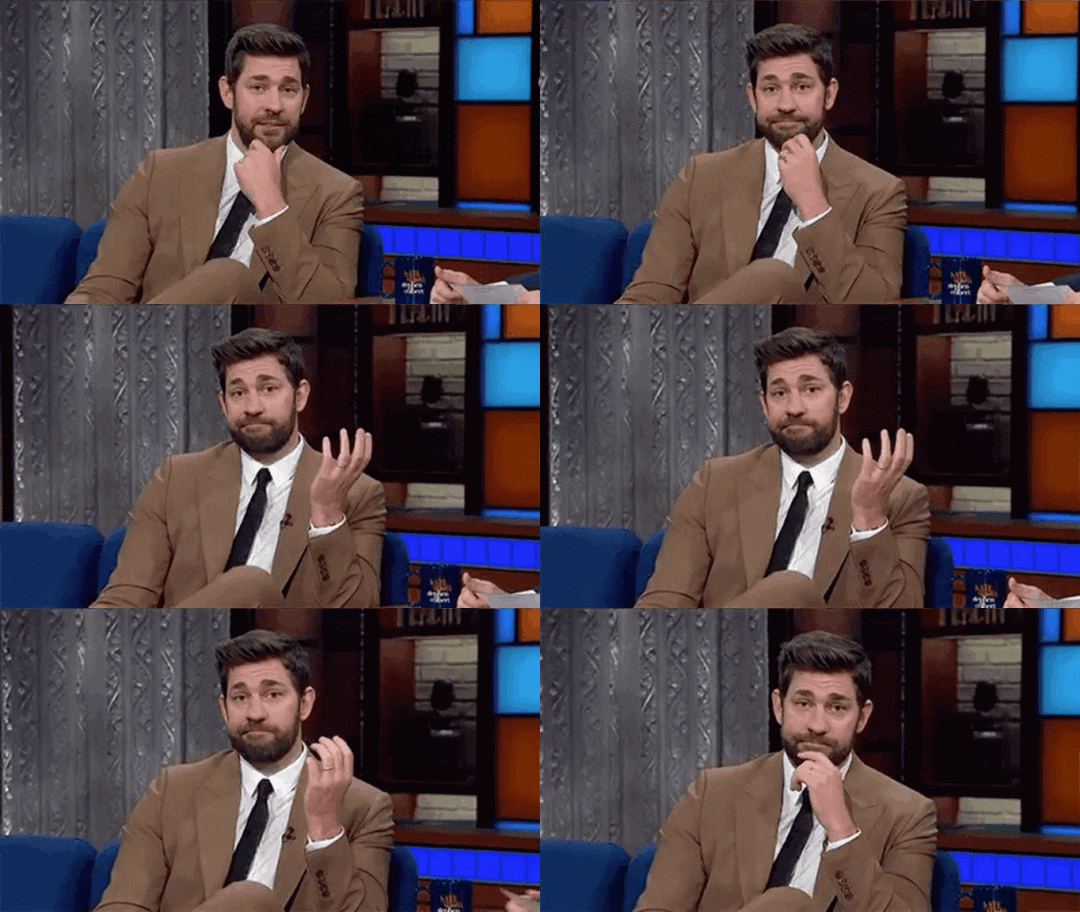
Let's get into the plot though, and why it's so bad.
Plot
First of all, let me say that I honestly had some hopes for this plot. Isard is one of the cooler characters Stackpole has invented, and I thought some fun might be had from resurrecting her.
But instead of focusing on Isard, Stackpole chooses to spend time on Warlord Admiral Krennel, who is apparently included in some comics, but has never before been introduced in the X-Wing series. So, if you've only read the books, like me, he's a completely new character, and he is, I kid you not, completely pointless.
Seriously. Take him out of the book, and nothing changes, except for the fact that you get fewer boring scenes with him in them.
Secondly, Stackpole has way too many plot threads, and most of them are left dangling, and some of them don't actually make any logical sense (see, for instance, spoiler above).
There is also so much in this plot that is clearly not properly worked through. There are inconsistencies and plot holes everywhere, and some truly enormous leaps of logic.
It is very clear that Stackpole has been inspired by the much, much better Thrawn trilogy, and is trying, in some measure, to emulate it. The trouble with his attempting this is, of course, that Timothy Zahn is a much better writer and can make a convoluted plot with lots of twists and turns work so that it actually feels like a logical, coherent unit of writing, whereas Stackpole doesn't have the talent, or the skill, for it.
Prose
Everything that was wrong with the first X-wing book is wrong with this one, and somehow even worse.
The fight scenes are so mathematical and convoluted that they lose every ounce of actual tension, leaving you to try to do calculus in your head in order to figure out which X-wing is currently doing what.
The conversations are beyond painful to read. Most of them are so stilted and unnatural sounding that I am left to seriously question whether Stackpole isn't actually from a different planet. In this volume, Stackpole also attempts to insert some philosophical elements in the musings of his characters, and for the most part a kid in primary school could probably do a better job philosophising.
The only really interesting aspect of this are the conversations between Asyr Sei'lar and Gavin Darklighter regarding their future as a couple and the possibility of adopting children, and this is, sadly, just left to fizzle out into nothing.
Additionally, Stackpole tries to insert humour here, but he always, always drags the joke on a line too far, so that instead of being funny, the jokes just feel overworked and fall completely flat.
He has also created a lot of weird Star Wars similes that he throws out here and there, often in the middle of a tense situation where said simile ends up lending a comical air to a situation that should be frightening, or sad.
The prose also frequently reads as though English isn't Stackpole's first language (which it is, I checked). His use of language is often so stunted and odd that it doesn't sound properly fluent, and there are also a lot of errors.
Characters
The characters are much as they ever have been. There is little to no character development in this volume, instead we're just rehashing a lot of the same stuff as before (the notable exception being Asyr and Gavin, as mentioned above).
There are few new characters in this, and I actually don't even remember most of them (which goes to show how interesting they were).
The chief new character (new if you haven't read the comics) is the abovementioned Krennel, who is about as interesting as wet cement.
Seriously, his most interesting trait is that he has a bionic arm, and even that is never used to full effect. I mean, I was at least expecting to see him strangle someone with it, à la Vader, but we didn't even get that.
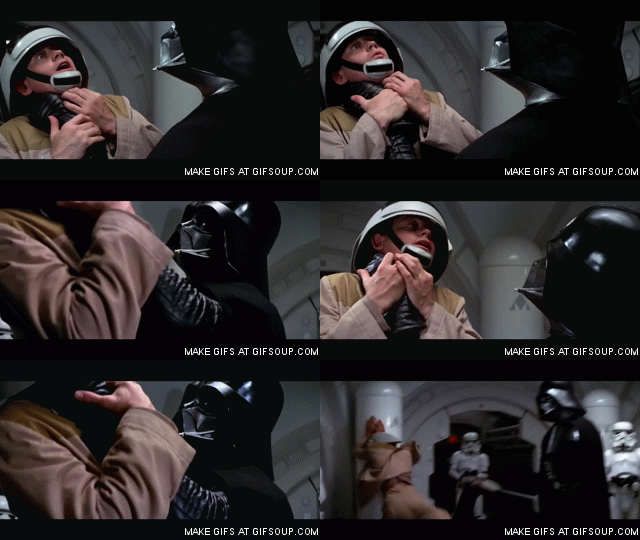
There is so much more I could complain about here, but I think you all get the point: I really, really didn't like this.
The worst Stackpole yet, which is saying something.
Seriously, if you're doing a read-through of this series, just give this book a miss. I don't think anything happens in this book that is going to have much impact on the series later.
There are, sadly, three more Stackpole books in the Legends universe, and at this point I'm considering battling my OCD and skipping them.
Have any of you read them, and if so, are they worth reading, like at all? Let me know.
Not to be extremely dramatic or anything, but how in the name of the almighty Force does something this unbelievably crappy get published?
I'm genuinely curious.
Now, at this point I would normally give you a small plot recap, but I genuinely don't quite know what the plot of this book was supposed to be.
It had something to do with Isard. And revenge .... presumably.
Let's get into the plot though, and why it's so bad.
Plot
First of all, let me say that I honestly had some hopes for this plot. Isard is one of the cooler characters Stackpole has invented, and I thought some fun might be had from resurrecting her.
But instead of focusing on Isard, Stackpole chooses to spend time on Warlord Admiral Krennel, who is apparently included in some comics, but has never before been introduced in the X-Wing series. So, if you've only read the books, like me, he's a completely new character, and he is, I kid you not, completely pointless.
Seriously. Take him out of the book, and nothing changes, except for the fact that you get fewer boring scenes with him in them.
Secondly, Stackpole has way too many plot threads, and most of them are left dangling, and some of them don't actually make any logical sense (see, for instance, spoiler above).
There is also so much in this plot that is clearly not properly worked through. There are inconsistencies and plot holes everywhere, and some truly enormous leaps of logic.
It is very clear that Stackpole has been inspired by the much, much better Thrawn trilogy, and is trying, in some measure, to emulate it. The trouble with his attempting this is, of course, that Timothy Zahn is a much better writer and can make a convoluted plot with lots of twists and turns work so that it actually feels like a logical, coherent unit of writing, whereas Stackpole doesn't have the talent, or the skill, for it.
Prose
Everything that was wrong with the first X-wing book is wrong with this one, and somehow even worse.
The fight scenes are so mathematical and convoluted that they lose every ounce of actual tension, leaving you to try to do calculus in your head in order to figure out which X-wing is currently doing what.
The conversations are beyond painful to read. Most of them are so stilted and unnatural sounding that I am left to seriously question whether Stackpole isn't actually from a different planet. In this volume, Stackpole also attempts to insert some philosophical elements in the musings of his characters, and for the most part a kid in primary school could probably do a better job philosophising.
The only really interesting aspect of this are the conversations between Asyr Sei'lar and Gavin Darklighter regarding their future as a couple and the possibility of adopting children, and this is, sadly, just left to fizzle out into nothing.
Additionally, Stackpole tries to insert humour here, but he always, always drags the joke on a line too far, so that instead of being funny, the jokes just feel overworked and fall completely flat.
He has also created a lot of weird Star Wars similes that he throws out here and there, often in the middle of a tense situation where said simile ends up lending a comical air to a situation that should be frightening, or sad.
The prose also frequently reads as though English isn't Stackpole's first language (which it is, I checked). His use of language is often so stunted and odd that it doesn't sound properly fluent, and there are also a lot of errors.
Characters
The characters are much as they ever have been. There is little to no character development in this volume, instead we're just rehashing a lot of the same stuff as before (the notable exception being Asyr and Gavin, as mentioned above).
There are few new characters in this, and I actually don't even remember most of them (which goes to show how interesting they were).
The chief new character (new if you haven't read the comics) is the abovementioned Krennel, who is about as interesting as wet cement.
Seriously, his most interesting trait is that he has a bionic arm, and even that is never used to full effect. I mean, I was at least expecting to see him strangle someone with it, à la Vader, but we didn't even get that.
There is so much more I could complain about here, but I think you all get the point: I really, really didn't like this.
The worst Stackpole yet, which is saying something.
Seriously, if you're doing a read-through of this series, just give this book a miss. I don't think anything happens in this book that is going to have much impact on the series later.
There are, sadly, three more Stackpole books in the Legends universe, and at this point I'm considering battling my OCD and skipping them.
Have any of you read them, and if so, are they worth reading, like at all? Let me know.
June 28, 2024
There are some books I feel badly about giving 3 stars, because they were very enjoyable but just didn't break "4 star" territory. This....isn't one of those books.
The plot is just a little too far fetched, which becomes a bigger problem because it feels like we're revisiting stories that were already settled, creating loose ends where there were none. In fact, this might be the first book I've ever read that would have been better without a plot. The first 50 pages or so were excellent, focusing on where the story left off, and life after the thrawn trilogy. The book should have stuck with that, and elaborated further. Other than that, the book was ok, pretty good writing outside of the combat (which took up too much space and was far too hard to follow/get into)
The other problem is, this was a dissapointment after the previous 3 books. Allstons trilogy were all masterpieces. They were a tough act to follow, and this story didn't step up at all, instead becoming the worst of the series so far.
The plot is just a little too far fetched, which becomes a bigger problem because it feels like we're revisiting stories that were already settled, creating loose ends where there were none. In fact, this might be the first book I've ever read that would have been better without a plot. The first 50 pages or so were excellent, focusing on where the story left off, and life after the thrawn trilogy. The book should have stuck with that, and elaborated further. Other than that, the book was ok, pretty good writing outside of the combat (which took up too much space and was far too hard to follow/get into)
The other problem is, this was a dissapointment after the previous 3 books. Allstons trilogy were all masterpieces. They were a tough act to follow, and this story didn't step up at all, instead becoming the worst of the series so far.
December 16, 2021
I would say this is a high three for me, because I did really enjoy it, but unfortunately I think it's my least favorite X-Wing novel. Maybe it's that Aaron Allston's run is so good, but this just wasn't hitting for me. I love characters like Wedge, Corran, and Mirax, and I was happy to spend some time with them, but this book just didn't really excite me. The Isard clone plot was interesting, but not much was done with it, to the point where I probably could have done without her in this book at all. The resolution of the prisoner rescue was satisfying, because that's one thread from The Bacta War that annoyed me to leave hanging, and I think it sets up Corran for I, Jedi very well, but overall I was sort of left just wanting to go read that book now. Worth the read if you like the X-Wing books, but nothing super special.
November 10, 2025
Probably my least favourite X-Wing book, but it's still an X-Wing book, so it isn't bad. Just some concepts and ideas I didn't like or care for, like Isard here, or how Asyr's story goes, and also a general issue with following the book. I somehow managed to miss a major character death. That's saying something about how tricky I found it to go along with. I also didn't even pick up on the Isard clones for some time. Maybe I just struggled with this book in particular. Anyway, some good character stuff for the characters I do like. But missing the charm and depth that the Wraiths had.
This entire review has been hidden because of spoilers.

June 5, 2023
This one is a lot of fun, even if it is the "somehow, Palpatine returned" of the legends era. Great scenes of Mirax and Iella working together, Wedge leading Rogue Squadron, and Corran both flying and getting some lightsaber action.

June 19, 2020
It was fun seeing the characters from the first 7 X-Wing books again, and now dealing with the aftermath of Thrawn's campaign.
But another clone? Blech.
But another clone? Blech.

April 9, 2021
Man, the Star Wars Expanded Universe is lousy with clones. Lucas opened that door with the idea of the Clone Wars, and writers will depend on them to make their plots work until the heat death of the universe.
I mean, it's not really a surprise that Isard returns to the X-Wing series; even when she crashed in The Bacta War, nobody said anything about finding a body, so I knew then she was going to come back (irrespective of the fact that I already knew a future book in the series was called Isard's Revenge). So ... surprise!
As for the rest of the story, it's just okay. I know this series is well-liked and well-regarded, but at best, it just feels serviceable to me.
I mean, it's not really a surprise that Isard returns to the X-Wing series; even when she crashed in The Bacta War, nobody said anything about finding a body, so I knew then she was going to come back (irrespective of the fact that I already knew a future book in the series was called Isard's Revenge). So ... surprise!
As for the rest of the story, it's just okay. I know this series is well-liked and well-regarded, but at best, it just feels serviceable to me.

July 16, 2010
“The way we rebuild the galaxy is by making lives better one at a time”
The New Republic is hot off the battle with Thrawn. Admiral Ackbar forces Wedge Antilles to accept a promotion to General so they can deal with the remnants of the Empire and the Prince-Admiral, Krennel, and rescue the remaining Lusankya prisoners. Little do they know that Isard is back and wants revenge.
NOTE: Listened to audiobook.
I Liked:
I don’t know if this audiobook was better edited, or I was paying attention better or the book was just better, but I definitely have been better involved with this book than my other forays into the X-Wing series.
I love how Stackpole seamlessly wove his narrative into so many sources. Zahn’s Thrawn trilogy; Allston’s Wraith Squadron books, and, of course, his own novels. I think it was cool to have Stackpole write the ending of the Thrawn trilogy from a new point of view. I like the consistency of Luke encouraging Corran to train as a Jedi. And I enjoy seeing how our characters end (Gavin and Asyr, the budding relationship between Wedge and Iella, Mirax and Corran).
The characters are good. Wedge, Mirax, Booster, Corran, Wes Janson, Iella, and many more return in their brilliance. Stackpole also deftly uses Talon Karrde, something that many other authors have been unable to do. I love this little conversation Gavin and Asyr have...where I got my quote, in fact. How change is made on an individual, personal level. It was very insightful, almost a key to what the Star Wars galaxy needed (and only a few authors, unfortunately, tried to show).
The story is good. While I typically don’t like the clone scenario (see below), I do like having Isard return to give Rogue Squadron one final run for their money. I felt her “death” in Bacta War was just not quite right. I also liked how Iella and Mirax went investigating with each other. Corran’s partner in CorSec and his wife. It just seemed cool, and I liked how they didn’t have to dress up sexy or act like courtesans or some other stereotypical “sexy woman” thing in order to investigate Commenor.
I Didn’t Like:
I do not like the convention of bringing back a character using the “clone” excuse. “Oh, so-and-so had a clone and that clone died.” Overused. Silly. And almost like a person has run out of ideas (“Dang, can’t think of a new enemy…wait! I’ll have a clone made of my best enemy and he/she can come back!”).
Coupled with this is the other cliché Stackpole is fond of: “returning from the dead” sequences. Stackpole did this with Corran, but somehow, I didn’t mind it. Here, there are two people who return from the dead…stretching credibility (I was actually looking forward to one of the deaths, it was a real heart-tugger).
And then the other stereotypical Star Wars cliché…yes, you know it’s coming! Superweapons! Dum dum dummmmmmmmmmm! Fortunately, this proto-Death Star is much smaller scale, and Ackbar mentions scoping out the rest of the superweapons quickly. I am just keeping my fingers crossed that this is the last of these stupid superweapons.
Also, more than a little tired of New Republic = Good, Empire = Bad. The villains are competent, don’t get me wrong, but could we please have a wee bit more balance?
Dialogue/Sexual Situations/Violence:
“Sithspawn” is about as harsh as it gets.
Gavin mentions to Asyr that Bothans and humans aren’t compatible.
Isard has scars from when she was blown up. Dogfights, Wedge stuns people while under cover, Corran gets to use his lightsaber…you know the drill.
Overall:
I was scared listening to this audiobook. The previous X-Wing novels just seemed lacking. So I was afraid I wouldn’t like this book as well. Fortunately, I was proven wrong.
However, I was a little disappointed with Stackpole. Superweapons, near-death experiences, and clones? Were they really necessary?
Ah, well, I had a good time, and that’s more than I can ask for. Four stars.
The New Republic is hot off the battle with Thrawn. Admiral Ackbar forces Wedge Antilles to accept a promotion to General so they can deal with the remnants of the Empire and the Prince-Admiral, Krennel, and rescue the remaining Lusankya prisoners. Little do they know that Isard is back and wants revenge.
NOTE: Listened to audiobook.
I Liked:
I don’t know if this audiobook was better edited, or I was paying attention better or the book was just better, but I definitely have been better involved with this book than my other forays into the X-Wing series.
I love how Stackpole seamlessly wove his narrative into so many sources. Zahn’s Thrawn trilogy; Allston’s Wraith Squadron books, and, of course, his own novels. I think it was cool to have Stackpole write the ending of the Thrawn trilogy from a new point of view. I like the consistency of Luke encouraging Corran to train as a Jedi. And I enjoy seeing how our characters end (Gavin and Asyr, the budding relationship between Wedge and Iella, Mirax and Corran).
The characters are good. Wedge, Mirax, Booster, Corran, Wes Janson, Iella, and many more return in their brilliance. Stackpole also deftly uses Talon Karrde, something that many other authors have been unable to do. I love this little conversation Gavin and Asyr have...where I got my quote, in fact. How change is made on an individual, personal level. It was very insightful, almost a key to what the Star Wars galaxy needed (and only a few authors, unfortunately, tried to show).
The story is good. While I typically don’t like the clone scenario (see below), I do like having Isard return to give Rogue Squadron one final run for their money. I felt her “death” in Bacta War was just not quite right. I also liked how Iella and Mirax went investigating with each other. Corran’s partner in CorSec and his wife. It just seemed cool, and I liked how they didn’t have to dress up sexy or act like courtesans or some other stereotypical “sexy woman” thing in order to investigate Commenor.
I Didn’t Like:
I do not like the convention of bringing back a character using the “clone” excuse. “Oh, so-and-so had a clone and that clone died.” Overused. Silly. And almost like a person has run out of ideas (“Dang, can’t think of a new enemy…wait! I’ll have a clone made of my best enemy and he/she can come back!”).
Coupled with this is the other cliché Stackpole is fond of: “returning from the dead” sequences. Stackpole did this with Corran, but somehow, I didn’t mind it. Here, there are two people who return from the dead…stretching credibility (I was actually looking forward to one of the deaths, it was a real heart-tugger).
And then the other stereotypical Star Wars cliché…yes, you know it’s coming! Superweapons! Dum dum dummmmmmmmmmm! Fortunately, this proto-Death Star is much smaller scale, and Ackbar mentions scoping out the rest of the superweapons quickly. I am just keeping my fingers crossed that this is the last of these stupid superweapons.
Also, more than a little tired of New Republic = Good, Empire = Bad. The villains are competent, don’t get me wrong, but could we please have a wee bit more balance?
Dialogue/Sexual Situations/Violence:
“Sithspawn” is about as harsh as it gets.
Gavin mentions to Asyr that Bothans and humans aren’t compatible.
Isard has scars from when she was blown up. Dogfights, Wedge stuns people while under cover, Corran gets to use his lightsaber…you know the drill.
Overall:
I was scared listening to this audiobook. The previous X-Wing novels just seemed lacking. So I was afraid I wouldn’t like this book as well. Fortunately, I was proven wrong.
However, I was a little disappointed with Stackpole. Superweapons, near-death experiences, and clones? Were they really necessary?
Ah, well, I had a good time, and that’s more than I can ask for. Four stars.

January 15, 2015
THE STORY:
Five years after 'Return of the Jedi', the New Republic, victorious over Grand Admiral Thrawn, turns it's attention to the brutal dictatorship of the Ciutric Hegemony. But Rogue Squadron are not the only ones gunning for Prince-Admiral Delak Krennel; Ysanne Isard is alive and well and plotting avidly, for Krennel is being advised by her clone, another Isard.
WHAT'S GOOD:
The opening of this book is awesome, throwing us into the deep end of the Battle of Bilbringi (from the end of 'The Last Command' by Timothy Zahn), threading the X-Wing series even deeper into the weave of the Star Wars saga. This book resolves the plotlines established in the X-Wing comic 'Mandatory Retirement' and also involves the rescue of the Lusankya prisoners featured in Stackpole's earlier X-Wing novels. I liked the idea that the Rogues have to ally themselves with their most hated enemy in order to eliminate the greater threat, flying side by side with Imperial pilots. P>WHAT'S BAD:
Depicted on the cover is the scene in which the Rogues destroy two AT-ATs. Since they do it so easily with their X-Wings you are forced to wonder why they bothered with Snowspeeders in 'The Empire Strikes Back'. I already knew (from the end of 'The Bacta War') that Isard would've miraculously escaped her 'death' (which was depressingly cliched enough), but here Stackpole claims that TWO Isard's escaped death at Thyferra! I can't honestly remember a bit of the book in which he sufficiently explains this nonsense and that's what detracted a star from this book's total. This how not to handle the cloning of a major character.
Five years after 'Return of the Jedi', the New Republic, victorious over Grand Admiral Thrawn, turns it's attention to the brutal dictatorship of the Ciutric Hegemony. But Rogue Squadron are not the only ones gunning for Prince-Admiral Delak Krennel; Ysanne Isard is alive and well and plotting avidly, for Krennel is being advised by her clone, another Isard.
WHAT'S GOOD:
The opening of this book is awesome, throwing us into the deep end of the Battle of Bilbringi (from the end of 'The Last Command' by Timothy Zahn), threading the X-Wing series even deeper into the weave of the Star Wars saga. This book resolves the plotlines established in the X-Wing comic 'Mandatory Retirement' and also involves the rescue of the Lusankya prisoners featured in Stackpole's earlier X-Wing novels. I liked the idea that the Rogues have to ally themselves with their most hated enemy in order to eliminate the greater threat, flying side by side with Imperial pilots. P>WHAT'S BAD:
Depicted on the cover is the scene in which the Rogues destroy two AT-ATs. Since they do it so easily with their X-Wings you are forced to wonder why they bothered with Snowspeeders in 'The Empire Strikes Back'. I already knew (from the end of 'The Bacta War') that Isard would've miraculously escaped her 'death' (which was depressingly cliched enough), but here Stackpole claims that TWO Isard's escaped death at Thyferra! I can't honestly remember a bit of the book in which he sufficiently explains this nonsense and that's what detracted a star from this book's total. This how not to handle the cloning of a major character.
February 25, 2025
Ein weiterer gelungener Eintrag in der X-Wing Reihe.
Die Handlung setzt direkt nach dem Ende von "Das letzte Kommando" an und legt im Vergleich zum Serien-Vorgänger "Kommando Han Solo" den Fokus wieder auf die Sonderstaffel, nachdem das allseits beliebte Fliegerass Wedge Antilles wieder das Kommando übernommen hat.
Nach dem Krieg gegen Großadmiral Thrawn hofft Corran Horn mit seiner Frau endlich mal wieder durchatmen zu können, als plötzlich ein anderer Gefangener der "Lusankya" auftaucht und ihn an das Versprechen erinnert, das er am Ende von "Bacta Piraten" gegeben hat. Damit einher gehen auch Gerüchte, nach denen ein tot geglaubter Feind der Sonderstaffel vielleicht zurückgekehrt ist. Und das alles passiert, während die Neue Republik den Feldzug gegen den imperialen Warlord Krennel vorbereitet. Doch mehr werde ich jetzt nicht zur Handlung sagen.
Den Fokus wieder auf die Sonderstaffel fand ich hier recht passend und in der Umsetzung gelungen, da die Handlung rund um die Gespensterstaffel in "Kommando Han Solo" ja zu einem passenden Ende geführt wurde. Stackpole schafft es dabei die Charaktere, die ursprünglich von Aaron Allston geschaffen wurden, problemlos weiter zu führen. Alles in allem kann ich dieses Buch jedem empfehlen, der die Vorgänger gelesen hat.
Die Handlung setzt direkt nach dem Ende von "Das letzte Kommando" an und legt im Vergleich zum Serien-Vorgänger "Kommando Han Solo" den Fokus wieder auf die Sonderstaffel, nachdem das allseits beliebte Fliegerass Wedge Antilles wieder das Kommando übernommen hat.
Nach dem Krieg gegen Großadmiral Thrawn hofft Corran Horn mit seiner Frau endlich mal wieder durchatmen zu können, als plötzlich ein anderer Gefangener der "Lusankya" auftaucht und ihn an das Versprechen erinnert, das er am Ende von "Bacta Piraten" gegeben hat. Damit einher gehen auch Gerüchte, nach denen ein tot geglaubter Feind der Sonderstaffel vielleicht zurückgekehrt ist. Und das alles passiert, während die Neue Republik den Feldzug gegen den imperialen Warlord Krennel vorbereitet. Doch mehr werde ich jetzt nicht zur Handlung sagen.
Den Fokus wieder auf die Sonderstaffel fand ich hier recht passend und in der Umsetzung gelungen, da die Handlung rund um die Gespensterstaffel in "Kommando Han Solo" ja zu einem passenden Ende geführt wurde. Stackpole schafft es dabei die Charaktere, die ursprünglich von Aaron Allston geschaffen wurden, problemlos weiter zu führen. Alles in allem kann ich dieses Buch jedem empfehlen, der die Vorgänger gelesen hat.
October 27, 2017
The Rogue Squadron series is still one of my favorite Star Wars series, but I would have to rank this as my 2nd least favorite book in the series. Here is my issue: Ysanne Isard is just not a good villain. I was glad when they killed her off, so bringing back TWO of her made it worse. Why is she considered a good villain? It just seems like lazy writing. Also, the whole plot of going after an Imperial Warlord on a murder charge seemed thin. Stackpole continued his main problem of not fleshing out any of the Rogues past the main 3 or 4. Inyri Forge has been in almost the entire series and you know next to nothing about her. I knew immediately that the two new characters would die and that the fakeout with Wes Janson was easily seen with hindsight. As always, the battle scenes are well done, but I've noticed more inconsistencies. How is it that Mon Calamari cruisers hold their own against the Iron Fist, a Super Star Destroyer, but then in this book struggle against the smaller Imperial Star Destroyers.
March 9, 2025
This is book 34 on my read-through of the Star Wars Legends books.
When I started this book, I remember feeling a fleeting sense of hope. Unlike Stackpole's last Star Wars books "The Bacta War" and "I, Jedi", the writing didn't make me want to gouge my eyes out. There were no wildly uncomfortable moments or blatant Gary Stu-isms. The Rogue Squadron was actually flying spaceships...in space. Against all odds, this book is completely readable...and that's about the only praise I can give it.
This book manages to do the bare minimum, but nothing more. Given the author's previous few books, that is a MIRACLE. But it doesn't mean the book is remotely good. It truly felt like Stackpole was going through the motions. There is no joy or substance to this book at all.
This book is nothing but plot -- a plot that is both wildly convoluted and yet thin, full of things happening and yet it always feels like nothing has happened. I genuinely don't know where those 300+ pages went. The book both felt like it flew by and yet lasted forever. I didn't care about anything that happened.
After reading the Wraith Squadron books, it is so jarring to go back to Stackpole's version of the X-Wing series. This book feels even more sterile and lifeless than his last entries. Basically no one in the squadron gets any screentime except Corran and Wedge. Most of them don't even get named, and they sure at hell don't get mentioned during battles. Unlike Wraith Squadron, where it felt like half the squadron were co-protagonists, in this book, every character feels like an extra, even the main characters. I can't believe I'm saying this, but I think I preferred when Corran was an overbearing Gary Stu. At least then he had some personality and presence. Here, it's like every character is following the script the plot has laid down. And you can forget about character development or arcs.
Whenever the plot manages to slow down for five seconds so characters can talk about something other than plot, they usually do so in the form of long soliloquys than treat human experiences in robotically sterile and analytical ways. As is standard with Stackpole, whenever he wants to make an actual point, he has one of his characters (usually self-insert Corran) turn directly to the reader and say it point-blank in the boring way possible.
There's actually a point in this book where Stackpole lectures the reader about something called the "Gray Area Fallacy," a fallacy where people assume that if there are people espousing two sides to an issue, then the truth must be somewhere in the middle, something which isn't necessarily true. Ironically, Stackpole has the opposite issue where he seems incapable of processing shades of gray or human complexity. But his conception of black-and-white morality isn't even fun. He just views evil people as incompetent losers (like Isard) and good people as boring heroes who always get along.
Stackpole almost stumbles onto something interesting by having an important plot thread that is essentially a PR battle between the good guys and bad guys. But he undercuts any potentially interesting aspects by having the villains be 100% duplicitous and the good guys 100% honest. He, as always, treats everything analytically, making the PR discussions feel sterile and boring. But don't worry, this plot thread is unceremoniously dropped halfway through the book and has zero impact on anything. This book also never allows us to get a glimpse at the human impact of anything that happens.
In previous Stackpole books, the sole bright spots were always the ship battles. Even "I, Jedi," as horrid as it was, had one really great space battle in it. In "Isard's Revenge," somehow even the ship battles are mediocre. It's often incredibly difficult to tell what's going on in them. In lieu of actually elaborating on battle tactics in a coherent way, he instead creates the illusion of exciting battles by providing wildly over-detailed descriptions of ship explosions. I'm not kidding -- every time Corran shoots down a ship, it is followed by multiple paragraphs describing the exact way the ship splits apart and explodes. This culminates during the climax with (no spoilers) a certain important character's death, where the book spends literally two entire pages describing the exact way the ship comes apart and crashes into the ground.
Then on the other hand, other battles are under-described. The AT-AT battle on the book's cover lasts about a page and a half. There's another battle with a genuinely interesting twist that, in a very strange choice, is spoiled by a brief non-linear scene that shows the outcome before it even begins.
There ARE some good parts to this book. There's a scene where Corran single-handedly takes down an imperial base which is actually pretty sweet. There's also a part where Rogue Squadron put on disguises to infiltrate an imperial world, which feels reminiscent of the Wraith Squadron books. But it comes nowhere near those books in terms of inventiveness and is so half-hearted and unbelievable, it nearly comes across as a joke (and not a funny joke, like it might have been in a Wraith Squadron book). It felt like Stackpole throwing up his hands and saying "fine! I'll do it like Allston! Are you happy now?" Frankly, every time this book references the Wraith Squadron series (which is not often as Stackpole seems content to pretend those books didn't happen), it just casts an even harsher light on his own work.
I am so tired...
When I started this review, I was actually planning on giving it a 5/10, but writing out my thoughts like this, I realize it's more of a 4/10. But unlike most 4/10 books, I don't feel angry at it. As is fitting for such a nothing of a book, I feel absolutely nothing towards it.
Somehow, I have read six entire Michael Stackpole books. If I wasn't doing this challenge, I 100% would have skipped this entry. I'm REALLY, REALLY hoping that Stackpole managed to pull it together for the Dark Tide duology. I know it sounds like I'm inherently biased against Stackpole, but I still think the first Rogue Squadron is phenomenal, a book whose positives massively outweigh its shortcomings. When Stackpole sticks to what he's good at, I believe he can shine. If the Dark Tide duology is actually good, no one will be more thrilled than me. If not...well, at least they are early on in the New Jedi Order and at least I'll never have to read another Stackpole book again after that.
When I started this book, I remember feeling a fleeting sense of hope. Unlike Stackpole's last Star Wars books "The Bacta War" and "I, Jedi", the writing didn't make me want to gouge my eyes out. There were no wildly uncomfortable moments or blatant Gary Stu-isms. The Rogue Squadron was actually flying spaceships...in space. Against all odds, this book is completely readable...and that's about the only praise I can give it.
This book manages to do the bare minimum, but nothing more. Given the author's previous few books, that is a MIRACLE. But it doesn't mean the book is remotely good. It truly felt like Stackpole was going through the motions. There is no joy or substance to this book at all.
This book is nothing but plot -- a plot that is both wildly convoluted and yet thin, full of things happening and yet it always feels like nothing has happened. I genuinely don't know where those 300+ pages went. The book both felt like it flew by and yet lasted forever. I didn't care about anything that happened.
After reading the Wraith Squadron books, it is so jarring to go back to Stackpole's version of the X-Wing series. This book feels even more sterile and lifeless than his last entries. Basically no one in the squadron gets any screentime except Corran and Wedge. Most of them don't even get named, and they sure at hell don't get mentioned during battles. Unlike Wraith Squadron, where it felt like half the squadron were co-protagonists, in this book, every character feels like an extra, even the main characters. I can't believe I'm saying this, but I think I preferred when Corran was an overbearing Gary Stu. At least then he had some personality and presence. Here, it's like every character is following the script the plot has laid down. And you can forget about character development or arcs.
Whenever the plot manages to slow down for five seconds so characters can talk about something other than plot, they usually do so in the form of long soliloquys than treat human experiences in robotically sterile and analytical ways. As is standard with Stackpole, whenever he wants to make an actual point, he has one of his characters (usually self-insert Corran) turn directly to the reader and say it point-blank in the boring way possible.
There's actually a point in this book where Stackpole lectures the reader about something called the "Gray Area Fallacy," a fallacy where people assume that if there are people espousing two sides to an issue, then the truth must be somewhere in the middle, something which isn't necessarily true. Ironically, Stackpole has the opposite issue where he seems incapable of processing shades of gray or human complexity. But his conception of black-and-white morality isn't even fun. He just views evil people as incompetent losers (like Isard) and good people as boring heroes who always get along.
Stackpole almost stumbles onto something interesting by having an important plot thread that is essentially a PR battle between the good guys and bad guys. But he undercuts any potentially interesting aspects by having the villains be 100% duplicitous and the good guys 100% honest. He, as always, treats everything analytically, making the PR discussions feel sterile and boring. But don't worry, this plot thread is unceremoniously dropped halfway through the book and has zero impact on anything. This book also never allows us to get a glimpse at the human impact of anything that happens.
In previous Stackpole books, the sole bright spots were always the ship battles. Even "I, Jedi," as horrid as it was, had one really great space battle in it. In "Isard's Revenge," somehow even the ship battles are mediocre. It's often incredibly difficult to tell what's going on in them. In lieu of actually elaborating on battle tactics in a coherent way, he instead creates the illusion of exciting battles by providing wildly over-detailed descriptions of ship explosions. I'm not kidding -- every time Corran shoots down a ship, it is followed by multiple paragraphs describing the exact way the ship splits apart and explodes. This culminates during the climax with (no spoilers) a certain important character's death, where the book spends literally two entire pages describing the exact way the ship comes apart and crashes into the ground.
Then on the other hand, other battles are under-described. The AT-AT battle on the book's cover lasts about a page and a half. There's another battle with a genuinely interesting twist that, in a very strange choice, is spoiled by a brief non-linear scene that shows the outcome before it even begins.
There ARE some good parts to this book. There's a scene where Corran single-handedly takes down an imperial base which is actually pretty sweet. There's also a part where Rogue Squadron put on disguises to infiltrate an imperial world, which feels reminiscent of the Wraith Squadron books. But it comes nowhere near those books in terms of inventiveness and is so half-hearted and unbelievable, it nearly comes across as a joke (and not a funny joke, like it might have been in a Wraith Squadron book). It felt like Stackpole throwing up his hands and saying "fine! I'll do it like Allston! Are you happy now?" Frankly, every time this book references the Wraith Squadron series (which is not often as Stackpole seems content to pretend those books didn't happen), it just casts an even harsher light on his own work.
I am so tired...
When I started this review, I was actually planning on giving it a 5/10, but writing out my thoughts like this, I realize it's more of a 4/10. But unlike most 4/10 books, I don't feel angry at it. As is fitting for such a nothing of a book, I feel absolutely nothing towards it.
Somehow, I have read six entire Michael Stackpole books. If I wasn't doing this challenge, I 100% would have skipped this entry. I'm REALLY, REALLY hoping that Stackpole managed to pull it together for the Dark Tide duology. I know it sounds like I'm inherently biased against Stackpole, but I still think the first Rogue Squadron is phenomenal, a book whose positives massively outweigh its shortcomings. When Stackpole sticks to what he's good at, I believe he can shine. If the Dark Tide duology is actually good, no one will be more thrilled than me. If not...well, at least they are early on in the New Jedi Order and at least I'll never have to read another Stackpole book again after that.

October 7, 2014
Anything that puts Wedge Antilles in a TIE Defender gets 5 stars from me.
May 5, 2026
Although the X-Wing books are widely adored by fans of the Star Wars EU, opinion is mixed as to the strongest components of the series. First you have the obvious split between partisans for Michael A. Stackpole and Aaron Allston. Yet the disagreements don't stop there, and opinions are so divergent that I've personally heard arguments for five separate installments as the highpoint of the series (books 1, 3, 4, 5, and 7). Maybe it simply comes down to one's opinion of Corran Horn, or to one's preferred ratio of space battles vs. character drama? Whatever the case, just about the only constant here is the presence of several X-Wing volumes that are routinely ranked near the bottom. Isard's Revenge is one of those relative lowlights, and even a Stackpole lover such as myself is forced to admit it's a noticeable downgrade from each of its predecessors. A fun read, but a quickly forgotten and largely unnecessary addendum to the Rogue vs. Isard story arc.
Isard's Revenge is set shortly after Timothy Zahn's Thrawn Trilogy, and returns the focus of the series to Rogue Squadron. Apart from Wedge Antilles, only a pair of characters developed by Aaron Allston appear in the book (Wes Jansen, Myn Donos), and that's merely because they have transferred into Rogue Squadron. The rest of Wraith Squadron plays zero role. As for the plot, the New Republic is reeling from the devastation caused by Grand Admiral Thrawn and is looking for an "easy victory". Their chosen target is an ex-Imperial warlord known as Prince-Admiral Delek Krennel. Given apparent links between Krennel and Ysanne Isard's long-lost Lusankya prisoners, Rogue Squadron are included as the head of the expeditionary force. However, their campaign goes less smoothly than expected, and it seems that Isard herself has miraculously returned from the dead, to serve at Krennel's side. Will the Rogues survive another encounter with a master of espionage who is now fixated on the squadron's destruction? Like previous Stackpole books, the novel's two primary protagonists are Corran Horn and Wedge Antilles, though Isard's Revenge has a broader slate of POVs than the author's earlier works. Playing equally important roles here are Asyr Sei'lar, Mirax Horn, and Iella Wessiri.
This is actually one of the more difficult EU novels to fairly assess. It's impossible to avoid comparisons with earlier X-Wing books and, given that the conflict here is significantly smaller in scale, it's easy to dismiss the entire volume as superfluous. Are you missing anything important if you stop reading the X-Wing series after Solo Command? Probably not. Even dedicated Stackpole fans are probably safe jumping forward to the superior I, Jedi, as everything relevant from Isard's Revenge could be garnered by reading the one-paragraph Wikipedia summary. And does the Star Wars EU need yet another "back from the dead", "possibly a clone" storyline? I strongly suspect that Isard's Revenge would've worked better if Isard wasn't shoehorned in. Just transform Krennel into an Isard acolyte and focus upon the rescue of the Lusankya prisoners, thus shifting focus from Isard herself to Isard's legacy. This would've granted the novel a similar niche as the Zahn's Hand of Thrawn duology, which also has its contrivances but is far more respectful to its author's earlier material.
Plot shortcomings aside, Isard's Revenge reads very similarly to Stackpole's earlier X-Wing novels. In particular, lovers of the first four X-Wing books should be entertained by Isard's Revenge, and even with this slight misstep Stackpole remains one of the best Star Wars authors. My only notable complaint about the novel's general style is that Stackpole's space battles can sometimes be hard to follow. There's more technical detail here than absolutely necessary (maneuvering nuances, headings, etc.), so when there's more than a couple ships I have difficulty visualizing the scene. Strangely, I don't remember the space battles being an issue with Stackpole's earlier X-Wing novels, so perhaps this only arises via comparison with Aaron Allston's particularly vivid action sequences. In any case, Isard's Revenge is a novel where the politics and character-centric moments work far better than the battles- a real peculiarity for a series that aims to blend the standard Star Wars formula with military sci-fi.
Isard's Revenge ultimately lands near the top end of the 3-star distribution. Generally entertaining, with plenty of great character moments, but with obvious flaws that prevent it from becoming a top-tier Star Wars novels. Modestly recommended to fans of Stackpole's first four X-Wing novels.
Isard's Revenge is set shortly after Timothy Zahn's Thrawn Trilogy, and returns the focus of the series to Rogue Squadron. Apart from Wedge Antilles, only a pair of characters developed by Aaron Allston appear in the book (Wes Jansen, Myn Donos), and that's merely because they have transferred into Rogue Squadron. The rest of Wraith Squadron plays zero role. As for the plot, the New Republic is reeling from the devastation caused by Grand Admiral Thrawn and is looking for an "easy victory". Their chosen target is an ex-Imperial warlord known as Prince-Admiral Delek Krennel. Given apparent links between Krennel and Ysanne Isard's long-lost Lusankya prisoners, Rogue Squadron are included as the head of the expeditionary force. However, their campaign goes less smoothly than expected, and it seems that Isard herself has miraculously returned from the dead, to serve at Krennel's side. Will the Rogues survive another encounter with a master of espionage who is now fixated on the squadron's destruction? Like previous Stackpole books, the novel's two primary protagonists are Corran Horn and Wedge Antilles, though Isard's Revenge has a broader slate of POVs than the author's earlier works. Playing equally important roles here are Asyr Sei'lar, Mirax Horn, and Iella Wessiri.
This is actually one of the more difficult EU novels to fairly assess. It's impossible to avoid comparisons with earlier X-Wing books and, given that the conflict here is significantly smaller in scale, it's easy to dismiss the entire volume as superfluous. Are you missing anything important if you stop reading the X-Wing series after Solo Command? Probably not. Even dedicated Stackpole fans are probably safe jumping forward to the superior I, Jedi, as everything relevant from Isard's Revenge could be garnered by reading the one-paragraph Wikipedia summary. And does the Star Wars EU need yet another "back from the dead", "possibly a clone" storyline? I strongly suspect that Isard's Revenge would've worked better if Isard wasn't shoehorned in. Just transform Krennel into an Isard acolyte and focus upon the rescue of the Lusankya prisoners, thus shifting focus from Isard herself to Isard's legacy. This would've granted the novel a similar niche as the Zahn's Hand of Thrawn duology, which also has its contrivances but is far more respectful to its author's earlier material.
Plot shortcomings aside, Isard's Revenge reads very similarly to Stackpole's earlier X-Wing novels. In particular, lovers of the first four X-Wing books should be entertained by Isard's Revenge, and even with this slight misstep Stackpole remains one of the best Star Wars authors. My only notable complaint about the novel's general style is that Stackpole's space battles can sometimes be hard to follow. There's more technical detail here than absolutely necessary (maneuvering nuances, headings, etc.), so when there's more than a couple ships I have difficulty visualizing the scene. Strangely, I don't remember the space battles being an issue with Stackpole's earlier X-Wing novels, so perhaps this only arises via comparison with Aaron Allston's particularly vivid action sequences. In any case, Isard's Revenge is a novel where the politics and character-centric moments work far better than the battles- a real peculiarity for a series that aims to blend the standard Star Wars formula with military sci-fi.
Isard's Revenge ultimately lands near the top end of the 3-star distribution. Generally entertaining, with plenty of great character moments, but with obvious flaws that prevent it from becoming a top-tier Star Wars novels. Modestly recommended to fans of Stackpole's first four X-Wing novels.
November 28, 2021
2 / 5
This delivers more of the same sort of escapist Star Wars entertainment as the previous seven novels in the X-Wing series. Stackpole’s formula for keeping the series fresh is for each installment to be a mashup with a different genre. This time it’s starfighter/espionage fiction. It is serviceable but suffers from a slow pace and unsatisfactory ending.
THE GOOD
The Bothan culture has a complex, thought-provoking, alien notion of honor and power. The Bothan/human interspecies marriage is interesting.
There are (brief) moments of effective espionage intrigue. (Who is the mole? Can we really trust Isard??...)
The Issorians are a sapient reptilian species that reproduces by laying eggs. This raises some juicy social-scifi questions. Without a birthing process, parentage is unclear, and consequently their notions of family and community differ. I wish this were developed further.
Darron soliloquizes an argument for Imperial ideals. These beliefs, while misguided, are indeed self-consistent. This adds some depth to the background Imperial characters, who tend to be one-dimensional villains.
THE BAD
X-Wing #5 through #7 are written by Allston and feature Wraith Squadron, a unit of original misfit characters. This book #8 is written by Stackpole and refocuses on Rogue Squadron. It is a rough transition. The Wraith books are vibrant and take creative risks; the Rogue books are comparatively staid and unmemorable. Maybe the established canon of the Rogues is to blame? Anyway, the Wraith books are more fun.
The book gets a sluggish start. I noticed around page 180 that we were still planning and discussing action. We should be doing something by then. The book is still slow after the action starts. Numerous scenes are filler that do not develop characters or advance the plot.
The ending...without getting into spoilers, all I can say is that it’s anticlimactic.
This delivers more of the same sort of escapist Star Wars entertainment as the previous seven novels in the X-Wing series. Stackpole’s formula for keeping the series fresh is for each installment to be a mashup with a different genre. This time it’s starfighter/espionage fiction. It is serviceable but suffers from a slow pace and unsatisfactory ending.
THE GOOD
The Bothan culture has a complex, thought-provoking, alien notion of honor and power. The Bothan/human interspecies marriage is interesting.
There are (brief) moments of effective espionage intrigue. (Who is the mole? Can we really trust Isard??...)
The Issorians are a sapient reptilian species that reproduces by laying eggs. This raises some juicy social-scifi questions. Without a birthing process, parentage is unclear, and consequently their notions of family and community differ. I wish this were developed further.
Darron soliloquizes an argument for Imperial ideals. These beliefs, while misguided, are indeed self-consistent. This adds some depth to the background Imperial characters, who tend to be one-dimensional villains.
THE BAD
X-Wing #5 through #7 are written by Allston and feature Wraith Squadron, a unit of original misfit characters. This book #8 is written by Stackpole and refocuses on Rogue Squadron. It is a rough transition. The Wraith books are vibrant and take creative risks; the Rogue books are comparatively staid and unmemorable. Maybe the established canon of the Rogues is to blame? Anyway, the Wraith books are more fun.
The book gets a sluggish start. I noticed around page 180 that we were still planning and discussing action. We should be doing something by then. The book is still slow after the action starts. Numerous scenes are filler that do not develop characters or advance the plot.
The ending...without getting into spoilers, all I can say is that it’s anticlimactic.

June 28, 2026
Probably the most lackluster book in the series (X-Wing, not the EU as a whole) despite there being some good reveals in it. It’s hard to say after reading some other books in the EU, since I’m going chronologically how events happen in universe. It’s been a while, five books since the last X-Wing book and another three since the last one that focused on Rogue Squadron.
I should say that I still thought this was a very good book. But after reading what Aaron Allston did with the Wraith Squadron and how he balanced the multiple character dynamics so well, then coming back to this where the focus is mainly on Corran, it’s really striking. To the point that it’s not surprising at all **mild spoilers** that it’s the two new rogue members are the only ones to die from the squadron. **end of mild spoiler**
That being said, Corran is still a likable character. I’m not upset at reading him or seeing him grow more now that he has been married to Mirax for a few years now. It’s just not a lot of that in the book. This is focused on him fulfilling his promise to rescue the Lusankya’s prisoners now that Zsinj and Thrawn are no longer a main focus, and that’s about it. No struggle that he should be learning the ways of the Force or anything like that. Not even a hide that once he has accomplished his goal, he’ll go learn with Luke.
But hey, it really is good to see this book tie up the loose ends that had been left when the series shifted focus to Wraith Squadron. Wedge is back in his groove with the team he feels the most comfortable with. I wish we got a little more with Myn now being with the Rogues, but I guess those growing pains were already worked out by this point in the timeline as well.
(I also wanted more with Gavin, but I can totally admit I’m bias on that.)
Honestly, this is more of a 2.5 but good reads doesn’t have half stars. So I’m rounding up to 3 since it is still a good read (no pun intended).
I should say that I still thought this was a very good book. But after reading what Aaron Allston did with the Wraith Squadron and how he balanced the multiple character dynamics so well, then coming back to this where the focus is mainly on Corran, it’s really striking. To the point that it’s not surprising at all **mild spoilers** that it’s the two new rogue members are the only ones to die from the squadron. **end of mild spoiler**
That being said, Corran is still a likable character. I’m not upset at reading him or seeing him grow more now that he has been married to Mirax for a few years now. It’s just not a lot of that in the book. This is focused on him fulfilling his promise to rescue the Lusankya’s prisoners now that Zsinj and Thrawn are no longer a main focus, and that’s about it. No struggle that he should be learning the ways of the Force or anything like that. Not even a hide that once he has accomplished his goal, he’ll go learn with Luke.
But hey, it really is good to see this book tie up the loose ends that had been left when the series shifted focus to Wraith Squadron. Wedge is back in his groove with the team he feels the most comfortable with. I wish we got a little more with Myn now being with the Rogues, but I guess those growing pains were already worked out by this point in the timeline as well.
(I also wanted more with Gavin, but I can totally admit I’m bias on that.)
Honestly, this is more of a 2.5 but good reads doesn’t have half stars. So I’m rounding up to 3 since it is still a good read (no pun intended).

April 25, 2018
Isard's Revenge continues the story that I had enjoyed in X-Wing books 1-4. Rogue Squadron and the New Republic have barely survived the Thrawn Campaigns (see Heir to the Empire, Dark Force Rising, The Last Command). The New Republic will now turn toward bringing justice back to the Galaxy. Soon they caught up in events and Ysanne Isard, their old enemy, has returned...
As usual with these Bantam abridgments the pace, music, and special effects are excellent. The complication during the second act (spoilers) sets up nicely the rest of the novel, unbalancing Rogue Squadron and forcing them to fight with un-trusted support. The return of Mr. Stackpole and his existing plot threads after the strange turn in the series of books 5-7 is also welcome.
As usual, and perhaps because of the abridgement, there are holes. No one explains why one of the main villains (spoiler) helps Rogue Squadron or how it helps their goal of stealing back their property. The idea that 1 intelligence person and 2 distraught family members would be allowed to be the only protection for that property is also laughable.
That said, it's fun, quick and a guilty little pleasure for this Star Wars fan.
As usual with these Bantam abridgments the pace, music, and special effects are excellent. The complication during the second act (spoilers) sets up nicely the rest of the novel, unbalancing Rogue Squadron and forcing them to fight with un-trusted support. The return of Mr. Stackpole and his existing plot threads after the strange turn in the series of books 5-7 is also welcome.
As usual, and perhaps because of the abridgement, there are holes. No one explains why one of the main villains (spoiler) helps Rogue Squadron or how it helps their goal of stealing back their property. The idea that 1 intelligence person and 2 distraught family members would be allowed to be the only protection for that property is also laughable.
That said, it's fun, quick and a guilty little pleasure for this Star Wars fan.
Displaying 1 - 30 of 150 reviews