

What do you think?

The Orator's Education #1
The Orator's Education, Books 1–2
Quintilian, born in Spain about A.D. 35, became a widely known and highly successful teacher of rhetoric in Rome. The Orator's Education (Institutio Oratoria), a comprehensive training program in twelve books, draws on his own rich experience. It is a work of enduring importance, not only for its insights on oratory, but for the picture it paints of education and social attitudes in the Roman world. Quintilian offers both general and specific advice. He gives guidelines for proper schooling (beginning with the young boy); analyses the structure of speeches; recommends devices that will engage listeners and appeal to their emotions; reviews a wide range of Greek and Latin authors of use to the orator; and counsels on memory, delivery, and gestures. Donald Russell's new five-volume Loeb Classical Library edition of The Orator's Education, which replaces an eighty-year-old translation by H. E. Butler, provides a text and facing translation fully up to date in light of current scholarship and well tuned to today's taste. Russell also provides unusually rich explanatory notes, which enable full appreciation of this central work in the history of rhetoric.
430 pages, Hardcover
First published January 1, 95
About the author
Quintilian
743 books39 followersMarcus Fabius Quintilianus or Quintilian (c. 35 – c. 100) was a Roman rhetorician from Hispania, widely referred to in medieval schools of rhetoric and in Renaissance writing.
Ratings & Reviews
Friends & Following
Create a free account to discover what your friends think of this book!
Community Reviews
Displaying 1 - 9 of 9 reviews

January 25, 2009
The "Orator's Education" is a book that is exactly that--or the next closest thing. Quintilian's project is to outline the course for an orator's career, its full schedule, from fledgling to full-adult.
The collection of books, which are twelve, this edition containing the first two, is conspicuously large size. And on first consideration the project of Quintilian's might be reasonably analogized to a latter-day rhetorical textbook. Very importantly, the discussion is not addressed to the student but rather the instructor. And the audience who he imagines then colors the entire face of the discourse. The discussion is more technical; goals are emphasized over method; taboo subjects get passing mention.
***
Other than Aristotle and Cicero, there is no one who stands higher in honor among the ancient instructors of rhetoric than Quintilian. And as far as the subject reaches, so to does his authority extend. But despite his great reputation and illustrious company Quintilian is hardly known to history, and only appears on the radar for those who pursue the subject actively.
Why then should this be? Is he undeserving of his rhetorical stature? Or has he been roughly handled by the mistresses of history?
My first impression is that both have truth to their side.
Quintilian's arrangement is clear, comprehensive, and lights upon the entirety of issues in oratory, from the simple to the sophisticated, and the obvious to the esoteric. He draws in wonderful anecdotes, such as Gaius Gracchus's penchant for keeping a musician by him during his public speaking so as to strike the perfect note in his perorations. He provides a very advanced discussion on the fine points of grammar, spelling, and pronunciation that, though bordering on the fastidious, offers a fascinating excursion to the frontier of Roman grammar. The pace he keeps is exactly tuned to the material--that expands or restrains itself in beautiful harmony with the subject-matter. Quintilian is conscious of his excess for technicalities, and excuses himself endearingly. He keeps his object always close at hand, and never lets his wandering obscure from his main purpose. His use of metaphors and poetic devices is infrequent, but when it appears, he does so with great effect. And, so as to give scope and significance to his instructions, Quintilian sets out all that proceeds in the context of the great philosophical condemnations of rhetoric--and gives his books the second dimension of a refutation as well as an education.
These qualities all sum to create a great work of rhetoric. But even then, it is understandable that it would never find immense celebrity and see its star rise to the inimitable heights of scholarship. First the book is possessed with a sort of rigidity that is irritating. Sort of like a master chef who has a taste only for gourmet cuisine, Quintilian seems to bear a disdain for dishes that don't express fine craftsmanship. Style that does not conform to exact forms of perfection get short shrift. For instance, poetry out of the epic style, such as elegy, are necessarily judged inferior products by that manufacture alone. Quintilian is well aware that usages change and standards age, but he sees in Cicero and Caesar timeless moments of excellence. And if his Education can produce statesman of that species, that will be all that it produces.
This all is to say that his attitude to oratory is uncompromising, perhaps even stifling. In his defense, he is writing for the purpose of educating; and it might be that he has exchanged the deliberative for the definitive. But even so, there is an unmistakable joyless disposition present in the writing. Quintilian is clearly miffed by orators of different stripes, and from other schools; and the sense for his impatience is felt in the reading.
But I think I may have overstated things. Quintilian is not glib in his dismissal of countervailing sentiments, and his arguments are always cogently arranged. His instruction on oratory, though admittedly rigid, is not so far as to be adamantine. His critique of the various specimens of oratory are most often fair, and always insightful. And if he has taken is formula for rhetoric too far, in any case, it is so thoughtful in its elaboration and comprehensive in extent that Quintilian excels beyond all but a few peers.
It is a fantastic shame Quintilian is hardly read. Or when he is, only for abstruse, academic interests. Much of his instruction is as relevant today as it was at the summit of Rome's empire.
The collection of books, which are twelve, this edition containing the first two, is conspicuously large size. And on first consideration the project of Quintilian's might be reasonably analogized to a latter-day rhetorical textbook. Very importantly, the discussion is not addressed to the student but rather the instructor. And the audience who he imagines then colors the entire face of the discourse. The discussion is more technical; goals are emphasized over method; taboo subjects get passing mention.
***
Other than Aristotle and Cicero, there is no one who stands higher in honor among the ancient instructors of rhetoric than Quintilian. And as far as the subject reaches, so to does his authority extend. But despite his great reputation and illustrious company Quintilian is hardly known to history, and only appears on the radar for those who pursue the subject actively.
Why then should this be? Is he undeserving of his rhetorical stature? Or has he been roughly handled by the mistresses of history?
My first impression is that both have truth to their side.
Quintilian's arrangement is clear, comprehensive, and lights upon the entirety of issues in oratory, from the simple to the sophisticated, and the obvious to the esoteric. He draws in wonderful anecdotes, such as Gaius Gracchus's penchant for keeping a musician by him during his public speaking so as to strike the perfect note in his perorations. He provides a very advanced discussion on the fine points of grammar, spelling, and pronunciation that, though bordering on the fastidious, offers a fascinating excursion to the frontier of Roman grammar. The pace he keeps is exactly tuned to the material--that expands or restrains itself in beautiful harmony with the subject-matter. Quintilian is conscious of his excess for technicalities, and excuses himself endearingly. He keeps his object always close at hand, and never lets his wandering obscure from his main purpose. His use of metaphors and poetic devices is infrequent, but when it appears, he does so with great effect. And, so as to give scope and significance to his instructions, Quintilian sets out all that proceeds in the context of the great philosophical condemnations of rhetoric--and gives his books the second dimension of a refutation as well as an education.
These qualities all sum to create a great work of rhetoric. But even then, it is understandable that it would never find immense celebrity and see its star rise to the inimitable heights of scholarship. First the book is possessed with a sort of rigidity that is irritating. Sort of like a master chef who has a taste only for gourmet cuisine, Quintilian seems to bear a disdain for dishes that don't express fine craftsmanship. Style that does not conform to exact forms of perfection get short shrift. For instance, poetry out of the epic style, such as elegy, are necessarily judged inferior products by that manufacture alone. Quintilian is well aware that usages change and standards age, but he sees in Cicero and Caesar timeless moments of excellence. And if his Education can produce statesman of that species, that will be all that it produces.
This all is to say that his attitude to oratory is uncompromising, perhaps even stifling. In his defense, he is writing for the purpose of educating; and it might be that he has exchanged the deliberative for the definitive. But even so, there is an unmistakable joyless disposition present in the writing. Quintilian is clearly miffed by orators of different stripes, and from other schools; and the sense for his impatience is felt in the reading.
But I think I may have overstated things. Quintilian is not glib in his dismissal of countervailing sentiments, and his arguments are always cogently arranged. His instruction on oratory, though admittedly rigid, is not so far as to be adamantine. His critique of the various specimens of oratory are most often fair, and always insightful. And if he has taken is formula for rhetoric too far, in any case, it is so thoughtful in its elaboration and comprehensive in extent that Quintilian excels beyond all but a few peers.
It is a fantastic shame Quintilian is hardly read. Or when he is, only for abstruse, academic interests. Much of his instruction is as relevant today as it was at the summit of Rome's empire.
May 28, 2013
Quintilian's perspective on early childhood education is spot on. It's precisely the younger years that can't afford to have uneducated or foolish teachers/role models.
The other volumes are good, but Volume 1 is necessary.
The other volumes are good, but Volume 1 is necessary.

March 16, 2025
A little dry with grammar at times, this influential book is full of great advice for teachers.

August 25, 2026
My boy Quinti goes H.A.M., of this it cannot and will not be denied.
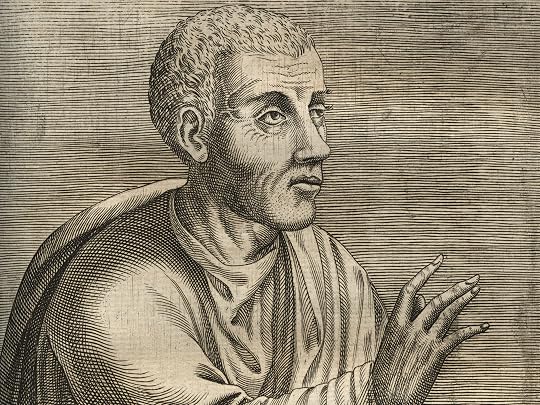
The educator of La Rioja set down these tracts not because he wanted to, but because he was such a beloved teacher that his students and colleagues pestered him into it. He resisted the idea at first because it aint easy, writing an essay on how a child should be taught. To get the to the heart of the matter you have to start from the beginning. Marcus Fabius thus came to the realization that to educate a good orator you must first educate the person on how to be a good person. This applies to all arts & sciences and all of the “jobs” therein.
I’m fascinated with spaces where the moral and educational overlap. “Be a good person” seems like the most trite BS, but implementing exercises that generate a love of reading in a child…? Now we’re talking.
The practical steps of learning to read are applicable today: trace the ABCs, learn syllables (I don’t see this often taught, but I saw with my own kids that teaching them syllables like “ing” and “er” just made sense). Quintilian says learn the trickiest syllables and the trickiest syllable combinations first, then the rest of language is easy.
Next, the little phrases one learns should be wholesome. This also sounds a bit cheesy but his reasoning is sound: when kids are young their memory is strongest; they’ll remember what they hear and say (which is why nurses, or childcare teachers, should also be wholesome), so get them to say good things and that will be in their head forever, not some grating TV show or mindless gibberish. What is “good”, what is “wholesome”? Anyone can decide that easily for themselves.
Quinch stresses the importance of keeping a child happy and wanting to learn to read. It sounds easy, but it isn’t, and it is so important. Ruin a child’s love of learning early (easy to do), and they’ll live a life of darkness and ignorance. Keep them interested, and human potential is limitless. But how?
There are practical means. For example, teaching them “barbarisms” (in Roman times foreign words incorporated into the vernacular) or any other “improper usages” must be “not by way of censuring these poets” (ie, not to call the people who speak this way stupid) “but to remind the pupil of technical rules and activate his memory of them.” (italics mine). I love the idea of teaching literature by way of activating memory — one can see how useful this would be to the budding writer, as well as orator. It also keeps the focus not on red-pen gotcha criticism, but illuminating the design of writing, and by way of that, thinking.
“That is why I shall reckon it among the virtues of the grammaticus not to know some things.”
“Verse they should first break up, then interpret in different words, then make a bolder paraphrase, in which they are allowed to abbreviate and embellish some parts, so long as the poet’s meaning is preserved.”
Apply this exercise, anyone of any age, to the hardest most dense and incomprehensible bit of poetry or prose, Ulysses or Sound and the Fury, and you’ll see that in half an hour you’re well on your way to sorting it all out. Harken to the words he uses: “allow”, “embellish”, “make”. These are all positive things for a student to do, helmed by the overall idea that you are trying to suss what the poet is actually saying (notice he leaves this open-ended, for we have to determine meaning.)
This is just Book 1, folks. Learn music, learn math, don’t bog students down in useless BS. It’s OK to get bits wrong, don’t be pedantic. Amazing stuff.
For the actual book, wherever it gets specific to Latin and Greek, I skipped; but apply this to English, or any language today, the lessons hold. This isn’t a book to be read and shelved, it is a blueprint for an entire Department of Education, should any of us adults be patient enough to learn these timeless lessons and make them new again.
The educator of La Rioja set down these tracts not because he wanted to, but because he was such a beloved teacher that his students and colleagues pestered him into it. He resisted the idea at first because it aint easy, writing an essay on how a child should be taught. To get the to the heart of the matter you have to start from the beginning. Marcus Fabius thus came to the realization that to educate a good orator you must first educate the person on how to be a good person. This applies to all arts & sciences and all of the “jobs” therein.
I’m fascinated with spaces where the moral and educational overlap. “Be a good person” seems like the most trite BS, but implementing exercises that generate a love of reading in a child…? Now we’re talking.
The practical steps of learning to read are applicable today: trace the ABCs, learn syllables (I don’t see this often taught, but I saw with my own kids that teaching them syllables like “ing” and “er” just made sense). Quintilian says learn the trickiest syllables and the trickiest syllable combinations first, then the rest of language is easy.
Next, the little phrases one learns should be wholesome. This also sounds a bit cheesy but his reasoning is sound: when kids are young their memory is strongest; they’ll remember what they hear and say (which is why nurses, or childcare teachers, should also be wholesome), so get them to say good things and that will be in their head forever, not some grating TV show or mindless gibberish. What is “good”, what is “wholesome”? Anyone can decide that easily for themselves.
Quinch stresses the importance of keeping a child happy and wanting to learn to read. It sounds easy, but it isn’t, and it is so important. Ruin a child’s love of learning early (easy to do), and they’ll live a life of darkness and ignorance. Keep them interested, and human potential is limitless. But how?
There are practical means. For example, teaching them “barbarisms” (in Roman times foreign words incorporated into the vernacular) or any other “improper usages” must be “not by way of censuring these poets” (ie, not to call the people who speak this way stupid) “but to remind the pupil of technical rules and activate his memory of them.” (italics mine). I love the idea of teaching literature by way of activating memory — one can see how useful this would be to the budding writer, as well as orator. It also keeps the focus not on red-pen gotcha criticism, but illuminating the design of writing, and by way of that, thinking.
“That is why I shall reckon it among the virtues of the grammaticus not to know some things.”
“Verse they should first break up, then interpret in different words, then make a bolder paraphrase, in which they are allowed to abbreviate and embellish some parts, so long as the poet’s meaning is preserved.”
Apply this exercise, anyone of any age, to the hardest most dense and incomprehensible bit of poetry or prose, Ulysses or Sound and the Fury, and you’ll see that in half an hour you’re well on your way to sorting it all out. Harken to the words he uses: “allow”, “embellish”, “make”. These are all positive things for a student to do, helmed by the overall idea that you are trying to suss what the poet is actually saying (notice he leaves this open-ended, for we have to determine meaning.)
This is just Book 1, folks. Learn music, learn math, don’t bog students down in useless BS. It’s OK to get bits wrong, don’t be pedantic. Amazing stuff.
For the actual book, wherever it gets specific to Latin and Greek, I skipped; but apply this to English, or any language today, the lessons hold. This isn’t a book to be read and shelved, it is a blueprint for an entire Department of Education, should any of us adults be patient enough to learn these timeless lessons and make them new again.

June 27, 2017
Quintilian's classic on the proper education of an orator!

Read
February 5, 2021***Nederlandse vertaling gelezen voor bachelorscriptie***
March 16, 2021
Nog steeds actueel en daarom zo boeiend!

November 26, 2015
11/27/20
Read again on 11/27/20. Changed my rating from 4 to 5 stars. Having studied and taught rhetoric for 5 years now, I've come to appreciate (and understand) Quintilian far more than I did the first time I encountered him. Can't wait to read through the rest of these again.
11/26/15
A classic, thorough treatise on rhetoric. I find Quintilian more helpful and enjoyable than Cicero or Aristotle. In this book particularly, I enjoy Quintilian's commentary on education. The only thing I didn't like was the extended section on the nature of words in the first third of the book. Most of his examples are Greek or Latin words, which I don't understand.
Read again on 11/27/20. Changed my rating from 4 to 5 stars. Having studied and taught rhetoric for 5 years now, I've come to appreciate (and understand) Quintilian far more than I did the first time I encountered him. Can't wait to read through the rest of these again.
11/26/15
A classic, thorough treatise on rhetoric. I find Quintilian more helpful and enjoyable than Cicero or Aristotle. In this book particularly, I enjoy Quintilian's commentary on education. The only thing I didn't like was the extended section on the nature of words in the first third of the book. Most of his examples are Greek or Latin words, which I don't understand.

January 18, 2010
Cicero and Aristotle were both pretty dry. Quntilian puts the rhetoric back into rhetoric theory. There was good advice and the book was written compellingly.
Displaying 1 - 9 of 9 reviews