

What do you think?

Constellations: The Story of Space Told Through the 88 Known Star Patterns in the Night Sky
Perfect for stargazers and armchair astronomers of all ages, CONSTELLATIONS is a beautifully illustrated, fascinatingguide to all 88 constellations, including an illustrated star map for each.In CONSTELLATIONS, award-winning astronomy writer Govert Schilling takes us on an unprecedented visual tour of all 88 constellations in our night sky. Much more than just a stargazer's guide, CONSTELLATIONS is complete history of astronomy as told by Schilling through the lens of each constellation. The book is organized alphabetically by constellation. Profiles of each constellation include basic information such as size, visibility, and number of stars, as well as information on the discovery and naming of the constellation and associated lore. Beyond details about the constellation itself is information about every astronomical event that took place or discovery made in the vicinity of the constellation. In the constellation of Cygnus (the Swan) we encounter the location of the first confirmed black hole. A stop at Gemini (the Twins) is a chance to say hello to the dwarf planet Pluto, and in Orion (the hunter) we find the location of the first identified gamma-ray burst.Stunning star maps throughout the book by acclaimed star mapmaker Wil Tirion show us the exact location of every constellation, the details of its structure, as well as its surrounding astronomical neighbors.
213 pages, Kindle Edition
Published June 4, 2019
About the author
Govert Schilling
118 books50 followersGovert Schilling is freelance wetenschapsjournalist en publicist. Hij schrijft over sterrenkunde en ruimteonderzoek voor kranten en tijdschriften in binnen- en buitenland, o.a. voor de Volkskrant, Eos magazine, Science, New Scientist, Sky & Telescope en BBC Sky at Night. Hij publiceerde tientallen boeken over uiteenlopende sterrenkundige onderwerpen, waarvan sommige zijn vertaald, o.a. in het Engels, Duits en Chinees. Regelmatig geeft hij op radio en tv toelichting op ontwikkelingen in de astronomie. Daarnaast verzorgt hij publiekslezingen en cursussen, en is hij eindredacteur van de populaire website allesoversterrenkunde.nl.
Govert is autodidact op het gebied van de astronomie en de journalistiek. Hij was jarenlang actief in de Jongerenwerkgroep (JWG) voor sterrenkunde, was van 1980 tot 1987 hoofdredacteur van het sterrenkundig tijdschrift Zenit, en was tot 1998 werkzaam als programmaleider bij het Artis Planetarium in Amsterdam.
Voor zijn werk op het gebied van de popularisering van de sterrenkunde ontving Govert diverse prijzen en onderscheidingen, waaronder de Simon Stevin-kijker van de Koninklijke Nederlandse Vereniging voor Weer- en Sterrenkunde KNVWS (1989, samen met astronaut Wubbo Ockels), de Eureka-oeuvreprijs van de Nederlandse organisatie voor Wetenschappelijk Onderzoek NWO (2002) en de David N. Schramm Award van de High-Energy Astrophysics Division van de American Astronomical Society (2014). In 2007 werd planetoïde (10986) Govert naar hem genoemd door de Internationale Astronomische Unie (IAU); in 2021 is hij benoemd tot erelid van deze organisatie.
Govert Schilling is getrouwd, heeft een zoon en een dochter, en woont in Amersfoort.
Govert is autodidact op het gebied van de astronomie en de journalistiek. Hij was jarenlang actief in de Jongerenwerkgroep (JWG) voor sterrenkunde, was van 1980 tot 1987 hoofdredacteur van het sterrenkundig tijdschrift Zenit, en was tot 1998 werkzaam als programmaleider bij het Artis Planetarium in Amsterdam.
Voor zijn werk op het gebied van de popularisering van de sterrenkunde ontving Govert diverse prijzen en onderscheidingen, waaronder de Simon Stevin-kijker van de Koninklijke Nederlandse Vereniging voor Weer- en Sterrenkunde KNVWS (1989, samen met astronaut Wubbo Ockels), de Eureka-oeuvreprijs van de Nederlandse organisatie voor Wetenschappelijk Onderzoek NWO (2002) en de David N. Schramm Award van de High-Energy Astrophysics Division van de American Astronomical Society (2014). In 2007 werd planetoïde (10986) Govert naar hem genoemd door de Internationale Astronomische Unie (IAU); in 2021 is hij benoemd tot erelid van deze organisatie.
Govert Schilling is getrouwd, heeft een zoon en een dochter, en woont in Amersfoort.
Ratings & Reviews
Friends & Following
Create a free account to discover what your friends think of this book!
Community Reviews
Displaying 1 - 8 of 8 reviews

Read
August 14, 2019Govert Schilling is an excellent science writer. I am a huge fan of Schilling's work, first exposed to it by Ripples in Spacetime: Einstein, Gravitational Waves, and the Future of Astronomy - which detailed the phenomena of gravitational waves and the 100 year search for them which was first achieved in September 2015 - and then various articles I've subsequently found from him. Wil Tirion is an excellent astronomical illustrator and stellar map maker -- the author of various star charts widely in use today. Together, they have made an incredibly concise and informative introduction to the 88 constellations established by the IAU in 1928 and a phenomenal jumping off point for anyone who wants to begin exploring the night sky.
The first thirty pages of the book focus on the histories of constellations, the naming conventions of the stars and objects found in constellations, a primer on astronomy, and other useful general information that will help prior to focusing on a particular spot on the night sky. After that, the book is essentially a constellation-by-constellation alphabetical guide outlining the history and characteristics of all the constellations in the sky (categorized as Northern, Equatorial and Southern constellations).
Physical characteristics like how many square degrees of the night sky it holds, what time of year visibility is best, how many naked-eye stars are visible, these are provided at a quick glance amid no shortage of some of the best astrographs and illustrations available showing the nebulae or cluster or other showpiece objects found in the constellation. A detailed map of the constellation itself is also provided (just to make that part explicit). Timelines are also provided, outlining discoveries that took place in the constellation -- the first sighting of a planetary nebula, or a quasar or where a hypernova was first observed for example.
I found this Timeline feature to be the most endearing component of the book. A book like this would be successful if it simply allowed the reader to pick up the "state lines" and borders of the night sky (Sagittarius there, Scorpius there, Ophicus there, etc.) This book also explains what happened in Sagittarius. What has been observed in Scorpius - when, and by whom. What makes Ophicus a section of the sky you could spend all night working through. Armed with that knowledge, looking into the night sky is a little more interesting. Over time, one might discover that the night sky itself becomes intimately familiar, no longer a seemingly random smattering of stars mysteriously migrating through the seasons through mechanisms and orders just beyond one's grasp.
As I consider it, I would probably recommend this book to anyone who is unable to efficiently direct someone else's gaze to a single point in the night sky using language alone. (no pointing allowed!) This is an excellent book for learning the constellations -- for learning the language of the night sky itself and what is found within these arbitrary boundaries we share.
The first thirty pages of the book focus on the histories of constellations, the naming conventions of the stars and objects found in constellations, a primer on astronomy, and other useful general information that will help prior to focusing on a particular spot on the night sky. After that, the book is essentially a constellation-by-constellation alphabetical guide outlining the history and characteristics of all the constellations in the sky (categorized as Northern, Equatorial and Southern constellations).
Physical characteristics like how many square degrees of the night sky it holds, what time of year visibility is best, how many naked-eye stars are visible, these are provided at a quick glance amid no shortage of some of the best astrographs and illustrations available showing the nebulae or cluster or other showpiece objects found in the constellation. A detailed map of the constellation itself is also provided (just to make that part explicit). Timelines are also provided, outlining discoveries that took place in the constellation -- the first sighting of a planetary nebula, or a quasar or where a hypernova was first observed for example.
I found this Timeline feature to be the most endearing component of the book. A book like this would be successful if it simply allowed the reader to pick up the "state lines" and borders of the night sky (Sagittarius there, Scorpius there, Ophicus there, etc.) This book also explains what happened in Sagittarius. What has been observed in Scorpius - when, and by whom. What makes Ophicus a section of the sky you could spend all night working through. Armed with that knowledge, looking into the night sky is a little more interesting. Over time, one might discover that the night sky itself becomes intimately familiar, no longer a seemingly random smattering of stars mysteriously migrating through the seasons through mechanisms and orders just beyond one's grasp.
As I consider it, I would probably recommend this book to anyone who is unable to efficiently direct someone else's gaze to a single point in the night sky using language alone. (no pointing allowed!) This is an excellent book for learning the constellations -- for learning the language of the night sky itself and what is found within these arbitrary boundaries we share.

October 3, 2024
Just so pretty! The images in this book are gorgeous and the information is very cool. Organized by constellation with lots of little tidbits about each one, it is a delight to flip through and learn from. A wonderful coffee table book or companion for a night of star gazing.

June 13, 2019
Just loving the way we get to discover the wide area that is called space
July 14, 2021
Invaluable for any amateur astronomer student.

December 14, 2021
Very pretty book for the coffee table. Not a hefty scientific work but nice to glaze through on rainy days and cloudy nights sipping on a nice cup of coco
May 5, 2022
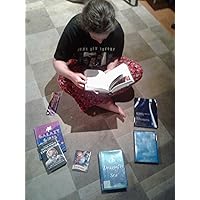
Great overview of the constellations.
March 16, 2025
Interesting format for this book combining historical drawings with modern photographs.

Displaying 1 - 8 of 8 reviews