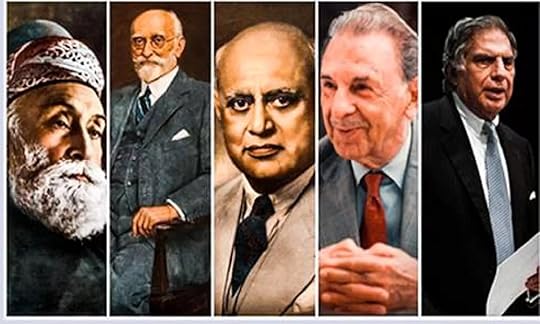
The narrative of Tata is inspiring. It is a tale which endorses the Indian tradition of upholding community values above individual gain. It is unbelievable that an enterprise could be built on such a philanthropic value system. Companies are customarily organised on two lines – either to make money for their shareholders or, in idealised socialist theory, to convey services for sections of the community. The story of Tata, is a story about a really inimitable company which was established to do both.
As to why this book was written, the author says:
“The Tata conglomerate is intricately intertwined in so many of India’s successes and firsts, and most of these, incredibly, have remained uncovered. Not many know that it was the Tatas who brought silk to Mysore or that they were the ones who got strawberries to Mahabaleshwar, a popular hill station in Maharashtra now synonymous with the fruit.
Not many are conscious, either, that the world’s earliest worker welfare policies were drafted in a Tata venture or that the Tatas were global pioneers in conceiving a hydroelectric project. Though much has been written about the Tatas, it has been more often than not from a corporate or industry-specific perspective, such as on Tata Steel or Tata Consultancy Services (TCS).
My effort here is to tell the human side of this business story, from the common man’s point of view, without resorting to jargon and mind-boggling numbers.”
Yet, numbers do play a vital role. By the 1930s, the Tatas were providing 72 percent of India’s requirement of steel, covering the gamut from defence applications, to the railways and iconic projects like the Howrah Bridge. 23,000 tonnes, or about 85 percent of the steel used to build the bridge that defines the Kolkata skyline to this day, came from Jamshedpur.
This role intensified after 1947. A newly independent India needed an agricultural and industrial revolution, neither of which could happen without machinery and power, or Tata’s steel.
Steel was indispensable to manufacturing agricultural tools. It was crucial for speedily scaling down the import of capital goods — needed to industrialise India — from a brutal 90 percent in 1950 to about half of that in the 1960s. It was essential to building factories, dams and power plants. Much of it came from the Tatas, the largest steel maker in the country then.
They have come a long way, but their pivotal role in nation building hasn’t changed.
And it all germinated in 1822, when a toddler was born in a priestly household in Gujarat’s Navsari. ‘This boy is going to rule the world. He will be rich enough to build a seven-storey bungalow,’ prophesied the astrologer and quite predictably got a nice offering for himself. Young Nusserwanji knew early on that his destiny lay beyond his village and decided to head for Bombay to start a business. He had neither higher education nor knowledge of trade matters, just a flaming passion to whittle his own trail.
“What Nusserwanji started as a cotton trading venture, his son Jamsetji—born in the same year as Rockefeller—grew into a multifaceted business, turning around sick textile mills, setting up an iron and steel company, and building a world-class hotel. Stewarded ably over the decades by Jamsetji’s sons Dorabji and Ratanji, the charismatic and larger-than-life JRD, and thereafter the more business-like Ratan, the Tata group today is a 110-billion-dollar empire.
The Tatas is their story. But it is more than just a history of the industrial house; it is an inspiring account of India in the making. It
Jamsetji Nusserwanji Tata had established Tata Group as a private trading firm in 1868. In 1902, the group incorporated the Indian Hotels Company to commission the Taj Mahal Palace & Tower; it was the first luxury hotel in the country.
In 1904, Jamsetji died and his son, Sir Dorab Tata took over as chair of the company. Under the guidance and leadership of Dorab, the group grew quickly, venturing into different industry segments like steel (1907), electricity (1910), education (1911), consumer goods (1917), and aviation (1932).
In 1932, when Dorab died, Sir Nowroji Saklatwala took the position. After six years, Jahangir Ratanji Dadabhoy Tata became the group’s chair. He took the company’s expansion on many new sectors including chemicals (1939), cosmetics (1952), marketing, engineering and manufacturing (1954), tea (1962) and software services (1968).
In 1945, Tata Group added another start in their sky by establishing Tata Engineering and Locomotive Company; it was renamed as Tata Motors in the year 2003. This company is involved in manufacturing engineering and locomotive products.
This book gives you a direct insight into the minds of four giants – Jamsetji, Sir Dorab, Nowroji Saklatwala and JRD. It is also a walk down India’s Industrial history.
If Jamsetji’s powerful vision inspired the steel and power industries in India, set the foundation for technical educaton, and helped the country leapfrog from backwardness to the ranks of industrialised nations, it was Sir Dorab Tata, who was instrumental in transforming his father's grand vision into reality. It was also Dorab’s leadership that the Tata Trust, the premier charitable endowment of the Tatas, was created, propelling the Tata tradition of philanthropy. Nowroji Saklatwala succeeded Dorabji as chairman of the Group. And it was JRD, who pioneered civil aviation on the subcontinent in 1932 by launching the airline now known as Air India. That was the first of many path-breaking achievements that JRD, who guided the destiny of the Group for more than half a century, came to be remembered for.
While turning over the pages of this book, you would almost feel trepidation, owing to the fact that here are the humane images of those people who have painstakingly carved a giant. With 500,000 orders being executed per second, the Bombay Stock Exchange (BSE) is the fastest stock exchange in the world. With more than 1,700 listed companies whose market capitalisation exceeds $2 trillion, the National Stock Exchange (NSE) is not only India’s largest stock exchange by transaction volume but also among the top three bourses in the world. The only commonality they share is that their systems and software are invisibly driven by Tata Consultancy Services (TCS), the world’s second most valuable information technology company.
Entrepreneurship single-handedly can never be enough in a nation like India; it has to walk hand in hand with an obligation to society and country. This demands a frame of mind that makes room for social responsibilities that are rendered as expansively as possible. A convincing example of how such a two-pronged approach — entrepreneurial success balanced by societal obligations — can be found in the way the Tata Group, one of India’s biggest and most respected business conglomerates, has conducted itself.
Read the book to live the experience on your own.