

What do you think?

Star Trek: TNG Movie Novelizations #1
Star Trek Generations
A time warp brings Captains Picard and Kirk together, as they join forces to stop a madman bent on using a new superweapon to destroy Veridian Three
304 pages, Mass Market Paperback
First published December 1, 1994
About the author
J.M. Dillard
44 books119 followersJ.M. Dillard is the pseudonym under which Jeanne Kalogridis (b. 1954) publishes her Star Trek novels.
Ratings & Reviews
Friends & Following
Create a free account to discover what your friends think of this book!
Community Reviews
Displaying 1 - 30 of 75 reviews

October 18, 2023
What a great novelization. Oh, this book added so much for the movie for me, particularly in the opening sequence. I now understand why J M Dillard did 6 of the novelizations for Star Trek.
This movie is certainly controversial, as many did not like Kirk's death or the general plot. That being said, this book really adds context and new scenes for both, and really makes them work well.
The opening portion of the book featuring Kirk and the TOS characters is 70 pages long, taking up almost a third of the novelization. The opening sequence of the movie only takes up about a very small portion of the movie, with the TNG characters having the lionshare of the screentime. This portion adds so many scenes and dialogues between the characters that really prepares the audience for the sendoff. The scenes before Kirk goes to the Enterprise-B are so touching, and the scene of Chekov breaking the news to Sulu and the scene of Spock meeting back up with McCoy at the memorial service really moved me to tears. If the movie had incorporated that sequence in some way, it would have been WAY better! I cannot tell you how much those sequences truly made me feel for the characters, in a way I haven't felt since Picard Season 3.
The main portion of the book is more straightforward, featuring fewer scenes original scenes and more as a straight adaptation. However, there is still tons of insight into the characters and situations that really makes hardcore Trekkies interested.
The one downside I had was that the final death scene of Kirk still felt a little off, just as it does in the movie, but I don't fault Dillard entirely. It needed more, but there was only so much she could give without compromising the canon of the story.
There was also a fantastic 40 page behind the scenes featurette at the end of the book, and I loved reading it almost as much as the novelization itself. It felt like a "making of book" but in mini-form. I wish every novelization utilized this feature.
Overall, a terrific novelization by J M Dillard! The movie is "mid" for me, but this novelization is amazing. 9.3 out of 10!
This movie is certainly controversial, as many did not like Kirk's death or the general plot. That being said, this book really adds context and new scenes for both, and really makes them work well.
The opening portion of the book featuring Kirk and the TOS characters is 70 pages long, taking up almost a third of the novelization. The opening sequence of the movie only takes up about a very small portion of the movie, with the TNG characters having the lionshare of the screentime. This portion adds so many scenes and dialogues between the characters that really prepares the audience for the sendoff. The scenes before Kirk goes to the Enterprise-B are so touching, and the scene of Chekov breaking the news to Sulu and the scene of Spock meeting back up with McCoy at the memorial service really moved me to tears. If the movie had incorporated that sequence in some way, it would have been WAY better! I cannot tell you how much those sequences truly made me feel for the characters, in a way I haven't felt since Picard Season 3.
The main portion of the book is more straightforward, featuring fewer scenes original scenes and more as a straight adaptation. However, there is still tons of insight into the characters and situations that really makes hardcore Trekkies interested.
The one downside I had was that the final death scene of Kirk still felt a little off, just as it does in the movie, but I don't fault Dillard entirely. It needed more, but there was only so much she could give without compromising the canon of the story.
There was also a fantastic 40 page behind the scenes featurette at the end of the book, and I loved reading it almost as much as the novelization itself. It felt like a "making of book" but in mini-form. I wish every novelization utilized this feature.
Overall, a terrific novelization by J M Dillard! The movie is "mid" for me, but this novelization is amazing. 9.3 out of 10!

December 29, 2018
This movie I know very well because it's still my favorite Trek movie after all these years (yes, I know that makes me strange since the odd numbered ones aren't the majority favorites). Anyhoo, compared to the movie, the audiobook was good, compared to the book, I don't know - it's an abridged version, and it's been years since I read it.
---
6/9/21 - Unabridged, definitely better, though not all that different... though I could swear it has the original ending where Kirk's shot, but it has been a while since.
---
6/9/21 - Unabridged, definitely better, though not all that different... though I could swear it has the original ending where Kirk's shot, but it has been a while since.

January 17, 2014
J.M. Dillard managed to take what was quite possibly the dullest of the Star Trek films and turn it into a solid read. I've always felt the film was a mid-quality Next Generation two-parter with a movie budget and an Original Series cast prologue stuck onto it which is something that Dillard does a really good job of readdressing here by giving the Original Series cast sections more depth and weight. It would also appear to be based on an earlier draft of the film's script and includes the original ending for the film which works far better on paper than it apparently did when they tried to include it in the film itself. In short, this is one of those rare occasions when an adaptation (in this a novelization) is far better than its source material.

February 21, 2025
I'm going to boldly go, er, publicly declare an opinion I have never, in thirty years, heard from anyone else's lips: Generations is my personal favorite of all the Star Trek feature films.
I ain't saying it's the "best," however that's measured. Or that's it's flawless, though few films and novels (even the great ones) are. Merely that it delivered exactly what I wanted from it in 1994... and resonates with me still -- perhaps more profoundly yet -- in 2024.
By the time I was aware of Trek, the movie phase of the franchise was already underway; there were two or three of them at that point. I used to watch syndicated reruns of The Original Series on local TV; I absolutely recall screening "The City on the Edge of Forever" for the first time, never having seen an episode of television so conceptually clever and emotionally affecting. Seeing how the TV show predated my birth by a decade, Captain Kirk and his crew were characters that, in my mind, had always existed, like Batman and Robin.
But unlike the Dynamic Duo, they aged; to experience the TV series and the feature films side-by-side was to flip through a family photo album of sorts. To be a young fan of Star Trek in the mid-1980s was to understand, if only tacitly, you had joined a history already in progress, one you could jump around and explore at your own discretion. Trek was, at the time, a rare wonder: a multimedia franchise comprised of a live-action TV show, an animated series, feature films, novels, and comic books, its stories spanning multiple eras in the adventures of the U.S.S. Enterprise. It was all for the taking; time -- which is to say linearity -- had no meaning in the expansive storyworld of Star Trek.
Trek's innovative (if mostly accidental) multimedia narrativity had its admirers -- and a paying audience, else Paramount would have otherwise bailed on the franchise -- but by the early '80s, it was still what you might call a cult success. The turning point came in 1986 when Star Trek IV: The Voyage Home was released: Everyone loved that movie. It won over audiences that weren't Trekkies, and in some cases had never previously so much as watched Star Trek. (It also coincided with Trek's twentieth anniversary, and I remember thinking at the time how crazy it was a media franchise had lasted that long! This was, of course, before forty-years-later sequels to properties like Ghostbusters and Beverly Hills Cop and Top Gun and
Halloween: The Official Movie Novelization and The Exorcist, etcetera, became commonplace, but I digress.) Hell, my fifth-grade teacher used Star Trek IV as an opportunity to introduce the subject of environmentalism to our class, since there wasn't anyone who hadn't seen it.
The commercial success and mainstream popularity of The Voyage Home paved the way for a new TV series that would not feature Shatner and Nimoy, et al. If you weren't there for it, it's hard to convey how mind-blowing that was -- an unprecedented franchise extension like that. That was the undiscovered country, pop-culturally speaking. (Now, of course, everything's a goddamn "shared universe," but it was really novel in 1987.)
For the next half-dozen years, Shatner headlined the movies while Stewart was patiently winning over viewers on TV, with some of the supporting actors of each generation (DeForest Kelley, Leonard Nimoy, James Doohan from TOS; Michael Dorn from TNG) making crossover appearances to the small and big screens, respectively.
Then... a pair of perfect sendoffs: first for the TOS crew with Star Trek VI: The Undiscovered Country, followed by TNG's series finale All Good Things.... And when Generations came out at Thanksgiving of 1994 -- the feature-length epic that was going to at long last unite Kirk and Picard face-to-face -- that was a capital-E event. I had just started college earlier that autumn; a bunch of us eagerly went to see it on my friend's eighteenth birthday.
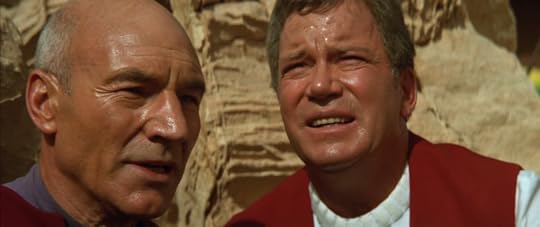
Here's a movie that had the unique challenge -- and unenviable task -- of being both a sequel to The Next Generation TV series and the six features that came before it, as well as having to stand on its own two legs, and despite a zillion needless nerd-blog reappraisals of the movie in the decades since its release, I'm here to tell you as someone who saw Generations on opening weekend -- long before the Internet, that cursed mouthpiece of modern "fandom," sucked the joy out of everything -- it rose to the occasion.
The premise: With millions of lives at stake, Captains Picard (Patrick Stewart) and Kirk (William Shatner) must prevent a mad scientist (Malcolm McDowell) from destroying a star, a mission that takes them into an extradimensional realm in which both death and time are rendered moot.
Even in 1994, critics largely dismissed this effort as a mere "two-hour installment of The Next Generation," and it does in many ways reflect the pacing and particular storytelling approach of the series (which was still in production as filming on Generations commenced), but there's some remarkable screenwriting at work here that, in my view, has gone inexplicably unappreciated, especially given all this movie had to do as a franchise transitional juncture.
First off, the conceit of a "temporal nexus" -- an elysian dreamland where one's past, present, and idealized future can be visited and revisited at will -- was a brilliant sci-fi whatsit to bridge the eighty-year gap between the two generations without resorting to conventional time travel (which had been done so often before, and would be resorted to yet again in the very next sequel).
Furthermore, far from a mere plot device, the Nexus directly informs the emotional arcs of both the heroes (Picard is dealing with the recent tragic death of his brother and nephew, the family's last male heir; Kirk is feeling used up and useless in retirement) and the villain (McDowell's Dr. Soran is grieving the inconsolable loss of his family, killed off-screen by the Borg).
Also, unlike the well-meaning but creatively ill-advised Star Trek V: The Final Frontier, issues of mortality and legacy are explored -- are dramatized -- with real nuance here. And how Tolian Soran isn't regarded as one of the great Trek antagonists alongside Khan I'll never know: Soran is a man who rejects the truth of his existence -- his mortality -- in favor of the "new truth" presented by the Nexus; surely the screenwriters had Søren Kierkegaard's concept of "Truth as Subjectivity" in mind when they named him?
For its narrative ambition, philosophical weight, and long-awaited team-up of Shatner and Stewart (who exhibited great chemistry), this is my personal favorite of the Trek feature films. Given that, I can't believe it's taken me thirty years to read the book! (The Kindle Store had it on sale for $1.99, and I had a $1.50 in digital credits about to expire, so I got it for the bargain price of forty-nine cents. Before I comment on content, I will briefly note here that this edition has its share of regular typos, which probably occurred when the original print manuscript was converted post factum to e-book format. It also includes a substantive and informative behind-the-scenes article on the project's creative development by Judith Reeves-Stevens and Garfield Reeves-Stevens.)
It's always wise to set one's expectations low with a novelization. I'd previously read J.M. Dillard's adaptation of Star Trek: Insurrection (reviewed here) and commended its efficient prose and background information on the villains, but felt the movie's romantic tone and rebellious spirit (owed to the direction of Jonathan Frakes, I presume) got lost in translation to the page. I'm pleased to report that the Generations novelization not only succeeds with respect to conveying the movie's plot and tone, but Dillard (who's written multiple tie-in novels for both TOS and TNG) nailed the voices of all the characters from both generations.
Furthermore, she expands on the story material in the best possible way. Generations is, for better and for worse, a movie that leaves you wanting more. I wanted more time with the original crew aboard the Enterprise-B in the opening sequence, and definitely more time in the Nexus. Shatner and Stewart had wonderful rapport; I would have welcomed more than their twenty minutes of screen time together. But...
I also appreciate (just as I did in 1994) that this is a two-hour feature film, a storytelling format that leaves no room for narrative digression. Screenwriting is, about all, about economy of storytelling. (Having worked as a professional screenwriter for many years, I'm grateful for the discipline it instilled in me, but quite happy to be a novelist now, a far less restrictive mode of creativity.) So, even though more could have been done with this story, I understand why it wasn't -- and I agree with the choices the screenwriters/filmmakers ultimately made.
That said, Dillard uses this opportunity to do what frustratingly few novelizations attempt (usually owed to creative limitations explicitly placed on the author by the producers): embellish the plot. She picks up the story immediately after the events of The Undiscovered Country, as the sobering realities of retirement are absorbed by the decommissioned Enterprise-A crew. We get a lot of scenes with the entire TOS ensemble -- not merely Kirk, Scotty, and Chekov, the only O.G. cast members to appear in the film -- and the additional material provides a nice postlude to the events of Star Trek VI. The inclusion of Spock and McCoy in particular, their absence so acutely felt in the movie, gives the early chapters added emotional weight. The arrival on the bridge of the Enterprise-B, which opens the movie, doesn't occur until the 6% mark of the novel. That would have been too much superfluous setup for a feature film, which needed to get to its inciting incident () as quickly as possible, but it makes for a joyful opening section of the book.
Just as Dillard spares some pages to lead up to the ill-fated adventure aboard the Enterprise-B, she also pauses afterward -- before transitioning to the TNG era -- to allow the crew of the Enterprise-A to learn of and react to the news of , including a tender scene between McCoy and Spock, and a sequence aboard the Excelsior with Captain Sulu. Again: These scenes would have weighted down a movie but give the novelization its value as an independent (or at least supplemental) entity. (Dillard also puts us in Soran's head occasionally, shedding more light on his genocidal grief, albeit sometimes with needless repetition.)
Eventually we get to the TNG portion of the story (a full quarter of the way through the novel!), which closely follows the events of the finished film, almost line-for-line. (Though we do get a bit more insight into how Soran's time in the Nexus affected him: )
It's the chapters in the Nexus itself that really make this worth the read. First off, merely the way Dillard describes the ribbon as a cosmological phenomenon expertly exploits the advantages of the page over the screen:
Furthermore, she conveys exactly how the intoxicating effects of the Nexus override the capacity for rational thought that might otherwise "break" its illusion, as in this scene in which Picard learns that his recently deceased brother will be arriving shortly for Christmas dinner, evoking vivid recollections of events that never actually occurred:
And when Picard begins to suspect something fishy, he still can't quite put his finger on what is happening to him, and tries to rationalize it based on phenomena he better understands:
Meanwhile, elsewhere in the Nexus, Kirk is having his own out-of-body experience(s):
[Reviewer's note: Owed to space constraints, the remainder of this review can be found in the comments section below.]
I ain't saying it's the "best," however that's measured. Or that's it's flawless, though few films and novels (even the great ones) are. Merely that it delivered exactly what I wanted from it in 1994... and resonates with me still -- perhaps more profoundly yet -- in 2024.
By the time I was aware of Trek, the movie phase of the franchise was already underway; there were two or three of them at that point. I used to watch syndicated reruns of The Original Series on local TV; I absolutely recall screening "The City on the Edge of Forever" for the first time, never having seen an episode of television so conceptually clever and emotionally affecting. Seeing how the TV show predated my birth by a decade, Captain Kirk and his crew were characters that, in my mind, had always existed, like Batman and Robin.
But unlike the Dynamic Duo, they aged; to experience the TV series and the feature films side-by-side was to flip through a family photo album of sorts. To be a young fan of Star Trek in the mid-1980s was to understand, if only tacitly, you had joined a history already in progress, one you could jump around and explore at your own discretion. Trek was, at the time, a rare wonder: a multimedia franchise comprised of a live-action TV show, an animated series, feature films, novels, and comic books, its stories spanning multiple eras in the adventures of the U.S.S. Enterprise. It was all for the taking; time -- which is to say linearity -- had no meaning in the expansive storyworld of Star Trek.
Trek's innovative (if mostly accidental) multimedia narrativity had its admirers -- and a paying audience, else Paramount would have otherwise bailed on the franchise -- but by the early '80s, it was still what you might call a cult success. The turning point came in 1986 when Star Trek IV: The Voyage Home was released: Everyone loved that movie. It won over audiences that weren't Trekkies, and in some cases had never previously so much as watched Star Trek. (It also coincided with Trek's twentieth anniversary, and I remember thinking at the time how crazy it was a media franchise had lasted that long! This was, of course, before forty-years-later sequels to properties like Ghostbusters and Beverly Hills Cop and Top Gun and
Halloween: The Official Movie Novelization and The Exorcist, etcetera, became commonplace, but I digress.) Hell, my fifth-grade teacher used Star Trek IV as an opportunity to introduce the subject of environmentalism to our class, since there wasn't anyone who hadn't seen it.
The commercial success and mainstream popularity of The Voyage Home paved the way for a new TV series that would not feature Shatner and Nimoy, et al. If you weren't there for it, it's hard to convey how mind-blowing that was -- an unprecedented franchise extension like that. That was the undiscovered country, pop-culturally speaking. (Now, of course, everything's a goddamn "shared universe," but it was really novel in 1987.)
For the next half-dozen years, Shatner headlined the movies while Stewart was patiently winning over viewers on TV, with some of the supporting actors of each generation (DeForest Kelley, Leonard Nimoy, James Doohan from TOS; Michael Dorn from TNG) making crossover appearances to the small and big screens, respectively.
Then... a pair of perfect sendoffs: first for the TOS crew with Star Trek VI: The Undiscovered Country, followed by TNG's series finale All Good Things.... And when Generations came out at Thanksgiving of 1994 -- the feature-length epic that was going to at long last unite Kirk and Picard face-to-face -- that was a capital-E event. I had just started college earlier that autumn; a bunch of us eagerly went to see it on my friend's eighteenth birthday.
Here's a movie that had the unique challenge -- and unenviable task -- of being both a sequel to The Next Generation TV series and the six features that came before it, as well as having to stand on its own two legs, and despite a zillion needless nerd-blog reappraisals of the movie in the decades since its release, I'm here to tell you as someone who saw Generations on opening weekend -- long before the Internet, that cursed mouthpiece of modern "fandom," sucked the joy out of everything -- it rose to the occasion.
The premise: With millions of lives at stake, Captains Picard (Patrick Stewart) and Kirk (William Shatner) must prevent a mad scientist (Malcolm McDowell) from destroying a star, a mission that takes them into an extradimensional realm in which both death and time are rendered moot.
Even in 1994, critics largely dismissed this effort as a mere "two-hour installment of The Next Generation," and it does in many ways reflect the pacing and particular storytelling approach of the series (which was still in production as filming on Generations commenced), but there's some remarkable screenwriting at work here that, in my view, has gone inexplicably unappreciated, especially given all this movie had to do as a franchise transitional juncture.
First off, the conceit of a "temporal nexus" -- an elysian dreamland where one's past, present, and idealized future can be visited and revisited at will -- was a brilliant sci-fi whatsit to bridge the eighty-year gap between the two generations without resorting to conventional time travel (which had been done so often before, and would be resorted to yet again in the very next sequel).
Furthermore, far from a mere plot device, the Nexus directly informs the emotional arcs of both the heroes (Picard is dealing with the recent tragic death of his brother and nephew, the family's last male heir; Kirk is feeling used up and useless in retirement) and the villain (McDowell's Dr. Soran is grieving the inconsolable loss of his family, killed off-screen by the Borg).
Also, unlike the well-meaning but creatively ill-advised Star Trek V: The Final Frontier, issues of mortality and legacy are explored -- are dramatized -- with real nuance here. And how Tolian Soran isn't regarded as one of the great Trek antagonists alongside Khan I'll never know: Soran is a man who rejects the truth of his existence -- his mortality -- in favor of the "new truth" presented by the Nexus; surely the screenwriters had Søren Kierkegaard's concept of "Truth as Subjectivity" in mind when they named him?
For its narrative ambition, philosophical weight, and long-awaited team-up of Shatner and Stewart (who exhibited great chemistry), this is my personal favorite of the Trek feature films. Given that, I can't believe it's taken me thirty years to read the book! (The Kindle Store had it on sale for $1.99, and I had a $1.50 in digital credits about to expire, so I got it for the bargain price of forty-nine cents. Before I comment on content, I will briefly note here that this edition has its share of regular typos, which probably occurred when the original print manuscript was converted post factum to e-book format. It also includes a substantive and informative behind-the-scenes article on the project's creative development by Judith Reeves-Stevens and Garfield Reeves-Stevens.)
It's always wise to set one's expectations low with a novelization. I'd previously read J.M. Dillard's adaptation of Star Trek: Insurrection (reviewed here) and commended its efficient prose and background information on the villains, but felt the movie's romantic tone and rebellious spirit (owed to the direction of Jonathan Frakes, I presume) got lost in translation to the page. I'm pleased to report that the Generations novelization not only succeeds with respect to conveying the movie's plot and tone, but Dillard (who's written multiple tie-in novels for both TOS and TNG) nailed the voices of all the characters from both generations.
Furthermore, she expands on the story material in the best possible way. Generations is, for better and for worse, a movie that leaves you wanting more. I wanted more time with the original crew aboard the Enterprise-B in the opening sequence, and definitely more time in the Nexus. Shatner and Stewart had wonderful rapport; I would have welcomed more than their twenty minutes of screen time together. But...
I also appreciate (just as I did in 1994) that this is a two-hour feature film, a storytelling format that leaves no room for narrative digression. Screenwriting is, about all, about economy of storytelling. (Having worked as a professional screenwriter for many years, I'm grateful for the discipline it instilled in me, but quite happy to be a novelist now, a far less restrictive mode of creativity.) So, even though more could have been done with this story, I understand why it wasn't -- and I agree with the choices the screenwriters/filmmakers ultimately made.
That said, Dillard uses this opportunity to do what frustratingly few novelizations attempt (usually owed to creative limitations explicitly placed on the author by the producers): embellish the plot. She picks up the story immediately after the events of The Undiscovered Country, as the sobering realities of retirement are absorbed by the decommissioned Enterprise-A crew. We get a lot of scenes with the entire TOS ensemble -- not merely Kirk, Scotty, and Chekov, the only O.G. cast members to appear in the film -- and the additional material provides a nice postlude to the events of Star Trek VI. The inclusion of Spock and McCoy in particular, their absence so acutely felt in the movie, gives the early chapters added emotional weight. The arrival on the bridge of the Enterprise-B, which opens the movie, doesn't occur until the 6% mark of the novel. That would have been too much superfluous setup for a feature film, which needed to get to its inciting incident () as quickly as possible, but it makes for a joyful opening section of the book.
Just as Dillard spares some pages to lead up to the ill-fated adventure aboard the Enterprise-B, she also pauses afterward -- before transitioning to the TNG era -- to allow the crew of the Enterprise-A to learn of and react to the news of , including a tender scene between McCoy and Spock, and a sequence aboard the Excelsior with Captain Sulu. Again: These scenes would have weighted down a movie but give the novelization its value as an independent (or at least supplemental) entity. (Dillard also puts us in Soran's head occasionally, shedding more light on his genocidal grief, albeit sometimes with needless repetition.)
Eventually we get to the TNG portion of the story (a full quarter of the way through the novel!), which closely follows the events of the finished film, almost line-for-line. (Though we do get a bit more insight into how Soran's time in the Nexus affected him: )
It's the chapters in the Nexus itself that really make this worth the read. First off, merely the way Dillard describes the ribbon as a cosmological phenomenon expertly exploits the advantages of the page over the screen:
Overhead, the sky faded to the odd, faux-twilight gray of a solar eclipse. The trees surrounding them, which had rustled with animal life, went abruptly silent; a solitary bird released a tremulous cry that echoed off the nearby mountains, then fell quiet. As Picard stood gazing upward, Soran reclimbed the scaffolding against the backdrop of darkening sky, streaked with jagged, writhing energy. Once atop the pinnacle, the scientist raised his face toward the heavens; the glow from the ribbon lit his features, revealing the ecstatic, beatific expression of a saint.
In the gathering gloom, the wind picked up quickly and began to whip up dust. The ribbon neared, illuminating the plateau with unearthly light, filling the air with a strangely electrical charge, one that smelled of a recent lightning strike, one that made the hair on the back of Picard's neck rise. He instinctively backed away until his back pressed against the scaffolding.
There was nowhere to run, nowhere to flee. He shut his eyes, grimacing at the airborne sand that stung his face, at the piercing crackle of the ribbon, at the light so dazzling, so colorful, it pained him despite his closed eyelids.
And then the ribbon intensified beyond all human capacity to bear; he cried out in agony at its deafening roar, its sheer brilliance, its blinding beauty.
And just as suddenly, there was no Picard, no Soran, no Veridian, no self or other. Only darkness...
Furthermore, she conveys exactly how the intoxicating effects of the Nexus override the capacity for rational thought that might otherwise "break" its illusion, as in this scene in which Picard learns that his recently deceased brother will be arriving shortly for Christmas dinner, evoking vivid recollections of events that never actually occurred:
Sudden tears stung his eyes; he blinked them back, swallowed hard, found his voice. His heartbeat quickened with abrupt anticipation. "And René. Will he and..." He paused, marveling at the memories that came from some mysterious place outside his own recollection. "... Katya be coming?"
Yes, Katya. That was her name; a tall, red-haired young woman with striking Asian features. He had attended their wedding two years before; Mimi had been flower girl.
And when Picard begins to suspect something fishy, he still can't quite put his finger on what is happening to him, and tries to rationalize it based on phenomena he better understands:
It had occurred to him that this was a strange mental state induced by dying ... but he was not dead. His flesh seemed to him perfectly solid.
Meanwhile, elsewhere in the Nexus, Kirk is having his own out-of-body experience(s):
[Reviewer's note: Owed to space constraints, the remainder of this review can be found in the comments section below.]

December 24, 2017
A good solid read to end the year...it was actually better that I recall the film being!

June 29, 2021
One or two bad words, on par with the rest of the Star Trek: TNG series. No sexuality, which was nice.
The writing was so good that I wasn't even aware of it – I was transported into the story again. It might have helped that I have already seen the movie several times. But it was so much fun to relive it again.
And I especially enjoyed the few interior thoughts we got of Picard, Riker, Geordi, and even Soran to help us understand their reasoning for their actions. Those are things that a movie just can't do very well. I loved how Deanna got a sense of what their future could have been. But I kept waiting to see how Deanna dealt with all the fears of the Enterprise crew in the disaster. It was never mentioned.
I also loved the Behind the Scenes report and pictures from the movie. It was like a separate little story within a story.
Favorite quotes:
One of my favorite scenes in the movie is this unnecessary but hilarious showcase of Data's emotion chip: “'I would be happy to, sir. I just love to scan for life-forms.' He set at once to work, ad-libbing a merry little song: 'Life-forms … tiny little life-forms … where are you, life-forms … ?'” (p. 160)
“He [Data] gave a small, sheepish shrug, causing a single glistening drop to spill down his pale cheek. 'I am not sure, Counselor. I am happy to see Spot … and yet I am crying. The chip must be malfunctioning.' Troi gently placed a hand on his arm. 'No, Data. I think it's working perfectly.' He looked up at her and smiled through his tears.” (p. 238-239)
“'It's not how many years you've lived, Will … but how you've lived them.' He [Jean-Luc] paused. 'Someone once told me that time is a predator that stalks us all our lives. But maybe time is also a companion … who goes with us on our journey, and reminds us to cherish the moments of our lives – because they will never come again. We are, after all, only mortal.” (p. 240)
(My husband bought this copy many years ago before we were married. I was not compensated for this review. All opinions are my own, as was the decision to write this review.)
The writing was so good that I wasn't even aware of it – I was transported into the story again. It might have helped that I have already seen the movie several times. But it was so much fun to relive it again.
And I especially enjoyed the few interior thoughts we got of Picard, Riker, Geordi, and even Soran to help us understand their reasoning for their actions. Those are things that a movie just can't do very well. I loved how Deanna got a sense of what their future could have been. But I kept waiting to see how Deanna dealt with all the fears of the Enterprise crew in the disaster. It was never mentioned.
I also loved the Behind the Scenes report and pictures from the movie. It was like a separate little story within a story.
Favorite quotes:
One of my favorite scenes in the movie is this unnecessary but hilarious showcase of Data's emotion chip: “'I would be happy to, sir. I just love to scan for life-forms.' He set at once to work, ad-libbing a merry little song: 'Life-forms … tiny little life-forms … where are you, life-forms … ?'” (p. 160)
“He [Data] gave a small, sheepish shrug, causing a single glistening drop to spill down his pale cheek. 'I am not sure, Counselor. I am happy to see Spot … and yet I am crying. The chip must be malfunctioning.' Troi gently placed a hand on his arm. 'No, Data. I think it's working perfectly.' He looked up at her and smiled through his tears.” (p. 238-239)
“'It's not how many years you've lived, Will … but how you've lived them.' He [Jean-Luc] paused. 'Someone once told me that time is a predator that stalks us all our lives. But maybe time is also a companion … who goes with us on our journey, and reminds us to cherish the moments of our lives – because they will never come again. We are, after all, only mortal.” (p. 240)
(My husband bought this copy many years ago before we were married. I was not compensated for this review. All opinions are my own, as was the decision to write this review.)

August 29, 2009
Fun in a nostalgic kind of way.

March 24, 2016
A fun novelization of a classic space opera.

March 8, 2025
Star Trek: Generations is a solid novelization that adds a little bit more depth to the movie. What I really enjoyed was the extra time spent with characters who didn’t get much focus on screen. We get more insight into Guinan’s connection to the Nexus, which makes her role feel more substantial, and there’s a really nice moment with Riker and Troi right before the Enterprise-D’s fake out demise.
That said, the book still follows the movie pretty closely, so it doesn’t dramatically change the experience. If you had issues with the film’s pacing or certain story beats, this won’t completely fix them. But if you’re a Star Trek fan who wants a little more insight into what was left on the cutting room floor, it’s definitely worth a read.
That said, the book still follows the movie pretty closely, so it doesn’t dramatically change the experience. If you had issues with the film’s pacing or certain story beats, this won’t completely fix them. But if you’re a Star Trek fan who wants a little more insight into what was left on the cutting room floor, it’s definitely worth a read.

Read
June 7, 2019The nice thing about novelizations is that the aspects to the movie that might not work so well can be minimized to some extent by the expanded nature of the plot.
Issue number one I’ve always had with the film is how the presence of the original cast in the beginning feels largely like the writers were going through the motions. In the book we get a much more detailed opening act. The story actually starts immediately following the events of Star Trek VI and the original cast gets to be presented in a way as if they have an important role - not just decorations. It’s actually kind of touching seeing them having to grapple with Kirk’s apparent death as well as seeing Kirk struggling with his notion of his own legacy and how much of his life has passed him by.
Issue number two - the emotion chip. I’m not going to lie, this is obviously still present. It’s not like they could have just removed it. But seeing it on the page instead of being acted out, in addition to everything else the book has going for it makes this feel much more like the throwaway subplot that it should have been. The humor just didn’t work for me in the movie. But in the book it isn’t nearly as distracting.
Issue number three : Kirk’s version of the nexus. I’ve always been of the mind that if the nexus becomes whatever you want, Kirk would end up with either Edith Keeler or on the bridge of original NCC-1701. As it stood, we got a bland scene referring to a character that to my knowledge never existed before in Star Trek. Antonia? Why not Carol Marcus? Especially since the character is never actually seen on camera.
And like with the emotion chip, we can’t just do away with that scene. It has to stay. But the consolation offered by the author is in showing other versions of the nexus that Kirk experiences that are far more satisfying for the fans. Overall, Kirk just feels like an actual emotional presence in the story.
Is it the greatest Trek story ever told? Nope. And even the book can’t explain why, when he had the choice to go back to any point, Picard didn’t just choose to go back to the moment when he met Soran on the Enterprise and he could have been more easily contained. But there is significantly more to the book that I found to enjoy and JM Dillard has some serious game. She writes like someone who has a lot of love and respect for the Trek universe. She even manages to work in a reference to Gillian Taylor from STIV.
So if you found yourself let down by this film, maybe give the book a spin. Actually, the novelizations for Star Treks five and six, followed by this make kind of a nice trilogy.
Issue number one I’ve always had with the film is how the presence of the original cast in the beginning feels largely like the writers were going through the motions. In the book we get a much more detailed opening act. The story actually starts immediately following the events of Star Trek VI and the original cast gets to be presented in a way as if they have an important role - not just decorations. It’s actually kind of touching seeing them having to grapple with Kirk’s apparent death as well as seeing Kirk struggling with his notion of his own legacy and how much of his life has passed him by.
Issue number two - the emotion chip. I’m not going to lie, this is obviously still present. It’s not like they could have just removed it. But seeing it on the page instead of being acted out, in addition to everything else the book has going for it makes this feel much more like the throwaway subplot that it should have been. The humor just didn’t work for me in the movie. But in the book it isn’t nearly as distracting.
Issue number three : Kirk’s version of the nexus. I’ve always been of the mind that if the nexus becomes whatever you want, Kirk would end up with either Edith Keeler or on the bridge of original NCC-1701. As it stood, we got a bland scene referring to a character that to my knowledge never existed before in Star Trek. Antonia? Why not Carol Marcus? Especially since the character is never actually seen on camera.
And like with the emotion chip, we can’t just do away with that scene. It has to stay. But the consolation offered by the author is in showing other versions of the nexus that Kirk experiences that are far more satisfying for the fans. Overall, Kirk just feels like an actual emotional presence in the story.
Is it the greatest Trek story ever told? Nope. And even the book can’t explain why, when he had the choice to go back to any point, Picard didn’t just choose to go back to the moment when he met Soran on the Enterprise and he could have been more easily contained. But there is significantly more to the book that I found to enjoy and JM Dillard has some serious game. She writes like someone who has a lot of love and respect for the Trek universe. She even manages to work in a reference to Gillian Taylor from STIV.
So if you found yourself let down by this film, maybe give the book a spin. Actually, the novelizations for Star Treks five and six, followed by this make kind of a nice trilogy.

November 16, 2024
Star Trek: Generations novelization by J.M Dillard
Continuing my trend of reading various novelizations this year, I come to Generations. I mildly enjoyed Generations as I love a good crossover between TNG And TOS. The Return is one of the first Star Trek books I’ve ever read and one of my favourites.
And Dillard did a really good job here. The movie felt very lacking and the stuff she adds is great. Just the beginning stuff with Kirk skydiving, Sulu, McCoy and Spock reacting to his death. More info on Soran, and other small things. The stuff she adds is really really great and this feels like the Director’s Cut of this. I think the only thing I really object to is they keep the original death of Kirk where he gets shot. His death in the final cut is almost laughably bad (not him dying, but the cause of his death is him falling off a rickety ass bridge) but him getting shot is worse. I will also say Dillard did a far better job then the movie in capturing the spirit and energy of Kirk, particularly in the Nexus and he feels more in character then he did during the movie. The book also wrapped up a little fast for my liking.
Overall, this is my second favourite novelization after the Voyage Home.
8/10
Continuing my trend of reading various novelizations this year, I come to Generations. I mildly enjoyed Generations as I love a good crossover between TNG And TOS. The Return is one of the first Star Trek books I’ve ever read and one of my favourites.
And Dillard did a really good job here. The movie felt very lacking and the stuff she adds is great. Just the beginning stuff with Kirk skydiving, Sulu, McCoy and Spock reacting to his death. More info on Soran, and other small things. The stuff she adds is really really great and this feels like the Director’s Cut of this. I think the only thing I really object to is they keep the original death of Kirk where he gets shot. His death in the final cut is almost laughably bad (not him dying, but the cause of his death is him falling off a rickety ass bridge) but him getting shot is worse. I will also say Dillard did a far better job then the movie in capturing the spirit and energy of Kirk, particularly in the Nexus and he feels more in character then he did during the movie. The book also wrapped up a little fast for my liking.
Overall, this is my second favourite novelization after the Voyage Home.
8/10

August 8, 2022
I saw this film many years ago, when it first came out, and to be perfectly honest I don't remember much about it bar the final crash and the major death. So in many ways, reading this novelisation was like coming across a whole new story. On the whole, I found Kirk's part of it more affecting. I've read a few TOS novels that are set in the twilight years of his career, and they've all got that underlying sense of loss and grief, as Kirk realises that he's gotten old, and that his days on a starship are numbered. I just find this a very compelling take on the character, and I'm far more interested in it than I am in the loss of Picard's brother and nephew, because let's be realistic here: they barely appeared in the series, and I've got no emotional attachment to them whatsoever. I feel for Picard, of course, because I do have an attachment to him, but I always got the feeling that, the very odd episode aside, he's not particularly close to his family. Which doesn't preclude his feeling grief for them, of course, but even so... Kirk's got the better part of this novel, I think.
August 15, 2017
I know some people dislike this movie, but not me. I grew up with the TOS cast on the big screen and TNG on TV, and this gave me both together and 'passed the torch'. (Nemesis, on the other hand... don't even get me started!)
So that being said, I quite enjoyed this novelization. It nicely expands the TOS moments (although some of it was hard to get through. Especially the scene between Spock and McCoy. SO hard.) The extra nexus stuff was also nice to read as that was something that always bothered me about the movie. I mean, why was Kirk cooking eggs for some random woman we'd never heard of before, in his 'paradise'? Why wasn't he with Carol or David or ANY of the TOS crew? Spoiler alert: he was, just not at that particular moment when Picard seeks him out.
Well, enough about this book. Time to move on, without delay, to 'Ashes of Eden'. Can't just leave Kirk buried in that cairn on Veridian 3!
So that being said, I quite enjoyed this novelization. It nicely expands the TOS moments (although some of it was hard to get through. Especially the scene between Spock and McCoy. SO hard.) The extra nexus stuff was also nice to read as that was something that always bothered me about the movie. I mean, why was Kirk cooking eggs for some random woman we'd never heard of before, in his 'paradise'? Why wasn't he with Carol or David or ANY of the TOS crew? Spoiler alert: he was, just not at that particular moment when Picard seeks him out.
Well, enough about this book. Time to move on, without delay, to 'Ashes of Eden'. Can't just leave Kirk buried in that cairn on Veridian 3!
January 18, 2016
The novelization of Star Trek Generations is an exciting and action-packed adventure that bridges two generations of this beloved franchise. While attempting to stop a rogue scientist named Soran from destroying a planet Captain Picard is sucked into an extra-dimensional realm called the Nexus where he meets Captain Kirk, who was transported there years earlier during an incident with the Enterprise-B, and together they work to escape the Nexus and try to stop Soran. Author J.M. Dillard does an impressive job at expanding upon the screenplay, and includes a private retirement get together with Kirk, Spock, and McCoy, along with more of Kirk’s Nexus experiences. Also, the book sticks to the original (and highly controversial) ending. While the film is mediocre at best, the Star Trek Generations novel is surprisingly good.
February 24, 2020
Rating between 3 & 3.5
a good adaptation of one of the better Star Trek movies.
Probably works better than other novelisations as although the movie does have some big action and effects scenes, the core of the story is centred on the effect of being career officer. Both Kirk and Picard have nothing outside of the service really, Kirk has nephew (and presumably other relatives) but no close relationships in the civilian world. Whilst Picard had a future in the lives of his brother and nephew. Neither had immediate family so for people of their disposition retirement was something unbearable.
2025 re read rating 4
Had forgotten how well the author translates the movie into a more interesting novel. Looking at it again now this was really only a TV movie/multi part story. Should have been an average story even with Kirk appearing in it, but the novelisation improves the story
a good adaptation of one of the better Star Trek movies.
Probably works better than other novelisations as although the movie does have some big action and effects scenes, the core of the story is centred on the effect of being career officer. Both Kirk and Picard have nothing outside of the service really, Kirk has nephew (and presumably other relatives) but no close relationships in the civilian world. Whilst Picard had a future in the lives of his brother and nephew. Neither had immediate family so for people of their disposition retirement was something unbearable.
2025 re read rating 4
Had forgotten how well the author translates the movie into a more interesting novel. Looking at it again now this was really only a TV movie/multi part story. Should have been an average story even with Kirk appearing in it, but the novelisation improves the story

Read
February 1, 2011Star Trek Generations
by J.M Dillard
isbn:0671537539
304pp.
This book is about a famous commander of Star Trek, James T. Kirk. The book starts out with Kirk finally being decommissioned of his ship the USS Enterprise. To see the new crew off on the new Enterprise, a few of the old crew and Kirk come on aboard to see the Enterprise on it's maiden voyage. While on that trip, Kirk falls into a Energy ribbon, Timeless Nexus.
Since I've actually seen some episodes of Star Trek, I actually felt sad that Kirk was being decommissioned. He was a hero in many ways. There was also a movie on this book.
by J.M Dillard
isbn:0671537539
304pp.
This book is about a famous commander of Star Trek, James T. Kirk. The book starts out with Kirk finally being decommissioned of his ship the USS Enterprise. To see the new crew off on the new Enterprise, a few of the old crew and Kirk come on aboard to see the Enterprise on it's maiden voyage. While on that trip, Kirk falls into a Energy ribbon, Timeless Nexus.
Since I've actually seen some episodes of Star Trek, I actually felt sad that Kirk was being decommissioned. He was a hero in many ways. There was also a movie on this book.

December 10, 2011
Did Rick Berman order all post-TNG era "Star Trek" movie novelizations to be written at a lowest-common-denominator level? The type of writing suitable for undemanding "Voyager" types? This one isn't anywhere NEAR the same league as the novelizations of "Star Treks I to VI"...all fabulous, deep adaptations, with layers of extra development. This is a transcription that makes Terrance Dicks' one-a-month "Doctor Who" novelizations of the late 1970s look like illuminated manuscripts! A complete disappointment, both in quality...AND...in asking Ms. Dillard to put out something below her usual level of excellence.
November 22, 2017
Star Trek Generations by J.M Dillard was a great sci fi story. The main character is well….there are actually Two main characters which is Captain Kirk and Captain Picard. They are on a spaceship called The Enterprise. They have lots of crew members that work in the cockpit with the Captains. They also have citizens in the ship in their rooms. The citizens get drop off each space station around the galaxy. It’s like a flying train on a track but in space. I would recommend this book to people that like Sci-fi and stuff about space. I would rate this book 4.5 stars because I like Star Trek and I like Sci-fi books and movies.

February 6, 2021
I had listened to the All The Books podcast and heard great things about this one. Here’s the link to their show about Star Trek TNG: https://m.soundcloud.com/allthebooks/...
I’ve read all the Star Trek novelizations up through Generations and I’ve liked them all, especially this one. The book adds some more detail to the story. You get things the movie lacks, like Spock and McCoy. There’s also some (brief) closure on elements from the the previous novelizations. The book does gloss over the movie’s ending though. Which is fine with me.
There’s a behind the scenes article in the back of the book.
I’ve read all the Star Trek novelizations up through Generations and I’ve liked them all, especially this one. The book adds some more detail to the story. You get things the movie lacks, like Spock and McCoy. There’s also some (brief) closure on elements from the the previous novelizations. The book does gloss over the movie’s ending though. Which is fine with me.
There’s a behind the scenes article in the back of the book.

June 26, 2016
VHS tape is on my shelf, but the *book* is best..... Working my way through Trek History.....
I'm enjoying my summer survey of all things Cinematic Trek - I've got all the books in hand and it's very enjoyable. There is a continuity and depth when the author can draw on *all* of Trek history for the narrative, not just relying on visuals. When one author like Dillard gets to handle the books, you get an even tighter connection across the stories! I look forward to working my way through "First Contact" next (in fact, I've already started....)
I'm enjoying my summer survey of all things Cinematic Trek - I've got all the books in hand and it's very enjoyable. There is a continuity and depth when the author can draw on *all* of Trek history for the narrative, not just relying on visuals. When one author like Dillard gets to handle the books, you get an even tighter connection across the stories! I look forward to working my way through "First Contact" next (in fact, I've already started....)

January 20, 2020
Weirdly, Generations was my first Star Trek so I have a soft spot for this movie. The novel did a nice job of expanding the story, giving Kirk and crew much more to do in the first half. It loses a star because it really rushes through the climax leaving the ending very unsatisfying. (Insert your own dig at Star Trek: Generations here.)
We discussed this movie and more in this special Trek themed episode of the All the Books Show: https://soundcloud.com/allthebooks/ep...
We discussed this movie and more in this special Trek themed episode of the All the Books Show: https://soundcloud.com/allthebooks/ep...

January 16, 2022
Essas novelizações de filmes são muito interessantes, porque permitem que os autores insiram na estória momentos que poderiam ter acontecido na versão cinematográfica mas não aconteceram, devido aos mais variados motivos: incapacidade do orçamento, burocracia ou mesmo pela vontade do elenco. Não ouso dizer que por conter esses trechos diferentes a versão do livro é "melhor" do que a do filme, porque ambas são ótimas cada qual à sua maneira. Acho que é muito bom que tenhamos essas duas "versões" da mesma estória para apreciar, uma enriquecendo a outra mutuamente.

December 14, 2019
I'm surprised it took me so long to finally read this novelization of the '94 movie Generations. This was an awesome read, definitely the way the movie should have unfolded if it wasn't for … you know, budgets and actor scheduling!
Dillard includes a lot of additional backgrounds into the story, especially regarding the Original Series characters and some details within the nexus. This is the way all novelizations should be written!
Dillard includes a lot of additional backgrounds into the story, especially regarding the Original Series characters and some details within the nexus. This is the way all novelizations should be written!

February 27, 2020
Not great, but it is Star Trek.
And it's got a photo section in the middle. Of cool action scenes? A fight between the Enterprise and the Klingon ship? The Nexus arcing through the sky?
Nope. Lots of pictures of Worf getting a promotion on the holodeck and everyone dressed in 1700's navy uniforms. Picture of Data and Spot the cat.
And it's got a photo section in the middle. Of cool action scenes? A fight between the Enterprise and the Klingon ship? The Nexus arcing through the sky?
Nope. Lots of pictures of Worf getting a promotion on the holodeck and everyone dressed in 1700's navy uniforms. Picture of Data and Spot the cat.
April 17, 2024
I read this before I saw the film. I loved it. I don't want to give away any spoilers but it features scenes that aren't in the film and the original ending as well. What made it for me was the added layer of emotion it conveyed which made some of the scenes even more heart-wrenching. A beautifully written novelisation of a very underrated film.

January 3, 2018
Really took what was on the screen to the next level. Returning Kirk's orbital diving scene in along with the chapter with Spock, Kirk and McCoy in their last moment on the Enterprise together added a lot the depth of Kirk's story arc which was lacking in the film.

October 13, 2015
Fleshed out some of the movie issues

May 9, 2020
Star Trek novels are a guilty secret for me. I again read this one in less than two days. It too is based on one of the Star Trek films.

October 2, 2023
Review 50. Star Trek The Next Generation Movies #1 Generations by J.M. Dillard
Page Count : 280
Star Trek Generations is another favourite movie of mine, mostly because it involves The Next Generation and the USS Enterprise NCC-1701-D.
But it also ties into The Original Series with appearances from William Shatner (Kirk), James Doohan (Scotty) and Walter Koenig (Chekov) at the very beginning.
This book like all of the others includes scenes which weren't in the movie including Kirk's orbital skydiving trip, the memorial service for him, an evacuation and saucer separation drill aboard the Excelsior and what Kirk experiences during his time in The Nexus....amongst others .
Part of the book contains a section about how the film was made, I didn't read this, but can imagine that it would be an interesting thing to read.
I thoroughly enjoyed this book and will most definitely be reading it again the future.
If like me, you are a Next Generation fan, then this book will be for you.
5*
*****
Page Count : 280
Star Trek Generations is another favourite movie of mine, mostly because it involves The Next Generation and the USS Enterprise NCC-1701-D.
But it also ties into The Original Series with appearances from William Shatner (Kirk), James Doohan (Scotty) and Walter Koenig (Chekov) at the very beginning.
This book like all of the others includes scenes which weren't in the movie including Kirk's orbital skydiving trip, the memorial service for him, an evacuation and saucer separation drill aboard the Excelsior and what Kirk experiences during his time in The Nexus....amongst others .
Part of the book contains a section about how the film was made, I didn't read this, but can imagine that it would be an interesting thing to read.
I thoroughly enjoyed this book and will most definitely be reading it again the future.
If like me, you are a Next Generation fan, then this book will be for you.
5*
*****

November 19, 2024
The Star Trek novelizations I'd read before (The Motion Picture, The Search for Spock, First Contact, 2009, and Into Darkness) had additions here and there, but didn't really feel elevated by those additions in my eyes. Generations, however, is another story. Most noticeable is how the first section of this book gives page time to TOS characters who did not appear in the book. And I really appreciate the callbacks to the beginning of The Final Frontier, a film I've long considered unfairly maligned. The ending of Generations ties back to that pretty well. I also feel like I got a better sense of how Data's uncontrollable emotions are meant to mirror Picard's dealing with emotions he doesn't want to have after he's lost some family. I think Generations is a more clever film than people give it credit for, but this novelization really knocks it out of the park.
Displaying 1 - 30 of 75 reviews