Vaxis – Act I: The Unheavenly Creatures is the ninth studio album by progressive rock band Coheed and Cambria. It was released on October 5, 2018, continuing the band's Amory Wars concept.
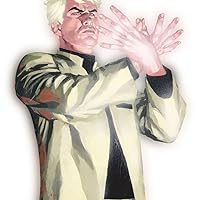
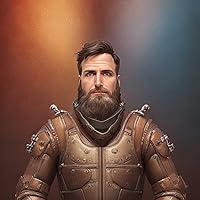
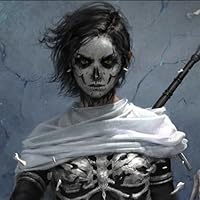
A deluxe box-set version of the album included a novella written by the band's vocalist and guitarist Claudio Sanchez and his wife Chondra Echert, with artwork by Chase Stone.
There is no point in sugar-coating this: the actual writing in this book is fucking abysmal. I've been trying to read it since the album came out and sincerely struggling as line after line makes me groan in pain. I spent a brief time thinking I'd re-write it as I went so that I could stand going it, and not stop every few sentences either groaning (seriously, out loud) at the phrasing, or stuck, trying to figure out what the hell they were talking about. It took me a year to get up the will to read 72 frickin' pages I hated the experience so much.
Claudio and Chondra have written good--even great: Translucid--comics. Claudio with Peter David turned in a serviceable novel for Year of the Black Rainbow. Even the stories, slight as they were in The Afterman, were palatable.
But here? My god. It was like some insane mixture of an enthusiastic but literarily limited middle schooler and some really creative mind struggling to phrase interesting figurative language.
The story is fine, I didn't expect tons there anyway: it's the dark, violent, tilted fiction I expect from Claudio. Archetypal antiheroes and villains with deep (if simplified) flaws that generally theoretically point quite directly back to his real friends/family/etc. This is entirely where the one star I managed to give comes from.
In "lore" terms, perfectly creative and interesting. But I'm not a "lore" guy if the surroundings are bad. Ideas are not enough.
Let me illustrate with a few of the many (MANY, MANY) examples:
"'Wow. You weren't lying. This is remarkably disgusting,' he said, the gluey consistency making it difficult to chew. The two friends chuckle in the low light." One of dozens of instances of switching tenses sentence to sentence. HOW.
"Pilo was silent, internally struggling with a response. She chewed on the inside of her recessed cheek. A siren wailed outside the thin, safe walls. Her rectangular ears curled out ever so slightly, a leftover ability from her Neporian lineage. The boarded up windows made the room feel unrotted and shaky, as if it were rocking gently on calm water. 'Hope that cold-blooded bastard got what he deserved at least,' she said, finally." Rectangular ears?? What's a Neporian?? And what does them "curling out" indicate? Why is her cheek recessed? Hope you don't want answers to these and more questions: they remind me of my writing when I was 12, trying to casually drop alien things as if they were normal, not realizing that this is insufficient for readers without greater context.
Look, it honestly pains me to write this. I was so depressed when I saw there were two "Story Editors" credited in the back, as I was sure the problem was this wasn't edited for some reason or other. I hope (sincerely) that it was editing from the context of narrative alone, because this shit is so bad.
Here's some more: "It was serene, exquisite. Nostrand was overwhelmed with emotion, but he could never define which one." I get the intent here, but look: "could never"? Were people asking him to define his emotion over something he saw on this prison planet for his entire life? Why is it only one emotion? Why is that clause even THERE? Try this alternative, just to keep things as close as possible: "It was serene, exquisite. Nostrand was overwhelmed with emotion, so much that he couldn't even define the feeling." See how that's all in the same moment? I'm not saying it's good, but at least it isn't inexplicably jumping into some other tense.
"At the center of the circle a being kneeled low, resting their chest on bent thighs. The being was impossible to identify in every way, not by gender or race nor whether human or alien."
Jesus. I hit that last sentence and wanted to cry. How about: "The being was impossible to identify in any way: their gender, their race--even whether they were human or alien." The printed version is grammatically confusing in such a way that it makes your brain trip and stop and scratch its head (do brains have heads? I digress...)
"He was mostly focused on learning the last that was expected of him where labor was concerned, so he could make the most of his free time on The Dark Sentencer. Otto had a talent for figuring out how to cut corners effectively, but, sometimes, his temper trumped all reason."
Sigh. Why you show-don't-tell in a nutshell here. Don't do this. Don't ever do this. It immediately precedes a memory of him getting angry *and then trying to cut corners because of his anger*, so it feels like an attempt to tell you the lesson of the following passage before you've read it, while also not accurately describing it.
"The job had almost gone completely belly up because of it. Fortunately, Nostrand's green demeanor came with an extra dose of patience and he cracked the box in the nick of time."
His demeanor isn't green, *he's* green, as in "new". Being new doesn't make your "demeanor" green, what does that even MEAN?
"Otto couldn't stand anyone--especially on the job--and the chip on his shoulder was so big that day it could have been served as an hors d'oeuvre."
Why on earth would you figuratively describe how big something is with a reference to a dish that is definitionally small? "His hands were so big they could be used to scoop individual grains of sand". It's a legitimately interesting turn of phrase--the idea of a chip on a shoulder being 'served'--but it's broken by the completely nonsensical comparison.
"Nostrand hated bullies. He believed not abiding by laws didn't have to be synonymous with acting like an asshole."
More telling instead of showing, but also just awkward.
"Everything was remarkably clean. Everything except the group of individuals held behind the bars. Nostrand tried to figure out what they were made of. Glass? Crystal? Some type of material no one outside of The Dark Sentencer had even heard of yet?"
I spent a while trying to figure out whether Nostrand was looking at relatives of Crystar or Martinex for a while before I realized that was in reference to the bars when I read the next line:
"He wondered if he could break one, then realized what a stupid thought it was. This cell was a prison within a prison. Whoever built it had certainly thought of people trying to escape."
I actually spent a moment trying to figure out why he was contemplating breaking one of the "individuals held behind the bars", for that matter--it was only the sentences after that that really told me what this was in reference to. You've got two sentences using "everything" as a subject and a focal point, and "bars" as simple object of a preposition that isn't emphasized. Carrying them over as antecedent to the subject-pronoun of the following sentence is a bad idea. Add in even a silly little half-sentence between: "..behind the bars. And those bars...Nostrand tried to figure out what they were made of." SOMETHING.
At least every single page, and usually multiple times a page, my brain would stumble and trip over these poor phrasings, poor word choices, and generally bad writing and I'd get so frustrated and embarrassed, that two people I knew to put together good, readable stories put together something that was just horrifically written and looked like it had never been edited. To be clear, that's an embarrassment of my own writing, but that's because I DON'T edit. It's a bad idea, but I also only publish stupid reviews on websites. I'm not that proud of these, but if I wanted something put into a printed book, you bet your ass I'd be going over it and over it and giving it to editors and others to read and help fix.
Fuck, man. I really hate writing this, honestly, but it's just so atrocious that I cannot stomach the current rating indicated here, because it's setting people up to be super sad--even if it's really just fans like myself who are ever going to look at this. I hope to christ the second volume is better edited, and if not, please, please find an editor before writing Vaxis III.
Not the best quality writing but the story was interesting enough. I didn’t love the art style either. I preferred the colourful and vibrant comic style of previous episodes. This felt a bit drab and lifeless (it is improved upon in Vaxis II).
The sci-fi setting and some interesting ideas weren’t really explored, the sci-fi just seemed to exist as the context for a (so far) cliché love story.
The soft cover coffee table booklet style was awkward to read entire double page spreads of text on. For it’s size, I think more artwork would be better suited to that type of print. The art was also vague and didn’t always seem to be in sync with where the text was up to. There was a spoiler image one page before that scene happened in the text which was a bit problematic.
The best reference to the music I noticed was the chorus from It Walks Among Us “If you want it all my dear, go on and get it” from the bank robbery scene which was cool.
Album lyrics at the back were a nice inclusion, it’s still hard to decipher what is going on and when from the lyrics but that’s not a bad thing.
I didn’t like that the writing was doing too much explaining how and what to feel instead of letting the story and dialogue do that.
I would have rated it 2 out of 5 if it hadn’t been related to an album and band that I’m really into.
While I am beyond thrilled that Coheed and Cambria are including a story with their new records (hopefully it's not wishful thinking to assume they're going give the rest of the Vaxis series the novella treatment) as the context enhances the listening experience, it's a shame the writing is a clunky as it is. This is par for the course for the band's literary tie-ins (see: the Amory Wars comics series which has the exact same problem). The story itself is great and I'm excited for the rest of the series to unfold. In essence it's a kickass intergalactic love story set on a planet that is a private prison. It's pulpy, but in a fun way. And then the characters talk to each other and the dialogue just hurts. It's like bad comic book dialogue in a story that desperately needs to be moody and cool. There are also a lot of weird little adjectives and metaphors that feel out of place with the space opera storytelling. At one point Sister Spider's mask is described as "Pepto-Pink" and I never got over that. They have Pepto Bismol in this galaxy? How interesting! Alas, I'll take what I can get.
Nice kickoff to what I'm hoping will be a series done in this format of story blended with full page art. I was thrown a bit because the art often matched scenes that was from pages prior, but toward the end got ahead of the story: some consistency there would have helped.
The art was sick and the production quality was top-notch. The writing had some strong moments but could have done with another proofread or two. Still, it's nice to have the accompanying story to the new Coheed album this early, and overall it does compliment the album well.
Even as a HUGE Coheed fan, I didn't love this as much as I wanted to. The story is great, but the language was a bit too flowery/overly descriptive at times and the real disappointment was the artwork. It's so blurry and dark I could barely tell what was going on and the artwork was oddly spaced, either appearing many pages after the action or even appearing before the action.
This isn't the greatest book in the world, but it is amazing how Claudio blends storytelling with music and art. Coheed and Cambria is more than a band, and this is a nice addition to the ongoing story, I. yet another new form.
Loved this one, another great dark story. I like how there are less characters than Amory Wars, it allows you to get more of a feel for the three main characters
*light spoilers for some character arcs and a big reveal around halfway through the book that even the cover art for the frickin album spoils*
Ok, let's get the bad out of the way first; the prose isn't great. It's not as bad as some are making it out to be, but it still feels off. Issues such as typos, tense shifts, poor word choice, and amatuer sentence structure plague the book, not to an overwhelming degree, but enough to still be distracting.
A lot of these issues seem to be the fault of the editors rather than Chondra as there are some really poignant and powerful sections, and she handles really complex stylistic choices such as three seperate POVs (that towards the end of the book even begin to meld together), a frequently shifting psychic distance, and peeks into other characters minds/backstories pretty fuckin well. Overall though the prose still detracts substantially from the novella (Ive taken off a whole star for it), which is a damn shame given the rest of it.
Now to the good stuff: this story is one of the most incredible ones ever created, and I don't say that lightly. I've read some really incredible stories over the years as a lover of all things SFF, and this story is honestly one of the best.
The characters are all incredibly complex and three dimensional, with even ones that the plot very clearly treats as particular roles being characterized beautifully. This makes characters like Sam and Otto who seem like they would be super one dimensional into fully fleshed out characters, even when both get very little screen time. Even a few innocent bystanders get full on backstories in little cutaways that make the whole world feel more alive.
More major characters like Nostrand and Nia are some of the most interesting characters i've ever encountered, and i was insanely impressed by their arcs. Nia especially has one of the largest arcs i've ever seen, with her entire personality and motivations doing a complete 180 from her childhood to the present, in a way that still keeps the essence of her character! Like, Nia's character rivals fuckin Stormlight and the Broken Earth trilogy imo (obviously both of those have a lot more time to fully flesh out their characters' arcs, but i think the actual *character* of nia stands up to them).
The worldbuilding of the Amory Wars has always been one of its strongest aspects, and this book is no different, with the world being incredibly captivating whilst still keeping that soft science fantasy flair that made it awesome in the first place. But even more impressive is the way the worldbuilding seemlessly melds with the plot. There are never big exposition dumps or anything (though i do love a good exposition dump tbf) but the world is still explored so fully it feels real. Minor characters everywhere are characterized so well, like Pilo? The bartender? The alien prostitute who low key hates her job? It's so fucking well done. Plus the Dark Sentencer and its machinations are so well thought out, I'm just in love with it.
Finally the plot itself is amazing. It's honestly really interesting to me because a lot of times these kind of Star Wars-esque space operas kinda live and die by their action scenes, but I love how this book proves that's really not necessary AT ALL. There are exactly two action scenes in the book, one of which takes place before the book even begins, and neither of which last very long, but it's all still insanely captivating. The book was a page turner even with its bare minimum of action, and the plot it did weave was so beautiful it's honestly one of my favorite plots of a book like ever.
Honestly this book is really fuckin good. It really suffers from its prose, which sucks, but if you can get past that, even if you're not a Coheed fan, I'd recommend it. It's better than any Star Wars movie in the past few decades hands down. If you are a Coheed fan, this is a must buy. I've tried to make this review as impartial as possible, setting aside my love of Coheed's music for it, but with their music this book becomes a truly transcendent experience. If you're still somehow on the Fence (get it?), I would definitely recommend it.
This entire review has been hidden because of spoilers.
This was of a higher quality than the Year of the Black Rainbow book. Four stars instead of five only because I agree with a comment I saw somewhere (maybe here) that the visuals (though beautiful and well done) some times came many pages after the connection in the story, and at the end sometimes before things happened. It seems like it could have been an easy fix to have moved around the images to fit more with the events one was reading at the time. Otherwise, this was an enjoyable way to start the new story of The Amory Wars.
I loved this so much. The art was spectacular and the story had me from the first page. Since the end of the Amory Wars (No World for Tomorrow) has never been published, the world we see in the Vaxis story is quite different and thus, more mysterious than the one we experienced in those stories. I absolutely can't wait for more