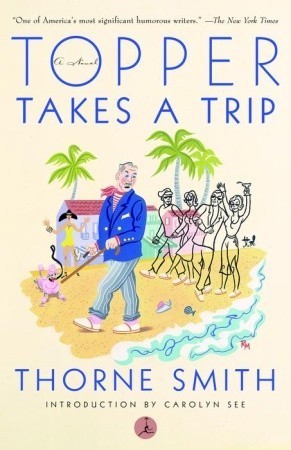
My co-reviewers have given enough of a rundown on Thorne Smith for me not to need to repeat the little I know. Suffice it for me to say that as a random choice from one of my regular secondhand bookshops (Border Books, Todmorden) this turned out to be a goody.
Mind you, I suspect it’s either a style and authorial tone you’ll like or won’t. Smith writes in a kind of Wodehousian longhand, so for people like me who rather enjoy playful prolixity, it’s fun. Having said that, like Wodehouse, Smith not infrequently produces inconsequential conversations that struck me as tiresome. In Wodehouse’s case it tends to be the kind that goes ‘What did you say? – Did I say anything? – Yes, you did. I distinctly heard you say X’ – Did I? – You did – I don’t remember – You most certainly did – I most certainly do not remember’. Smith’s are rather more longwinded, and usually occur when the speakers are in their cups, so they impress with the same dullness as, in real life, do the conversations of those who have a few pints inside them on a listener who has been drinking tonic without the gin.
The other aspect of the book which I found wearing if I did not limit the number of chapters I read at a sitting was the one-trick idea of a man bedevilled by ‘lower plane’ ghosts who are keen to enjoy the pleasures of life to the full with him and quite often at his expense. This means that the novel, set in the South of France, reads as a series of episodes, each one focused on a single escapade, and I found it most enjoyable if I read a couple of episodes at a time so that custom could not stale Smith’s capacity to get infinite variety out of his trick.
The novel also struck me as a manifestation of the end of the Prohibition Era in the USA as it was published in 1934. Thus all alcoholic restraints are off among the Americans in Europe. Equally, of course, those restraints would not have applied in Europe during Prohibition. Either way, the Americans, material, materialised and ectoplasmic, are set on having a good time, especially after Mr Topper has enjoyed divesting himself of his killjoy, dyspeptic wife and those of his compatriots he associates with ‘Glendale’ prudery and respectability. This is achieved with help from his ghostly friends – George and Marion Kerby, Colonel Scott and Mrs Hart and the back half of a dog called Oscar. The life-lovers can then set about enjoying sun, food, sex, drink and mischief in a riot of hedonistic naughtiness and delinquency.
Such delinquency often manifests itself through the ghosts’ deployment of their ability to materialise and dematerialise at will. In their visible form, they are capable of smoking and drinking and eating as normal human beings, and this adds a great deal to the book’s joie de vivre. In their invisible – or semi-invisible – form they can get up to no-good. They upset a swimming float; they kick balls into groups of beach-picknickers; they remove the last vestiges of swimming costume from a sunbathing German model; they dematerialise in the middle of a dive; they tip Topper’s hat for him; they cheat in the casino, they wreck Topper’s rented villa, and, perhaps most memorably, brilliantly sabotage an entire race meeting to their own pecuniary advantage. Marion, in particular, is wickedness itself in terms of her sexual libertarian behaviour with the cuddly but distinctly unadonean Topper and her growing determination to have him all to herself on the lower plane, necessitating Topper’s continual watchfulness towards the end of the novel as he finds knives and rocks in unexpected places and discovers himself being led to a diving place above rocky shallows. All good fun.
Two things gave me great pleasure. Firstly, Wodehouse tends to people his stories with a small cast suitable to stage farce. After I finish one of his books I increasingly find myself feeling what a small, melancholy, limited and unfruitful world he portrays. Smith, by contrast, in this novel has a film set in mind with his core (or corps?) of stars and a large supporting cast; he creates a world that is more recognizably real because it’s fuller and less confined. I prefer this.
Secondly, many of this supporting cast are French and their speech is presented in literal English. This I found very funny, juvenile as I am. Thus we have moments such as:
“But should it eventuate that he does go ‘poof!’ then it is that one makes water to run on a scale very grand.”
“If you do not descend all at once, it is that I shall fire!”
“It is of a marvellousness in full truth, but – hein! It is also an affair of the most lamentable nature, for is it not that there go an illimitable number of francs that should be rightfully ours?”
Maybe you have to be there to get a kick out of that sort of stuff, but I was and I did.