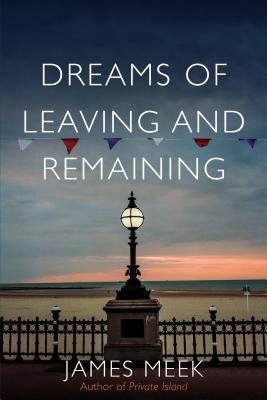
The anatomy of Britain on the edge of Brexit by an Orwell Prize–winning journalist.
In March 2019, the UK will leave the EU, facing an unpredictable future. Since the referendum in 2016, the nation has been split into two; one half dreaming of leaving, the other of remaining. During this period, James Meek, who has been described as ‘the George Orwell of our times’, went in search of the stories and consequences of this rupture. He discusses the desire to leave with farmers and fishermen, despite the loss of protections and fears of the future that this might bring. He reports as a Cadbury’s factory is shut down and moved to Poland, in the name of free market economics, and how it impacts on the local community left behind. He charts how the NHS is coping with the twin burdens of austerity and an aging population. Dreams of Leaving and Remaining is urgent reporting from the frontline of the crisis from one of our finest journalists. James Meek asks what we can recover from the debris of an old nation as we head towards new horizons, and what we must leave behind. He does not find any easy answers that will satisfy Brexiteers or Remainers, but instead paints a masterly portrait of an anxious nation.
James Meek is a Contributing Editor of the London Review of Books. He is the author of six novels. The People’s Act of Love was longlisted for the Booker Prize and won the Ondaatje Prize; We Are Now Beginning Our Descent won the 2008 Le Prince Maurice Prize; and The Heart Broke In was shortlisted for the2012 Costa Prize. His previous non fiction-work, Private Island, won the 2016 Orwell Prize. In 2004 he was named the Foreign Correspondent of the Year by the British Press Awards.
An astonishing read. You've read everything there is on Brexit, have you? Well, check this one out, even so - it is a well-researched, thoroughly interviewed, and eloquently written. Meek ruthlessly ferrets out the micropolitics and historical relationships that constellate the differences and similarities between Labour-Brexiteer and Conservative-Brexiteers, Labour-Remainers and Neoliberal-Remainers.
Refreshingly, Meek's investigations take him into the histories of people and places first. Only after do the questions of macropolitics come into focus - but rarely in a deterministic way. Partially, this is a reflection of his compositional tactics. Initially, after all, these began as journalistic pieces in advance of elections and referendums. Yet there is much merit too to the suspension of headline politics in favour of the patience of complexities and the moments of real connection, no matter with whom it happens to be.
At the end of the day, there are chapters on Britain's local fishing economies, agriculture, health system, and political capture by rampant "frictionless" neoliberalism - or, as someone else might say, Britain's "labour". Each is well worth your time, and if the chapter on the NHS does drag a little, the chapters on Grimsby's politics and the policy blindness of UKIP agriculturalists are compelling and remarkable enough to make the difference. Meek is resolutely human and remorsefully persistent. This is great journalism.
It feels like almost every week since the referendum a book about Brexit has been published. So far I have wanted to avoid reading about it; why waste precious book time when the news is spewing out op-eds at breakneck speed?
For some reason a proof copy of James Meek’s Dreams of Leaving and Remaining (due March 5th) stood out to me. Now I have finished it I can see why. Meek looks at the underlying issues that have led to Brexit as opposed to celebrating or bemoaning the referendum result.
Over the course of the book, which takes him from Grimsby to Norwich to Poland, he explores how narratives have shaped the debate in a prose which is striking in its elegance. Particular importance is given to institutions or places that evoke deep cultural meaning such as the sea, the NHS and Cadbury. Ultimately this is a book that looks, not at the consequences of Brexit, but at Brexit as the consequence of rising inequality and communities alienated from the powers that affect their day to day lives.
Meek is a journalist with the London Review of Books. This is a fascinating and thoughtful look at the Brexit phenomenon, which I think would interest both puzzled foreigners like myself as well as Britons.
Meek visits Grimsby, a former centre of the fishing industry that may have a future in windpower, during a hotly contested election. He speaks with both organic and conventional farmers to explore the effects of EU subsidies. He delves into what seems like endless restructuring of the NHS in Leicester (very interesting for those with experience in restructuring in other industries or jurisdictions - different acronyms but some of the same issues!). He also visits both a town in England that loses a longstanding Cadbury factory and the community in Poland that got a new one. In each of these chapters, there's a helpful blend of lived experiences and attention to structural nuances and trends. Well worth reading!
Nothing is harder to understand from a London/global perspective than Brexit. James Meek does a brilliant job of really listening to the voices and dreams of those who wish to quit, and helping us all learn in the process. This book rewards your attention and I wish there were more like it.
Absolutely brilliant insight into contemporary Britain. Much more about how decades of neoliberalism have fucked over so many of the public services we rely on than about Brexit itself.
Now that the issues of Brexit seem to have been politically memory-holed and sealed off as relics of a distant age, reading this could have been weird. Certainly, its intro paints a picture of a book that is going to be wordy, worth, and over-intellectualising things.
But the meat of the book satisfies. Chapters on the NHS, farming, fishing, and outsourcing get to the heart of the issues by getting under the skin of the people involved. There are touching stories, frustrating stories, and a lot to be learned about the subject matter. It’s only really tangentially about Brexit, I think - in the sense that it explains the causes and symptoms of people’s sentiments.
I really enjoyed this. It's a series of four essays on different aspects related in some way to Brexit. Meek writes in an engaging style and effectively expresses perspectives I've not read elsewhere. I found myself wishing he'd looked a bit broader at some other related issues, e.g. Scotland and Brexit. However, this is much better for not trying to give a comprehensive view of Brexit but focusing on a few undertold stories.
A good read that walks through the neoliberal decay, the exacerbation by the EU and the use of this disenfranchisement and dispossession by insidious right wing forces. The plurality is good