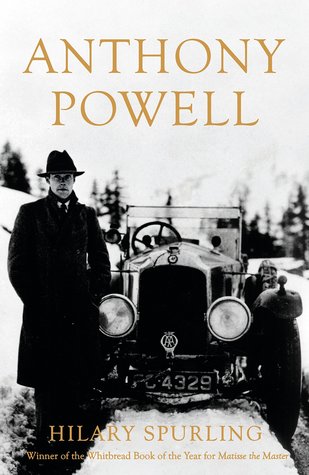
"Tony needed a project to keep him sane through the coming months or years of war when it would be impossible to concentrate on anything so demanding as a novel. Wanting something scrappier and more prosaic, requiring no creative input, he picked biography instead."
A characteristic remark from a biographer almost as self-effacing as her subject matter. Probably there is no greater testament to Powell's disinterest in himself than one's desire to read his biography only a few months after reading his memoirs, and being constantly surprised by its contents. Some revelations came with the breaking down of accepted cliches concerning his class and attitudes: born to a socially-dubious pair of eccentrics, he might have been a (low-level) fixture of the London 20s deb scene, but he was still treated by Sacheverell Sitwell as 'an upper servant' - connectionless and without any great expectations, existing in a state of financial anxiety until his forties. He read modernist literature, frequented seedy nightclubs and moved primarily in the company of painters and penniless writers.
Other disclosures were less expected. I was taken aback to learn of his wife Violet having had an affair with an unknown man during the war, and felt a vicarious bottoming-out of the stomach on reading her disclosure to George Orwell's widow Sonia: 'he was the love my life.' Up until reading that I perhaps hadn't realised just how invested in Powell's life-story I really was - the sensation was close to personal affront. It is a curious demonstration of how one can be possessed, as A.S. Byatt would have it, by the authors one admires.
Appropriate, given her subject, Spurling barely permits the account a whole page before briskly moving on, pausing only to suggest its later importance as emotional weight behind Dance narrator Nick Jenkins' own romantic dealings with Jean Duport. However, on the whole Spurling is hesitant to engage in what Christopher Hitchens has elsewhere called literary England's 'favourite parlour game' - the matching up of Powell characters with their real life counterparts.
The book is straight-forward and lucid, quoting from a trove of letters and contemporary accounts, occasionally supplemented by Powell's own laconic autobiographical remarks. Yet something of the ultra-urbane edifice lingers. Spurling, who knew Powell from 1969 onwards, confines all personal experience to a final postscript, outlining his later years. Any hope of Aubrey-esque anecdote - Powell racing up Frome high street in desperate need of loo paper - remain unfulfilled. Perhaps it is precisely because she was a close friend that Spurling respectfully withholds the scatalogical incidents which must accrue in every person's life. The loyalty certainly makes itself known when she defends her subject from literary criticism: the only quoted bad reviews are from friends who have previously expressed admiration, being thus easily dismissed as back-stabbing or marks of jealousy. (Such is the appraisal of criticisms made by Philip Larkin, V.S. Naipaul, Malcom Muggeridge, Auberon Waugh). One might agree that they were callous, but it seems a sign of complacency on Spurling's part not to treat them seriously.
Powell's ultimate critical legacy is not touched on. Spurling goes no further than to (rightly) defend him from accusations of snobbishness, and to cast him as the most European of British writers: IE not someone to be enjoyed exclusively by the English upper classes.
A Dance to the Music of Time remains probably my favourite book. It is quiet and wry, devoid of undergraduate grandiloquence. Perhaps one might have expected a little more humour from his biographer, but otherwise a fittingly unemphatic read.