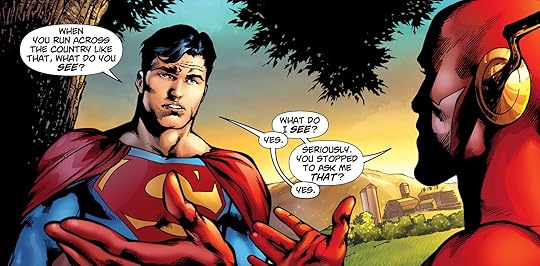
Superman looks to reconnect with the roots of his battle for Truth, Justice and the American Way. He visits Philadelphia – on foot – then continues in a small town in Ohio where, as in many towns, a number of its residents are from other places. But when The Man of Steel discovers that there are also a number of residents secretly from other worlds, he unravels a mystery that may have grave consequences for Earth.
Joseph Michael Straczynski is an American filmmaker and comic book writer. He is the founder of Synthetic Worlds Ltd. and Studio JMS and is best known as the creator of the science fiction television series Babylon 5 (1993–1998) and its spinoff Crusade (1999), as well as the series Jeremiah (2002–2004) and Sense8 (2015–2018). He is the executor of the estate of Harlan Ellison. Straczynski wrote the psychological drama film Changeling (2008) and was co-writer on the martial arts thriller Ninja Assassin (2009), was one of the key writers for (and had a cameo in) Marvel's Thor (2011), as well as the horror film Underworld: Awakening (2012), and the apocalyptic horror film World War Z (2013). From 2001 to 2007, Straczynski wrote Marvel Comics' The Amazing Spider-Man, followed by runs on Thor and Fantastic Four. He is the author of the Superman: Earth One trilogy of graphic novels, and he has written Superman, Wonder Woman, and Before Watchmen for DC Comics. Straczynski is the creator and writer of several original comic book series such as Rising Stars, Midnight Nation, Dream Police, and Ten Grand through Joe's Comics. A prolific writer across a variety of media and former journalist, Straczynski is the author of the autobiography Becoming Superman (2019) for HarperVoyager, the novel Together We Will Go (2021) for Simon & Schuster, and Becoming a Writer, Staying a Writer (2021) for Benbella Books. In 2020 he was named Head of the Creative Council for the comics publishing company Artists, Writers and Artisans. Straczynski is a long-time participant in Usenet and other early computer networks, interacting with fans through various online forums (including GEnie, CompuServe, and America Online) since 1984. He is credited as being the first TV producer to directly engage with fans on the Internet and to allow viewer viewpoints to influence the look and feel of his show. Two prominent areas where he had a presence were GEnie and the newsgroup rec.arts.sf.tv.babylon5.moderated.
The final pre-DC Comics: The New 52 run on Superman, sees J Michael Straczynski give Superman… depression. Yep, you read that right! As ever Straczynski drops something major that no other creator could contemplate and does it well. Some really great issues in this arc. I read the comic books Superman #700-714. 7 out of 12 Three Stars. 2012 read
I read this during the 2020 BLM riots so it's even more striking in its resonance and contrast. As a non-American, I was quite glad the writers didn't try to de-nationalize the ideals of truth, justice and 'the American way', giving readers enough credit to read it as a label for an idea and not a trademark or patent of a country. I've come across the Jumper episode many times before but this is the first time I actually got around to reading the entire series, and it takes an entire series to realize the advice he's giving the Jumper is advice he's actually giving himself, fighting his demons of loss, hopelessness and impotence with the raw simplicity of putting one foot in front of the other and looking to save just that one next person. The entire arc reads like Nietzsche's ideals given Jungian practical steps, transcend humanity into the Ubermensch by reconciling with shadow and embracing the hero's quest, the latter being called out on quite a few occasions, although Jung might not be pleased about the collective-unconscious crusader being called a Freudian Superego.
I haven't read enough of Superman to know if he's had depression before, but apart from some complaints that it was a little too on the nose especially in the exchange with Flash, it was a very touching exploration of why depression is such a malaise and how it can fundamentally alter sensory perception to become a quicksand of negative spirals. Regardless of how super we are, if we are rising to the limit of our abilities and not succumbing to complacency, we're eventually going to hit challenges beyond our scope, which presents a peculiar paradox: the more potent we are, the harder we are hit by evidence of our impotence. 'What could Superman ever have to feel sad about' is a thought I've had about many people in real life, and this outlines the journey one must take through overreach, the underworld, and re-emergence in order to finally embody the thing we're all really seeking over happiness and contentment and love: the heart of a hero.
I honestly didn’t expect to adore this nearly as much as I did, but oh my gosh, it’s just beautiful. Simple, but there’s beauty in that simplicity. Superman: Grounded is, more than anything, a character study; it reminds me of Superman For All Seasons and Superman: Up in the Sky (which is high praise). It has some really lovely moments that make me think “Yes — this is the core of who Superman is” (like Superman gently talking a woman out of suicide and later saving a family from a domestic abuser). This is such a wholesome, uplifting, comforting story, and I love it.
A premissa da história é bem boa. Leva em consideração temas de existência de violência pela existência de um protetor. POrém descamba rapidinho e não recomendo a leitura
This entire review has been hidden because of spoilers.