His family name goes back to his great grandparents, Jewish immigrants from Kiev and Odessa at the end of the 19th century, his first name tells of his mother's infatuation with Edgar Allan Poe. After an adolescence mostly spent in neighbourhood cinemas showing double bills of old Hollywood films and reading an inordinate amount of fiction in Spanish, English and French (favourite authors - Stevenson, Conrad, some Henry James), he studied literature at Buenos Aires university, wrote for local and Spanish cinephile magazines and published an early essay on James which developed out of graduation work - El laberinto de la apariencia (The Labyrinth of Appearance, 1964), a book he later suppressed. He was barely twenty when he became acquainted with Borges, Bioy Casares and Silvina Ocampo, all writers of prestige whom he saw frequently during his years in Buenos Aires. In 1973 he won a literary prize with an essay on gossip as narrative device in James and Proust. In 1974 he published Borges y el cine, a book enlarged in every reprint (Spain, 1978 and 2002, and translations) which he also does not want reprinted now. After a first nine-month stay in Europe and a visit to New York between September 1966 and June 1967, he returned to Buenos Aires with the desire and the decision to leave behind his life as a literary idler. After dabbling in journalism, in the culture section of the weeklies Primera Plana and Panorama, he made a first film, an underground feature shot on weekends throughout a year, knowing that it could not pass the local censorship of the period. It was nevertheless screened at festivals throughout Europe and the United States. Its title was already a challenge - ... (Puntos suspensivos - Dot Dot Dot). In 1974, in the turmoil of political agitation and imminent repression, he left Buenos Aires for Paris. There he embarked into filmmaking that falls roughly into two categories - fiction films and "essays", mixing documentary material with a personal, even private reflexion on the issues raised by the material. The most distinguished of these is La Guerre d'un seul homme (One Man's War, 1981), a confrontation between Ernst Jünger wartime diaries and the French newsreels of the occupation period. At a time when the arts' departments of several European television networks were willing to support such ventures, Cozarinsky was able to develop this approach in a series of very original works. During the rest of the seventies and the eighties his literary career was mostly dormant. But his only published work of the period became an instant cult book - Vudú urbano (Urban voodoo, 1985), a mixture of fiction and essay not unlike his film work, with prologues by Susan Sontag and the Cuyban writer Guillermo Cabrera Infante. In the same year, after the end of the military regime in Argentina, he visited briefly to Buenos Aires. Three years later, he made a film in Argentina, in the far South, a "Southern" - Guerreros y cautivas (Warriors and Captive Women). From that date on he started visiting his native country more and more often, occasionally shooting there material for his European "essays". His most adventurous later films were Rothschild's Violin and Ghosts of Tangier, both made between 1995 and 1996. In 1999, he spent a month in a Paris hospital for a backbone infection, a period during which a cancer was diagnosed. In his own words, he felt the ringing of a bell telling to stop wasting his time - "I always wanted to be a writer, and had not dared publish, even finish what I started..." It was in hospital that he wrote the first two stories in his prize-winning book La novia de Odessa (The Bride from Odessa). From that date on, his film work became sparse and he started publishing "all the books I had not put on paper", fiction mostly but also essays and chronicles. He became immediately established as a writer to reckon with in the Spanish language, and was translated into English, French, German and several o
Isn't this why we read? The thrill of the unknown, the unfurling of alien lands, faded maps of history, fragments of the human heart? What was it that made me stop at this spine as I was scanning the shelves in Wanstead library? Maybe it was the conjunction of sounds, the promise that was redolent in those strange vowels and consonants?
Edgardo. Cozarinsky. Odessa.
In just three words, you have a lightning glimpse of the tormented history of the 20th century - an infinite of dramatic narratives unspooling out of a lost corner of Europe, rolling out to the remotest reaches of this unhappy planet.
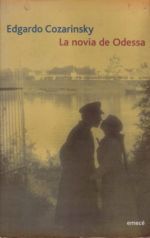
The Bride of Odessa brings together, at last, in one potent package, some of the persistent preoccupations that have informed much of my reading over the last couple of years. Some thirty books covering Russia and East Europe, South America and the Hispanic world, exile and immigration, the Jewish diaspora and the Holocaust. It's as if Cozarinsky, this Ukrainian son of Argentina, had somehow read my mind, seen my reading list, and presented me with these stories that are as perfect in theme as they are brilliant in execution. If I had to conjure up my idea of reading nirvana, it would have to be stories like "The Bride of Odessa" and "Literature", "Real Estate" and "Obscure Loves".
But let's take them one by one. We know all about the East European Jews who fled the Czar's pogroms, sailed out of the shtetls and settled in the Lower East Side of New York City or in the East End of London. But how much did I know about an alternative current that flowed southwest across the Atlantic and ended up in airy Argentina of all places? I even have a friend from that part of the world, goes by the name of Yalonetzky, but what did I know of his roots? Nada, nicht, nothing at all.
The title story of the book sheds light on that little-known saga. Somewhere in the Ukrainian heartland, a young man leaves the Pale of Settlement and arrives at the Crimean port of Odessa. He has tickets for a transatlantic passage. He is bound for new beginnings, Buenos Aires, the New World. But the million-dollar question - who will get to use his second ticket?
The next story "Literature" is another miniature masterpiece. Who was that old "Russky woman" who lived out her days in a tiny one-bed flat in Buenos Aires, who once upon a time taught Turgenev and Tolstoy to the young narrator? What tragedies lay in her past?
The answer, of course, is the kind of unique cataclysm that befell that slice of humanity that had the misfortune of finding itself trapped in East Europe circa 1914-1945. The name Natalia Dolgoruki brought back memories of Pavel Dolgorukov, the executed aristocrat, and of Nina Berberova, the exile who stitched together stories of emigre life in Paris. Counts and generals driving humble taxicabs down Haussmann's leafy boulevards. Proud Slavs hiding their genteel poverty behind frayed lace curtains, worthless mementoes of the vanished past crammed in drawers.
"Real Estate" and "Days of 1937" and "Budapest" all have their merits, in descending order. As for "Obscure Loves", I was thrilled by every single one, Cozarinsky superbly channeling the spirit of Borges in these three tales that exist out of time. Coming on the heels of Ahsan Akbar's jagged poetry (review soon), Cozarinsky's love stories melded perfectly with that mercury mood. "Christmas '54" and "Emigre Hotel" are still to come, but I need no further convincing about señor Cozarinsky's touch :-)
Finally, a word about Nick Caistor's elegant translation. Having just come off Sonia Soto's bland, off-key rendition of The Oxford Murders, it's a joy to find a translator who actually knows what the fuck he's doing. You can't go wrong with prose this fluid.
So, time to end this long and self-indulgent ramble. I'll bet you'd never heard of Cozarinsky either, but now that you have, you really have no excuses not to try him out. If you have ever wondered about the millions of leaves blown about by history's fiercest hurricanes, this book is for you. Some of them came to rest on South America's exotic shores - but whether they were the lucky ones is an open question.
Short story collections are usually a grab bag but I felt this short collection by the Argentine author/filmmaker was uniformly excellent. The best stories in my opinion were the opening title story, and the last story Emigre Hotel, both about imposture and exile in the face of the Pogroms and the Third Reich. An Evita Peron cameo by those paying attention in one story. Worth picking up if you happen to see a copy.
Luego de haber leído los dos primeros relatos, tenía la sensación de estar leyendo una de esas novelas que conforme avanza la trama vas encontrando las relaciones entre los personajes, pero no. Es un libro de relatos que giran sobre el tema del inmigrante europeo en Argentina. Disfruté de la mayoría de los relatos, el que da nombre al libro me hizo recordar los textos de Auster y sus ficciones cimentadas en las casualidades; Literatura es otro relato que me gustó mucho. Hay también textos sueltos que no llegan a ser cuentos, pero que sostienen el tema. Un libro de relatos sumamente melancólico, ideal para leer en un café durante los previos a la proyección de una película francesa o alemana en algún cineclub. Funciona.
Tr Nick Caistor. Short and quick to read this book completely hits a sweet spot for me - wistful and melancholic stories looking at exile and (occasionally) love, with lots of references back to a ‘lost’ Europe. I particularly enjoyed the first (eponymous) and last stories.