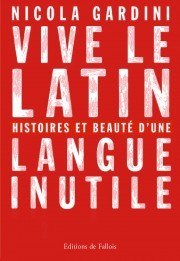
Au-delà des considérations coutumières sur la valeur formatrice des Humanités, Nicola Gardini s’adresse ici directement aux jeunes gens qui découvrent le latin, et aux moins jeunes qui en gardent la nostalgie.
En une vingtaine de brefs chapitres, il retrace l’histoire de cette langue sans laquelle la nôtre ne serait pas ; il fait comprendre les grandes étapes de son évolution d’Ennius à saint Augustin ; il montre la puissance et l’étendue de son rayonnement jusqu’au seuil du monde contemporain. Son chaleureux discours est illustré par un large choix de textes, présentés dans leur version originale, puis traduits et commentés. La langue qu’il nous apprend ainsi à goûter se fait entendre par la voix de ses plus glorieux témoins.
Son plaidoyer est aussi un cri d’alarme.
Sans verser dans l’utopie passéiste, il montre pourquoi il est urgent de redonner au latin une place raisonnable dans notre enseignement, sous peine de nous laisser submerger bientôt par le « pidgin » de la communication et des médias, ou par le bavardage des blogs et des textos ; bref, de ne plus avoir sous les yeux qu’un paysage culturel rétréci et défiguré car des pans entiers de nos enseignements littéraires sont comme adossés à la langue de Virgile et de Cicéron.
Le latin, rappelait naguère Paul Valéry, c’est « la langue à laquelle nous devons ce qu’il y a de plus solide et de plus durable dans les monuments de la nôtre ». Nicola Gardini nous rappelle l’importance de ce qui est ici en jeu. Il est grand temps d’écouter son message.
Nicola Gardini è scrittore e pittore. Vive tra Oxford e Milano. Scrive poesie, saggi, romanzi, memoir, articoli giornalistici, e traduce poesia dal latino e da alcune lingue moderne, soprattutto l’inglese. Dipinge prevalentemente a olio, su tela e su cartone.
This is Latin nerd heaven, and Gardini's obvious passion and ethusiasm for the language, its literature and culture is sure to inspire some not-yet-Latinists to become true believers! :-) Don't expect some superficial motivational-speech-turned-book though: Gardini, a professor of comparative literature and a specialist for classical poetry, analyzes Catullus, Marcus Tullius Cicero, Ennius, Gaius Julius Caesar, Lucretius, Virgil, Tacitus, Sallust, Ovid, Livy, Seneca, Juvenal, Apuleius, Petronius, Augustine of Hippo, Propertius, and Horace. He explores specific forms like satire and themes like self-improvement, profanity, identity, sex and happiness in Latin texts and the Latin world.
A great book for everyone who loves the magic of language and its potential to disclose other worlds.
I read about half of this book, and I'm marking it as dnf because although I really enjoyed Gardini's style, it was getting too esoteric for me. I am really interested in Latin and its enduring influences on the English language. However, I have a difficult time following examples when I don't have a good foundation of the subject, and most of the chapters here approach individual Latin authors and include translations and discussions about Latin cases. It became a little too dense for me to follow, but I think that someone with a better understanding of Latin could better appreciate Gardini's argument.
I received an ARC of this novel through NetGalley in exchange for an honest review.
This is not a long book, but it takes some time to read even if you know Latin pretty well. It is more a book about Latin literature than the Latin language. After a brief introduction to the language, Gardini looks at a series of major Latin authors: Catullus, Cicero, Ennius, Caesar, Lucretius, Vergil, Tacitus and Sallust, Livy, Seneca, Apuleius and Petronius, Juvenal, Propertius, and Horace. It is a roughly chronological progression, with a few significant dislocations. Catullus and Vergil (Virgil, in Gardini's traditional English but incorrect rendition) each get two short chapters at two different point in the book.
Gardini provides brief overviews of each author and then discusses a handful of passages in detail, after giving the Latin followed by his translation. The translations are mostly good, if at times a bit overly interpretive. There are some clearly wrong translations. An example in his reading of ad solis occasum naves solvit (Caesar, BG V.8) as "set sail to the west." It is just possible, but no Roman would have read it this way. The correct version is "he launched the ships around sunset," as is made clear by the following lines as they proceed in the night (media nocte). At another place Gardini translates Sallust's fusas copias as "disbanded forces" when surely it refers to Catiline's "routed forces." There are also a few typos in the Latin. Minor carping aside, Gardini offers a very personal and perceptive appreciation of Latin literature. Well worth reading if you have any interest at all in Latin or Latin literature.
This is a book written by someone who, like many classicists, is greatly interested in the Latin language and desirous to interest other people in so being as well. If I am not exactly a Latin scholar myself, I am least passingly familiar with and interested in the language. And like the author, my interest is not so much on a practical basis but simply out of a love for learning languages and appreciating what they have to offer in terms of their style and the literature (and music) that can be found in them. As such, I think that I am part of the core demographic that this book is reaching for and I can appreciate that given that the work speaks to me and to my own interest in Latin and other languages. The author is especially keen to get the readers of this book to not see Latin as a language to learn for pragmatic reasons but rather out of love for the language. And this book provides reasons for the reader to love Latin, though interestingly enough the reasons chosen by the author are not the reasons I most love the language myself or most appreciate what it has to offer.
This book is between 200 and 250 pages long and it is divided into 22 short chapters that mostly deal with various Latin stylists and the author's thoughts on them. So we begin with an ode to a useless language, and then discuss the author's interests in Latin (1) as well as questions like the identity of Latin (2) and which Latin is being referred to when people think of the language, given its wide differences over time (3). The author praise the Latin alphabet (4) and discusses Catallus (5) as a way of understanding Latin. There is a look at such varied writing styles in Latin as Cicero (6), Ennius (7), Caesar (8), and Lucretius (9). The author discusses Catullus again and the meaning of sex to the heathen Romans (10). There is a look at Virgil's style (11) as well as the mastery of Tacitus and Sallust in various ways (12), as well as reflections on Ovid (13) and Livy (14). There is a discussion on Virgil's Eclogues (15) as well as a praise of the writing of Seneca (16), a look at the oddities of Apuleius and Petronius (17), a discussion of Augustine's linguistic reformation (18) that led into medieval Latin, and the book even includes a look at Juvenal and satire (19), the loneliness of love in Propertius (20), Horace's writings on happiness (21), and a closing exhortation to study Latin (22), after which there are notes, acknowledgments, and an index of names.
Speaking personally, my appreciation for Latin is mainly as a source for witty titles of blogs and poems/songs on the one hand, or for the witty epigrams of Juvenal or the religious writings in the language that are still written. Among the pleasures of this book is the way that the author manages to discuss many elements of Latin, so that those who are fond of particular Latin authors (like I am fond of Juvenal, for example) can find the author's rather ecumenical thinking about the many different moods and styles which have found themselves exhibited in the Latin that has survived for us. Without wishing to impugn upon the Latin of Augustine, Cicero, Seneca, and numerous others that this author praises and which I too respect and appreciate, I think personally that Juvenal has a lot to say about our own troubled times, especially the way in which epigrammatic wisdom such as the kind that I personally appreciate is a sign of living in decadent times, which is certainly the case for us today. The author's interest in matters of Latin and in some aspects of what could be considered decadence are also attempts to capture the morality (or immorality) that is present within Latin that we can appreciate today and ponder as aspects of the culture of Rome and how it markedly differs from today.
This book is unabashedly a love letter to Latin. The author loves the language, but he did not write the book for fellow Latin lovers. Instead, he wrote it for those who know little or nothing about Latin. He rightly states that even though English may be a Germanic-structured language, the majority of its words come from Latin. Also, the very basis for western law, architecture, and writing comes from ancient Rome and Latin. Therefore, by studying Latin we gain a profound knowledge of the basis of western society. In addition, for those who wish to understand (as much as possible) ancient Rome, one must read the original Latin. A culture can only be understood through immersion in that culture, especially its language.
IMO Latin should be offered in Middle Schools and forward. Even if students only take a semester of Latin, their minds will be opened to a fuller understanding of western history and of English itself. It is also a wonderful launching pad for Spanish, French, and all of the Romance languages.
Latin is not a dead language. It lives and grows in the modern world in numerous professions. But most importantly, it lives and grows in the very fabric of western culture, and is therefore, worthy of study and appreciation.
"Il latino, anche se non è più parlato, è testimoniato in una vastissima quantità di manoscritti e la scrittura, in particolare la scrittura letteraria, è un mezzo assai più efficace di qualunque esecuzione orale. Se, dunque, il latino permane nella forma scritta più elaborata che si possa pensare, la letteratura, non è un'assurdità affermare che è morto? Il latino è vivo. Viva è la lingua che dura e che produce altra lingua, che è appunto il caso del latino. D'altro canto, non è neanche vero che il latino sia completamente sparito dal commercio orale. Il latino è parlato ancora nella Chiesa (Papa Benedetto XVI diede la sua rinuncia al pontificato appunto in latino). Ho incontrato, sia in Italia sia in altri paesi, medici e ingegneri che lo parlano come una lingua madre. A me stesso capita di scambiare periodicamente qualche email in latino con un signore che di mestiere fa il commercialista."
One of the best books about Latin for the non-Latinist I have ever read!
I do love the genre of the apologia for Latin - I have quite a collection - but this one is quite good, extolling the virtues of Latin in terms with which I can agree and in ways I understand, and exhorting the presumed English-speaking audience (of this translation) to take up the study of Latin in any way that they can, for reasons which are self-evident in the minds of most Latinists, but which we forget require explicit explanation to the uninitiated. Highly recommended for everyone - especially if you DON'T know Latin!
3.5 In realtà il volume meriterebbe di più, ma a mio parere fallisce nel suo intento di base: rendere il latino appettibile a chi non lo conosca. Gli interventi filologici e le analisi stilistiche dei testi possono essere interessanti per me, che già ho una base e la passione, ma non smuoveranno certo chi ritiene il latino lingua ostica e, appunto, inutile.
Este es el primer libro que leo como ''formación'' filológica antes de empezar la carrera. Lo tenía en mi mesilla desde hacía varios meses y tenía muchísimas ganas de leerlo.
Me ha encantado la presentación que hace del latín a través de los escritores romanos más famosos. Nos muestra ejemplos de su literatura para poder apreciar las diferencias que tienen cada uno tanto social como políticamente. Realmente es un libro que cualquier persona podría leer, sin necesidad de saber algo de latín. Pero yo, que lo llevo estudiando unos años, me ha parecido aún más enriquecedor. El latín y todo lo que tenga que ver con él me encanta. De verdad, qué maravilla. He descubierto a autores y fragmentos muy guays, y he intentado darme cuenta de las diferencias entre César, Catulo u Ovidio (que son de los que más me gustan). Lo mejor es que aparece la versión original en latín y la traducción del autor del libro, Nicola Gardini. A veces lo intentaba leer en latín, y aunque sí comprendía alguna cosa, no llegaba a enterarme de todo, obviamente.
En fin, sé que esto es un desastre, pero al menos he intentado dejar algo claro. Amo el latín y después de este libro más.
DNF. Struggled to get to halfway before giving up. Just way too much assumed knowledge which I don’t have. Seems more aimed at those who have read the texts discussed. But not sure why they would want to read this? Not for me …
Latín era mi materia favorita en la universidad. Desafortunadamente, nunca pasamos de traducir oraciones cortas y textos pequeños. Este libro me hace querer volver a estudiar latín, sólo porque sí.
I've been reading books on Latin to understand its origin. "Long Live Latin" provided some answers (see P 31 below) plus some other interesting things about the language:
P11 Who among Cicero’s contemporaries spoke the way he wrote? Nobody. Not even Cicero himself. What about modern writers such as Virginia Woolf for Henry James? It’s all literature – if we are using a criterion that a language must be spoken or it is dead is not valid, because as written it is art a construction, a calculation, stylized, like music or painting.
P16 The double origin of English vocabulary is obvious in the different roots of semantically related nouns and adjectives: consider the pairs “sun/solar”, “moon/lunar” and “tooth/dental”. The noun is Germanic, the adjective is Latin.
P31 How did Latin itself come to be? … the Roman people of Latium were born from a fusion of Trojan refugees and the local population. The goddess Juno, toward the end of Virgil’s narrative (in the Aeneid XII.823), convinces Jupiter to let the language of Rome, this new city, remain that of its first inhabitants: the “indigenas Latinos”. Latin, therefore, according to the myth, would be a product of the original population, as it indeed proves itself to be through linguistic analysis. At the very beginning, it was the tongue of a small community. With the years and the centuries, and in proportion to the growth in power and prestige of its city, Latin became the language of an enormous empire…
P32 Latin belongs to an extended linguistic family, which boasts some eighty members, among them ancient Greek, Sanskrit, and the Slavic and Germanic languages. Latin had to clear its path in a crush of concurrent languages: Etruscan, Oscan, Umbrian, Faliscan, Messapian, Venetic …
P34 There are six logical functions in all, and therefore six inflections (the grammatical cases): nominative (which marks the subject), genitive (used to express possession), dative (which marks the recipient of an action), accusative (marks the direct object), vocative (used to address someone) and ablative (to express separation or the means by which an action is performed, often preceded by a preposition).
P35 Each word has twelve different inflections, six in the singular, six in the plural. Taken all together, this is known as a word’s declension. Indo-European included two additional cases: the locative and the instrumental.
Old Latin is attested to in hundreds of epigraphs… It is a coarse language, far from anything we might call literature: its orthography varies and its grammar is incoherent.
P86 …Latin, unlike Greek, has a dearth of vocabulary. Lucretius had to invent new terms or extended the meaning of a term. His methods are “semantic saturation” and “metaphorization”.
I'm not giving a star rating as most of the book is for those that can read Latin to appreciate the discussion offered.
Ho comprato questo libro dopo aver letto le recensioni su La lingua geniale, altro testo di analisi su una “lingua morta” che veniva tacciato di faciloneria, le quali proponevano proponevano questo saggio come più accademicamente corretto, meno autoindulgente e meglio strutturato.
Si, è vero, anche se i due testi sono diversi per un’idea di fondo (quello della Marcolongo analizza la lingua da un punto di vista grammaticale, quello di Gardini è un’antologia autoriale che procede per temi) e quindi sono difficili da comparare.
Certo è che dove Andrea è la compagna brava che non si applica granché, Nicola è il secchione che nel tempo libero legge Agostino, e questo emerge prepotentemente dalle loro prose e dal taglio degli interventi sulla loro vita che incorporano nel testo (la prima non sa fare nulla, il secondo legge e traduce ogni testo mentre fa colazione la mattina).
Ulteriore differenza: il libro sul latino è più saggio letterario, accademico e quasi distante emotivamente, se non per le parole d’amore dell’autore sugli autori; quello sul greco, proprio per la sua natura da grammatica, per forza di cose ti spinge a ricordare com’era essere uno studente del classico (se lo si è stati), quindi è inevitabile che un coinvolgimento emotivo di tipo personale sarà molto più forte con il secondo.
A me questo libro è piaciuto, e molto anche, della serie pelle d’oca, ma io ho fatto il classico e sono una grande appassionata di letteratura latina. Una persona a cui manca uno di questi due requisiti (soprattutto la passione in realtà, volere e potere) farà molta fatica ad apprezzare il libro in questione, perché è molto tecnico, spesso votato ai voli pindarici e si preoccupa di spiegare i punti più oscuri, ma nemmeno troppo attentamente.
Detto questo, leggetelo, anche perché le parti su Seneca e Orazio mi hanno profondamente smossa dentro, e non è cosa da tutti.
This is a perfectly fine book but I could not get into it.
I get that this book was basically the author’s love letter to Latin, and love letters can get very personal, but I do know this man, and in reading the book I read way too many personal anecdotes about the high school education of a man that I do not know.
3.5 * Partiamo dal presupposto che il latino e il greco al liceo erano due delle mie materie preferite e non avevo bisogno di essere convinto della loro bellezza. Tra l’altro, avendo abbandonato gli studi classici dopo le superiori, ho sempre un senso di nostalgia e i ricordi sono circondati da un’aura romantica di passato perduto. Il libro in sé consiste in una digressione su celebri e meno celebri passi della letteratura latina. Ho trovato alcuni capitoli molto interessanti mentre altri un po’ aridi. D’altro canto, non so se una persona convinta che il latino sia inutile troverebbe questo libro di interesse. Ho apprezzato la conclusione che il latino non vada studiato perché utile ma perché è una delle lingue della storia europea. Devo confessare che ero uno di quelli che pensava sì alla bellezza della letteratura ma anche che lo studio del latino fosse utile come una sorta di palestra mentale, di scuola della disciplina. Ma a questo punto, afferma Gardini, potremmo studiare lingue altrettanto complesse come il tedesco e il cinese, lingue parlate ancora oggi, lingue “vive”. Ma, secondo l’autore, il latino non è una lingua “morta” perché continuiamo a poter leggere tantissime opere in questa lingua, e lo scritto sopravvive molto più a lungo che l’orale. Non so se quest’ultimo punto mi convince molto ora che abbiamo supporti per salvaguardare l’orale tanto come lo scritto. Ad ogni modo, ho trovato il libro piacevole ma, dato che ogni capitolo affronta un tema distinto, ho trovato alcuni capitoli più interessanti di altri. Soprattutto, a me sono piaciute le digressioni puramente linguistiche, come l’analisi etimologica di alcune parole: ad esempio, “simplex”, da cui l’italiano “semplice”, ha la radice “sim-“ che indica unità e che ritroviamo in avverbi come “semel” (una volta) e “semper” (sempre).
I enjoyed this one. Gardini's passion for Latin is clear, and his (or should that be Portnowitz's?) translations of the Latin are beautiful - eloquent without taking too many liberties. I've always found the "usefulness" of something rather pointless, and Gardini's introduction suggests he does too. While he does point out some of the ways Latin can be useful, Gardini's aim instead is to explain his love for Latin. I liked the way different chapters focused on different authors. This could easily be a rambling book, but Gardini keeps the focus tight throughout. By giving the reader just a taste of some of the best Latin authors, this book really did make me want to read more Latin literature.
My only concession is that Gardini seems to have written this book for beginners, to encourage them to give Latin a go. That's not who I would recommend this book for. It feels better suited for people who have studied Latin the past, but are perhaps a little rusty. Someone who doesn't know any Latin is likely to simply skip over the Latin quotations (understandably), but I think to do so is to lose so much of the book. Gardini comes across like many academics I've encountered, who are clearly very intelligent, but have a slightly skewed vision of "the real world". I think he expects the reader to have at least some Latin education - normally a view reflective of class, but perhaps here more reflective of nationality. I daresay even those adept at Latin, and well-versed in its literature, would find something to take from this book, given Gardini's passion and eloquence.
As an aside, I love the book cover. I received this book as a gift, and I think it serves that purpose well.
I realize this book has a niche audience, and I am admittedly a Latin teacher and classics enthusiast. However, the book is not just about Latin, which Nicola Gardini masterfully explains is NOT a dead language. Rather, it is a series of chapters each devoted to one of the extraordinary authors who wrote in Latin. Whether you can read Latin or a translation, the author waxes poetic about Catullus, Cicero, Caesar, Lucretius, Virgil, Ovid, Livy, and others. It is truly about the power of language and the legacy of masterfully written words.
One of my favorite stories from the book was in the Seneca chapter. The author wrote about a friend whose 33-year-old partner was killed in Iraq while on a journalistic assignment. The author sent the grieving man a copy of Seneca’s work about Marcia and wrote:
“I had no doubt that in that moment Seneca’s words would be far more precise and worthy than anything I could say or put to paper. Some would argue that in the face of death, especially violent death, no words exist: that words must not exist. I admit, words are not the only way of expressing our emotions. But I’m still convinced of one thing: that we all have the right to count on words, at any time of life, even the most difficult; that it’s right to put our faith in words; and that when they come to us, we should never be embarrassed to use them. Our linguistic inadequacy might lead others to feel uncomfortable; but it must never lead us to relinquish our words in preemptive fear. If we can’t find them in ourselves, we must look for them in others.”
Una difesa appassionata del latino, lingua "morta" e inutile solo per i pecoroni che non hanno il ben dell'intelletto. Malgrado alcune prolungate e forse eccessive riflessioni di pur notevole erudizione, il libro costituisce una interessante rivisitazione di tutti i più importanti autori classici e genera (almeno su di me) la voglia di riprendere in mano i vecchi libri impolverati e le grammatiche latine. Se ogni capitolo è costituito dalla analisi di autori diversi, il libro risente di troppa introspezione dialettica. L'autore spesse volte sembra parlare a voce alta di sue riflessioni e perde il filo conduttore dell'opera. Quindi ci si ritrova con molte citazioni e anche la voglia di approfondire, ma per una persona che si avvicini la prima volta agli autori latini il libro potrebbe apparire quasi insostenibile e difficile da portare a termine.
Confesión: ni siquiera he podido terminarlo. Lo he intentado incluso alternándolo con otros, pero ni así. Es soporífero y se me caía de las manos. No son historias del latín ni sirve para aprender un poco de la lengua, es todo puras divagaciones del autor diciendo lo guay que es el latín sólo porque a él le gusta y lo tonta que es la gente que lo ha sacado de los programas educativos, unido a anécdotas personales sin ningún interés y a fragmentos de obras "cultas" traducidas.
Le pongo 2 estrellas porque no es malisímo y puede que a gente que adore el latín le pueda servir para identificarse y pasar un buen rato, pero lo que es yo paso ampliamente de leer más de 200 páginas de onanismo mental. Esto es el equivalente al abuelo que cuenta batallitas sobre sus gustos y opiniones y no tengo paciencia para aguantar una chapa tan larga.
This is a lovely, well written, breathtaking book. As a lover and learner of Latin, I was curious to see what Nicola Gardini had to say about arguably my favourite language - and it was worth every page. This was such a delightful read. I have the feeling it will become a comfort book to me, something I can look back at and read when I'm doubting my progress in my studies, or simply when I want to be reminded of the beauty of Latin. And that's what Gardini does best - he breathes new life into this ancient language, and makes a very compelling case for it. While at times it was a bit pretentious, and I found it hard to understand (in all fairness, I was sick when I was reading it), overall it flowed wonderfully. I highly recommend this book to everyone, not just people who know Latin, but even those who wish to learn more about its history and place in our world.
Good. "IF" you have studied Latin. In other words to the lay person asking this question, you will not receive any satisfactory answers. L A M E. In English. In Latin? Who cares. It's a dead language. At least if you go by this author. Oh and BTW, read who he had to recommend the book on the jacket!
Ein sehr gutes Buch. Nicola Gardini beschreibt seine Liebe zu Latein sehr mitreißend und gefühlvoll. Er greift auf viele Textausschnitte bestimmter Autoren zu, wodurch er dem Leser Latein sehr Nahe bringt, obgleich man sich schonmal mit Latein beschäftigt hat oder nicht. Gardini legt Latein so das Etikett einer toten Sprache ab und zeigt wie lebendig Latein auch heute noch ist.
Quando, un secolo e un millennio fa, fui costretto a studiare il latino sui banchi di un ginnasio della provincia meridionale, pensavo che questa fosse una lingua del tutto inutile ... Questo è l'incipit di un post che avrei potuto scrivere. Ma queste due parole che ho appena digitato vanno in conflitto: "lingua inutile". Così pensavo allora. Così ho pensato per un bel pò di tempo, fino a quando la lingua latina di oggi, l'inglese, mi ha convinto del contrario.
Leggendo questo libro appena uscito, mi sono ricreduto. Ha ragione Nicola Gardini che l'ha scritto, un giovane e valente studioso italiano. A distanza di oltre mezzo secolo, devo dire che se credevo di avere ragione, allora, quando ero un ingenuo e stupido giovinetto ginnasiale, a ritenere che la lingua latina fosse inutile, ho torto oggi.
Oggi, a distanza di cinquanta e passa di anni, dopo di aver fatto il mio percorso di vita e di studi, e dopo aver letto questo imperdibile libro su una lingua che non è affatto "morta", come pensavo sui banchi del ginnasio, devo ricredermi. E ne sono felice.
Mi rendo conto che devo spiegarmi, altrimenti chi mi legge non capisce. Non me ne meraviglio, visto che scrivo per capire quello che penso. Allora entriamo nel merito della "questione", una parola che fa rima con "ricostruzione". Mi riferisco al periodo in cui stavo per affrontare lo studio della lingua latina, perché il "contesto" vuole la sua parte. Questo, lo si sa, è costituito dallo spazio e dal tempo. Lo spazio e' quello di una cittadina meridionale, un sud non del tutto "profondo", ma abbastanza. Abbastanza per dire che anche a Sarno, la mia città di adozione, dove la mia famiglia risiedeva, la parola era, appunto, "ricostruzione" dopo una guerra disastrosa.
Era come un brivido che percorreva la schiena del Paese Italia. Anche nelle mura del glorioso liceo-ginnasio che questo blogger si apprestava a frequentare in questa cittadina campana. Lui non lo sapeva, almeno non se ne rendeva conto. Me ne rendo conto oggi, a distanza di tanto tempo. Uscivamo da una guerra che vagamente ricordavo e c'era bisogno di "ricostruire".
Dopo un triennio di scuola media, trascorso negli scantinati di quello stesso edificio, (le famigerate "cantinelle"), ero salito su quel "piano nobile" che mi avrebbe ospitato più tardi per decenni in veste di docente di una lingua moderna, fu deciso che dovessi entrare nella "classicità". Un liceo-ginnasio intitolato, infatti, ad uno scrittore, tanto antico che era un "classico" di nome e di fatto: Tito Lucrezio Caro. Allora quel "signore", con quel nome, mi era del tutto ignoto. Avrei saputo, poi, che:
"Titus Lucretius Carus nascitur, qui postea a poculo amatorio in furorem versus et per intervalla insaniae cum aliquot libros conscripsisset, quos postea Cicero emendavit, sua manu se interfecit anno 44" ("nasce il poeta T. Lucrezio, che dopo essere impazzito per un filtro d'amore e aver scritto alcuni libri negli intervalli della follia, che Cicerone pubblicò postumi, si suicidò all'età di quarantaquattro anni"). (@@@)
Mio padre non lo sapeva. A lui interessava solo che io varcassi la soglia di quell'edificio costruito in perfetto stile fascista. Non per continuare quella ideologia, ma per un malinteso senso di "status" familiare e sociale, comune a molte famiglie del tempo, un sentimento vivo ancora oggi: recuperare una gloria antica andata perduta, affermando una condizione personale e sociale inesistente. Il mito della classicità.
Questi brevi accenni, tra il passato e il trapassato, mi servono per tessere i fili dei ricordi. Ero uno dei tanti giovani dell'agro sarnese vesuviano, l'antica terra dei Sarrasti, che veniva dalla scuola media, fatta nelle "cantinelle" di quello stesso edificio, al di sotto del livello stradale, in compagnia di topi veri, occasionali compagni di banco e tanta provvisorietà. Una comunità scolastica sarnese che si incamminava verso una indefinita e piuttosto problematica "ricostruzione". Lo "status" familiare lo richiedeva.
Chi aveva frequentato, invece, la vicina scuola, quella cosiddetta di "avviamento professionale", non aveva altra scelta se non essere "avviato", appunto, al mondo del lavoro, a fare una professione che non avrebbe avuto nessun contatto con la classicità. Questo blogger, se stava per entrare nella "classicità", non sapeva che sarebbe poi diventato prigioniero di un'altra lingua, diventata poi "il latino moderno".
La classicità era vista come la speranza per il futuro di un Paese che doveva essere ricostruito. E ginnasio fu! Un impatto forte, non solo con il latino, ma anche con il greco. Due lingue "morte" che non mi aiutavano affatto a capire cosa dovevo fare per imparare a come "ricostruire" una società, un paese, una comunità dopo i disastri di una guerra. Mio padre era passato da un lavoro ad un altro. Da collaudatore di cannoni all'Ansaldo di Pozzuoli era diventato tipografo nella piccola azienda tipografica appena rilevata dopo la fine della guerra. Passaggi epocali ...
A distanza di tanto tempo, i ricordi si sono sbiaditi e ho dovuto rileggermi la cronologia di quel tempo perduto. Quei fatidici primi anni cinquanta che mi videro a malavoglia, studente ginnasiale distratto e spaesato. Anni sofferti dentro, che mi fecero davvero dubitare delle mie facoltà, non solo scolastiche, a causa di un penoso disagio comunicativo, in una scuola che considerava i suoi alunni come tanti "vasi" da riempire. Conoscenze astruse ed incomprensibili di due lingue che allora ritenevo "morte". Tra grammatiche e sintassi, paradigmi e declinazioni, traduzioni e memorizzazioni, era come muoversi in un mondo inesistente, rincorsi da fantasmi, mentre fuori da quelle mura il mondo parlava di ben altro.
Gli anni 1950-1954: era il tempo in cui negli Usa si faceva la "caccia alle streghe" con la "crociata anticomunista di McCarthy, i giorni di quando scoppiò la guerra in Corea. In Italia la caccia e la morte del bandito Giuliano, un segreto tutto italiano, nel quale, di sicuro ci fu soltanto il fatto che Giuliano morì. E poi l'alluvione nel Polesine, il primo festival di San Remo, la rivolta in Africa dei Mau Mau, la morte di Stalin, la "legge truffa" nel parlamento italiano.
La realtà esterna alle aule di una scuola, un ginnasio di provincia meridionale, che rimaneva fermo nel tempo, ai miei occhi e di tanti altri miei compagni, una vita come congelata in una classicità che non aveva nulla di moderno e con la quale non si poteva ricostruire il futuro di una nazione ed di un popolo distrutti da una guerra esterna ed interna. Così pensavo allora. Poi, con il tempo, e nonostante tutto, ho imparato che sia il latino che il greco sono due monumenti alla civiltà della parola umana e alla fede nelle possibilità del linguaggio.
A che serve il latino? si chiede l'autore di questo libro. È la domanda che continuamente sentiamo rivolgerci e che anche io, sbarbatello alunno ignorante e svogliato, ginnasiale per forza, mi chiedevo. La lingua di Cicerone altro non era che un'ingombrante rovina, da eliminare dai programmi scolastici. In questo libro personale e appassionato, Nicola Gardini risponde che il latino è, molto semplicemente, lo strumento espressivo che è servito, e continua a essere indispensabile per fare di noi quelli che siamo. Ed io non sapevo quello che potevo essere.
"In latino, un pensatore rigoroso e tragicamente lucido come Lucrezio ha analizzato la materia del mondo; il poeta Properzio ha raccontato l'amore e il sentimento con una vertiginosa varietà di registri; Cesare ha affermato la capacità dell'uomo di modificare la realtà con la disciplina della ragione; in latino è stata composta un'opera come l'Eneide di Virgilio, senza la quale guarderemmo al mondo e alla nostra storia di uomini in modo diverso. Gardini ci trasmette un amore alimentato da una inesausta curiosità intellettuale, e ci incoraggia con affabilità a dialogare con una civiltà che non è mai terminata perché giunge fino a noi, e della quale siamo parte anche quando non lo sappiamo. Grazie a lui, anche senza alcuna conoscenza grammaticale potremo capire come questa lingua sia tuttora in grado di dare un senso alla nostra identità con la forza che solo le cose inutili sanno meravigliosamente esprimere."
Tutto questo l'ho imparato a mie spese, soltanto dopo avere conosciuto un'altra lingua, moderna ed internazionale, la lingua di Shakespeare, il "latino moderno". Paradossalmente potrei dire semplicemente che è stato il "latino moderno" a farmi conoscere il "latino antico". Ho potuto così riconoscere le radici essenziali del nostro pensiero. Radici lontane che risalgono a quando mia nonna, in anni lontani e agresti, qualche tempo prima che diventassi ginnasiale, mi costringeva a recitare, dopo una giornata di lavori nella campagna della Costa d'Amalfi, un interminabile rosario in latino.
Le radici, appunto, di un albero quanto mai antico e ricco, perciò "classico", formato da ramificazioni diverse ed impreviste. Come per l'inglese, quale latino? Quello di Shakespeare o di Cicerone? di Wall Street o di Agostino? di Virgilio o di Virginia Woolf? della Bibbia di Re Giacomo o di Google? A chi ama conoscere e viaggiare sia nel mondo classico che in quello moderno la risposta. https://goo.gl/XzqKa2
¿Es el latín una lengua inútil, como lo sugiere que se la haya marginado en la educación? Nicola Gardini, profesor de la Universidad de Oxford, nos descubre la trascendencia de la lengua que fue la base de la civilización que construyó Europa y en la que «están escritos los secretos de nuestra identidad». El latín es, además, la puerta de acceso a los tesoros de una literatura en que la lengua es un elemento indispensable para captar unos valores que se pierden irremediablemente en una traducción. Gardini nos ofrece, por ello, una guía personal y vívida de la literatura latina, de Catulo a San Agustín, pasando por Cicerón, Tácito, Virgilio, Lucrecio o Séneca, en la que utiliza breves textos que, con la ayuda de su traducción y de sus comentarios, podemos disfrutar, sin necesidad de recurrir a gramáticas o diccionarios. Un viaje de descubrimiento por las obras maestras de la literatura de la antigua Roma.