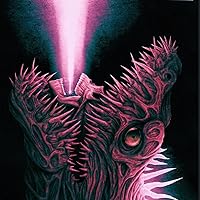
They named the planet Chaos X, because one hemisphere was not in this universe--and no one who ventured there would ever return. They named the other universe Ultra, because it was beyond the laws of the Milky Way galaxy. It was only by means of Ultra's non-Euclidean physics that men could travel the starways.
They named the ruler of that "immobile" planet Fury, because that was the effect of his power on people.
But they were afraid to call Craig Star Gazer by any other name, because he was the space captain who was going to cross into Fury's domain and wrench his loved one from Ultra's power--and this was something that no one had ever done before except the legendary Orpheus.
Brian Michael Stableford was a British science fiction writer who published more than 70 novels. His earlier books were published under the name Brian M. Stableford, but more recent ones have dropped the middle initial and appeared under the name Brian Stableford. He also used the pseudonym Brian Craig for a couple of very early works, and again for a few more recent works. The pseudonym derives from the first names of himself and of a school friend from the 1960s, Craig A. Mackintosh, with whom he jointly published some very early work.
They named the planet chaos x,because one hemisphere was not in this universe-and no one who ventured there would ever return.they named the other universe ultra,because it was beyond the laws of the milky way galaxy.it was only by means of ultra's non-euclidean physics that man could travel the starways.they named the ruler of that immobile planet fury,because that was the effect of his power on people.but they were afraid to call craig star gazer by any other name,because he was the space captain who was going to cross into fury's domain and wrench his love one from ultra's power-and this was something no one had ever done before except the legendary Orpheus.
Here is a striking and often excellently written sci-fi concerning a journey into another universe, bathed in blackness rather than light, which operates on a sort of dream logic rather than the laws of our universe. In this world the dead persist even as their bodies deteriorate for millions of years, held together as long as their own consciousness can sustain itself. They are the subjects of a cruel king who has harnessed the dream energy of this universe to his advantage. He lures them in with Faustian promises, kills them, and sets them to work in his empire.
The plot proper concerns the travels of a group of ambivalent and alienated characters through the weird psychic geographies of this universe. All seek to meet the king for one reason or another but all are so introverted, reluctant or unable to empathise with others that they barely comprehend this shared goal, and treat efforts at communication with hostility. The psychology of some of these characters is drawn with surprising depth. Stableford is derisive of their weaknesses, and signifies the characters' motives as confused, selfish and illusionistic. He treats them all with a cool contempt, alienating the reader into the same mental isolationism as his characters. There is a strain of J.G. Ballard in the characterization of these solipsist sorts. However at points the cold treatment falters into mood breaking mean-spiritedness. There are some notably "edgy" parts which are intended to shock but are betrayed as emotional ploys. A few of the characters suffer for the addition of needless violence and dramatic intrigue into their back-stories which blunt the soft tones of psychological detail Stableford paints in the books early sections. Others are effectively rendered as both embodiments of mythical archetypes and faulty human persons who can't see through their own illusions, both self-creating their mythical identifications and also inheriting archetypal figures beyond their will.
The isolated dreamy mood is very visual, though in an interestingly "flat" absurd way which has totally weirdo monster freaks popping out of nowhere and Looney-Tunes physics at play. Far from painterly this visual coda of backlit plants and creatures against darkness evokes cartoon or early video-game starkness.. The consistent tone is of an insonorous, sleepy threat offset with flourishes of visual splendour . The eerie darkness of the landscape bursts alive in moments of high psychic energy into colourful monsters and terrains. The encounters with these things, all of which are described in heightened detail, play out like the Disney version of Alice in Wonderland but do not capsize the seriousness of the work as a whole. Instead they enrich the idea of a place which obeys an intangible logic based on the submerged fears and desires of the travellers. Stableford *must* have been familiar with psychedelic drugs, or perhaps maintained an obsessively detailed dream diary, as his ability is to relate the minutiae of altered states, the chains of reason and visual patternings which are difficult to recall after the fact. A chapter concerning an enormous cockroach-dog-Thing is exceptionally potent with half-stated suggestions and possibilities.The violence in this chapter carries an inexplicable emotional weight and Stableford accurately presents violent action as stemming out of the aggressor's inner weakness.
The other aspect to the book is a loose exploration of mythology. This theme is more effective in some places than in others, which is a criticism I would launch at the book generally. It is quite hit or miss. Sometimes whole chapters pass without a single breach of reader immersion from the dream-image and moodiness of the black universe. But at other times the writing feels rushed and the ideas a hodge-podge without the mythical and dream-like coherence of the rest. Such an offending chapter is the one about the "Metallic Forest" depicted in very abstracted (or rushed) prose presenting an idea out of reason with the rest of the book , no matter how many adjectives Stableford throws at it. Towards the end these messy chapters are more common and the final scenes are basically poor, the narrative concluding hurriedly and ineffectively. Although it's never completely sour, with some last-minute poignant observations about the inability of myth to encapsulate the reality of human experience.
Overall this book earns high marks and deserves to be read not because it is perfect as whole but because when it is good, it is very good. The ideas and images have a singular enchanted quality that sets them apart from typical sci-fi.
I got this book in an online auction under the impression that it was the fourth book in Brian Stableford's six-part Hooded Swan series. I was excited because I enjoyed the first three books quite a bit, but when I opened this up I realized that it was a very different kind of journey, and after reading it, I can say it's one that I didn't appreciate nearly as much. This was only Brian Stableford's fifth published novel (emerging novelists got a lot more chances to write books before hitting their strides back in those days), and that shows since it's a bit formless and unimpactful. Stableford is technically a really good writer and that still shows here, but it's lost in a lot of dreamy and possibly self-indulgent murk; alright, if I'm going to be throwing those kinds of words around, let's get some context for my critiques...
The book starts with a little forward about Ultra X (like, the Roman numeral), a tidally-locked planet where the side always facing away from the sun actually exists in another dimension. The laws of physics are different in this other universe (which is called Ultra), including the laws of conservation of matter and energy requirements; in Ultra, you don't need to breath, eat, or drink, meaning that it's very hard to die. In fact, some people go to Ultra so they never have to die at all, even though some people (namely Ultra residents) will later insist that eternal life isn't worth all the pain and mental damage they accrue along the way. This universe is led by the mysterious Fury, and only three people know how to enter Ultra from the planet of Ultra X itself: Fury, Orpheus (a folk hero who's the only man thought to have ever escaped from Ultra with their life) and Julius Watchgod, who Fury's hired to guide immigrants to his capital city from the outside universe. *To Challenge Chaos* is about one of those trips, where Watchgod has to take his "cargo" of seven people through the non-congruent side of Ultra X. The first chunk of the journey includes a flashback into each character's (usually dark) past, and their adventure is otherwise peppered with incidents like . What else can you do at that point?
The book could've been really cool since a planet half submerged in a universe with incongruent rules of physics is a good concept, and Stableford had the imagination to pull it off, but there's this feeling of darkness shoved upon the story that didn't really need to be there, and I had a really hard time engaging with what Stableford was writing. You see, I don't like overly dreamy, psychedelic, or generally "out of it" prose - I appreciate beauty, but not that kind of reality-questioning slipstream that some authors find themselves in. I don't feel that the feeling of reality breaking down translates very well over text (unless your name is something like Philip K. Dick's), and that's what a lot of this book was - a breakdown in reality with a noncommittal view of physics and objective reality. I'm not saying that it was wrong of Stableford to focus on, but it wrapped his story in layers of obfuscation that made it hard to latch on to and remember; I had to read through the back dozen pages of this book while writing this review to remember what happened because the breakdown of things just didn't lead to a good reading experience for me.
Stableford also framed this story inside an overdose of darkness, and all these characters just felt edgy for the sake of feeling edgy. In the first chunk of the book every other chapter is a flashback into one of Stableford's eight main characters. Each one actually has a pretty cool writing gimmick in that before every couple paragraphs there's a negative digit like "-23" or "-6," which states that the following paragraphs are about what that character went through twenty-three or six years before the book's main story takes place, respectively, so we get little life overviews of our cargo. This includes those from Ernst Nimrod, a professional torturer (see what I mean about edgy?), Donna Teredo (who has a deceptively boring past), John Wrath (a hero who a mysterious voice told to go to Ultra), Craig Star Gazer (a galactic journeyer suddenly obsessed with love), or Marc Coldflame (who ). I really like the style of how these characters were introduced and the little bit of prose styling along with it, but I found them all to be a bit... forced. There's such a heavy sense of darkness and self-reflection and brooding among so many of the characters, even Watchgod, that was just... pretentious? It didn't seem real. But then again, neither did anything that happened in Ultra.
And just like the characters didn't convince me, neither did the world of Ultra. It probably has to do with the dreaminess of everything, but I wasn't sold (here I go again) on the fine details. For example, in the opening pages of the book, we're told that spaceships fly through Ultra and use its space-bending-ness to get through space faster than normal ships can. But we're also told that it's accessible on Ultra X by only three people... are there other ways in and out of this universe that Stableford declined to mention? There are other little logical fallacies sprinkled throughout the book too, but - in Stableford's defense - there are also a lot of really cool elements to this world. Like, the undead pirate ship. I would've been sold on that if the rest of the book wasn't janky. And Stableford's purple descriptions of the world, when not wringing its own hands in dark self-reflections, are still beautiful and should be poignant. He is a good writer; he just chose to write something with less than the required amount of the important details and a whole lot more of the guessing game.
I do wish the book would've ended on a more solid note. Like... there are some very important pieces of dialogue thrown about as we come to a close, but they weren't ground/world-breaking. There's still a lot of mystery to what Stableford was trying to get at with this book. That's his prerogative, and I do respect him for telling the story he wanted to tell, even if I wasn't the biggest fan and if it probably wound being less than a commercial hit. It just didn't land with *me*, as I've said a pretentious amount of times during this review. I suppose I wanted something clearer and easier to hold on to, but even if that's not *To Challenge Chaos*' MO, it's still technically well written and a worthwhile experiment to people interested in Brian M. Stableford, even if I don't think a lot of people will find joy in it.
Overall, this book gets a 5/10; it has its moments, but I ultimately found it purposeless. Hopefully this review was a little less purposeless and actually helped you in your hunt for the next obscure, buried gem of an SF novel (or whatever else it is that readers search for nowadays). I will be reading the actual fourth Hooded Swan novel (*The Paradise Game*) before the year is out, and I'll be reviewing it here not long after that. Until then, I'm sure I can find some other forgotten SF that's worth a bit more salt; thanks for reading, and I'll see you in the next one.
Overall just an okay story. Felt more like fantasy than SF. Things were randomly happening, not making a lot of sense. However, it was a weird enough book and I'm a fan of unusual stories. 2.50*
The planet Chaos X has a sun-facing side in our universe and a dark side in the parallel universe called Ultra:
Blackside is in the ultrauniverse where the star ships go to be free of the restrictive laws of physics that determine the time they should spend in their traveling. In ultra the so-called laws are merely irrelevancies. Energy can be created or destroyed; no rules determine its flow. Time is not necessarily unidirectional and not necessarily there at all.
The guide Julius Watchgod takes seven passengers on his “gondola” that slides on the weird terrain of blackside, each with a special reason to risk madness, slavery or annihilation to meet the insane chaos-ruler King Fury. The main protagonist is Craig Star Gazer:
Craig Star Gazer wandering the ruined city of Lyrex, looking for beauty and wanting to be loved.
And for another of the travelers, we see Brian Stableford's outlandish omniscient narrator perspective:
Heroines were made to be rescued. Heroines are trite but good theater even now.
For Donna Teredo there was unlikely to be any rescue available. But Donna was a heroine and forever willing to put her faith in the artistry of cosmic injustice. If only the universe had been created by Richard Orpheus...
Yes, the whole book is written in this flowery, self-parodying prose, but then you get used to it, but... a bunch of weird people go to the weirdest place in the universe, everything there is weird, and then everything is going okay until... something incredibly weird happens! And when they reach their destination, things get really weird!
A torturous, unfocused, ambiguous ride through Stableford's spin on a descent into a version of Hades. None of the characters are interesting, believable, well-drawn or deserving of a reader's sympathy. The so-called hero, according to the back cover and front inside description, does absolutely nothing of merit, nor even is granted a majority of the storyline, ignorantly causing the villain's downfall solely through having carried something another character gave him to hold.
The fundamental flaw for me is the attempt to create a world where "nothing had meaning", which like dream-sequences or magic realism simply give authors the opportunity to write whatever the heck they want, in a feverish unruly stream of meaningless, which rarely ever engages a reader. As much as Stableford has been influenced by, and attempts to create, a sense of mythology, a mashup perhaps of The Odyssey and The Divine Comedy: Inferno - Purgatorio - Paradiso, he instead gives us something more reminiscent of Willy Wonka's factory, or Oz (neither of which have ever been to my taste, though I hardly deny their continued popularity).
Frankly, it starts off on a cringeworthy wrong foot when all the characters are given the most insipid, ridiculous names (Craig Star Gazer, Dark Aura, Marc Coldflame, John Wrath, Gray Gay Storm, Julius Watchgod). Then there are intervening episodes sandwiched between character flash-backs, which are almost entirely without purpose or charm (other than perhaps to allude to the episodes faced by Odysseus), and even go on to rather absurd length in some cases just to be completely dropped without ever having meant anything. For example, the Singing Sea concept (which I believe even alludes to sirens at one point) culminates in a scene where Star Gazer is finally able to comprehend one word, though he cannot utter it or explain it, which makes him realize that "The song, Craig knew now, was the song of the glaucomorphs", promptly following which statement there are no further references whatsoever throughout the book to said "glaucomorphs" or their singing, nor any explanation of why any of that was relevant or interesting.
This book really makes me question my desire to read so many of these early DAW SF books.
3.5 Star I wish more people would read this so I could get a better handle on it.
It's like a combination of weird fiction, recruitment stories (Seven Samurai or...Ocean's Eleven), new wave SF, self-aware names (Watchgod? King Fury? DARK AURA!?), a horrific wonderland, and old myths.
Even though it wasn't always fun to read, Stableford's writing, in particular some of his characterizations, was pretty great.
Take a look, maybe? I'm not even sure it's that good. Sometimes I was even a bit annoyed, but all in all, I was impressed.
I’m typically a big fan of Stableford’s weird and wild sci-fi books, but this was a bit of a miss for me. Probably the worst of his I’ve read. Yes it still has Stableford’s characteristic breadth of imagination and delightful prose, but the story itself was a bit too colour-by-number. Almost felt as if one was tossing Canterbury Tales, Hyperion and an Orphic legend into a pot and stirring to see what would result. And the result is muddy. Ah well.
To Challenge Chaos tells the story of a world, Chaos X, which is half in our universe and half in another, a dimension where people can survive bodily death, and where one man has set up his own kingdom. Several travelers take the trip to this other dimension, each for their own reasons.
It sounds like fantasy, but it is at least nominally science fiction, and outlandish as it is it at least pays lip service to science fictional tropes. In many ways, it feels like it's attempting to recast certain old myths in a science fictional context, and it's written in a more stylized, almost poetical way than a traditional adventure. The characters often feel more like archetypes than real people.
It was interesting enough to keep me reading, but the story didn't do much for me. However, there are a lot of great descriptions, both of wondrous environments and about the characters, that really resonated with me and are something I might come back to in the hopes of emulating.