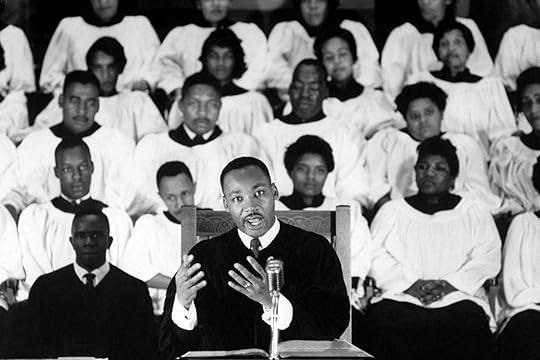
In 1957, Time magazine named Martin Luther King, Jr. its "Man of the Year". It characterized him as an "expert organizer" but "no radical" – a Christian civil rights organizer, presumed to be quite different from 1940s black socialists with labor politics. In reality, as is shown in his autobiography, King never narrowed his politics only to civil rights. He had clear links to working-class and poor people through his family, church, and community. While to white journalists the well-dressed, highly educated “Dr. King” appeared as the typical middle-class leader, he came from a line of people, including slaves, who struggled fiercely against poverty and Jim Crow. His grandmother, for example, took in washing and ironing for whites but was not afraid to beat up a white man who had assaulted her son, Martin’s father. “Daddy” King, Martin’s father, later escaped lynching terror and low wages by moving to Atlanta from rural Georgia. Preaching a religious Social Gospel aimed at elevating the black urban poor, he took his son – born in the year of the stock market crash of 1929 – to see the unemployed people standing in food lines, so that Martin, who was being raised in relative material comfort, would understand the hardships of the poor.
Martin wrote that he learned at an early age that “the inseparable twin of racial injustice was economic injustice,” and that he developed “anti-capitalist feelings” as he witnessed dreadful southern poverty and labor exploitation during part-time summer work. Although he had an optimistic belief in the goodness of human nature and the power of America’s democratic ideals, this optimism was constantly tested by the profound racism of most whites. As an undergraduate in sociology at historically black Morehouse College, he studied the connection between racism and poverty and how it might be overcome through democratic action. As a master’s-degree student at Crozier Theological Seminary and then as a Ph.D. student at Boston University, King read about, and came to be fascinated by, Gandhi and his campaigns of nonviolent direct action; he disagreed with Karl Marx’s atheism, but adopted his critique of capitalism as damaging to the poor and workers.
When Martin met his future wife, Coretta Scott, in Boston, he saw in her another black Southerner (raised in rural Alabama) who wanted to change the world and who remained a peace advocate all of her life. In September 1954, less than four months after the U.S. Supreme Court overturned school segregation, they moved to Montgomery, Alabama.
Their lives changed on December 1, 1955, when Rosa Parks, a weary seamstress, refused to give up her seat on a bus to a white man, and the Montgomery Bus Boycott got under way. Parks had long worked as an assistant to E. D. Nixon, past president of the Montgomery NAACP and the city's leading civil rights activist, and she also led NAACP youth groups. Her refusal to give up her seat led to her arrest, which energized black working people, the majority of whom rode buses. They boycotted for 381 days, walking or getting rides in car pools to their jobs. Nixon got Parks out of jail, and most importantly, steered Martin Luther King, Jr. into Movement leadership.
Martin had the qualities that allowed him to lead a mass movement that joined working-class people to the middle class through the black church. In a few moments in his first speech at the first mass meeting of the Montgomery Improvement Association (MIA), King powerfully presented the struggle against segregation from a moral point of view: “There comes a time when people get tired of being trampled over by the iron feet of oppression," and have to organize. Nixon, meanwhile, embodied the connection between labor and civil rights, raising hundreds of thousands of dollars as treasurer of the MIA by appealing to union members across the country, and by helping to connect King to "the world of civil rights unionism and pacifism." Thanks to him, Martin sharpened his understanding of nonviolent direct action. Although racists blew up King’s house, the house of E. D. Nixon, and the residences and churches of other activists, the Montgomery movement stayed united and won a Supreme Court ruling against segregation in transportation. King’s religious framework, his stunning eloquence, and his learning made him a strong orator, and the mass media gave him phenomenal attention.
In 1957, he and other ministers held a conference on desegregating transportation through boycotts and other protests, producing the Southern Christian Leadership Conference (SCLC), a ministers’ group that sought to end Jim Crow and “redeem the soul of America” through nonviolent organizing. Many black labor activists, such as Bayard Rustin, Ella Baker, and Stanley Levison, helped King tighten his ties to civil rights and labor advocates. King also went to Ghana to celebrate its independence from British colonialism, and visited India to learn more about nonviolence. As Indian Prime Minister Nehru spoke with him about democratic and socialist anticolonial movements in the developing world, King gained an increasingly global perspective and became adept in identifying the links between issues. In September 1957 he called for a coalition between organized labor and African Americans to end Jim Crow, adding, “I never intend to adjust myself to the tragic inequalities of an economic system which will take necessities from the masses to give luxuries to the classes.” Although the media tended to portray him as almost solely a civil rights leader, demanding equal rights within American capitalism, his views went much further than that.
American conservatives and segregationists constantly attacked Martin Luther King, Jr. as a covert Communist. Georgia’s Commission on Education even sent an undercover agent to take a picture of King sitting next to a reporter for the Communist Party newspaper, the Daily Worker, and right-wing groups turned the photo and headline, “Martin Luther King at Communist Training School,” into the most famous billboard of the era. Congressional investigating committees used this reasoning of anti-Communism against King for the rest of his life, imposing guilt by association when he insisted on defending other people’s civil liberties. But King was not the dupe of anyone – he viewed civil liberties and civil rights as indivisible, and he recognized that denying freedom of speech for leftists created an air of fear aimed at silencing all movements for change. Along with other leading black intellectuals, King called for the abolition of HUAC, the antisubversive Senate committee, and other efforts to suppress freedom of speech and thought. He also recognized the failures of capitalism for people of color, and, encouraged by Coretta, increasingly opposed America’s interventionist militarism in Vietnam.
Although Martin's reputation as a leader of masses sometimes by far exceeded his resources and experience, although he could not export the bus-boycott model to other communities, although he struggled in his efforts to organize a mass movement, King's fascinating autobiography demonstrates that he soldiered on, searching for new viable strategies and expanding his view of the the problems and the possible solutions confronting the freedom movement. This valuable book presents us Martin Luther King, Jr. not as a legendary, idolized figure, but as a human being. It helps us realize his humanity, his personal and public pains; it reminds us that he was similar to us, that we could go and do likewise.