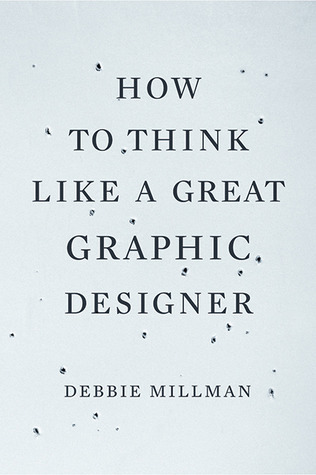
Take a peek inside the heads of some of the world’s greatest living graphic designers. How do they think, how do they connect to others, what special skills do they have? In honest and revealing interviews, nineteen designers, including Stefan Sagmeister, Michael Beirut, David Carson, and Milton Glaser, share their approaches, processes, opinions, and thoughts about their work with noted brand designer Debbie Millman. The internet radio talk host of Design Matters, Millman persuades the greatest graphic designers of our time to speak frankly and openly about their work. How to Think Like a Great GraphicDesigners offers a rare opportunity to observe and understand the giants of the industry. Designers interviewed -Milton Glaser -Stefan Sagmeister -David Carson -Paula Scher -Abbott Miler -Lucille Tenazas -Paul Sahre -Emily Oberman and Bonnie Siegler -Chip Kidd -James Victore -Carin Goldberg -Michael Bierut -Seymour Chwast -Jessica Helfand and William Drenttel -Steff Geissbuhler -John Maeda
Allworth Press, an imprint of Skyhorse Publishing, publishes a broad range of books on the visual and performing arts, with emphasis on the business of art. Our titles cover subjects such as graphic design, theater, branding, fine art, photography, interior design, writing, acting, film, how to start careers, business and legal forms, business practices, and more. While we don't aspire to publish a New York Times bestseller or a national bestseller, we are deeply committed to quality books that help creative professionals succeed and thrive. We often publish in areas overlooked by other publishers and welcome the author whose expertise can help our audience of readers.
Debbie Millman is an American writer, educator, artist, and designer who is perhaps best known as the host of the Design Observer podcast 'Design Matters'. She is 'President of Design' at Sterling Brands, based in New York City, working with brands such as Pepsi, Gillette, Colgate, Kimberly-Clark, Nestlé, and Campbells. She chairs the 'Masters in Branding' program at the School of Visual Arts, is a contributing editor to Print, a blogger for Fast Company, and the 'President Emeritus' of AIGA.
This was not only a great read as a graphic designer (finding insight into some fantastically talented creative minds), but also a thoughtful journey into what vocation means...how we are called to some tasks and find pleasure in them. This book made me think a lot about what I love and what I want to do and learn more about and pursue. It was creatively inspiring without being a myopic designer's book--I felt less torn about wanting to do a million things and being interested in everything. I appreciated that the interviewees were humble and human--this is not a pretentious coffee table book, but real conversations between human beings discussing what it means to create and fail and break molds.
This book contains a collection of interviews of graphic designers conducted by fellow designer Debbie Millman. As a designer doing a lot of web developing recently, reading this book is a perfect anodyne for those times when I hit a wall coding. I've met several of the subjects Debbie interviews but my brief intro's and questions only provided a glimpse of who they are. What's nice is that she infuses such shared experience and knowledge into each question that it brings out those responses I was looking for. It's heartening and encouraging to hear "rock star" designers confess their human failings. They just work harder than most.
Debbie Millman was able to build an highly enjoyable journey through the minds of celebrated designers. We get to understand how they think, what motivates them, what makes them anger, fear, content and happy. If you want to be a designer, this book is obligatory. If you want to know how a mind of a designer works, read this book. If you want a glimpse on the creative thought, its challenges, concerns, disruptions, deficiencies as its marvels, read this book.
As other reviewers have pointed out, a more appropriate, if maybe not as sales-worthy title for this book would be, "Thoughts of the Great Graphic Designers". It contains a series of interviews with the some of the most recognizable names in graphic design - this is not a how-to book! Still, if you take the contents of the interviews to heart, I think there's a lot of inspiration anyone can take away.
My review would be more positive except for the few interviews that wound up being conducted by email or phone. When compared with the content that the author was able to capture from those she sat and talked with directly, the other sections are shallow and uninteresting.
Do yourself a favor and ignore the title! As is said in the introduction, it’s not a ‘how to manual’ or some kind ‘process’, it’s actually some great interviews with graphic designers like Stefan Sagmeister, Peter Saville & Paula Scher (to name but three), who give beautifully honest interviews that will make you realize that even the best are insecure / sometimes deliver work they’re unhappy with; which was a huge relief to read!
For those who’ve ever had self doubt about themselves or their designs, this is the book you need to put those worries aside and focus on doing what you love!
I think that it’s dangerous to have any kind of satisfaction. You always have to be striving to improve on the next project. The next project has to be what you’re aspiring for, not what you’ve just completed— you’ve already done that.
I realized that the anger I sometimes had toward clients was not necessarily about the clients. It was within me. When I didn’t have clients to tend to, I was just as angry, or not angry, as I was before. One of the things I realized that year was that there was a certain amount of anger in me that was fairly un-client-related.
I spoke to Danny Gilbert about this. He is a psychologist from Harvard who has done a lot of research on happiness. All his studies show that outside events have surprisingly little to do with our happiness. He said that with a few exceptions—like the death of a child—there is almost nothing that happens in our lives that has a profound impact on our lives six months after the event.
You’ve got to like what you’re doing, and then you do it well. You’ve got to like what you’re doing, and you have to put meaning into it for others.
I think the role of a teacher is to imbue confi- dence in students, to encourage them to be curious and to take chances. The one teacher that influenced me more than any other was the first teacher who made me feel like I could be smart.
I wouldn’t be able to stay at home or in a studio alone and work in a complete vacuum. I know that works great for some people, but I need to be around others who are also making things. It’s very inspiring.
Sometimes the authors do the research for you, and every now and then, they pleasantly surprise you. Both John Updike and Orhan Pamuk presented me with the art to use for their most recent covers— Terrorist and Istanbul, respectively—and in both cases, they were terrific. Sure made my job easier.
When I present the work, I show my client the very rational way the connections have evolved. I start with the self-evident solution and take them on the journey of my thinking. When they see what I see, it’s no longer a surprise; it makes perfect rational sense.
For me, our essential purpose is about connecting with another person, another culture, and anyone who is different or has a different life. But our paths and goals are the same. People want to be happy, and they want to have a measure of success and acknowledgment of who they are. Their needs exist regardless of nationality, language, or culture.
My friend Umberto Eco wrote a book about beauty, and now he’s writing a book about ugliness. He told me the last time I saw him that it was much more difficult to write a book about ugliness than to write one about beauty.
Only the person at the top can take risk. He’s used to it. That is how he got to the position he’s in. He understands what you are doing, and he doesn’t have to report to anybody. He makes his decision, and that’s the way it goes.
I really enjoyed reading these interviews. It was fascinating to read the different ways they think, and to glean some good learning points from what they said. Not a “how to” (as is described in the introduction), but educational nonetheless. Would recommend.
one of the best books i have ever read. how to think like a great graphic designer is full of wisdom applicable to any area of life— not just graphic design. from discussions about the nature of hard work to disagreements on the value of perfectionism, httlagd makes clear that the field of graphic design is not a monolith. however, shared values of the graphic designers shine through: particularly their pathos and intense motivation. httlagd was an inspiring read with wisdom that i will carry with me for years to come!
I enjoyed this exercise in going to an area which I really have no affinity other than enjoying and being fascinated by book covers. I was surprised at the similarities between the writing and graphic design world. There also seemed to be a lot of cross over and I was intrigued by how the different artists approached their work and dealt with the inherent paradox of art versus commercial. The presence of the audience is front and center in graphic design, maybe it should be in every art form.
Title is misleading, I wish it were named "Interviews with Influential Graphic Designers." With that mentality, I wouldn't have expected to learn how to think like a great graphic designer. It was interesting to read and learn about graphic designers, but that wasn't the reason why I picked up the book.
The title is misleading. The book is not about learning how to think like a graphic designer. I would say less than 3% of it is about their design process and how they tackle projects and their way of thinking. 97% is about the lives of the designers interviewed, including their childhood. A better title would be "Interviews with Great Graphic Designers"
I've read about a third of this, but there's nothing new or exciting about the interviews. There's a few quotes about the business I could absolutely relate to, just nothing that broadened my thinking about Graphic Design. Perhaps that's included in the latter half? ;)
🦆 Rubber Duck Review: How to Think Like a Great Graphic Designer
Snap Review: Honestly, I didn’t really know what to expect—I just thought the title sounded interesting. But wow, this turned out to be a surprisingly deep and thoughtful swim through the creative minds of some of the greatest designers out there. Debbie Millman doesn’t just ask questions—she gets designers to open up about fear, failure, purpose, and passion. It’s less about tools and more about the messy beauty of how creative people think. And somehow, it’s exactly what I didn’t know I needed.
Rating: 🦆🦆🦆🦆½ out of 5 Quacks (half a quack docked because one duck drifted off mid-interview thinking about color theory)
Mood: Like floating on a still pond while design legends whisper existential truths into your feathers.
Current Thoughts: • I didn’t expect this to be so human and relatable. • These designers don’t just create—they reflect, question, and feel. • Millman’s interviews feel like sitting in on a quiet, honest conversation—just you, a notebook, and a duck full of feelings. • Also: Should I rethink everything I’ve ever created… or just buy a new notebook and start scribbling wildly?
Would I Recommend It? Absolutely. If you’re a creative soul, a curious mind, or just a duck who likes to overthink things in a stylish font—this one’s worth the paddle.
I first listened to Debbie's podcast around 1 year ago, and I just discovered this book like one week ago! She has deep expertise in this area. I like the idea of bringing lots of great designers and artists and asking tough, mindblowing questions.
This book is a compilation, a culmination, a cornucopia of interviews of Debbie along with her great guests in her podcast. While it seems superficial, the guests are some of the most talented artists, such as Massimo Vignelli, Milton Glaser, Paula Scher, Michael Bierut, etc.
The first thing that I like about the book is the way she asks questions--she dug deep & did some research! Some examples: how is your design process, how he/she gets inspired, how to start a project, how do you know if a project is finished, etc. It's personal, exciting, funny, and philosophical, and inspiring. I got lots of inspirations while I read this. It can get a little boring if you're not familiar with the guest, but the answer and lessons are worth it, especially for aspiring designers/artists out there.
Title is clickbait-y and at times the question quality could be improved (asking stuff like "What are you afraid of?" to many of the interviewees strikes me as one of those lazy intimacy openers trying to hit on something juicy, instead of tailoring the question to that designer's work and asking about particular fears). That said, the interviewee list is full of influential designers who have put out great work and I appreciate having the opportunity to read their thoughts. I really enjoyed some of the interviews and read them closely, and skimmed others I found less interesting. I recommend it for light reading, and especially if one of your favorite designers is featured.
Definitely mis-titled. This is really a series of interviews with some of the iconic designers of our time, but it's not in any way a "how to" book. You will learn some of the though processes of the designers, but very little about design itself. That said, it's an excellent intro to who's who and going through the books interviewees and following up on Google will give you some great examples.
Also, as others have noted, the email interviews follow a sort of generic template and don't have the liveliness that the face-to-face ones do.
A remarkable collection of interviews with some of the brilliant graphic designers of the world revealing the unknown facets of their life, career, and craft. Debbie Millman had done a commendable job of bringing the booty of an extraordinary treasure hunt to readers to enjoy. The budding and practicing design professionals would find this wonderful volume enlightening and inspiring.
Captivating look into the minds of design legends like Milton Glaser and Stefan Sagmeister. Through honest interviews, it reveals their creative processes, philosophies, and resilience. Perfect for aspiring and seasoned designers, it offers practical insights on risk-taking, client work, and innovation. Though slightly unstructured, it’s a must-read for anyone passionate about graphic design.
Well, you can safely skip this collection of generic interviews with well- and lesser known graphic designers; was hoping for some insights into the artistic way of thinking and life, but all I got was this scraped together bunch of non-interesting casual conversations and an author who obviously does not know how to create anything worth remembering.
Was an enjoyable read and insight to some amazing designers, although there was more I wanted to know. There was a few that I wasn't very familiar with but I'm now totally digging like Chip Kidd. Yup, good read but just missing out on 'Pure Dead Brilliant' status.
Alright, this one has decent value Debbie asks interesting questions but I just prefer podcasts as its raw and it feels more honest then reading a dialog. A collective wisdom of the best-known designers.
This book was a good insight in to the, well known, minds of graphic designers. You will have to put yourself into the graphic designer's shoes to really enjoy this book. Good read.
I love her podcast and it feels so wrong to NOT hear her voice on this audiobook. But it was very interesting to hear the thoughts of so many great graphic designers.