Clarimonde' is a short story originally published in French, in 1836, under the title 'La Morte Amoureuse' (in English: 'The Dead Woman in Love'). It tells the story of Romauld, a priest, who falls in love with the title character, Clarimonde. She, however, is a vampire, and Romauld begins to struggle with discerning reality from illusion. This is a classic vampiric romance and a must read for anyone with a passion for the genre. We are republishing this book with a brand new introductory biography of the translator of the work, Lafcadio Hearn.
Pierre Jules Théophile Gautier was a French poet, dramatist, novelist, journalist, and literary critic. In the 1830 Revolution, he chose to stay with friends in the Doyenné district of Paris, living a rather pleasant bohemian life. He began writing poetry as early as 1826 but the majority of his life was spent as a contributor to various journals, mainly for La Presse, which also gave him the opportunity for foreign travel and meeting many influential contacts in high society and in the world of the arts, which inspired many of his writings including Voyage en Espagne (1843), Trésors d'Art de la Russie (1858), and Voyage en Russie (1867). He was a celebrated abandonnée of the Romantic Ballet, writing several scenarios, the most famous of which is Giselle. His prestige was confirmed by his role as director of Revue de Paris from 1851-1856. During this time, he became a journalist for Le Moniteur universel, then the editorship of influential review L'Artiste in 1856. His works include: Albertus (1830), La Comédie de la Mort (1838), Une Larme du Diable (1839), Constantinople (1853) and L'Art Moderne (1856)
Junto con las cuatro mujeres de Poe (Ligeia, Morella, Eleonora y Berenice), Vera es el típico ejemplo de la fèmme fatale del Romanticismo, con la muerte como mediadora entre los amantes.
"Clarimonde" is the English translation of the 1836 gothic supernatural tale "La Morte Amoureuse." A man lives the life of a village priest by day, and the lover of the beautiful courtesan Clarimonde when he dreams at night. Duty calls for him to love God, but his passion is for Clarimonde. It's a story of infatuation with a supernatural femme fatale.
Gothic writing at its finest!!! What an unexpected treasure found inside the pages of a vampire anthology!
Loved every word. So descriptive, each phrase brimming with passion and enthusiasm. I fell in love with Clarimonde and Romualdo as they fell in love with with each other. Sparkling and ingenious...she was both beauty and the beast!
I read CLarimonde La Morte Amoureuse in French (The Lover Dead), because there’s nothing better than Théophile Gautier in French… sorry for you, dear friend readers!
As soon as the first sentence: “You ask me, brother, if I have loved? I have.” we have only one desire: to read all the others! It's simple, concise and intriguing. And we aren’t disappointed! Théophile Gautier’s prose is the most beautiful of the world, of all languages, of all eras ... Yes, I am a fan, so what? I love him and I am not ashamed: only those who don’t love should be ashamed of not loving. But let’s come back to our Morte Amoureuse. Romuald, who has always wanted to be a priest, knowing nothing of the world, men or women, looks up on the day of his ordination on the superb Clarimonde. "A single glance too full of complacency on a woman caused the loss of my soul." And Romuald becomes aware of the existence of sensual love, awakening of the senses, awarness that another world exists outside the priesthood, a world of physical love, of human beauty, which is opposed to the world of divine beauty, of spiritual love. We’ll see that it’s not only the struggle of a priest torn between love of God, chastity, self-denial on one side, and love of the woman, control of his own life on the other hand. The priesthood in this short story represents the social shackles. Our young Romuald doesn’t want to become a priest anymore; he could say no and leave the church as a free man. But, like the girl walking towards the altar with the firm resolve to refuse a husband she hasn’t chose, as the poor novice girl ready to tear the veil before becoming a nun contrary to her wishes, Romuald says yes to the priesthood, crushed by the heavy silent looks and wills that have chosen his life for him; to avoid scandal.
Although this short story is fantastic, and constantly balancing between night and day, the reality of the life of the young women and men of the author's time is constantly underlining the story. When Romuald realizes that he has made a huge mistake by becoming a priest, he thinks of running away. But as the girl locked up in the paternal house or the marital house: how to escape, how to gain freedom when one knows nothing of the world, when one is not adapted to the practical life, and one is without money? So we resign ourselves. But when life swells in you and makes your heart beat, resignation can’t last forever. The black of the cassock, for Romuald, is the mourning of life that he touched, for a moment, in Clarimonde’s eyes.
Romuald is assigned to a church, in a village and seems to accept his life ... until one year later, Clarimonde, dead, come back to haunt his dreams. Night after night, she makes Romuald a Venetian prince and becomes his lover. So, for Romuald, the reality is reversed: the dreams of his nights as a prince and lover become his reality, and his priest days become his nightmares. But Clarimonde is slowly dying again. Her only way to remain alive is to drink Romuald's blood; but she loves him, so she drinks as little as possible to keep him alive too. The two lovers are in a vicious circle: Clarimonde doesn’t want to die so as not to hurt Romuald who loves her; on the other hand, she exists only because he dreams of her: "I will not die because all what I am comes from you," she said to him.
We find, in this story, the themes dear to my dear Théophile Gautier:
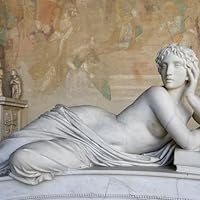
The statuary: Clarimonde, on her deathbed, wrapped in white linen, looks like a white marble statue that will come back to life with the power of love. More than painting, which the author had practiced and knew so well, sculpture is a sensual pleasure for Gautier, a pleasure that will be found in many of his novels such as Arria Marcella, for example. The costumes also: When Romuald puts on a prince's costume, he becomes a prince not only in appearance, but also in character, in qualities as well as in defects, for Gautier is not fooled by the weakness of the character of men!
The costumes also: Gautier loved the picturesque costumes of the countries where he traveled: he dressed like a Spanish in Spain and like a Russian in Russia. He regretted a lot, already in his time, the standardization of costumes in the world. What would he say today? But this is another story, let's go back to our poor and tortured Romuald: how is he going to get out of it? Read the book!
And ... take care: "One minute is enough to lose eternity." I will dare to add after my venerable great poet: isn’t sometimes a minute worth an eternity?
Uno de los relatos de vampiros más divertidos que he leído, o por lo menos yo me reí varias veces sea intencional o no. La pocas quejas que tengo son, el nombre Clarimunda...realmente no quiero leer sobre esta femme fatale, devoradora de hombres y que se llame así,me hace pensar en una señora de 90 años.
Le jeune prêtre Romuald mène une existence partagée entre son service religieux le jour, sa vie dissolue de seigneur vénitien auprès de la noble libertine Clérimonde la nuit.
« et la mort chez elle semblait une coquetterie de plus. »
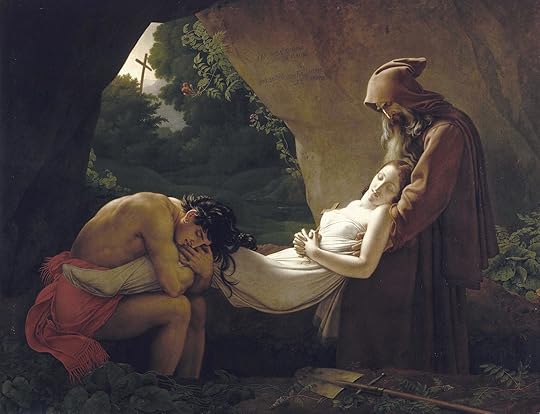
Anne-Louis Girodet, Les Funérailles d’Atala, 1808, huile sur toile, 207 x 267 cm (musée du Louvre, Paris).
LIVRES ANALOGUES :
Un récit fantastique dans la Nouvelle-Angleterre puritaine, au 17e siècle : Young Goodman Brown
Nouvelle fantastique classique de Maupassant (je vous conseille une édition qui présente les différentes versions de la nouvelle) : Le Horla et autres nouvelles fantastiques
Pequeño relato, pionero del vampirismo. Con una trama muy simple y moralizante, aunque con una cosa interesante, no se juzga severamente a la vampira, que al fin de cuentas actuaba por amor. Ricas descripciones y una ambientación lograda.
Pretty good gothic short story. For some reason I pictured Clarimonde looking either like Isabelle Adjani or Monica Belluci.
"She was rather tall, with a form and bearing of a goddess. Her hair, of a soft blonde hue, was parted in the midst and flowed back over her temples in two rivers of rippling gold; she seemed a diademed queen. Her forehead, bluish-white in its transparency, extended its calm breadth above the arches of her eyebrows, which by a strange singularity were almost black, and admirably relieved the effect of sea-green eyes of unsustainable vivacity and brilliancy. What eyes! With a single flash they could have decided a man's destiny. They had a life, a limpidity, an ardour, a humid light which I have never seen in human eyes; they shot forth rays like arrows, which I could distinctly see enter my heart. I know not if the fire which illumined them came from heaven or from hell, but assuredly it came from one or the other." ---
"She seemed conscious of the martyrdom I was undergoing, and, as though to encourage me, she gave me a look replete with divinest promise. Her eyes were a poem; their every glance was a song." ---
"A prie-dieu stood at the foot of the bed; a bluish flame flickering in a bronze patern filled all the room with a wan, deceptive light, here and there bringing out in the darkness at intervals some projection of furniture or cornice. In a chiselled urn upon the table there was a faded white rose, whose leaves—excepting one that still held—had all fallen, like odorous tears, to the foot of the vase. A broken black mask, a fan, and disguises of every variety, which were lying on the armchairs, bore witness that death had entered suddenly and unannounced into that sumptuous dwelling." ---
"The red damask curtains, decorated with large flowers worked in embroidery and looped up with gold bullion, permitted me to behold the fair dead, lying at full length, with hands joined upon her bosom. She was covered with a linen wrapping of dazzling whiteness, which formed a strong contrast with the gloomy purple of the hangings, and was of so fine a texture that it concealed nothing of her body's charming form, and allowed the eye to follow those beautiful outlines—undulating like the neck of a swan—which even death had not robbed of their supple grace. She seemed an alabaster statue executed by some skilful sculptor to place upon the tomb of a queen, or rather, perhaps, like a slumbering maiden over whom the silent snow had woven a spotless veil."
Nunca me canso de leer este relato tanto que he perdido la cuanta de las veces que lo he hecho. Para mi es el paradigma del cuento de vampiras. Siempre que pregunto sobre este tipo de cuentos, me nombran Carmilla y me detallan por qué les fascina. Si, "Carmilla" es un buen cuento , pero este es
Adoro su ambiente exótico y onírico,el relato sensual y como reescribe el pacto satánico a través de un amor tenebroso con visos de locura.
"Este amor, nacido hacía bien poco, se había enraizado de forma indestructible. De tan imposible como me parecía, ni siquiera pensaba en intentar arrancarlo. Esta mujer se había apoderado de mí, por completo, tan sólo una mirada suya había bastado para transformarme; me había insinuado su voluntad; y ya no vivía en mí, sino en ella y para ella."
I love Théophile Gautier, he is one of my favorite french author and poet. He wrote so beautifully with such rich vocabulary and his stories are all so beautiful as well. In this book are a few of his dark fantasy short stories and one of them involves a vampire, a tragic love story. The French saw the vampire and ghost more positive than the rest of the world by making them nicer, the type who loved so much someone they had to come back from the grave to be with the person they love, and the short story La morte amoureuse here is a good example of that.
This was a unique tale of the supernatural that blended many elements together. And Gautier’s writing style was able to blend it all together into this forgotten tale.
This is another time where I don't have anything meaningful to say, I just wanted to announce that I thought the prose was very pretty. Man, people back then knew how to write
সেমিস্টারের প্যারা শুরু। সকালে উঠে বাসে যাওয়া আর আসা। এই যাওয়া আসার মাঝেই বাসের মাঝেই আমি ছোট ছোট বই পড়ি। সেটা সংকলন কিংবা উপন্যাসিকা হতে পারে। আজও বেনজিন প্রকাশন থেকে প্রকাশিত ১৮৩৬ সালে থিওফিল গতিয়ের লেখা La Morte Amoureuse যেটা বাংলা অনুবাদে নাম 'ক্ল্যারিমোঁদ' পড়ে শেষ করেছি। অনুবাদক করেছেন লুৎফুল কায়সার ।
ভ্যাম্পায়ার সাহিত্যের এই বইটা কেবল একটি ভ্যাম্পায়ারের গল্প নয়-এটি প্রেম, ধর্ম এবং নিষিদ্ধ কামনার এক অনুসন্ধান বলা যায়। গল্পটি রোমল্ড নামের এক তরুণ যাজকের স্বীকারোক্তি নিয়ে, যে সুন্দরী রহস্যময়ী ক্ল্যারিমোঁদের প্রেমে পড়ে নিজের পবিত্র জীবনকে প্রশ্নবিদ্ধ করে তুলে।
গল্পটি দুটি রাজ্যের মধ্যে এক বিপজ্জনক সেতু তৈরি করে। পবিত্রতা এবং পৈশাচিকতা,আলো ও অন্ধকার। ক্ল্যারিমোঁদ, যে কিনা মৃত্যুর পরে পুনরুজ্জীবিত এক সত্তা, রোমল্ড কাছে কোনো ভীতিজনক দানব নয়। তার কাছে ক্ল্যারিমোঁদ হলো এক চূড়ান্ত আকাঙ্ক্ষার একজন। যাকে পেতে ঈশ্বরকেও ত্যাগ করতে প্রস্তুত হয়ে যেতে পারে রোমল্ড।
রোমল্ডের দ্বিধাদ্বন্দ্বই এই উপন্যাসের প্রাণ বলা যায়। যাজক হিসেবে ঈশ্বরের প্রতি তার ব্রত এবং ক্ল্যারিমোঁদের প্রতি তার আসক্তি, এই দুইয়ের মধ্যে চলতে থাকা টানাপোড়ন কাহিনিকে ভিন্ন স্তরে নিয়ে যায়।
যারা কেবল ভয়ংকর ভ্যাম্পায়ার কাহিনি খোঁজেন, তাদের জন্য এটি নাও হতে পারে। কিন্তু যারা এরকম দোটানায় ভোগা, যেখানে কোনটা আসল সত্যের আলো, রোমান্টিসিজমের ক্লাসিক উপাদান উপভোগ করতে চান, তাদের জন্য 'ক্ল্যারিমোঁদ' একটি দারুণ বই হতে পারে। এটি প্রেম এবং আকাঙ্ক্ষার চিরন্তন সত্যকে তুলে ধরে, যা সমস্ত নৈতিক এবং জীবন-মৃত্যুর সীমা লঙ্ঘন করতে পারে। নিয়ে যেতে পারে তার কাছে যে হয়তো কবরে শুয়ে আছে আর সেই কবরের উপরে পাথর চাপা দেওয়া।
শেষের দিকে রোমল্ডের অন্তিম স্বীকারোক্তি আমার মনে একটা প্রশ্ন জাগিয়ে তোলে। আমাদের জীবনের সবচেয়ে সুন্দর স্মৃতি কি সবসময় নিষিদ্ধতার রঙে রাঙানো থাকে? অনুবাদ নিয়ে কিছু বলার নেই। লুৎফুল কায়সার ভাইয়ের অনুবাদে হরর সাহিত্যের সকল জনপ্রিয় বইগুলো পড়া হয়েছে। এই বইয়েও উনার দুর্দান্ত অনুবাদ দেখা গিয়েছে। বইটাতে ফুটনোটও আছে। তাই সহজে ধরতে পারা যায় সব।
Una historia que refleja la naturaleza de seducción de los vampiros que, con una mirada, pueden corromper hasta al sacerdote más entregado.
Lo que me parece curiosa es la mesura de la vampira a la hora de alimentarse del sacerdote. Vamos, que uno pensaría que no van gotita a gotita sino que se lo zampan entero, jajaja.
This collection includes four horror stories with gothic elements. La Morte Amoureuse, Le Chevalier double, Le Pied de momie and Deux acteurs pour un rôle. La Morte Amoureuse – Clarimonde – is the first and the most interesting.
The story centers around a priest, Romuald, and his meeting with a young, beautiful woman, Clarimonde. He is incapable of restraining himself and falls into a peculiar situation. The gothic segments are profound, and the story includes everything from death to vampires. Although, it's a rather nice vampire and a victim that prefers to be with her instead of living his chaste life.
The novel alternates between Romuald's two conditions and he is not aware of which is his real life. Is he dreaming when meeting Clarimonde, or when he is a priest? What is reality and what is illusion? Another question is whether it could all be a dream about seduction considering his newly taken wows?
Gautier was one of the initial French authors in the romantic period. According to Gautier, art is eternal, while everything else perishes. The phrase ”l’art pour l’art” - art for art's sake – is credited to him, even if not made up entirely by him. He claimed that art didn't need moral justification and was allowed to be neutral. Gautier was highly influential in the early romantic era.
Fue una lectura bastante entretenida; me encanta el horror gótico. Comprendo que el amor a primera vista era algo muy popular en los escritos de aquella época y he leído varios relatos de ese tipo, suelo dejar de lado el romance porque al tratarse de historias de terror, no puedo evitar verlos más con un tinte perturbador y enfermizo.
Ese es el motivo por el que amé la historia de Romualdo y Clarimonda, ella despertaba el lado más lujurioso y obsesivo del cura, ella era su sueño y a la vez su pesadilla. Me encanta leer cómo se atormentan a sí mismos jaja. Me mantuvo bastante entretenida.
No sentí mucha profundidad en los personajes, pero logré conectar con ellos. Logré comprender a Romualdo y el autor supo transmitirme su desesperación.
¿QUÉ ME IMPORTA QUE TODOS LOS RELATOS CLÁSICOS DE VAMPIROS SEAN LA MISMA METÁFORA GASTADA DE DESEO CARNAL FLAGELADO, TEMIDO, ABORRECIDO Y UN DESCENSO A LA LOCURA POR UNA DUALIDAD ENTRE LA ATRACCIÓN Y LA MORAL IMPUESTA Y APRENDIDA??? THAT’S MY TYPE OF SHIT. Me gustó muchísimo este tanto por el uso del lenguaje y las imágenes (bueno, claro, es Gautier, el mayor exponente del parnasianismo) como por el uso de un cura y una vampiro para representar esa moral victoriana de recato y ascetismo y el primer tirón de un deseo que se sale de esa moralidad… hmmmmm. Lo único que puede hacer mejor a los relatos de vampiros es cuando son homoeroticos. ¿QUÉ MÁS CONTRARIO A LA MORAL VICTORIANA QUE ESO??
embodies many of my favorite aspects of gothic literature: erotic, atmospheric, religiosity, dreamscape, the inherent supernatural strangeness in all things. after reading I was surprised to see it was written in 1836, it seemed to be a later work by 60 or so years in the genre, it was stood the test of time very well. fascinating psychologically. the prose was beyond lovely, I must read more of Gautier!
La Morte Amoreuse is the tale of love between a young priest, Romuald, and a beautiful vampiress, Clarimonde. Gautier's short story offers plently of food for symbolism and analysis as it functions on multiple levels. As it happens with most gothic fiction of that kind, Clarimonde blurs the boundaries between life and death. As a vampiress, she comes and goes, travelling between the two worlds while not fully belonging to either. However, the same applies to Romuald. Dead during his duties as a priest, alive while being Clarimonde's lover.
La Morte Amoreuse shares a common trait with Edgar Alan Poe's Ligeia as it plays heavily with the idea that love can break the confines of death. In a scene of incomparable beauty and profound romanticism, Romuald brings Clarimonde back from the dead with a single kiss. Both have to fight against obstacles. Romuald against God and the Chrurch and Clarimonde against Satan and the carnal pleasures. Nonetheless, their love is able to transcend both the physical and the metaphysical.
The night advanced, and feeling the moment of eternal separation approach, I could not deny myself the last sad sweet pleasure of imprinting a kiss upon the dead lips of her who had been my only love. . . . Oh, miracle! A faint breath mingled itself with my breath, and the mouth of Clarimonde responded to the passionate pressure of mine. Her eyes unclosed, and lighted up with something of their former brilliancy; she uttered a long sigh, and uncrossing her arms, passed them around my neck with a look of ineffable delight. ‘Ah, it is thou, Romuald!’ she murmured in a voice languishingly sweet as the last vibrations of a harp. ‘What ailed thee, dearest? I waited so long for thee that I am dead; but we are now betrothed: I can see thee and visit thee. Adieu, Romuald, adieu! I love thee. That is all I wished to tell thee, and I give thee back the life which thy kiss for a moment recalled. We shall soon meet again.’
Her head fell back, but her arms yet encircled me, as though to retain me still. A furious whirlwind suddenly burst in the window, and entered the chamber. The last remaining leaf of the white rose for a moment palpitated at the extremity of the stalk like a butterfly’s wing, then it detached itself and flew forth through the open casement, bearing with it the soul of Clarimonde. The lamp was extinguished, and I fell insensible upon the bosom of the beautiful dead.
La Morte Amoreuse employs one of the oldest tropes, that of the femme fatale. Brimming with eroticism and sensuality, it reads as a tale of repressed passions and frustrated sexual desires. Romuald, through his dreams, enters into a realm where reality melts into fantasy and the boundaries that separate each are extremely foggy. Clarimonde becomes ''the other'', the Devil incarnate that sets out to seduce the young priest and make him stray from God's path. Romuald answers her call, gaining the life his vocation deprives him of.
And that's where La Morte Amoreuse's originality stems from. The vampiress is not presented as a lifeless, soulless corpse but rather a red-blooded (no pun intended) creature full of life and vitality which she passes on to her bloodless (again no pun intended) lover along with pleasure and hedonism.
The story ends once again with one of the most common tropes in gothic literature: those involved with the supernatural are unable to go on with their life the way they did before the incident. What they lived haunts them forever. Romuald once again represses his desires and stifles his sexual wishes with the death of Clarimonde. However, the vampiress holds a place in Romuald's mind for all eternity as her final words to him turn out prophetic.
But once only, the following night, I saw Clarimonde. She said to me, as she had said the first time at the portals of the church: ‘Unhappy man! Unhappy man! What hast thou done? Wherefore have hearkened to that imbecile priest? Wert thou not happy? And what harm had I ever done thee that thou shouldst violate my poor tomb, and lay bare the miseries of my nothingness? All communication between our souls and our bodies is henceforth for ever broken. Adieu! Thou wilt yet regret me!’ She vanished in air as smoke, and I never saw her more.
Alas! she spoke truly indeed. I have regretted her more than once, and I regret her still. My soul’s peace has been very dearly bought. The love of God was not too much to replace such a love as hers. And this, brother, is the story of my youth.
"Era bastante alta, con talante y majestad de diosa; sus cabellos, delicadamente rubios, dividíanse en lo alto de su cabeza y, como río de oro, se deslizaban por las sienes: dijérase una emperatriz con su diadema; su frente, de una azulina transparencia en su blancura, dilatábase, serenamente amplia, sobre el arco de dos cejas, rayanas en la negrura, singularidad que hacía más relevante aún el verde-mar de sus pupilas, de una viveza y brillo irresistibles."
Sabía de qué trataba más o menos este cuento pero realmente me ha sorprendido. Aquí conocemos a Romuald, joven que ha llevado una vida austera y discreta de emociones. Decide hacerse cura y durante su ceremonia de consagración se le aparece al fondo de la iglesia una misteriosa mujer, que luego sabemos que se llama Clarimonde. Su belleza deslumbra al pobre Romuald quien tiene terribles momentos de duda y angustia. Me gustó esta parte porque el autor describe excelentemente lo que se propone y además la angusita de Romuald pensando que se está cerrando a sí mismo la felicidad de conocer y probablemente estar con una mujer tan hermosa.
"A partir de que anoche, mi naturaleza, en cierto modo, se desdobló, y, a esto debido, dábanse en mí dos hombres que entre sí se desconocían. Unas veces creíame que era un sacerdote que soñaba, llegada la noche, que era un hidalgo; y otras, un hidalgo que soñaba ser sacerdote."
Luego vemos a través del tiempo cómo la sombra de Clarimonde sigue presente y Romuald permanentemente cae en ensoñaciones donde ellos se aman y pasan por distintas aventuras. Estas suelen suceder de noche y dejan a Romuald muchas veces perturbado o ensoñado en la belleza de ella. Es por ello que un sacerdote superior le comenta a Romuald que debe estar en contacto con algo malvado y demoniaco por lo que trata de separar a Romuald de su amada. Me encantó la manera de contarlo y el abordaje que da el autor al tema del Vampirismo. Definitivamente podemos hablar de algunas innovaciones. Este cuento fue publicado en 1836 y presenta el tema de la vampiresa como femme fatale. Si bien es cierto, en relatos alemanes anteriores ya se presentaba a los vampiros como amantes que se buscaban después de la muerte y tenía un tinte sentimental. Pero aquí Clarimonde es símbolo también de perdición. Se adeltanta a la novela "Carmila" que es de 1872. Por otro lado, también de alguna manera hay un tema de duplicidad que se menciona muchas veces en el cuento, por cuanto Romuald es por un lado sacerdote y por otra un caballero que disfruta de los placeres de la vida; pues bebe, tiene relación con Clarimonde y participa en muchos eventos. Se siente el conflicto entre ambos y Romuald no soporta la contradicción de sus dos partes, queriendo por un momento que uno asesine al otro o que ambos mueran. Nos hace recordar a "El extraño caso del doctor Jekyll y el señor Hyde" que es de 1886. El final es bueno aunque esperable, pero me pareció muy curioso este abordaje de una vampira - niña hasta cierto punto enamorada como dice el título pues tenía unas conductas protectoras con su amado hasta cuando lo utiliza para poder seguir viviendo. El mundo en el que vivían por momentos no se aprecia si es realidad o no y eso también le da un buen toque al cuento.
"Yo no tenía gran miedo; la mujer me respondía de la vampiresa."
This is fabulous, sumptuously written 1836 romance about ravishing vampire courtesan - rosy-cheeked beauty who walks happily in sunlight and is too beautiful to be human - and young Catholic priest, tied together with love and blood. Bathetic but never dull, it is more love story than horror tale, despite ending in the atmospheric graveyard, and one of my favorite stories, vampire or otherwise.