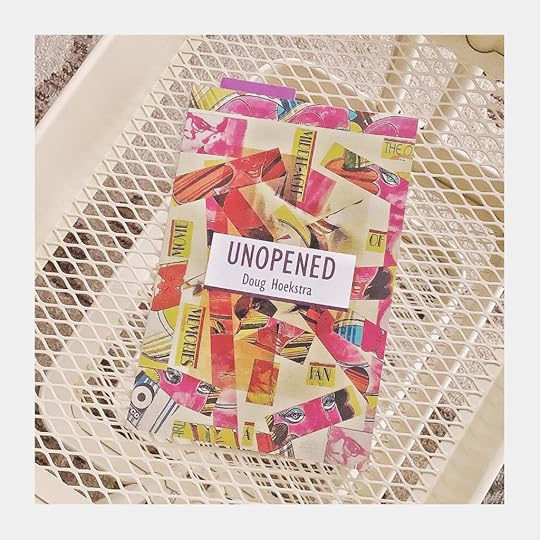
"Unopened," an intriguing volume of previously published and unpublished poetry, is Doug Hoekstra's latest and third book. Among its fifty-seven selections, the reader will find poems that rhyme, poems that don't, prose poems, sedokas, and yes, even an obligatory sonnet. Some are personal; some are societal. Some look inward, some look outward. Throughout the reader is invited to connect and reflect."Unopened" is divided into three selections to allow the works to cross-pollinate and the reader to choose his or her adventure -- "On the Page" (themes close to home), "Off the Canvas" (out in to the world), and "Between the Notes" (the space between, the indefinable). Hoekstra's introduction sets the tone for this journey, but the reader sets the course."Unopened" also features Hoekstra's his original artwork on the front and back covers, taken from a series of collages created to reflect the content of the book. As he says in the afterword, the art and prose both reveal themselves "as a collection of fragments-memory, imagination, anticipation-broken, reassembled, and made whole."Taken as that entity, "Unopened" is a worthy addition to Hoekstra's body of work, living somewhere between the "five-minute worlds" of his songwriting canon and the short and long fiction of his prose writing. "Hoekstra writes in a style that could safely be called eclectic, but that doesn't do his either his music or his literary genius true justice. He is like a quirky art collector, putting together odd bits and ends, and then making them into something with an effect so much more than the mere sum of their collective oddities." (Midwest Book Review)
I received this book for free from JKS Communications in exchange for an honest review.
This was interesting poetry collection. It’s different than the type of poetry I usually read (I usually read more of the Instagram poet type), but I still enjoyed it. I liked that, unlike a lot of Instagram poems, some the poems were longer (more than a page long). I like it when poems are a bit longer because it allows you to go more in-depth. There was a good mix of both short and longer poems.
I liked how the book was divided into three sections. All the poems fit well into the section they were in and I could tell the themes (family, nature, music, etc.) of each section without it being overly obvious. It was subtle which is sometimes very hard to do.
Additionally, I loved the story behind the cover. It added a really nice personal touch.
My one critique is that the book should have been longer. I would have loved to seen at least 20 more poems to really make it more impactful and feel more complete. I felt like I got a small taste of his poetry, but I wanted more.
Overall, this was an enjoyable and unique poetry collection.
Unopened by Doug Hoekstra is the writer's first collection of poetry. Hoekstra is a Chicago-bred, Nashville-based writer and musician, educated at DePaul University (B.A.) and Belmont University (M.Ed.). His first book, Bothering the Coffee Drinkers (Canopic Publishing, April 2016) was an Independent Publisher Award Bronze Medal Finalist for Best Short Fiction.
It is very refreshing to see a new poet who is not an "Instagram poet." I may just be getting old, but poetry is more than a few trite lines on a page. Hoekstra's poems vary in style and format to even include a sonnet. There is a connection in the words that form art, images, and even memories in the reader's mind. Unopened is divided into three sections. The first section, "On the Page," represents the things that are close to us and ties us together. From the first poem "Memory," the reader is connected with the poet. It is in these poems the reader realizes that I have experienced that too...that same exact moment. We look back with nostalgia at "The Teeterboard" or see a bit of ourselves years ago in young couples.
The second section "Off the Canvas (Out into the World) takes the reader into adulthood, sometimes alone, and sometimes with others. There may be a bit of nostalgia, but there is a healthy dose of questioning. "The Minimum" and "Officespeak" detail a touch of the reality of the real world. "The Claims Approver" brings to mind a Dickens-like drudgery and the thanklessness of modern employment. I was taken back to earlier days with the "Ode to the Sunday Paper." That huge collection of newsprint where one can spend the entire day relaxing and reading while enjoying a pot of coffee. The memories of reporters working to provide that important story seem to have been replaced with internet news entertainment. The section closes with the poem "Stars." It is a simply written poem with only one word on each line. We climb a hill to get a more unobstructed view to name the stars. Yet, many of these stars do not exist today as we are looking at the light they gave off millions of years ago.
The final section, "Between the Notes," takes the reader further into life. The poem "Gravitas" is the opposite of "Stars." Here complex electronics sounds, as music, are described in a mechanical way. Even the stanzas give the impression of a digital stereo spectrograph. The poet's tone makes a noticeable change with the poem "Vinyl" -- the antithesis of electronic music.
Hoekstra, being a musician, manages to include music in many of his poems -- Sinatra, McCartney, Blues, and Jazz. He does this in a very natural manner that is not forced and does not come across as song lyrics posing as poetry. The variety of forms are work well. It is a nice mixture of free form with a few sedokas and a sonnet (about a radiator of all things). Unopened is a meaningful collection of poetry that will strike a chord with most readers. It is a reminder that although we are all different, we share many of the same experiences and sometimes it takes good poetry to remind us of that.
Back in 1999, when I began with the whole Internet radio thing with collegemusic.com there was a period where interviews only happened in chat (all typing, no audio), or with the lo-fi quality of a telephone microphone suction cup pickup. It was during this time I came across compelling songwriter Doug Hoekstra and his album Make Me Believe (One Man Clapping Records OMC 0018, 1999) with its memorable opener “Sam Cooke Sang The Gospel”. Hoping to get some recollection or saved artifact from this, possibly, very first interview on my show for my book, I reached out to Doug. While no 1999 traces emerged, such is the font of talent and creativity from Doug that I found instead an opportunity to enjoy his latest collection of poetry: Unopened (Five-Minute Books, 2019).
The title piece begins recalling his father and artfully dodges into a forgotten, left behind, unopened vinyl LP. “Vinyl” from a concluding section in this triptych also explores the magic of those spinning time capsules. That final set of poems explores the mysteries of interactions after groups of pieces on the personal and greater worlds. Broadly, there is little form here in the sense of rhyme and meter in these prose pieces while there is an intriguing similarity to a style of rigid form: the haiku. Know you the typical characteristic of the haiku, that there is a division somewhere in the tiny poem, so that the focus on the first, obvious thing, switches to another exposing a subtle relationship between the two in a that is insightful and sometimes surprising? These pieces tend to end that way, drawing me from first line to the last.
Doug Hoekstra is a man of words, whether as a musician or poet or short story writer. His songs are some of the most literate pop around, sung with a seductive, honey and bourbon voice that draws you into his music. This same seductiveness is present in his new book of poems, Unopened. You can hear the dark/sweet voice behind them. And what a delightfully varied collection this is: poems of travel, love, music, family, and introspection. Hoekstra pays attention to the world, to the sensual pleasures of it: sight, sound, feel. “The radiator wretches, kicks and clanks/working its whisper into a roar,” he begins one poem. “Since anything of man/Is also of nature,/This must be/A nature poem,” he ends another. And, here, one of my favorite closing lines: “In the same way nothing is at it used to be/Except when it is.” Nostalgia is a sweet siren and the poet knows when to follow and when to move away. I’d follow Hoekstra anywhere. As they used to say about rock music, back in the day: Come for the music. Stay for the words.
I loved this collection. Specifically, I was moved by Hoekstra's kindness toward the reader: he organizes the collection into three distinct sections, (On the Page, Off the Canvas, and Between the Notes) which made me feel as though he truly valued my interaction with his words, and wanted to help me journey through them.
Hoekstra's third work further cements his identity as an artist of many talents. I enjoyed Unopened because of the sheer versatility of Hoekstra's poetry style, which he showed as he moved from traditional forms to contemporary ones, and from the internal to the universal. Additionally, I was impressed by the cover art: Hoekstra's vibrant work as well.
I received this book as a giveaway winner and was pleasantly surprised. I wanted to expand my horizons since I don’t normally read poetry. “Unopened” is accessible to all audiences with the added bonus of some homey reminders of Chicago.