Karolina Andersson, badaczka modernizmu cieszącą się uznaniem w środowisku historyków sztuki, jest w średnim wieku, nie ma dzieci ani stałego partnera i nie czuje się w życiu spełniona. Pewnego dnia pod opiekę pani profesor trafi a młody doktorant twierdzący, że odkrył nieznaną dotąd, niezwykle utalentowaną malarkę. Czy wreszcie nadszedł długo oczekiwany przełom w życiu Karoliny?
Therese Bohman stworzyła bohaterkę podobną do naszych znajomych i przyjaciółek. Jaka jest rola singielek w średnim wieku w naszym społeczeństwie? Czego pragną te kobiety, kogo szukają? Co jest w życiu najważniejsze? W powieści nominowanej do prestiżowej Nagrody Augusta autorka próbuje odpowiedzieć na te skomplikowane pytania.
Therese Bohman is an editor of the magazine Axess and a columnist for Expressen and Tidningen Vi, writing about literature, art, culture, and fashion. She lives in Sweden.
What happens when you're a woman who chooses to focus on her career during her thirties, instead of doing what biology dictates - finding a mate and having babies?
If you're Karolina, professor of Art in a Stockholm university, you drink too much. You feel deep loneliness. You find yourself isolated from other women, who have lives you don't understand. You feel a desperation when a man gives you attention and you experience the walk of shame more times than you'd like to admit. You play second fiddle to your lover's wife and baby-mama.
Karolina has always been attractive to men, but at forty, she senses an impending doom. She's fascinated with periods in history just before their ruin, the 'halcyon days'. In many ways, this is how she sees herself, just about to become a ruined woman that no one will want. No longer physically attractive, no longer biologically ripe, she will soon have nothing to offer.
This thoughtful, melancholic story brings up many good questions about women's choices, how biology shapes them, and what defines a full, successful life. It is also a meditation on loneliness that should be relatable to many women.
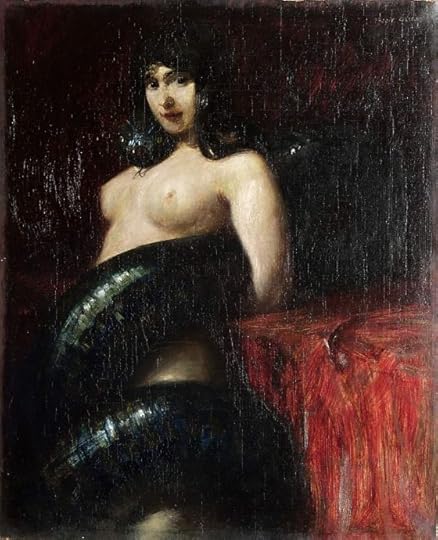
I appreciated this novel for its many artistic references. I especially enjoyed discovering German symbolist Franz von Stuck, who is known for paintings of women with snakes. This image isn't unique in art history. There are other artists who have featured fallen Eve with her coiled seductor, newly ashamed at her nakedness. But von Stuck's women are bold, and show no shame for their sexuality. The phallic serpent may be coiled around her, but it's clear that she 'owns' it.
I can't help but think that women like Karolina who live lives differently from the 'norm' - wife, mother, monogamist - struggle to find such a defiant, brave face. But when they do, it's hard to look away.
Thank you to Netgalley and Other Press for providing a free copy of this book in exchange for an honest review.
Dużo w tej książce chaosu i choć nawiązania do sztuki są wspaniałe, czuję, że jest to trochę miks dwóch poprzednich książek autorki i chęć podjęcia zupełnie innego, nowego wątku. Dla mnie najsłabsza książka tej autorki do tej pory, mimo to czekam na inne jej dzieła, bo ją uwielbiam!
Gdybyście słuchali opowieści koleżanki z którą już za bardzo nie macie kontaktu o jej życiu, sprawach miłosnych z wieloma anegdotami i głupio by wam było powiedzieć że w ogóle was to nie interesuje to prawdopodobnie czulibyście się jak ja w momencie czytania tej książki. Zupełnie do mnie nie trafiła i wynudziła.
On the surface, this book seemed to be yet another middle-aged professor has relationship with student narrative, with the flipped gender script. But I'm glad I read to the end, because I felt like it was much more than that.
Karolina is an art professor, recently divorced, and living in a tiny apartment. She starts to question what she is doing with her life, and along the way there are some encounters that felt very real, even the conversation with the colleague down the hall who can barely give her the time of day because his ego takes up so much of the room. She enters into a fling with a PhD student with very little thought, just an impulse really, and then realizes why that might have happened (and it isn't as flattering as one would hope; if you were looking for a steamy professor-student romance this is not your book)....
I appreciated the exploration of where women truly are in society now. Has feminism freed us? Are we still tied to whether or not a man wants to have babies with us? What is feminism in art? Is it focusing on obscure female artists or is it something more? Can a female art professor have a focus other than that and what would that be? What is her value and how do others see her? Should she entertain the blue collar boy from her childhood and give up on the life she has created? Where would the meaning be found? Where is satisfaction?
Hmm, I feel I've given a lot away, but not how she discovers these questions, or how she answers them. It was a resonant read for me.
Thanks to the publisher for providing access to this title through NetGalley. It came out April 10.
Zabrakło mi tej nici porozumienia między mną a bohaterką, którą czułam przy lekturze "Tej drugiej". Problemy Karoliny Andersson, czterdziestoletniej profesorki historii sztuki, były mi zupełnie obce, ale podoba mi się to, jak Bohman pisze o kobietach. Niezależnie od ich wieku.
Książka mnie nie porwała, ale to nadal dobra literatura.
Karolina Andersson finds herself suddenly single in her early forties. She still loves her job as an art professor at a university in Stockholm. But she is lonely, aimless and without purpose. She tends to drink too much. She indulges in social media voyeurism of her acquaintances' lives, without posting or engaging. What's there to post about? She doesn't like travelling, she doesn't go out much, especially since she's been single, she mostly just works.
When a graduate student she's supervising finally makes himself known to her, she finds him intriguing and very attractive. A passionate relationship ensues. Of course, all is not what it seems. I'll leave it at that, as I've already given too much away.
Therese Bohman wrote a very realistic novel. A tad too realistic. Karolina could be any educated, childless, middle-aged woman in the Western world. Karolina's quest for finding a purpose, to give some meaning to her life was insightful. It is so easy to get lost. It is so easy to become lonely. Lately, I've been reading and seeing quite a few things on TV and on the Internet about the plight of loneliness that's taking over the western world. While loneliness wasn't the main aspect of the novel, Karolina would easily make it into the category of lonely people.
I appreciated the novel and the writing was very competent and compelling, although it left me sad.
Najsłabsza książka Bohman, choć ciągle miała swoje momenty - błyskotliwe, niekomfortowe, absurdalnie adekwatne. Sztuka, historia sztuki, jest tu właściwie kolejną bohaterką, a czytanie o niej jest niesamowicie odprężające. Zakończenie bardzo mi się podobało. Mimo wszystko, trafiła do mnie najmniej z książek autorki, które miałam okazję czytać. Niekiedy byłam znużona, nie ciągnęło mnie do czytania, chciałam ją skończyć. Nie umiem jej właściwie ocenić.
Główną bohaterką "O zmierzchu" jest dojrzała kobieta, która ma już pewne etapy życia za sobą. To bardzo stonowana książka, przeważa w niej melancholia i nostalgia za utraconymi szansami; dużo tu rozważań o słuszności wybranych przez Karolinę życiowych dróg, o długoletnim związku z przyzwyczajenia, a nie z miłości, o karierze, która niby jakaś jest, ale nie daje całkowitej satysfakcji. Dryfujemy więc przez te wszystkie rozmyślania bohaterki, a także przez jej kolejne przelotne romanse z młodszymi mężczyznami (wyglada na to, że Bohman wyjątkowo lubi motyw różnicy wieku w relacjach). Z racji tego, że zawodowo Karolina wykłada historię sztuki, znajdziemy w książce wątki związane również z taką tematyką (co akurat dla mnie było niespecjalnie interesujące).
Myślę, że „O zmierzchu” może się spodobać tym, których w poprzednich książkach Bohman męczyło stężenie toksycznych związków i złych decyzji, jednak w moim odczuciu ta książka była zbyt rozmyta, nieokreślona, nijaka. O wiele bardziej wolę Bohman w bardziej drapieżnym wydaniu.
Ta książka ostatecznie upewniła mnie w tym, że bardzo odpowiada mi pisarstwo Bohman. Dużo osób zarzuca jej książkom brak konkretnej fabuły czy po prostu przynudzanie, a ja za każdym razem wsiąkam w ten klimat od początku do końca. „O zmierzchu” to pozornie zwyczajna historia o smutku, samotności i potrzebie miłości- nie jest to co prawda moja ulubiona Bohman (ba, wydaje mi się, że z przeczytanej przeze mnie trójki była najsłabsza), ale i tak będę ją dobrze wspominał. 3,5
Książka była na pewno dobrze napisana więc czytało mi się bardzo przyjemnie. Opis życia akademickiego ze strony wykładowcy również był ciekawy, bo to fabuła którą rzadko spotykam w książkach. Jednak wydaje mi się, że nie miała w sobie czegoś szczególnie zapadającego w pamięci i wydaje mi się, że niedługo nie będę już o niej myśleć.
“Det kan ju vara så”, sa hon. “Att de bästa relationerna är de som aldrig blir romantiska, eller sexuella, men som liksom har potentialen att bli det. Där det finns ett slags undertryckt attraktion som man aldrig benämner eller släpper fram, som förhöjer hela relationen.”
Is a real life about happiness or merely the absence of unhappiness? Therese Bohman creates a self-seeking protagonist in Karolina, a professor of art history at the University of Stockholm, whose passion for art is matched with the ennui of her personal life.
At the twilight of her youth, perched to enter middle age, Karolina idles away her time roaming the city and reminiscing about former relationships gone sour. She has separated from a boring relationship that ate up eleven years of her time and now she makes unwise choices: connecting physically with a man who votes for the far right, her influential arts editor, a man from her teen years. Although art is a stable in her life, she can’t help but think that her devotion to research and study has alienated her from a more meaningful connection with a partner.
The narrative starts off slowly and the numerous references to art builds credibility for Karolina’s personality, while, at times, distancing the reader who is unfamiliar with the Scandinavian art world. There is, of course, the joy of discovery of researching the art that’s described but – at least for me – it was hard to break the spell of the narrative to do so.
The crux of the novel occurs when Karolina’s self-assured Ph.D. student, Anton, arrives in her office after a year abroad to reveal that he has uncovered an overlooked female Swedish artist who may hold the key to German Expressionist art. She finds herself attracted to him and his potential claim to fame. The way this plotline progresses is suspenseful and delicious.
Karolina’s malaise, her sense of alienation, and her cynicism do ring true—particularly for some women who never married or who married later in life. This erudite book, while slim, is heavy with insight. 4.5 stars.
Kiedy czytam sobie opinie o "O zmierzchu" to myślę sobie, że: mhm, byłoby dobrze jakby to właśnie o tym było. Tyle że nie jest. Generalnie - ani ta książka nie jest dobrze napisana, ani oryginalna, ani odkrywcza, ani to powieść feministyczna. Nic nowego (w kontekście światka uniwersyteckiego czy artystycznego) pani Bohman nie powiedziała, coś tam próbowała pokazać po łebkach. Nawrzucała do powieści zupełnie niepotrzebne pseudonaukowe fragmenty, "watę słowną", jeszcze bardziej się rozdrabniając. Ostatecznie wyszła jakaś przedziwna mieszanka treści, obraz kobiety, która jest chodzącą niespójnością, z jednej strony ma, jak rozumiem, uchodzić za silną, niezależną, wykształconą, etc., z drugiej - jej uwieszenie na mężczyznach przyprawia o lekkie mdłości.* Nie łamie żadnych stereotypów, a za taką bohaterkę uchodzi w czytanych przeze mnie recenzjach. *Jak teraz to piszę to pomyślałam sobie, że tę jej niespójność można uznać w sumie za jedyny udany motyw powieści. Jeśli uznać to za efekt zamierzony. Bardziej jednak prawdopodobne, że to po prostu zła konstrukcja postaci.
I ostatnia rzecz - ta książka to dla mnie historia, która nigdy się na dobre nie zaczęła. Lekko rozmemłany wstęp przeciągnął się aż do ostatniej strony. Za dużo tam chaosu, niepotrzebnych pseudonaukowych i artystycznych wtrąceń, które ani to czegoś czytelnika uczą, ani coś wnoszą do fabuły, a za mało świadomości, co się właściwie chce przekazać. Niespójna, słaba literatura moim zdaniem.
"O zmierzchu" to trzecia książka Therese Bohman, jaką miałam okazję czytać. "Ta druga" była świetna, natomiast "Utonęła" nie do końca do mnie trafiła.
W "O zmierzchu" poznajemy historię kobiety w średnim wieku - Karoliny, która nie ma dzieci ani stałego partnera, a ważną rolę w jej życiu odgrywa kariera zawodowa i historia sztuki.
Czytając "O zmierzchu" miałam skojarzenia z "Ostatnim stadium" Niny Lykke, obie bohaterki są w średnim wieku, są niezadowolone ze swojego życia, mają podobną mentalność. Tylko o ile "Ostatnie stadium" było świeże i interesujące, bardzo doceniłam tę książkę za humor i analizę norweskiego społeczeństwa, tak "O zmierzchu" było dość nudne.
Mam wrażenie, że przeleciała przeze mnie ta historia. Nie mogłam się w nią wciągnąć i zaangażować, a podczas lektury odpływałam myślami. I choć ma świetne momenty, a niektóre przemyślenia bardzo do mnie trafiły, to mam wrażenie, że było ich za mało w stosunku do nieinteresujących mnie dygresji. Im dalej brnęłam w tę książkę, tym bardziej zaczynała mnie męczyć i nużyć. Nie poczułam tej historii, nie wywołała mnie żadnych emocji i głębszych refleksji, a losy głównej bohaterki były mi obojętne. Szkoda 😢
czy ta książka była słabsza niż poprzednie? być może, ale i tak mnie usatysfakcjonowała. szczerze nie spodziewałam się takiego plot twistu. nawiązania do sztuki zawsze skradają moje serce, ale tutaj jakoś szczególnie na mnie oddziaływały. odkrycie roku🌷🌷
Therese Bohman’s “Eventide” is a perfect, extremely satisfying short novel (mere 190 pages). Karolina, the protagonist, is a professor of arts at the university in Stockholm in her early 40s, who recently broke up with her partner, with whom she had stayed for way too long and whom, she realises, she had probably never loved. As the academic year begins she is full of hope: for finding a new partner - this time her true soulmate, for supervising a PhD student who supposedly discovered groundbreaking material on an until now unknown Swedish feminist painter, and for being unapologetically herself, for the first time in the life. Yet as months pass she becomes bitterer and more resigned to the uneventful life, to which she desperately tries to add some colour.
Bohman created a stunning, multi-layered portrait of a woman losing hope, sinking deeper into her apathy, in whose life one-night stands with inappropriate men, reeking of desperation and an attempt to prove her own attractiveness, are the only glimmers of joy. The way the author describes these encounters (“(...) it had been a good evening, maybe even wonderful.”) shows how much Karolina is ready to lie to herself that these evenings, nights, mean anything. And yet she is becoming gradually more frustrated that all those men cheat with her on their regular partners and that this is not how feminism works; that she betrays true feminists by eagerly sharing her body with more or less random men but declining to letting them get to know her true self. “Eventide” is a very sad novel, marvellous when it comes to the psychology of the main protagonist, written in a beautiful, crystal clear language (which made me think of Hisham Matar). The struggle of Karolina to try to be happy on her own and following her own rules, but secretly dreaming of having a family and fearful of life spent in loneliness, is what many a reader could empathise with, I believe. The dissonance between society’s expectations and our own is masterfully described. A gem of a novel for our times.
Therese Bohman cenię za to, jakie wątki podnosi w swoich powieściach. "O zmierzchu" dotyka tematu samotności, roli singielki w społeczeństwie, a w jakimś sensie także moralności. Na początku miałam pewien problem z główną bohaterką, ale ostatecznie to, że jej nie polubiłam, nie oznacza, że nie jest interesująca. Owszem, jest antypatyczna, nieszczęśliwa i zgorzkniała. Po części wynika to jednak z samotności i ja to rozumiem. Z drugiej strony, bohaterka ewidentnie nie umie stworzyć głębszej relacji, bo liczy się dla niej powierzchowność. Każdy mężczyzna, który na nią spojrzy, jest potencjalnym obiektem westchnień, a na pewno staje się obiektem jej pożądania. Całkiem zasadne jest więc pytanie, czy ktoś, kto zdradza na prawo i lewo, sam nie rujnuje szansy na stały związek i czy takiego związku naprawdę chce? Dochodzi też jeden ważny aspekt osobowości bohaterki: zazdrość. Jak można być zazdrosnym o nowo poznanego mężczyznę, z którym poza jednorazowym seksem, nic nie łączy? Może przez te złożoność postaci i wątki bliskie mnie samej, Therese Bohman nadal jest dla mnie jednym z większych czytelniczych odkryć tego roku.
Fabuła dla mnie była trochę pozbawiona sensu. Tak naprawdę niewiadomo do czego miała dążyć ta historia. Bardzo podobały mi się przemyślenia i refleksje głównej bohaterki. Po raz kolejny autorka tworzy postać, która jest nieoczywista i dająca do myślenia.
Nie mogę powiedzieć, że było to coś zachwycającego i powalającego na łopatki, bo nie było. Ciekawie czytało się o sztuce, ale nie było to nic ponadto. Typowa bohaterka wykreowana przez Bohman odznacza się w jakimś stopniu na tle innych, ale schemat jest ten sam. Jednak ta książka to jeden wielki bałagan.
This is one of those books that is deceptively slender and seems as if it can be read in one afternoon. Not so. The richness of the prose, the accumulation of material, and the three dimensional characterizations slow a reader's pace, so as not to miss anything. Karolina Andersson is a Professor of Art, a title she adores if not the execution. At times, Karolina's negativity seems overwhelming, but there are many reasons for this, not the least of which her questioning of whether she made the correct decision to pursue her career at the cost of a traditional womanly existence. This book is rewarding though due to the fact that Karolina is, if anything, honest with herself. Uncompromising. Her inner monologues rendered in third person ring true, and so the reader can't help but accept her as she is, flaws and all.
In the last part of the book, there is a scene that stands out to me in which a conversation of much import is held between Karolina and another person, in which not a word is exchanged. Since there is a third person in the room, all is conveyed through eyes and expression. It was a masterful stroke that I don't believe I've ever seen before.
Jestem taka zawiedziona tą książką! To moje trzecie spotkanie z Bohman i okazało się ono zdecydowanie najgorsze.
Lubię to, co Bohman robi z moją głową. Nie uważam, żeby jej książki były idealne, ale jednak podczas lektury jestem w nich gdzieś głęboko, rozważam czy sama postąpiłabym tak jak poszczególne postaci. Po odłożeniu natomiast fabuła długo we mnie zostaje a ja często wracam myślami do tego, czego dotyczyła dana historia.
Problem w tym, że "O zmierzchu" mi tego nie dostarczyło. W ogóle nie rozumiałam denerwujących mnie odniesień do życia szympansów, czy do zapładniania kobiet ich nasieniem (jakby co to nie jest jakiś istotny spoiler). Poza tym nie potrafiłam się utożsamić z główną bohaterką. Przez większość książki Karolina była dla mnie zupełnie obcą kobietą. Nie byłam w stanie jej współczuć ani popierać jej decyzji. Jej pragnienie bycia zauważoną momentami mnie przytłaczało. Wiem, że są na świecie takie kobiety i mam nadzieję, że one potrafiłyby odnaleźć się w tej opowieści lepiej niż ja. Wierzę w to, że dla nich to byłaby dobra książka.
Bohman tworzy postacie skrzywdzone własnością archetypu. Niedowartościowane kobiety wikłające się w romanse, którym próbują nadać wyrazu; choćby stylu. Ambicjonalnie przerośniętych mężczyzn, za dowód drogi, którą przeszli, wskazujący nagi, stychiczny sukces. Kobiety i mężczyzn, próbujących wydostać się z narracji samotności, w jakiej są opowiadani. Ludzi - tych też, może nawet przede wszystkim. Jest to pewna umiejętność, ba!, charakterystyka twórcza, odblaskowa wrażliwość pióra, ale w tej książce - nieprowadząca donikąd. Dla osób, którym ta wąsko pojęta ludzkość nie wystarczy, może być nudno, niewygodnie, nie w środku i z trudem z tyłu głowy. Mi (w) "O zmierzchu" było dobrze, nie za zimno. Motyw sztuki wytrącał przytłaczającą emocjonalność Karoliny z nierównowagi, a pewna część jej samej była mi nawet znajoma, tak jakbyśmy już się kiedyś spotkały, w jednej głowie np.
Another one for my international reading catalog. Sweden this time. A story of an art professor in her 40s who becomes unmoored following a dissolution of an eleven year long relationship. She starts reevaluating her life, priorities, choices, etc. particularly as far as romantic attachments go. She goes from one unsuitable love affair to another, she drinks too much, she wallows. That's about it. There is an actual plot there involving a very attractive graduate student with a very attractive research project, but mainly this is a character study. The protagonist is in every scene and the readers are inside her brain exclusively, single POV sort of thing. For what it is it's good, especially if you're in a mood for something deliberately maudlin, but for such an exclusive character engagement the character doesn't really engage that much. She's sorry for herself and you'll probably be sorry for her, but it's all very much a one note performance, albeit well played or as the case may be here well written. For me the most interesting aspects of this novel were the research subjects, mostly art, with some bizarre experiments thrown in. Ended up looking up some of the art and artists, so learned something new, which is always great. And the book isn't that long either, read in one day. Thanks Netgalley.